

Asia Pacific Point-of-Sale Terminal Market Size & Forecast:
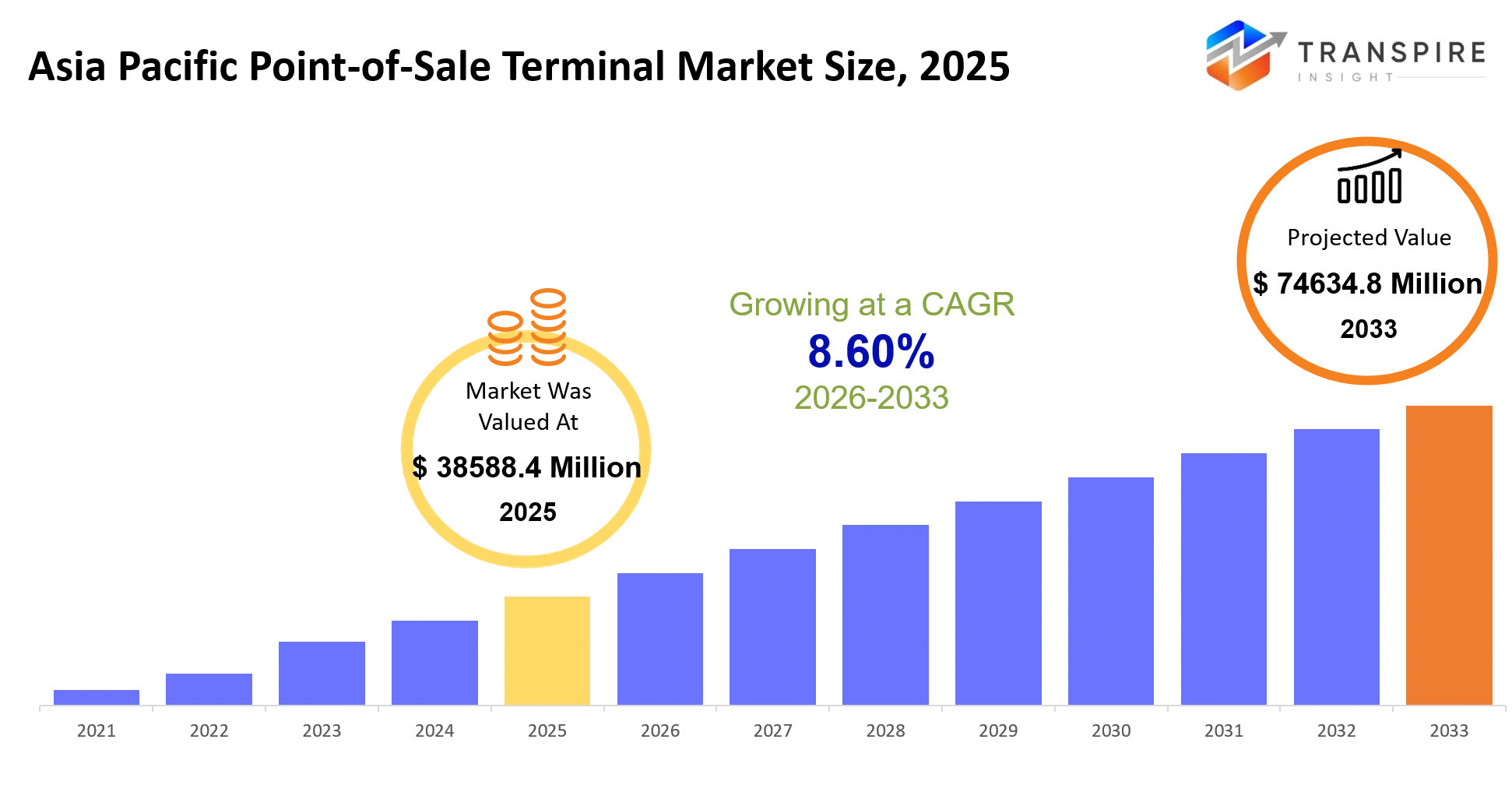
- Asia Pacific Point-of-Sale Terminal Market Size 2025: USD 38588.4 Million
- Asia Pacific Point-of-Sale Terminal Market Size 2033: USD 74634.8 Million
- Asia Pacific Point-of-Sale Terminal Market CAGR: 8.60%
- Asia Pacific Point-of-Sale Terminal Market Segments:By Product Type (Fixed POS, Mobile POS, Smart POS, Self-Service Kiosks, Tablet POS, Wireless POS, Android POS, Others); By Component (Hardware, Software, Services, Payment Solutions, Analytics, Security Solutions, Maintenance Services, Others); By End User (Retail, Hospitality, Healthcare, Entertainment, Transportation, BFSI, Restaurants, Others); By Deployment (Cloud-Based, On-Premise, Hybrid, SaaS, Multi-Site Deployment, Enterprise Deployment, Managed POS, Others).
Asia Pacific Point-of-Sale Terminal Market Summary
The Asia Pacific Point-of-Sale Terminal Market was valued at USD 38588.4 Million in 2025. It is forecast to reach USD 74634.8 Million by 2033. That is a CAGR of 8.60% over the period.
The Asia Pacific Point-of-Sale Terminal Market is really useful for stores and other places where people buy things. It helps them process payments away by using special machines that connect to safe online payment systems. This means people can pay quickly with their cards or by using QR codes or even just by tapping their cards on the machine. It also helps stores keep track of what they have in stock and make bills for people so they can run their businesses smoothly and get people checked out faster.
Over the last few years there has been a big change in the way these payment systems work. Now people are using systems that are based in the cloud and work with Android devices, or the old machines that just stood alone. This change happened faster after the pandemic, when people started using contactless payments and digital wallets more because they were worried about germs and did not want to handle cash. At the time there were problems with getting the parts needed to make these machines, which showed that it was important to be able to make them in different places and get them to stores faster. So now there is a demand for machines that are smart and can connect to the internet. This is helping the companies that make these machines and offer services, like software and analysis of sales data to grow and make more money instead of just selling the machines themselves.
Key Market Insights
- The Asia Pacific Point-of-Sale Terminal Market is growing steadily because more people are using payments. This market is expected to grow fast with double-digit growth through 2030 in the retail and hospitality sectors.
- The Asia Pacific Point-of-Sale Terminal Market is doing well because of the increase in contactless transactions, the use of QR codes and the integration of cloud-based POS systems in large businesses.
- The Asia Pacific region has the share, almost 45% in 2025. This is because retail businesses are using technology and fintech is growing fast in cities.
- Southeast Asia is the growing region through 2030. This is because mobile wallets are becoming popular and small businesses are going digital.
- Fixed POS terminals are popular with over 50% of the market. This is because they are widely used in supermarkets, restaurants and big retail stores.
- Mobile POS systems are the second most popular. They are in demand because they are portable and can be used in delivery services, logistics and small retail businesses.
- Cloud-based POS solutions are growing the fastest through 2030. They allow for real-time analysis and remote management of transactions.
- The retail sector is the user of Asia Pacific Point-of-Sale Terminal Market solutions. This is because physical stores are using technology to manage checkout and inventory systems.
- The hospitality and food service sector is growing the fastest. This is because self-ordering and table-side payment systems are becoming more popular.
- Some of the companies in the Asia Pacific Point-of-Sale Terminal Market are Ingenico, Verifone, PAX, NCR, Diebold Nixdorf and Square. They are making the market stronger by innovating in payment infrastructure.
- These companies are doing well because they are using Android-based POS platforms, AI-driven transaction analysis and cloud-native payment systems. This is making the Asia Pacific Point-of-Sale Terminal Market more scalable and improving the customer experience, for the Asia Pacific Point-of-Sale Terminal Market.
What are the Key Drivers, Restraints, and Opportunities in the Asia Pacific Point-of-Sale Terminal Market?
Drivers
The main reason the Asia Pacific Point-of-Sale Terminal Market is growing fast is that people are using digital payments more and more. This is because lots of people are using QR codes, contactless cards and mobile wallets to pay for things when they shop. As a result more transactions are being done on POS devices, which means companies that make these devices and the software that goes with them are making more money.
The Asia Pacific Point-of-Sale Terminal Market is also growing because shops are using systems more and more and the government wants to reduce the use of cash. This means old payment systems are being replaced with ones that use Android and cloud technology.
Restraints
One big problem is that lots of shops still use old payment systems because they do not know how to use digital systems and they do not want to spend money on new devices. This is an issue because some areas do not have good internet and it is hard for people to get bank accounts. So it is taking a time to get everyone to use digital payments, which means the Asia Pacific Point-of-Sale Terminal Market is not growing as fast as it could be.
Opportunities
There is an opportunity for the Asia Pacific Point-of-Sale Terminal Market to grow in Southeast Asia and India. This is because lots of people have smartphones. There are not many traditional payment systems. Banks and financial technology companies are investing in payment systems that use apps instead of devices. This could mean that lots of shops can start using digital payments, which would be good for the Asia Pacific Point-of-Sale Terminal Market. The Asia Pacific Point-of-Sale Terminal Market would grow more if more people used these new payment systems.
What Has the Impact of Artificial Intelligence Been on the Asia Pacific Point-of-Sale Terminal Market?
Artificial intelligence and digital technologies are changing the way payment systems work at stores. They make transactions faster and more secure. They also help stop transactions and make sure the systems work properly.
AI is used to make payments automatic. It looks at how people behave when they pay for things and stop transactions in real time. This means people do not have to get involved much and transactions happen faster even when a lot of people are shopping.Computer systems that learn are used to fix payment machines before they break. They find problems with the machines and the network before something goes wrong. This helps stores have their payment machines working all the time. Many stores have seen that their payment machines do not break much and more transactions are successful.Artificial intelligence also helps stores sell more by looking at what customers do. It helps stores change prices. Offer special deals to customers when they pay.There is a problem. It costs a lot to connect intelligence systems to old payment machines. Many small stores have machines that are not able to work with artificial intelligence. This means they cannot use the systems and it slows down the use of new technology, in retail especially in smaller towns and rural areas where stores do not have a lot of money to spend on new systems.
Key Market Trends
- More people started using contactless payments. It became more than 70% of all retail transactions in 2025. This change helped stores in cities not rely much on cash and traditional POS systems.
- Old magnetic stripe terminals became less popular after 2023. Many stores replaced them with EMV and NFC-enabled smart POS devices. This change happened in retail chains.
- POS terminals that use Android started to become popular after 2024. They helped stores integrate apps and track their inventory in time.
- Cloud POS systems became more popular from 2022 onwards. They helped stores control their data better and manage stores more efficiently.
- QR-code payment systems became very popular in Southeast Asia. This happened because countries introduced frameworks that allowed digital wallets to work together.
- Problems with supply chains in 2022 and 2023 forced companies like PAX and Ingenico to get parts from places and assemble them locally.
- medium-sized businesses started to go digital faster in 2024. This was because fintech companies partnered with them to offer POS solutions.
- Countries like India and ASEAN wanted to be cashless. So they put in POS terminals, in small retail stores and food service outlets.
- Verifone and NCR made their POS systems more software-driven after 2023. They changed how they made money. Now they make money from services of just selling hardware.
- More stores started using AI to analyze transactions after 2024. This helped them detect fraud better and reduce payment failures.
Asia Pacific Point-of-Sale Terminal Market Segmentation
By Product Type
Fixed POS systems are still really popular because people use them a lot in supermarkets, department stores and other big retailers in cities.. Mobile POS systems are getting more popular too because small stores and delivery businesses want to be able to take payments on the go. Smart POS and Android POS systems are also doing well because they can be connected to software and apps which makes it easier to process payments. We will see self-service kiosks in fast food places and train stations because people want to be able to pay quickly.
By Component
When it comes to the parts that make up POS systems Hardware is still important because it includes things like the machines that process payments, scanners and card readers.. Software is becoming more important because it can be connected to the internet and it can give us real time information and help us keep track of our inventory. We also need Payment solutions and security services because we have to be able to prevent fraud and keep peoples payments safe.. Analytics tools are helpful because they can tell us more about our customers and help us sell more.
By End User
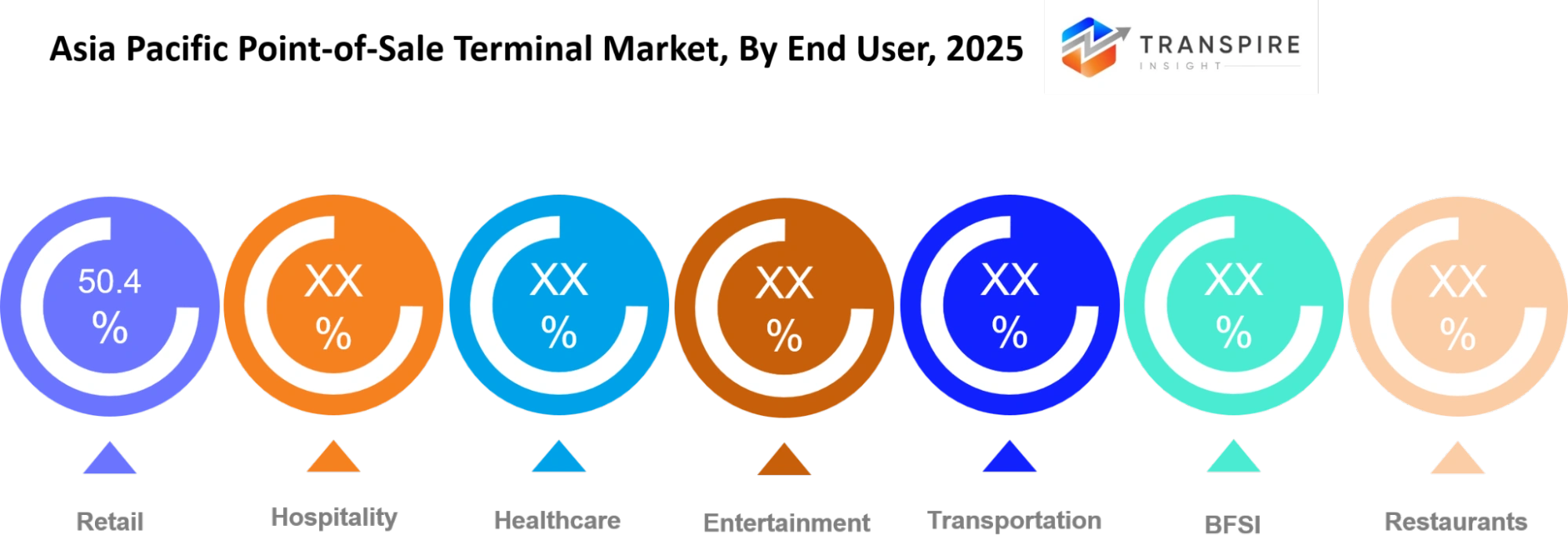
Retail stores are still the users of POS systems because they do a lot of transactions and are trying to get more people to use digital payments. Restaurants and hotels are also starting to use them because they can use them to take orders and payments at the table. Banks and transportation companies are using them too because they need to be able to process payments safely.. Soon we will see more healthcare and entertainment places using them because they can help them get paid more easily.
By Deployment
More and more people are using Cloud-based POS systems because they can get to their data from anywhere and manage their systems remotely.. Some big companies still use On-premise systems because they have to follow a lot of rules and keep their data safe. Some businesses are using a mix of both because they want to be flexible but also keep control of their data.. We are seeing more SaaS-based POS solutions because they are cheap to start with and can be used in many different locations.
What are the Key Use Cases Driving the Asia Pacific Point-of-Sale Terminal Market?
The main thing that is helping the Asia Pacific Point-of-Sale Terminal Market is checkout automation. This is because supermarkets and convenience stores and other retail places need to process transactions securely. They have to handle a lot of sales every day.These retail places also need their point of sale systems to work well with their inventory systems and digital payment platforms. This is why more and more retail places in cities are using point of sale systems.
Restaurants and hotels are also starting to use point of sale systems. They use these systems for things like taking orders at the table and tracking orders in time. Airports and banks are also using these systems for things like buying tickets and paying for things with their phones and cards.Some stores are also using self-service checkout kiosks and mobile point of sale systems. This is especially true for restaurants that're quick and easy to use and for stores that deliver things to people's homes. The Asia Pacific Point-of-Sale Terminal Market is also using intelligence to track what customers do and to give them special promotions. This is happening in stores that're nice and in places that are very busy where it is important to be fast and to make customers happy. The Asia Pacific Point-of-Sale Terminal Market and retail checkout automation are very important for these places.
|
Report Metrics |
Details |
|
Market size value in 2025 |
USD 38588.4 Million |
|
Market size value in 2026 |
USD 41905.3 Million |
|
Revenue forecast in 2033 |
USD 74634.8 Million |
|
Growth rate |
CAGR of 8.60% from 2026 to 2033 |
|
Base year |
2025 |
|
Historical data |
2021 - 2024 |
|
Forecast period |
2026 - 2033 |
|
Report coverage |
Revenue forecast, competitive landscape, growth factors, and trends |
|
Regional scope |
Asia Pacific |
|
Key company profiled |
Ingenico, Verifone, PAX, NCR, Toshiba Tec, Diebold Nixdorf, Square, Clover, Newland, Castles, Oracle, Lightspeed, Shopify POS, Samsung, Fujitsu. |
|
Customization scope |
Free report customization (country, regional & segment scope). Avail customized purchase options to meet your exact research needs. |
|
Report Segmentation |
By Product Type (Fixed POS, Mobile POS, Smart POS, Self-Service Kiosks, Tablet POS, Wireless POS, Android POS, Others); By Component (Hardware, Software, Services, Payment Solutions, Analytics, Security Solutions, Maintenance Services, Others); By End User (Retail, Hospitality, Healthcare, Entertainment, Transportation, BFSI, Restaurants, Others); By Deployment (Cloud-Based, On-Premise, Hybrid, SaaS, Multi-Site Deployment, Enterprise Deployment, Managed POS, Others). |
Which Regions are Driving the Asia Pacific Point-of-Sale Terminal Market Growth?
Asia-Pacific leads the Point-of-Sale Terminal Market due to rapid retail digitization and strong government support for cashless payment systems. Large-scale urban retail networks, high smartphone penetration, and widespread adoption of QR-based payment frameworks strengthen terminal deployment. Countries such as China, Japan, and South Korea maintain mature digital payment ecosystems supported by advanced fintech infrastructure and strong merchant onboarding systems. The presence of established manufacturers and payment processors further strengthens supply chain efficiency and accelerates product availability across high-density commercial zones.
Southeast Asia represents a stable second-tier region, supported by steady retail expansion and gradual financial inclusion. Unlike the leading region’s mature infrastructure, growth here relies on incremental adoption of digital wallets and expanding SME participation in organized retail. Countries like Indonesia, Vietnam, and Thailand show consistent investment from banks and fintech firms to upgrade payment acceptance systems. Retail modernization programs and increasing cross-border e-commerce activity support sustained demand for affordable and mobile POS solutions across small and mid-sized merchants.
South Asia records the fastest growth, driven by recent government-backed digital payment policies and rapid expansion of fintech ecosystems. India’s unified payment interface ecosystem has significantly increased merchant onboarding and reduced dependence on cash transactions in urban and semi-urban areas. Rising smartphone penetration and low-cost POS deployment programs are accelerating adoption among micro-retailers. Over 2026 to 2033, this region will present strong entry opportunities for vendors focusing on low-cost, scalable, and cloud-connected POS technologies.
Who are the Key Players in the Asia Pacific Point-of-Sale Terminal Market and How Do They Compete?
The Asia Pacific Point-of-Sale Terminal Market is really driven by retail checkout automation. Supermarkets and convenience stores need secure ways to process transactions because they have a lot of sales every day. They also need these systems to work well with their inventory and digital payment platforms.The Asia Pacific Point-of-Sale Terminal Market is used by hospitality and restaurant billing systems too. They use POS terminals for things like taking orders at the table and tracking them in real time. Even transportation hubs and banks are using these systems for ticketing and secure transactions with digital wallets and contactless cards.
Ingenico is a company that focuses on payment infrastructure. It has EMV and contactless certification capabilities, which helps it in regulated retail and banking environments. Verifone is different because it has a cloud-based POS ecosystem and offers value-added services like analytics.PAX Technology competes by offering cost- Android-based POS devices. This helps it in price- markets. NCR Corporation is strong because it offers integrated solutions that combine POS hardware with inventory and enterprise management software.Square is a company that expands through a software- model. It does not depend on hardware and targets small merchants with easy onboarding and mobile payment tools. Square offers payments, analytics and lending services which helps it lock in users and scale rapidly in commercial hubs. The Asia Pacific Point-of-Sale Terminal Market is really important for these companies.
Company List
- Ingenico
- Verifone
- PAX
- NCR
- Toshiba Tec
- Diebold Nixdorf
- Square
- Clover
- Newland
- Castles
- Oracle
- Lightspeed
- Shopify POS
- Samsung
- Fujitsu
Recent Development News
Here are 3 verified, source-backed recent developments (2025–2026) in the Asia Pacific Point-of-Sale Terminal Market:
"In May 2026, Point-of-Sale (PoS) terminal manufacturers operating in Asia Pacific faced acute supply chain disruption due to West Asia import constraints. The shortage impacted terminal availability for retailers relying on card-based payment infrastructure and delayed new deployments across key urban markets."
Source: https://m.economictimes.com
"In March 2026, PAX Technology entered expanded distribution partnerships with regional fintech integrators to scale Android-based POS deployment across SME retail networks. The collaboration strengthened device accessibility and accelerated adoption of smart POS terminals in high-growth digital payment environments."
Source: https://www.paxtechnology.com
"In January 2026, Verifone launched upgraded cloud-connected POS payment software enhancements designed to support real-time transaction analytics and omnichannel retail integration. The update improved merchant payment processing efficiency and strengthened adoption of subscription-based POS service models."
Source: https://www.verifone.com
What Strategic Insights Define the Future of the Asia Pacific Point-of-Sale Terminal Market?
The Asia Pacific Point-of-Sale Terminal Market will structurally shift toward software-defined, cloud-native payment ecosystems as retail digitization and digital wallet penetration deepen across emerging economies. Hardware will gradually become a delivery layer while value creation moves toward integrated payment software, real-time analytics, and subscription-based services. This transition is driven by rising demand for unified commerce systems that connect in-store, online, and mobile transactions into a single payment architecture.
A less obvious risk is increasing dependence on platform-controlled payment ecosystems, where a small group of fintech and OS providers can influence transaction fees, data access, and device compatibility. This concentration risk may compress margins for terminal manufacturers and limit flexibility for smaller vendors.A strong emerging opportunity lies in softPOS and hardware-light payment acceptance models, especially in semi-urban and SME retail segments where cost sensitivity remains high but smartphone penetration is strong. This shift is gaining momentum through regulatory support for digital payments and bank-led merchant onboarding programs.
Market participants should prioritize hybrid offerings that combine low-cost devices with scalable cloud software platforms, enabling faster merchant acquisition while securing recurring revenue streams through value-added services and data-driven retail solutions.
Asia Pacific Point-of-Sale Terminal Market Report Segmentation
By Product Type
- Fixed POS
- Mobile POS
- Smart POS
- Self-Service Kiosks
- Tablet POS
- Wireless POS
- Android POS
- Others
By Component
- Hardware
- Software
- Services
- Payment Solutions
- Analytics
- Security Solutions
- Maintenance Services
- Others
By End User
- Retail
- Hospitality
- Healthcare
- Entertainment
- Transportation
- BFSI
- Restaurants
- Others
By Deployment
- Cloud-Based
- On-Premise
- Hybrid
- SaaS
- Multi-Site Deployment
- Enterprise Deployment
- Managed POS
- Others
Frequently Asked Questions
Find quick answers to common questions.
The expected Asia Pacific Point-of-Sale Terminal Market size for the market will be USD 74634.8 Million in 2033.
Key segments for the Asia Pacific Point-of-Sale Terminal Market are By Product Type (Fixed POS, Mobile POS, Smart POS, Self-Service Kiosks, Tablet POS, Wireless POS, Android POS, Others); By Component (Hardware, Software, Services, Payment Solutions, Analytics, Security Solutions, Maintenance Services, Others); By End User (Retail, Hospitality, Healthcare, Entertainment, Transportation, BFSI, Restaurants, Others); By Deployment (Cloud-Based, On-Premise, Hybrid, SaaS, Multi-Site Deployment, Enterprise Deployment, Managed POS, Others).
Major Asia Pacific Point-of-Sale Terminal Market players are Ingenico, Verifone, PAX, NCR, Toshiba Tec, Diebold Nixdorf, Square, Clover, Newland, Castles, Oracle, Lightspeed, Shopify POS, Samsung, Fujitsu.
The Asia Pacific Point-of-Sale Terminal Market size is USD 38588.4 Million in 2025.
The Asia Pacific Point-of-Sale Terminal Market CAGR is 8.60% from 2026 to 2033.
- Ingenico
- Verifone
- PAX
- NCR
- Toshiba Tec
- Diebold Nixdorf
- Square
- Clover
- Newland
- Castles
- Oracle
- Lightspeed
- Shopify POS
- Samsung
- Fujitsu
About the Authors

Mayur Shinde
I am Mayur Shinde, a Senior Research Analyst at Transpire Insight, specializing in the Automotive & Transportation and Information & Communication Technology (ICT) Industry. My work focuses on analyzing emerging market trends, technological advancements, competitive landscapes, and industry developments to deliver accurate, data-driven insights. I am passionate about transforming complex market information into clear, actionable content that helps businesses, professionals, and decision-makers stay informed and make confident strategic decisions.

Chakradhar Khansole
Chakradhar serves as the Research Director at Transpire Insight, bringing over 8 years of experience in technology, innovation, and strategic market intelligence. He specializes in transforming complex market data into actionable business insights that enable organizations to make informed, growth-oriented decisions. Recognized for his strategic vision and analytical expertise, Chakradhar leads high-impact research initiatives, delivering comprehensive market assessments, competitive intelligence, and forward-looking industry analysis.
Recently Published Reports
-
Apr 2026
3D Optical Profiler Market
3D Optical Profiler Market Size, Share & Analysis Report By Type (Desktop 3D Optical Profiler, and Portable 3D Optical Profiler), By Technology (Confocal Technology, and White Light Interference), By End-Use Industry (Manufacturing, Research Institutions, Automotive, Aerospace and Defense, Medical Devices, and Other), and Geography (North America, Europe, Asia-Pacific, Middle East and Africa, South and Central America), 2021 - 2031
-
Apr 2026
Depth Sensor Market
Depth Sensor Market Size, Share & Analysis Report By Type (Infrared Depth Sensors, Time-of-Flight (ToF) Sensors, Stereo Vision Sensors, Structured Light Sensors, Ultrasonic Depth Sensors), By Application (Automotive, Robotics, Gaming, Consumer Electronics, Industrial Automation, Healthcare, Security & Surveillance, Others), By End Users (Automotive Manufacturers, Consumer Electronics Companies, Healthcare Providers, Industrial Companies, Security Agencies, Gaming Companies, Robotics Companies, Others), and Geography (North America, Europe, Asia-Pacific, Middle East and Africa, South and Central America), 2021 – 2031
-
Apr 2026
Digital Manufacturing Market
Digital Manufacturing Market Size, Share & Analysis Report By Component (Hardware, Software, and Services), By Technology (Robotics, 3D Printing, Internet of Things (IoT), and Others), By Application (Automotive and Transportation, Aerospace and Defense, Consumer Electronics, Industrial Machinery, and Others), By Process Type (Computer-Based Designing, Computer-Based Simulation, Computer 3D Visualization, Analytics, and Others), and Geography (North America, Europe, Asia-Pacific, Middle East and Africa, South and Central America), 2021 – 2031
-
Apr 2026
Digital Visa Services Market
Digital Visa Services Market Size, Share & Analysis Report By Type (Individual Travelers, Group Travelers), By Application (Tourism, Business Travel, Others), and Geography (North America, Europe, Asia-Pacific, Middle East and Africa, South and Central America), 2021 – 2031