
Asia Pacific Plastic Resin Market Summary
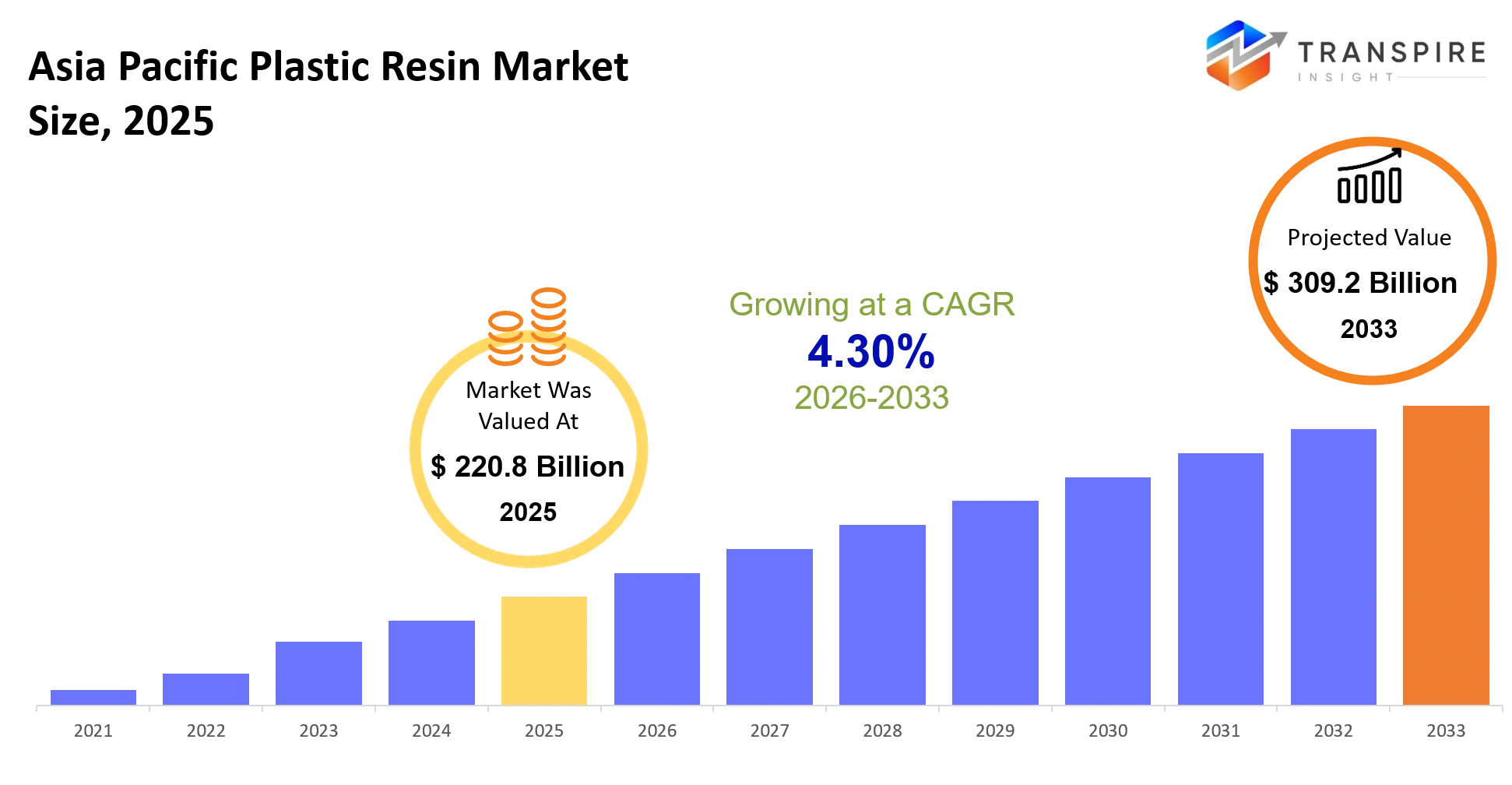
As per Transpire Insight Analysis the Asia Pacific Plastic Resin Market size is estimated at USD 220.8 Billion in 2025 and is anticipated to reach USD 309.2 Billion by 2033, growing at a CAGR of 4.30% from 2026 to 2033.
According to Transpire Insight Analysis , the Asia Pacific Plastic Resin Market was valued at USD 220.8 billion in 2025 , and it is projected to hit USD 309.2 billion by 2033. In simple terms Plastic resins are sort of the foundation block for modern manufacturing, because they provide lightweight yet rigid, and also budget-friendly materials for packaging, vehicles, buildings , electrical gear, medical products, and those everyday consumer goods. The “material versatility” angle helps manufacturers boost overall product performance, while also trimming production costs, and still keeping high-volume output going across many different industries.
In the last five years, the market has been tilting more toward higher-value engineering plastics and recyclable resin grades. This is happening as governments roll out stricter waste management policies, and as manufacturers redesign items for circular material use, so the loop stays tighter. Also, COVID-19 supply chain disruptions made it obvious how much the region relied on imported feedstocks ,so companies began pushing regional capacity expansion and putting money into localized production setups. Because of these moves, domestic manufacturing has gotten stronger, adoption of advanced processing technologies has increased, and new revenue channels have opened up through specialty resins that can meet both performance targets and sustainability ,plus the regulatory requirements—across Asia Pacific industries.
Asia Pacific Plastic Resin Market Size & Forecast:
- Asia Pacific Plastic Resin Market Size 2025: USD 220.8 Billion
- Expected Market Value 2033: USD 309.2 Billion
- Forecast CAGR: 4.30%
- Leading region in 2025:East Asia (led by China)
- Fastest Growing region:Southeast Asia
- Key Profile: SABIC, BASF, Dow, LyondellBasell, ExxonMobil, LG Chem, Formosa Plastics, Reliance Industries, Sinopec, PetroChina, Mitsubishi Chemical, Sumitomo Chemical, Toray Industries, INEOS, Covestro
Key Market Insights
- The Asia Pacific Plastic Resin Market is kind of being pulled forward by China, it brings in more than 46% of the regional revenue in 2025 , mainly because of big petrochemical production plus downstream manufacturing that never really slows down.
- India on the other hand is likely to show the fastest expansion through 2033, fueled by industrial expansion , fresh packaging investments, and government help for home grown domestic manufacturing programs.
- When it comes to resin types, Polyethylene is still kind of the main pick, sitting at roughly 32% market share in 2025, and you can really see that in how widely it gets used across flexible packaging plus a bunch of industrial uses.
- Polypropylene stays close behind as the second-largest resin category with nearly 24% share , and that’s backed by automotive parts, consumer goods, and those everyday household uses too.
- Bio based resins are projected to show the fastest growth rate all the way through 2033 , largely because sustainability targets are getting stricter and investments in alternative feedstocks keep climbing.
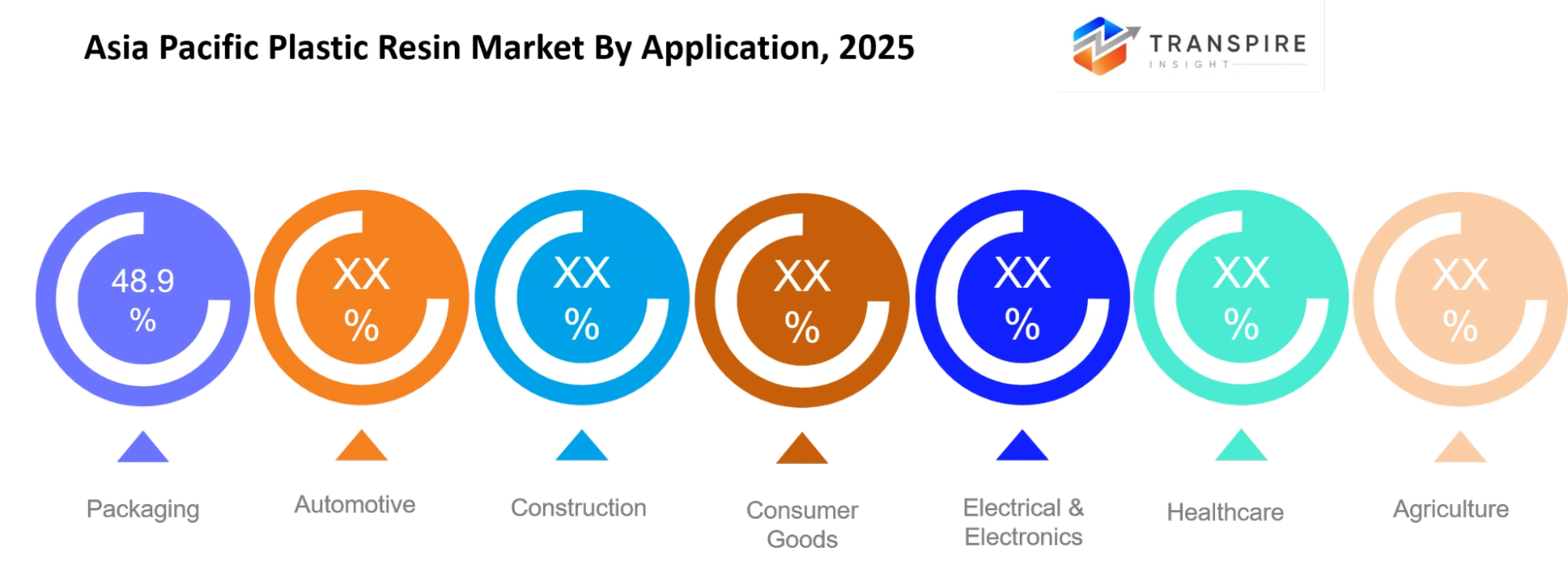
- On the applications side, Packaging accounts for almost 39% of total application revenue in 2025, so it ends up being the biggest application segment across regional manufacturing industries.
- Healthcare applications are also expected to grow at the quickest pace during the forecast window, since medical packaging, disposable devices, and pharmaceutical production keep increasing.
- For end-users, the packaging industry remains the leading group at about 37% market share, while electronics manufacturing is coming up as one of the faster growing customer categories.
- Big players like Sinopec, PetroChina, LG Chem, Formosa Plastics Corporation, Mitsubishi Chemical Group, and Reliance Industries keep putting money into specialty grades, recycling technologies ,and they’re also pushing to expand regional production.
What are the Key Drivers, Restraints, and Opportunities in the Asia Pacific Plastic Resin Market?
The strongest growth driver is the rapid expansion of manufacturing industries across China, India, Vietnam, and Southeast Asia, backed by industrial development policies ,and pretty noticeable investments in domestic production. Packaging, automotive, electronics, and construction manufacturers keep swapping traditional materials for plastic resins, because they cut down weight, help with design flexibility, and also reduce processing costs. On top of that, investments in new petrochemical complexes and downstream processing facilities have improved regional supply, and that lets manufacturers bring in specialty resin grades that generate more value… so revenue growth keeps going across a lot of industrial uses.
Still, plastic waste management is the most significant structural challenge, no doubt. Recycling infrastructure varies a lot across Asia Pacific, meanwhile collection systems, sorting capacity, and recycled material quality are not consistent. At the same time, the crude oil ,and feedstock prices just fluctuate, and that creates uncertainty for resin producers and converters. These long-term issues push production costs higher, can delay investment decisions, and in practice reduces adoption of recycled materials especially where applications need strict quality standards.
Chemical recycling and bio-based resin production also look like the strongest long-term opportunity. Governments and private investors are scaling up advanced recycling facilities, able to convert mixed plastic waste into feedstock suitable for new resin production. Japan, South Korea, and Singapore continue investing in circular economy projects, and India is pulling in new investments in specialty polymers and sustainable materials.
What Has the Impact of Artificial Intelligence Been on the Asia Pacific Plastic Resin Market?
Artificial intelligence plus more advanced digital technologies are, kinda shifting how plastic resin manufacturers work, like it is improving day-to-day output but in a more hands on way that affects production efficiency, quality monitoring , and the coordination of supply chain flow. With AI driven process control, systems can keep checking reactor temperature, pressure, raw material makeup, and even energy use all the time, so polymer quality stays steadier, and there’s less waste too. Then, computer vision shows up inspecting resin pellets and finished parts in real time, spotting defects that older inspection approaches sometimes skip or can’t see. On top of that, automated production planning helps balance inventories, use the plant space and capacity more wisely, and react faster when customer orders start changing.
Machine learning models also help with predictive maintenance, by studying signals like vibration, temperature, and overall equipment behavior from reactors, compressors, and extrusion setups. Catching problems earlier means fewer surprise shutdowns, better uptime, and lower maintenance spending. Plus there’s AI based demand forecasting which can guide producers when it comes to procurement and scheduling, so inventory costs go down and delivery performance improves across regional supply chains.
Even so, AI adoption is still kinda held back, by high rollout costs, fragmented data platforms, and not enough skilled digital professionals. Many small and medium sized manufacturers are still using older equipment that doesn’t include the right sensors or connectivity, so effective AI deployment becomes difficult. That’s why the broader digital transformation across the plastics industry in the region tends to move slower than it could.
Key Market Trends
- Chemical recycling investments started speeding up after 2022, and then you could see a few regional producers enlarging their recycled feedstock capacity for so called premium resin output.
- In 2025, China held up more than 46% of the regional market, mostly due to ongoing petrochemical expansion and the usual integrated manufacturing sites that keep things running smooth.
- Bio-based resin development also got more traction. Manufacturers rolled out commercial alternatives for packaging , and even for consumer product uses, which pushed adoption further.
- Engineering plastics meanwhile picked up faster in automotive and electronics manufacturing, because the need for lightweight materials kept getting stronger after 2021 , not just for one segment but across multiple.
- On the supply side, manufacturers lifted local production capacity after pandemic related supply disruptions, which then lowered the reliance on imported raw materials, somewhat.
- At the same time digital manufacturing platforms became more common, and AI-driven quality inspection setups were increasingly used too, so production consistency improved and material losses went down by measurable margins.
- Major companies such as LG Chem, Sinopec, Reliance Industries, and Formosa Plastics Corporation expanded their specialty polymer portfolios, aiming at higher value industrial applications instead of staying in the standard lanes.
- Between 2021 and 2025, governments also introduced tougher plastic waste regulations, and that nudged more investment into recycling technologies and circular production systems.
- Electronics manufacturers shifted toward high-performance polymers with better thermal resistance, to better support semiconductor work and advanced device manufacturing.
- Finally, strategic partnerships between resin producers and packaging manufacturers kept growing, helping accelerate recyclable material development and also improve compliance with new sustainability regulations that seem to be evolving every year.
Asia Pacific Plastic Resin Market Segmentation
By Resin Type
Polyethylene kind of holds the biggest share, mostly because flexible packaging, films, carry bags, industrial liners, pipes , and containers really need something that is durable, resists moisture, and still stays cost efficient. High density polyethylene ends up fitting the more rigid use cases like bottles, drums, and piping systems, while low density and linear low density grades get used for packaging films and even agricultural products. Polypropylene follows close behind, with pretty wide use across automotive parts, household products, food containers , woven sacks, and industrial packaging, since it has good mechanical strength and chemical resistance. Polyvinyl chloride is still kind of a go to option in construction materials like pipes, fittings, window profiles, cables, and flooring , and it keeps feeling relevant because it has a long service life, plus low maintenance needs, which is honestly a big deal.
Polystyrene keeps showing up in disposable packaging, insulation products, and consumer items where light weight performance is sort of essential, or at least preferred. Polyethylene terephthalate appears in beverage bottles, food packaging, and textile fibers too , mainly because it brings strong clarity, along with recyclability.
Engineering plastics are also moving forward across automotive, electronics, and industrial machinery , with materials such as polycarbonate, polyamide, and ABS that can offer higher strength together with thermal stability. Bio based resins get more investment attention since they use renewable feedstocks and often result in a lower environmental impact , while the “others” category covers specialty polymers made for aerospace, healthcare, electrical insulation, adhesives, coatings, and additional advanced industrial uses.
By Processing Method
Injection molding still kinda rules in terms of processing because fast production speed, good dimensional accuracy, and this whole design flexibility thing really help with big run manufacturing for things like automotive parts, electrical gear, medical devices, packaging containers, and consumer goods. Blow molding is still pretty relevant too, especially for bottles , tanks, industrial containers, and household packaging, where that hollow plastic structure is sort of the whole point. Extrusion keeps supporting continuous production of pipes, sheets, films, cables, window profiles ,and plastic tubing so it’s kind of indispensable across construction, packaging, and infrastructure work. Rotational molding stays pretty steady for water tanks, storage containers, playground gear, and industrial products that need seamless hollow shapes with not much fuss.
Compression molding is kinda the go to method for thermosetting materials, like electrical insulation, automotive pieces, and industrial gear where toughness and heat resistance genuinely matter. Thermoforming meanwhile matches food trays, disposable packaging , medical packaging, and retail displays mostly because sheet processing stays cost effective, practical, even if the schedule gets a bit brutal. And then three dimensional printing kinda keeps sliding into commercial use for prototype building, bespoke manufacturing, healthcare devices, and lighter weight industrial components, since the material lineup keeps widening year after year.The others category is basically a catch-all for transfer molding , casting, calendering, and other specialized processing methods that were developed for niche use, where those unique performance traits are the real requirement.
By Application
Packaging is probably the biggest application overall, mainly because food, beverage, personal care, pharmaceutical, and industrial manufacturers need lightweight yet durable materials that are also cost efficient for protecting the product and getting it shipped safely. Flexible films, rigid containers, bottles, caps, and protective wraps use a lot of polyethylene, polypropylene, and polyethylene terephthalate, and you can feel that volume add up pretty fast. Automotive keeps growing too, especially with lighter interior components, bumpers, dashboard pieces, fuel systems, and exterior parts, these help with fuel efficiency and also manufacturing flexibility, which matters a lot on modern lines. Construction is still another big driver, with pipes, insulation panels, flooring, roofing materials, window profiles and cable insulation that provide durability and corrosion resistance over time.
Then you have consumer goods, where resin use stays fairly steady across furniture, kitchenware, toys, storage products and household appliances. In electrical and electronics, engineering plastics show up in connectors, housings, circuit protection, and insulation, largely because they deliver strong thermal and electrical performance. Healthcare is also expanding across medical packaging, syringes, diagnostic products, laboratory equipment, and disposable devices, though everything has to meet strict quality standards. Agriculture helps support the resin demand via irrigation systems, greenhouse films, mulch films, water storage solutions, and crop protection products, while the “others” group covers aerospace, textiles, industrial machinery, renewable energy, and specialty manufacturing applications.
By Distribution Channel
Direct sales end up taking the largest share, simply because the biggest manufacturers often like long term supply agreements. Those deals usually give stable pricing, steady quality control, and delivery schedules that are actually reliable . Industrial distributors, in the meantime help in regional supply chains by keeping inventory on hand, providing technical support, and working with small and medium sized processors using flexible purchasing options, which can be a big deal. OEM supply still matters too, especially since automotive, electronics, appliance, and machinery manufacturers often pull customized resin grades straight from producers so they can hit particular performance needs. Online sales also keep growing via digital procurement platforms that make order management easier, support price comparison, and improve overall purchasing efficiency for industrial buyers.
Wholesalers back broader market coverage by moving standard resin grades to converters that work across many industries. Dealers also bring localized availability and technical help, mostly for smaller manufacturers with lower purchasing volumes. Contract supply keeps gaining momentum because longer procurement agreements cut down raw material uncertainty and make production planning smoother for both sides , suppliers and customers. The others category is basically trading companies, import export firms, partners that handle project based procurement , and specialized distribution networks serving niche industrial use cases.
By End User
The packaging industry still sits as the leading end user, mostly because food processing, beverages, pharmaceuticals, e-commerce, and general consumer goods need dependable materials for safe storing, transport and shelf-life extension . Automotive manufacturers take in big resin volumes for lighter vehicle parts that help with fuel efficiency, cut down emissions, and also make the whole production process simpler. Construction companies lean on plastic materials for pipes, insulation items, roofing systems, flooring, doors, windows and electrical installations, since these are durable and usually low upkeep, in a very practical way. Electronics manufacturers keep pushing their resin usage upward for connectors, housings, cable insulation, and those precision components used across both consumer electronics and industrial equipment.
In healthcare , companies use higher-quality polymers for medical packaging, surgical instruments, lab products, diagnostic devices, and single-use medical supplies, all of which need strict regulatory compliance. For consumer goods, manufacturers produce furniture, household goods, toys, personal care packaging, and kitchen accessories using plastic materials that are both flexible and good-looking in design options. The agriculture sector also supports fairly stable resin consumption through irrigation equipment, greenhouse films, crop protection products, and water management systems, which basically boost farming efficiency. The “others” bucket covers textile manufacturing, industrial equipment, renewable energy, aerospace, marine goods, and a handful of specialized industrial applications that need advanced polymer solutions.
What are the Key Use Cases Driving the Asia Pacific Plastic Resin Market?
Packaging is still basically the main use case because food, beverage, pharmaceutical, and personal care manufacturers rely on plastic resins to make lighter bottles, flexible films, firm containers, caps, and protective wrapping. Material durability, moisture resistance, and smooth processing, all of that helps producers cut down transportation costs , while still keeping product safety and pushing shelf life longer.
Automotive and electronics keep growing too. In many places manufacturers are shifting away from heavier materials toward engineering plastics, including polypropylene parts, which supports better vehicle efficiency and makes production easier. Construction also keeps feeding adoption through pipes insulation products, window profiles , cable insulation, and roofing items used by construction companies across rapidly developing economies.
And then there are the newer use cases that open fresh growth avenues in healthcare and advanced manufacturing. Medical device makers are choosing specialty polymers for diagnostic tools, lab supplies, and sterile packaging, while additive manufacturing is pulling in higher demand for high performance resin materials for customized industrial pieces and quick prototyping. Bio based as well as chemically recycled resins are getting more commercial traction , as companies build circular production setups that match changing sustainability expectations without dropping material performance.
|
Report Metrics |
Details |
|
Market size value in 2025 |
USD 220.8 Billion |
|
Market size value in 2026 |
USD 230.3 Billion |
|
Revenue forecast in 2033 |
USD 309.2 Billion |
|
Growth rate |
CAGR of 4.30% from 2026 to 2033 |
|
Base year |
2025 |
|
Historical data |
2021 - 2024 |
|
Forecast period |
2026 - 2033 |
|
Report coverage |
Revenue forecast, competitive landscape, growth factors, and trends |
|
Regional scope |
United States; Canada; Mexico; United Kingdom; Germany; France; Italy; Spain; Denmark; Sweden; Norway; China; Japan; India; Australia; South Korea; Thailand; Brazil; Argentina; South Africa; Saudi Arabia; United Arab Emirates |
|
Key company profiled |
SABIC, BASF, Dow, LyondellBasell, ExxonMobil, LG Chem, Formosa Plastics, Reliance Industries, Sinopec, PetroChina, Mitsubishi Chemical, Sumitomo Chemical, Toray Industries, INEOS, Covestro |
|
Customization scope |
Free report customization (country, regional & segment scope). Avail customized purchase options to meet your exact research needs. |
|
Report Segmentation |
By Resin Type (Polyethylene, Polypropylene, Polyvinyl Chloride, Polystyrene, Polyethylene Terephthalate, Engineering Plastics, Bio-Based Resins, Others); By Processing Method (Injection Molding, Blow Molding, Extrusion, Rotational Molding, Compression Molding, Thermoforming, 3D Printing, Others); By Application (Packaging, Automotive, Construction, Consumer Goods, Electrical & Electronics, Healthcare, Agriculture, Others); By Distribution Channel (Direct Sales, Industrial Distributors, OEM Supply, Online Sales, Wholesalers, Dealers, Contract Supply, Others); By End User (Packaging Industry, Automotive Manufacturers, Construction Companies, Electronics Manufacturers, Healthcare Companies, Consumer Goods Manufacturers, Agriculture Sector, Others) |
Which Regions are Driving the Asia Pacific Plastic Resin Market Growth?
East Asia still seems to be the biggest regional market, sort of led by China, Japan and South Korea. China takes the top spot in resin output and resin use because it has an integrated petrochemical industry, a huge manufacturing base, and logistics infrastructure that is pretty advanced. There’s also strong government backing for domestic chemical production, ongoing investments in refining capacity, and industrial clusters that are already well developed. So the whole thing, resin manufacturers kinda get a dependable ecosystem to work in. On top of that, demand stays high in packaging, automotive, electronics, and construction, which helps producers get economies of scale while keeping the market moving forward steadily.
South Asia is usually viewed as the second-largest contributor , and India is the one driving most of the regional revenue growth. But this is different from East Asia because expansion is backed by quick industrialization, manufacturing policies that look favorable, and increasing investment in infrastructure, not by “production dominance” that was already there. Domestic packaging, consumer goods, agriculture, and automotive industries keep building up capacity, so resin consumption stays consistent across several sectors. With steady economic growth, improving industrial infrastructure, and additional capacity coming from local petrochemical companies, South Asia ends up looking dependable for long-term regional revenue.
Southeast Asia, meanwhile, is projected to see the fastest growth in the 2026–2033 period. The recent shift of global manufacturing away from single-country supply chains has pushed investors to put more money into Vietnam, Indonesia, Thailand, and Malaysia, which then strengthens downstream plastics processing capacity.
Who are the Key Players in the Asia Pacific Plastic Resin Market and How Do They Compete?
Competition in the Asia Pacific Plastic Resin Market is kinda moderately consolidated, like you can see integrated petrochemical companies have big production capacity and then regional manufacturers push back by leaning on specialty materials and localized supply networks. In general cost competitiveness still matters a lot for commodity resins, but more and more firms try to stand out using advanced polymer technologies, recycled material know-how, better production efficiency, and a stronger regional manufacturing footprint. At the same time, investments into specialty polymers and circular economy solutions keep shifting how firms compete across the whole market , without slowing down.
Sinopec, for instance, keeps a competitive edge thanks to vertically integrated refining and petrochemical operations. That basically means reliable feedstock availability and cost-efficient resin output across China, which is hard to match. LG Chem takes a different approach and keeps focus on specialty polymers, recycled plastics, and advanced engineering materials for automotive, electronics, and healthcare, so it competes with technology , not only with production volume. Reliance Industries keeps expanding integrated manufacturing capacity and downstream operations across India, which helps lock in domestic supply and also backs export growth through one of the region’s biggest petrochemical complexes.
Formosa Plastics differentiates itself by sticking with large-scale manufacturing facilities, delivering consistent product quality and stable supply across polyethylene, polypropylene, and PVC markets. Meanwhile Mitsubishi Chemical leans into high-performance engineering plastics and specialty materials meant for electronics, healthcare, and industrial uses, where technical performance usually creates higher customer value.
Company List
• SABIC
• BASF
• Dow
• LyondellBasell
• ExxonMobil
• LG Chem
• Formosa Plastics
• Reliance Industries
• Sinopec
• PetroChina
• Mitsubishi Chemical
• Sumitomo Chemical
• Toray Industries
• INEOS
• Covestro
Recent Development News
In April 2026, LG Chem unveiled approximately 90 high-value specialty materials at Chinaplas 2026. The launch strengthened its portfolio for robotics, electric vehicles, medical products, and recyclable polyethylene while expanding its presence in Asia's specialty plastics market.https://en.sedaily.com
In April 2026, LG Chem received the Top 10 Technology Excellence Award at Chinaplas 2026 for its recyclable heat-resistant HRTP material. The recognition reinforced the company's leadership in advanced engineering plastics and sustainable material technologies for electric vehicle applications.https://en.sedaily.com/markets
In February 2026, LG Chem announced progress toward commercializing its 99.9% purity recycled polycarbonate technology. The project entered the pilot engineering phase and supports future production of premium recycled engineering plastics for industrial and electronics applications.https://blog.lgchem.com
What Strategic Insights Define the Future of the Asia Pacific Plastic Resin Market?
The Asia Pacific plastic resin industry is slowly turning away from mostly commodity led output and moving toward specialty polymers, reclaimed materials, and high-performance engineering plastics that help the growth of more advanced manufacturing. Growth here is likely to come from investments in nearby petrochemical capacity, circular economy programs, and a broader take up of specialized materials across auto, electronics, health care, plus industrial manufacturing too.
There is also a sort of hidden snag, the one that doesn’t get enough attention, the steady reliance on fossil based feedstocks . This can leave producers exposed to crude oil price swings, geopolitical shocks, and stricter environmental rules, all of which may squeeze production economics.
At the same time , chemical recycling know how and bio based resin production could become major long term openings. This is especially true as governments push harder on recycling obligations and as manufacturers want more premium sustainable offerings. In general, businesses that put money into advanced recycling facilities , invest in specialty polymer R and D , and build regional manufacturing alliances will probably do better on higher margin uses, while also strengthening supply steadiness and staying competitive across the whole Asia Pacific market.
Asia Pacific Plastic Resin Market Report Segmentation
By Resin Type
• Polyethylene
• Polypropylene
• Polyvinyl Chloride
• Polystyrene
• Polyethylene Terephthalate
• Engineering Plastics
• Bio-Based Resins
• Others
By Processing Method
• Injection Molding
• Blow Molding
• Extrusion
• Rotational Molding
• Compression Molding
• Thermoforming
• 3D Printing
• Others
By Application
• Packaging
• Automotive
• Construction
• Consumer Goods
• Electrical & Electronics
• Healthcare
• Agriculture
• Others
By Distribution Channel
• Direct Sales
• Industrial Distributors
• OEM Supply
• Online Sales
• Wholesalers
• Dealers
• Contract Supply
• Others
By End User
• Packaging Industry
• Automotive Manufacturers
• Construction Companies
• Electronics Manufacturers
• Healthcare Companies
• Consumer Goods Manufacturers
• Agriculture Sector
• Others
Frequently Asked Questions
Find quick answers to common questions.
The expected Asia Pacific Plastic Resin Market size for the market will be USD 309.2 Billion in 2033.
Key segments for the Asia Pacific Plastic Resin Market are By Resin Type (Polyethylene, Polypropylene, Polyvinyl Chloride, Polystyrene, Polyethylene Terephthalate, Engineering Plastics, Bio-Based Resins, Others); By Processing Method (Injection Molding, Blow Molding, Extrusion, Rotational Molding, Compression Molding, Thermoforming, 3D Printing, Others); By Application (Packaging, Automotive, Construction, Consumer Goods, Electrical & Electronics, Healthcare, Agriculture, Others); By Distribution Channel (Direct Sales, Industrial Distributors, OEM Supply, Online Sales, Wholesalers, Dealers, Contract Supply, Others); By End User (Packaging Industry, Automotive Manufacturers, Construction Companies, Electronics Manufacturers, Healthcare Companies, Consumer Goods Manufacturers, Agriculture Sector, Others).
Major Asia Pacific Plastic Resin Market players are SABIC, BASF, Dow, LyondellBasell, ExxonMobil, LG Chem, Formosa Plastics, Reliance Industries, Sinopec, PetroChina, Mitsubishi Chemical, Sumitomo Chemical, Toray Industries, INEOS, Covestro.
The Asia Pacific Plastic Resin Market size is USD 220.8 Billion in 2025.
The Asia Pacific Plastic Resin Market CAGR is 4.30% from 2026 to 2033.
• SABIC
• BASF
• Dow
• LyondellBasell
• ExxonMobil
• LG Chem
• Formosa Plastics
• Reliance Industries
• Sinopec
• PetroChina
• Mitsubishi Chemical
• Sumitomo Chemical
• Toray Industries
• INEOS
• Covestro
About the Authors

Pankaj Ghogare Patil
I am Pankaj Ghogare Patil, a Senior Research Analyst at Transpire Insight, specializing in the Pharmaceutical, Chemicals & Materials, Healthcare IT, and Biotechnology industry. My expertise lies in conducting comprehensive market research, analyzing industry trends, evaluating competitive landscapes, and translating complex data into actionable insights. At Transpire Insight, I closely follow emerging technologies, regulatory developments, and market innovations to create accurate, well-researched, and informative content that helps businesses and professionals make informed decisions. I am committed to producing credible, evidence-based articles that reflect industry best practices while making technical topics accessible and valuable for a broad audience.

Chakradhar Khansole
Chakradhar serves as the Research Director at Transpire Insight, bringing over 8 years of experience in technology, innovation, and strategic market intelligence. He specializes in transforming complex market data into actionable business insights that enable organizations to make informed, growth-oriented decisions. Recognized for his strategic vision and analytical expertise, Chakradhar leads high-impact research initiatives, delivering comprehensive market assessments, competitive intelligence, and forward-looking industry analysis.
Recently Published Reports
-
May 2026
Healthcare Polymer Packaging Market
Healthcare Polymer Packaging Market Size, Share & Analysis Report By Packaging Type (Syringes, IV Bottles and Pouches, Clamshells, Blisters, Bottles & Jars, Containers, Tubes, IV Parental Packaging, Others), By Type (Regulated, Non-regulated), By Polymer Type (LDPE (Low-Density Polyethylene), HDPE (High-Density Polyethylene), Homo-polymer (Homo), Random Copolymer (Random), Block Copolymer (Block), PET, Polystyrene, Polyvinyl Chloride, Polyamide/EVOH, Others), and Geography (North America, Europe, Asia-Pacific, Middle East and Africa, South and Central America), 2021 - 2031
-
Apr 2026
Hydrophilic Tape (Waterstop) Market
Hydrophilic Tape (Waterstop) Market Size, Share & Analysis Report By Type (Bentonite-Based Hydrophilic Tape, Rubber-Based Hydrophilic Tape), By Application (Residential Buildings, Commercial Buildings, Infrastructure Projects), and Geography (North America, Europe, Asia-Pacific, Middle East and Africa, South and Central America), 2021 - 2031
-
Apr 2026
Metalens Market
Metalens Market Size, Share & Analysis Report By Type (Visible Light Metalens, and Infrared Metalens), By Application (Consumer Electronics, Automotive Electronics, Industrial, Medical, and Others), and Geography (North America, Europe, Asia-Pacific, Middle East and Africa, South and Central America), 2021 - 2031
-
Apr 2026
PBT Resin Market
PBT Resin Market Size, Share & Analysis Report By Type (Reinforced PBT Resin, Unreinforced PBT Resin), By Processing Method (Injection Molding, Extrusion, Blow Molding, Others), By End-User (Automotive, Electrical & Electronics, Consumer Appliances, Industrial Machinery, Medical Devices, Packaging, Others), and Geography (North America, Europe, Asia-Pacific, Middle East and Africa, South and Central America), 2021 - 2031