
South Korea High-Density Polyethylene Resins Market Size & Forecast:
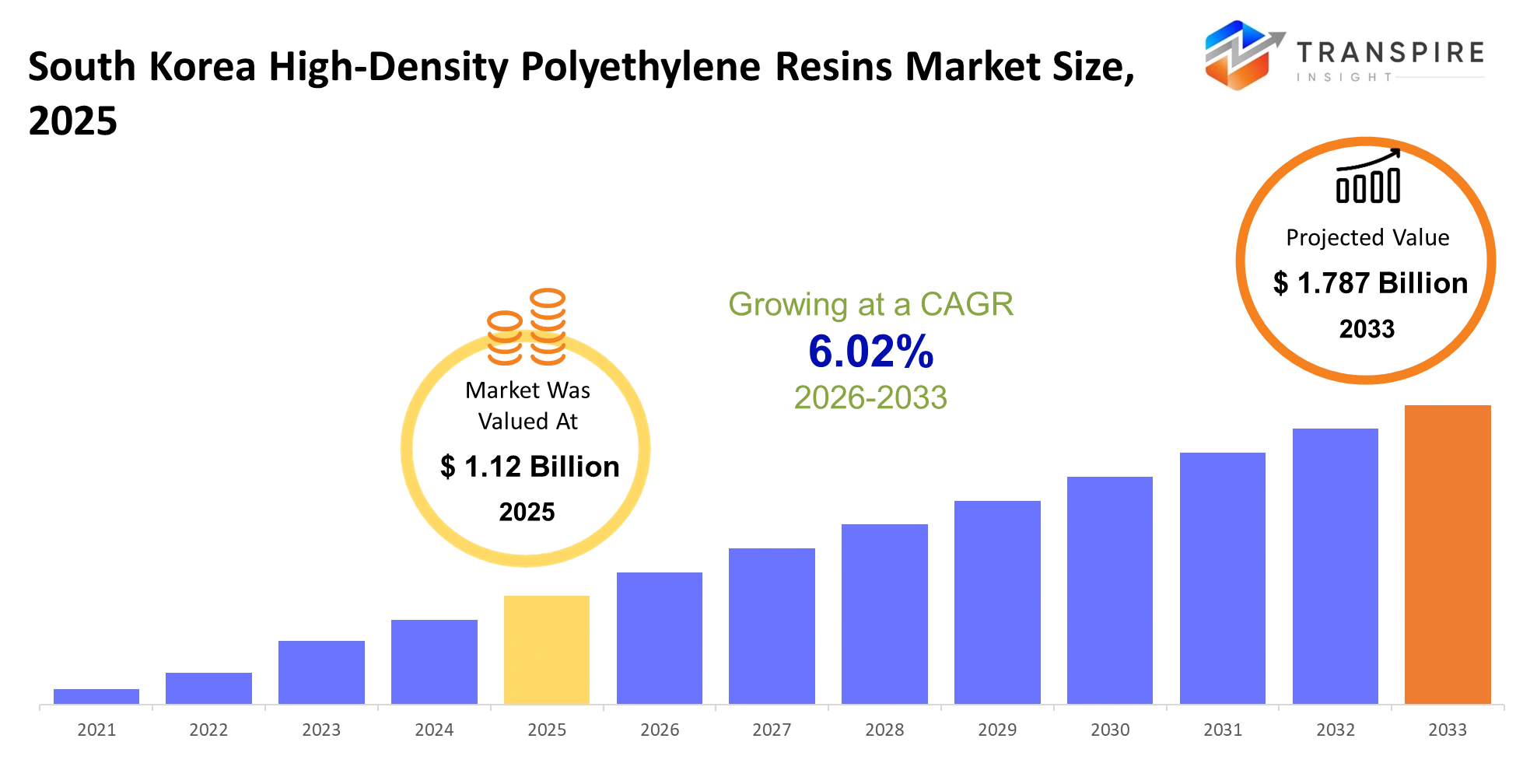
- South Korea High-Density Polyethylene Resins Market Size 2025: USD 1.12 Billion
- South Korea High-Density Polyethylene Resins Market Size 2033: USD 1.787 Billion
- South Korea High-Density Polyethylene Resins Market CAGR: 6.02%
- South Korea High-Density Polyethylene Resins Market Segments: By Product Type (Blow Molding HDPE, Injection Molding HDPE, Pipe Grade HDPE, Film Grade HDPE, Others); By Application (Packaging, Pipes & Fittings, Automotive Components, Consumer Goods, Others); By End User (Packaging Industry, Construction Industry, Automotive Industry, Consumer Goods Industry, Others); By Form (Pellets, Granules, Powder, Others); By Processing Technology (Extrusion, Injection Molding, Blow Molding, Others).
To learn more about this report,  Download Free Sample Report
South Korea High-Density Polyethylene Resins Market Summary
The South Korea High-Density Polyethylene Resins Market was valued at USD 1.12 Billion in 2025. It is forecast to reach USD 1.787 Billion by 2033. That is a CAGR of 6.02% over the period.
In South Korea, high-density polyethylene resins are pretty much used as the main base, or backbone, for long-lasting packaging films, pressure-resistant piping layouts, industrial containers, and also automotive fluid tanks that help manufacturing and infrastructure move along. This market really works like a key input layer for downstream businesses that need light weight strength, chemical pushback resistance, and materials that are cheaper to make at scale. Over the last 3–5 years, things have changed in a more structural way, because the industry has been leaning more toward circular polymer systems, so petrochemical producers are mixing in better recycling methods and cleaner cracking technologies directly into resin output. Meanwhile, global supply chain disruptions—started after the pandemic, with logistics bottlenecks plus energy price volatility—ended up reshaping how Korean converters buy materials, so they tend to choose localized sourcing or contract-based purchasing instead. That did improve supply stability, but it also made converters more dependent on integrated domestic producers, and that in turn raised revenue concentration within a few big chemical groups. So now adoption is driven less by just growing volumes , and more by performance upgrades, plus regulatory alignment with sustainability oriented manufacturing standards.
Key Market Insights
- South Korea basically keeps almost all the domestic demand share, close to 100% , because of those integrated petrochemical clusters around Ulsan and Yeosu.
- For the wider region, Northeast Asia is the clear heavyweight, taking more than 60% consumption share in 2025, mainly pulled by industrial polymer conversion hubs.
- On the product side, packaging grade HDPE ends up as the leading bucket with an estimated 45–50% share, supported by FMCG movement and logistics expansion.
- Then, blow molding resins sit in the second place, backed by things like automotive fuel tank use and container applications , sort of.
- The injection molding grade is the fastest grower right through 2033, it is largely tied to higher precision industrial component demand.
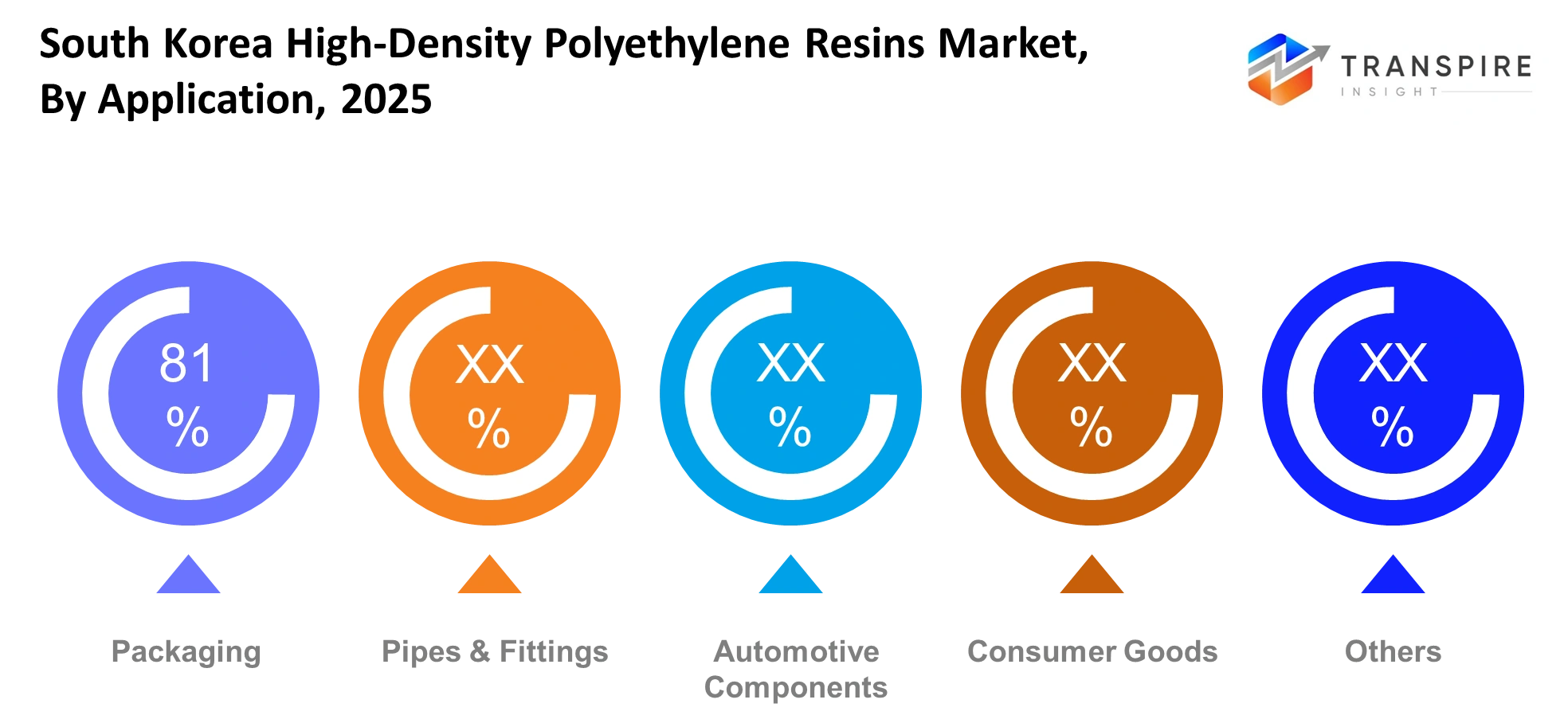
- When you look at uses, packaging applications own nearly 55% of the market, largely because of e-commerce logistics , plus industrial storage ramp up.
- Construction piping is the one that’s emerging fastest , mostly due to municipal infrastructure replacement programs.
- As for customers, industrial end users lead consumption with over 40% share, linked with chemical and manufacturing integration.
- And automotive end use is also moving fastest, since lightweight polymer adoption keeps replacing metal components.
What are the Key Drivers, Restraints, and Opportunities in the South Korea High-Density Polyethylene Resins Market?
The primary driver in the South Korea High-Density Polyethylene Resins Market is basically that export-driven manufacturing stays structural, especially for packaging, automotive parts, and industrial logistics. As the push for high performance lightweight materials gets stronger, resin adoption also speeds up, because makers want lower transportation expenses while still meeting tougher durability standards. Firms that tie into downstream petrochemical clusters like Hanwha Solutions, kind of lock in supply steadier, which helps conversion cycles run quicker and production throughput goes up more.
One major restraint is volatility in upstream ethylene feedstock pricing, and it’s closely bound to crude oil swings as well as naphtha import dependency. That kind of exposure makes margin stability harder for resin producers, and it often causes periodic delays when converters try to pass costs through. Also, the scalability of fully recycled HDPE streams is still limited, so fast substitution for virgin resin doesn’t really happen. That slows the circular production transition, even though regulations keep pressing.
The most promising opportunity is in advanced, higher-purity HDPE grades for chemical containment and for industrial infrastructure systems. Demand is increasing from niche uses, like corrosion-resistant piping tied to semiconductor related industrial zones. Producers such as SABIC, are expanding their high performance resin portfolios, and this suggests a move toward value added differentiation not just plain commodity competition. So, there’s room for new revenue streams beyond the usual packaging focus.
What Has the Impact of Artificial Intelligence Been on the South Korea High-Density Polyethylene Resins Market?
Artificial intelligence is getting mixed into HDPE resin production facilities more and more, mostly to fine tune polymerization control systems and to push extrusion line efficiency higher. Smart manufacturing platforms in plants run by companies like ExxonMobil , rely on machine learning models that basically help steady reactor conditions, which in turn cuts down batch variability and keeps resin behavior more consistent for the downstream converters. In South Korea, you can also see related digital systems landing in petrochemical complexes, where they keep an eye on catalyst performance and use automation for quality grading, in near real time.
Predictive maintenance models now sift through vibration signals, temperature readings, and pressure data across the resin production equipment, so they can foresee failures before downtime even starts. This has helped operational uptime in continuous polymerization units, and it also trims losses from unexpected shutdowns. On top of that, AI based optimization tools boost energy efficiency by shifting heat input and feedstock ratios on the fly, lowering the cost per ton for high density polyethylene output.
Still, there is a major bottleneck, the shortage of high quality training data that is both domain focused and actually collected from real industrial environments. A lot of production setups still run with partially siloed digital architectures, so the models struggle to stay accurate when plant conditions change. Also, the integration costs are pretty steep for mid scale resin manufacturers, so adoption moves slower outside the big integrated petrochemical hubs.
Key Market Trends
- South Korea High-Density Polyethylene Resins Market kinda shifted toward recycled blend integration, moving from pilot scale use in 2021 to more industrial adoption in 2025.
- At the same time, packaging demand patterns sort of rearranged, because e-commerce logistics kept expanding, which then bumped up flexible HDPE film consumption through a lot of supply chains.
- On the domestic side, petrochemical firms pushed capacity utilization rates above 85% in 2025, after the earlier supply chain disruptions kind of calmed down and normalized.
- Catalyst innovation also played a role, since better formulations improved resin strength to weight ratios, letting buyers substitute materials in automotive fluid setups and industrial container systems without too much hassle.
- Meanwhile export packaging requirements tightened in 2024, which made manufacturers lean toward higher grade resin across multiple manufacturing clusters.
- The market also saw more digital plant monitoring adoption among big producers like Dow, and that adoption wasn’t just window dressing.
- Feedstock diversification strategies expanded after 2022 energy volatility, so dependency on imported naphtha got reduced, somewhat.
- And industrial construction recovery in 2025 sped up pipe grade HDPE demand, especially across infrastructure modernization projects where the installs needed reliable performance.
- Finally, competitive pricing pressure got more intense as regional suppliers scaled capacity across Northeast Asia supply chains, and everyone seemed to respond with tighter margins.
South Korea High-Density Polyethylene Resins Market Segmentation
By Product Type
HDPE blow molding stays important for all the containers and industrial drums that get made along with packaging solutions in general. Logistics and export manufacturing drive a lot of this demand since the material holds up to impacts and keeps shape during transport. High speed lines fit well with it for steady output.
Injection molding takes a solid share from automotive and consumer goods along with rigid packaging. Pipe grade matters in construction because of corrosion resistance and how long it lasts. Film grade looks to be growing quicker now as things move to lightweight flexible packaging for exports. There are other specialty blends too but they stay niche.
Over the coming years film and injection types should expand more I think due to needs for lighter designs. Pipe grade probably holds steady from infrastructure work. It is not totally clear how much the others will change though.
By Application
Packaging seems to drive most of the demand for this material. It shows up heavily in food containers and industrial chemical packaging along with export logistics. High moisture resistance and strength help protect goods over long distances and e commerce growth plus cold chain systems add to the need for both flexible and rigid formats.
Pipes and fittings hold steady from infrastructure projects and fluid transport needs. Automotive components are seeing more interest as manufacturers want lighter chemical resistant options for fuel systems and similar parts. Consumer goods add regular volume through household containers and storage items that get replaced often. Other uses cover agriculture and some specialized equipment.
Packaging and automotive applications should expand quicker due to design changes and material shifts while pipes stay tied to steady infrastructure work. I think that last part gets overlooked sometimes.
To learn more about this report, Download Free Sample Report
By End User
The packaging side looks like it leads overall. Demand stays high from food processing along with retail and export needs. It seems the push for high output and durability keeps resin use steady in both flexible and rigid formats. That lines up with manufacturing cycles in a pretty consistent way.
Construction holds a solid share too from pipe systems and drainage work plus industrial buildings. Automotive demand is growing though because of efforts to make things lighter and meet performance needs in fluid handling and molded parts. Consumer goods stays fairly steady with replacement buying in household items and retail products. Other areas like agriculture and electronics play smaller roles.
Over time automotive and packaging should pick up speed as substitution happens more often. Construction probably stays stable from ongoing infrastructure work. I think the substitution part might be easy to overlook at first.
By Form
Pellets kind of dominate the form segment, mostly because they’re easier to move around, they hold up better during storage, and they fit well with automated processing systems used in big scale manufacturing plants. The consistency in melt flow behavior really helps keep production uniform, especially during extrusion and molding, so pellets stay the input format for industrial users.
Granules still see solid demand in mid sized processing settings where people need more flexible batch handling. Powder form ends up in a more niche role for specialized coating and compounding work, since fine dispersion really matters for performance boosts. Then there are also other types, like customized pre-mixed blends made for specific industrial needs. Looking across the forecast period, pelletized HDPE is expected to keep its leading position as production automation keeps expanding, while granules and specialty powders should grow steadily, supported by customized and higher performance material use cases driven by precision manufacturing needs.
By Processing Technology
Extrusion is a lead processing technology because it’s used everywhere in pipe manufacturing, film production, and sheet use, and well it tends to run smooth as a continuous process. The whole idea of continuous processing plus really good efficiency and high throughput, makes extrusion kind of a core technology for packaging too, and for infrastructure supply chains. When you look at big, large-scale facilities, strong adoption there basically keeps reinforcing its dominant position over time
Injection molding is still a big deal for automotive parts and consumer goods production, mainly because precision shaping matters, and design flexibility is hard to beat. Blow molding is also gaining some extra momentum now, largely due to demand for hollow containers, industrial bottles, and chemical packaging systems. You also see rotational molding along with more specialized hybrid processing techniques for niche uses, where conditions are a little unusual. Over the forecast period blow molding should expand faster since logistics and packaging needs keep evolving, while extrusion and injection molding remain steady anchors that support industrial-scale production stability across those core end-use sectors
What are the Key Use Cases Driving the South Korea High-Density Polyethylene Resins Market?
In the South Korea High-Density Polyethylene Resins Market the dominant use case seems to be rigid packaging for chemicals, food products, and industrial liquids where durability and chemical resistance are important,especially for export logistics and storage stability. Honestly this segment brings the top demand because South Korea’s export-heavy manufacturing structure keeps pushing that direction.
After that, expanding applications show up in automotive fuel tanks and lightweight fluid systems too, plus construction piping tied to industrial infrastructure projects. They’re getting more attention as makers lean toward corrosion-resistant and low-weight alternatives, for higher-stress conditions where reliability matters.
Then there are emerging applications like advanced semiconductor plant utility piping and specialized containment systems for high-purity chemical transport. These smaller pockets are picking up momentum, as industrial clusters look for ultra-clean high-strength materials with long lifecycle performance, and steady handling.
|
Report Metrics |
Details |
|
Market size value in 2025 |
USD 1.12 Billion |
|
Market size value in 2026 |
USD 1.187 Billion |
|
Revenue forecast in 2033 |
USD 1.787 Billion |
|
Growth rate |
CAGR of 6.02%from 2026 to 2033 |
|
Base year |
2025 |
|
Historical data |
2021 - 2024 |
|
Forecast period |
2026 - 2033 |
|
Report coverage |
Revenue forecast, competitive landscape, growth factors, and trends |
|
Regional scope |
South Korea |
|
Key company profiled |
LG Chem, Lotte Chemical, Hanwha Solutions, SABIC, ExxonMobil, Dow, INEOS, Chevron Phillips Chemical, Formosa Plastics, Reliance Industries, Borealis, Braskem, TotalEnergies, Mitsubishi Chemical, Sinopec. |
|
Customization scope |
Free report customization (country, regional & segment scope). Avail customized purchase options to meet your exact research needs. |
|
Report Segmentation |
By Product Type (Blow Molding HDPE, Injection Molding HDPE, Pipe Grade HDPE, Film Grade HDPE, Others); By Application (Packaging, Pipes & Fittings, Automotive Components, Consumer Goods, Others); By End User (Packaging Industry, Construction Industry, Automotive Industry, Consumer Goods Industry, Others); By Form (Pellets, Granules, Powder, Others); By Processing Technology (Extrusion, Injection Molding, Blow Molding, Others). |
Which Regions are Driving the South Korea High-Density Polyethylene Resins Market Growth?
The leading region is the Seoul–Gyeonggi industrial corridor, mostly powered by how tightly packed it is with petrochemical processing units, logistics hubs, and export manufacturing sites. It kind of leans on nearness to major ports and more integrated supply chains, which generally shorten the resin conversion lead times. Strong regulatory enforcement on industrial material standards also helps keep demand steady for high grade HDPE. And the whole ecosystem sort of locks in because refiners, converters , and packaging manufacturers coordinate together. So yeah, it ends up being the core demand center.
The southeastern industrial belt, say around Ulsan and Yeosu, works like a steady secondary hub, supported by heavy petrochemical infrastructure. Unlike the capital region, the big point here is large-scale refining and consistent resin output, not so much downstream diversification. A lot of long term contracts with industrial users keep demand stable, even when global trade swings around. In that way, this area acts as a balancing element for resin export supply stability.
The fastest growing spot is the western coastal industrial zone, pushed by recent port modernization and expanded logistics projects. New investments in container handling, plus chemical export terminals have raised resin throughput needs quite a bit. On top of that, government backed industrial diversification policies have pulled in mid scale manufacturers too. Between 2026 and 2033, this relocation and buildup will make the region a critical growth node, for both domestic consumption and export-linked resin processing.
Who are the Key Players in the South Korea High-Density Polyethylene Resins Market and How Do They Compete?
South Korea High-Density Polyethylene Resins Market looks kind of moderately consolidated, with integrated petrochemical producers basically calling the shots since they can secure feedstock access and run large scale polymerization capacity. Most competition seems to hinge on cost efficiency, catalyst innovation, and downstream integration ,not really on pure price fighting, which is a bit different. The long-term players defend their ground using supply agreements with packaging, automotive, and construction manufacturers, while the global companies tend to push via specialty resin grades, more nuanced and less generic.
LG Chem leans hard into technology led resin differentiation ,especially for high-strength and lightweight packaging uses. The edge is pretty clear: integrated refining to polymer production, which helps keep margins stable and supply reliability steady. Their expansion is centered on advanced materials R&D along with partnerships with downstream converters, so it feels more coordinated than just capacity.Lotte Chemical meanwhile boosts its stance via big capacity expansion and export forward resin output, aiming for cost leadership across Asia-Pacific markets. In practice, it’s like they optimize scale and shipment strategy together, not only formulation.
ExxonMobil and SABIC go after high-performance HDPE grades, relying on broad global R&D networks and a specialty polymer set. Dow also differentiates but in its own way, with application specific resin solutions for packaging and industrial systems, so rather than chasing commodity pricing it leans into performance customization.
Company List
- LG Chem
- Lotte Chemical
- Hanwha Solutions
- SABIC
- ExxonMobil
- Dow
- INEOS
- Chevron Phillips Chemical
- Formosa Plastics
- Reliance Industries
- Borealis
- Braskem
- TotalEnergies
- Mitsubishi Chemical
- Sinopec
Recent Development News
In March 2026, LOTTE Chemical announced merger with HD Hyundai Chemical following the spin-off of its Daesan plant. The restructuring is designed to consolidate naphtha-cracking operations, improve cost efficiency, and strengthen polyethylene and derivative resin competitiveness amid regional oversupply pressures.
Source: https://www.lottechem.com
In February 2026, South Korea’s Ministry of Trade approved the petrochemical restructuring plan involving LOTTE Chemical and HD Hyundai Chemical. The approved deal includes integration of Daesan operations and temporary shutdown measures to balance HDPE and ethylene supply, directly impacting resin production capacity and market pricing stability.
Source: https://www.reuters.com
In December 2025, LG Chem submitted a petrochemical restructuring plan to the South Korean government. The move aligns with nationwide capacity rationalization efforts and is expected to optimize ethylene-to-polyethylene integration, indirectly supporting HDPE resin supply chain efficiency and margin stabilization.
Source: https://www.reuters.com
What Strategic Insights Define the Future of the South Korea High-Density Polyethylene Resins Market?
South Korea’s High-Density Polyethylene Resins Market seems to be shifting, a bit like it’s going toward higher value, more application-aware resin output, and this is being helped by integrated petrochemical ecosystems and digital manufacturing tweaks, too. Instead of only growing through raw volume, the momentum is more tied to export packaging that holds up well and modernization across industrial infrastructure. There’s also a risk that is easy to miss, it is about how dependent the supply chain is on global naphtha pricing for feedstock, so margins can get squeezed, even while demand stays strong, during those cycle periods. On top of that, there is a different kind of pressure, substitution by other polymers especially in lightweight packaging, which changes the whole playing field.
Still, an interesting opening exists for high-purity HDPE aimed at semiconductor-linked industrial systems plus advanced chemical containment uses, where strict performance needs allow premium pricing. For market players, the smartest move is probably to strengthen downstream ties with converters, and to put money into specialty-grade development so they can expand margin, rather than just racing on scale, or chasing cost efficiency.
South Korea High-Density Polyethylene Resins Market Report Segmentation
By Product Type
- Blow Molding HDPE
- Injection Molding HDPE
- Pipe Grade HDPE
- Film Grade HDPE
- Others
By Application
- Packaging
- Pipes & Fittings
- Automotive Components
- Consumer Goods
- Others
By End User
- Packaging Industry
- Construction Industry
- Automotive Industry
- Consumer Goods Industry
- Others
By Form
- Pellets
- Granules
- Powder
- Others
By Processing Technology
- Extrusion
- Injection Molding
- Blow Molding
- Others
Frequently Asked Questions
Find quick answers to common questions.
The estimated South Korea High-Density Polyethylene Resins Market size for the market will be USD 1.787 Billion in 2033.
Key segments for the South Korea High-Density Polyethylene Resins Market are By Product Type (Blow Molding HDPE, Injection Molding HDPE, Pipe Grade HDPE, Film Grade HDPE, Others); By Application (Packaging, Pipes & Fittings, Automotive Components, Consumer Goods, Others); By End User (Packaging Industry, Construction Industry, Automotive Industry, Consumer Goods Industry, Others); By Form (Pellets, Granules, Powder, Others); By Processing Technology (Extrusion, Injection Molding, Blow Molding, Others).
Major South Korea High-Density Polyethylene Resins Market players are LG Chem, Lotte Chemical, Hanwha Solutions, SABIC, ExxonMobil, Dow, INEOS, Chevron Phillips Chemical, Formosa Plastics, Reliance Industries, Borealis, Braskem, TotalEnergies, Mitsubishi Chemical, Sinopec.
The South Korea High-Density Polyethylene Resins Market size is USD 1.12 Billion in 2025.
The South Korea High-Density Polyethylene Resins Market CAGR is 6.02% from 2026 to 2033.
- LG Chem
- Lotte Chemical
- Hanwha Solutions
- SABIC
- ExxonMobil
- Dow
- INEOS
- Chevron Phillips Chemical
- Formosa Plastics
- Reliance Industries
- Borealis
- Braskem
- TotalEnergies
- Mitsubishi Chemical
- Sinopec
Recently Published Reports
-
May 2026
Healthcare Polymer Packaging Market
Healthcare Polymer Packaging Market Size, Share & Analysis Report By Packaging Type (Syringes, IV Bottles and Pouches, Clamshells, Blisters, Bottles & Jars, Containers, Tubes, IV Parental Packaging, Others), By Type (Regulated, Non-regulated), By Polymer Type (LDPE (Low-Density Polyethylene), HDPE (High-Density Polyethylene), Homo-polymer (Homo), Random Copolymer (Random), Block Copolymer (Block), PET, Polystyrene, Polyvinyl Chloride, Polyamide/EVOH, Others), and Geography (North America, Europe, Asia-Pacific, Middle East and Africa, South and Central America), 2021 - 2031
-
Apr 2026
Hydrophilic Tape (Waterstop) Market
Hydrophilic Tape (Waterstop) Market Size, Share & Analysis Report By Type (Bentonite-Based Hydrophilic Tape, Rubber-Based Hydrophilic Tape), By Application (Residential Buildings, Commercial Buildings, Infrastructure Projects), and Geography (North America, Europe, Asia-Pacific, Middle East and Africa, South and Central America), 2021 - 2031
-
Apr 2026
Metalens Market
Metalens Market Size, Share & Analysis Report By Type (Visible Light Metalens, and Infrared Metalens), By Application (Consumer Electronics, Automotive Electronics, Industrial, Medical, and Others), and Geography (North America, Europe, Asia-Pacific, Middle East and Africa, South and Central America), 2021 - 2031
-
Apr 2026
PBT Resin Market
PBT Resin Market Size, Share & Analysis Report By Type (Reinforced PBT Resin, Unreinforced PBT Resin), By Processing Method (Injection Molding, Extrusion, Blow Molding, Others), By End-User (Automotive, Electrical & Electronics, Consumer Appliances, Industrial Machinery, Medical Devices, Packaging, Others), and Geography (North America, Europe, Asia-Pacific, Middle East and Africa, South and Central America), 2021 - 2031