
Middle East and Africa Polyethylene Terephthalate Catalyst Market Size & Forecast:
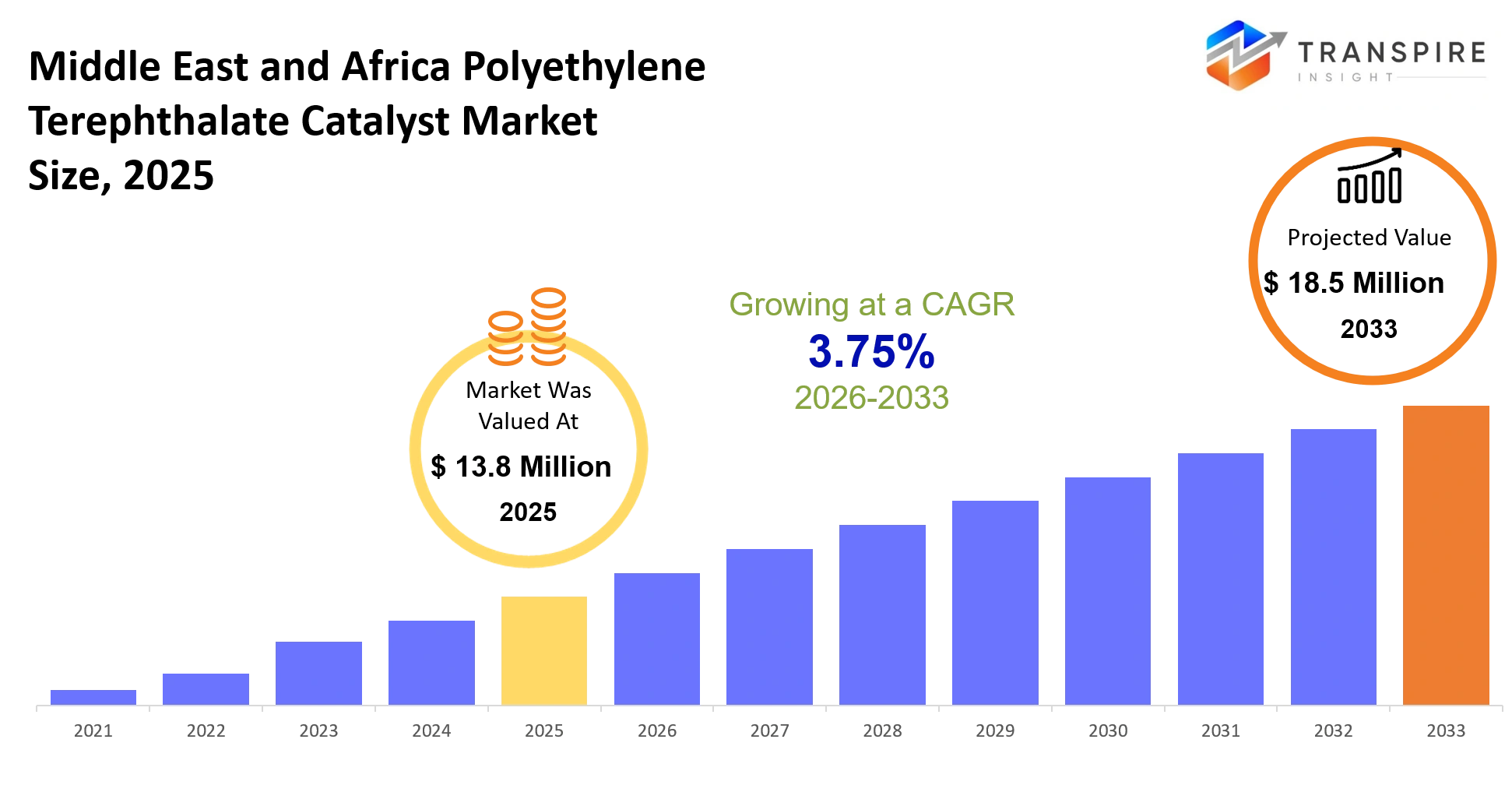
- Middle East and Africa Polyethylene Terephthalate Catalyst Market Size 2025: USD 13.8 Million
- Middle East and Africa Polyethylene Terephthalate Catalyst Market Size 2033: USD 18.5 Million
- Middle East and Africa Polyethylene Terephthalate Catalyst Market CAGR: 3.75%
- Middle East and Africa Polyethylene Terephthalate Catalyst Market Segments: By Catalyst Type (Antimony-Based, Titanium-Based, Germanium-Based, Aluminum-Based, Mixed Metal Catalysts, Others); By Application (PET Bottles, Polyester Fibers, Films & Sheets, Packaging, Engineering Plastics, Others); By Form (Powder, Liquid, Granules, Other); By End User (Packaging Industry, Textile Industry, Automotive, Electronics, Other)
Middle East and Africa Polyethylene Terephthalate Catalyst Market Summary
The Middle East and Africa Polyethylene Terephthalate Catalyst Market was valued at USD 13.8 Million in 2025. It is forecast to reach USD 18.5 Million by 2033. That is a CAGR of 3.75% over the period.
Polyethylene terephthalate catalyst systems basically act like a helper in PET resin manufacturing , they speed up polymerization reactions and help manufacturers reach that specific combination of optical clarity, high strength, and uniform performance people need for bottles, fibers, films, and various engineered plastic items. In the Middle East and Africa the way catalysts are chosen matters a lot , it can change production efficiency , the final material consistency, and even the day to day operating costs that packaging and textile producers have to carry. Over the last five years, the market has seen a structural move toward lower emission and higher purity catalyst approaches, because PET producers are lining up with circular economy goals and food-contact compliance needs. One big push behind this shift has been the growth of PET recycling programs and the wider integration of recycled PET through regional packaging supply chains, especially in Gulf regions and several parts of Africa. As beverage makers, consumer goods producers, and textile manufacturers expand their PET output while also tightening material performance targets , catalyst suppliers are now getting more requests for solutions that improve polymer quality and minimize process losses. In practice this is showing up as steadier revenue growth, more money being put into catalyst optimization, and a broader take-up of advanced catalyst formulations in regional production plants.
Key Market Insights
- Saudi Arabia kinda dominated the regional market, ending up with 58.8% share in 2024, backed by integrated petrochemical output and really solid PET manufacturing ability.
- The UAE in comparison is showing the fastest growth through 2033 , mainly because of packaging investments and some broader industrial diversification plans.
- For catalysts, antimony-based types lead at 76.8% market share in 2024, and this seems tied to well set manufacturing infrastructure plus cost efficient PET production.
- Then titanium-based catalyst adoption picked up quickly, as producers looked for lower-toxicity options and aimed for better food-grade PET performance.
- On the application side, packaging stayed on top, with 61.8% of revenue in 2024, largely fueled by beverage bottles and consumer packaged goods demand.
- Polyester fiber production also popped up as a quicker growing use-case, largely due to expanding textile manufacturing investments across the region.
- When it comes to end-users, the packaging industry contributed the most , since converters keep expanding PET bottle production capacity.
- Textile producers meanwhile increased their use of high-performance catalyst systems, hoping to boost polymer uniformity and overall fiber quality.
- Companies like Clariant, Evonik, BASF, Indorama Ventures and SABIC are putting money into process innovation, plus more regional expansion.
- And strategic partnerships are centering on recycled PET, catalyst efficiency, and sustainable packaging solutions, which is basically helping firms strengthen their competitive position across the regional PET catalyst arena.
What are the Key Drivers, Restraints, and Opportunities in the Middle East and Africa Polyethylene Terephthalate Catalyst Market?
The most powerful growth driver seems to be the continuing expansion of PET packaging production across food, drink, and consumer goods sectors. PET manufacturers end up needing catalyst systems that stay reliable in polymerization, while still meeting tighter quality requirements. Lately, higher bottled water consumption, more packaged foods, and general demand for lighter packaging have pushed resin producers to raise production volumes. This, kind of directly, raises catalyst consumption since every added PET production line needs dependable catalyst inputs. So basically catalyst suppliers see steady demand, tied to long-term PET manufacturing output, which keeps coming back.
The big holdback is the heavy reliance on established antimony-based catalyst systems, plus the capital needed to shift toward other technology options. Most existing PET plants have been tuned around particular catalyst chemistries for decades, so the whole setup is not exactly flexible. If someone wants to convert the process, it often means equipment changes, process validation, and then customer approvals, all of it at the same time. These practical barriers slow down technology migration, and they also shrink near-term revenue possibilities for newer catalyst technologies, even if those newer options are technically better.
A notable opportunity sits in recycled PET and food-grade circular packaging investments. Across the Gulf Cooperation Council, and in several African markets, recycling infrastructure is being strengthened, and recycled-content targets are getting more serious. Advanced catalyst systems that can keep polymer quality stable when recycled feedstocks are used can unlock meaningful value. With investments in rPET plants and circular packaging programs, new demand is forming for specialty catalyst solutions that can support higher recycled content without messing up product performance.
What Has the Impact of Artificial Intelligence Been on the Middle East and Africa Polyethylene Terephthalate Catalyst Market?
Artificial intelligence is gradually changing PET production operations in a kind of back and forth way, mostly by tightening process control, making catalyst use more sensible, and pushing manufacturing efficiency. PET producers are increasingly rolling out AI-driven process analytics to keep an eye on reactor conditions, polymerization pace, temperature curves, and how well the catalyst is doing in real time. In practice, these setups will automatically tweak operating settings so resin quality stays uniform, while energy usage goes down and day to day production swings feel less severe
Also, machine learning is being used more and more for predictive maintenance across polymerization reactors, filtration systems, and catalyst handling hardware. When models catch signs of equipment wear, in patterns, before a failure really hits, manufacturers can cut down on surprise stoppages and boost plant uptime. On top of that, AI forecasting tools can help operators anticipate resin traits and tune catalyst dosage levels, which lowers raw material waste and usually lifts production yield
The operational upsides are pretty clear: more equipment uptime, steadier production consistency, lower maintenance expenses, and stronger alignment with product quality requirements. And then there are digital twins plus advanced simulation platforms, they basically let manufacturers “try” process changes first, before those changes are actually rolled out on the line
Still, the takeup is not fully smooth since adoption is limited by high integration costs, and by the lack of big historical process datasets in many regional plants. A lot of older facilities don’t have the digital backbone needed to collect the large volumes of high quality data that advanced AI needs, so deployment tends to move slower across parts of the Middle East and Africa.
Key Market Trends
- Antimony based catalysis basically held onto more than 75% market share through 2024, but at the same time titanium based alternatives started showing up more in food grade PET makers.
- Packaging manufacturers, in the years from 2021 to 2025, pushed recycled PET usage higher, and that kind of thing made catalyst suppliers tweak performance for blended feedstocks.
- Saudi Arabia also kept leaning into regional leadership with roughly 59% market share, largely due to continued petrochemical and packaging investments.
- Beverage packaging firms meanwhile expanded PET bottle production capacity to back up bottled water consumption across Gulf and African markets, that push was pretty visible.
- On the catalyst side, development work leaned more and more toward cutting down acetaldehyde generation and boosting resin clarity, especially for premium packaging uses.
- BASF then moved catalyst manufacturing forward during 2026, using industrial scale innovation initiatives that targeted process efficiency gains, sort of everywhere at once.
- Circular economy policies helped coax stronger funding for food grade rPET infrastructure and for closed loop packaging systems.
- Indorama Ventures also broadened sustainability oriented PET programs, which in turn strengthened regional interest in making products with recycled content.
- PET resin producers increasingly favored catalyst systems that can handle higher production throughput, without creating noticeable quality drift.
- Overall competition seems to have slid away from pricing only, and toward process efficiency, sustainability results, and the kind of technical support that feels more like partnership rather than just selling a product.
Middle East and Africa Polyethylene Terephthalate Catalyst Market Segmentation
By Catalyst Type
Antimony based catalysts seem to keep the largest share, because PET producers still rely on tried and true tech that sort of delivers stable polymerization performance, plus cost efficiency. There is also strong adoption across bottle-grade resin manufacturing, so demand keeps moving. Titanium based catalysts are picking up traction in uses where people ask for higher purity, reduced residue levels, and also compliance with packaging standards that keep changing.
Germanium based catalysts mostly show up in specialized applications, where exceptional transparency matters a lot and premium material quality is non negotiable. Aluminum based catalysts work as an alternative path for selected PET formulations, while mixed metal catalysts sort of blend performance benefits from multiple catalyst chemistries. There are also other catalyst types, they stay in niche spots and support specific production needs, where conventional options may not quite give the performance characteristics that are expected.
By Application
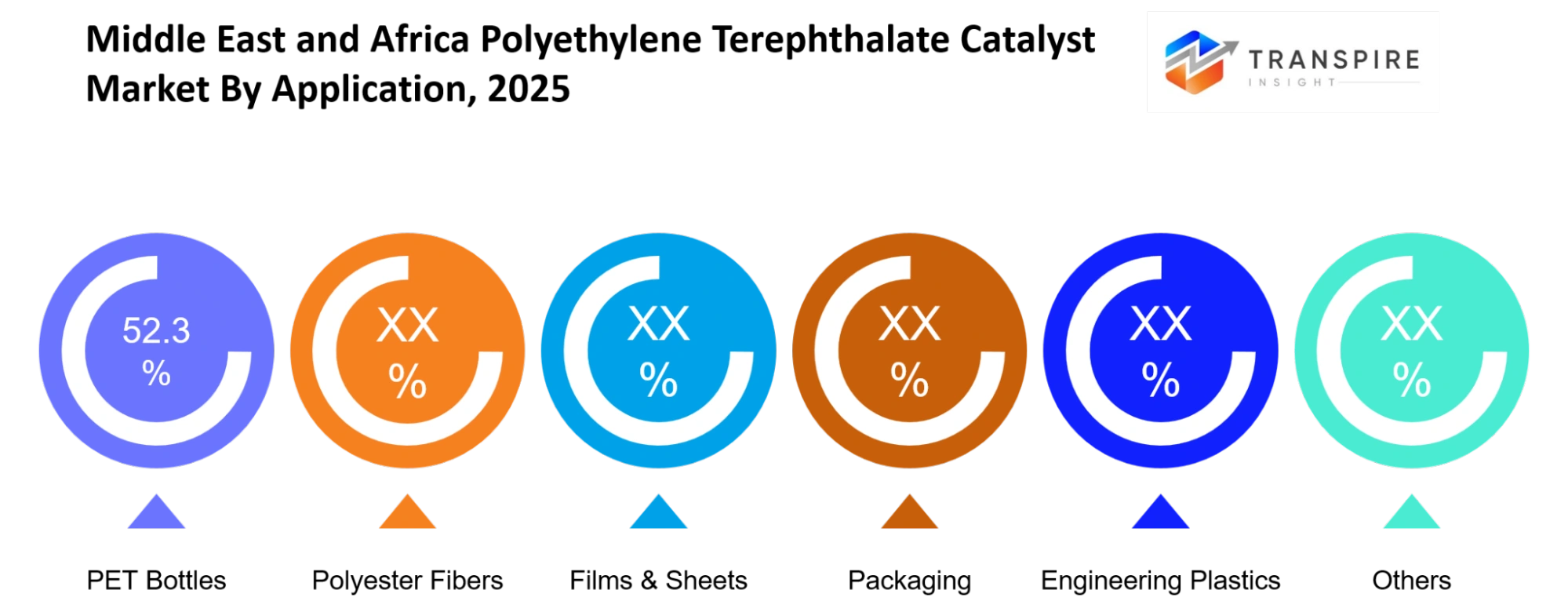
PET bottles are still kind of the biggest place for this, since beverage and food packaging makers really need huge amounts of PET resin, not small batches. Catalyst demand tends to track bottle production pretty closely too, you can see it across bottled water, soft drinks and consumer packaging, all the time. Polyester fibers are also a major route, mainly because textile production keeps going in multiple nearby regional economies.
At the same time films and sheets are getting more weight for industrial and consumer packaging uses, where thin materials still have to stay tough and dependable. Engineering plastics add even more room for catalyst suppliers, because manufacturers are hunting for PET blends that feel stronger and more heat-resistant. Beyond that there are other uses that support niche industrial needs, where folks want custom resin traits and specific manufacturing processes, rather than one-size-fits-all.
By Form
Powder catalyst remain kinda widely used because they provide efficient handling plus they work well with many of the existing PET manufacturing systems. When dispersion stays consistent and the processing methods are basically already established , it helps them keep being adopted across big scale production facilities. Liquid catalyst formulations are getting more attention though, mainly where precise dosing is a priority and where process control has to be really tight
Granule-based catalysts also give some practical benefits tied to storage, transport , and overall handling efficiency. As manufacturing plants keep adding more automation, these formats get accepted more often. Other catalyst formats can be used too , but usually for specialized manufacturing setups where the delivery approach has to be unique, or where the whole process configuration is different
By End User
The packaging industry generates the most catalyst consumption, because PET bottles, containers and food contact applications kinda need big resin production volumes. Packaging manufacturers keep looking for catalyst solutions that boost productivity, boost the material quality, and help with staying in compliance with food safety standards. The textile industry also adds a lot, through polyester fiber production for apparel and industrial fabrics, you know.
Automotive manufacturers are using PET based materials more and more for lightweight components and interior uses. Electronics producers use specialty PET materials in a few technical applications where durability and dimensional stability matter. Other end user sectors create more opportunities, for specialized catalyst technologies made for those particular performance demands.
What are the Key Use Cases Driving the Middle East and Africa Polyethylene Terephthalate Catalyst Market?
The main use case still sits in bottle-grade PET production for beverage and food packaging, you know. Catalyst systems directly mess with polymer quality, its clarity, and also processing efficiency, so they end up being a big deal for high volume bottle manufacturing runs that serve bottled water, soft drinks, and consumer packaged goods.
Other use cases are also showing up, especially around polyester fiber production and industrial packaging. Textile manufacturers lean on PET catalysts for more steady fiber properties, while films and sheets makers need controlled polymer characteristics, for packaging, labeling, and even protective materials. In practice it’s kind of the same theme but different forms.
Looking ahead, opportunities are growing around recycled PET production and specialty engineering plastics. As recycling capacity expands in different regions, advanced catalyst technologies that can keep polymer quality solid even with higher recycled content are likely to get more commercial traction. There’s also longer term growth potential in technical PET applications for automotive and electronics manufacturing, that part feels pretty clear.
|
Report Metrics |
Details |
|
Market size value in 2025 |
USD 13.8 Million |
|
Market size value in 2026 |
USD 14.3 Million |
|
Revenue forecast in 2033 |
USD 18.5 Million |
|
Growth rate |
CAGR of 3.75% from 2026 to 2033 |
|
Base year |
2025 |
|
Historical data |
2021 - 2024 |
|
Forecast period |
2026 - 2033 |
|
Report coverage |
Revenue forecast, competitive landscape, growth factors, and trends |
|
Regional scope |
United States; Canada; Mexico; United Kingdom; Germany; France; Italy; Spain; Denmark; Sweden; Norway; China; Japan; India; Australia; South Korea; Thailand; Brazil; Argentina; South Africa; Saudi Arabia; United Arab Emirates |
|
Key company profiled |
Dorf Ketal, Clariant, Evonik, Tosoh, Johnson Matthey, Umicore, BASF, Chemours, Eastman, Indorama Ventures, SABIC, Lotte Chemical, Reliance Industries, Sinopec, Mitsubishi Chemical |
|
Customization scope |
Free report customization (country, regional & segment scope). Avail customized purchase options to meet your exact research needs. |
|
Report Segmentation |
By Catalyst Type (Antimony-Based, Titanium-Based, Germanium-Based, Aluminum-Based, Mixed Metal Catalysts, Others); By Application (PET Bottles, Polyester Fibers, Films & Sheets, Packaging, Engineering Plastics, Others); By Form (Powder, Liquid, Granules, Other); By End User (Packaging Industry, Textile Industry, Automotive, Electronics, Other) |
Which Regions are Driving the Middle East and Africa Polyethylene Terephthalate Catalyst Market Growth?
Saudi Arabia is kind of leading the market, mainly because its broad petrochemical infrastructure works well, plus integrated supply lines, and also big scale polymer output capacity. The government-backed industrial development programs keep pushing investments into downstream plastics and packaging making. With strong feedstock availability and a well set manufacturing ecosystem, conditions look good for catalyst consumption . All of these advantages, together, help Saudi keep that dominant edge in regional PET production.
The United Arab Emirates feels more like a steady, strategically important contributor. When you compare it to Saudi Arabia, the growth there leans more on value-added manufacturing, export driven packaging operations, and solid logistics connectivity. Industrial diversification policies stay firm, so investment in advanced materials and packaging technologies continues. This kind of balanced growth model supports catalyst demand that stays fairly consistent across several industrial sectors, not just one.
Africa is starting to look like the fastest growing opportunity area too. It’s supported by urbanization, packaged food consumption, and the steady buildout of recycling infrastructure. Lately, investments in PET recycling facilities, plus circular packaging initiatives , have improved the long term outlook there. Industrial development efforts and local manufacturing push are also lifting domestic PET production capabilities . For investors, and new entrants, these shifts can open the door to set up early positions in markets expected to expand steadily through 2033.
Who are the Key Players in the Middle East and Africa Polyethylene Terephthalate Catalyst Market and How Do They Compete?
Competition still feels somewhat moderately fragmented, like, a bunch of global chemical firms are pushing at the same time via technology performance, production efficiency, regional presence ,and technical support capabilities. The established suppliers tend to have real advantages because they sit on broad manufacturing know-how and have long-standing ties with PET resin producers. Cost competitiveness is still there, sure, but the real edge now more often comes from catalyst efficiency, sustainability performance, and product consistency ,not just price.
Clariant goes hard on catalyst innovation and process optimization solutions meant to help manufacturers squeeze out better production efficiency. Evonik leans on advanced specialty chemical expertise to work on high-performance catalyst technologies built for tough industrial use. BASF strengthens its standing by focusing on manufacturing innovation and keeping catalyst technology evolving, which in turn supports productivity gains across chemical processing industries.
Indorama Ventures stands out by being deeply integrated within the PET value chain and by ramping up investments in recycling and circular materials. SABIC, meanwhile, benefits from solid regional manufacturing infrastructure and being close to major polymer production hubs across the Middle East. These players keep moving forward using sustainability initiatives, technology upgrades, partnerships, and targeted investments that boost operational efficiency and also match the changing expectations for PET manufacturing requirements.
Company List
- Dorf Ketal
- Clariant
- Evonik
- Tosoh
- Johnson Matthey
- Umicore
- BASF
- Chemours
- Eastman
- Indorama Ventures
- SABIC
- Lotte Chemical
- Reliance Industries
- Sinopec
- Mitsubishi Chemical
Recent Development News
"In March 2026, BASF inaugurated an industrial-scale facility dedicated to mass production of 3D-printed catalysts using its X3D technology platform. The development is expected to improve catalyst efficiency and accelerate innovation across chemical manufacturing processes.https://www.basf.com
"In May 2023, Indorama Ventures announced a strategic partnership with Origin Materials to accelerate commercialization of bio-based materials and bio-PET solutions. The collaboration supports future low-carbon PET production pathways and sustainable packaging development.https://investors.originmaterials.com
What Strategic Insights Define the Future of the Middle East and Africa Polyethylene Terephthalate Catalyst Market?
The market is slowly shifting toward higher-performance catalyst technologies that back circular packaging systems, the integration of recycled PET, and better manufacturing efficiency. The most important sort of structural force behind this shift is basically the change in regional packaging value chains, where producers try to stay cost competitive while also meeting sustainability constraints and product quality expectations. There is also a less visible risk, it’s like concentration around a relatively small set of catalyst technologies and suppliers. That situation might make manufacturers more exposed to supply disruptions, or even end up with slower innovation cycles.
At the same time, there’s a developing opportunity, it sits in catalyst systems that are tailored for high-recycled-content PET output. This is especially relevant as recycling infrastructure keeps spreading across the Gulf countries and several important African economies. Market players should put priority on investing in more advanced catalyst formulations that enhance polymer quality while still supporting circular material streams. Firms that line up catalyst development with the needs of recycled PET processing are probably going to seize more than their fair share of the upcoming growth chances.
Middle East and Africa Polyethylene Terephthalate Catalyst Market Report Segmentation
By Catalyst Type
- Antimony-Based
- Titanium-Based
- Germanium-Based
- Aluminum-Based
- Mixed Metal Catalysts
- Others
By Application
- PET Bottles
- Polyester Fibers
- Films & Sheets
- Packaging
- Engineering Plastics
- Others
By Form
- Powder
- Liquid
- Granules
- Others
By End User
- Packaging Industry
- Textile Industry
- Automotive
- Electronics
- Others
Frequently Asked Questions
Find quick answers to common questions.
The expected Middle East and Africa Polyethylene Terephthalate Catalyst Market size for the market will be USD 18.5 Million in 2033.
Key segments for the Middle East and Africa Polyethylene Terephthalate Catalyst Market are By Catalyst Type (Antimony-Based, Titanium-Based, Germanium-Based, Aluminum-Based, Mixed Metal Catalysts, Others); By Application (PET Bottles, Polyester Fibers, Films & Sheets, Packaging, Engineering Plastics, Others); By Form (Powder, Liquid, Granules, Other); By End User (Packaging Industry, Textile Industry, Automotive, Electronics, Other)
Major Middle East and Africa Polyethylene Terephthalate Catalyst Market players are Dorf Ketal, Clariant, Evonik, Tosoh, Johnson Matthey, Umicore, BASF, Chemours, Eastman, Indorama Ventures, SABIC, Lotte Chemical, Reliance Industries, Sinopec, Mitsubishi Chemical
The Middle East and Africa Polyethylene Terephthalate Catalyst Market size is USD 13.8 Million in 2025.
The Middle East and Africa Polyethylene Terephthalate Catalyst Market CAGR is 3.75% from 2026 to 2033.
- Dorf Ketal
- Clariant
- Evonik
- Tosoh
- Johnson Matthey
- Umicore
- BASF
- Chemours
- Eastman
- Indorama Ventures
- SABIC
- Lotte Chemical
- Reliance Industries
- Sinopec
- Mitsubishi Chemical
About the Authors

Pankaj Ghogare Patil
I am Pankaj Ghogare Patil, a Senior Research Analyst at Transpire Insight, specializing in the Pharmaceutical, Chemicals & Materials, Healthcare IT, and Biotechnology industry. My expertise lies in conducting comprehensive market research, analyzing industry trends, evaluating competitive landscapes, and translating complex data into actionable insights. At Transpire Insight, I closely follow emerging technologies, regulatory developments, and market innovations to create accurate, well-researched, and informative content that helps businesses and professionals make informed decisions. I am committed to producing credible, evidence-based articles that reflect industry best practices while making technical topics accessible and valuable for a broad audience.

Chakradhar Khansole
Chakradhar serves as the Research Director at Transpire Insight, bringing over 8 years of experience in technology, innovation, and strategic market intelligence. He specializes in transforming complex market data into actionable business insights that enable organizations to make informed, growth-oriented decisions. Recognized for his strategic vision and analytical expertise, Chakradhar leads high-impact research initiatives, delivering comprehensive market assessments, competitive intelligence, and forward-looking industry analysis.
Recently Published Reports
-
May 2026
Healthcare Polymer Packaging Market
Healthcare Polymer Packaging Market Size, Share & Analysis Report By Packaging Type (Syringes, IV Bottles and Pouches, Clamshells, Blisters, Bottles & Jars, Containers, Tubes, IV Parental Packaging, Others), By Type (Regulated, Non-regulated), By Polymer Type (LDPE (Low-Density Polyethylene), HDPE (High-Density Polyethylene), Homo-polymer (Homo), Random Copolymer (Random), Block Copolymer (Block), PET, Polystyrene, Polyvinyl Chloride, Polyamide/EVOH, Others), and Geography (North America, Europe, Asia-Pacific, Middle East and Africa, South and Central America), 2021 - 2031
-
Apr 2026
Hydrophilic Tape (Waterstop) Market
Hydrophilic Tape (Waterstop) Market Size, Share & Analysis Report By Type (Bentonite-Based Hydrophilic Tape, Rubber-Based Hydrophilic Tape), By Application (Residential Buildings, Commercial Buildings, Infrastructure Projects), and Geography (North America, Europe, Asia-Pacific, Middle East and Africa, South and Central America), 2021 - 2031
-
Apr 2026
Metalens Market
Metalens Market Size, Share & Analysis Report By Type (Visible Light Metalens, and Infrared Metalens), By Application (Consumer Electronics, Automotive Electronics, Industrial, Medical, and Others), and Geography (North America, Europe, Asia-Pacific, Middle East and Africa, South and Central America), 2021 - 2031
-
Apr 2026
PBT Resin Market
PBT Resin Market Size, Share & Analysis Report By Type (Reinforced PBT Resin, Unreinforced PBT Resin), By Processing Method (Injection Molding, Extrusion, Blow Molding, Others), By End-User (Automotive, Electrical & Electronics, Consumer Appliances, Industrial Machinery, Medical Devices, Packaging, Others), and Geography (North America, Europe, Asia-Pacific, Middle East and Africa, South and Central America), 2021 - 2031