
France Petrochemical Market Size & Forecast:
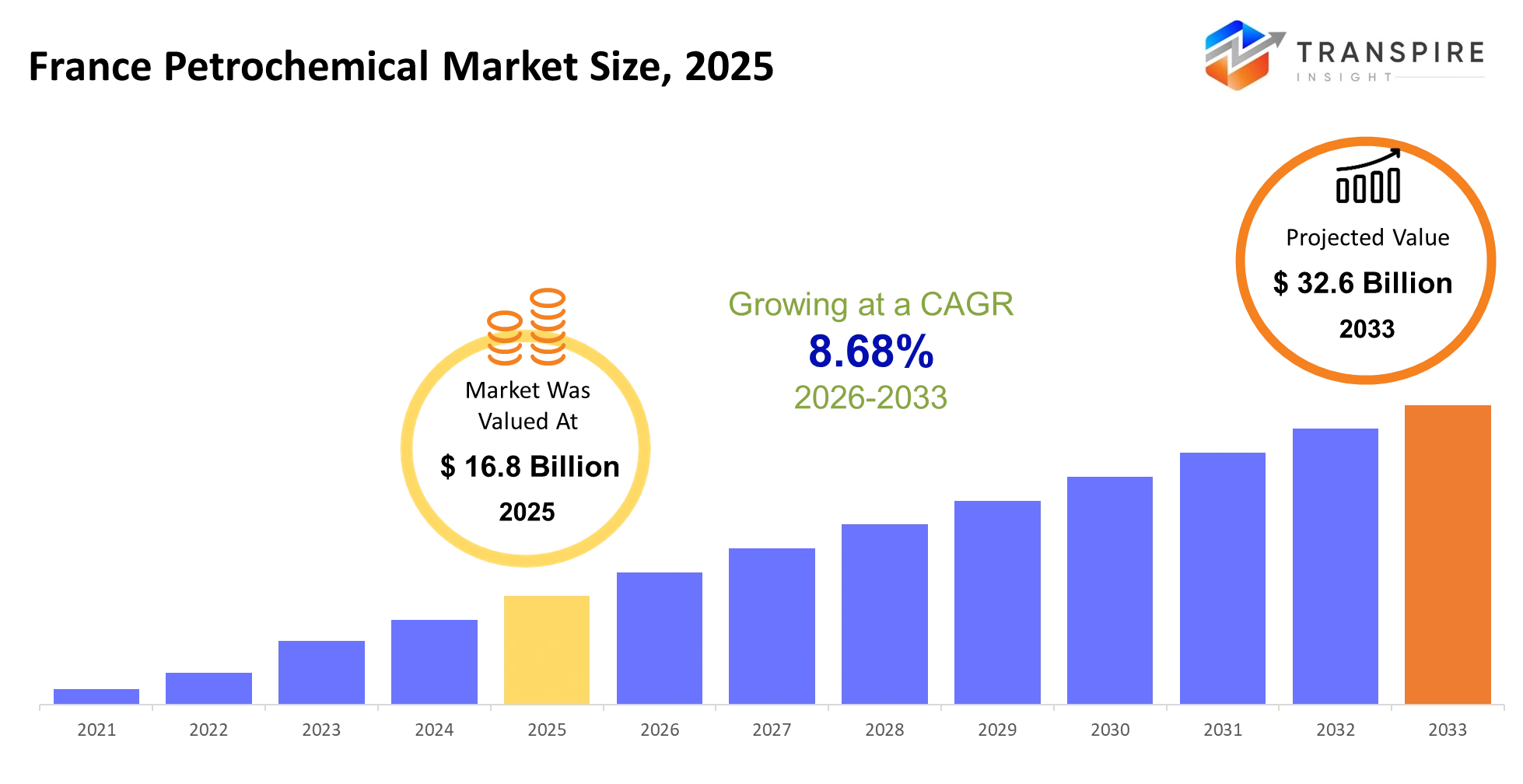
- France Petrochemical Market Size 2025: USD 16.8 Billion
- France Petrochemical Market Size 2033: USD 32.6 Billion
- France Petrochemical Market CAGR: 8.68%
- France Petrochemical Market Segments: By Type (Ethylene, Propylene, Benzene, Methanol, Others); By Application (Plastics, Chemicals, Synthetic Fibers, Rubber, Others); By End-User (Packaging, Automotive, Construction, Textile, Others); By Form (Liquid, Gas, Others).
To learn more about this report,  Download Free Sample Report
France Petrochemical Market Summary
The France Petrochemical Market was valued at USD 16.8 Billion in 2025. It is forecast to reach USD 32.6 Billion by 2033. That is a CAGR of 8.68% over the period.
The France petrochemical market kinda plays a foundational role in the country’s industrial economy, it ends up supplying those chemical building blocks that end up in plastics, packaging, automotive components, construction materials, fertilizers, and also consumer goods manufacturing. In practice these materials help a lot with large scale industrial production, while also backing the downstream folks that need lightweight, durable, and generally cost efficient inputs. Over the past five years the market has kind of shifted toward lower emission production models , because France pushed harder on carbon reduction policies under the European Green Deal , and also sped up investment in circular chemical processing.
Then the energy price shock after the Russia-Ukraine conflict really changed feedstock economics across Europe, which basically forced manufacturers to squeeze more efficiency out of production and at the same time diversify their sourcing strategy, in a more quiet but persistent way. That disruption also helped accelerate the move toward advanced recycling technologies, plus bio based feedstocks. And as automotive electrification, sustainable packaging mandates, and specialty polymer applications keep expanding, petrochemical producers are gradually moving toward higher value products, with stronger margins , which supports long term revenue growth and additional capital investment across France’s industrial supply chain.
Key Market Insights
- Northern France kind of dominated the France Petrochemical Market, with nearly 42% industry share in 2025. This mostly came from refinery concentration and a pretty strong export infrastructure situation.
- Western France showed up as the fastest-growing regional cluster, bio-based chemical investments really accelerated between 2024 and 2033, almost on purpose.
- Ethylene-based derivatives basically held the largest market share because automotive packaging, and industrial manufacturing all lean heavily on polyethylene production.
- Propylene derivatives ranked as the second-largest segment, they stayed steady thanks to demand from construction materials and industrial coatings applications.
- Specialty petrochemicals are forecast to record the fastest growth through 2033, as high-performance polymers gain traction in electric vehicle manufacturing.
- Packaging applications accounted for more than 30% of market demand in 2025, mainly because food preservation and lighter material requirements are still a thing.
- Automotive applications expanded fast after 2022, when French EV manufacturers increased procurement of engineered plastics, and synthetic rubber compounds too.
- Industrial manufacturing kept being the leading end-user segment, supported by domestic chemical processing plus advanced materials production capacity.
- Renewable chemicals and recycled polymer buyers were the fastest-growing end-user category, following stricter EU circular economy regulations.
- Petrochemical manufacturers are also deploying AI-driven process optimization systems more and more, to cut energy consumption, boost cracker efficiency, and reduce operational downtime.
What are the Key Drivers, Restraints, and Opportunities in the France Petrochemical Market?
The most powerful force, pushing the France petrochemical market ahead, is this ongoing reworking of European industrial supply chains toward more localized production that also stays lower-carbon, sort of in one go. When the European Union emissions rules got tighter , and the carbon pricing tools became more “real” for manufacturers, companies felt compelled to modernize crackers, step up energy efficiency, and switch into more advanced feedstocks. In practice, this shift has shown up as higher spending in specialty polymers , recycled chemicals, and those lighter industrial materials that end up in electric vehicles and sustainable packaging. At the same time French manufacturers are also chasing better profit arrangements by delivering engineered petrochemical products, tuned for automotive electrification, and industrial automation use cases.
Still, the biggest “block” in the structure is Europe’s higher energy and feedstock costs versus North America and the Middle East. Steam crackers and refining facilities rely on energy-heavy routines, and they lean a lot on dependable natural gas prices and hydrocarbon pricing stability. Because these disadvantages come from regional infrastructure realities and geopolitical dependence on energy, they aren’t the sort of thing you can fix quickly. When production gets more expensive , exports become less competitive, and then capacity expansion programs tend to slow down, especially for commodity-grade chemicals where the margins are already thin.
Looking forward , a substantial opportunity comes from chemical recycling and the blending of bio-based petrochemical production. France is ramping up its investment in circular manufacturing infrastructure, mostly around recycled plastics and renewable feedstocks , at least that’s the direction the agencies are pointing. Firms like Arkema and TotalEnergies are expanding partnerships focused on advanced recycling approaches, essentially turning industrial and consumer waste into usable chemical feedstocks . It’s like they are taking what was discarded and, with a bit of alchemy and a lot of planning, turning it back into something purposeful, again .
What Has the Impact of Artificial Intelligence Been on the France Petrochemical Market?
Artificial intelligence and advanced digital systems are kinda reshaping petrochemical operations in France, by improving plant efficiency, reducing downtime, and also strengthening process safety a bit. In practice refiners and chemical manufacturers are using AI-driven control platforms more and more, to automate steam cracker monitoring, optimize feedstock use and regulate pressure and temperature conditions in real time. These setups help operators cut energy losses while keeping production steadier across big, high-volume chemical sites.
Machine learning models are now also being used for predictive maintenance across compressors, pumps, and heat exchangers. They look at vibration rhythms thermal shifts, and operational irregularities, so companies can spot equipment failure before any shutdown actually happens. A few facilities said they saw real gains in uptime and maintenance scheduling once predictive analytics got folded into day to day operations. AI based forecasting tools furthermore back emissions tracking and carbon intensity management, which makes it easier to meet new European environmental rules while still reducing operating costs.
Digital twins and advanced simulation systems improve production planning too, by trying out process tweaks before anything is actually rolled out. Still, adoption is held back by the high integration expenses, and by how complicated it can be to retrofit older refining infrastructure with compatible digital systems. Many older petrochemical facilities also do not really have unified operational datasets, so AI model accuracy stays limited and deployment moves slower at scale.
Key Market Trends
- In 2022, French petrochemical producers started to bump up investment in recycled polymer capacity, so they can kind of line up with the tighter EU packaging waste reduction rules.
- Steam cracker operators then got into AI based process optimization systems, after energy price swings made the profits look less stable across commodity chemical production.
- Meanwhile, automotive suppliers shifted procurement toward lighter engineered plastics, as electric vehicle manufacturing grew across France , and also well beyond it across broader Europe.
- Between 2023 and 2025, partnerships for bio based feedstocks moved faster, and manufacturers tried to reduce their reliance on imported fossil derived raw materials.
- Chemical companies have been putting more weight on specialty polymers rather than commodity chemicals, mainly to protect margins while Europe keeps feeling persistent pressure from energy costs.
- Strategic cooperation between refiners and recycling businesses expanded quite a bit, after the circular economy targets came in under EU climate policies.
- Manufacturers also trimmed long distance feedstock exposure after the Russia Ukraine supply disruptions, showing where the European chemical supply chains are weak.
- Companies like BASF and TotalEnergies increased low carbon material development programs after the 2024 industrial decarbonization incentives arrived.
- On the buyer side, industrial customers increasingly leaned toward locally sourced petrochemical materials, to lower procurement risk, and to make supply chain reliability feel more steady.
- And finally, adoption of digital twin technology rose across refinery operations, because companies wanted quicker production planning and fewer unplanned maintenance surprises.
France Petrochemical Market Segmentation
By Type
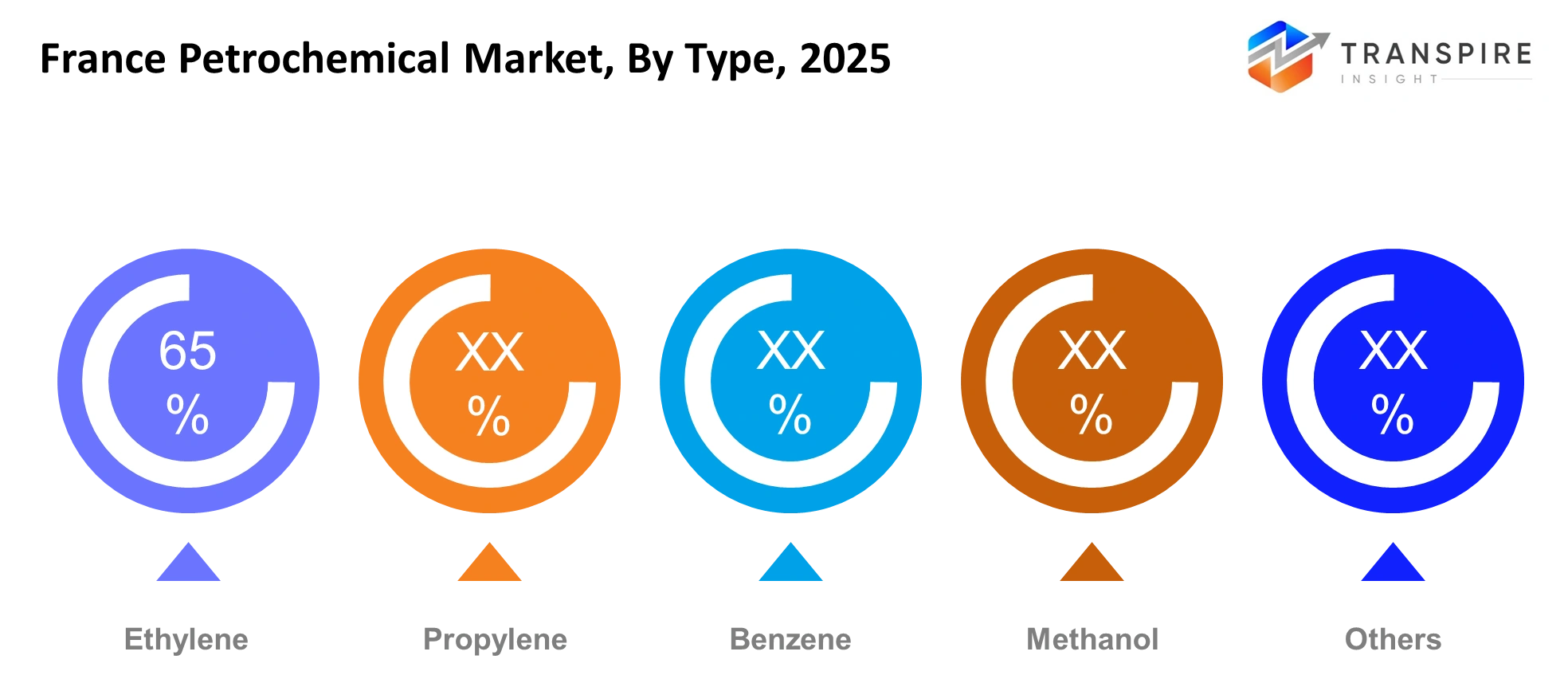
Ethylene keeps the dominant position in the market, largely because polyethylene production leans heavily on ethylene feedstock across packaging, automotive and industrial manufacturing use cases. The big demand coming from flexible packaging films, containers, and consumer goods helps keep production volumes steady across France’s chemical infrastructure. Also, steam crackers that are integrated with refinery operations, just make things more efficient and it supports supply stability for the ethylene producers. Meanwhile, investment in recyclable polyethylene grades and lightweight industrial materials is expected to speed up during the forecast period, and that tends to open doors for specialty polymer developers, as well as advanced packaging suppliers.
Propylene still holds a significant market share, mostly due to strong consumption for polypropylene production for automotive parts, textiles and industrial components. Buyers are still looking for lightweight , and heat-resistant materials, so propylene-based applications keep getting backed inside electric vehicle manufacturing and consumer appliance production. Benzene remains important too ,because downstream industries depend on styrene, phenol and nylon intermediates that flow into resins, insulation and engineering plastics. Methanol is gaining momentum as industrial producers look into low-carbon fuel alternatives, and also new chemical feedstocks. At the same time, other specialty petrochemicals are expected to see selective growth, tied to advanced materials and more sustainable industrial chemistry.
To learn more about this report, Download Free Sample Report
By Application
Plastics show up as the main application segment, because packaging producers automotive manufacturers , and industrial processors lean on petrochemical derived polymers for things like light but durable material options. In practice, high volume consumption across food packaging, logistics and consumer goods production keeps the demand fairly steady, all the way through that value chain. On top of that, recyclable polymer innovation , plus a more circular materials approach, is also pulling more investment into advanced plastics manufacturing. And yeah, the growing use of engineered plastics in electric mobility along with industrial automation is expected to boost longer term commercial chances for polymer suppliers and material technology firms.
Chemical applications stay in a strong position too, mostly because solvents , coatings, adhesives and industrial intermediates are still basically required in manufacturing plus infrastructure. Synthetic fibers keep growing in a steady way as textile and technical fabric producers increase their reliance on polyester and nylon materials, especially for industrial clothing and automotive interiors. Rubber applications meanwhile, benefit from tire manufacturing and industrial sealing systems where durability and heat resistance stay as key buying criteria. Other uses , including specialty coatings and performance materials, are expected to gather momentum, since manufacturers are prioritizing higher value petrochemical derivatives with better profit margins and more technical differentiation.
By End-User
Packaging is kind of the real driver for the end-user space, mostly because food producers, retail distributors and logistics operators need polymer materials that are light, cheap, and still good for storage and transport , plus protecting the product. In France, the high use of flexible films, rigid containers, and industrial packaging systems is still feeding big petrochemical processing activity, even if people don’t always notice it. At the same time, sustainability regulations are pushing investment toward recyclable, and lower- carbon packaging materials, which is kinda interesting because the demand is leaning more and more toward advanced barrier packaging and, well, circular polymer solutions. This should open up long- term opportunities for specialty resin manufacturers, as well as for the recycling technology providers.
Automotive is still a major contributor too, mainly because vehicle manufacturers are relying on engineered plastics, synthetic rubber and lightweight composites more often, to improve fuel efficiency and also battery performance. Construction keeps a pretty solid pull as well, with steady demand for insulation materials, pipes, industrial coatings and structural polymers that are linked to infrastructure development projects. Textile manufacturing adds more steady petrochemical use through synthetic fibers, going into apparel, industrial fabrics, and technical applications that are maybe a bit niche. Other end-user industries, like electronics and healthcare manufacturing, are also expected to adopt specialty petrochemical materials more quickly, for high-performance uses and precision engineered applications.
By Form
Liquid petrochemicals kinda keep the largest market share, mainly because the whole refining, chemical processing, and industrial transportation systems feel engineered around liquid feedstocks and intermediates. In practice, liquid form materials make storage work better, move in big scale distribution more smoothly, and they also slot right into downstream manufacturing activities across plastics, coatings, and fuel processing. There’s also refinery infrastructure plus well known pipeline logistics, and that combo basically boosts the commercial efficiency for liquid petrochemical handling. Looking forward, growth in advanced liquid feedstocks made from recycled plastics and renewable sources is expected to open up fresh investment opportunities across more sustainable chemical production networks, even if the overall timeline is a bit uneven.
Gas-based petrochemicals still hold a strong position, because they show up a lot in steam cracking, industrial heating ,and chemical synthesis use cases. Natural gas derivatives keep backing the production of ammonia, methanol and olefins across industrial manufacturing sites. Meanwhile the push for cleaner industrial energy systems and lower-emission chemical processing keeps raising the strategic value of gas-based feedstocks, especially within Europe’s decarbonization framework. Meanwhile other forms, like semi-solid and specialty material variations, are expected to pick up selective momentum in high-performance industrial roles where people need customized handling, storage stability, and advanced chemical performance features.
What are the Key Use Cases Driving the France Petrochemical Market?
Packaging production is still kind of the biggest use case inside the France petrochemical market, because food manufacturers , consumer goods companies and logistics operators lean a lot on polyethylene and polypropylene materials. Lighter packaging helps with transport efficiency and it also extends product shelf life across both retail and industrial distribution networks, which is useful in practice.
Automotive and construction applications are growing at a steady pace too, as manufacturers move toward engineered plastics, synthetic rubber , insulation materials, and industrial coatings. Electric vehicle producers are also using specialty polymers more often, partly to reduce vehicle weight but also to help battery efficiency. Meanwhile, infrastructure projects keep needing long-lasting petrochemical-based construction materials, even when timelines get tight.
Newer angles show up as advanced recycled polymers and bio-based chemicals, aimed at circular manufacturing systems. French industrial producers are moreover looking at petrochemical-derived materials for hydrogen storage systems, energy infrastructure, and next-generation electronics, and that may open up space for specialty chemical suppliers during the forecast period.
|
Report Metrics |
Details |
|
Market size value in 2025 |
USD 16.8 Billion |
|
Market size value in 2026 |
USD 18.2 Billion |
|
Revenue forecast in 2033 |
USD 32.6 Billion |
|
Growth rate |
CAGR of 8.68%from 2026 to 2033 |
|
Base year |
2025 |
|
Historical data |
2021 - 2024 |
|
Forecast period |
2026 - 2033 |
|
Report coverage |
Revenue forecast, competitive landscape, growth factors, and trends |
|
Regional scope |
United States; Canada; Mexico; United Kingdom; Germany; France; Italy; Spain; Denmark; Sweden; Norway; China; Japan; India; Australia; South Korea; Thailand; Brazil; Argentina; South Africa; Saudi Arabia; United Arab Emirates |
|
Key company profiled |
TotalEnergies, BASF, Shell, ExxonMobil, Dow, SABIC, INEOS, LyondellBasell, Chevron Phillips, Reliance Industries, Sinopec, PetroChina, Formosa Plastics, Borealis, Versalis. |
|
Customization scope |
Free report customization (country, regional & segment scope). Avail customized purchase options to meet your exact research needs. |
|
Report Segmentation |
By Type (Ethylene, Propylene, Benzene, Methanol, Others); By Application (Plastics, Chemicals, Synthetic Fibers, Rubber, Others); By End-User (Packaging, Automotive, Construction, Textile, Others); By Form (Liquid, Gas, Others). |
Which Regions are Driving the France Petrochemical Market Growth?
The Normandy area still feels like the dominant force in the France petrochemical market, it pretty much mixes deep water port infrastructure, integrated refining facilities, and easy reach to Northern European trade lanes. You can see it in the industrial hubs around Le Havre and Rouen , they keep backing large scale imports of crude oil, feedstocks, and specialty chemicals , then exports move out efficiently toward Germany, Belgium, and the United Kingdom. Also, the region gets a solid boost from state-backed decarbonization programs, these push refinery modernization, low-carbon hydrogen rollout , and even recycling projects that are more advanced than before.
Auvergne-Rhône-Alpes sort of operates more like a specialty engine. It leans into specialty chemicals and high value industrial materials instead of leaning too hard on big volume commodity petrochemicals. In comparison with Normandy, growth there depends less on port logistics , and more on steady industrial demand from pharmaceuticals, advanced manufacturing, and electronics. Producers around Lyon and the nearby industrial corridors have kept consistent capital spending focused on process tuning and sustainable materials, even when energy costs bounce around across Europe .
Western France is now showing up as the fastest moving regional market , driven by circular petrochemical infrastructure that’s getting real traction, plus renewable feedstock processing. Over the last three years, new chemical recycling facilities, bio based polymer initiatives, and low-carbon industrial efforts have been gathering speed after tighter European Union waste reduction goals. Ports along the Atlantic corridor are also supporting imports of alternative feedstocks and recycled material streams more often , and that’s creating additional supply chain openings for petrochemical processors.
Who are the Key Players in the France Petrochemical Market and How Do They Compete?
Competition in the France petrochemical market stays kinda moderately consolidated because only a limited number of multinational chemical AND energy companies control the big refining, cracking, and polymer production capacity. Over time competition is going more by operational efficiency, low-carbon production capabilities, feedstock flexibility, and specialty chemical innovation , not just plain production scale. Incumbents keep defending market share with refinery modernization and advanced recycling investments, and meanwhile Asian producers keep pressing European margins with lower production costs.
TotalEnergies sets itself apart via an integrated setup across refining, petrochemicals, and low-carbon energy operations, which helps it manage production costs and energy supply more tightly. It is also expanding chemical recycling capacity and locking in long-term electricity agreements to smooth out industrial operating expenses. BASF competes with specialty chemistry plus advanced recycling technologies, especially its ChemCycling platform that turns plastic waste into certified circular feedstocks for automotive and packaging use. INEOS meanwhile holds strength through big olefins and polymer production that is integrated with European logistics infrastructure, so supply can reach industrial manufacturers across Western Europe more efficiently.
Shell keeps investing in lower-emission chemicals and digital process optimization, aiming to boost refinery utilization and bring down carbon intensity. LyondellBasell concentrates on high-performance polymers and advanced recycling technologies , especially those tied to automotive lightweighting and circular plastics initiatives.
Company List
- TotalEnergies
- BASF
- Shell
- ExxonMobil
- Dow
- SABIC
- INEOS
- LyondellBasell
- Chevron Phillips
- Reliance Industries
- Sinopec
- PetroChina
- Formosa Plastics
- Borealis
- Versalis
Recent Development News
In March 2026, TotalEnergies launched France’s first advanced plastics recycling plant at its Grandpuits platform. The facility uses pyrolysis technology from Plastic Energy to convert difficult-to-recycle plastic waste into synthetic feedstock, strengthening France’s circular petrochemical capacity.
Source: http://totalenergies.com
In March 2026, TotalEnergies entered a long-term partnership with EDF to secure low-carbon electricity supply for refining and chemical operations in France. The agreement covered around 60% of electricity demand across refining and petrochemical sites, improving industrial cost stability and decarbonization performance.
Source: http://totalenergies.com/
What Strategic Insights Define the Future of the France Petrochemical Market?
The France petrochemical market is slowly, but kind of definitely moving toward circular feedstocks specialty polymers and lower-carbon industrial chemistry, as European emissions policies keep tightening and commodity chemical margins stay under pressure. Over the next five to seven years, producers that blend advanced recycling know-how with energy efficient manufacturing are probably going to get stronger pricing power and more stable long-term industrial contracts. There’s also this one less obvious risk, the growing competitiveness gap between European producers and lower-cost exporters from the Middle East and Asia, especially if energy prices in Europe continue to sit, structurally, higher than elsewhere. That cost imbalance could then speed up plant rationalization and make operators more cautious about investing in commodity petrochemical capacity.
At the same time, advanced chemical recycling that connects with packaging compliance rules is turning into a real emerging opportunity, particularly for facilities that can handle hard mixed plastic waste streams. Market participants should try to line up partnerships across recycling, renewable energy, and specialty materials ecosystems, rather than leaning only on traditional refining expansion plans.
France Petrochemical Market Report Segmentation
By Type
- Ethylene
- Propylene
- Benzene
- Methanol
- Others
By Application
- Plastics
- Chemicals
- Synthetic Fibers
- Rubber
- Others
By End-User
- Packaging
- Automotive
- Construction
- Textile
- Others
By Form
- Liquid
- Gas
- Others
Frequently Asked Questions
Find quick answers to common questions.
The approximate France Petrochemical Market size for the market will be USD 32.6 Billion in 2033.
Key segments for the France Petrochemical Market are By Type (Ethylene, Propylene, Benzene, Methanol, Others); By Application (Plastics, Chemicals, Synthetic Fibers, Rubber, Others); By End-User (Packaging, Automotive, Construction, Textile, Others); By Form (Liquid, Gas, Others).
Major France Petrochemical Market players are TotalEnergies, BASF, Shell, ExxonMobil, Dow, SABIC, INEOS, LyondellBasell, Chevron Phillips, Reliance Industries, Sinopec, PetroChina, Formosa Plastics, Borealis, Versalis.
The France Petrochemical Market size is USD 16.8 Billion in 2025.
The France Petrochemical Market CAGR is 8.68% from 2026 to 2033.
- TotalEnergies
- BASF
- Shell
- ExxonMobil
- Dow
- SABIC
- INEOS
- LyondellBasell
- Chevron Phillips
- Reliance Industries
- Sinopec
- PetroChina
- Formosa Plastics
- Borealis
- Versalis
Recently Published Reports
-
Apr 2026
Healthcare Polymer Packaging Market
Healthcare Polymer Packaging Market Size, Share & Analysis Report By Packaging Type (Syringes, IV Bottles and Pouches, Clamshells, Blisters, Bottles & Jars, Containers, Tubes, IV Parental Packaging, Others), By Type (Regulated, Non-regulated), By Polymer Type (LDPE (Low-Density Polyethylene), HDPE (High-Density Polyethylene), Homo-polymer (Homo), Random Copolymer (Random), Block Copolymer (Block), PET, Polystyrene, Polyvinyl Chloride, Polyamide/EVOH, Others), and Geography (North America, Europe, Asia-Pacific, Middle East and Africa, South and Central America), 2021 - 2031
-
Apr 2026
Hydrophilic Tape (Waterstop) Market
Hydrophilic Tape (Waterstop) Market Size, Share & Analysis Report By Type (Bentonite-Based Hydrophilic Tape, Rubber-Based Hydrophilic Tape), By Application (Residential Buildings, Commercial Buildings, Infrastructure Projects), and Geography (North America, Europe, Asia-Pacific, Middle East and Africa, South and Central America), 2021 - 2031
-
Apr 2026
Metalens Market
Metalens Market Size, Share & Analysis Report By Type (Visible Light Metalens, and Infrared Metalens), By Application (Consumer Electronics, Automotive Electronics, Industrial, Medical, and Others), and Geography (North America, Europe, Asia-Pacific, Middle East and Africa, South and Central America), 2021 - 2031
-
Apr 2026
PBT Resin Market
PBT Resin Market Size, Share & Analysis Report By Type (Reinforced PBT Resin, Unreinforced PBT Resin), By Processing Method (Injection Molding, Extrusion, Blow Molding, Others), By End-User (Automotive, Electrical & Electronics, Consumer Appliances, Industrial Machinery, Medical Devices, Packaging, Others), and Geography (North America, Europe, Asia-Pacific, Middle East and Africa, South and Central America), 2021 - 2031