
Asia Pacific Personal Computers Market Summary
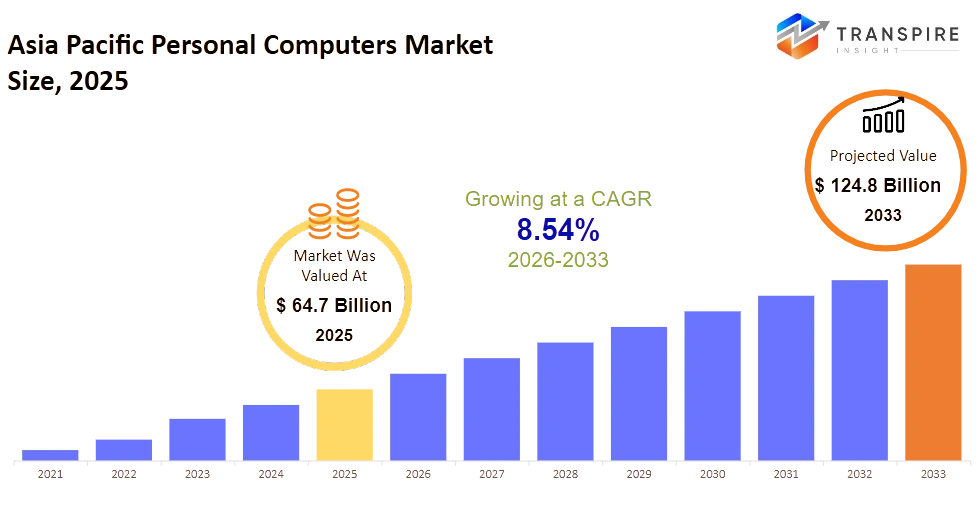
As per Transpire Insight Analysis the Asia Pacific Personal Computers Market size is estimated at USD 64.7 Billion in 2025 and is anticipated to reach USD 124.8 Billion by 2033, growing at a CAGR of 8.54% from 2026 to 2033.
The Asia Pacific Personal Computers Market, well it basically keeps day to day operations moving for business work, education, software creation, engineering, healthcare, and also public administration… all of that, by using dependable computing platforms for data processing, messaging, content making, and enterprise applications. PCs are still the backbone when productivity, security, and application speed need more headroom than mobile devices can realistically give. Over the last five years the whole market mood has changed, it moved away from just replacement driven buying and moved toward hybrid work plus digital transformation spending. Because of that organizations now try to lock in modern laptops and desktops, with tighter security controls and AI ready components.
Then COVID-19 happened, and it sort of forced the issue, it highlighted how remote work still needs dependable computing infrastructure, while also tweaking how companies purchase IT equipment in general. Now as organizations keep updating older systems, follow Windows refresh cycles, and plug in AI enabled productivity tools, hardware replacement is more like a strategic commitment instead of a normal routine expense. This evolution should boost commercial sales, raise adoption of premium devices, and open up new revenue routes for manufacturers, component vendors, and enterprise solution partners.
Asia Pacific Personal Computers Market Size & Forecast:
- Asia Pacific Personal Computers Market Size 2025: USD 64.7 Billion
- Expected Market Value 2033: USD 124.8 Billion
- Forecast CAGR: 8.54%
- Leading region in 2025: China
- Fastest Growing region: India
- Key Profile: Lenovo, HP Inc., Dell Technologies, Apple, ASUS, Acer, Samsung, Microsoft, MSI, Huawei, Fujitsu, Toshiba, LG Electronics, Gigabyte, Razer
Key Market Insights
- China, sort of dominated the Asia Pacific Personal Computers Market in 2025, with around 43% market share and that was mostly supported by big manufacturing capacity, plus enterprise tech investments too.
- India will probably keep being the quickest expanding regional market from 2025 to 2033 , since digital infrastructure continues to grow, enterprise modernization stays on track and education technology gets rolled out more and more .
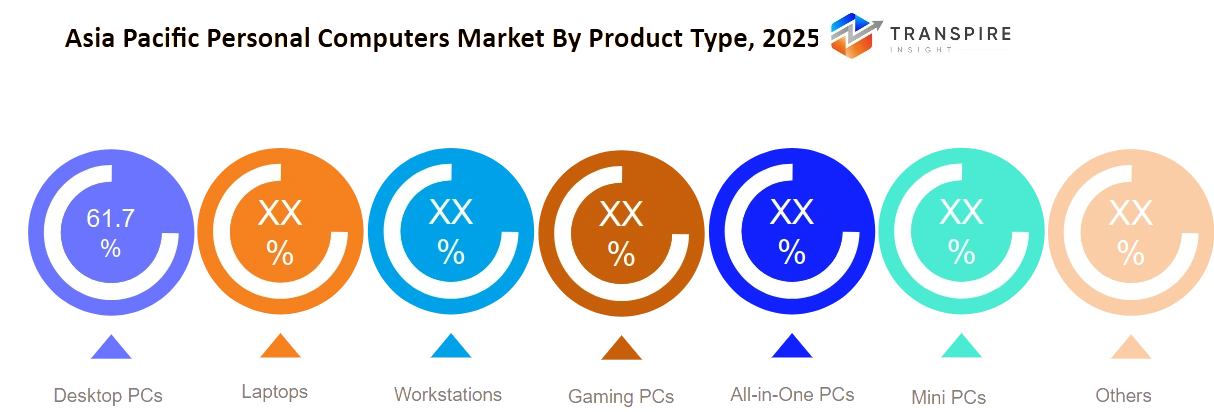
- When it comes to devices, laptops led the product slice with almost 62% share in 2025, mainly since hybrid workplaces and mobile productivity approaches keep changing what organizations actually buy.
- Desktops stayed in second place too, not because they’re slow or anything, but because financial institutions, manufacturing facilities and government organizations kept replacing older workplace systems, again and again.
- AI-enabled personal computers are expected to grow the quickest through 2033, fueled by purpose-built AI processors and the way enterprise productivity software is getting integrated.
- Commercial, and also enterprise computing, together accounted for about 56% market share in 2025, largely driven by device refresh initiatives and upgrades that focus on cybersecurity hardened hardware.
- In education, applications should expand fastest across the whole forecast, since digital classrooms and online learning infrastructure continue progressing through Asia Pacific, steadily.
- Big enterprises contributed roughly 48% of end user revenue in 2025, supported by standardized procurement rules and longer-term modernization programs.
- Smaller companies, meaning small and medium-sized enterprises, are projected to grow the fastest by 2033 as cloud adoption grows, and affordable AI-ready systems help improve day to day business productivity, more or less.
What are the Key Drivers, Restraints, and Opportunities in the Asia Pacific Personal Computers Market?
The strongest growth driver is basically the quick movement toward AI-enabled workplace computing, like it’s happening faster than most people expected. Enterprise software keeps asking for more sophisticated processors, dedicated AI accelerators, and better cybersecurity capabilities too. At the same time hybrid work policies along with those Windows device refresh cycles have pushed many companies and even public institutions to replace gear sooner. In practice organizations now seem to value productivity gains more than trying to stretch hardware lifecycles, even if that feels annoying. And yeah this kind of shift tends to lift premium device sales, increases average selling prices, and generally helps stronger revenue growth across the regional personal computing industry.
The biggest restraint though is still semiconductor supply concentration plus all that component sourcing volatility. Advanced processors, graphics chips, and memory components rely on a fairly narrow manufacturing ecosystem. Capacity issues, and also geopolitical trade restrictions, don’t really get fixed quickly because semiconductor fabrication needs years of investment, not months. From what we can see in the Transpire Insight review of regional procurement announcements and launch schedules, the concentration problem stays the main execution risk. If component deliveries get delayed then commercial deployments slip, quarterly revenues get suppressed and enterprise replacement cycles get extended across multiple Asia Pacific markets, which then ripples through demand.
The really strongest opportunity is in AI native computing platforms that are sort of baked into cloud services and edge processing, not just bolted on later. Governments , and also private firms keep putting money into digital infrastructure. That makes it easier for intelligent workplace devices to actually land and spread. India and Southeast Asia look especially promising for expansion, mainly because enterprise digitization, education modernization, and those domestic manufacturing incentives keep moving faster. In the next phase , vendors that pair AI software ecosystems with localized manufacturing plus enterprise support services will tend to lock in better competitive positions.
What Has the Impact of Artificial Intelligence Been on the Asia Pacific Personal Computers Market?
Artificial intelligence is kind of reshaping the Asia Pacific personal computer industry, by changing both the way manufacturing runs and how end users actually experience computing. In many cases , manufacturers now deploy AI for a kind of nonstop monitoring in production , plus quality inspection, inventory management, and component traceability across the various regional assembly sites. Then there are the smart analytics side of things, which help with procurement, because they can surface supply disruptions ahead of time, before they start wrecking production schedules. With machine learning, teams can forecast commercial purchasing cycles, tune inventory allocation in a more careful way, and also predict component demand with better accuracy. That helps them cut down excess inventory, while still keeping product availability where it needs to be.
On the device side, AI-enabled processors in newer machines support more capable productivity tools and real-time language translation, plus a bit of intelligent content creation, and better cybersecurity protections too,so enterprises end up being more willing to adopt higher-end computing systems. Overall, these kinds of functions tend to push operational efficiency forward, speed up the deployment timeline, and even reduce IT management costs, mostly because predictive diagnostics are running in the background and automatic device management keeps things steady.Commercial organizations can also see better system uptime and smoother fleet administration across distributed employees.
Still, even with all that, the broad rollout is not effortless. There are major roadblocks, like the high integration costs for AI-ready hardware, plus software that isn’t well optimized for older enterprise applications. On top of that, uneven access to advanced semiconductor technologies keeps slowing adoption, especially for small businesses and for developing economies where technology budgets are just tight.
Key Market Trends
- In 2024 and 2025 AI-capable processors started showing up as pretty standard in those premium business laptops, especially as manufacturers sort of pushed commercial product launches across Asia Pacific more aggressively.
- Windows refresh cycles also nudged enterprises to move on from older machines beginning in 2024, which basically supported stronger commercial procurement over the whole forecast period, or at least that’s how it played out.
- China, after 2023, doubled down on domestic semiconductor and PC manufacturing investments, to improve supply chain resilience and also to cut the reliance on external sourcing, not just a little bit.
- Meanwhile India between 2023 and 2025 widened electronics manufacturing incentives, which in a way helped nudge global PC manufacturers to boost regional production capability, kinda in a practical, ground level mode.
- By 2025 enterprise buyers were increasingly selecting devices that include integrated cybersecurity processors, because ransomware threats kind of reshaped how companies actually purchased equipment, and then the reasoning behind the choices shifted too.
- Lenovo, HP Inc., Dell Technologies, ASUS and Acer also rolled out more AI ready product introductions in 2024 and 2025, partly to sharpen that competitive differentiation, you know.
- ARM based computing platforms got broader commercial acceptance as well, because the processor efficiency improvements stretched battery life without really sacrificing enterprise performance, and that part matters.
- Educational institutions, after 2023, leaned harder into cloud-connected notebook deployments to back digital learning programs and centralize device management.
- At the same time manufacturers diversified component sourcing beyond single-country suppliers, so operational disruption risk went down, while long-term production flexibility went up, kind of a safer setup.
Asia Pacific Personal Computers Market Segmentation
By Product Type :
Laptops still held the largest share because mobility, battery efficiency, and those more flexible workplace models kept steering purchasing decisions across commercial , and even educational environments. In many corporate refresh programs people kept leaning toward lighter devices with tougher security features and AI-ready processors, which kinda helped drive premium product sales. Desktop PCs stayed at a fairly steady level too, especially in government offices , financial institutions , and manufacturing facilities, where fixed workstations are basically required for day to day operations. Gaming PCs picked up momentum as esports participation grew more visible, and because buyers wanted stronger performance for graphics, like high-end visuals without compromise.
Meanwhile, workstations got solid traction in engineering, architecture, media production, and scientific research, because the improved computing performance stayed basically non negotiable there. All-in-One PCs also attracted buyers who wanted space saving arrangements, for offices , healthcare facilities and even customer support zones. Mini PCs grew at a slower pace, as compact layouts reduced energy consumption, yet they were still able to handle everyday business tasks in retail as well as industrial environments.Other product categories continued to fill more specialized computing needs across both professional and consumer use cases, even when budgets were a bit tighter.
By Operating System :
Windows kinda stayed on top overall, mainly due to enterprise software compatibility , security update cycles, and all that broad hardware support that kept shaping procurement decisions in a bunch of industries. A lot of commercial orgs leaned into standardized device management and application compatibility which then helped lock in longer term adoption. macOS stayed pretty strong too with creative pros, people developing software, and the premium consumer crowd who were really chasing optimized hardware plus software synergy . Meanwhile ChromeOS kept growing in schools and universities where low cost devices, and those cloud based learning setups, made day to day operations feel more efficient.
Linux also gained traction across software development teams, research groups , and technical computing because the open source flexibility supports more specialized workloads. Other operating systems kept showing up in smaller niches, like certain industrial or embedded environments where customized software environments matter a lot more than “one size fits all”. Continuous improvements in operating systems also pushed hardware upgrades along with stronger security , better productivity, and higher enterprise performance. Platform competition will probably keep nudging innovation across both business and consumer computing spaces.
By End User :
Enterprises, kind of represented the largest share because their digital transformation programs , cybersecurity investments, and the usual hardware refresh cycles helped push big procurement volumes in the market. In parallel, business productivity software along with hybrid workplace strategies kept nudging organizations to buy advanced computing systems, with stronger processing ability than before, yes. Consumers also carried on replacing older devices for remote work, online services, entertainment, and everyday personal productivity, and that meant retail demand stayed steady. Educational institutions went further too, expanding technology rollouts so classrooms could become more digital and students could access learning materials more easily.
On the government side, organizations kept a fairly consistent purchasing pace, mainly through digital public service initiatives and ongoing modernization of administrative infrastructure. Meanwhile gaming users increased spend for high-performance systems, especially models with advanced graphics processors and faster memory setups. Other end-user segments supported demand as well, including specialized industrial, healthcare, and research uses where dependable computing performance matters. Overall, technology investments across multiple sectors should keep sustaining a balanced kind of market growth.
By Distribution Channel :
Corporate sales raked in the largest revenue, mainly because big organizations tended to stick with direct procurement agreements, plus they wanted customized hardware configurations and those long term service contracts. Enterprise teams leaned hard on lifecycle management, centralized deployment, and solid after-sales technical support. Online retail also grew very fast, since digital purchasing platforms kept getting better at showing product availability, more transparent pricing, and faster delivery across different regional markets. Brand stores, meanwhile , boosted customer engagement via premium product demonstrations, and some personalized technical help that felt very “hands on”.
Electronics retailers kept pulling buyers in, especially people who want to compare things in person before they commit. Distributors mattered a lot too, they supported regional supply networks and served business customers across many industries. Other pathways covered more specialized procurement requirements, through value-added service providers and system integrators. Distribution strategies will keep shifting as customer purchasing behavior changes, and as digital commerce continues to expand.
By Processor Type :
Intel processors stayed in the lead, mostly due to the general enterprise compatibility, dependable performance, and those long-standing ties with device manufacturers that made deployment feel almost effortless. In the commercial world, customers kept choosing Intel powered systems for day to day office productivity, security capabilities, and overall application stability , because it just worked. Meanwhile, AMD processors grew their footprint by leaning into sharper pricing, solid multi-core throughput, and a noticeably broader acceptance across gaming plus professional computing. Ongoing tweaks in each generation also helped keep the rivalry close, both in higher end devices and in the more mainstream categories.
ARM based processors saw the fastest growth, mainly because better energy efficiency and longer battery endurance made lightweight mobile computing feel more practical, especially on the move. Hardware makers also kept pouring effort into optimized software ecosystems, and that kind of thing helped improve compatibility with both business apps and consumer applications. Other processor approaches still found ways to serve niche industrial , and embedded computing uses, often with tailored performance profiles. Processor innovation will remain one of the biggest drivers shaping what future hardware becomes, and what buyers end up choosing, at least for the foreseeable future.
What are the Key Use Cases Driving the Asia Pacific Personal Computers Market?
Commercial workplace computing is still the main reason the market keeps growing, like it or not. Big companies, banks and other financial institutions, healthcare providers, and government agencies typically buy laptops, plus desktop systems, to run day to day business apps. They also use them for secure communications and smoother digital workflows. Then there are the usual hardware refresh routines , and frankly tighter cybersecurity rules which keep pushing procurement in all these sectors.
On top of that, education settings and gamers are getting a lot more attention as the expansion continues. Schools, universities, and training centers keep rolling out notebook computers for digital learning platforms and also for exam related systems. Meanwhile gaming communities invest in high-performance setups with advanced graphics, so they can do competitive play, streaming, and content creation without headaches.
Also, AI enabled computing along with edge based enterprise processing looks like a promising direction. Manufacturing sites are starting to place intelligent workstations for production analytics and quality inspection, while engineering groups test AI ready computers that can handle computer aided design and simulation. Broader uptake should keep building as software tuning gets better and hardware prices become more approachable across different regional markets, even if it takes time.
|
Report Metrics |
Details |
|
Market size value in 2025 |
USD 64.7 Billion |
|
Market size value in 2026 |
USD 70.3 Billion |
|
Revenue forecast in 2033 |
USD 124.8 Billion |
|
Growth rate |
CAGR of 8.54% from 2026 to 2033 |
|
Base year |
2025 |
|
Historical data |
2021 - 2024 |
|
Forecast period |
2026 - 2033 |
|
Report coverage |
Revenue forecast, competitive landscape, growth factors, and trends |
|
Regional scope |
Asia Pacific (India, China, Japan, Australia, South Korea, Rest of Asia Pacific) |
|
Key company profiled |
Lenovo, HP Inc., Dell Technologies, Apple, ASUS, Acer, Samsung, Microsoft, MSI, Huawei, Fujitsu, Toshiba, LG Electronics, Gigabyte, Razer . |
|
Customization scope |
Free report customization (country, regional & segment scope). Avail customized purchase options to meet your exact research needs. |
|
Report Segmentation |
By Product Type (Desktop PCs, Laptops, Workstations, Gaming PCs, All-in-One PCs, Mini PCs, Others); By Operating System (Windows, macOS, ChromeOS, Linux, Others); By End User (Consumers, Enterprises, Educational Institutions, Government Organizations, Gaming Users, Others); By Distribution Channel (Online Retail, Brand Stores, Electronics Retailers, Corporate Sales, Distributors, Others); By Processor Type (Intel Processors, AMD Processors, ARM-Based Processors, Others) |
Which Regions are Driving the Asia Pacific Personal Computers Market Growth?
In 2025, China accounted for about 43% of regional revenue , and in practice that makes the country the big center of Asia Pacific. With government support for semiconductor manufacturing, digital infrastructure, and domestic electronics production, the long term industry trajectory looks more secure, and not just short lived. There’s also extensive manufacturing capacity, plus integrated component suppliers, plus the presence of major global computer brands. All of that adds up to a rather streamlined production ecosystem. Looking ahead, more spending on AI-ready hardware, advanced manufacturing, and enterprise digital transformation should keep market leadership intact across the forecast period.
Japan, meanwhile, came in as the second-largest regional market. Here, buying choices are often shaped by stable enterprise replacement cycles, not by fast capacity expansion. The technology standards stay consistent, corporate IT spending is fairly predictable, and overall economic resilience remains strong. As a result, hardware procurement continues steadily across commercial, healthcare, and industrial sectors. Advanced manufacturing, financial services, and research organizations keep putting money into premium computing systems, usually with long operational lifecycles. Those stable procurement patterns make Japan a reliable source of recurring income for manufacturers and technology suppliers.
India is expected to capture the quickest growth from 2026 to 2033, as electronics manufacturing incentives get stronger, broadband infrastructure keeps expanding, and enterprise digitalization speeds up. The Government actions, like those that back local production and broader technology adoption, have already helped investments move faster across education, small businesses, and public administration, even if not always smoothly. With commercial demand climbing for AI enabled devices, plus additional local production capacity coming online, the market situation stays pretty favorable. Overall, these strong growth signals should mean solid prospects for manufacturers, component suppliers, and technology investors who want durable regional expansion.
Who are the Key Players in the Asia Pacific Personal Computers Market and How Do They Compete?
Competition across the Asia Pacific Personal Computers Market still looks pretty moderately consolidated, and in general global manufacturers take a big slice of both commercial and consumer sales. You can see that it mostly comes down to tech innovation , how the products perform, pricing strategies, plus regional manufacturing strength. Most of the established players keep beefing up their product portfolios with AI-enabled hardware, while local brands kind of push back using localized offerings, value-focused pricing, and a quicker response to what domestic demand wants.
Lenovo boosts competitiveness with wide product coverage, from commercial notebooks all the way to premium AI-enabled systems. It also has extensive manufacturing operations across Asia, plus ongoing investment in enterprise solutions , which helps with faster availability of products and tailored business offerings. HP Inc. stands out via commercial security technologies, device management services, and AI-powered workplace computers built for enterprise productivity. They keep running strategic product launches for hybrid work setups, and that keeps growing commercial customer adoption.
Dell Technologies is really centered on enterprise infrastructure integration, so teams can manage everything in corporate IT environments without too much friction while also, you know, keeping those long term customer relationships stronger. ASUS on the other hand leans into premium gaming devices and creator-minded laptops, plus ongoing investment in high performance computing technologies that specifically fit specialized audience needs. Acer is expanding its regional footprint by rolling out affordable notebooks aimed at education and business use cases, and at the same time it keeps tightening distribution partnerships across several emerging economies in Asia Pacific. Over the whole forecast window, the main competitive playbooks will likely stay similar, meaning continuous product innovation, heavier AI integration, and extra regional manufacturing investments, even if the messaging changes a bit.
Company List
- Lenovo
- HP Inc.
- Dell Technologies
- Apple
- ASUS
- Acer
- Samsung
- Microsoft
- MSI
- Huawei
- Fujitsu
- Toshiba
- LG Electronics
- Gigabyte
- Razer
Recent Development News
In January 2026, Lenovo launched a new portfolio of AI-powered Yoga and IdeaPad laptops, AI desktops, and Lenovo Qira personal AI technology at CES 2026. The launch expanded AI PC offerings for consumers and enterprises, strengthening Lenovo's position in next-generation personal computing across Asia Pacific.
Source https://news.lenovo.com/
In May 2026, Acer expanded its Copilot+ PC portfolio by introducing new Aspire AI laptops and AI all-in-one desktops powered by the latest Intel and AMD processors. The product expansion reinforced Acer's AI computing strategy and increased competition in the premium and commercial PC segments. Source https://news.acer.com/
What Strategic Insights Define the Future of the Asia Pacific Personal Computers Market?
The Asia Pacific Personal Computers Market is starting to lurch toward something more like an ecosystem, centered on AI-native computing, not just the usual hardware swap cycle. Value tends to show up more and more from intelligent processors, localized making capability, secure enterprise platforms, and software tuning that lets AI run on-device.
One bit that’s kinda overlooked is the risk of still leaning too hard on a concentrated semiconductor supply chain. If there are disruptions in the production of advanced chips, or if export restrictions tighten, then launches can slip and margins get squeezed, even when demand is still looking healthy.
At the same time an opportunity is quietly building in India and Southeast Asia. Government backed electronics manufacturing programs, plus enterprise digital infrastructure that keeps expanding will help regional production sit alongside the rising commercial take up of AI-ready devices. Basically, the companies that blend local assembly with cloud-based AI services, and also stick with long-term enterprise support, should end up with stronger positions.
If they invest in diversified component sourcing, build regional collaborations, and grow software ecosystems, they’ll get more resilience, and they can aim for sustainable growth over the next five to seven years.
Asia Pacific Personal Computers Market Report Segmentation
By Product Type
- Desktop PCs
- Laptops
- Workstations
- Gaming PCs
- All-in-One PCs
- Mini PCs
By Operating System
- Windows
- macOS
- ChromeOS
- Linux
By End User
- Consumers
- Enterprises
- Educational Institutions
- Government Organizations
- Gaming Users
By Distribution Channel
- Online Retail
- Brand Stores
- Electronics Retailers
- Corporate Sales
- Distributors
By Processor Type
- Intel Processors
- AMD Processors
- ARM-Based Processors
Frequently Asked Questions
Find quick answers to common questions.
The expected Asia Pacific Personal Computers Market size for the market will be USD 124.8 Billion in 2033.
Key segments for the Asia Pacific Personal Computers Market are By Product Type (Desktop PCs, Laptops, Workstations, Gaming PCs, All-in-One PCs, Mini PCs, Others); By Operating System (Windows, macOS, ChromeOS, Linux, Others); By End User (Consumers, Enterprises, Educational Institutions, Government Organizations, Gaming Users, Others); By Distribution Channel (Online Retail, Brand Stores, Electronics Retailers, Corporate Sales, Distributors, Others); By Processor Type (Intel Processors, AMD Processors, ARM-Based Processors, Others).
Major Asia Pacific Personal Computers Market players are Lenovo, HP Inc., Dell Technologies, Apple, ASUS, Acer, Samsung, Microsoft, MSI, Huawei, Fujitsu, Toshiba, LG Electronics, Gigabyte, Razer.
The Asia Pacific Personal Computers Market size is USD 64.7 Billion in 2025.
The Asia Pacific Personal Computers Market CAGR is 8.54% from 2026 to 2033.
- Lenovo
- HP Inc.
- Dell Technologies
- Apple
- ASUS
- Acer
- Samsung
- Microsoft
- MSI
- Huawei
- Fujitsu
- Toshiba
- LG Electronics
- Gigabyte
- Razer
About the Authors

Mayur Shinde
I am Mayur Shinde, a Senior Research Analyst at Transpire Insight, specializing in the Automotive & Transportation and Information & Communication Technology (ICT) Industry. My work focuses on analyzing emerging market trends, technological advancements, competitive landscapes, and industry developments to deliver accurate, data-driven insights. I am passionate about transforming complex market information into clear, actionable content that helps businesses, professionals, and decision-makers stay informed and make confident strategic decisions.

Chakradhar Khansole
Chakradhar serves as the Research Director at Transpire Insight, bringing over 8 years of experience in technology, innovation, and strategic market intelligence. He specializes in transforming complex market data into actionable business insights that enable organizations to make informed, growth-oriented decisions. Recognized for his strategic vision and analytical expertise, Chakradhar leads high-impact research initiatives, delivering comprehensive market assessments, competitive intelligence, and forward-looking industry analysis.
Recently Published Reports
-
Apr 2026
3D Optical Profiler Market
3D Optical Profiler Market Size, Share & Analysis Report By Type (Desktop 3D Optical Profiler, and Portable 3D Optical Profiler), By Technology (Confocal Technology, and White Light Interference), By End-Use Industry (Manufacturing, Research Institutions, Automotive, Aerospace and Defense, Medical Devices, and Other), and Geography (North America, Europe, Asia-Pacific, Middle East and Africa, South and Central America), 2021 - 2031
-
Apr 2026
Depth Sensor Market
Depth Sensor Market Size, Share & Analysis Report By Type (Infrared Depth Sensors, Time-of-Flight (ToF) Sensors, Stereo Vision Sensors, Structured Light Sensors, Ultrasonic Depth Sensors), By Application (Automotive, Robotics, Gaming, Consumer Electronics, Industrial Automation, Healthcare, Security & Surveillance, Others), By End Users (Automotive Manufacturers, Consumer Electronics Companies, Healthcare Providers, Industrial Companies, Security Agencies, Gaming Companies, Robotics Companies, Others), and Geography (North America, Europe, Asia-Pacific, Middle East and Africa, South and Central America), 2021 – 2031
-
Apr 2026
Digital Manufacturing Market
Digital Manufacturing Market Size, Share & Analysis Report By Component (Hardware, Software, and Services), By Technology (Robotics, 3D Printing, Internet of Things (IoT), and Others), By Application (Automotive and Transportation, Aerospace and Defense, Consumer Electronics, Industrial Machinery, and Others), By Process Type (Computer-Based Designing, Computer-Based Simulation, Computer 3D Visualization, Analytics, and Others), and Geography (North America, Europe, Asia-Pacific, Middle East and Africa, South and Central America), 2021 – 2031
-
Apr 2026
Digital Visa Services Market
Digital Visa Services Market Size, Share & Analysis Report By Type (Individual Travelers, Group Travelers), By Application (Tourism, Business Travel, Others), and Geography (North America, Europe, Asia-Pacific, Middle East and Africa, South and Central America), 2021 – 2031