

Global Contract Management Software Market Summary
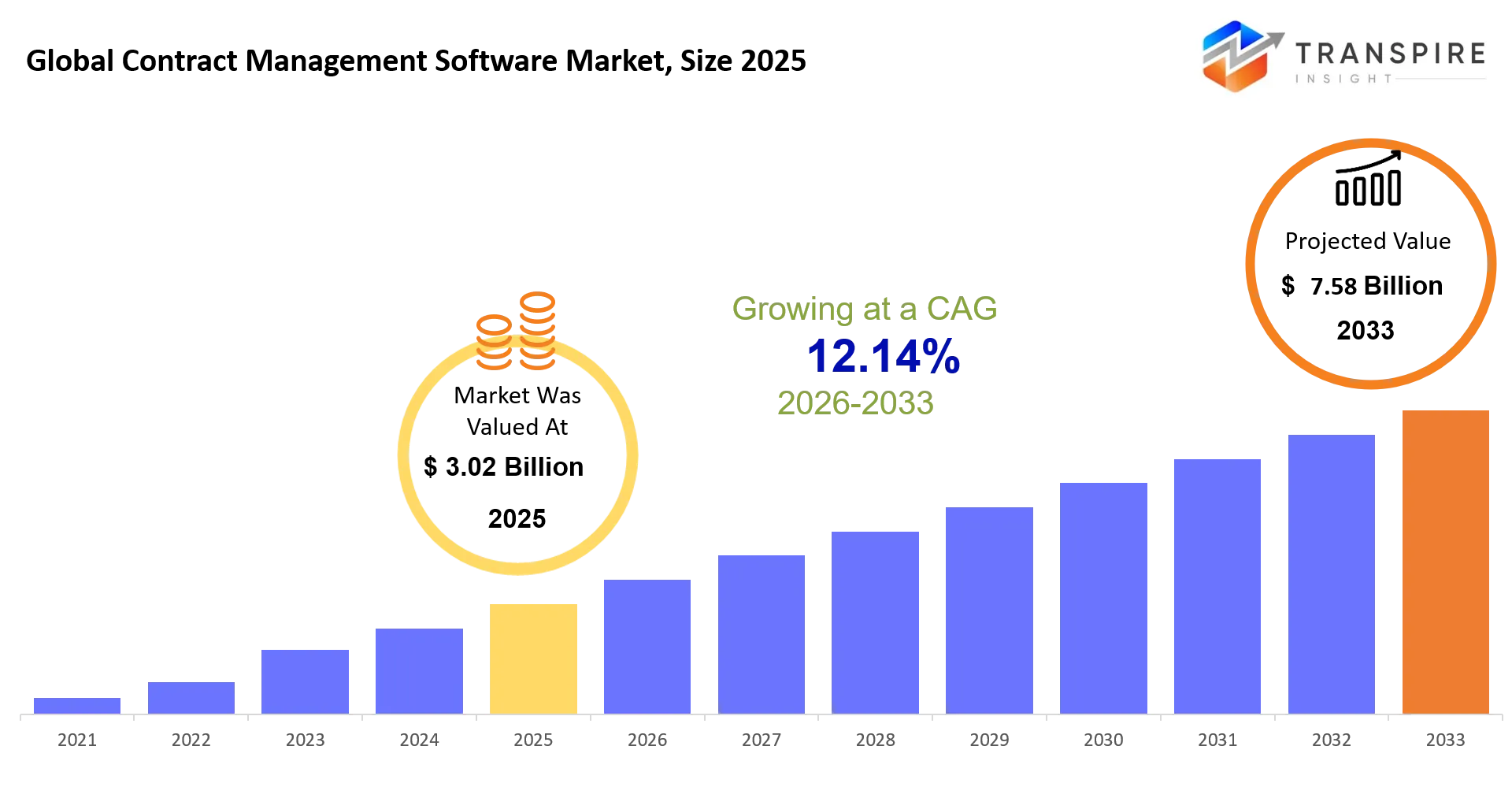
As per Transpire Insight Analysis, The Global Contract Management Software Market size is estimated at USD 3.02 Billion in 2025 and is anticipated to reach USD 7.58 Billion by 2033, growing at a CAGR of 12.14% from 2026 to 2033.
The Market provides centralized digital platforms that automate how businesses draft, negotiate, track, and execute legal agreements across vendor, sales, and employment pipelines. Over the last three to five years - the industry has shifted away from acting as basic static document repositories toward dynamic, automated lifecycle ecosystems. A major structural shift has been the industry-wide integration of large language models capable of extracting metadata and flagging risky clauses instantly. Additionally - the rapid post-pandemic normalization of cross-border distributed workforces served as a real-world trigger, making cloud-accessible, secure signing workflows an operational necessity. As companies face tighter regulatory scrutiny and corporate auditing pressures, this urgent push to eliminate manual operational friction is directly driving widespread software adoption.
Global Contract Management Software Market Size & Forecast
- Global Market Size 2025: USD 3.02 Billion
- Expected Market Value (2033): USD 7.58 Billion
- Forecast CAGR (2026–2033): 12.14%
- Leading Region in 2025: North America
- Fastest Growing Region: Asia Pacific
- Key Company Profiles: Icertis, DocuSign, Agiloft, SAP Ariba, Oracle, Coupa Software, Conga, Ironclad, ContractWorks, CobbleStone Software, Evisort, LinkSquares, SirionLabs, Wolters Kluwer, Gatekeeper
Key Global Contract Management Software Market Insights
The industry is moving away from basic, passive cloud storage folders toward smart, connected contract lifecycle tracking systems. Companies are gaining a competitive edge by combining machine learning tools, automated multi-department workflows, and easy e-signature features.
- Cloud-based Software drives 45% of total Market value - as companies like DocuSign and Icertis focus heavily on secure SaaS setups to keep remote corporate teams aligned instantly.
- Contract Lifecycle Management (CLM) options claim a 19% share, with Agiloft and Conga building out comprehensive drafting, negotiation, and storage loops to untangle complex enterprise sales and purchasing pipelines.
- Workflow Automation tech captures 13% of the sector, pushed forward by Ironclad and SirionLabs creating low-code, hands-free approval setups that stop documents from stalling during cross-department reviews.
- Compliance Management features account for 9% of sales, where Wolters Kluwer and CobbleStone Software use active monitoring algorithms to protect corporate users from shifting regulatory laws and penalties.
- E-signature Integration holds an essential 6% share, backed by platforms like ContractWorks speeding up multi-party approvals via highly responsive mobile interfaces.
- Analytics & Reporting options take up 5% of the space, with data specialists like LinkSquares and Evisort extracting hidden metadata to give executive boards clearer visibility over upcoming renewal dates and potential legal risks.
- AI-powered Contract Management software is the fastest-moving piece of the Market, growing at a sharp CAGR of 20.8% as SirionLabs and Icertis roll out generative AI models to clean up and revise bulk clauses.
- North America remains the primary demand driver with a 44% revenue share, led by financial and enterprise rollouts from Coupa Software and Oracle across tightly regulated corporate landscapes.
- Europe commands a steady 26% Market share, where localized tracking hubs like Gatekeeper help large operations map vendor activities to strict regional digital safety guidelines.
- The Asia Pacific region stands out as the fastest-accelerating geography with a major CAGR of 21.6%, powered by providers like SAP Ariba deploying cloud tools to support rapid digital business shifts across the territory.
What Are the Key Drivers, Restraints, and Opportunities in the Global Contract Management Software Market?
Driver
Market growth is propelled by the structural transition toward agentic AI workflows and automated clause redlining across distributed legal frameworks. This shift was triggered by the rapid normalization of cross-border distributed corporate workforces and tighter compliance auditing. Automated systems eliminate manual bottlenecks by extracting text metadata instantly, which dramatically reduces sales contract cycle times and boosts enterprise software adoption.
In January 2026, enterprise contract intelligence leader Icertis officially accelerated automated governance capabilities by rolling out its third annual State of Contracting analysis, detailing the widespread deployment of its Vera AI-native platform experience. This software architecture introduces autonomous agentic workflows designed to help global firms draft, review, and execute high-volume supplier deals with deep contextual safety. By proving that 44% of modern corporations have operationalized AI for active redlining, this platform deployment demonstrates how large enterprises are scaling secure SaaS infrastructure to protect revenue margins and compress cross-department legal cycles.
Restraint
Severe integration bottlenecks and hidden implementation expenses across legacy ERP setups act as a persistent structural barrier. When organizations deploy multi-step digital agreement platforms, the lack of standardized API hooks forces IT departments into complex custom configuration cycles. This friction persists because older database systems cannot easily parse dynamic metadata fields, resulting in data silos and long deployment delays that inflate administrative overhead.
Opportunity
The most lucrative growth window lies in the widespread adoption of predictive post-signature obligation tracking paired with edge-based legal analytics. Connecting cloud repositories with real-time risk scoring modules allows corporate compliance teams to instantly identify performance deviations across extensive vendor networks. This shift unlocks predictable subscription-based software usage, where businesses utilize proactive renewal alerts to prevent accidental expirations and easily mitigate cross-border operational liabilities.
What Has the Impact of Artificial Intelligence Been on the Global Contract Management Software Market?
Artificial intelligence has completely shifted contract management away from static - folder-based storage solutions toward autonomous, agentic contract lifecycle networks. Instead of requiring legal and procurement teams to manually check long documents, operators now deploy large language models that extract text metadata, evaluate real-time compliance risks, and track post-signature obligations automatically.
Inside high-volume enterprise operations - built-in AI models drive immense operational improvements through automated multi-party negotiation and predictive renewal forecasting. These algorithms continuously analyze legal language against predefined corporate playbooks, highlighting problematic clauses and suggesting pre-approved fallback text instantly to accelerate sales cycles. By predicting milestone targets and expiration liabilities well in advance, the software coordinates workflow routes and alerts stakeholders without manual intervention, drastically cutting down on administrative logjams.
However, a serious operational limitation persists around localized accuracy gaps and high backend integration costs. Ambiguous legal jargon or highly customized regional templates can sometimes mislead AI parsing engines, generating processing anomalies or missed compliance flags that still require experienced human oversight to correct.
In January 2026, Docusign officially unveiled its next-generation eSignature platform powered by Docusign Iris, its proprietary AI engine designed to automate complex document preparation. This intelligent software architecture scans incoming agreements to place signing fields precisely where they belong while generating custom term summaries for recipients to improve conversion rates. By removing manual drafting friction and providing signers with instant, context-aware answers to document questions, this technology rollout highlights how modern enterprise networks are leveraging intelligent edge software to accelerate transaction cycles.
Key Market Trends
The Global Contract Management Software Market is shifting from static, cloud-hosted document repositories toward automated, cognitive contract lifecycle networks. Driven by the urgent corporate need to minimize transactional bottlenecks and guarantee strict alignment with shifting digital governance laws, enterprises are abandoning disconnected manual tracking sheets in favor of centralized, automated contract lifecycle management platforms.
- Corporate legal departments are moving away from manual word processor drafting to adopt pre-filled, low-code template libraries that enforce standard organizational guidelines automatically.
- Enterprise procurement teams are transitioning from static post-execution storage folders to implement automated, post-signature obligation tracking systems that actively monitor vendor service level agreements.
- Cross-functional negotiation cohorts are abandoning email-based redlining loops to utilize centralized, real-time digital workspaces that synchronize contract adjustments across multi-party stakeholders simultaneously.
- Risk - compliance officers are shifting from retrospective periodic auditing routines to embed continuous, AI-driven regulatory monitoring blocks that automatically flag non-compliant clauses.
- Sales operations divisions are moving past isolated Customer Relationship Management (CRM) tools to adopt fully unified contract lifecycle workflows that instantly convert approved quotes into signed digital agreements.
- Financial management executives are stepping away from unmonitored vendor renewal calendars to deploy automated, predictive expiration alert engines that prevent accidental subscription leakages.
- Global administrative teams are transitioning from physical or siloed authentication steps to enforce biometric-backed, e-signature integrations that secure immediate mobile validation across international borders.
- Information technology architects are abandoning rigid, single-point legacy databases to implement modular, API-first contract repositories that exchange metadata smoothly with existing enterprise resource planning systems.
- Supply chain management personnel are moving from generic supplier forms to deploy verticalized contract structures optimized specifically to map complex environmental, social, and governance (ESG) reporting requirements.
Global Contract Management Software Market Segmentation
By Deployment
Cloud-based Software: This deployment option takes up about 45% of the total Market space. The logic is simple: modern businesses hate maintaining local server hardware when they can just let a SaaS vendor handle it. Right now - AI-powered Contract Management is accelerating faster than any other option, racing ahead at a 20.8% CAGR. Meanwhile, standard SaaS Platforms hold 15%, old-school On-premise installations sit at 10%, Hybrid networks take 6%, Enterprise CLM platforms account for 3%, and Mobile-only configurations make up the final 1%. Multi-office corporations use cloud deployments so legal teams can edit the same document at the same time without creating weird version-control errors. Down the road, Experts suggest we will see a major push toward zero-trust setups with unalterable audit trails to block modern hackers.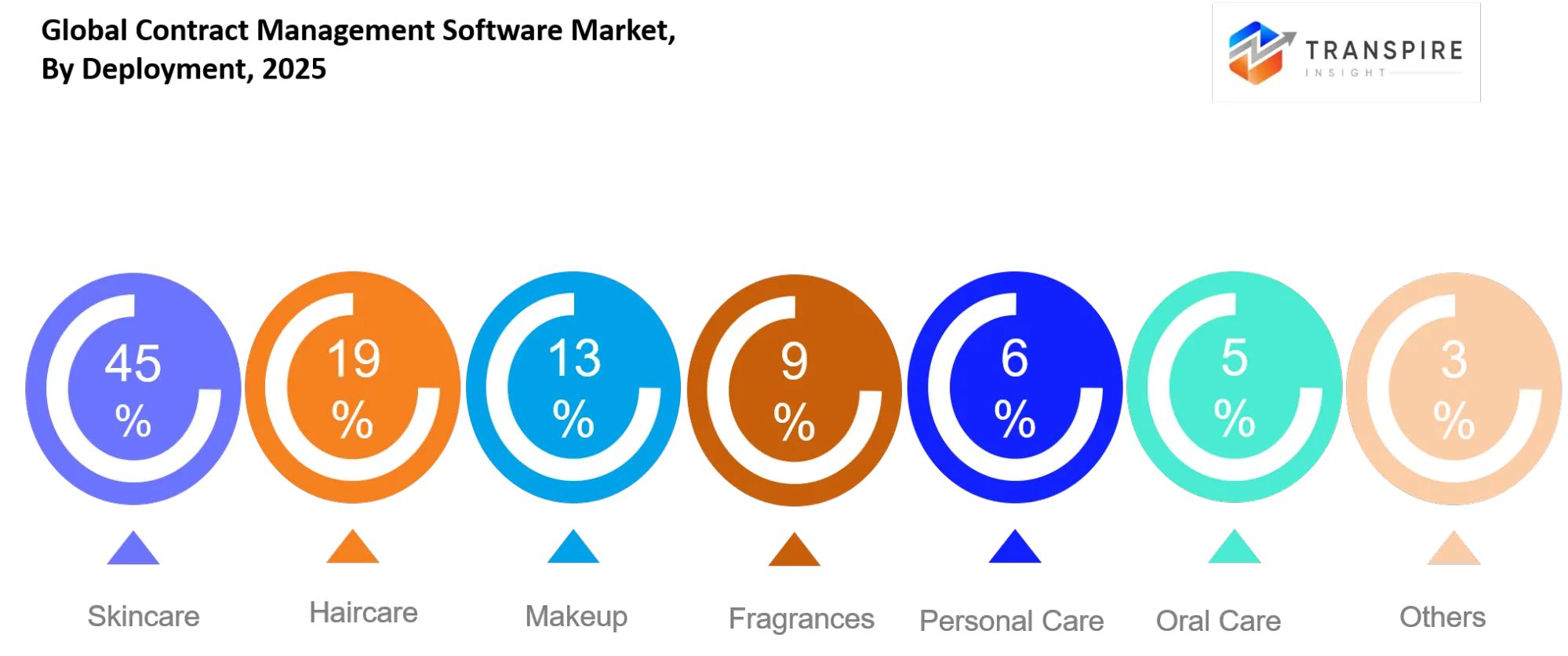
By Component
Contract Repository: Keeping all historic paperwork organized makes this component the biggest revenue generator, with Contract Authoring tools following right behind. For the rest of the breakdown, Workflow Automation handles 13% of the load, Compliance Management claims 9%, E-signature tools take 6%, Analytics & Reporting lands at 5%, and automated Renewal tracking manages the remaining 2%. Most companies buy these systems for one reason: their shared drives are a mess, and they need a single searchable database. Repositories get the most funding because when a sudden audit hits, the legal team can't afford to waste days digging for missing clauses. Moving forward, developers are working on smart data extractors that scan and tag complicated legalese automatically, completely removing human error from the sorting process.
By Enterprise Size
Large Enterprises: Large multinational firms pour the most cash into this Market because their branch networks produce mountains of vendor and client paperwork daily. Medium and Small Enterprises follow close behind as fast-growing user bases, while Startups, Government agencies, schools, and Non-profits offer steady, baseline business. If you are managing thousands of active legal agreements, manual tracking just doesn't work. Fortune 500 operations rely heavily on these tools to cut through corporate red tape, grab early-payment vendor discounts, and prevent revenue leakage from unmonitored agreements. In the next few years, the real battleground will be the mid-Market space, forcing software companies to release simpler, low-code templates that let smaller teams get up and running in days instead of months.
By End User
BFSI (Banking, Financial Services, and Insurance): Financial institutions are the clear big spenders here, while IT & Telecom acts as the second-largest buyer group. Healthcare, Manufacturing, Retail, Government offices, and dedicated Legal firms use the software to keep up with industry rules. In banking, the main goal is avoiding massive regulatory fines and speeding up everyday loan or vendor checks. Because financial groups operate under intense government oversight, they have to track their risk metrics and lending terms perfectly. Looking ahead, expect software companies to roll out highly specialized versions built explicitly for clinical settings, featuring heavily shielded, HIPAA-compliant document folders that automatically track pharmaceutical supply networks.
By Application
Contract Lifecycle Management (CLM): Full lifecycle management sits at the absolute top of this category, with Risk & Compliance acting as another crucial security tool. The remaining functional pillars include Vendor Management, Procurement Contracts, Sales Contracts, Legal Document Management, and standalone Digital Agreements. The big mindset shift happening right now is that enterprises no longer look at a contract as a one-and-done signature event - they see it as a living business relationship that requires constant tracking. CLM dominates because watching a document change from a rough draft into a negotiated agreement, an official signature, and an automatic renewal is the only way to safeguard profit margins. Soon, these trackers will link up directly with corporate accounting tools, meaning a smart contract will auto-trigger a vendor's bank payout the second a project milestone is checked off.
What Are the Key Use Cases Driving the Global Contract Management Software Market?
Centralized metadata extraction and automated repository indexing drive the bulk of this Market because converting messy, unorganized piles of legacy word files into single searchable databases is a corporate priority. Legal and procurement teams deploy cloud-based setups during initial digital transformation campaigns, allowing multi-office corporations to instantly extract critical clauses, notice periods, and governing laws from third-party documents without manual data entry.
Outside core data storage - enterprise procurement divisions and financial institutions leverage automated workflow orchestration to accelerate draft-to-sign transaction speeds. By connecting contract platforms directly with internal enterprise resource planning tools, operations cohorts deploy intelligent routing agents that automatically pass high-value supplier agreements through multi-tier approval channels while triggering native e-signatures to eliminate cross-department bottlenecks.
Lately, corporate compliance boards are aggressively adopting AI-driven - post-signature obligation tracking and proactive renewal forecasting. Risk mitigation teams deploy these advanced analytics modules to continuously monitor vendor service level agreements, automatically flagging performance deviations and generating early expiration alerts to protect profit margins from accidental auto-renewals.
|
Report Metrics |
Details |
|
Market size value in 2025 |
USD 3.02 Billion |
|
Market size value in 2026 |
USD 3.40 Billion |
|
Revenue forecast in 2033 |
USD 7.58 Billion |
|
Growth rate |
CAGR of 12.14% from 2026 to 2033 |
|
Base year |
2025 |
|
Historical data |
2021 - 2024 |
|
Forecast period |
2026 - 2033 |
|
Report coverage |
Revenue forecast, competitive landscape, growth factors, and trends |
|
Regional scope |
United States; Canada; Mexico; United Kingdom; Germany; France; Italy; Spain; China; Japan; India; Australia; South Korea; Brazil; Argentina; South Africa; Saudi Arabia; United Arab Emirates |
|
Key company profiled |
Icertis, DocuSign, Agiloft, SAP Ariba, Oracle, Coupa Software, Conga, Ironclad, ContractWorks, CobbleStone Software, Evisort, LinkSquares, SirionLabs, Wolters Kluwer, Gatekeeper |
|
Customization scope |
Free report customization (country, regional & segment scope). Avail customized purchase options to meet your exact research needs. |
|
Report Segmentation |
By Deployment (Cloud-based Software, On-premise Software, Hybrid Software, SaaS Platforms, AI-powered Contract Management, Enterprise Contract Lifecycle Management, Mobile Contract Platforms, Others); By Component (Contract Authoring, Contract Repository, Workflow Automation, E-signature Integration, Compliance Management, Analytics & Reporting, Renewal Management, Others); By Enterprise Size (Large Enterprises, Medium Enterprises, Small Enterprises, Startups, Government Organizations, Educational Institutions, Non-profit Organizations, Others); By End User (BFSI, Healthcare, IT & Telecom, Manufacturing, Retail, Government, Legal Services, Others); By Application (Contract Lifecycle Management, Vendor Contract Management, Procurement Contracts, Sales Contracts, Legal Document Management, Risk & Compliance, Digital Agreements, Others) |
Which Regions are Driving the Global Contract Management Software Market Growth?
North America maintains a commanding grip on the contract management software Market, capturing a dominant 44% of all worldwide industry revenue. This geographic leadership is heavily driven by strict municipal enforcement of financial reporting laws combined with intense data tracking demands from regional Fortune 500 companies. The regional ecosystem is structurally supported by a dense concentration of highly regulated industries that aggressively install automated lifecycle software to eliminate expensive manual processing mistakes. Consequently, transitioning away from messy shared folders toward centralized, cloud-hosted agreement hubs has become the standard operational baseline for North American enterprise executives securing their localized business pipelines.
Europe serves as a highly stable, predictable secondary pillar for the global Market, locking down an essential 26% share of total industry demand. While North American expansion is propelled by large financial enterprise rollouts and fast-paced commercial sales loops, European adoption is shaped by rigid regional data sovereignty rules and strict digital governance frameworks. This regional Market stability is structurally insulated by long-term corporate models that prioritize absolute compliance with strict European privacy directives and cross-border digital identity standards. To minimize legal liabilities and navigate complex compliance tracking without structural errors, continental corporate networks steadily invest in localized lifecycle software equipped with active multi-language compliance monitoring tools.
In April 2026, cloud agreement platform Agiloft expanded its footprint across European enterprise networks by officially rolling out its Astra artificial intelligence engine to automate complex post-signature obligation checking. This software update introduces scalable compliance layers that allow international businesses to easily map operational workflows against strict regional guidelines like the European Commission's Data Act templates. By instantly identifying performance deviations and translating legal terms smoothly across multiple jurisdictions without losing legal meaning, this deployment helps European legal teams maintain total visibility over complex supplier agreements. [https://www.agiloft.com/news/]
The Asia Pacific region has emerged as the fastest-growing territory globally, accelerating at a Market-leading standalone CAGR of 21.6% while currently holding a 23% slice of global sales. This sudden structural shift is driven by massive government-led enterprise digitization campaigns, rapid commercial business infrastructure expansion, and heavy investment in localized cloud technology hubs across developing urban corridors. Historically, regional independent businesses relied on unmonitored paper files or basic isolated spreadsheets, but a rapid push toward high-volume corporate networks has forced the widespread adoption of cloud-based contract lifecycle systems. Looking ahead, future digital infrastructure development in this booming corridor relies heavily on deploying automated, low-code template libraries and automated multi-tier approval paths to securely anchor new high-speed transactional business zones.
In early 2026, AI-native contract intelligence pioneer Sirion advanced its regional product footprint by deploying its conversational search agents across fast-growing corporate enterprises in the Asia Pacific Market. This cognitive software setup combines broad large language models with over 1,200 task-specific small data models to help regional procurement teams automatically extract metadata and clear complex contract terms up to 60% faster than traditional workflows. By giving cross-border teams the ability to handle plain-language document queries and track milestone deadlines on interactive visual dashboards, this software deployment allows expanding regional firms to boost overall deal velocity and prevent revenue leakage. 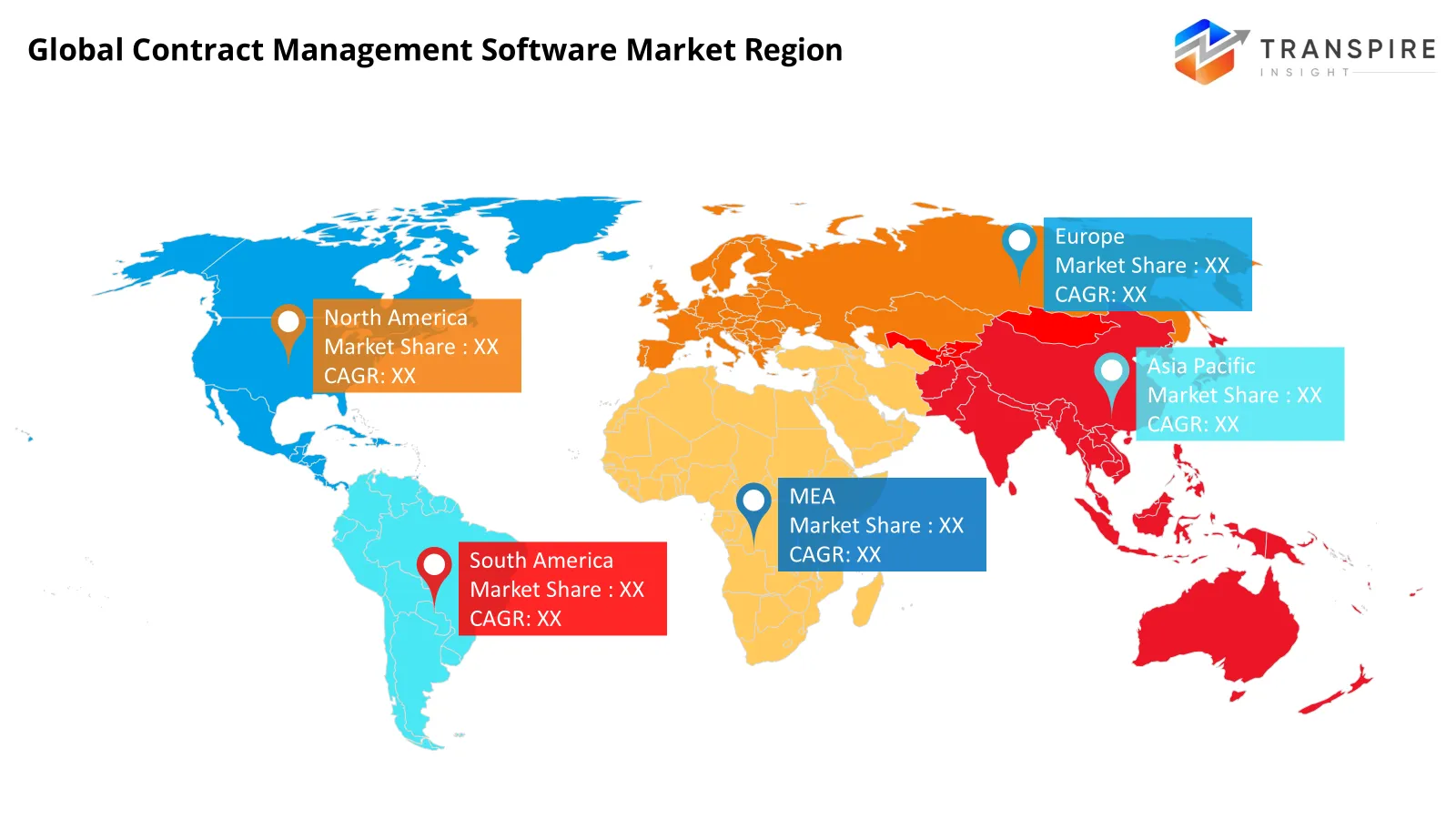
Who Are the Key Players in the Global Contract Management Software Market and How Do They Compete?
The Global Contract Management Software Market is an intense technology battleground contested by massive enterprise resource planning (ERP) providers - dominant digital signature networks, and dedicated, AI-native contract lifecycle management (CLM) platforms. As organizations face immense pressure to speed up transaction cycles and meet shifting digital governance laws, software vendors compete on three primary operational fronts: building autonomous agentic drafting tools, scaling zero-trust secure cloud architectures, and delivering real-time compliance analytics.
Icertis utilizes a high-level enterprise innovation strategy, positioning its core Market presence around its proprietary - AI-native Vera contract intelligence platform. What makes them stand out is their ability to train machine learning models on a massive data pool of over 17 million active agreements, giving their software the unique ability to execute autonomous multi-party redlining while understanding deep industry context. The company expands its Market reach by establishing deep-level native product integrations with existing operational backbones like - SAP, Microsoft, and Salesforce, allowing Fortune 500 corporations to easily automate procurement data flows.
DocuSign runs a massive scale-and-expansion strategy focused on transforming its global electronic signature user base into a broader - automated lifecycle Market through its newly launched Intelligent Agreement Management (IAM) framework. The vendor differentiates its position by offering pre-built AI review playbooks and automated clause summarization modules that connect directly to existing customer relationship management setups. They expand their international Market share by cross-selling modular cloud upgrades straight to their massive base of over 1.8 million active customers, helping mid-Market and enterprise businesses instantly compress manual signing bottlenecks down to hours.
Company List
- Icertis
- DocuSign
- Agiloft
- SAP Ariba
- Oracle
- Coupa Software
- Conga
- Ironclad
- ContractWorks
- CobbleStone Software
- Evisort
- LinkSquares
- SirionLabs
- Wolters Kluwer
- Gatekeeper
Recent Development News
- In February 2026, Sirion finalized its majority investment acquisition from private equity firm Haveli Investments. This major capital injection accelerates Sirion’s long-term product innovation and global go-to-Market scaling for its AI-native contract lifecycle management software ecosystem. [https://www.enterprisetimes.co.uk
- In March 2025, enterprise financial operations platform Workday rolled out its newly integrated Evisort AI-powered Contract Intelligence solution. This rollout follows Workday's structural acquisition of Evisort, enabling large organizations to bring unstructured legal data directly into their core finance and human capital management software to streamline vendor obligation tracking. [https://tracxn.com
- In October 2025, CobbleStone Software introduced its dynamic bulk contract uploading feature within the CobbleConnect platform module. This product launch updates the company’s flagship contract management platform by introducing automated drag-and-drop ingestion, bulk CSV file matching, and enhanced metadata backup options to dramatically cut down manual data configuration times for corporate legal teams. [https://www.cobblestonesoftware.com
What Strategic Insights Define the Future of the Global Contract Management Software Market?
The Market is heading toward agentic legal ecosystems, where static document tracking transitions into self-executing, autonomous contract lifecycle loops. A major hidden risk lies in "automated clause compliance drift." As legal operations scale their reliance on generative AI engines for contract drafting, localized updates to regional privacy regulations or sudden trade laws can escape training data baselines, introducing invisible legal liabilities across bulk legacy templates.
Conversely, an essential emerging opportunity is the development of deep post-signature event-trigger platforms. Integrating contract data directly with active enterprise resource planning ledgers allows corporate systems to auto-release milestone payments or trigger renewal negotiations based on real-time operational performance.
Strategic recommendation - Platform providers must shift from selling basic repository tools to delivering unified, zero-trust digital agreement frameworks featuring continuous compliance monitoring. This pivot insulates enterprise users from changing regulatory risks while maximizing transactional velocity.
By Deployment
- Cloud-based Software
- On-premise Software
- Hybrid Software
- SaaS Platforms
- AI-powered Contract Management
- Enterprise Contract Lifecycle Management
- Mobile Contract Platforms
- Others
By Component
- Contract Authoring
- Contract Repository
- Workflow Automation
- E-signature Integration
- Compliance Management
- Analytics & Reporting
- Renewal Management
- Others
By Enterprise Size
- Large Enterprises
- Medium Enterprises
- Small Enterprises
- Startups
- Government Organizations
- Educational Institutions
- Non-profit Organizations
- Others
By End User
- BFSI
- Healthcare
- IT & Telecom
- Manufacturing
- Retail
- Government
- Legal Services
- Others
By Application
- Contract Lifecycle Management
- Vendor Contract Management
- Procurement Contracts
- Sales Contracts
- Legal Document Management
- Risk & Compliance
- Digital Agreements
- Others
Regional Outlook
North America
- United States
- Canada
- Mexico
Europe
- Germany
- United Kingdom
- France
- Spain
- Italy
- Rest of Europe
Asia Pacific
- Japan
- China
- Australia & New Zealand
- South Korea
- India
- Rest of Asia Pacific
South America
- Brazil
- Argentina
- Rest of South America
Middle East & Africa
- Saudi Arabia
- United Arab Emirates
- South Africa
- Rest of the Middle East & Africa
Frequently Asked Questions
Find quick answers to common questions.
The Global Contract Management Software Market size was valued at USD 3.02 Billion in 2025 and is poised to reach USD 7.58 Billion by 2033, expanding at a 12.14% CAGR.
Key segments for the Global Contract Management Software Market are Deployment (Cloud-based Software, On-premise Software, Hybrid Software, SaaS Platforms, AI-powered Contract Management, Enterprise Contract Lifecycle Management, Mobile Contract Platforms, Others), Component (Contract Authoring, Contract Repository, Workflow Automation, E-signature Integration, Compliance Management, Analytics & Reporting, Renewal Management, Others), Enterprise Size (Large Enterprises, Medium Enterprises, Small Enterprises, Startups, Government Organizations, Educational Institutions, Non-profit Organizations, Others), End User (BFSI, Healthcare, IT & Telecom, Manufacturing, Retail, Government, Legal Services, Others), and Application (Contract Lifecycle Management, Vendor Contract Management, Procurement Contracts, Sales Contracts, Legal Document Management, Risk & Compliance, Digital Agreements, Others).
Growth is primarily driven by the structural transition toward agentic AI workflows and automated clause redlining across distributed legal frameworks, the rapid normalization of cross-border distributed corporate workforces, tighter compliance auditing pressures, and the urgent push to eliminate manual operational friction.
The global Market is led by major manufacturers including Icertis, DocuSign, Agiloft, SAP Ariba, Oracle, Coupa Software, Conga, Ironclad, ContractWorks, CobbleStone Software, Evisort, LinkSquares, SirionLabs, Wolters Kluwer, and Gatekeeper.
North America holds a dominant 44% share of worldwide industry revenue, heavily influencing global dynamics through strict municipal enforcement of financial reporting laws, a dense concentration of heavily regulated enterprise corridors, and massive multi-tier supplier investments from regional Fortune 500 companies accelerating large-scale digital transformation campaigns.
Highly lucrative commercial opportunities exist in the widespread deployment of predictive, post-signature obligation tracking paired with edge-based legal analytics, connecting cloud repositories with real-time risk scoring modules, and integrating contract platforms directly with active enterprise resource planning ledgers to auto-release milestone payments.
- Icertis
- DocuSign
- Agiloft
- SAP Ariba
- Oracle
- Coupa Software
- Conga
- Ironclad
- ContractWorks
- CobbleStone Software
- Evisort
- LinkSquares
- SirionLabs
- Wolters Kluwer
- Gatekeeper
About the Authors

Mayur Shinde
I am Mayur Shinde, a Senior Research Analyst at Transpire Insight, specializing in the Automotive & Transportation and Information & Communication Technology (ICT) Industry. My work focuses on analyzing emerging market trends, technological advancements, competitive landscapes, and industry developments to deliver accurate, data-driven insights. I am passionate about transforming complex market information into clear, actionable content that helps businesses, professionals, and decision-makers stay informed and make confident strategic decisions.

Chakradhar Khansole
Chakradhar serves as the Research Director at Transpire Insight, bringing over 8 years of experience in technology, innovation, and strategic market intelligence. He specializes in transforming complex market data into actionable business insights that enable organizations to make informed, growth-oriented decisions. Recognized for his strategic vision and analytical expertise, Chakradhar leads high-impact research initiatives, delivering comprehensive market assessments, competitive intelligence, and forward-looking industry analysis.
Recently Published Reports
-
Apr 2026
3D Optical Profiler Market
3D Optical Profiler Market Size, Share & Analysis Report By Type (Desktop 3D Optical Profiler, and Portable 3D Optical Profiler), By Technology (Confocal Technology, and White Light Interference), By End-Use Industry (Manufacturing, Research Institutions, Automotive, Aerospace and Defense, Medical Devices, and Other), and Geography (North America, Europe, Asia-Pacific, Middle East and Africa, South and Central America), 2021 - 2031
-
Apr 2026
Depth Sensor Market
Depth Sensor Market Size, Share & Analysis Report By Type (Infrared Depth Sensors, Time-of-Flight (ToF) Sensors, Stereo Vision Sensors, Structured Light Sensors, Ultrasonic Depth Sensors), By Application (Automotive, Robotics, Gaming, Consumer Electronics, Industrial Automation, Healthcare, Security & Surveillance, Others), By End Users (Automotive Manufacturers, Consumer Electronics Companies, Healthcare Providers, Industrial Companies, Security Agencies, Gaming Companies, Robotics Companies, Others), and Geography (North America, Europe, Asia-Pacific, Middle East and Africa, South and Central America), 2021 – 2031
-
Apr 2026
Digital Manufacturing Market
Digital Manufacturing Market Size, Share & Analysis Report By Component (Hardware, Software, and Services), By Technology (Robotics, 3D Printing, Internet of Things (IoT), and Others), By Application (Automotive and Transportation, Aerospace and Defense, Consumer Electronics, Industrial Machinery, and Others), By Process Type (Computer-Based Designing, Computer-Based Simulation, Computer 3D Visualization, Analytics, and Others), and Geography (North America, Europe, Asia-Pacific, Middle East and Africa, South and Central America), 2021 – 2031
-
Apr 2026
Digital Visa Services Market
Digital Visa Services Market Size, Share & Analysis Report By Type (Individual Travelers, Group Travelers), By Application (Tourism, Business Travel, Others), and Geography (North America, Europe, Asia-Pacific, Middle East and Africa, South and Central America), 2021 – 2031