

Asia Pacific Palm Oil Market Summary
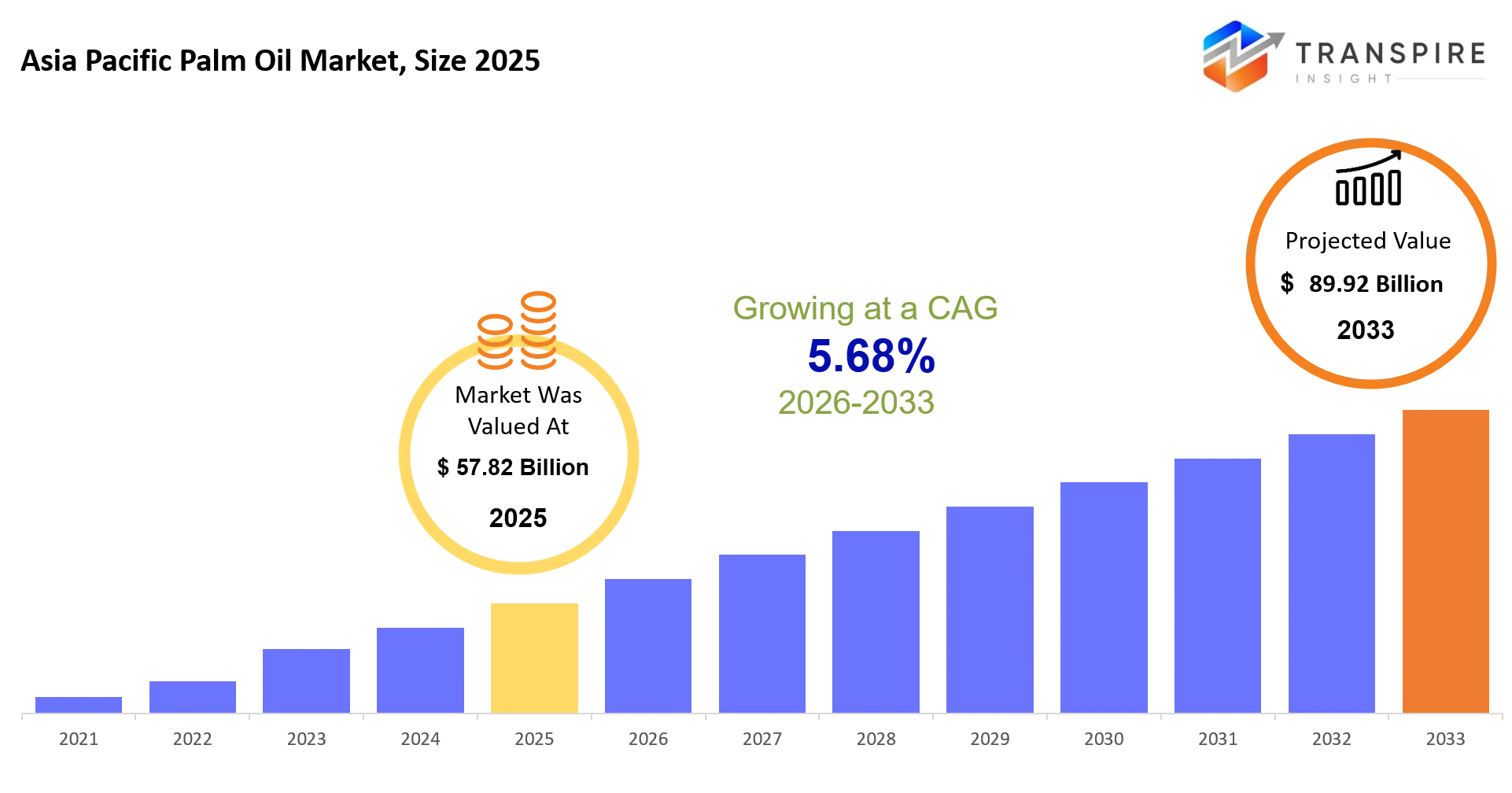
As per Transpire Insight Analysis the Asia Pacific Palm Oil Market size is estimated at USD 57.82 Billion in 2025 and is anticipated to reach USD 89.92 Billion by 2033, growing at a CAGR of 5.68% from 2026 to 2033.
The Asia Pacific Palm Oil Market offers this kind of vegetable oil that’s almost too versatile to ignore, it works for cooking and food making, for personal care goods, for biofuel generation ,and for all sorts of industrial processing tasks across regional supply lines.When the supply is reliable, the pricing is pretty cost efficient too, and it works for many uses , palm oil becomes a core input for manufacturers that need stable raw material sourcing at commercial scale.
Over the last five years , the market sort of moved a bit closer toward certified sustainable production, while governments , multinational buyers, and consumer brands got stricter with sourcing rules and leaned harder on traceability. Then, changes in export policy from big producing countries, like temporary trade limits and the occasional supply wobble, ended up reshaping regional trade corridors. So downstream companies started to diversify procurement approaches , even in cases where they had previously stayed on the familiar lanes.
At the same time , stronger biodiesel blending programs across several Asia Pacific economies redirected a larger share of palm oil toward energy uses. Put together, all of this nudged producers to expand processing capacity, put money into sustainable cultivation practices, and strengthen supply chain resilience, which in turn opened up new earning options across food , energy, and industrial sectors.
Asia Pacific Palm Oil Market Size & Forecast:
- Asia Pacific Palm Oil Market Size 2025: USD 57.82 Billion
- Expected Market Value 2033: USD 89.92 Billion
- Forecast CAGR: 5.68%
- Leading region in 2025: Southeast Asia
- Fastest Growing region: South Asia
- Key Profile: Wilmar International, Sime Darby Plantation, Golden Agri-Resources, Musim Mas, IOI Corporation, KLK Oleo, Apical Group, Bunge, Cargill, ADM, PT Astra Agro Lestari, Indofood Agri Resources, GAR, Felda Global Ventures, Louis Dreyfus Company
Key Market Insights
- Southeast Asia kind of dominated the Asia Pacific Palm Oil Market, holding around 72% share in 2025, boosted by Indonesia and Malaysia’s integrated plantation plus refining industries , so it’s not surprising really.
- Meanwhile South Asia is forecast to be the fastest growing regional market during 2025–2033, helped by bigger food processing capacity and biodiesel blending push, and more than a few initiatives are ramping up.
- On the product side, crude palm oil sort of led the segment with about 58% share in 2025 ,because refiners leaned into big scale edible oil as well as industrial feedstock output.
- Refined palm oil still sat as the second largest segment, as packaged food manufacturers kept extending their premium and fortified edible oil offerings across city areas.
- Palm kernel oil is expected to see the quickest growth through 2033, supported by more growth in personal care, cosmetics, and specialty chemical manufacturing.
- If we look at the application landscape, food and beverage uses held roughly 66% market share in 2025, supported by bakery and confectionery, instant food, plus cooking oil production.
- Biofuel applications are projected to expand at the fastest pace through 2033, basically following stronger biodiesel blending mandates across Indonesia, Malaysia, and Thailand.
- On end users, food processing companies were the top group with about 61% share in 2025, showing steady investment in packaged and processed food manufacturing.
- Finally, renewable energy producers look like they are set to become the fastest growing end user group by 2033, supported by government sponsored biodiesel expansion programs, which are expected to keep scaling up.
What are the Key Drivers, Restraints, and Opportunities in the Asia Pacific Palm Oil Market?
The real engine behind the market expanding a lot is, kind of, the broader adoption of biodiesel blend mandates across many big producing and consuming economies. In the meantime national renewable fuel policies, they did raise domestic palm oil utilization, and they also pushed refiners into wanting to expand processing capacity. On top of that food manufacturers managed to lock in longer procurement contracts after those recent supply disruptions showed how fragile sourcing can be. Put together these steps made revenue outlook clearer for plantation operators and for the downstream processing firms, while at the same time it supported new investment in refining, storage, and transport related infrastructure.
The biggest structural brake still looks like exposure to weather swings, export policy changes, plus those sustainability compliance costs. Plantation growth is not instant, it takes years before commercial yields show up, so any supply adjustment is slow and a bit clunky. Certification standards add extra production expenses too, especially for smaller growers, who don’t have as much room to maneuver. From the Transpire Insight review of regional procurement updates and launch timing, it seems supply chain concentration stays the main execution risk. And that concentration keeps causing delays in procurement decisions, it reduces production agility, and it can suppress revenue when the market gets disrupted.
The biggest long-term opportunity is really more about pushing into value-added downstream products, instead of depending on bulk commodity exports, or whatever you want to call it. Specialty fats, oleochemicals, sustainable aviation fuel feedstocks, and advanced bio-based ingredients should pull in higher investment during the next decade. South Asia kind of stands out here, because refining capacity, packaged food manufacturing, and renewable fuel programs keep getting bigger, not just in theory, but in practice. Firms that put money into traceability platforms, smoother processing technologies, and certified sustainable production will end up with a better competitive position, also, they can tap into premium international markets.
What Has the Impact of Artificial Intelligence Been on the Asia Pacific Palm Oil Market?
Artificial intelligence and digital technologies are, kind of, improving efficiency across the regional palm oil value chain by making plantation management, refinery operations, and logistics a lot more data driven. Computer vision systems now watch crop conditions via drones and satellite imagery, so plantation operators can find nutrient shortfalls, pest activity, and harvest readiness with more precision. AI powered refinery control systems tune temperature and pressure, and also energy use, which helps cut processing losses while still keeping the product quality where it should be. Machine learning models also make demand estimates sharper by mixing weather signals, trade flows, export policies, and past consumption behavior, so procurement work and inventory control get better support.
Predictive maintenance platforms keep an eye on pumps, conveyors, and other processing assets, which lowers the chance of surprise shutdowns and boosts day to day plant availability. Digital traceability platforms go a bit further too, strengthening sustainability compliance by following fresh fruit bunches from plantations through refining and out to the export routes. In the end, these improvements help deliver better operational efficiency , less waste generation, and stronger supply chain visibility. Still, broad AI adoption is held back by high implementation costs, fragmented plantation ownership, and uneven digital infrastructure across rural production areas. And when standardized field data access is limited, model accuracy takes a hit, so large scale deployment slows down, even if the operational advantages are pretty clear.
Key Market Trends
- After 2022 sustainability certification kinda became a more serious procurement requirement, and it pushed producers to invest more in traceability stuff , plus it helped certified plantation operations to scale up.
- In Indonesia, biodiesel rollout got stronger across 2023 to 2025, so bigger palm oil volumes got redirected toward domestic renewable fuel production, rather than moving outward.
- Between 2022 and 2025 digital monitoring of plantations seemed to spread across the major producers, which improved harvest timing, and also crop productivity using remote sensing technologies.
- At the same time, food manufacturers leaned more into longer term procurement agreements after those recent supply disruptions, so they could reduce exposure to export limits , and also to raw material price swings.
- Refiners meanwhile accelerated spend on specialty fats and oleochemicals during 2024–2026, aiming for better margins in industrial use and consumer applications.
- Regional governments also tightened environmental compliance requirements , which nudged producers to modernize mills and improve methane capture from palm oil processing facilities.
- Companies like Wilmar International and Golden Agri-Resources moved further with digital traceability programs, trying to stay sharper on export competitiveness and on sustainability reporting.
- In South Asia, refining investments kept rising fairly steadily after 2023, supporting more regional processing capacity , and easing dependence on imported refined products.
- Overall, supply chain diversification turned into a strategic focus sort of, as manufacturers widened sourcing networks , to improve resilience against climate driven production disruptions and shifting policy rules, at the same time.
Asia Pacific Palm Oil Market Segmentation
By Product Type :
Crude Palm Oil held the largest share, largely because big food processors, refineries, and industrial manufacturers kept relying on raw palm oil as the main feedstock for a range of downstream products. Strong refining capacity across Southeast Asia helped keep production volumes pretty steady, and the supply stayed dependable too. The cost efficiency, plus the broad availability , also backed demand both in edible oil processing and industrial manufacturing. Stable procurement by domestic buyers and export oriented industries will keep supporting this segment, more or less .
Refined Palm Oil ranked as the second-largest category , mainly due to its broad role in packaged foods, cooking oils, bakery items, and processed ingredients. Palm Kernel Oil showed the fastest growth, with cosmetic, personal care, and specialty chemical producers expanding output capacity across regional markets. Meanwhile, Palm Olein and Palm Stearin kept up a steady pull from food processing and industrial uses. Palm Fatty Acids meanwhile gained value through soaps, detergents, and oleochemical manufacturing. Other specialty products went on serving small but specific industrial uses, where customized formulations opened up extra commercial chances.
By Application :
Food & Beverages stayed like the leading application, mainly because palm oil gives this kind of stability, long shelf life, and yes, a cost effective processing route for cooking oils, bakery items, confectionery, and also packaged foods. Bigger investments in food production , especially across developing economies, helped lock in the long term consumption trend. On top of that, ongoing product innovation kept pushing palm oil into more processed food categories. With urban food production rising, the demand is likely to stay firm for basically the whole forecast window.
Biofuels then showed up as the fastest growing application, after biodiesel blending programs expanded across multiple regional economies. Government renewable fuel targets nudged refiners to put more emphasis on energy use. Meanwhile Personal Care & Cosmetics and Pharmaceuticals kept growing too, supported by higher output of specialty ingredients. Animal Feed remained fairly steady, driven by livestock industries. Industrial Chemicals also got stronger tailwinds, helped by broader use of oleochemicals, lubricants, and bio based manufacturing materials.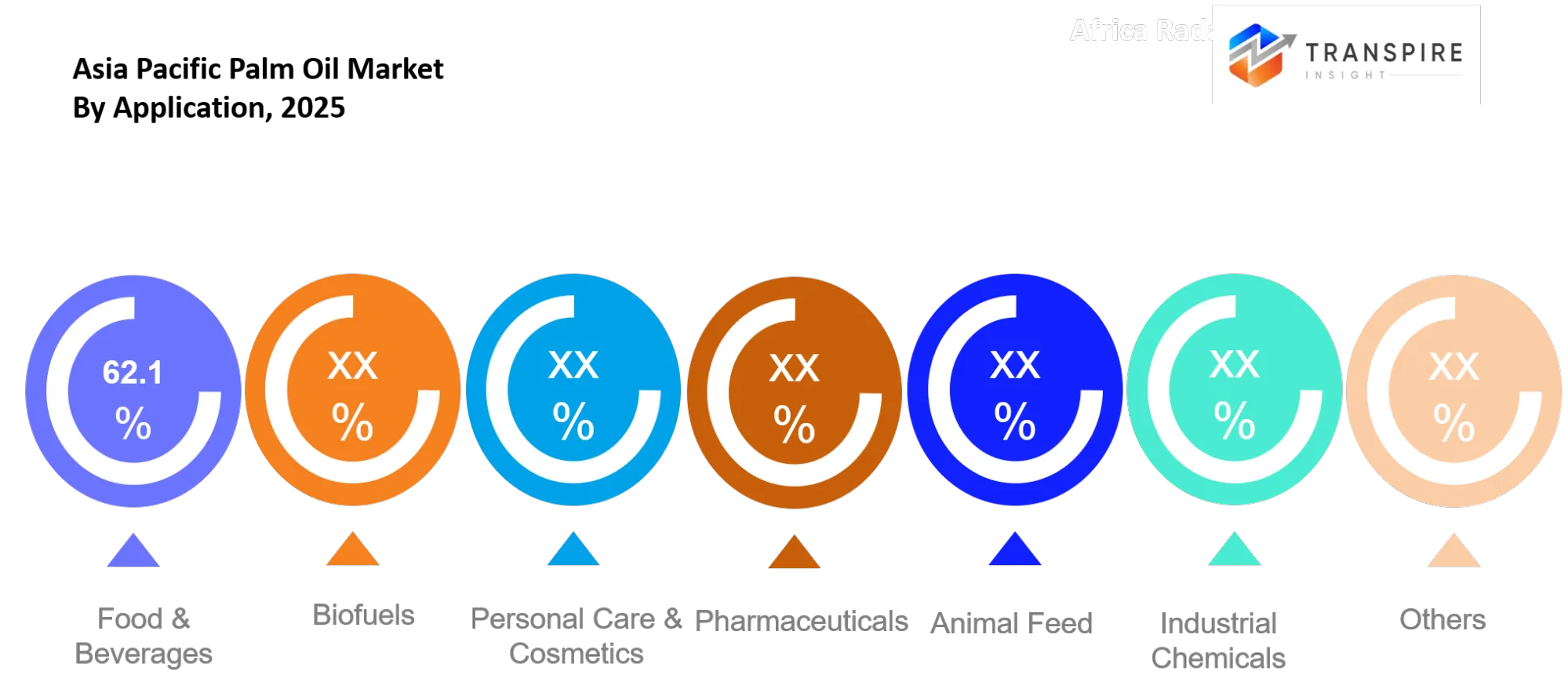
By Distribution Channel :
Food & Beverages stayed the leading application, because palm oil provides that kinda stability , long shelf life, and it stays cost-effective for processing cooking oils, bakery products , confectionery and packaged foods. In many developing economies, large scale food manufacturing investments kind of kept coming, so long-term consumption was reinforced. And yeah, continuous product innovation kept pushing palm oil further into processed food categories, not just the basics. With growing urban food production, demand should stay solid through the whole forecast period.
Biofuels showed up as the fastest-growing application , especially when biodiesel blending programs expanded across multiple regional economies. Government renewable fuel targets essentially nudged refiners to channel more output into energy use. Personal Care & Cosmetics and Pharmaceuticals kept moving upward too, mostly thanks to higher production of specialty ingredients. Meanwhile, Animal Feed held steady, because livestock industries remained consistent. Industrial Chemicals also got more traction, with broader adoption of oleochemicals, lubricants, and bio-based manufacturing materials.
By End User :
Food Manufacturers showed up as the main end-user slice, mainly because raw material availability stayed fairly steady so that large-scale production of edible oils, processed foods, snacks, and bakery products could run smoothly. As packaged food manufacturing keeps expanding in many areas, commercial consumption sort of goes up across developing economies too. Those long term procurement contracts, they also helped keep production steady. And with ongoing investment in processing facilities, this segment’s leadership should stay intact, more or less.
Biodiesel Producers turned out to be the fastest movers, because renewable fuel policies pushed for higher domestic palm oil usage. Cosmetic Companies kept raising their purchases for skincare, haircare, and personal care item manufacturing, meanwhile the Chemical Industry also broadened its need for oleochemical production. Retail Consumers still kept household consumption fairly stable, especially when it comes to packaged cooking oil products. Then, other industrial users added more demand, like for specialized manufacturing applications that don’t really fit the usual categories.
By Certification :
Conventional Palm Oil stayed as the leading certification category, mainly because the production networks that were already in place and the fairly competitive pricing helped move big commercial volumes through both food and industrial uses. The existing refining infrastructure kind of nudged things along too, it really favored the usual supply chains. Even with procurement requirements that kept shifting, strong domestic consumption basically held market leadership in position. Big producers kept tuning up their production efficiency, so they could stay competitive without drifting too far.
RSPO Certified Palm Oil showed the quickest growth, especially when big international food companies and well known consumer brands doubled down on certified sourcing commitments. Sustainable Palm Oil, meanwhile, was more and more accepted commercially, helped by tougher procurement rules and export market expectations. Organic Palm Oil kept working well for premium food and personal care manufacturers that want higher value options. The other certification categories also mattered for niche buyers , where traceability plus verified production practices add more market value for specific customers.
What are the Key Use Cases Driving the Asia Pacific Palm Oil Market?
The Asia Pacific Palm Oil Market actually gets its biggest demand share from the food and beverage side, like for cooking oils, bakery items, instant noodles, confectionery, and a lot of processed foods. You’ll notice food makers, quick-service restaurants, and even regular household buyers use palm oil because it stays consistent, it has that long shelf life, and it’s cost efficient for big production volumes—especially with urban markets growing fast.
Demand is going up in personal care too, and also in biofuel. In cosmetics and skincare, companies rely on palm oil derivatives for soaps, shampoos, and creams since they bring real functional benefits. For biodiesel, producers are steadily raising how much they use as governments push renewable fuel blending goals, so they can cut back on traditional fossil fuels and also support lower emission transport.
At the same time, some emerging chances are forming around sustainable specialty ingredients and newer industrial applications. Certified sustainable palm oil is starting to get more attention, mainly from multinational consumer goods firms that want stronger environmental compliance across their supply chains ,and they want it earlier rather than later. Also, work on bio-based chemicals, biodegradable materials, and specialty oleochemicals should generate fresh demand from manufacturers aiming at circular production and whatever sustainability rules keep changing.
|
Report Metrics |
Details |
|
Market size value in 2025 |
USD 57.82 Billion |
|
Market size value in 2026 |
USD 61.10 Billion |
|
Revenue forecast in 2033 |
USD 89.92 Billion |
|
Growth rate |
CAGR of 5.68% from 2026 to 2033 |
|
Base year |
2025 |
|
Historical data |
2021 - 2024 |
|
Forecast period |
2026 - 2033 |
|
Report coverage |
Revenue forecast, competitive landscape, growth factors, and trends |
|
Regional scope |
Asia Pacific (India, China, Japan, Australia, South Korea, Rest of Asia Pacific) |
|
Key company profiled |
Wilmar International, Sime Darby Plantation, Golden Agri-Resources, Musim Mas, IOI Corporation, KLK Oleo, Apical Group, Bunge, Cargill, ADM, PT Astra Agro Lestari, Indofood Agri Resources, GAR, Felda Global Ventures, Louis Dreyfus Company . |
|
Customization scope |
Free report customization (country, regional & segment scope). Avail customized purchase options to meet your exact research needs. |
|
Report Segmentation |
By Product Type (Crude Palm Oil, Palm Kernel Oil, Refined Palm Oil, Palm Olein, Palm Stearin, Palm Fatty Acids, Others); By Application (Food & Beverages, Biofuels, Personal Care & Cosmetics, Pharmaceuticals, Animal Feed, Industrial Chemicals, Others); By Distribution Channel (Direct Sales, Distributors, Commodity Traders, Online Procurement, Others); By End User (Food Manufacturers, Biodiesel Producers, Cosmetic Companies, Chemical Industry, Retail Consumers, Others); By Certification (Conventional Palm Oil, RSPO Certified Palm Oil, Organic Palm Oil, Sustainable Palm Oil, Others) |
Which Regions are Driving the Asia Pacific Palm Oil Market Growth?
The Asia Pacific Palm Oil Market is sorta led by Southeast Asia, bringing in around 68–72% of the regional revenue, while Indonesia and Malaysia provide the biggest volumes. There’s strong government support for plantation development, export frameworks, and also the biodiesel blending mandates which has reinforced production dominance in the area. It’s like an integrated ecosystem of plantation operators, refiners, processors, ports, and export logistics, and this is backed by ongoing investment in downstream processing, so supply stays efficient for both domestic and international buyers. If refining capacity keeps expanding, productivity keeps improving, and export demand remains steady, then Southeast Asia should keep its leadership role through the forecast period.
Meanwhile East Asia sits as the second-largest regional market, and it’s mainly driven by large scale food manufacturing and industrial consumption, more than upstream cultivation. Food safety regulations are stable, import policies are predictable and consumer demand stays resilient, so palm oil suppliers get a business environment that feels dependable. There are extensive refining facilities, established distribution networks, and long term procurement contracts, all helping secure consistent purchasing across food processing, personal care, and oleochemical industries. Continued investment in manufacturing efficiency, plus value added processing, will keep East Asia as a steady revenue contributor even though domestic production is limited.
South Asia is expected to see the swiftest growth from 2026 to 2033, with rising food consumption, more refining capacity, and policy moves meant to boost edible oil security all pushing imports and also domestic processing along. At the same time, rapid urbanization and the growing demand from packaged food , bakery, and quick-service restaurant sectors have built up real momentum in the market across key economies like India.
Meanwhile investments in port infrastructure, storage facilities, and more connected edible oil supply chains are raising distribution efficiency, and yes that also helps consumption climb higher. This faster-pace demand should end up making solid opportunities for exporters, refiners, and investors, especially those hunting longer-term expansion in high-growth consumer markets.
Who are the Key Players in the Asia Pacific Palm Oil Market and How Do They Compete?
In the Asia Pacific Palm Oil market , competition is kind of moderately consolidated, so only a few big integrated players sit on a lot of the plantation, refining, and export ability. At the same time, regional processors still hustle in more specific downstream spaces , where they can be quicker or more niche. What usually decides who wins is cost efficiency, vertically linked supply routes, sustainability certification, and basically how far they can reach geographically. The longer-standing producers keep pushing to hold and grow market share via productivity upgrades, adding more steps in the downstream, and doing sustainability work too. Meanwhile, the smaller regional companies are moving further into higher value uses, like food ingredients and oleochemical applications.
For example , Wilmar International makes a big point of being fully integrated, from plantations to refining, manufacturing, and distribution across Asia. This setup helps with cost control , and it keeps product availability more stable. Sime Darby Plantation leans hard on certified sustainable production, precision agriculture, and traceable sourcing, which helps them keep strong ties with multinational food firms and consumer goods manufacturers. Golden Agri-Resources on the other hand grows its competitive position through responsible sourcing programs, digital management across plantations, and also investments in downstream palm products with more value, so they can better match the way customer needs are changing.
First Resources really puts the weight on operational efficiency, and kind of disciplined plantation management, so they can keep competitive production costs while also pushing refining capabilities in the strategic export markets, you know. On the other side Musim Mas, keeps building its own kind of differentiation via specialty palm derivatives, plus a lot of oleochemical processing, and then partnerships that help with supply chain clarity and sustainability compliance. Looking ahead, further investments in certified production, downstream processing, and regional distribution networks will stay pretty central for competitive positioning, even as demand shifts toward higher-value palm oil products that are more sustainably sourced.
Company List
- Wilmar International
- Sime Darby Plantation
- Golden Agri-Resources
- Musim Mas
- IOI Corporation
- KLK Oleo
- Apical Group
- Bunge
- Cargill
- ADM
- PT Astra Agro Lestari
- Indofood Agri Resources
- GAR
- Felda Global Ventures
- Louis Dreyfus Company
Recent Development News
In February 2026, Musim Mas and Nanyang Technological University (NTU) Singapore launched a multi-year partnership to improve sustainable palm oil production through research and smallholder engagement. The collaboration strengthens innovation, sustainability practices, and long-term productivity across the regional palm oil value chain.
Source https://www.musimmas.com/
In May 2025, Musim Mas, Ferrero, Preferred by Nature, Agriterra, the Sustainable Agriculture Network (SAN), and the Danish Government launched the Rokan Hulu Landscape and Livelihoods Initiative. This strategic partnership promotes sustainable palm oil production, strengthens independent smallholder resilience, and supports compliance with the EU Deforestation Regulation (EUDR), enhancing the competitiveness of Indonesia's palm oil sector. Source https://www.musimmas.com/
What Strategic Insights Define the Future of the Asia Pacific Palm Oil Market?
Over the next five to seven years, the Asia Pacific Palm Oil Market will likely shift into something that’s more value-driven and sustainability focused , with regulatory compliance and traceability mandates mattering more than just bumping up production. At the same time, downstream processing is becoming a bigger deal, kind of like the background “engine” behind where demand settles. Competitive advantage will, more and more, hinge on certified supply routes, better productivity, and a move toward higher value segments in food, personal care, and oleochemical uses.
There’s also a risk that feels less obvious at first glance, basically the heavy concentration of global supply in just a few producing countries. If weather patterns get erratic, labor shortages show up, or land-use rules start changing, availability can get hit. That in turn can push price volatility onto regional buyers, even if they are not the ones making the immediate production decisions.
On the opportunity side, something new is beginning to take shape: digitally verified sustainable palm oil, along with low-carbon processing options. This is tied to international procurement standards that are getting stricter year after year. Companies that act early—by investing in traceability tools, building certified sourcing partnerships, and accelerating downstream product innovation—can improve resilience while also capturing premium demand from export-oriented manufacturers.
Asia Pacific Palm Oil Market Report Segmentation
By Product Type
- Crude Palm Oil
- Palm Kernel Oil
- Refined Palm Oil
- Palm Olein
- Palm Stearin
- Palm Fatty Acids
By Application
- Food & Beverages
- Biofuels
- Personal Care & Cosmetics
- Pharmaceuticals
- Animal Feed
- Industrial Chemicals
By Distribution Channel
- Direct Sales
- Distributors
- Commodity Traders
- Online Procurement
By End User
- Food Manufacturers
- Biodiesel Producers
- Cosmetic Companies
- Chemical Industry
- Retail Consumers
By Certification
- Conventional Palm Oil
- RSPO Certified Palm Oil
- Organic Palm Oil
- Sustainable Palm Oil
Frequently Asked Questions
Find quick answers to common questions.
The Expected Asia Pacific Palm Oil Market size for the Market will be USD 89.92 Billion in 2033.
Key Segments for the Asia Pacific Palm Oil Market are By Product Type (Crude Palm Oil, Palm Kernel Oil, Refined Palm Oil, Palm Olein, Palm Stearin, Palm Fatty Acids, Others); By Application (Food & Beverages, Biofuels, Personal Care & Cosmetics, Pharmaceuticals, Animal Feed, Industrial Chemicals, Others); By Distribution Channel (Direct Sales, Distributors, Commodity Traders, Online Procurement, Others); By End User (Food Manufacturers, Biodiesel Producers, Cosmetic Companies, Chemical Industry, Retail Consumers, Others); By Certification (Conventional Palm Oil, RSPO Certified Palm Oil, Organic Palm Oil, Sustainable Palm Oil, Others).
Major Asia Pacific Palm Oil Market Players are Wilmar International, Sime Darby Plantation, Golden Agri-Resources, Musim Mas, IOI Corporation, KLK Oleo, Apical Group, Bunge, Cargill, ADM, PT Astra Agro Lestari, Indofood Agri Resources, GAR, Felda Global Ventures, Louis Dreyfus Company.
The Current Asia Pacific Palm Oil Market size is USD 57.82 Billion in 2025.
The Asia Pacific Palm Oil Market CAGR is 5.68% from 2026 to 2033.
- Wilmar International
- Sime Darby Plantation
- Golden Agri-Resources
- Musim Mas
- IOI Corporation
- KLK Oleo
- Apical Group
- Bunge
- Cargill
- ADM
- PT Astra Agro Lestari
- Indofood Agri Resources
- GAR
- Felda Global Ventures
- Louis Dreyfus Company
About the Authors

Chetan Dhatrak
I’m Chetan Dhatrak, a Senior Research Analyst at Transpire Insight, specializing in the Consumer Goods, Foods and Beverages industry. I focus on analyzing market trends, consumer behavior, competitive landscapes, and industry developments to deliver accurate, data-driven insights. My research at Transpire Insight is built on credible sources and in-depth analysis, helping businesses and readers better understand market dynamics, emerging opportunities, and evolving consumer preferences. I’m committed to creating reliable, well-researched content that supports informed decision-making and reflects the latest developments in the consumer goods and food & beverage sectors.

Chakradhar Khansole
Chakradhar serves as the Research Director at Transpire Insight, bringing over 8 years of experience in technology, innovation, and strategic market intelligence. He specializes in transforming complex market data into actionable business insights that enable organizations to make informed, growth-oriented decisions. Recognized for his strategic vision and analytical expertise, Chakradhar leads high-impact research initiatives, delivering comprehensive market assessments, competitive intelligence, and forward-looking industry analysis.
Recently Published Reports
-
Apr 2026
Baby Infant Formula Market
Baby Infant Formula Market Size, Share & Analysis Report By ype (Infant Milk, Follow On Milk, Specialty Baby Milk, Growing-Up Milk), By Ingredient (Carbohydrate, Fat, Protein, Minerals, Vitamins, and Others), By Product Form (Powder, Liquid, and Ready-to-feed), By Distribution Channels (Supermarket/Hypermarket, Specialty Store, Pharmacies, Online Retail, and Others), and Geography (North America, Europe, Asia-Pacific, Middle East and Africa, South and Central America), 2021 - 2031
-
Apr 2026
Edible Insects for Animal Feed Market
Edible Insects for Animal Feed Market Size, Share & Analysis Report By Type (Insect Powder, Insect Meal, Insect Bar, Insect Paste, Insect Oil, and Others), By Insect Type (Beetles, Cricket, Caterpillar, Hymenoptera, Orthoptera, Tree Bugs, and Others), By Application (Livestock, Pet Food, and Aquaculture), By Livestock Type (Poultry, Swine, and Others), and Geography (North America, Europe, Asia-Pacific, Middle East and Africa, South and Central America), 2021 - 2031
-
Apr 2026
Food Industry Disinfection and Bacterial Control Market
Food Industry Disinfection and Bacterial Control Market Size, Share & Analysis Report By Type (Chemical Disinfectants, Physical Disinfectants, and Biocides and Antimicrobials), By Application (Food Processing Equipment Surface Disinfection, Food Preparation Areas Surface Disinfection, Storage Areas Surface Disinfection, Anti-microbial Coatings Food Preservation, and Preservative Solutions Food Preservation), By End User (Meat and Poultry Processing, Dairy Processing, Seafood Processing, Bakery and Confectionery, Restaurants and Commercial Kitchens, and Food Service Providers), By Sales Channel (Online, Offline), and Geography (North America, Europe, Asia-Pacific, Middle East and Africa, South and Central America), 2021 - 2031
-
May 2026
Freeze Dried Food Market
Freeze Dried Food Market Size, Share & Analysis Report By Product Type (Fruits, Vegetables, Freeze-Dried Dairy Products, Freeze-Dried Meat and Seafood, Freeze-Dried Pet Food, and Prepared Meal), By Nature (Organic, and Conventional), By Form (Powdered, Granules, and Diced), By End Use (Breakfast Cereals, Dairy Products, Bakery & Confectionery, Nutritional Bars & Supplements, Powdered Beverages, Snacks, and Retail (Household)), and Geography (North America, Europe, Asia-Pacific, Middle East and Africa, South and Central America), 2021 - 2031