
Global Natural Oil Polyols Market Size & Forecast
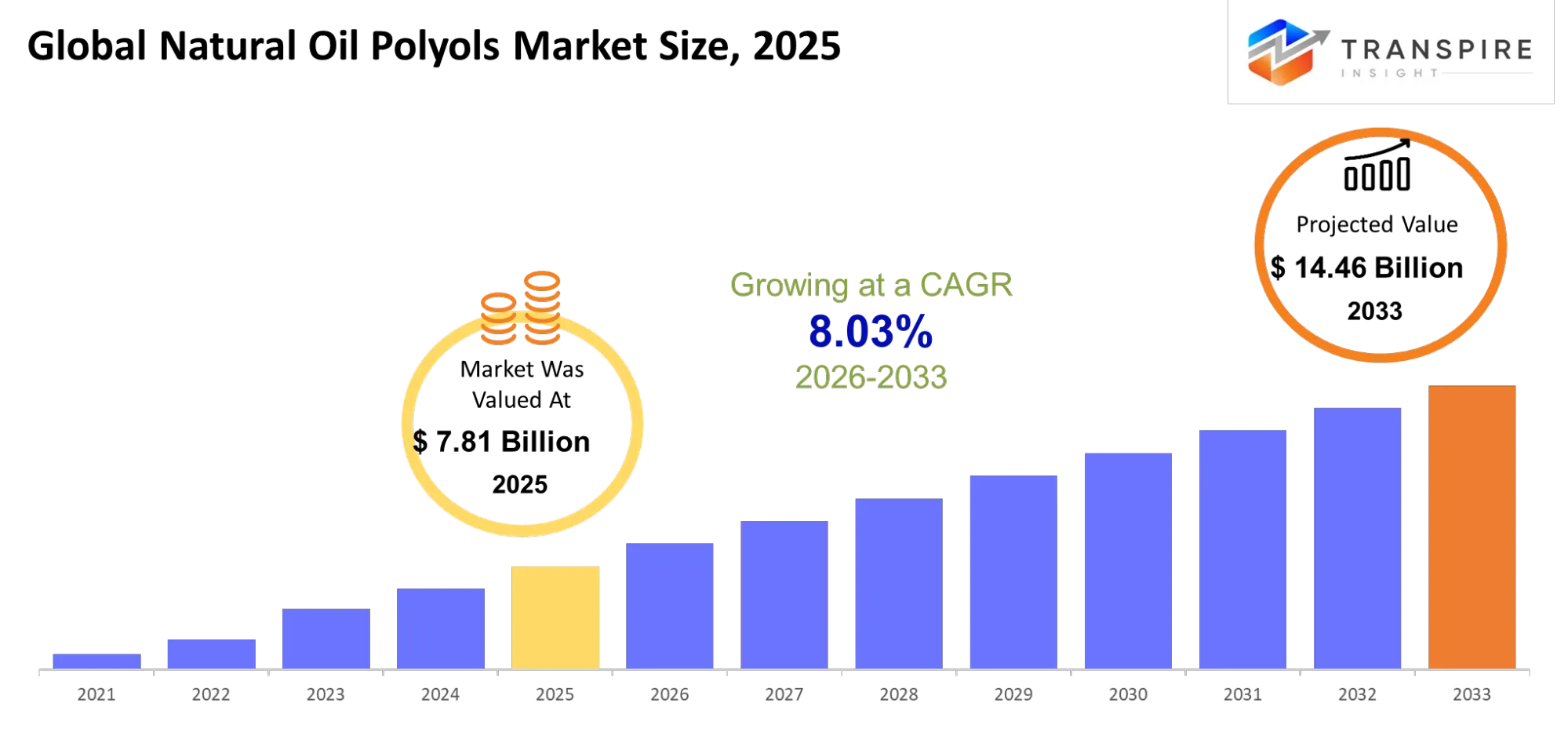
- Global Natural Oil Polyols Market Size 2025: USD 7.81 Billion
- Global Natural Oil Polyols Market Size 2033: USD 14.46 Billion
- Global Natural Oil Polyols Market CAGR: 8.03%
- Global Natural Oil Polyols Market Segments: By Oil Type (Soybean Oil, Palm Oil, Canola Oil, Sunflower Oil), By Application (Flexible Polyurethane Foam, Rigid Polyurethane Foam, Coatings & Adhesives), By End-User (Automotive, Construction, Furniture & Bedding)
To learn more about this report,  Download Free Sample Report
Global Natural Oil Polyols Market Summary
Natural oil polyols (NOPs) really do one thing well: they replace petroleum-derived polyols in polyurethane systems - thus enabling manufacturers to make foam, coatings, and adhesives with a noticeably lower fossil carbon footprint. The very real effect this creates isn't symbolic. For a furniture maker or an automotive seat supplier, switching from traditional polyols to ones based on soybeans or palm oil can decrease your lifecycle carbon intensity by up to 50 percent per kilogram of finished polyurethane - all without you needing to put money into new production lines.
The market shifted direction around 2021, when two major factors merged. First, the EU's Carbon Border Adjustment Mechanism went from a policy idea to a very likely legislative reality, forcing European manufacturers to calculate embedded carbon in their raw materials. Second, automotive OEMs - especially German and Japanese companies - started putting specific thresholds for bio-based content directly into their top-tier supplier contracts. This combination made bio-based polyols go from being a marketing preference to a procurement necessity. Soybean oil, which had an existing transesterification supply chain in North America for years, picked up about 41% of all adoption in the first round. The result is a market that now keeps growing because procurement teams demand it - not because customers ask for it.
Key Global Natural Oil Polyols Market Insights
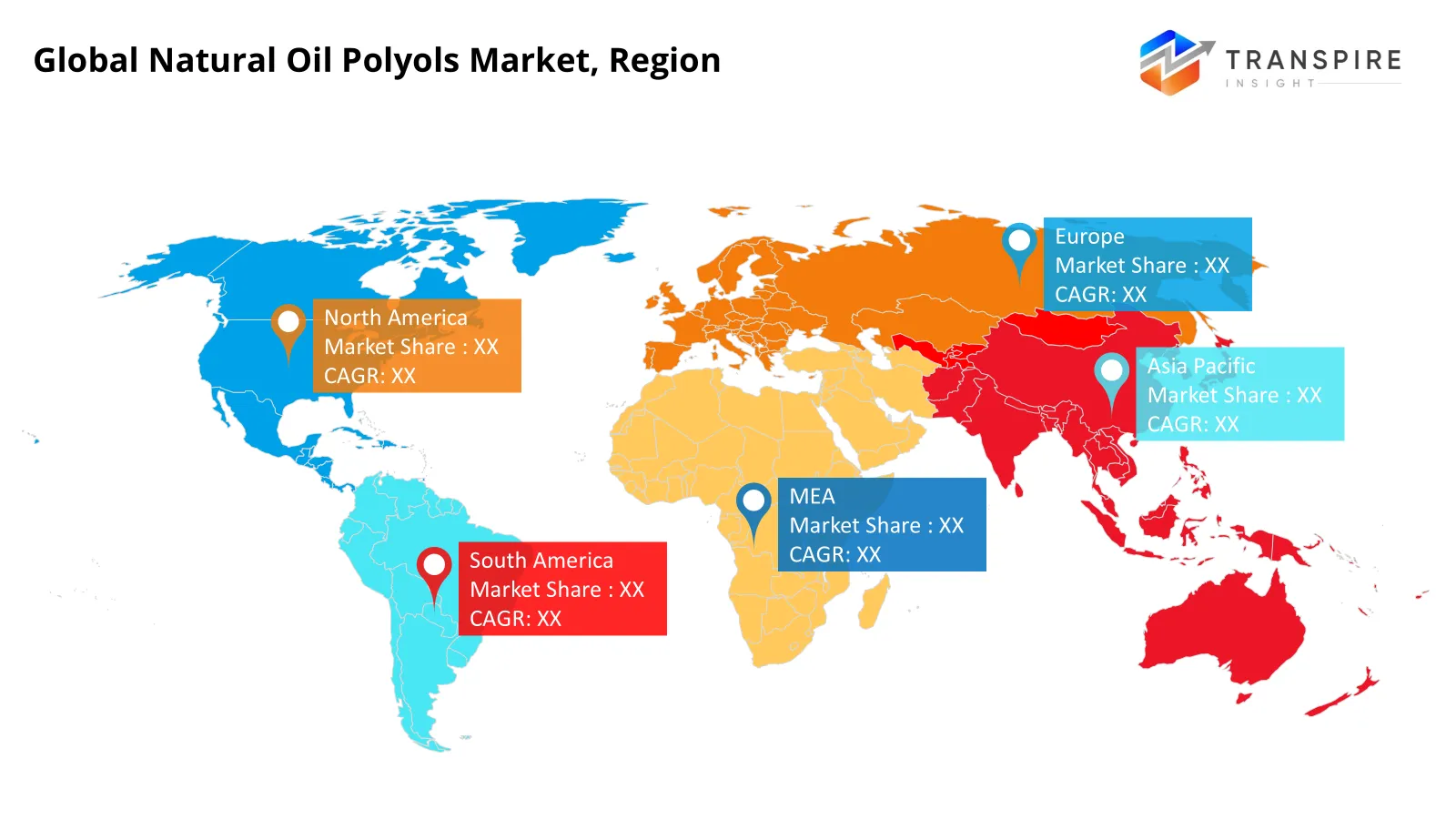
- North America dominates the global natural oil polyols market with a 36.2% share in 2024, backed by an established soybean processing infrastructure, active USDA BioPreferred program participation, and strong OEM-level sustainability commitments from Detroit-based automotive manufacturers.
- Asia Pacific is the fastest-growing region, projected to record an above-average CAGR through 2033, driven by expanding construction activity in India and Southeast Asia and rising domestic polyurethane foam production in China.
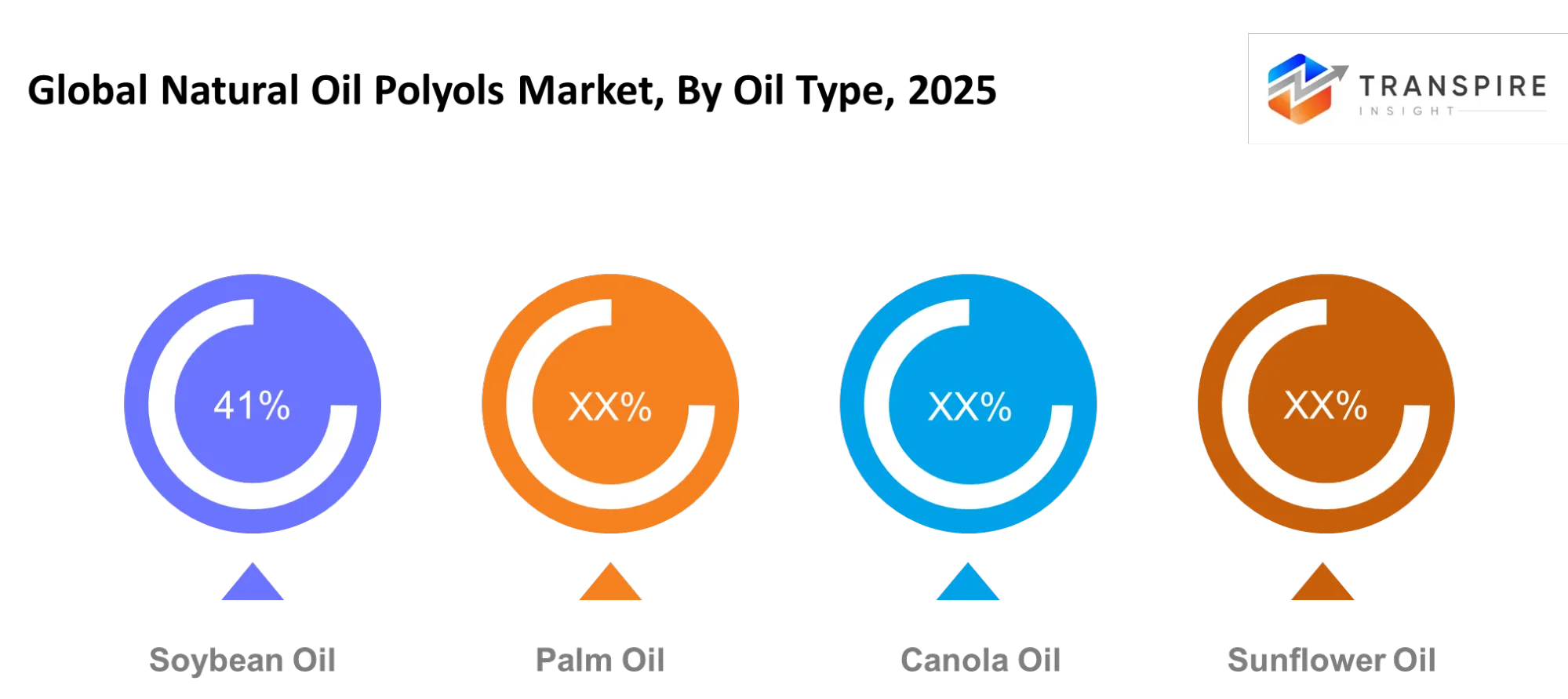
- Soybean oil leads the oil type segment with a 41% share in 2024. The United States soy processing industry gives this segment a scale and traceability advantage no other bio-based feedstock has yet matched in North American and European supply chains.
- Palm oil holds the second-largest oil type position at approximately 28% of the market in 2024, driven by cost competitiveness and established oleochemical infrastructure in Malaysia and Indonesia, though sustainability certification pressures are reshaping buyer preferences.
- Flexible polyurethane foam dominates the application segment accounting for over 48% of natural oil polyols demand in 2024. Automotive seating, furniture cushioning, and mattress applications drive the bulk of this volume.
- Rigid polyurethane foam is the fastest-growing application segment, with construction-grade insulation panels driving demand as green building standards tighten across Europe and North America from 2023 onward.
- Automotive is the leading end-user, with OEM programs at Ford, BMW, and Toyota requiring bio-based content in seating foam systems directly stimulating NOP procurement at tier-one suppliers.
- Construction is the fastest-growing end-user segment, as LEED and BREEAM certification programs increasingly reward embedded-carbon reductions in building insulation materials, creating a pull-through for bio-based rigid foam systems.
- Cargill Incorporated and BASF SE lead market share positions in 2024. Cargill's BiOH polyols line and BASF's Sovermol product family collectively account for a significant portion of commercially available NOP volume in North America and Europe.
- Dow Inc. and Huntsman Corporation are expanding NOP product lines through R&D investment in high-bio-content formulations targeting the rigid insulation and coatings segments, where fossil-based alternatives face increasing regulatory headwinds.
What are the Key Drivers, Restraints, and Opportunities in the Global Natural Oil Polyols Market?
The primary driver is automotive OEM procurement policies, not consumer sentiment. Starting in 2022, big vehicle manufacturers really did embed bio-based content thresholds into tier-one supplier qualification requirements. Ford's goal of 20 percent bio-based materials in interior components by 2025 and BMW's sustainability scorecard for foam suppliers both create pretty tough procurement floors that generate quite consistent NOP volume regardless of spot oil prices. This regulatory setup within the supply chain is even more durable than consumer preference - because it really can't be turned around at the next quarterly earnings call.
The structural constraint is feedstock price volatility, and the problem really goes deeper than commodity cycles. Soybean and palm oil prices correlate with food market conditions, so NOP input costs can actually spike during drought years or when biofuel mandates redirect agricultural supply. Unlike a petrochemical polyol producer that can forward-hedge crude oil, NOP manufacturers face a basis risk between agricultural commodity indices and polyurethane-grade processed inputs that no standard financial instrument currently resolves cleanly. This makes multi-year fixed pricing quite difficult to offer - which in turn slows adoption among cost-sensitive buyers in construction and furniture markets.
The clearest opportunity actually lies in green building insulation, specifically in the rigid foam segment serving commercial construction. The European Energy Performance of Buildings Directive was recast in 2023 and now mandates near-zero energy status for commercial buildings undergoing major renovation. Rigid polyurethane panels made with high-NOP content already meet thermal performance specs comparable to fossil-based equivalents, and several European insulation manufacturers, including Recticel and Kingspan, have actually signaled intent to source bio-based polyol inputs. That demand, once it really moves from signalling to contract, represents a volume shift that could easily rival the automotive segment by 2030.
What Has the Impact of Artificial Intelligence Been on the Global Natural Oil Polyols Market?
Artificial intelligence really shows its face at the formulation and quality control stage. BASF and Cargill both use AI-assisted molecular modeling to speed up the development of NOP formulations that match the mechanical properties of petroleum-based polyols over hardness, resilience, and thermal stability parameters. What previously required around 18 to 24 months of laboratory iteration now takes significantly less time with generative chemistry platforms that forecast hydroxyl number outcomes even before any physical batch is produced.
Predictive process control is a second busy application. NOP production involves transesterification or hydroxylation reactions that are very sensitive to feedstock oil composition - which varies seasonally quite a bit. AI models trained on sensor data from continuous reactors now adjust catalyst dosing and residence time in real time, reducing off-spec batch rates in commercial facilities greatly. Cargill has actually reported noticeable reductions in process waste at its soy polyol facilities, though exact figures are not made public.
The current bottleneck is model transferability. An AI system trained on soybean oil chemistry does not transfer very well to palm or canola feedstocks without retraining, since fatty acid profiles differ quite a lot between oil types. For manufacturers operating multi-feedstock production schedules, this means the cost of AI deployment really multiplies with feedstock diversity instead of being split across different product lines. Until foundation models for oleochemical process chemistry become available, the efficiency gains remain feedstock-specific and hard to scale across the whole NOP product portfolio.
Key Market Trends
- Automotive OEM bio-content mandates shifted NOP from an optional specification to a default procurement requirement at tier-one foam suppliers in 2022 and 2023.
- Palm oil's market share faces compression as RSPO certification requirements tighten buyer acceptance in European markets, redirecting volume toward certified soy and canola sources.
- Rigid foam applications grew as a share of total NOP demand after 2022, reflecting building insulation investment tied to post-pandemic construction recovery and energy efficiency regulations.
- Cargill's BiOH polyols line expanded commercial availability in Asia Pacific from 2023, signaling supply chain development beyond the North American and European core markets.
- Coatings and adhesives emerged as the fastest-growing application sub-segment from 2023, driven by architectural coatings manufacturers seeking bio-based inputs for low-VOC, sustainable product lines.
- BASF and Dow both launched higher-bio-content NOP grades in 2023 and 2024, targeting 50 percent or greater renewable content formulations for next-generation foam systems.
- Furniture and bedding end-users began shifting toward certified bio-based foam specs in 2023 as retail brand sustainability commitments created pull-through demand at the foam converter level.
- Canola oil is gaining share in Canadian and European NOP production as non-GMO certification and shorter transport routes create a differentiated value proposition versus soy imports.
- Investors directed capital toward NOP production capacity in Southeast Asia in 2023 and 2024, particularly in facilities that could serve both the export market and domestic Indonesian and Vietnamese polyurethane industries.
Global Natural Oil Polyols Market Segmentation
By Oil Type
Soybean oil will hold a 41% share of the global natural oil polyols (NOP) market in 2024 - and that position really reflects both infrastructure advantages as well as the chemical properties of the oil itself. The US soy processing industry operates at a very large scale that no other bio-based feedstock can match right now, and the existing transesterification supply chain lets buyers get soy-based polyols with very detailed, USDA-certified documentation about their bio-content. That traceability matters greatly to automotive OEMs who perform regular supplier audits. Soybeans will keep their leading position through 2033, though the margin of dominance may narrow as alternative feedstocks continue to scale up.
Palm oil claims about 28% of global NOP feedstock volume and has a cost-per-unit price advantage over soy in Asian markets where palm oleochemical infrastructure is already well-established. Malaysian and Indonesian producers supply palm-based polyols to Chinese and Southeast Asian polyurethane converters at prices that soy-based alternatives just can't match on a per kilogram basis. However, pressure from European buyers demanding RSPO certification is creating a two-tier market: certified palm gets a premium, uncertified palm is starting to be excluded from European supply chains. That dynamic is actually compressing palm's addressable market in the West even as it grows in Asia more.
Canola oil represents a smaller yet still expanding segment, particularly in Canada and Northern Europe, where non-GMO certification and favorable fatty acid profiles for polyol chemistry make a very unique product. Sunflower oil occupies a rather niche position, with adoption concentrated in Eastern Europe and limited somewhat by the relatively smaller scale of sunflower processing infrastructure. Both canola and sunflower segments will grow much faster than soy or palm through 2033 - but they'll start from a much smaller base because specialty applications are increasingly demanding non-GMO and regionally sourced bio-based inputs.
To learn more about this report, Download Free Sample Report
By Application
Flexible polyurethane foam accounts for over 48 percent of global NOP demand in 2024 and generates more volume than any other application because it serves the two highest-throughput end markets simultaneously: automotive seating and residential furniture. The economics work for both buyers and sellers. Automotive foam converters gain a supplier qualification advantage when they can document bio-based content percentages to OEM customers. Furniture makers gain a brand story for retail. The result is a demand base that compounds across two distinct customer types rather than depending on a single vertical.
Rigid polyurethane foam is growing faster than flexible foam because the regulatory environment for building insulation is tightening independently of consumer demand. Commercial buildings undergoing energy retrofits in Europe and North America increasingly specify rigid foam panels, and developers of green-certified buildings actively seek bio-based inputs to lower embedded carbon scores. The rigid segment remains smaller than flexible in absolute volume, but its growth rate will exceed the market average through 2033 as building energy codes tighten globally.
Coatings and adhesives represent the smallest of the three defined application segments but show the highest growth momentum from 2023 onward. Architectural coatings manufacturers face pressure to reduce VOC content and petrochemical inputs simultaneously, and NOP-derived polyols address both requirements in a single formulation change. Adhesives applications, particularly in wood panel manufacturing and automotive interior assembly, are following a similar trajectory as low-emission certifications become standard purchasing criteria in European and North American markets.
By End-User
The automotive end-user segment leads the market because OEM-level sustainability procurement programs create a direct and measurable pull on NOP volume. Ford, BMW, Toyota, and Hyundai have each published interior component sustainability targets that require bio-based content documentation from seat foam suppliers. This contractual demand mechanism is fundamentally different from market-driven adoption: it does not slow down when commodity prices rise or when economic conditions soften, because supplier qualification requirements do not pause for economic cycles.
The construction segment is the fastest-growing end-user category. Building insulation demand is expanding on two tracks: new construction activity in Asia Pacific, and retrofit-driven insulation upgrades in Europe and North America. Both tracks favor rigid foam systems, which increasingly specify bio-based polyol inputs as green building certification programs reward embedded-carbon reduction. The construction segment's share of total NOP demand will grow from approximately 24 percent in 2024 to a higher position by 2033 as building energy standards tighten across major markets.
Furniture and bedding end-users account for a stable share of the market and adopt NOP-based foam primarily through retail brand sustainability commitments rather than regulatory mandates. Large furniture retailers, including IKEA, have published bio-based material sourcing targets that cascade into foam converter procurement decisions. The bedding segment is showing similar movement, with mattress brands seeking bio-content certifications as consumer awareness around chemical content in sleep products increases. Growth in this segment is steadier and less cyclical than automotive but slower than construction.
What are the Key Use Cases Driving the Global Natural Oil Polyols Market?
The most widely used application scenario is the production of automotive seat foam using NOP-derived flexible polyurethane foam. Tier-one seat system providers use this kind of foam so as to satisfy OEM bio-content standards that are actually written into the supplier qualification contracts themselves. A vehicle seat will consume approximately four to six kilograms of foam across both the cushion and backrest parts - creating a very concentrated demand point per vehicle which, when multiplied by the overall global production numbers, really forms the largest individual use case in the entire NOP market. The economic considerations further encourage its use: soy-based polyols often have a relatively small price premium compared to their petroleum-based counterparts - yet that extra cost is more often than not absorbed into the OEM sustainability scorecard rather than being considered as a pure increase in costs.
Other notable applications are residential mattress foam and commercial building insulation panels. In mattresses, foam converters providing branded products with bio-content marketing commitments really push NOP adoption right across the furniture and bedding customer segment itself. In construction, makers of rigid foam boards serving large commercial retrofit projects in Germany, France, and the UK are actively testing and qualifying new NOP-based formulations as a method to reduce the life-cycle carbon scores in the building material declarations themselves.
The emerging use case is soy-based adhesives for engineered wood panel production. Cross-laminated timber (CLT) and laminated veneer lumber (LVL) manufacturing demands high-performance adhesive systems - and several European CLT producers are starting to evaluate NOP-based polyurethane adhesives so as to decrease the formaldehyde content and also improve the environmental product declarations at the same time. This application is in the initial qualification stages, but the sheer amount of investment in wood construction in Europe and North America really gives it immense long-term potential itself.
Report Overview Table
|
Report Metrics |
Details |
|
Market size value in 2025 |
USD 7.81 Billion |
|
Market size value in 2026 |
USD 8.42 Billion |
|
Revenue forecast in 2033 |
USD 14.46 Billion |
|
Growth rate |
CAGR of 8.03% from 2026 to 2033 |
|
Base year |
2025 |
|
Historical data |
2021 – 2024 |
|
Forecast period |
2026 – 2033 |
|
Report coverage |
Revenue forecast, competitive landscape, growth factors, and trends |
|
Regional scope |
United States; Canada; Mexico; United Kingdom; Germany; France; Italy; Spain; Denmark; Sweden; Norway; China; Japan; India; Australia; South Korea; Thailand; Brazil; Argentina; South Africa; Saudi Arabia; United Arab Emirates |
|
Key companies profiled |
Cargill Incorporated, BASF SE, Dow Inc., Huntsman Corporation, Emery Oleochemicals Group, Jayant Agro-Organics Ltd., Mitsui Chemicals Inc., Arkema S.A., Stepan Company, Croda International plc, Oleon NV, Emery Oleochemicals LLC, Elevance Renewable Sciences Inc., Johnson Matthey Plc, Global Bio-Chem Technology Group Co. Ltd. |
|
Customization scope |
Free report customization (country, regional & segment scope). Avail customized purchase options to meet your exact research needs. |
|
Report Segmentation |
By Oil Type (Soybean Oil, Palm Oil, Canola Oil, Sunflower Oil), By Application (Flexible Polyurethane Foam, Rigid Polyurethane Foam, Coatings & Adhesives), By End-User (Automotive, Construction, Furniture & Bedding) |
Which Regions are Driving the Global Natural Oil Polyols Market Growth?
North America stands out globally as the leader in the natural oil polyols market - its foundation is more structural than cyclical. The U. S. soybean processing industry manufactures refined oil inputs on an enormous scale giving natural feedstock cost advantages to NOP manufacturers operating in the region itself. USDA BioPreferred certification provides a government-backed procurement preference that channels federal purchasing toward bio-based products, including NOP-derived foam components. Automotive production is concentrated in the US Midwest and Southern states placing vehicle seat foam converters close geographically to soy polyol manufacturing, reducing logistics costs and making possible just-in-time supply arrangements that fossil-based polyol producers based in the Gulf Coast have trouble replicating.
Europe contributes a fairly stable and increasing revenue share driven by regulatory pressure rather than feedstock cost advantage. The European Union's Green Deal and the Energy Performance of Buildings Directive create a compliance environment that rewards bio-based inputs across construction, automotive, and consumer goods sectors simultaneously. European NOP demand differs from North America in one key aspect: the feedstock mix is much more diverse, with canola oil and locally sourced sunflower oil competing alongside imported soy and palm, because European buyers put a lot more emphasis on regional sourcing and non-GMO certification. This makes a more complex procurement environment - but also a premium pricing structure that supports higher margins for specialty NOP producers.
Asia Pacific is the fastest-growing region, and this change has been most apparent since 2022. India's construction boom, driven by urban infrastructure investment under the National Infrastructure Pipeline, creates direct demand for rigid foam insulation in commercial and residential building projects. China's domestic polyurethane industry has been very actively qualifying bio-based inputs as environmental regulations become tighter and international customers apply supply chain sustainability expectations on Chinese manufacturers. For market entrants and investors, Asia Pacific offers the highest volume growth potential through 2033, but the region really remains a net importer of commercially produced NOP, creating a supply gap that new production capacity in Malaysia, Indonesia, and India is starting to fill.
To learn more about this report, Download Free Sample Report
Who are the Key Players in the Global Natural Oil Polyols Market and How Do They Compete?
The global natural oil polyols market is moderately concentrated at the top, with Cargill and BASF holding the largest commercially established positions, while a second tier of chemical companies including Dow, Huntsman, Arkema, and Stepan compete for application-specific segments. Competition does not hinge primarily on price. The differentiating factors are bio-content certification documentation, formulation consistency across production batches, and the ability to offer technical service support for customers adapting polyurethane systems from fossil to bio-based polyol inputs. Smaller regional producers, including Oleon and Jayant Agro-Organics, compete on geographic proximity and specialty feedstock access rather than trying to match the volume or service infrastructure of global chemical companies.
Cargill competes on feedstock integration. Its BiOH polyols platform sources soybean oil directly from Cargill's agricultural supply chain, enabling full traceability documentation from farm to finished polyol. That integration gives Cargill a credibility advantage with automotive OEMs running supplier audits and a cost advantage in North American markets where soy logistics are optimized. BASF differentiates through formulation breadth: its Sovermol NOP product range covers multiple hydroxyl number grades and bio-content levels, allowing BASF to serve both flexible and rigid foam applications from a single product family, reducing the qualification burden for customers using BASF polyols across multiple production lines.
Dow and Huntsman are both expanding NOP product lines through internal R&D rather than acquisition, targeting higher-bio-content formulations in the 50 to 80 percent renewable content range. Elevance Renewable Sciences, using metathesis chemistry derived from natural oils, occupies a distinct technical position, producing specialty polyols for coatings and adhesives that compete on performance rather than cost. Jayant Agro-Organics in India and Global Bio-Chem Technology in China represent the geographic expansion layer, serving domestic markets where established Western brands have limited distribution but where NOP demand is growing as regional polyurethane manufacturers face sustainability expectations from export customers.
Global Natural Oil Polyols Market Companies
- Cargill Incorporated
- BASF SE
- Dow Inc.
- Huntsman Corporation
- Emery Oleochemicals Group
- Jayant Agro-Organics Ltd.
- Mitsui Chemicals Inc.
- Arkema S.A.
- Stepan Company
- Croda International plc
- Oleon NV
- Emery Oleochemicals LLC
- Elevance Renewable Sciences Inc.
- Johnson Matthey Plc
- Global Bio-Chem Technology Group Co. Ltd.
Recent Developments
In January 2026, Cargill Incorporated announced the expansion of its BiOH soy-based polyols production capacity at its Iowa facility, targeting increased supply for automotive and construction foam applications in North America. The investment supports growing OEM-level bio-content mandates across Cargill's tier-one supplier customer base. https://www.cargill.com
In February 2026, Huntsman Corporation entered a supply agreement with a European automotive seat foam converter to provide bio-based polyol systems meeting minimum 30 percent renewable content thresholds for a German OEM platform launching in 2027. The agreement positions Huntsman as a qualified NOP supplier in the European automotive supply chain. https://www.huntsman.com
What Strategic Insights Define the Future of the Global Natural Oil Polyols Market?
The natural oil polyols market is structurally moving toward mandated bio-content rather than voluntary adoption. Over the next five to seven years, the primary growth engine will not be new applications but deeper penetration into existing polyurethane markets as automotive, construction, and consumer goods buyers embed bio-based content requirements into supplier contracts rather than just sustainability reports. That shift changes the competitive dynamic fundamentally. NOP producers who cannot offer consistent traceability documentation, multi-batch formulation stability, and technical application support will lose supply agreements to those who can, regardless of price.
The hidden risk is feedstock geopolitics. Soybean oil supply in North America and palm oil supply in Southeast Asia are both subject to agricultural policy decisions, export restrictions, and climate-driven yield variability that can disrupt NOP production schedules independently of demand conditions. A regulatory shift in Indonesia's palm export policy, or a drought year compressing US soybean yields, creates input cost spikes that NOP producers cannot hedge cleanly. That risk is not visible in five-year demand forecasts but could significantly affect margin performance and supply availability in any given year through 2033.
The emerging opportunity is bio-based polyols for engineered wood adhesives, where performance requirements are high, volumes are growing, and competitive alternatives are limited. The concrete strategic recommendation for incumbents and investors is straightforward: secure long-term feedstock supply agreements now, before tightening agricultural commodity markets force NOP manufacturers into spot purchasing. Producers who control feedstock access through direct supply contracts or backward integration into oil processing will hold a structural cost advantage over those who buy on the open market as demand grows and agricultural commodity volatility increases.
Global Natural Oil Polyols Market Report Segmentation
By Oil Type
- Soybean Oil
- Palm Oil
- Canola Oil
- Sunflower Oil
By Application
- Flexible Polyurethane Foam
- Rigid Polyurethane Foam
- Coatings & Adhesives
By End-User
- Automotive
- Construction
- Furniture & Bedding
Frequently Asked Questions
Find quick answers to common questions.
The Global Natural Oil Polyols Market size is expected to reach USD 14.46 Billion by 2033.
The key segments of the Global Natural Oil Polyols Market are By Oil Type (Soybean Oil, Palm Oil, Canola Oil, Sunflower Oil), By Application (Flexible Polyurethane Foam, Rigid Polyurethane Foam, Coatings & Adhesives), By End-User (Automotive, Construction, Furniture & Bedding).
Major players in the Global Natural Oil Polyols Market include Cargill Incorporated, BASF SE, Dow Inc., Huntsman Corporation, Emery Oleochemicals Group, Jayant Agro-Organics Ltd., Mitsui Chemicals Inc., Arkema S.A., Stepan Company, Croda International plc, Oleon NV, Emery Oleochemicals LLC, Elevance Renewable Sciences Inc., Johnson Matthey Plc, and Global Bio-Chem Technology Group Co. Ltd.
The Global Natural Oil Polyols Market size is USD 7.81 Billion in 2025.
The Global Natural Oil Polyols Market CAGR is 8.03% from 2026 to 2033.
- Cargill Incorporated
- BASF SE
- Dow Inc.
- Huntsman Corporation
- Emery Oleochemicals Group
- Jayant Agro-Organics Ltd.
- Mitsui Chemicals Inc.
- Arkema S.A.
- Stepan Company
- Croda International plc
- Oleon NV
- Emery Oleochemicals LLC
- Elevance Renewable Sciences Inc.
- Johnson Matthey Plc
- Global Bio-Chem Technology Group Co. Ltd.
Recently Published Reports
-
Apr 2026
Healthcare Polymer Packaging Market
Healthcare Polymer Packaging Market Size, Share & Analysis Report By Packaging Type (Syringes, IV Bottles and Pouches, Clamshells, Blisters, Bottles & Jars, Containers, Tubes, IV Parental Packaging, Others), By Type (Regulated, Non-regulated), By Polymer Type (LDPE (Low-Density Polyethylene), HDPE (High-Density Polyethylene), Homo-polymer (Homo), Random Copolymer (Random), Block Copolymer (Block), PET, Polystyrene, Polyvinyl Chloride, Polyamide/EVOH, Others), and Geography (North America, Europe, Asia-Pacific, Middle East and Africa, South and Central America), 2021 - 2031
-
Apr 2026
Hydrophilic Tape (Waterstop) Market
Hydrophilic Tape (Waterstop) Market Size, Share & Analysis Report By Type (Bentonite-Based Hydrophilic Tape, Rubber-Based Hydrophilic Tape), By Application (Residential Buildings, Commercial Buildings, Infrastructure Projects), and Geography (North America, Europe, Asia-Pacific, Middle East and Africa, South and Central America), 2021 - 2031
-
Apr 2026
Metalens Market
Metalens Market Size, Share & Analysis Report By Type (Visible Light Metalens, and Infrared Metalens), By Application (Consumer Electronics, Automotive Electronics, Industrial, Medical, and Others), and Geography (North America, Europe, Asia-Pacific, Middle East and Africa, South and Central America), 2021 - 2031
-
Apr 2026
PBT Resin Market
PBT Resin Market Size, Share & Analysis Report By Type (Reinforced PBT Resin, Unreinforced PBT Resin), By Processing Method (Injection Molding, Extrusion, Blow Molding, Others), By End-User (Automotive, Electrical & Electronics, Consumer Appliances, Industrial Machinery, Medical Devices, Packaging, Others), and Geography (North America, Europe, Asia-Pacific, Middle East and Africa, South and Central America), 2021 - 2031