

Asia Pacific Oleochemicals Market Size & Forecast:
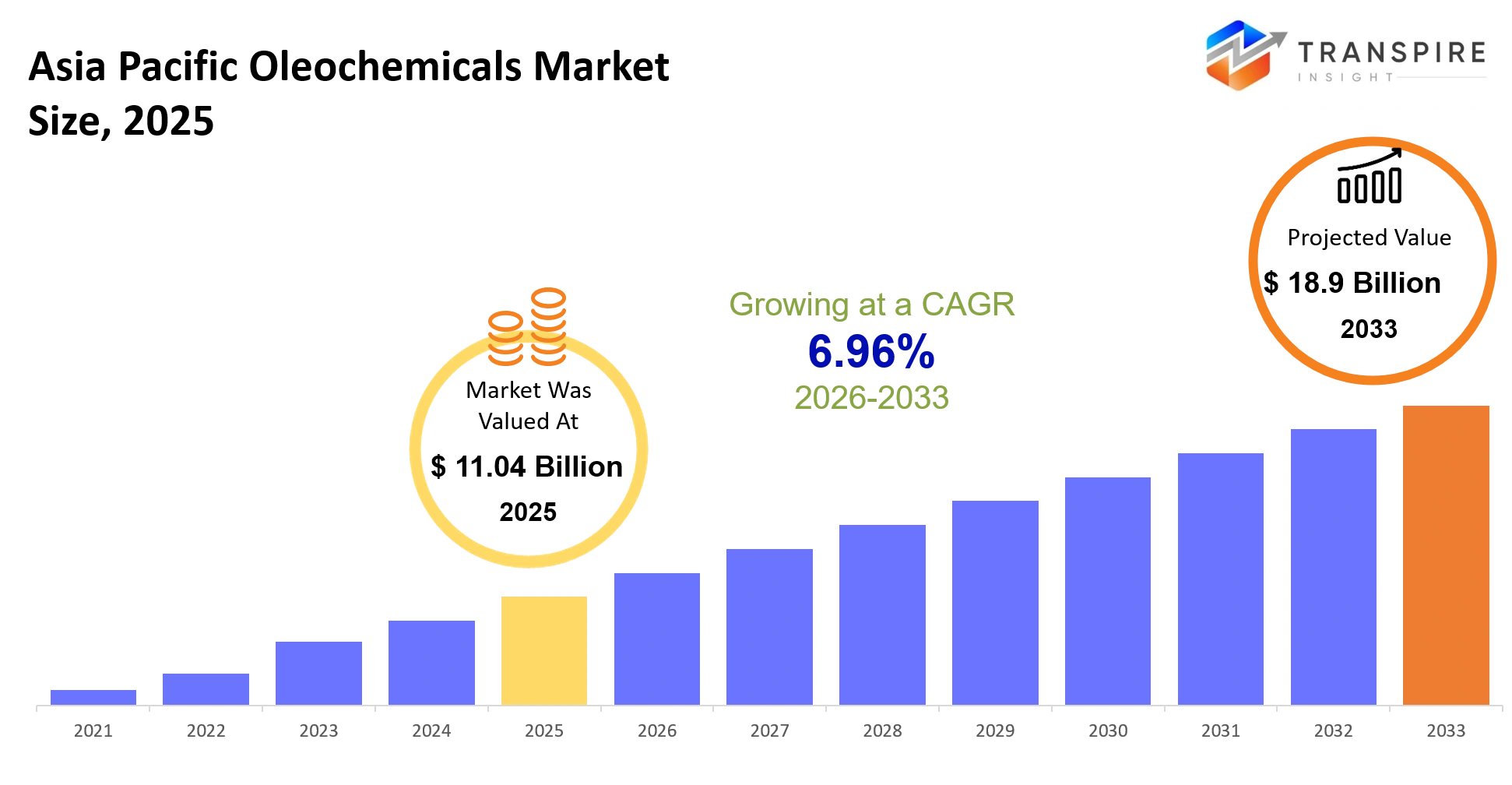
- Asia Pacific Oleochemicals Market Size 2025: USD 11.04 Billion
- Asia Pacific Oleochemicals Market Size 2033: USD 18.9 Billion
- Asia Pacific Oleochemicals Market CAGR:6.96%
- Asia Pacific Oleochemicals Market Segments: By Product Type (Fatty Acids, Fatty Alcohols, Glycerin, Methyl Esters, Fatty Amines, Specialty Esters, Soap Noodles, Others); By Source (Palm Oil, Soybean Oil, Sunflower Oil, Coconut Oil, Rapeseed Oil, Animal Fats, Waste Oils, Others); By Application (Personal Care, Soaps & Detergents, Food Processing, Pharmaceuticals, Lubricants, Plastics, Textiles, Others); By End User (Consumer Goods Companies, Chemical Manufacturers, Food Producers, Pharma Companies, Cosmetic Brands, Industrial Users, Textile Manufacturers, Others)
Asia Pacific Oleochemicals Market Summary
The Asia Pacific Oleochemicals Market was valued at USD 11.04 billion in 2025. It is forecast to reach USD 18.9 Billionby 2033. That is a CAGR of 6.96% over the period.
The Asia Pacific Oleochemicals Market gives us chemicals that come from oils and fats. These chemicals replace the ones made from petroleum in things like detergents and personal care products and lubricants and industrial cleaners. The Asia Pacific Oleochemicals Market helps companies make products that have labels and work better. This is also good for the environment because it meets the stricter rules about being kind to the earth. The Asia Pacific Oleochemicals Market is really, about making things that're better for us and the planet.
In years the market has changed significantly. It now focuses more on high-value specialty oleochemicals, driven by innovations in chemistry. This shift was sped up by environmental rules on petrochemicals and global supply chain issues that showed weaknesses in fossil-based feedstock sourcing. As a result buyers now prefer bio-based and traceable materials. This has led producers to increase production of fatty alcohols, esters and glycerin derivatives.
This change has also led to long-term contracts between oleochemical producers and companies in the FMCG, pharmaceutical and industrial manufacturing sectors. This has improved revenue stability. Encouraged investments in palm oil and coconut-based processing infrastructure across Asia Pacific. The Asia Pacific Oleochemicals Market continues to play a role, in this shift towards more sustainable and bio-based products. Oleochemicals are helping to drive this change.
Key Market Insights
- The Asia Pacific Oleochemicals Market is really big. It makes a lot of the worlds oleochemicals. Over 45 percent in 2025. This is because this region has a lot of palm oil and coconut that can be used to make oleochemicals.
- Southeast Asia is growing fast from 2025 to 2032 because it is making more palm oil.
- Fatty alcohols are the used oleochemicals product with almost 30 percent share and they are used a lot to make soap and other cleaning products.
- Fatty acids are the most used oleochemicals product because they can be used for many things like making things slippery and coatings.
- Glycerin derivatives are growing fast until 2032 because people want to use them in medicine and to take care of themselves.
- People are using a lot of oleochemicals to make things like skincare products and cosmetics.
- Many companies are now using chemistry to make surfactants, which is the fastest-growing area where oleochemicals are used.
- companies that make things people use every day are the biggest users of oleochemicals. They used over 40 percent of all oleochemicals in 2025.
- Pharmaceutical companies are using more oleochemicals to make medicine.
- Some of the companies that make oleochemicals are Wilmar International, BASF, Evonik, Croda, Kao Corporation, Musim Mas and Godrej Industries.
What are the Key Drivers, Restraints, and Opportunities in the Asia Pacific Oleochemicals Market?
Drivers
The main thing that is driving the Asia Pacific Oleochemicals Market is that people are starting to use natural ingredients in things like soap and laundry detergent. This is because the government is making rules to protect the environment and big companies are saying they want to use ingredients that're good for the planet. So now people want to buy things like fatty alcohols and glycerin that come from sources. This is good for companies that make these things because they can sell them for a price and make a steady profit.
Restraints
One big problem is that the price of the ingredients that these companies use can go up and down a lot. This is because the weather and how much land is available can affect how much palm oil and coconut oil is made. This makes it hard for companies to know how money they will make and it can be scary to invest in new things. It is also hard to make term plans when the price of ingredients is always changing.
Opportunity
There is a chance for companies to make more money by selling very pure oleochemicals to people who make medicine and soap. Especially in Indonesia and Malaysia where companies are building factories to make these things. If companies invest in technology they can make special products that are worth more money. This will allow them to make more than regular products and get a higher profit. The Asia Pacific Oleochemicals Market is going to be very important, for companies that make oleochemicals.
What Has the Impact of Artificial Intelligence Been on the Asia Pacific Oleochemicals Market?
The Asia Pacific Oleochemicals Market is changing because of intelligence and new digital technologies. These technologies are making production more efficient using feedstock better and controlling processes in bio-refineries. Now people use intelligence to automatically monitor things like how reactors are doing how much energy is being used and how catalysts are working. This helps producers make sure the quality of their fatty alcohols and fatty acids is always good.People are using machine learning to predict when equipment needs maintenance. This means they can look at data from sensors to figure out when things might go wrong and fix them before they do. This helps reduce shutdowns and keeps the plant running. Some companies are even using twin models to practice different production scenarios. This helps them make product and use less energy especially in big oleochemical complexes in Indonesia and Malaysia.
Because of these technologies companies are using energy to make each ton of product. They are also getting more out of their feedstock. Spending less time on maintenance. However it is expensive to set up these systems with old equipment and different companies have different ways of collecting data. This makes it hard for some companies, smaller ones in the Asia Pacific region to use artificial intelligence fully. The Asia Pacific Oleochemicals Market is still. Artificial intelligence is playing a big role, in this change. Artificial intelligence is helping the Asia Pacific Oleochemicals Market become more efficient.
Key Market Trends
- The palm oil industry got a lot better after 2023. This happened because companies that make food and soap started to buy palm oil that they could track back to the place it originally came from. These companies bought forty percent more of the palm oil that they could trace back to where it came from which is the kind of palm oil they wanted. The palm oil industry is really, about the palm oil and these companies are buying a lot of the palm oil.
- Making alcohols became really popular in 2024. This is because companies started using palm oil and other natural things of chemicals that come from oil to make soap and other cleaning things.
- After 2025 people started using glycerin often. This is because medicines need to be very pure and companies are making better medicines with glycerin.
- Indonesia and Malaysia are making more palm oil. In fact they make over 60 percent of the palm oil in Southeast Asia.
- Companies are using natural things to make soap and other cleaning things because the government is making rules to stop them from using bad chemicals.
- After 2023 companies started using computers to make palm oil. This helps them make palm oil with less energy.
- Big companies like BASF and Evonik are making better chemicals that are good for the earth. They are working with companies to make sure they get the things they need in a way that is good, for the earth.
- Wilmar International and Musim Mas are working hard to make sure they have palm oil to make the things they need. They do not want the price of palm oil to go up and down too much.
- Companies that make soap and other things for people to use on their bodies are using more natural ingredients. By 2025 they will use ingredients in 35 percent of the things they make.
- Companies are finding ways to make palm oil using special helpers called enzymes. This makes it easier and better to make palm oil and other things.
Asia Pacific Oleochemicals Market Segmentation
By Product Type:
The Asia Pacific Oleochemicals Market is really strong when it comes to fatty acids, fatty alcohols, glycerin and methyl esters. These are the things that industries are moving towards because they are based on things. Fatty acids are still very useful for things like lubricants, coatings and adhesives. This is because they work well and do not change much. Fatty alcohols are used a lot in making soap and other cleaning things. This is because companies that make these things want to use ingredients that come from plants. Glycerin is used more and more in medicine and personal care because it has to be very pure. Methyl esters are used in biodiesel and other industrial things because they are good for the environment. When companies make different products they can make more money and be more stable. In Southeast Asia there are places that can make bio things, which helps make production better and more consistent. As people find ways to make green things the Asia Pacific Oleochemicals Market will have more valuable products.
By Application:
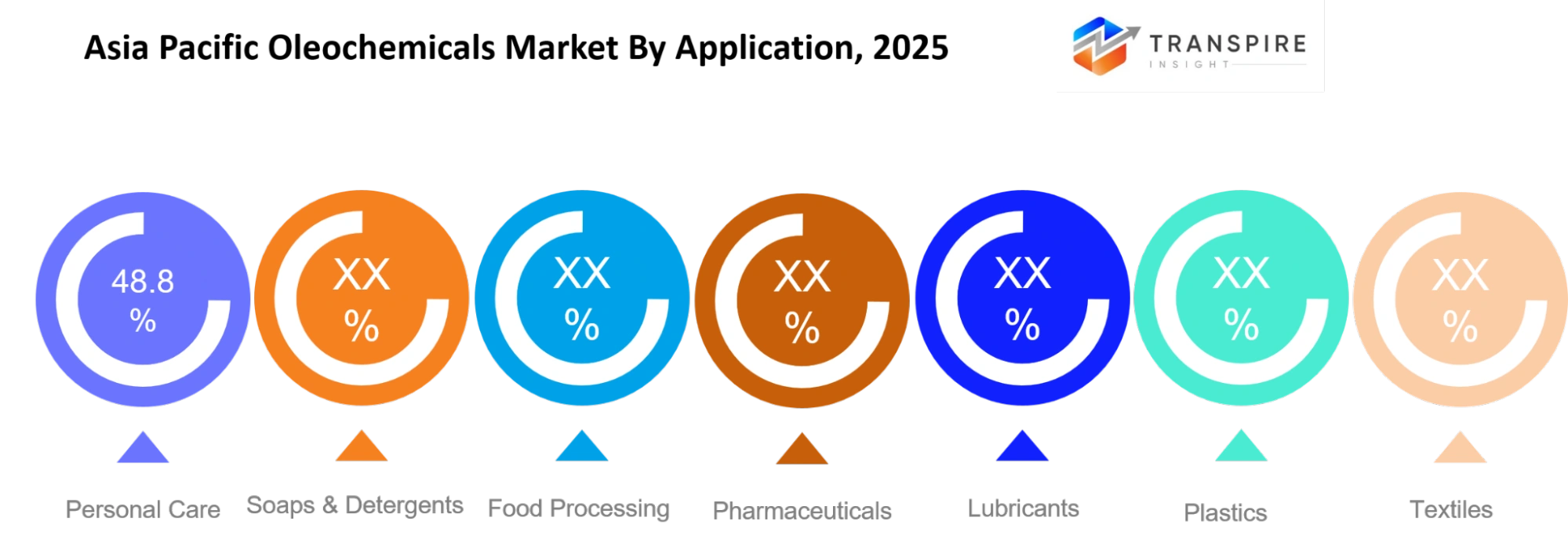
Personal care and cosmetics are a part of the Asia Pacific Oleochemicals Market. This is because people want to use things that come from plants. Detergents and surfactants are also very important because people use a lot of cleaning things. Medicine uses oleochemicals to make things better and to help them work properly. Industrial things like lubricants, coatings and plastic additives use oleochemicals because they are natural. Food processing uses oleochemicals to make things, like emulsifiers and stabilizers. People want to use things that're natural and good for them so companies are making more of these things. The government is also helping by making rules that support the use of things. This will help the Asia Pacific Oleochemicals Market grow and be strong.
By End User:
Companies that make things for use are the biggest buyers of oleochemicals. This is because they use a lot of surfactants and personal care things. Medicine companies use oleochemicals to make glycerin and to help their products work better. Industrial companies use oleochemicals to make lubricants, coatings and other things. Car companies use oleochemicals to make based lubricants and performance additives. Farming companies use oleochemicals to make pesticide formulations and crop protection solutions. Cosmetic companies use a lot of plant-based emulsifiers and conditioning agents. Food and beverage companies use bio-based additives to make their products better and safer. When many different companies use oleochemicals it helps the market grow and be strong.
What are the Key Use Cases Driving the Asia Pacific Oleochemicals Market?
The Asia Pacific Oleochemicals Market is really taking off because of the care and detergents manufacturing industries. These industries use fatty alcohols and surfactants of petroleum-based ingredients. This is because companies that make things like soaps and shampoos need ingredients that're stable and good for the environment.
They also need ingredients that're cheap. The Asia Pacific Oleochemicals Market is doing well because it can provide these things. Lots of companies are using the Asia Pacific Oleochemicals Market for their manufacturing needs.The Asia Pacific Oleochemicals Market is also being used in areas like making medicines and industrial lubricants. Pharmaceutical companies use the Asia Pacific Oleochemicals Market to make their medicines more stable. The Asia Pacific Oleochemicals Market is also used in the manufacturing sectors to make machines work better and be more environmentally friendly.
People are starting to use the Asia Pacific Oleochemicals Market for things like making agricultural chemicals and biodegradable packaging. The Asia Pacific Oleochemicals Market is being used to make pesticides and packaging materials that are better, for the environment. The Asia Pacific Oleochemicals Market is becoming more popular because people are trying to be more sustainable and make use of natural resources.
|
Report Metrics |
Details |
|
Market size value in 2025 |
USD 11.04 Billion |
|
Market size value in 2026 |
USD 11.8 Billion |
|
Revenue forecast in 2033 |
USD 18.9 Billion |
|
Growth rate |
CAGR of 6.96% from 2026 to 2033 |
|
Base year |
2025 |
|
Historical data |
2021 - 2024 |
|
Forecast period |
2026 - 2033 |
|
Report coverage |
Revenue forecast, competitive landscape, growth factors, and trends |
|
Regional scope |
Asia Pacific |
|
Key company profiled |
Wilmar International, KLK OLEO, IOI Oleochemical, Emery Oleochemicals, BASF, Evonik, Croda, Kao Corporation, Musim Mas, Godrej Industries, Oleon, Cargill, VVF, P&G Chemicals, Ecogreen Oleochemicals |
|
Customization scope |
Free report customization (country, regional & segment scope). Avail customized purchase options to meet your exact research needs. |
|
Report Segmentation |
By Product Type (Fatty Acids, Fatty Alcohols, Glycerin, Methyl Esters, Fatty Amines, Specialty Esters, Soap Noodles, Others); By Source (Palm Oil, Soybean Oil, Sunflower Oil, Coconut Oil, Rapeseed Oil, Animal Fats, Waste Oils, Others); By Application (Personal Care, Soaps & Detergents, Food Processing, Pharmaceuticals, Lubricants, Plastics, Textiles, Others); By End User (Consumer Goods Companies, Chemical Manufacturers, Food Producers, Pharma Companies, Cosmetic Brands, Industrial Users, Textile Manufacturers, Others) |
Which Regions are Driving the Asia Pacific Oleochemicals Market Growth?
Asia Pacific leads the Oleochemicals Market due to its strong upstream integration in palm oil and coconut cultivation, particularly across Indonesia, Malaysia, and Thailand. The region benefits from established bio-refining infrastructure and favorable agro-climatic conditions that ensure steady feedstock availability. Strong export-oriented production ecosystems support large-scale supply to FMCG, detergent, and industrial chemical manufacturers. Government-backed incentives for bio-based chemical production and sustainable palm oil certification frameworks further strengthen regional competitiveness. This integrated ecosystem allows producers to maintain cost advantages while scaling fatty acid and fatty alcohol output for global markets.
Europe represents a stable and regulation-driven market where demand is shaped by strict environmental compliance and sustainability mandates. Unlike Asia Pacific’s feedstock-driven structure, Europe depends heavily on imported oleochemical inputs for downstream processing in personal care, pharmaceuticals, and specialty chemicals. Strong regulatory enforcement on biodegradable and non-toxic ingredients ensures consistent consumption patterns. Industrial buyers prioritize certified sustainable sourcing, which supports long-term contracts with Asian suppliers. This steady demand structure makes Europe a reliable revenue contributor despite limited upstream production capacity.
North America shows the fastest growth momentum, driven by increasing adoption of bio-based chemicals in industrial and consumer applications. Recent investments in green chemistry programs and renewable feedstock substitution policies have accelerated market expansion since 2024. Strong demand from personal care and pharmaceutical sectors is pushing manufacturers toward plant-derived surfactants and specialty oleochemicals. For investors and new entrants, this growth signals expanding opportunities in high-margin specialty applications and partnerships with sustainable ingredient suppliers through 2026–2033.
Who are the Key Players in the Asia Pacific Oleochemicals Market and How Do They Compete?
The Asia Pacific Oleochemicals Market shows a moderately consolidated structure where large integrated producers dominate upstream feedstock processing, while regional specialty players compete in value-added derivatives. Competition is primarily driven by feedstock access, production efficiency, and sustainability certification rather than price alone. Incumbents are defending market share through vertical integration into palm oil and coconut supply chains, while new entrants focus on niche specialty oleochemicals for personal care, pharmaceuticals, and industrial surfactants. Differentiation increasingly depends on green chemistry capabilities, traceability systems, and long-term FMCG supply agreements.
Wilmar International strengthens its position through full vertical integration from plantation to downstream oleochemical production, ensuring cost efficiency and supply stability. Its advantage lies in controlling feedstock sourcing, which reduces exposure to raw material volatility. BASF focuses on high-value specialty oleochemicals and green chemistry innovation, differentiating through advanced formulation capabilities for personal care and industrial applications. Evonik emphasizes performance-driven chemical solutions, expanding its portfolio in fatty alcohol derivatives used in surfactants and cleaning products.Croda builds competitive strength through niche specialization in bio-based ingredients for cosmetics and pharmaceuticals, leveraging strong customer co-development partnerships. Kao Corporation integrates oleochemicals into its consumer product ecosystem, enabling direct demand linkage with end-use applications. Musim Mas expands through downstream capacity investments in Indonesia, strengthening its export competitiveness and improving production scalability across global supply chains.
Company List
- Wilmar International
- KLK OLEO
- IOI Oleochemical
- Emery Oleochemicals
- BASF
- Evonik
- Croda
- Kao Corporation
- Musim Mas
- Godrej Industries
- Oleon
- Cargill
- VVF
- P&G Chemicals
- Ecogreen Oleochemicals
Recent Development News
In February 2026, Hindustan Unilever Limited launched the “Closeup Love Tunes” AI-driven personalization campaign supported by WPP Mindshare and HiVoco Content-Tech Studios. The initiative demonstrated large-scale use of AI-generated personalized content in consumer product engagement, strengthening demand visibility for bio-based personal care ingredients linked to oleochemical derivatives.
https://www.adgully.com
In March 2025, Wilmar International expanded its downstream oleochemical production capacity in Southeast Asia through new integrated refining upgrades. The expansion strengthened vertical integration across palm-based supply chains and improved export competitiveness for fatty alcohol and fatty acid products.https://www.wilmar-international.com
In January 2025, BASF announced enhanced investment in sustainable chemical and bio-based ingredient production across its Asia Pacific operations. The move supported increased demand for green chemistry inputs in personal care and industrial surfactant applications.https://www.basf.com
What Strategic Insights Define the Future of the Asia Pacific Oleochemicals Market?
Over the next 5–7 years, the Asia Pacific Oleochemicals Market will structurally shift toward high-margin specialty bio-based chemicals as FMCG, pharmaceutical, and industrial buyers reduce dependence on petrochemical inputs. This direction is driven by stricter sustainability procurement standards and rising demand for traceable, low-carbon raw materials across global supply chains. Production will increasingly concentrate in vertically integrated bio-refining hubs where feedstock control and downstream diversification determine competitiveness.
A hidden risk lies in feedstock concentration within palm oil-dependent supply chains, where climate variability and land-use policy changes can sharply disrupt cost stability and export continuity. This dependency creates exposure to sudden margin compression even when end-user demand remains strong.
An emerging opportunity is the scale-up of enzymatic and low-energy bio-conversion technologies in Southeast Asian refining clusters, enabling higher purity oleochemical derivatives for pharmaceutical and advanced personal care applications. Indonesia and Malaysia are positioned to lead this transition due to integrated plantation and refining ecosystems.Market participants should prioritize backward integration with certified sustainable plantations while simultaneously investing in specialty oleochemical R&D. This dual strategy will secure supply resilience while capturing premium pricing in high-value downstream applications.
Asia Pacific Oleochemicals Market Report Segmentation
-
By Product Type
- Fatty Acids
- Fatty Alcohols
- Glycerin
- Methyl Esters
- Fatty Amines
- Specialty Oleochemicals
- Others
-
By Application
- Personal Care & Cosmetics
- Detergents & Surfactants
- Pharmaceuticals
- Food & Beverages
- Industrial Lubricants
- Coatings & Paints
- Agriculture
- Others
-
By End Use Industry
- FMCG
- Pharmaceutical & Healthcare
- Industrial Manufacturing
- Automotive
- Agriculture
- Food Processing
- Others
-
By Process Type
- Hydrolysis
- Transesterification
- Fractionation
- Hydrogenation
- Esterification
- Others
-
By Grade
- Industrial Grade
- Pharmaceutical Grade
- Food Grade
- Cosmetic Grade
-
By Distribution Channel
- Direct Sales
- Distributors & Traders
- Online Platforms
- Specialty Chemical Suppliers
Frequently Asked Questions
Find quick answers to common questions.
The expected Asia Pacific Oleochemicals Market size for the market will be USD 18.9 Billion in 2033.
Key segments for the Asia Pacific Oleochemicals Market are By Product Type (Fatty Acids, Fatty Alcohols, Glycerin, Methyl Esters, Fatty Amines, Specialty Esters, Soap Noodles, Others); By Source (Palm Oil, Soybean Oil, Sunflower Oil, Coconut Oil, Rapeseed Oil, Animal Fats, Waste Oils, Others); By Application (Personal Care, Soaps & Detergents, Food Processing, Pharmaceuticals, Lubricants, Plastics, Textiles, Others); By End User (Consumer Goods Companies, Chemical Manufacturers, Food Producers, Pharma Companies, Cosmetic Brands, Industrial Users, Textile Manufacturers, Others).
Major Asia Pacific Oleochemicals Market players are Wilmar International, KLK OLEO, IOI Oleochemical, Emery Oleochemicals, BASF, Evonik, Croda, Kao Corporation, Musim Mas, Godrej Industries, Oleon, Cargill, VVF, P&G Chemicals, Ecogreen Oleochemicals.
The Asia Pacific Oleochemicals Market size is USD 11.04 Billion in 2025.
The Asia Pacific Oleochemicals Market CAGR is 6.96% from 2026 to 2033.
- Wilmar International
- KLK OLEO
- IOI Oleochemical
- Emery Oleochemicals
- BASF
- Evonik
- Croda
- Kao Corporation
- Musim Mas
- Godrej Industries
- Oleon
- Cargill
- VVF
- P&G Chemicals
- Ecogreen Oleochemicals
About the Authors

Pankaj Ghogare Patil
I am Pankaj Ghogare Patil, a Senior Research Analyst at Transpire Insight, specializing in the Pharmaceutical, Chemicals & Materials, Healthcare IT, and Biotechnology industry. My expertise lies in conducting comprehensive market research, analyzing industry trends, evaluating competitive landscapes, and translating complex data into actionable insights. At Transpire Insight, I closely follow emerging technologies, regulatory developments, and market innovations to create accurate, well-researched, and informative content that helps businesses and professionals make informed decisions. I am committed to producing credible, evidence-based articles that reflect industry best practices while making technical topics accessible and valuable for a broad audience.

Chakradhar Khansole
Chakradhar serves as the Research Director at Transpire Insight, bringing over 8 years of experience in technology, innovation, and strategic market intelligence. He specializes in transforming complex market data into actionable business insights that enable organizations to make informed, growth-oriented decisions. Recognized for his strategic vision and analytical expertise, Chakradhar leads high-impact research initiatives, delivering comprehensive market assessments, competitive intelligence, and forward-looking industry analysis.
Recently Published Reports
-
May 2026
Healthcare Polymer Packaging Market
Healthcare Polymer Packaging Market Size, Share & Analysis Report By Packaging Type (Syringes, IV Bottles and Pouches, Clamshells, Blisters, Bottles & Jars, Containers, Tubes, IV Parental Packaging, Others), By Type (Regulated, Non-regulated), By Polymer Type (LDPE (Low-Density Polyethylene), HDPE (High-Density Polyethylene), Homo-polymer (Homo), Random Copolymer (Random), Block Copolymer (Block), PET, Polystyrene, Polyvinyl Chloride, Polyamide/EVOH, Others), and Geography (North America, Europe, Asia-Pacific, Middle East and Africa, South and Central America), 2021 - 2031
-
Apr 2026
Hydrophilic Tape (Waterstop) Market
Hydrophilic Tape (Waterstop) Market Size, Share & Analysis Report By Type (Bentonite-Based Hydrophilic Tape, Rubber-Based Hydrophilic Tape), By Application (Residential Buildings, Commercial Buildings, Infrastructure Projects), and Geography (North America, Europe, Asia-Pacific, Middle East and Africa, South and Central America), 2021 - 2031
-
Apr 2026
Metalens Market
Metalens Market Size, Share & Analysis Report By Type (Visible Light Metalens, and Infrared Metalens), By Application (Consumer Electronics, Automotive Electronics, Industrial, Medical, and Others), and Geography (North America, Europe, Asia-Pacific, Middle East and Africa, South and Central America), 2021 - 2031
-
Apr 2026
PBT Resin Market
PBT Resin Market Size, Share & Analysis Report By Type (Reinforced PBT Resin, Unreinforced PBT Resin), By Processing Method (Injection Molding, Extrusion, Blow Molding, Others), By End-User (Automotive, Electrical & Electronics, Consumer Appliances, Industrial Machinery, Medical Devices, Packaging, Others), and Geography (North America, Europe, Asia-Pacific, Middle East and Africa, South and Central America), 2021 - 2031