
South Korea Methyl Methacrylate Market Size & Forecast:
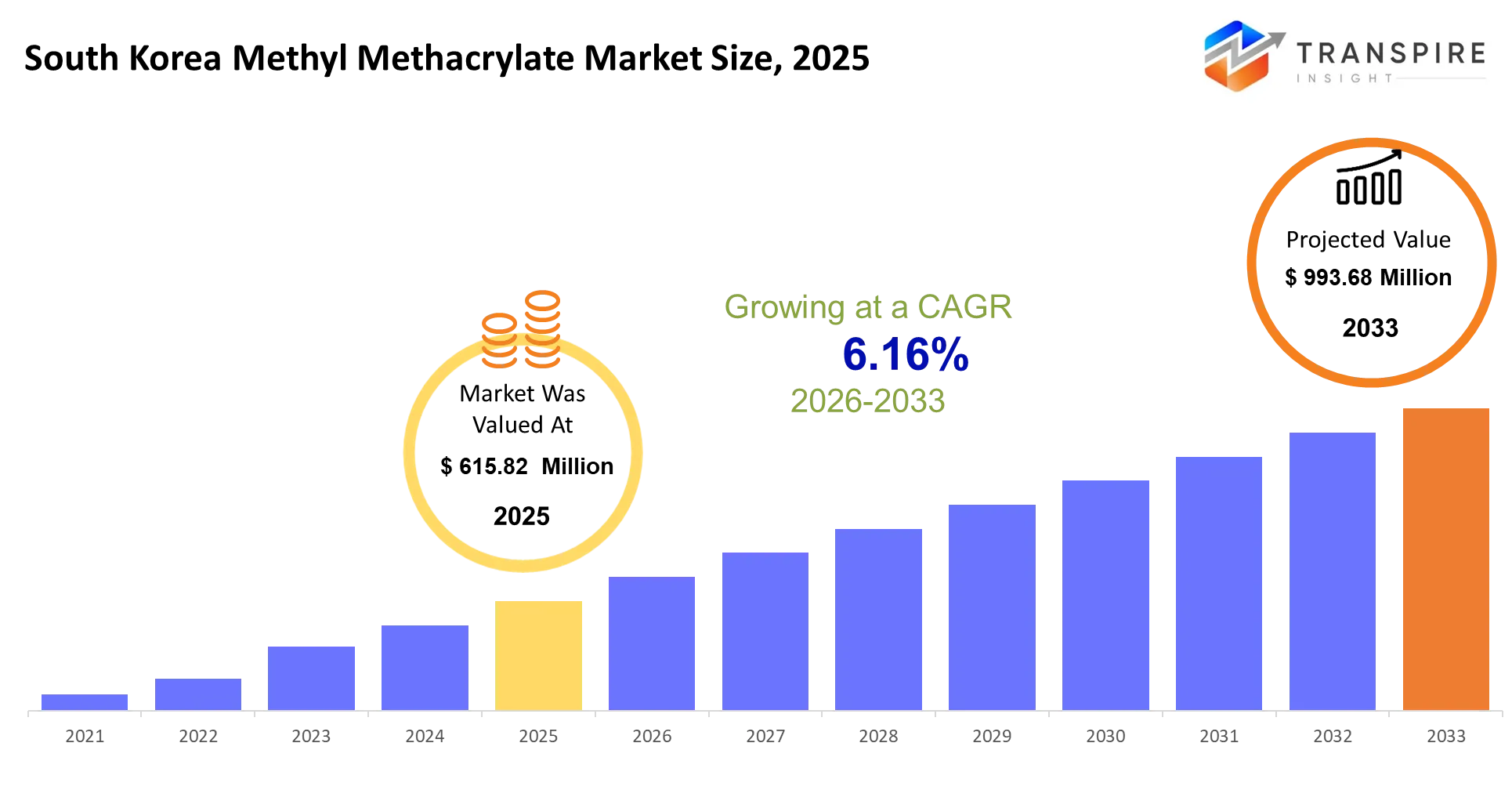
- South Korea Methyl Methacrylate Market Size 2025: USD 615.82 Million
- South Korea Methyl Methacrylate Market Size 2033: USD 993.68 Million
- South Korea Methyl Methacrylate Market CAGR: 6.16%
- South Korea Methyl Methacrylate Market Segments: By Production Process (ACH Process, C4 Process, Ethylene Process, Others); By Application (PMMA Production, Surface Coatings, Adhesives, Automotive Components, Others); By End User (Chemical Industry, Automotive Industry, Construction Industry, Electronics Industry, Others); By Form (Liquid MMA, Resin-grade MMA, Others)
To learn more about this report,  Download Free Sample Report
South Korea Methyl Methacrylate Market Summary
The South Korea Methyl Methacrylate Market was valued at USD 615.82 Million in 2025. It is forecast to reach USD 993.68 Million by 2033. That is a CAGR of 6.16% over the period.
The South Korea Methyl Methacrylate Market plays a critical role in feeding high-performance acrylic materials that get used for automotive displays, electronics enclosures, construction sheets, coatings, and optical systems where durability, clarity, and light mass performance really matter. In day to day manufacturing, methyl methacrylate helps produce PMMA sheet stock and engineered resins, which lets makers cut down on part weight while still holding on to solid impact resistance , and also giving more design flexibility. Over the last five years, the market seems to have drifted toward specialty-grade MMA formulations that are linked to semiconductor packaging , EV parts, and better display technologies.
This shift picked up after global supply chain disruptions, and the feedstock swings made it clear how dependent South Korea is on imported petrochemical intermediates during the post pandemic rebound, kind of like it was always there but then suddenly became obvious. At the same time, domestic electronics groups , and mobility manufacturers expanded their premium lines, so demand for high purity acrylic materials went up.That change, improved price leverage for producers, encouraged capital to focus on process efficiency, and also made longer term revenue outlooks feel steadier across downstream industrial uses.
Key Market Insights
- The South Korea Methyl Methacrylate Market kinda benefits from the way PMMA consumption is growing in automotive displays, lightweight panels, and high clarity electronic components and stuff like that.
- In 2025, electronics and semiconductor manufacturing accounted for nearly 38% of total methyl methacrylate demand, basically because precision material needs are strict over there.
- The Seoul Capital Area seems to dominate the South Korea Methyl Methacrylate Market with an estimated 45% industry share, due to concentrated petrochemical and electronics infrastructure.
- Meanwhile Ulsan and the southeastern industrial clusters are showing the fastest growth as regional production hubs through 2033, driven by refinery integration and export oriented chemical capacity.
- For segments, PMMA production stays in the lead with over 50% market share, mostly because optical sheets, LED panels, and automotive glazing are everywhere.
- Surface coatings and specialty resins are the second largest segment, since makers are prioritizing weather resistant industrial finishing materials rather than plain uses.
- High purity electronic grade MMA is projected to be the fastest growing segment during the forecast period, since advanced chip packaging requirements keep tightening the specs.
- When it comes to applications, automotive is still the biggest with nearly 34% revenue share, supported by EV dashboard displays, lightweight exterior parts, and advanced lighting systems.
- Medical and healthcare applications are emerging pretty fast, because acrylic polymers are increasingly showing up in dental products, diagnostics, and transparent medical equipment.
- Electronics manufacturers keep leading as the end user category, with major market share tied to South Korea’s display and semiconductor ecosystem.
- Electric vehicle component suppliers are the fastest growing end user segment too, as battery efficiency targets push lightweight acrylic based materials into more designs.
What are the Key Drivers, Restraints, and Opportunities in the South Korea Methyl Methacrylate Market?
The main thing pushing the South Korea methyl methacrylate industry along is, sort of, the country’s growing electric vehicle and advanced electronics manufacturing base. Automakers and display makers keep leaning on PMMA based materials because they cut component weight while still keeping optical clarity and structural toughness. The shift toward bigger in vehicle displays LED lighting systems and lighter battery adjacent parts has really boosted the use of specialty MMA derivatives. Also, government supported semiconductor and battery investments are adding momentum to downstream buying, so chemical suppliers can lock in steadier long term purchasing agreements.
The biggest limiter though is how the market depends on jumpy petrochemical feedstocks like acetone and hydrogen cyanide. Because MMA production economics stay tightly tied to crude oil conditions and refinery swings, producers often get stuck with unstable operating margins when global energy prices move around. And this problem can’t be fixed fast, not really, since swapping in other production pathways means heavy capital spending, process makeovers, and new environmental approvals that take time. Because of that, smaller manufacturers frequently put off capacity plans which reduces supply flexibility and can slow revenue growth when demand surges.
A clear opening is showing up via sustainable and recycled acrylic material development. South Korean producers are investing in circular chemistry approaches that can recover MMA monomers from acrylic waste streams. If suppliers can provide semiconductor grade recycled inputs they may get an early edge, especially as electronics and automotive brands start putting stronger carbon reduction requirements into their procurement processes.
What Has the Impact of Artificial Intelligence Been on the South Korea Methyl Methacrylate Market?
Artificial intelligence plus advanced digital tools are kind of reshaping the way methyl methacrylate production works in South Korea, mainly by boosting operational accuracy, making energy use more efficient, and keeping the whole process more dependable across petrochemical sites. More and more chemical producers use AI based monitoring systems, where they can watch reactor temperature, pressure states, and catalyst behavior continuously, in real time. Those automated control setups can dampen production volatility, so operators still manage to hold steady MMA purity, the kind electronics grade users actually demand, even with all the daily fluctuations.
At the same time, machine learning is rolling out for predictive servicing on pumps, compressors, and heat exchangers in acrylic monomer plants. These systems look at vibration signals, and also spot operational irregularities, then they flag the likelihood of equipment issues before any planned shutdown happens. Some major manufacturers say their plant uptime went up, and maintenance expenses went down, after they connected predictive analytics with process management. AI optimization tools also assist with energy performance, because they can tune feedstock usage and reaction timing using live operating measurements. That tends to cut off waste, improve overall output, and support higher production yield.
Digital supply chain platforms have further helped with inventory forecasting and export scheduling for PMMA makers downstream, especially those supplying automotive and semiconductor clients. Still, AI take up has limits, partly because integration costs can be high and because training reliable models is messy, particularly in facilities that run on older industrial infrastructure. A number of mid-sized producers do not have enough long term historical process data, so the machine learning systems can’t be fully tuned, and that slows wider adoption across the sector.
Key Market Trends
- Since 2022, South Korean electronics manufacturers… sort of, kept bumping up their buying of high-purity MMA grades, close to 18% more, for OLED displays, and semiconductor packaging materials, too.
- During 2023 and 2024, Automotive OEMs moved toward lighter acrylic components after EV battery efficiency rules got stricter across Asian export markets, not suddenly but steadily.
- LG Chem and LOTTE Chemical expanded their specialty materials investment plans as margins on commodity petrochemicals weakened, in the wake of post-pandemic feedstock volatility, which felt kinda chaotic.
- By 2025, electronics and semiconductor uses made up roughly 38% of domestic MMA consumption, mainly because optical material requirements kept climbing, without much pause.
- Between 2023 and 2025, manufacturers increasingly used AI-based process monitoring systems, to cut reactor downtime, and to make MMA production more consistent, which is kinda the point really.
- Recycled PMMA and circular MMA approaches started getting real commercial traction after global buyers rolled out tougher carbon disclosure rules across electronics supply chains.
- In 2026, Mitsubishi Chemical restructured pieces of its Asian MMA operations, aiming to stay competitive against growing Chinese production capacity, and the pricing pressure that comes with it.
- Export-focused producers shifted their supply tactics toward Southeast Asia after logistics disruptions showed how dependent they were on a few concentrated regional shipping routes during 2021–2023.
- Meanwhile, South Korea’s EV component suppliers have increased their use of acrylic materials by more than 20% since 2022, for display covers, lighting systems and lightweight panels, with that incremental growth vibe.
- Partnerships between chemical producers and semiconductor companies sped up after 2024, because advanced chip packaging demanded better thermal stability and optical precision related materials, so everyone had to align.
South Korea Methyl Methacrylate Market Segmentation
By Production Process
ACH process takes the most prominent place in production, mostly because South Korean petrochemical producers kind of rely on acetone based routes for dependable feedstock supply and for that already proven operational setup. Big chemical complexes stick with this approach, since it has a well known link to current refinery outputs , and it delivers a stable output profile that downstream PMMA and coatings users can count on. The C4 process is the next biggest segment, and it keeps growing as manufacturers start using it more often to cut down on acetone price swings and to keep their long term cost position better. The ethylene process is still comparatively smaller, yet it matters in a strategic way, mainly because it connects tightly with integrated petrochemical value streams. Other pathways, meanwhile, tend to remain narrow, either experimental or only used for certain niche outputs.
One of the ACH process strong points is that it has already been rolled out for a long time across key industrial hubs, where security of feedstock and reliable operations are the priority, not how fast someone can invent something. C4 process expansion is pushed by changing raw material economics, especially when companies try to hedge against global acetone instability and protect margins in export markets. Ethylene based production also helps because it sits inside wider olefin supply networks , so it can be matched more easily to downstream diversification plans across chemicals. During the forecast period, C4 process adoption should increase in a steady manner, which will motivate producers to put money into hybrid production setups and feedstock flexible MMA manufacturing options.
By Application
PMMA production really kind of dominates the application landscape, mostly because there’s strong demand coming from electronics, automotive lighting systems , and also from optical grade plastic manufacturing. The high clarity plus durability and those lightweight traits of PMMA, make it a go to material for display panels and precision parts that show up in advanced manufacturing sectors. Then surface coatings sit as the second-largest segment, since more industries are leaning into MMA based resins for weather resistant, corrosion protective, and also decorative industrial finishes. Adhesives and automotive components keep picking up momentum too, while several other areas stay tied to specialized industrial formulations, and lower volume chemical applications.
PMMA demand has strengthened lately as electronics producers move toward bigger display panels, plus higher performance optical materials, in both consumer devices and vehicles. Surface coating benefits from tougher durability expectations in construction and industrial equipment, where chemical resistance and environmental stability matter a lot. Adhesives are expanding through automotive lightweighting approaches and by improving industrial assembly efficiency across manufacturing sites. Over the forecast period automotive components are expected to grow faster than the traditional coating applications, because EV platforms increasingly include acrylic based lightweight structural and design elements.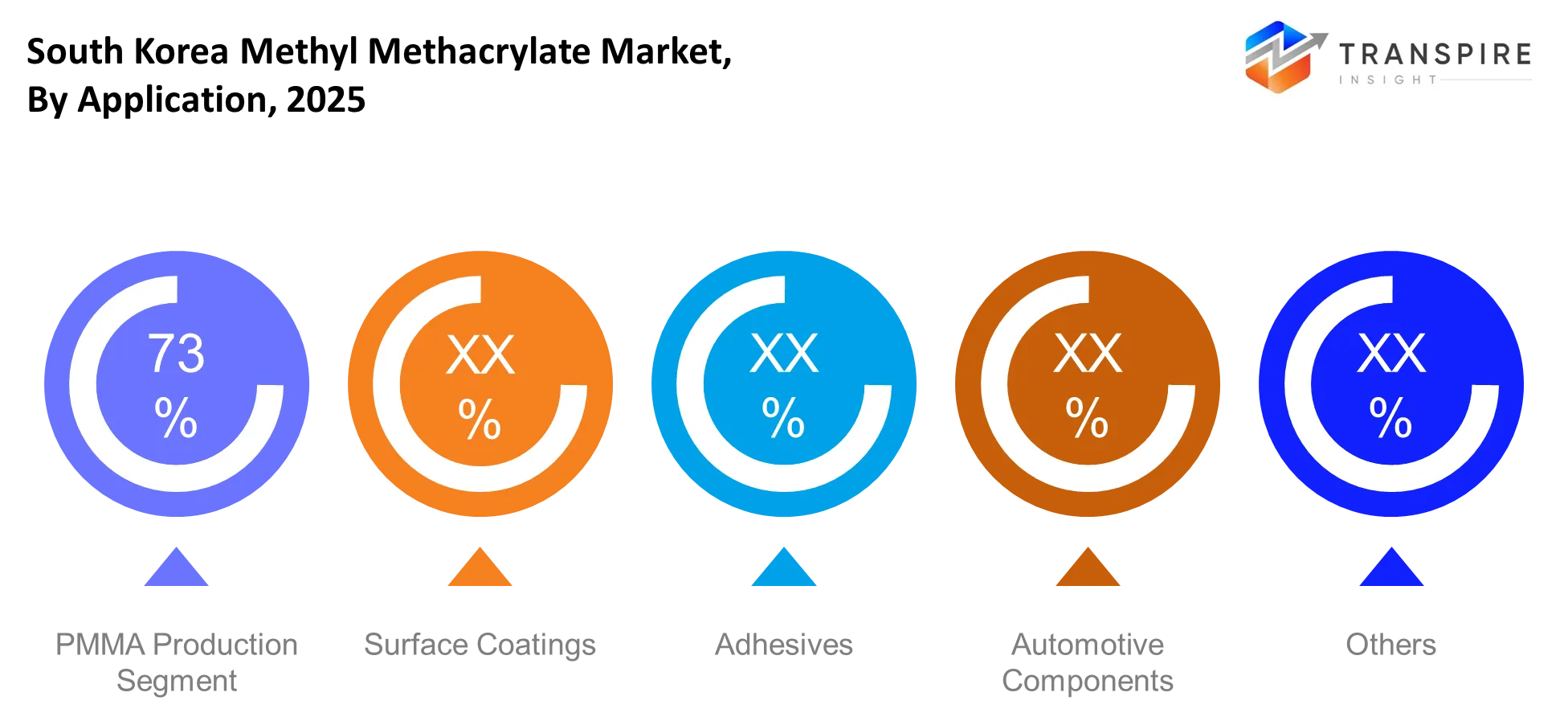
To learn more about this report, Download Free Sample Report
By End User
The chemical industry kind of holds the dominant position since MMA output and downstream resin making are mostly tucked inside integrated petrochemical complexes. In practice these facilities work as both producers and processors ,so they move along intermediate plus finished acrylic materials across local and export channels. The automotive industry shows up as the second-largest piece because EV production, lightweight vehicle planning, and more advanced lighting setups are pushing PMMA-based consumption higher. The construction industry keeps a steadier appetite through architectural glazing, and also industrial infrastructure usage, while the electronics industry keeps widening its footprint because precision optical work and semiconductor applications need it.
The strength of the chemical industry is also backed by vertical integration across refinery tasks, polymer production, and export-focused supply chains, which helps keep the output rhythm consistent. Automotive demand is rising under regulatory pressure tied to fuel efficiency, plus the spread of EV adoption across parts of Asia, and this together helps substitution toward lighter acrylic components. Construction usage gets a boost from urban redevelopment efforts ,and people want durable transparent materials for current architecture. Over the forecast horizon, the electronics industry is expected to speed up sharply too, mainly because semiconductor packaging and display manufacturing are increasingly asking for high-purity MMA-derived materials with better optical performance and thermal stability.
By Form
Liquid MMA kind of holds the leading position, because it is the main feedstock for polymerization into PMMA and other acrylic related materials that are used basically across a lot of industrial applications. Also it’s flexible and fairly easy to move around, so it becomes the preferred input for big scale chemical processing and the downstream resin output. Resin grade MMA sits in the second spot, not so surprisingly, since makers are more and more asking for pre processed material for precision tasks especially in electronics and automotive parts. The other categories still end up mostly staying in smaller, niche uses or in specialized chemical blends where the volume is lower, and the demand isn’t as aggressive.
Liquid MMA demand stays solid, mainly because it’s at the center of bulk polymer production and it also plugs into the established petrochemical supply pathways across South Korea. Meanwhile resin grade MMA is picking up momentum as downstream industries lean toward stronger performance targets, like better optical clarity, improved thermal resistance, and tighter dimensional stability. This movement seems to mirror the rising quality expectations coming from semiconductor players and automotive manufacturers, who want advanced material consistency, and they want it reliably. Over the forecast period resin grade MMA is likely to expand quicker than the liquid form. That’s encouraging producers to widen value added processing, and to invest in higher margin specialty material lines, so yeah it’s not just growth, it’s more like a shift in emphasis.
What are the Key Use Cases Driving the South Korea Methyl Methacrylate Market?
The biggest use case for methyl methacrylate in South Korea kinda comes from PMMA production for electronics and cars, more or less. Producers rely on acrylic materials in display panels, instrument clusters, LED lighting covers,and even lightweight outer body parts because they manage to blend optical clarity with solid shock tolerance. That specific application still drives the most demand, mostly because South Korea has a very strong semiconductor, display, and EV manufacturing setup.
Beyond that, expanding applications show up in architectural glazing, industrial coatings,and also in parts used in consumer appliances. Construction groups are starting to adopt acrylic sheets for transparent safety barriers, decorative interiors,and weather-resistant structures. Meanwhile appliance makers use MMA based resins in premium consumer electronics and smart home products. All of this is getting momentum as producers look for durable and lightweight options, not just “good enough” materials.
Newer use cases are also appearing, including medical-grade acrylic products and recycled MMA solutions aimed at more sustainable manufacturing. Dental materials, transparent diagnostic instruments, and specialized healthcare devices are basically creating fresh revenue. At the same time, chemical recycling methods for acrylic waste recovery are opening additional chances for circular materials manufacturing over the forecast period.
|
Report Metrics |
Details |
|
Market size value in 2025 |
USD 615.82 Million |
|
Market size value in 2026 |
USD 653.74 Million |
|
Revenue forecast in 2033 |
USD 993.68 Million |
|
Growth rate |
CAGR of 6.16% from 2026 to 2033 |
|
Base year |
2025 |
|
Historical data |
2021 - 2024 |
|
Forecast period |
2026 - 2033 |
|
Report coverage |
Revenue forecast, competitive landscape, growth factors, and trends |
|
Regional scope |
South Korea |
|
Key company profiled |
Mitsubishi Chemical, LG Chem, Sumitomo Chemical, Dow, Arkema, Evonik Industries, Kuraray, Asahi Kasei, Chi Mei Corporation, BASF, Lucite International, Saudi Methacrylates, Röhm GmbH, Formosa Plastics, LOTTE Chemical |
|
Customization scope |
Free report customization (country, regional & segment scope). Avail customized purchase options to meet your exact research needs. |
|
Report Segmentation |
By Production Process (ACH Process, C4 Process, Ethylene Process, Others); By Application (PMMA Production, Surface Coatings, Adhesives, Automotive Components, Others); By End User (Chemical Industry, Automotive Industry, Construction Industry, Electronics Industry, Others); By Form (Liquid MMA, Resin-grade MMA, Others) |
Which Regions are Driving the South Korea Methyl Methacrylate Market Growth?
The Seoul Capital Area still stays kinda the main region in South Korea methyl methacrylate market, mainly because it links together advanced electronics production, bundled petrochemical distribution, and solid downstream pull from automotive technology suppliers. Big semiconductor and display manufacturers around Seoul and Gyeonggi Province swallow large amounts of high-purity MMA, for optical films, display panels, and electronic parts, in general. Also, the area has established logistics routes connected to Incheon Port, which makes it easier to bring in feedstocks and also push out specialty acrylic materials. There’s a dense network of chemical producers, R&D centers, plus precision manufacturers and that keeps the whole thing leading over the long run, while also helping quick commercialization of specialty MMA uses.
Ulsan shows up as the second-largest contributor but its strength is more about industrial steadiness, not so much a heavy cluster of cutting-edge tech. Different from the Seoul metro area, Ulsan is powered by integrated refinery and petrochemical operations that enable low-cost MMA production and make the supply chain feel reliable, most of the time. Major industrial complexes, run by firms like LOTTE Chemical and LG Chem, keep output consistent for coatings, construction materials, and industrial resin purposes. In addition, the region has long-standing export infrastructure, and a manufacturing base that holds up well, so it keeps working as a dependable revenue contributor even when feedstock swings around, or when electronics demand slows down.
And the fastest-growing region is basically that southeastern industrial corridor around Busan and Pohang, where new investments in battery materials, mobility manufacturing, and upgraded logistics infrastructure started ramping up after 2023, pretty noticeably.
Who are the Key Players in the South Korea Methyl Methacrylate Market and How Do They Compete?
In the South Korea methyl methacrylate market, competition looks moderately consolidated, sort of, with both big petrochemical players and regional specialty material suppliers rubbing elbows. They tend to compete through technology capability, production efficiency and even a bit of downstream integration, but not always in a neat way. Most established manufacturers are still defending market share by tuning and strengthening their specialty MMA product sets, mostly for electronics EVs and optical uses, not just chasing commodity pricing. Production scale and feedstock integration are still kind of major, but increasingly companies try to separate themselves via higher purity formulations, sustainability spend, and some strategic alliances with automotive as well as semiconductor manufacturers.
LG Chem , for example , leans hard on vertically integrated petrochemical operations and on long standing relationships with domestic electronics and mobility makers. It differentiates through advanced materials development and sustainability oriented technologies , including carbon utilization initiatives and specialty electronic material partnerships. And honestly, its collaborations with semiconductor and optics companies make its high-margin acrylic offerings feel a lot more defensible.
Mitsubishi Chemical Group meanwhile is more focused on process technology optimization, plus selective regional restructuring to keep its edge in the Asian MMA space. It has recently streamlined chunks of its MMA business network, so it can concentrate resources on markets with better long-term profitability and specialty pull. While Evonik Industries competes by going more niche, specializing in high performance acrylic systems used across healthcare coatings and industrial applications, where material consistency and hands on technical support count much more than production size.
Company List
- Mitsubishi Chemical
- LG Chem
- Sumitomo Chemical
- Dow
- Arkema
- Evonik Industries
- Kuraray
- Asahi Kasei
- Chi Mei Corporation
- BASF
- Lucite International
- Saudi Methacrylates
- Röhm GmbH
- Formosa Plastics
- LOTTE Chemical
Recent Development News
In April 2026, Mitsubishi Chemical announced the transfer of its stake in Kaohsiung Monomer Company to China Petrochemical Development Corporation. The transaction will help Mitsubishi Chemical consolidate MMA production into more competitive locations as Asian market competition intensifies due to expanding Chinese capacity.http://https://www.chemanalyst.com
In March 2025, Sumitomo Chemical launched chemically recycled PMMA produced from recycled methyl methacrylate monomer and secured adoption agreements with LG Display and Nissan Motor. The development strengthened sustainable MMA supply chains for electronics and automotive applications while accelerating commercialization of recycled acrylic materials in Asia.http://https://www.chemengonline.com/
What Strategic Insights Define the Future of the South Korea Methyl Methacrylate Market?
The South Korea methyl methacrylate market is, kinda structurally, drifting toward high-purity, specialty grade production that is tied to semiconductors , electric vehicles , advanced optics , and those “sustainable materials” making waves. Really though the shift is less about just stacking more tons and more about needing performance minded acrylic inputs that help with lightweight electronics thermal stability, and optical exactness. Still, there is a risk people don’t talk about enough: the concentration of MMA production capacity across Asia, especially in China. That could make price rivalry sharper and squeeze operating margins for South Korean suppliers, even if downstream demand stays fairly solid. Meanwhile recycled MMA monomer recovery, and low carbon acrylic output, are becoming real openings with longer term strategic importance, in particular when global manufacturers tighten up their supply chain emissions rules. Firms that move early on circular chemistry, AI aided process optimization, and semiconductor grade specialty formulations may end up with stronger pricing leverage and better export reach across the next decade.
South Korea Methyl Methacrylate Market Report Segmentation
By Production Process
- ACH Process
- C4 Process
- Ethylene Process
- Others
By Application
- PMMA Production
- Surface Coatings
- Adhesives
- Automotive Components
- Others
By End User
- Chemical Industry
- Automotive Industry
- Construction Industry
- Electronics Industry
- Others
By Form
- Liquid MMA
- Resin-grade MMA
- Others
Frequently Asked Questions
Find quick answers to common questions.
The Expected South Korea Methyl Methacrylate Market size for the Market will be USD 993.68 Million in 2033.
Key Segments for the South Korea Methyl Methacrylate Market are By Production Process (ACH Process, C4 Process, Ethylene Process, Others); By Application (PMMA Production, Surface Coatings, Adhesives, Automotive Components, Others); By End User (Chemical Industry, Automotive Industry, Construction Industry, Electronics Industry, Others); By Form (Liquid MMA, Resin-grade MMA, Others)
Major South Korea Methyl Methacrylate Market Players are Mitsubishi Chemical, LG Chem, Sumitomo Chemical, Dow, Arkema, Evonik Industries, Kuraray, Asahi Kasei, Chi Mei Corporation, BASF, Lucite International, Saudi Methacrylates, Röhm GmbH, Formosa Plastics, LOTTE Chemical.
The Current South Korea Methyl Methacrylate Market size is USD 615.82 Million in 2025.
The South Korea Methyl Methacrylate Market CAGR is 6.16% from 2026 to 2033.
- Mitsubishi Chemical
- LG Chem
- Sumitomo Chemical
- Dow
- Arkema
- Evonik Industries
- Kuraray
- Asahi Kasei
- Chi Mei Corporation
- BASF
- Lucite International
- Saudi Methacrylates
- Röhm GmbH
- Formosa Plastics
- LOTTE Chemical
Recently Published Reports
-
May 2026
Healthcare Polymer Packaging Market
Healthcare Polymer Packaging Market Size, Share & Analysis Report By Packaging Type (Syringes, IV Bottles and Pouches, Clamshells, Blisters, Bottles & Jars, Containers, Tubes, IV Parental Packaging, Others), By Type (Regulated, Non-regulated), By Polymer Type (LDPE (Low-Density Polyethylene), HDPE (High-Density Polyethylene), Homo-polymer (Homo), Random Copolymer (Random), Block Copolymer (Block), PET, Polystyrene, Polyvinyl Chloride, Polyamide/EVOH, Others), and Geography (North America, Europe, Asia-Pacific, Middle East and Africa, South and Central America), 2021 - 2031
-
Apr 2026
Hydrophilic Tape (Waterstop) Market
Hydrophilic Tape (Waterstop) Market Size, Share & Analysis Report By Type (Bentonite-Based Hydrophilic Tape, Rubber-Based Hydrophilic Tape), By Application (Residential Buildings, Commercial Buildings, Infrastructure Projects), and Geography (North America, Europe, Asia-Pacific, Middle East and Africa, South and Central America), 2021 - 2031
-
Apr 2026
Metalens Market
Metalens Market Size, Share & Analysis Report By Type (Visible Light Metalens, and Infrared Metalens), By Application (Consumer Electronics, Automotive Electronics, Industrial, Medical, and Others), and Geography (North America, Europe, Asia-Pacific, Middle East and Africa, South and Central America), 2021 - 2031
-
Apr 2026
PBT Resin Market
PBT Resin Market Size, Share & Analysis Report By Type (Reinforced PBT Resin, Unreinforced PBT Resin), By Processing Method (Injection Molding, Extrusion, Blow Molding, Others), By End-User (Automotive, Electrical & Electronics, Consumer Appliances, Industrial Machinery, Medical Devices, Packaging, Others), and Geography (North America, Europe, Asia-Pacific, Middle East and Africa, South and Central America), 2021 - 2031