
United States Heat Resistant Coatings Market Size & Forecast:
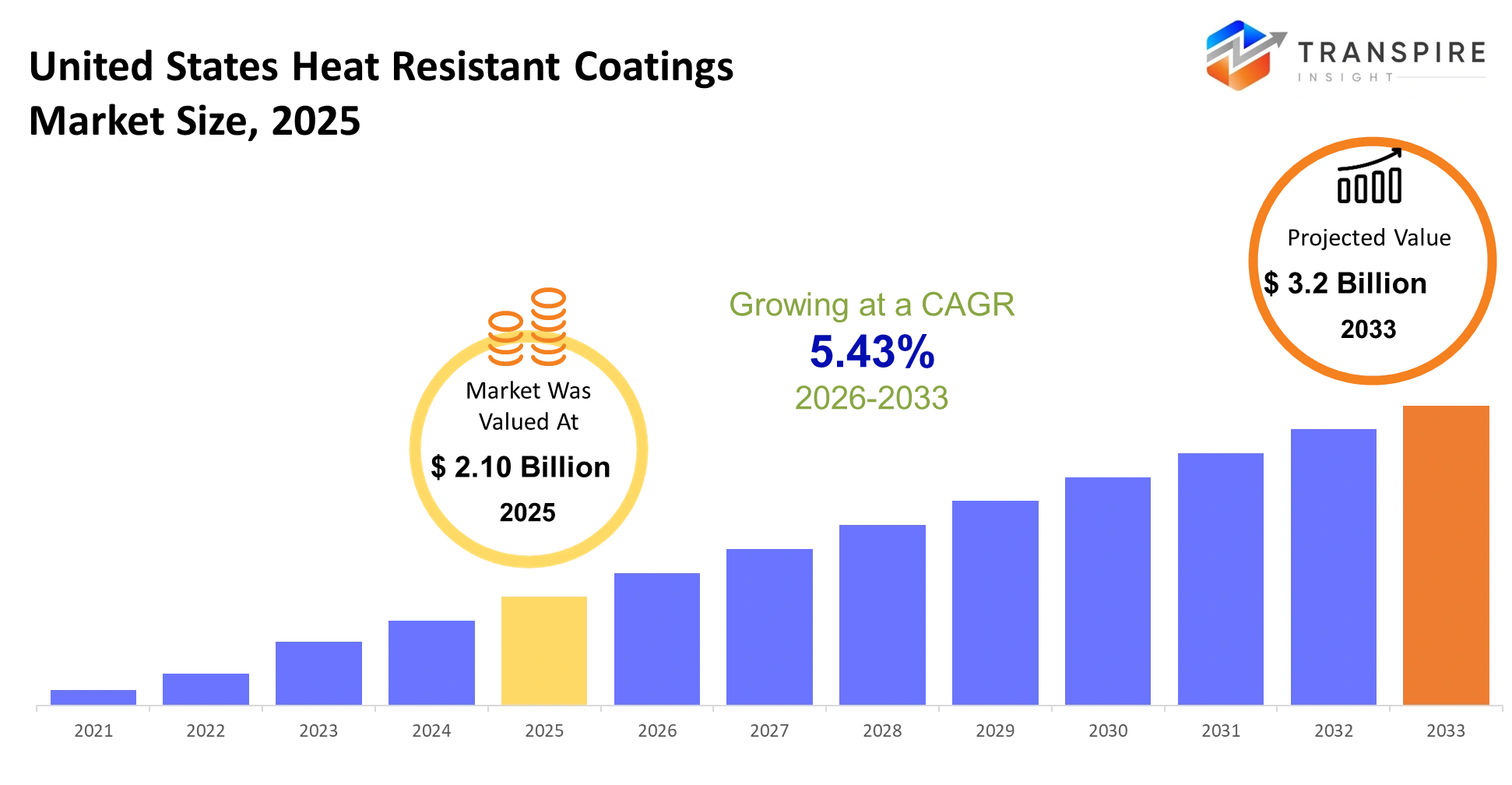
- United States Heat Resistant Coatings Market Size 2025: USD 2.10 Billion
- United States Heat Resistant Coatings Market Size 2033: USD 3.2 Billion
- United States Heat Resistant Coatings Market CAGR: 5.43%
- United States Heat Resistant Coatings Market Segments: By Resin Type (Epoxy, Silicone, Acrylic, Polyester, Alkyd, Polyurethane, Others), By Technology (Water-based, Solvent-based, Powder Coatings, UV-cured Coatings, Ceramic Coatings, Others), By Application (Automotive, Aerospace, Industrial Equipment, Marine, Construction, Oil & Gas, Others), By End User (Manufacturing, Automotive Industry, Aerospace Industry, Energy Sector, Infrastructure Sector, Others).
To learn more about this report,  Download Free Sample Report
United States Heat Resistant Coatings Market Summary:
The United States Heat Resistant Coatings Market size is estimated at USD 2.10 Billion in 2025 and is anticipated to reach USD 3.2 Billion by 2033, growing at a CAGR of 5.43% from 2026 to 2033. The United States Heat Resistant Coatings Market seems to play a key role , in protecting industrial assets that run under extreme heat stress , not just “hot” conditions, but the kind that gradually punishes materials. These coatings get used on things like exhaust systems , refinery vessels , marine engines , turbines , pipelines , and also power generation infrastructure. The idea is pretty straightforward, to prevent corrosion, surface wear, and thermal fatigue from taking hold over time. What it really does in practice is stretch maintenance schedules, lower shutdown expenses , and keep operators from dealing with random reliability problems in high temperature spaces.
In the last five years, the market has moved away from standard solvent based formulations toward newer ceramic plus silicone related coatings. They handle higher operating temperatures while still aligning with tighter emissions rules and workplace safety expectations. This change sort of sped up after supply chain disruptions , and then energy price volatility made the financial impact of surprise industrial downtime more obvious during the pandemic recovery window. Since then , manufacturers have been modernizing aging infrastructure and also pushing more activity tied to domestic energy, aerospace , and industrial production capacity. Heat resistant coatings are being treated more like a cost control method than a nice-to-have protective layer, if you will. That perspective is raising the number of specifications in long life industrial jobs, and it supports wider adoption of premium coating types across the most critical use cases.
Key Market Insights
- Gulf Coast industrial hubs were kind of all over the United States Heat Resistant Coatings Market, they held nearly 38% market share in 2025, mainly because refineries cluster there , a concentration thing.
- Texas and Louisiana are still big revenue drivers, since petrochemical, offshore and LNG infrastructure basically needs steady high-temperature surface protection, not just “sometimes”.
- The Midwest looks like the fastest-growing regional market through 2032, helped by steel manufacturing modernization plus industrial plant retrofitting investments that keep coming in.
- Meanwhile the Western United States facilities are pushing harder toward ceramic-based thermal coatings in aerospace and renewable energy manufacturing , applications keep expanding too.
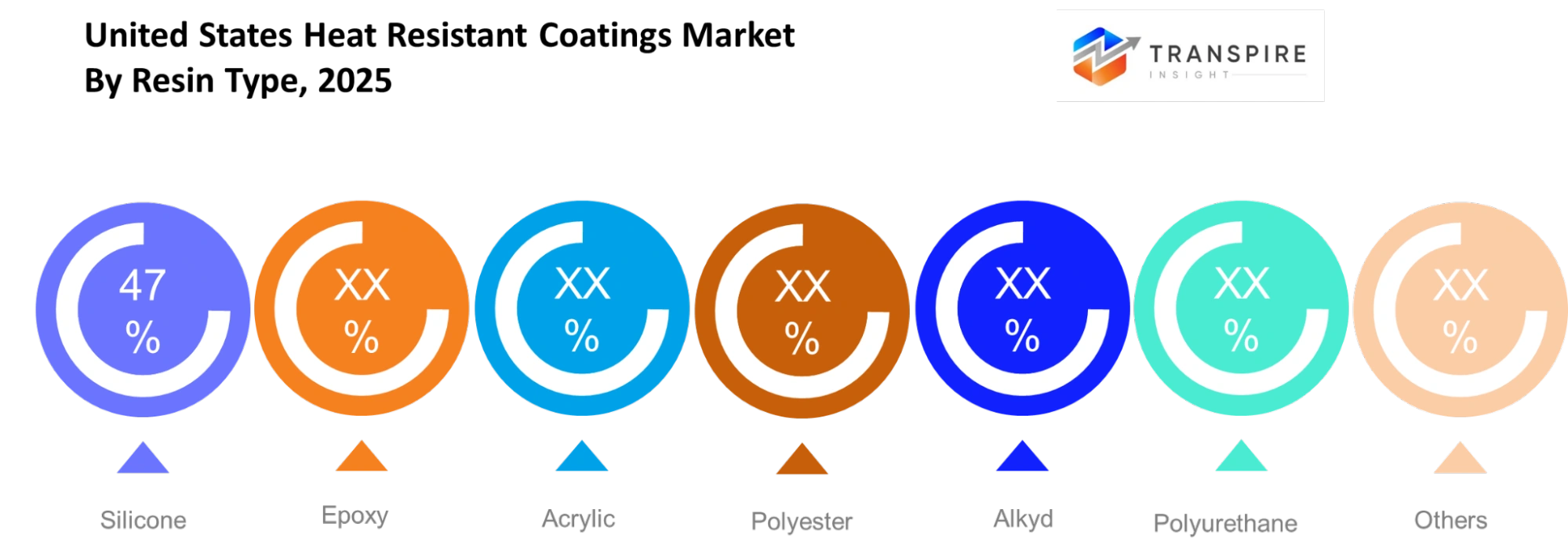
- Silicone-based coatings dominated the United States Heat Resistant Coatings Market with around 42% revenue share in 2025, because they bring superior thermal stability, pretty consistent under heat.
- Epoxy heat resistant coatings took the second spot , operators tend to like them for cost-effective corrosion control and chemical resistance performance.
- Ceramic heat resistant coatings are the quickest growth segment from 2025–2032, because the aerospace and energy sectors keep asking for ultra-high temperature tolerance, like they really need it.
- Water-based coating technologies are also getting more traction, as manufacturers align with VOC compliance, and workplace emission reduction standards too.
- Industrial equipment use accounted for nearly 35% of United States Heat Resistant Coatings Market demand in 2025, largely due to continuous process operations that don’t stop.
- Marine engine and exhaust system coatings still keep a meaningful slice of share, saltwater corrosion ramps up thermal surface degradation, pretty fast.
- Power generation infrastructure is the fastest-growing application segment through 2032 , driven by gas turbine efficiency upgrades as well as grid modernization projects.
What are the Key Drivers, Restraints, and Opportunities in the United States Heat Resistant Coatings Market?
The strongest force pushing forward the United States Heat Resistant Coatings Market is basically the modernization of high-temperature industrial infrastructure across refining, power generation, aerospace, and also heavy manufacturing. That shift really picked up speed after the pandemic , which made the financial hit from equipment shutdowns and maintenance delays painfully obvious to many plants. So operators now lean harder toward coatings that help extend asset life and lower thermal corrosion , because swapping out turbines, exhaust systems, or refinery vessels costs a lot more than doing preventive surface protection. And since more facilities are running hotter to boost energy efficiency, older style coatings end up failing faster, so the industry is moving toward advanced ceramic plus silicone based systems with better thermal durability. This change is gradually lifting premium coating revenues , while also growing long term maintenance contracts.
Raw material volatility is still the market’s most structural hurdle, and it shows up in a pretty stubborn way. Heat resistant coatings rely on specialized resins, ceramic additives, and silicone intermediates that are connected to global petrochemical as well as mineral supply chains. Those input prices can swing quite a bit, largely due to geopolitical disruptions , rising energy costs, and a limited number of suppliers. Manufacturers therefore struggle to relocate these materials easily, or adjust formulations quickly without risking thermal performance certifications. The end result is longer procurement timelines, tighter margins, and slower adoption especially among the more cost sensitive industrial operators.
Another meaningful growth opening is advanced energy infrastructure. Gas turbine upgrades, LNG export terminals, and concentrated solar power sites are all demanding coatings that can handle sustained extreme heat exposure over time, not just short bursts.
What Has the Impact of Artificial Intelligence Been on the United States Heat Resistant Coatings Market?
Artificial intelligence along with more advanced digital technologies is kind of reworking the United States Heat Resistant Coatings Market, mostly by changing how industrial operators keep an eye on thermal stress , plan work, and steer coating performance in real time. In refineries, power stations , and marine operations, teams are increasingly using AI-enabled sensor networks to watch temperature swings corrosion signals and coating deterioration across turbines, exhaust runs, boilers, and other high-heat processing assets. These automated monitoring setups can now spot odd thermal cycling before any visible surface failure starts, so operators can step in earlier and try to sidestep those costly shutdown events.
On top of that , machine learning is sharpening predictive maintenance routines. Many plants lean on past operating records, moisture exposure, and heat-load conditions to estimate how fast the coating will wear, then they can tune the recoating timetable. For gas turbines and marine exhaust systems, predictive analytics are used to cut down sudden stoppages and also boost fuel efficiency, mainly because the thermal insulation is performing more consistently.Some operators say they’ve seen lower maintenance spending and real uptime gains after they paired digital inspection systems with coating lifecycle management software and, it kinda shows up fast, but not always. Meanwhile, advanced robotics plus drone-style inspection tools are shrinking the time spent on manual checks ,especially in risky or hard to access spots, you know.
Still, AI adoption hits a pretty stubborn ceiling because many older industrial facilities rely on disconnected data platforms and the sensor rollout is lopsided, uneven in practice.Still, AI adoption runs into a stubborn ceiling because a lot of older industrial facilities rely on disconnected data platforms, and the sensor build-out is uneven. That kind of situation can weaken model precision and it also pushes integration costs higher, particularly at legacy energy and manufacturing sites where the real-time operational data is simply not there enough.
Key Market Trends
- Since 2021, Gulf Coast refiners have been leaning harder toward ceramic thermal coatings , to cut down those corrosion driven shutdowns in the really hot processing equipment.
- In the aerospace sector, manufacturers started turning more toward ultra high temperature coating systems , once turbine operating temps crept up, mainly to boost aircraft fuel efficiency performance.
- For water based heat resistant coatings , things picked up after stricter VOC regulations kicked in , because compliance costs climbed for solvent heavy industrial formulations and it made switching feel more realistic.
- Between 2020 and 2025, coating suppliers put more money into domestic production, partly to lower reliance on volatile imported silicone intermediates and certain specialty additives.
- At the same time, predictive maintenance platforms, linked with thermal coating inspections , became increasingly normal as manufacturers aimed to push down unplanned maintenance expenses after pandemic disruptions.
- PPG Industries and Sherwin-Williams then expanded their high temperature product lineups, so they could better lock in long term industrial infrastructure contracts.
- And the LNG terminal expansion efforts across Texas and Louisiana pushed specification rates up, especially for coatings that can handle continuous extreme heat exposure.
- After 2022, industrial buyers also adjusted procurement approaches, choosing longer life coating systems even when upfront costs were higher, because shutdown penalties keep rising.
- Robotics and drone assisted inspection tools began showing up inside refinery maintenance , which reduced manual inspection time in risky thermal surroundings by 30% or more.
- Finally, modernization projects for energy infrastructure are increasingly demanding coatings that can play nice with corrosion monitoring compatibility , so suppliers are moving toward digitally connected surface protection systems, whether customers ask directly or not.
United States Heat Resistant Coatings Market Segmentation
By Resin Type
Silicone based resins keep the strongest position, in the resin type space, because industrial operators need stable thermal resistance during long high temperature runs. There is broad adoption across refinery vessels, exhaust systems, turbines, and also aerospace components, so silicone coatings stay in the leading spot. Epoxy resins still have a big market share, mainly due to lower costs plus dependable chemical resistance in industrial processing settings. Polyester and alkyd coatings carry on for moderate temperature use, where budget constraints quietly steer procurement choices.
Polyurethane coatings are getting more attention for applications that need both abrasion resistance, and thermal endurance, especially in transportation plus heavy manufacturing gear. Acrylic formulations are more or less confined to lower heat environments, because their performance drops when they sit under sustained thermal stress. Looking ahead, the direction seems toward hybrid resin systems—mixing ceramic additives with silicone or epoxy chemistries—so service life improves and maintenance intervals get shorter. Manufacturers are also putting more money into advanced resin engineering, trying to lock in premium industrial contracts and stand out by offering longer operational performance.
To learn more about this report, Download Free Sample Report
By Technologies
Solvent based technologies keep winning in industrial settings, mostly because when it gets really hot you need dependable adhesion, fast crosslinking, and consistent behavior even when conditions are rough. So, refinery operators, marine facilities, and heavy manufacturing plants often still stick with solvent based coatings for the stuff that cannot fail, since the financial consequences of a breakdown are pretty big. At the same time, water based technologies are gradually growing too, especially as environmental compliance rules get tighter across industrial states like California and Texas. People like that these systems cut down volatile organic compound output and, beyond that, they also help worker safety , which makes them easier to justify in manufacturing and automotive uses.
Powder coatings are also getting more attention since they reduce material waste and tend to give a steadier surface appearance when production is tightly controlled. Ceramic coatings, though, seem like the quickest moving segment, mainly because of their strong thermal endurance for aerospace, and energy infrastructure where heat is always part of the deal. UV cured coatings are still more limited, mostly due to equipment costs and a narrower range of industrial fit, and future competition is likely to revolve around that tradeoff, balancing thermal performance with environmental compliance. In practice this means suppliers will need to push low emission product innovation faster, or they will fall behind.
By Applicaation
Industrial equipment applications take the biggest slice of the market, mostly because there’s ongoing exposure to heat, pressure,and corrosive working environments, so the need for strong protective coatings keeps showing up again and again. You can see it clearly in boilers, turbines, heat exchangers, and refinery processing setups where thermal barrier coverage matters for cutting down on operational interruptions and the whole maintenance spend.
In the oil and gas space the influence is still pretty solid, with pipeline expansion, LNG terminal building, and refinery modernization initiatives happening along the Gulf Coast and nearby. Aerospace is also moving fast, since aircraft engine makers are leaning into advanced ceramic coating systems that can endure extreme combustion temperatures without giving up. Automotive keeps evolving too, with an increased emphasis on exhaust hardware durability and better thermal control efficiency, rather than just general protection.
Marine demand tends to rise as well, because corrosion-resistant thermal coatings are needed for engine rooms and offshore platforms where conditions can be rough. Construction stays a smaller piece, likely because most infrastructure work doesn’t really call for long-running, high-temperature protection. Looking ahead, the next wave of growth should focus on energy transition infrastructure and next-generation industrial manufacturing systems, with energy related facilities being a major driver.
By End- User
Manufacturing stays the leading end-user kind of category, mainly because industrial facilities run extensive networks of high-temperature machinery, so they need lots of maintenance and more thermal protection upgrades, kinda over and over. Steel production, chemical processing, and heavy equipment manufacturing drive serious coating consumption because the operating environment is not forgiving. On the other hand, the energy sector also stays a major revenue source, as gas-fired power plants, LNG sites, and even renewable infrastructure keep growing and they keep asking for better thermal management.
Aerospace demand is increasing steadily as well , since advanced propulsion setups depend on coatings that can really shield engine parts when the temperatures get extreme, like too much heat. Automotive makers are also asking for heat resistant coatings more often for exhaust systems , battery enclosures and underbody applications, which in turn supports vehicle durability, and it improves operational efficiency too. Infrastructure demand grows a bit more slowly though, because transportation modernization moves in steps and new industrial builds come in waves. Looking ahead, the market seems to drift toward tighter relationships between coating suppliers and owners of industrial assets, so long-term service agreements and predictive maintenance solutions are becoming a more typical buying pattern .
What are the Key Use Cases Driving the United States Heat Resistant Coatings Market?
Industrial processing equipment still seems to be the main, sort of obvious, driver for heat resistant coatings across refineries, petrochemical sites and power generation operations. In places like this, turbines, boilers, exhaust stacks and heat exchangers basically run under constant thermal stress, so protective coatings become critical, to stop corrosion, lower the chance of unplanned shutdowns, and stretch the maintenance cycles by quite a bit.
More and more, aerospace plus marine use is picking up, partly because engine temperatures keep climbing and the people running these assets are dealing with tighter reliability expectations. For example, aircraft engine builders have been leaning into ceramic thermal barrier coatings to help with fuel efficiency, and offshore vessels or LNG carriers are putting high temperature coatings on exhaust systems that see corrosive saltwater conditions every day.
Then there are the “newer” categories, like battery manufacturing floors and concentrated solar power infrastructure. Electric vehicle production lines now need heat resistant coatings for thermal processing gear and battery enclosures, while solar thermal projects are pulling in advanced coating demand that can endure sustained extreme heat exposure for long periods of operation, with fewer compromises over time.
|
Report Metrics |
Details |
|
Market size value in 2025 |
USD 2.10 Billion |
|
Market size value in 2026 |
USD 2.21 Billion |
|
Revenue forecast in 2033 |
USD 3.2 Billion |
|
Growth rate |
CAGR of 5.43% from 2026 to 2033 |
|
Base year |
2025 |
|
Historical data |
2021 - 2024 |
|
Forecast period |
2026 - 2033 |
|
Report coverage |
Revenue forecast, competitive landscape, growth factors, and trends |
|
Geographic scope |
United States of America |
|
Key company profiled |
PPG Industries, Akzo Nobel, Sherwin-Williams, Jotun, Axalta Coating Systems, RPM International, Kansai Paint, Hempel, Nippon Paint, BASF, Sika AG, Carboline, Berger Paints, Tnemec Company, Weilburger Coatings |
|
Customization scope |
Free report customization (country, regional & segment scope). Avail customized purchase options to meet your exact research needs. |
|
Report Segmentation |
By Resin Type (Epoxy, Silicone, Acrylic, Polyester, Alkyd, Polyurethane, Others), By Technology (Water-based, Solvent-based, Powder Coatings, UV-cured Coatings, Ceramic Coatings, Others), By Application (Automotive, Aerospace, Industrial Equipment, Marine, Construction, Oil & Gas, Others), By End User (Manufacturing, Automotive Industry, Aerospace Industry, Energy Sector, Infrastructure Sector, Others) |
Which Regions are Driving the United States Heat Resistant Coatings Market Growth?
The Gulf Coast area seems to lead the United States heat resistant coatings market , largely because refinery clustering, LNG export expansion , and the petrochemical workhorse facilities together keep pulling demand for high temperature surface protection. Texas and Louisiana in particular have some of the biggest refining and energy processing centers, and a lot of the equipment is still running through sustained thermal, plus corrosive, conditions. On top of that , strong environmental oversight and industrial safety compliance rules push companies toward regular coating renewals along pipelines, boilers, and processing modules. There’s also this kind of mature ecosystem of coating producers, engineering contractors, maintenance service providers, and specialty chemical suppliers, so procurement stays busy long term and cycles remain pretty active.
The Midwest counts as the second-largest regional contributor, but the growth logic isn’t the same as the Gulf Coast. Industrial manufacturing steadiness across places like Ohio, Illinois,and Michigan helps keep coating demand stable for steel processing, automotive production, and heavy machinery output. Long running industrial supply networks, plus more predictable capital spending routines , make the region less exposed to commodity price swings that can hit energy heavy markets. Factory upgrade initiatives and the replacement of older industrial assets continue to generate recurring needs for thermal protection systems, usually with less volatility than you see in refinery expansion waves.
In the Western United States, you can see it as the fastest-growing regional market, sort of, because there is a fast expansion happening across aerospace manufacturing , renewable energy infrastructure, and advanced battery production facilities. States like California, Arizona , and Nevada have been ramping up investments in electric vehicle supply chains, semiconductor manufacturing, and concentrated solar power projects since 2022. At the same time, stricter state-level emissions standards , plus workplace environmental regulations, have helped speed the shift toward advanced ceramic and low-VOC heat-resistant coating technologies, kind of in a more steady way than before. Overall this regional move is creating strong opportunities for coating suppliers, material innovators and industrial maintenance firms that are looking for premium growth markets during 2026 to 2033.
Who are the Key Players in the United States Heat Resistant Coatings Market and How Do They Compete?
The competitive landscape of the United States Heat Resistant Coatings Market still looks moderately consolidated, where big multi national coating manufacturers control many high value industrial contracts, while smaller regional suppliers push harder in specialized maintenance jobs. Overall competition is drifting away from price alone , and more toward thermal behavior, environmental compliance, and how long the coating actually lasts when things get brutal. Industrial buyers are now looking at total lifecycle cost reduction, whether the coating plays nicely with predictive maintenance programs, and how well it resists failure under extreme operating conditions. Bigger players keep holding ground via proprietary resin know how , steady domestic supply, and technical service teams, while newer entrants tend to lean on ceramic improvements and more narrow industrial uses.
PPG Industries stands out with more mature silicone and ceramic coating systems, made for refinery, aerospace, and power generation assets that run under sustained thermal stress. They also sharpen their positioning by rolling in coating analytics, inspection assistance, and maintenance programs tailored for long term industrial service agreements. Sherwin-Williams keeps competing through a wide domestic distribution setup, plus quick delivery practices that can help operators minimize procurement delays during shutdown windows. Their expansion across Gulf Coast energy routes supports faster response for refinery maintenance cycles, and it also helps with LNG infrastructure projects.
AkzoNobel really leans into low-VOC yet also high-durability formulations, which kind of match the more strict industrial environmental rules getting tighter in places like California. Jotun keeps making its own lane especially in marine and offshore work, with corrosion-resistant thermal coatings designed for saltwater conditions and also high-heat exposure, you know. Axalta Coating Systems is expanding too, mainly via high-temperature automotive and industrial coating know-how that backs electric vehicle output and the kind of automated manufacturing systems factories use now.
Company List
- PPG Industries
- Akzo Nobel
- Sherwin-Williams
- Jotun
- Axalta Coating Systems
- RPM International
- Kansai Paint
- Hempel
- Nippon Paint
- BASF
- Sika AG
- Carboline
- Berger Paints
- Tnemec Company
- Weilburger Coatings
Recent Development News
In April 2026, PPG Reports Strong Q1 2026 Growth Driven by Aerospace and Industrial Coatings Demand: PPG Industries posted stronger-than-expected quarterly revenue as demand increased across aerospace and protective coatings applications, including high-temperature industrial environments. The company highlighted pricing strength and continued momentum in advanced coatings technologies used in infrastructure and industrial manufacturing.
Source: https://www.reuters.com
In April 2026, PPG Launches Advanced Protective and Thermal Coating Solutions for Data Centers: PPG Industries introduced a new portfolio of protective coatings and application services focused on data centers. The launch includes thermal-resistant, fire-protection, and corrosion-control coatings designed for critical infrastructure requiring high heat durability and performance reliability.
Source: https://news.ppg.com
What Strategic Insights Define the Future of the United States Heat Resistant Coatings Market?
The United States Heat Resistant Coatings Market is kind of moving, in a structurally obvious way, toward high-performance data- integrated coating systems aimed at energy intensive industrial infrastructure. In the next five to seven years, growth will come more and more from places that want longer run times, predictive maintenance tie-ins, and better thermal efficiency not just from plain replacement orders. Meanwhile LNG infrastructure, aerospace propulsion systems, advanced manufacturing, and grid modernization are pushing adoption of ceramic enhanced and multifunctional coatings that can stay effective under truly extreme thermal loads.
One smaller, undernoticed risk has to do with supply concentration for specialty silicone intermediates ceramic additives, and those rare mineral inputs used in the premium blends. Even a modest geopolitical hiccup, or export restrictions that pop up suddenly, could boost production costs a lot and also delay industrial maintenance windows, in a real practical sense. Another thing that’s starting to show up is technology substitution in a few key uses, where advanced composite materials might reduce the demand for conventional thermal coatings.
A big emerging chance sits in battery manufacturing plus semiconductor fabrication plants across the Western United States where thermal management standards are tightening fast. Companies in this space should think about partnering with industrial automation providers along with predictive maintenance software firms, so the coatings get framed as performance management systems not just commodity protective materials.
United States Heat Resistant Coatings Market Report Segmentation
By Resin Type
- Epoxy
- Silicone
- Acrylic
- Polyester
- Alkyd
- Polyurethane
- Others
By Technology
- Water-based
- Solvent-based
- Powder Coatings
- UV-cured Coatings
- Ceramic Coatings
- Others
By Application
- Automotive
- Aerospace
- Industrial Equipment
- Marine
- Construction
- Oil & Gas
- Others
By End User
- Manufacturing
- Automotive Industry
- Aerospace Industry
- Energy Sector
- Infrastructure Sector
- Others
Frequently Asked Questions
Find quick answers to common questions.
The approximate United States Heat Resistant Coatings Market size for the market will be USD 3.2 Billion in 2033.
The key segments of the United States Heat Resistant Coatings Market are By Resin Type (Epoxy, Silicone, Acrylic, Polyester, Alkyd, Polyurethane, Others), By Technology (Water-based, Solvent-based, Powder Coatings, UV-cured Coatings, Ceramic Coatings, Others), By Application (Automotive, Aerospace, Industrial Equipment, Marine, Construction, Oil & Gas, Others), By End User (Manufacturing, Automotive Industry, Aerospace Industry, Energy Sector, Infrastructure Sector, Others).
Major players in the United States Heat Resistant Coatings Market are PPG Industries, Akzo Nobel, Sherwin-Williams, Jotun, Axalta Coating Systems, RPM International, Kansai Paint, Hempel, Nippon Paint, BASF, Sika AG, Carboline, Berger Paints, Tnemec Company, Weilburger Coatings.
The current market size of the United States Heat Resistant Coatings Market is USD 2.10 Billion in 2025.
The United States Heat Resistant Coatings Market CAGR is 5.43%.
- PPG Industries
- Akzo Nobel
- Sherwin-Williams
- Jotun
- Axalta Coating Systems
- RPM International
- Kansai Paint
- Hempel
- Nippon Paint
- BASF
- Sika AG
- Carboline
- Berger Paints
- Tnemec Company
- Weilburger Coatings
Recently Published Reports
-
Apr 2026
Healthcare Polymer Packaging Market
Healthcare Polymer Packaging Market Size, Share & Analysis Report By Packaging Type (Syringes, IV Bottles and Pouches, Clamshells, Blisters, Bottles & Jars, Containers, Tubes, IV Parental Packaging, Others), By Type (Regulated, Non-regulated), By Polymer Type (LDPE (Low-Density Polyethylene), HDPE (High-Density Polyethylene), Homo-polymer (Homo), Random Copolymer (Random), Block Copolymer (Block), PET, Polystyrene, Polyvinyl Chloride, Polyamide/EVOH, Others), and Geography (North America, Europe, Asia-Pacific, Middle East and Africa, South and Central America), 2021 - 2031
-
Apr 2026
Hydrophilic Tape (Waterstop) Market
Hydrophilic Tape (Waterstop) Market Size, Share & Analysis Report By Type (Bentonite-Based Hydrophilic Tape, Rubber-Based Hydrophilic Tape), By Application (Residential Buildings, Commercial Buildings, Infrastructure Projects), and Geography (North America, Europe, Asia-Pacific, Middle East and Africa, South and Central America), 2021 - 2031
-
Apr 2026
Metalens Market
Metalens Market Size, Share & Analysis Report By Type (Visible Light Metalens, and Infrared Metalens), By Application (Consumer Electronics, Automotive Electronics, Industrial, Medical, and Others), and Geography (North America, Europe, Asia-Pacific, Middle East and Africa, South and Central America), 2021 - 2031
-
Apr 2026
PBT Resin Market
PBT Resin Market Size, Share & Analysis Report By Type (Reinforced PBT Resin, Unreinforced PBT Resin), By Processing Method (Injection Molding, Extrusion, Blow Molding, Others), By End-User (Automotive, Electrical & Electronics, Consumer Appliances, Industrial Machinery, Medical Devices, Packaging, Others), and Geography (North America, Europe, Asia-Pacific, Middle East and Africa, South and Central America), 2021 - 2031