

Asia Pacific On-demand Insurance Market Size & Forecast:
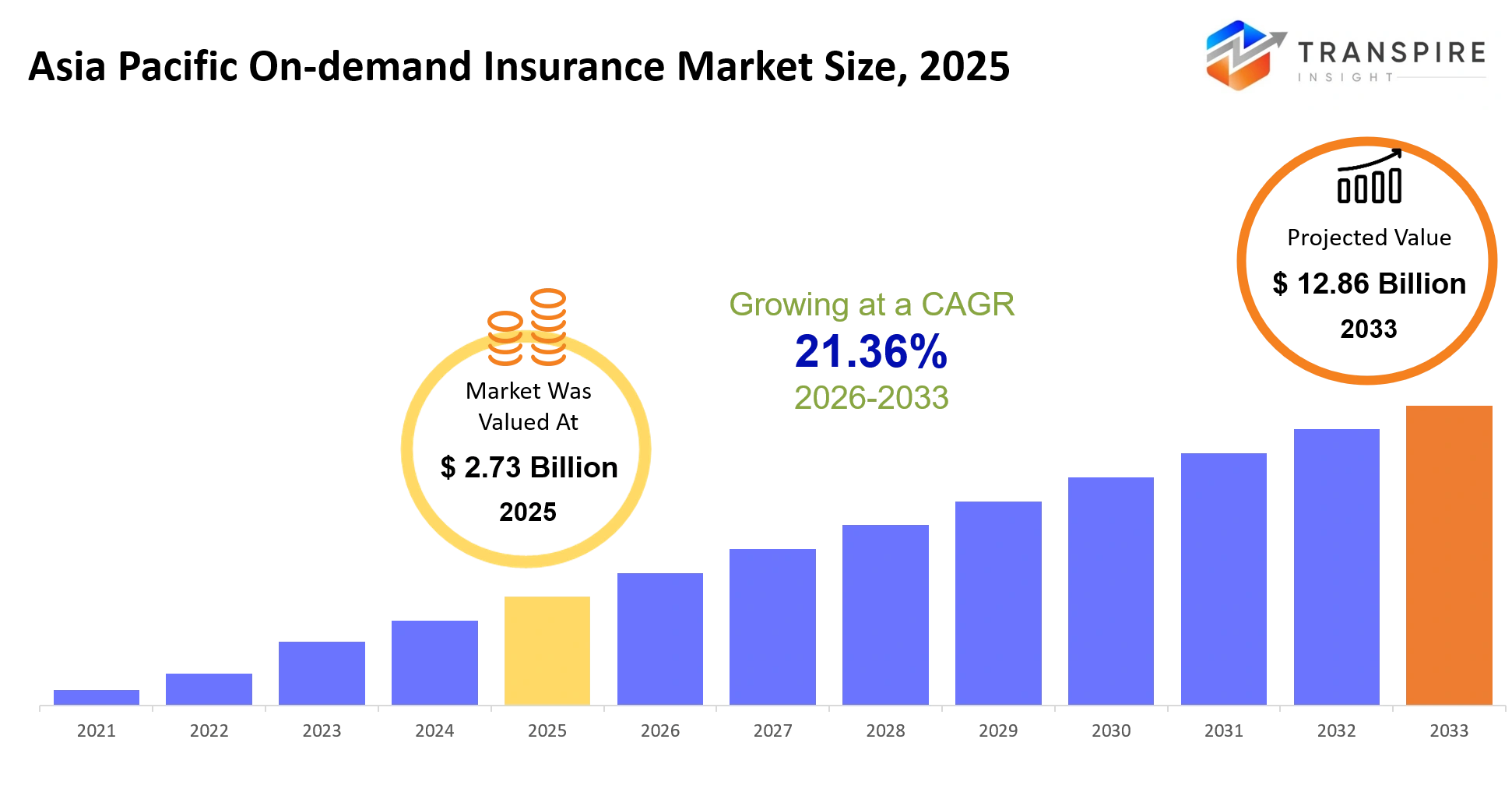
- Asia Pacific On-demand Insurance Market Size 2025: USD 2.73 Billion
- Asia Pacific On-demand Insurance Market Size 2033: USD 12.86 Billion
- Asia Pacific On-demand Insurance Market CAGR: 21.36%
- Asia Pacific On-demand Insurance Market Segments: By Insurance Type (Health Insurance, Motor Insurance, Travel Insurance, Gadget Insurance, Home Insurance, Event Insurance, Others); By Platform (Mobile Apps, Websites, Embedded Insurance Platforms, Others); By End User (Individuals, SMEs, Enterprises, Others); By Coverage Duration (Hourly, Daily, Monthly, Usage-Based, Others).
Asia Pacific On-demand Insurance Market Summary
The Asia Pacific On-demand Insurance Market was valued at USD 2.73 Billion in 2025. It is forecast to reach USD 12.86 Billion by 2033. That is a CAGR of 21.36% over the period.
The Asia Pacific On-demand Insurance Market kind of speaks to a real issue, for both consumers and companies: you pay for insurance only when protection is actually required. It could be like covering a traveler for just one trip, insuring a rented car for a few hours, or turning on coverage for electronic devices during certain usage windows. These on-demand approaches help cut down unnecessary premium spending, while also giving people more leeway. So it ends up making insurance far easier for digital-first users, and for gig economy participants too.
Over the last 3–5 years, the market has moved away from the older annual policy style, and more toward API-driven embedded insurance, which gets tucked into e-commerce platforms, mobility applications, travel portals, and fintech ecosystems. The COVID-19 pandemic, pretty much pushed things forward, it accelerated digital transactions and made insurers rethink their offerings around short term, usage-based protection. And as insurers start getting access to real time behavioral signals and transaction details, underwriting becomes way more accurate, which supports tailored pricing and quicker policy activation. All of this boosts customer take-up, widens distribution routes, and opens up fresh income chances across underserved, and previously uninsured groups throughout the region.
Key Market Insights
- China is really big in the Asia Pacific On-demand Insurance Market. It is going to have around 35 to 40 percent of the market by 2025. This is because China has good technology for insurance and people can pay digitally.
- Southeast Asia is growing fast from 2025 to 2032. This is because more people are shopping online and using their phones to buy insurance. They are also using ride-hailing services and mobile insurance platforms.
- India is also doing well. Insurance companies are using the governments systems and many people have smartphones.
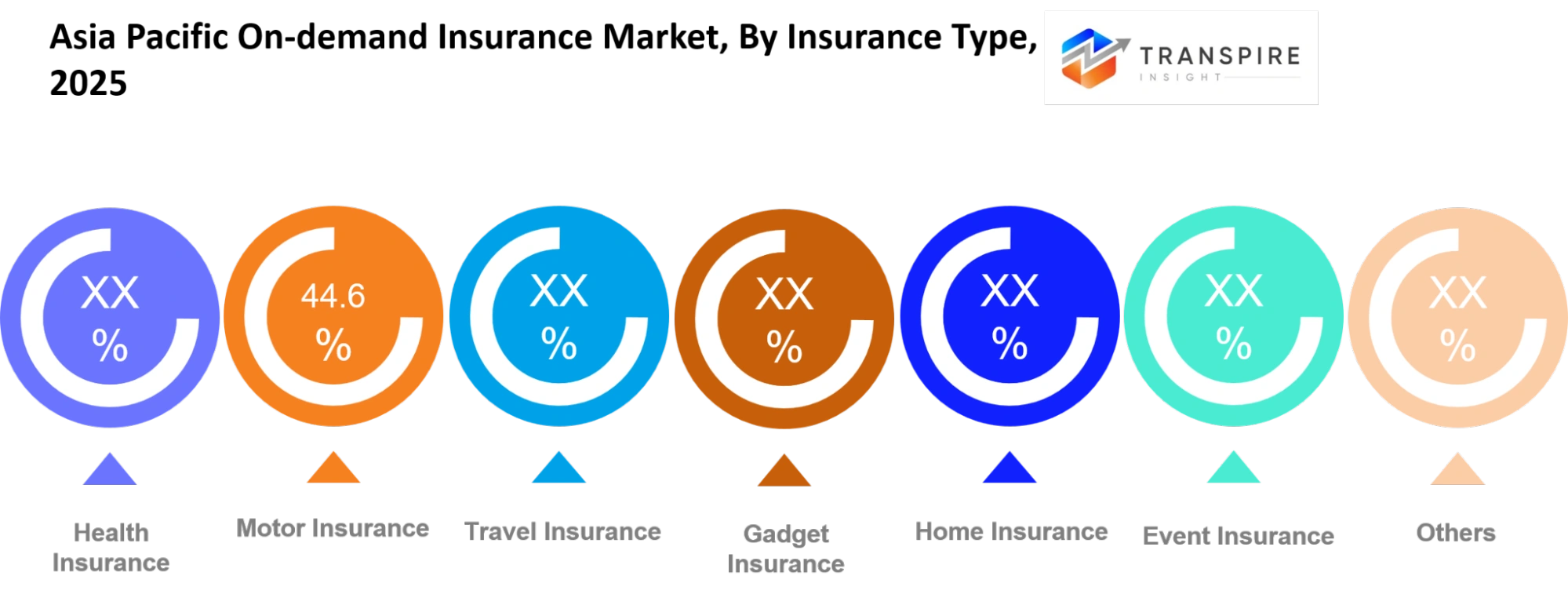
- When we look at the types of insurance motor insurance is the biggest. It will have around 28 to 32 percent of the market in 2025. This is because many cars have devices that can track how people drive and they can pay for insurance based on how much they use their cars.
- Travel insurance is the biggest. More people are traveling to countries and they can buy insurance on their phones.
- Gadget insurance is growing fast. This is because many people have phones, laptops and other devices.
- Many people are buying insurance on their phones. In 2025 around 45 percent of the market will come from apps. This is because it is easy to buy insurance and make claims on phones.
- Some companies are also putting insurance directly into their apps and websites. This means people can buy insurance when they are shopping online or using services.
- Nowadays insurance companies can activate policies and process claims quickly. This makes customers happy. They are more likely to stay with the company.
- Most of the market is made up of consumers. In 2025 they will have, over 60 percent of the market. This is because insurance companies are offering affordable options for them.
What are the Key Drivers, Restraints, and Opportunities in the Asia Pacific On-demand Insurance Market?
The strongest force, pushing the Asia Pacific On-demand Insurance Market forward, is the fast growth of digital ecosystems, that make it possible for insurance to be tucked right into everyday consumer transactions. You can see it in the way mobile wallets, e-commerce platforms, ride-hailing apps, and online travel services are showing up everywhere. They also build new distribution channels where coverage can be turned on immediately, almost as soon as someone taps or confirms. This change was really set off by API integration improvements, plus real-time data processing, and that mix lets insurers adjust pricing as the situation unfolds and then issue policies within seconds. So in practice, insurers end up meeting customers at that exact moment of purchase, which helps boost conversions and brings in revenue from activities that used to be uninsured or at least not properly insured.
Still, the biggest obstacle is the fragmented regulatory landscape across Asia Pacific. Licensing rules for insurance, consumer protection expectations, data privacy requirements, and even the digital policy standards are not consistent, they can be quite different from one country to the next. In a way this is structural, since insurers working across several jurisdictions have to rework their products, revise compliance workflows, and re-align underwriting frameworks for each local market. On top of that, the extra burden raises operating costs, delays product launches, and reduces how far a regional insurance platform can scale. As a result, expansion and revenue growth tend to move slower than technology adoption alone might suggest.
There’s a major chance sitting right in AI based personalized insurance and embedded coverage for these new digital services, you know. Countries like India and across Southeast Asia are seeing fast movement in digital payments and in platform style work. If insurers take artificial intelligence and blend it with real time behavioral signals, then they can provide super focused micro-duration policies for gig workers, people who use mobility apps, and even online merchants. Done this way, the whole thing might open up fresh customer slices and over the coming decade, it could really boost premium volumes , a lot.
What Has the Impact of Artificial Intelligence Been on the Asia Pacific On-demand Insurance Market?
Artificial intelligence plus advanced digital tech is really shifting the marine emission control systems, you know, by turning exhaust gas cleaning operations into something more automated, more data driven, and generally more in line with the changes in environmental rules. In fact, modern scrubber performance setups now often lean on AI enabled monitoring platforms, which keep on continuously examining sensor feeds tied to washwater quality, exhaust emissions, pressure readings, and the overall equipment health. With these platforms, compliance tracking gets automated, and they can issue near real time warnings when the performance drifts past the regulatory limits. That means less time spent on hands-on inspections, and less tedious reporting too
Also, machine learning models are making predictive functions better across vessel fleets. Basically, by looking at past operational logs, plus fuel traits, weather patterns, and how the equipment behaves, these systems can anticipate maintenance needs, tune scrubber settings for better results, and even estimate emission performance across multiple operating cases. So operators can line up maintenance ahead of time before something breaks, and also cut down on that unplanned downtime which is always a pain in practice.
The operational advantages are pretty clear, honestly. Digital optimization tools help push equipment uptime up, bring maintenance costs down, boost fuel efficiency thanks to better engine-scrubber interaction, and also reinforce regulatory compliance across international shipping routes. Fleet operators might even get improved visibility into vessel performance, via centralized dashboards and these remote diagnostics kind of things.
Still, AI adoption has some limits. The integration costs can be high, the data quality can be a bit inconsistent across fleets, and connectivity constraints during long ocean voyages can affect model accuracy, plus make the deployment of advanced analytics solutions at scale slower .
Key Market Trends
- Since 2021 insurance partnerships have grown on shopping and financial technology platforms. This shift moves insurance sales away from agents.
- Insurers now use online connections to sell policies quickly. For example you can buy travel insurance in seconds when booking a trip or get coverage during a ride-hailing transaction.
- The use of intelligence in insurance underwriting took off after 2022. It helps insurers make decisions by looking at how people behave in real-time.
- Short-term insurance products have become popular. They are useful for people who work on gig platforms or provide services through apps.
- Big insurance companies like Allianz, AXA, Ping An and ZhongAn are investing more in insurance. They want to attract and keep customers.
- In some Asia Pacific countries people prefer to use apps for insurance. This is because many people use smartphones and digital payments.
- New technologies have made it faster to process insurance claims. This makes customers happier. Improves the efficiency of insurance companies.
- Regulators in countries like Singapore, Australia and India are supportive of digital insurance ideas. They also make sure that customers are protected.
- Insurers are now working with companies, like mobility platforms, travel providers and online shopping sites. This is a strategy for them to compete with others.
- Insurers are using data to offer insurance plans. This means that people can get coverage that suits their needs and pay premiums that're fair.
- This change happened between 2023 and 2025.
Asia Pacific On-demand Insurance Market Segmentation
By Insurance Type:
Motor insurance kind of holds a leading place, mainly because so many people are leaning into pay-per-use and usage-based coverage things across different mobility services and day to day personal travel. With digital policy activation, short-term protection is, somehow, easier to grab, especially when someone only drives once in a while or when they use shared mobility arrangements. Travel insurance is also slowly but surely getting more popular, mostly via online booking platforms where coverage can be added right at the time of ticket purchase, or alongside the travel reservations.
Gadget insurance has shown up as a fast-growing category too, as smartphone, laptop, tablet ownership and other connected devices keep expanding throughout the region. Consumers seem to like flexible protection plans that cover a device mainly during periods of active use, rather than constantly. Home insurance, event insurance, and other more specialized options are benefiting in a similar way from digital distribution channels , because they make it simpler to choose and activate coverage. And overall product diversification lets insurers tap into wider customer groups , while also opening up more revenue chances.
By Platform:
Mobile applications kinda became the go to place for buying policies, kicking off coverage and doing claims management, and honestly it just fits better with how people live now. With smartphone penetration climbing, and digital payments pretty much everywhere, insurers feel more pushed to focus on app based customer experiences, rather than old school processes. Also onboarding that is fast and policy issuance in real time make it easier for both new customers and existing ones, which reduces friction in a direct way.
Websites still matter a lot though, especially for customers who want deeper comparisons of products and a wider look at what protection covers. Meanwhile embedded insurance platforms are getting a lot of attention, since coverage is becoming part of other everyday actions like e commerce, fintech services, travel plans, and mobility journeys. Platform providers are starting to team up with insurers, so protection can show up right at the moment of purchase. That method helps customer conversion, and it also opens up new distribution chances across several digital ecosystems.
By End User:
Individuals really show up as the biggest end-user group, mostly because people keep leaning toward insurance that feels flexible and also affordable. Short-term protection fits nicely with how lifestyles evolve , plus the digital way people now buy stuff, and then the need for activity based coverage types. The whole thing gets an extra push since it’s easier to access through mobile channels, so participation in this segment keeps going up, even if it’s kinda on the fly.
SMEs are also moving toward flexible insurance products, mainly to handle operational risks while not locking themselves into long-term policy structures. Cost control is still a major driver too, especially for smaller businesses, so they can stay careful with spend. Meanwhile enterprise customers continue investing in customized on-demand coverage, often backed by advanced analytics and risk assessment tools. On top of that, more growth looks to be coming from gig economy workers, platform service providers, and independent professionals who want coverage adjusted to particular activities and needs.
By Coverage Duration:
Hourly coverage has been getting more popular with customers who need protection for certain tasks, trips, events, or temporary asset usage , you know when it’s not always “all year” type of thing. With real-time activation the coverage can start and then stop based on actual needs , so it can cut down on unnecessary insurance costs which sounds simple but it matters. Pricing that’s more adaptable has really helped this idea spread across different personal and business scenarios.
Daily and weekly options still pull in people who want short-term protection without signing on for an entire year. Monthly coverage is still a better match for those who need something ongoing, but still adjustable as their situation changes. Also there are more digital tools for handling the policy , so picking the duration feels easier and clearer. Overall, having more room to move between different coverage periods helps customer satisfaction, while letting insurers support a broader set of risk profiles and day-to-day usage patterns.
What are the Key Use Cases Driving the Asia Pacific On-demand Insurance Market?
Motor related coverage still seems like the top use case, especially for ride hailing services, vehicle sharing platforms and short term vehicle rentals. In general, coverage can be activated only when a vehicle is in use , so users don’t have to pay for those usual yearly policies. This approach creates a lot of momentum too, since protection lines up with real world usage cycles and how often transactions happen
Travel related protection is starting to pick up speed via airline booking platforms, online travel agencies, plus hospitality providers. Trip cancellation , delay handling, and medical emergencies coverage is now commonly positioned right in the middle of the booking flow. And gadget protection is getting broader interest with both consumers and small businesses , people using smartphones , laptops and other connected devices for routine work, or simple everyday tasks.
More emerging ideas include coverage for gig economy workers and platform based service providers who really only need protection while the assignment is active. There’s also “embedded” insurance for digital commerce transactions, which looks pretty strong because the coverage can be attached instantly during online purchases. These models should become even more normal as digital ecosystems keep maturing across Asia Pacific markets
|
Report Metrics |
Details |
|
Market size value in 2025 |
USD 2.73 Billion |
|
Market size value in 2026 |
USD 3.32 Billion |
|
Revenue forecast in 2033 |
USD 12.86 Billion |
|
Growth rate |
CAGR of 21.36% from 2026 to 2033 |
|
Base year |
2025 |
|
Historical data |
2021 - 2024 |
|
Forecast period |
2026 - 2033 |
|
Report coverage |
Revenue forecast, competitive landscape, growth factors, and trends |
|
Regional scope |
Asia Pacific (India, China, Japan, Australia, South Korea, Rest of Asia Pacific) |
|
Key company profiled |
Lemonade, Allianz, AXA, Ping An, ZhongAn, AIA, Prudential, Tokio Marine, Sompo, Chubb, Zurich, MetLife, Cover Genius, bolttech, PolicyBazaar. |
|
Customization scope |
Free report customization (country, regional & segment scope). Avail customized purchase options to meet your exact research needs. |
|
Report Segmentation |
By Insurance Type (Health Insurance, Motor Insurance, Travel Insurance, Gadget Insurance, Home Insurance, Event Insurance, Others); By Platform (Mobile Apps, Websites, Embedded Insurance Platforms, Others); By End User (Individuals, SMEs, Enterprises, Others); By Coverage Duration (Hourly, Daily, Monthly, Usage-Based, Others). |
Which Regions are Driving the Asia Pacific On-demand Insurance Market Growth?
East Asia kinda leads the market because it has a really developed digital economy, a big insurtech scene, and this enormous base of people who are digitally connected. China is sort of at the center, through advanced fintech ecosystems, where insurance offerings can be tucked directly into e commerce, mobility services, and even payments. Plus, the regulatory rules for digital financial services are pretty supportive, so insurers can try out more flexible protection models and even automated underwriting. There is also a mature tech infrastructure, lots of mobile payment adoption, and ongoing collaboration between insurers and tech firms, which keeps pushing regional leadership forward.
Oceania comes next as the second-largest regional contributor, but the growth pattern is not exactly the same as East Asia. Australia and New Zealand do well due to stable financial systems, higher insurance penetration, and steady spending on digital transformation initiatives. Here, expansion is supported by a slow and deliberate rollout of technology enabled insurance products, not this fast platform driven disruption. And because consumers already trust regulated financial services, plus insurers continue investing in customer experience upgrades, the region ends up being a dependable source for long-term revenue.
Southeast Asia seems to be the fastest growing region lately, what with digital commerce, mobile banking, and platform based services rolling out across most major economies. Lately, investments in digital infrastructure and financial inclusion programs have helped push more people into insurance products ,especially those who were underserved. At the same time, ride hailing, online travel, and e-commerce transactions are expanding super quickly ,so it’s opening up room for embedded and pay as you use coverage. All this momentum should pull insurers, technology providers and investors into these high growth markets ,from 2026 to 2033.
Who are the Key Players in the Asia Pacific On-demand Insurance Market and How Do They Compete?
Competition in the Asia Pacific On-demand Insurance Market is still kinda moderately fragmented, you know, with traditional insurers, digital-first carriers, and insurtech platforms all chasing customer access across digital ecosystems that are expanding fast. In practice, technology integration has become the main “battlefield” , especially for embedded insurance, real-time underwriting and automated claims processing. The big insurance groups keep defending market share with distribution power, plus brand recognition, even if the landscape is shifting. Meanwhile, newer players tend to lean into platform-based delivery models, which helps cut the friction when customers are trying to buy and activate a policy. What matters more and more is the ability to tuck insurance right into everyday consumer transactions, instead of depending only on usual sales routes and channels.
ZhongAn built its edge using a fully digital operating model that can handle high-volume policy issuance, and also supports automated customer interactions. It also has strong expertise in embedded insurance , so it can plug into e-commerce and online service platforms. This creates an efficient path for customer acquisition. Ping An meanwhile combines artificial intelligence and advanced analytics with its broad digital ecosystem assets, aiming to tailor coverage and sharpen underwriting accuracy. They keep investing in technology partnerships and digital services too, which supports a more durable competitive position across multiple customer segments.
Cover Genius kinda zeroes in on embedded protection solutions for travel, retail, and digital commerce platforms , so insurance can be offered right at the point of transaction. That focus gives some clear advantages, like scalability plus a wider distribution reach in practice. bolttech, on the other hand, is more about a tech enabled insurance exchange , connecting insurers with distributors and customers across several markets. They also lean on strategic partnerships with financial institutions, telecom providers, and digital platforms, which helps them spread further across Southeast Asia and other fast growing regional markets .
Company List
- Lemonade
- Allianz
- AXA
- Ping An
- ZhongAn
- AIA
- Prudential
- Tokio Marine
- Sompo
- Chubb
- Zurich
- MetLife
- Cover Genius
- bolttech
- PolicyBazaar
Recent Development News
"In April 2026, bolttech entered a strategic partnership with Mehrwerk to expand embedded insurance and value-added protection services. The agreement broadens access to integrated insurance solutions across financial services, retail, and utility sectors, supporting wider distribution of on-demand and embedded insurance products.
Source: https://fintech.global/2026/04/29
"In May 2025, Sumitomo Corporation announced an investment in bolttech and plans to establish a joint venture in Southeast Asia. The initiative combines bolttech’s insurance distribution capabilities with Sumitomo’s device lifecycle expertise, creating new embedded protection opportunities and accelerating digital insurance expansion across the region.
Source: https://www.sumitomocorp.com
What Strategic Insights Define the Future of the Asia Pacific On-demand Insurance Market?
In the next five to seven years, the market is probably going to drift away from standalone, on-demand policies toward something more deeply embedded— like protection that sits inside digital commerce, financial services, mobility platforms and all those connected ecosystems . The main push behind this shift is that there is more real-time transaction and behavioral data floating around, which helps insurers price risk with more precision, and then deliver coverage right when a service is bought , or when it’s actually used. And as embedded models get more mature , the distribution edge could end up mattering even more than underwriting scale by itself.
There’s also a quieter risk nobody talks about as much, platform concentration. Meaning, a small handful of big digital ecosystems could end up having a lot of say in how customers reach services, what the pricing visibility looks like, and the overall distribution economics. That can squeeze insurers’ negotiating leverage, and make their growth dependent on third-party platforms , even if they didn’t mean to.
On the opportunity side, there’s growing momentum for AI-powered micro-coverage products for gig workers, digital merchants, and independent service providers across Southeast Asia. If regulators keep backing digital financial inclusion , adoption could really accelerate. Market participants should start investing early in API-driven partnerships, plus scalable data infrastructure. The idea is that future competitive advantage may hinge less on having a wide product shelf , and more on ecosystem integration, sort of end to end.
Asia Pacific On-demand Insurance Market Report Segmentation
By Insurance Type
- Health Insurance
- Motor Insurance
- Travel Insurance
- Gadget Insurance
- Home Insurance
- Event Insurance
- Others
By Platform
- Mobile Apps
- Websites
- Embedded Insurance Platforms
- Others
By End User
- Individuals
- SMEs
- Enterprises
- Others
By Coverage Duration
- Hourly
- Daily
- Monthly
- Usage-Based
- Others
Frequently Asked Questions
Find quick answers to common questions.
The expected Asia Pacific On-demand Insurance Market size for the market will be USD 12.86 Billion in 2033.
Key segments for the Asia Pacific On-demand Insurance Market are By Insurance Type (Health Insurance, Motor Insurance, Travel Insurance, Gadget Insurance, Home Insurance, Event Insurance, Others); By Platform (Mobile Apps, Websites, Embedded Insurance Platforms, Others); By End User (Individuals, SMEs, Enterprises, Others); By Coverage Duration (Hourly, Daily, Monthly, Usage-Based, Others).
Major Asia Pacific On-demand Insurance Market players are Lemonade, Allianz, AXA, Ping An, ZhongAn, AIA, Prudential, Tokio Marine, Sompo, Chubb, Zurich, MetLife, Cover Genius, bolttech, PolicyBazaar.
The Asia Pacific On-demand Insurance Market size is USD 2.73 Billion in 2025.
The Asia Pacific On-demand Insurance Market CAGR is 21.36% from 2026 to 2033.
- Lemonade
- Allianz
- AXA
- Ping An
- ZhongAn
- AIA
- Prudential
- Tokio Marine
- Sompo
- Chubb
- Zurich
- MetLife
- Cover Genius
- bolttech
- PolicyBazaar
About the Authors

Mayur Shinde
I am Mayur Shinde, a Senior Research Analyst at Transpire Insight, specializing in the Automotive & Transportation and Information & Communication Technology (ICT) Industry. My work focuses on analyzing emerging market trends, technological advancements, competitive landscapes, and industry developments to deliver accurate, data-driven insights. I am passionate about transforming complex market information into clear, actionable content that helps businesses, professionals, and decision-makers stay informed and make confident strategic decisions.

Chakradhar Khansole
Chakradhar serves as the Research Director at Transpire Insight, bringing over 8 years of experience in technology, innovation, and strategic market intelligence. He specializes in transforming complex market data into actionable business insights that enable organizations to make informed, growth-oriented decisions. Recognized for his strategic vision and analytical expertise, Chakradhar leads high-impact research initiatives, delivering comprehensive market assessments, competitive intelligence, and forward-looking industry analysis.
Recently Published Reports
-
Apr 2026
3D Optical Profiler Market
3D Optical Profiler Market Size, Share & Analysis Report By Type (Desktop 3D Optical Profiler, and Portable 3D Optical Profiler), By Technology (Confocal Technology, and White Light Interference), By End-Use Industry (Manufacturing, Research Institutions, Automotive, Aerospace and Defense, Medical Devices, and Other), and Geography (North America, Europe, Asia-Pacific, Middle East and Africa, South and Central America), 2021 - 2031
-
Apr 2026
Depth Sensor Market
Depth Sensor Market Size, Share & Analysis Report By Type (Infrared Depth Sensors, Time-of-Flight (ToF) Sensors, Stereo Vision Sensors, Structured Light Sensors, Ultrasonic Depth Sensors), By Application (Automotive, Robotics, Gaming, Consumer Electronics, Industrial Automation, Healthcare, Security & Surveillance, Others), By End Users (Automotive Manufacturers, Consumer Electronics Companies, Healthcare Providers, Industrial Companies, Security Agencies, Gaming Companies, Robotics Companies, Others), and Geography (North America, Europe, Asia-Pacific, Middle East and Africa, South and Central America), 2021 – 2031
-
Apr 2026
Digital Manufacturing Market
Digital Manufacturing Market Size, Share & Analysis Report By Component (Hardware, Software, and Services), By Technology (Robotics, 3D Printing, Internet of Things (IoT), and Others), By Application (Automotive and Transportation, Aerospace and Defense, Consumer Electronics, Industrial Machinery, and Others), By Process Type (Computer-Based Designing, Computer-Based Simulation, Computer 3D Visualization, Analytics, and Others), and Geography (North America, Europe, Asia-Pacific, Middle East and Africa, South and Central America), 2021 – 2031
-
Apr 2026
Digital Visa Services Market
Digital Visa Services Market Size, Share & Analysis Report By Type (Individual Travelers, Group Travelers), By Application (Tourism, Business Travel, Others), and Geography (North America, Europe, Asia-Pacific, Middle East and Africa, South and Central America), 2021 – 2031