

Asia Pacific Movie And Entertainment Market Size & Forecast:
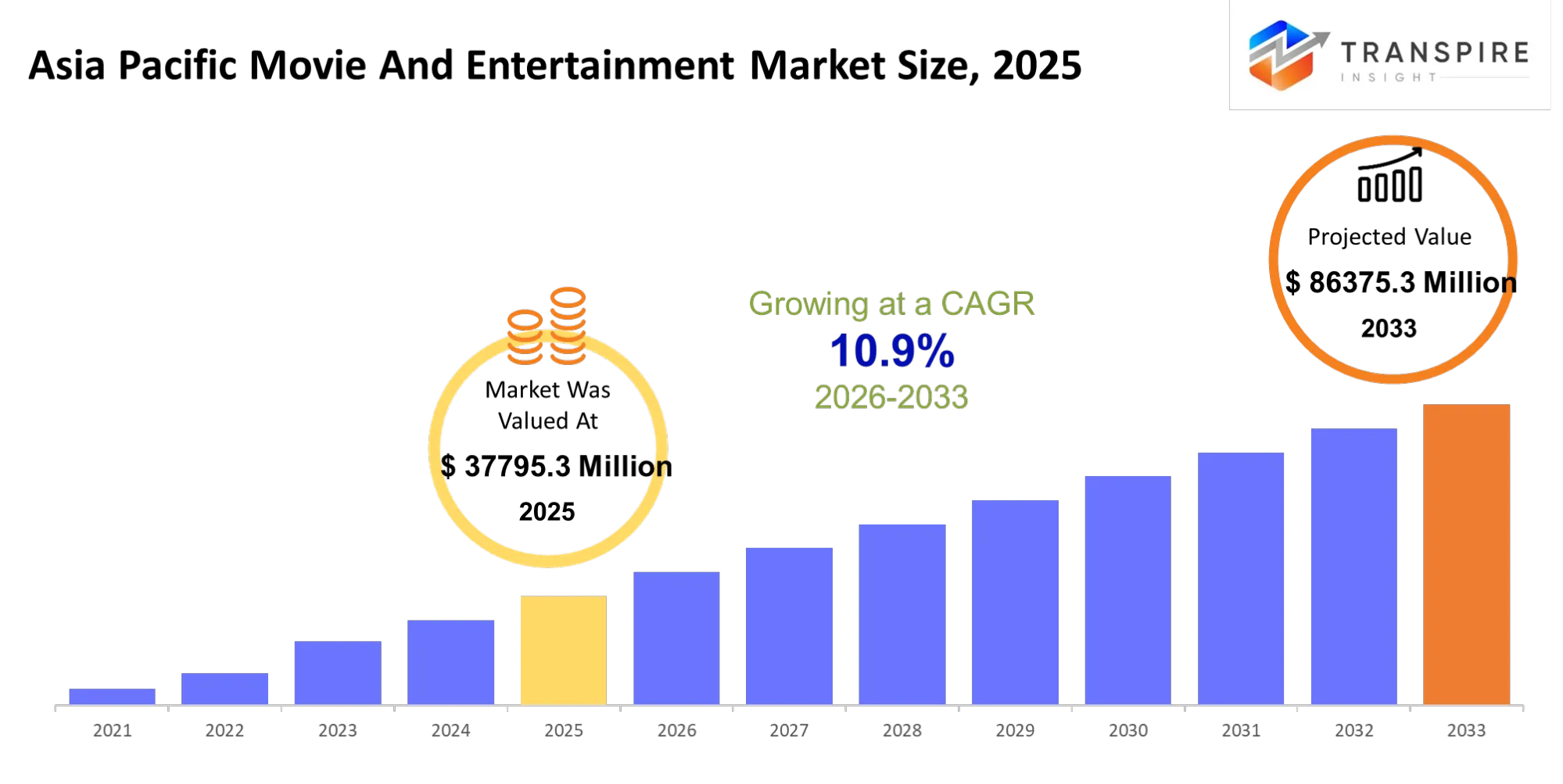
- Asia Pacific Movie And Entertainment Market Size 2025: USD 37795.3 Million
- Asia Pacific Movie And Entertainment Market Size 2033: USD 86375.3 Million
- Asia Pacific Movie And Entertainment Market CAGR: 10.9%
- Asia Pacific Movie And Entertainment Market Segments: By Content Type (Movies, TV Shows, Streaming Content, Animation, Live Events, Gaming Entertainment, Short Videos, Others); By Distribution Channel (Theaters, OTT Platforms, Television, Mobile Platforms, Social Media Platforms, Others); By Revenue Source (Subscriptions, Advertising, Ticket Sales, Merchandise, Licensing, Others); By End User (Children, Teenagers, Adults, Families, Corporate Users, Others)
Asia Pacific Movie And Entertainment Market Summary
The Asia Pacific Movie And Entertainment Market was valued at USD 37795.3 Million in 2025. It is forecast to reach USD 86375.3 Million by 2033. That is a CAGR of10.9% over the period.
The Asia Pacific Movie and Entertainment Market is really important for making and sharing content with people. It helps companies make money from the things they create like movies and shows. It lets people watch or play them whenever they want on different devices like at the cinema on television or on streaming platforms.
The Asia Pacific Movie and Entertainment Market has changed a lot in the five years. Now people do not just go to the theater to watch movies. They also watch things on streaming platforms and other digital ways. The COVID-19 pandemic made this change happen faster. It made people watch things on their devices and it made studios and broadcasters send their content directly to people at home.
Now the Asia Pacific Movie and Entertainment Market is growing because it is easy for people to get internet on their phones more content is being made in the region and companies are using data to make things that people really want to watch. The Asia Pacific Movie and Entertainment Market is making money because platforms are making content in local languages and they are making special shows that people really want to watch. This makes people watch for longer. It makes companies money, from subscriptions, advertising and other things.
Key Market Insights
- China is really big in the market with around 35 to 40 percent of the share in 2025. This is because China makes a lot of content and has a lot of people who watch it.
- India is going to grow fast during the time we are looking at. This is because more and more people in India are using streaming services and there is a lot of content being made in local languages.
- In Southeast Asia more people are starting to watch content. This is happening because more people have smartphones and it is easier to pay for things
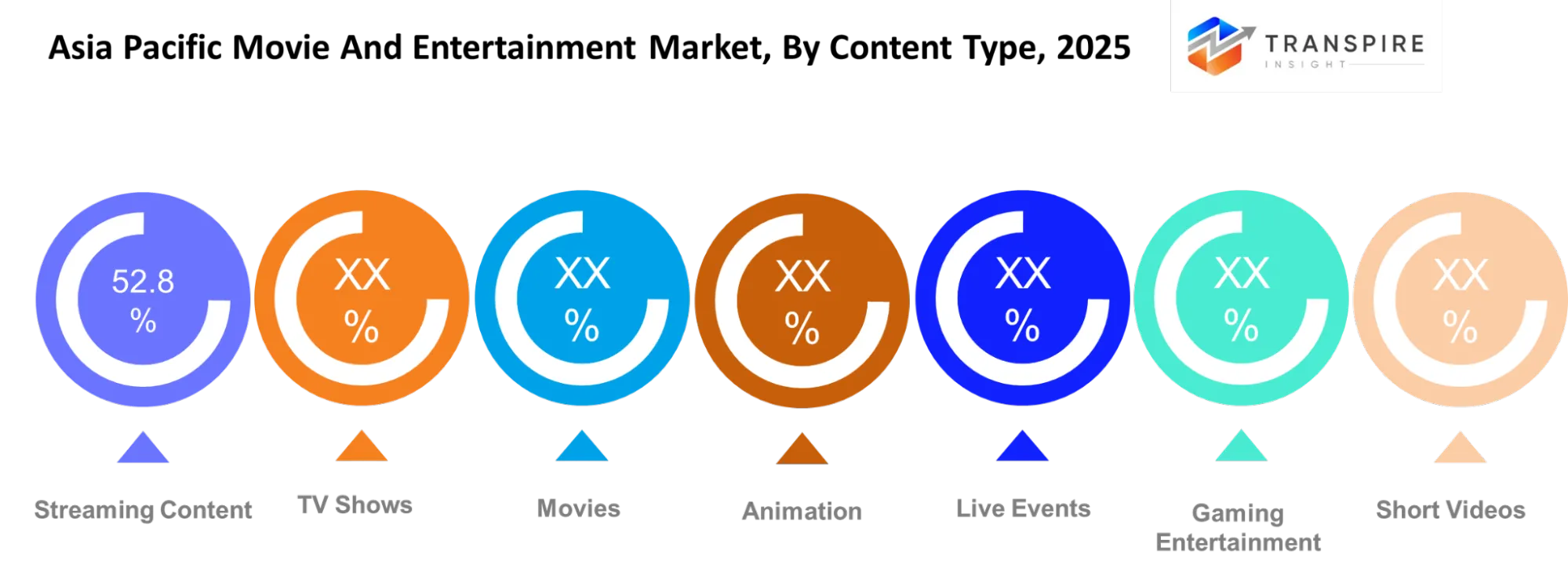
- The thing that people watch the most is streaming content. In 2025 it made up around 30 to 35 percent of what people watched. This is because people like to pay for streaming services and watch ads.
- Movies are the most popular thing. People like to watch movies, especially the big blockbuster ones. They also like to watch movies that are part of a series and have a special experience in the theater
- Short videos are going to become really popular by 2030. This is because people like to watch videos on their phones.
- Online streaming services or OTT platforms make up around 40 percent of the market. This means they are the way people watch content.
- People use their phones to watch content more. This is because almost everyone has a smartphone and the internet on their phone is really fast.
- Social media platforms are also getting more popular. This is because they have videos, live streams and people can interact with the creators.
- Most of the people who watch content are individuals. In fact they make up, than 70 percent of the market. This shows that a lot of people like to watch entertainment.
What are the Key Drivers, Restraints, and Opportunities in the Asia Pacific Movie And Entertainment Market?
The greatest driving factor that has accelerated growth in the Asia Pacific Movie And Entertainment Market is the fast move towards digital media consumption due to affordable mobile Internet connections and smartphones. With high-speed 4G and 5G networks becoming available in countries such as China, India, South Korea, and parts of Southeast Asia, there has been a considerable decrease in barriers related to video streaming. As a consequence, entertainment companies could directly target their products to Millions of consumers, thus generating additional income through subscriptions, advertising, and purchases of premium movies. Companies are also able to target customers better due to advances in digital media analytics.
One of the greatest obstacles to the growth of the market is content piracy. Contrary to temporary inefficiencies that can be overcome relatively easily, this factor stems from structural causes. Specifically, piracy refers to the illegal broadcasting or downloading of copyrighted content, which negatively impacts profits earned by the movie studios, broadcasters, and even streaming sites. It is particularly challenging to address this problem due to discrepancies in the standards of enforcement in various Asia Pacific countries, leading to revenue loss and investment decline.
Another significant opportunity for the future will be the creation of content in a localized language and in regions. Investing in original programming made specifically for particular audiences is opening new opportunities for growth. India, Indonesia, and Vietnam have become new territories where digital development has reached a point allowing monetization through content creation. Organizations combining local storytelling with machine learning-based content recommendations are likely to find success with such a strategy.
What Has the Impact of Artificial Intelligence Been on the Asia Pacific Movie And Entertainment Market?
AI and advanced digital technologies are disrupting the processes of producing, distributing, and engaging audiences with content in the Asia-Pacific film and entertainment industry. Streaming platforms are implementing AI to streamline processes such as automatic content tagging, generating subtitles, managing metadata, and running recommendation engines to minimize manual labor and speed up the release of content in different markets. Media firms are leveraging AI technologies such as generative AI solutions in script analysis, visual effects production, localization, and creation of marketing materials to shorten production cycles and save on costs.
There has been an increase in machine learning algorithms for predicting audience engagement. The platforms are able to make predictions such as the demand for certain genres and predict subscriber loyalty using machine learning algorithms to analyze viewer behaviors and content preferences from different regions. This helps minimize risks associated with failed launches and improve advertising efficiency and content monetization through better prediction of audience behaviors.
In terms of operations, the use of AI increases efficiency in discovering content, conducting targeted advertising, and allocating resources, thus enhancing the utilization of the platform and improving revenue performance. Nonetheless, a big challenge that is posed by the use of AI technology is its high level of complexity and the cost associated with implementing it to content that is spread across several different libraries and languages.
Key Market Trends
- Since 2020 the way streaming platforms release things has changed a lot. They do not just show things in theaters anymore. Now they use a mix of ways to get their content out to people. This has changed the way they make money from their content in big markets.
- Between 2021 and 2025 companies like Netflix and Disney put a lot of money into making content in local languages. They wanted to get more people to watch their stuff. Other companies in regions also did this.
- After 2020 people started watching videos a lot more. This made entertainment companies change the way they make their content. They had to think about people watching on their phones
- The tools that help figure out what people want to watch got a lot better. They used to be simple tools that suggested things based on what you liked. Now they are a part of how companies keep people watching and how they sell ads.
- In cities in Asia people started using connected TVs a lot more. This meant they did not need to pay for cable or satellite TV anymore.
- After 2021 media companies started working with phone and internet companies. They did this so they could offer entertainment services as part of peoples phone and internet plans.
- Companies that make content started spending money on things that are already well known like superheroes or popular book series. They did this because they knew people would keep watching and they could make money from these things for a time.
- People did not want to pay for a lot of streaming services. So from 2022 streaming services that are free and have ads became more popular.
- Companies like Netflix started making content in Southeast Asia especially in Indonesia, Thailand and Vietnam. They put a lot of money into making shows and movies in these places.
- People started paying attention to games and interactive things, on their devices. This made companies think about how they could make content that works on different platforms.
Asia Pacific Movie And Entertainment Market Segmentation
By Content Type:
The movies are still strong because of their theatrical releases, franchises, and better viewing experience, thus attracting many audiences in some of the biggest countries around the world. With good investments in the area of visual effects and story, together with the production in regional languages, there is assured revenue generation. The animation has been accepted well with the increase of content production, targeting not only children but adults too. Better access to the internet has made animated movies and series reach more markets.
With streaming becoming more prominent in people's daily lives, there is now a new trend in terms of entertainment. Video clips have become more popular as part of the changing preferences. Gaming entertainment is making its way in the market through interaction and more digital platforms available. Live events are still popular because of the uniqueness they bring to the audiences.
By Distribution Channel:
OTT platforms have emerged as a key method of distribution as their flexibility in viewing caters to evolving consumer demands. This is coupled with increased competitiveness from subscription-based, ad-supported, and exclusive content distribution methods. Major players have continued expanding regional content libraries in order to reach a wider customer base. Big data analytics enables better recommendations and retention of the viewers.
The television channel continues playing an important role in distribution especially for news, sporting events, and programmed shows. The mobile platform plays a vital role due to the availability of affordable smartphones and fast broadband connectivity. Social media platforms are playing an important role through short-form videos, live streaming, and user generated content.
By Revenue Source:
The other important source of revenue is through the subscription service. Consumers are increasingly subscribing to content libraries and services to gain access to content that they would have otherwise not had access to. Subscription models offer regular revenue streams for streaming services and digital entertainment companies. Investment in content production will continue to enable the adoption of strategies for acquiring and retaining subscribers. The provision of subscription-based business models in tandem with telecom products strengthens the business model.
Ad revenue will still play an essential role, especially for free and hybrid entertainment services. Digital advertising provides tools to target specific audiences and track campaigns. Revenue from licensing deals and syndicating content will also continue to contribute towards revenue generation.
By End User:
Consumers as individuals form the biggest proportion of the consumption base when it comes to entertainment in the region. Increased availability of smartphones, smart televisions, and high-speed internet is enhancing the accessibility of entertainment content. Personalization and localization are enhancing engagement among different target groups. The provision of entertainment products is evolving to meet the changes in consumption patterns.
The commercial use segment comprises cinema halls, hospitality sectors, educational institutions, and public spaces for entertainment activities. Increasingly, young people are shaping the strategies employed by the entertainment industry due to their digitized consumption patterns. Family entertainment consumption remains significant when it comes to the subscription of online entertainment content.
What are the Key Use Cases Driving the Asia Pacific Movie And Entertainment Market?
The largest volume of market transactions is derived from video-on-demand streaming services. Users leverage digital solutions in accessing films, series, and unique content through smartphones, smart TV’s, and tablets. The application has the highest level of popularity as it provides users with convenience, content recommendations, and schedule freedom.
Additional applications are developing within short video sharing platforms and gaming entertainment applications. Increasingly, businesses are using these digital solutions for promotion and engagement purposes, whereas younger consumers engage in digital content that allows more interaction. Digital broadcasting of live events continues to gain traction among urban populations.
Potential developments will revolve around artificial intelligence in content development and VR and AR applications in immersive entertainment. New forms of interactive storytelling and virtual fan conventions are not yet popular; however, investment in this area may increase adoption throughout the forecast period.
|
Report Metrics |
Details |
|
Market size value in 2025 |
USD 37795.3 Million |
|
Market size value in 2026 |
USD 41878.1 Million |
|
Revenue forecast in 2033 |
USD 86375.3 Million |
|
Growth rate |
CAGR of 10.9% from 2026 to 2033 |
|
Base year |
2025 |
|
Historical data |
2021 - 2024 |
|
Forecast period |
2026 - 2033 |
|
Report coverage |
Revenue forecast, competitive landscape, growth factors, and trends |
|
Regional scope |
Asia Pacific (India, China, Japan, Australia, South Korea, Rest of Asia Pacific) |
|
Key company profiled |
Netflix, Disney, Warner Bros. Discovery, Sony Pictures, Paramount, Amazon Prime Video, Tencent Video, iQIYI, Zee Entertainment, CJ ENM, Toei Animation, TVB, NHK, HBO Asia, Viu |
|
Customization scope |
Free report customization (country, regional & segment scope). Avail customized purchase options to meet your exact research needs. |
|
Report Segmentation |
By Content Type (Movies, TV Shows, Streaming Content, Animation, Live Events, Gaming Entertainment, Short Videos, Others); By Distribution Channel (Theaters, OTT Platforms, Television, Mobile Platforms, Social Media Platforms, Others); By Revenue Source (Subscriptions, Advertising, Ticket Sales, Merchandise, Licensing, Others); By End User (Children, Teenagers, Adults, Families, Corporate Users, Others) |
Which Regions are Driving the Asia Pacific Movie And Entertainment Market Growth?
East Asia remains the dominant region in the market, led by China, Japan, and South Korea. Strong digital infrastructure, high broadband penetration, and mature content production ecosystems support leadership across both traditional and digital entertainment channels. China benefits from large-scale film production capabilities and extensive streaming platform adoption, while Japan and South Korea maintain global influence through animation, gaming, and premium content exports. A well-developed network of studios, technology providers, distributors, and media companies sustains regional dominance and supports continuous content investment.
Compared with East Asia, Oceania contributes through stability rather than scale. Australia and New Zealand benefit from resilient consumer spending, established regulatory frameworks, and consistent investment in film production and broadcasting services. Government support programs and production incentives continue to attract domestic and international content projects. This steady operating environment makes the region a reliable source of revenue despite a smaller audience base.
Fastest growing markets are that of South and Southeast Asia. Availability of mobile internet services at reasonable rates, availability of 5G networks, and huge investment in producing regional content has brought a change in the way of entertainment. Streaming subscription and usage is increasing at a fast pace in India, Indonesia, Vietnam, and Thailand. Future growth of the industry within these countries will offer tremendous prospects for content creators, streaming service providers, advertisers, and investors from 2026 to 2033.
Who are the Key Players in the Asia Pacific Movie And Entertainment Market and How Do They Compete?
Competition in the Asia Pacific film and entertainment industry is somewhat concentrated, where there is fierce competition among international streaming sites, studios, and local content suppliers for market dominance and content rights. The main criteria for competitive advantage in the industry have moved away from content quantity to content quality, localization, engagement of customers, and technological platform differentiation. Market incumbents are maintaining their market position through investment in huge amounts of content, whereas regional content suppliers are taking on global competitors by providing culturally and linguistically appealing content.
As for Netflix, the company is concentrating its competitive strategy on personalization via technology and content production. Recommendation algorithms can assist in increasing viewer engagement, whereas massive investment in regional language productions will allow gaining ground in India, South Korea, and Southeast Asia. Disney is known for the possession of popular franchises and a wide range of movies, TV series, and streaming services, which distinguishes it from other content providers.
Tencent Video makes use of its dominance in the Chinese digital environment through the integration of entertainment services along with social media, gaming, and digital payment solutions. Warner Bros. Discovery prioritizes the development of franchises and cross-platform marketing strategies in order to expand audience base outside conventional methods of consumption. Amazon Prime Video utilizes entertainment services within a larger subscription service model, thus adding extra value while making greater investments in regional originals to boost competitiveness in the APAC region.
Company List
- Netflix
- Disney
- Warner Bros. Discovery
- Sony Pictures
- Paramount
- Amazon Prime Video
- Tencent Video
- iQIYI
- Zee Entertainment
- CJ ENM
- Toei Animation
- TVB
- NHK
- HBO Asia
- Viu
Recent Development News
In April 2026, Warner Bros. Discovery and JioHotstar expanded their partnership with the exclusive launch of HBO Max in India. The agreement strengthened Warner Bros. Discovery's direct-to-consumer presence in one of Asia Pacific's largest streaming markets while broadening premium content distribution. Source:https://avia.org
In November 2025, Singapore's Infocomm Media Development Authority (IMDA) entered a partnership with Warner Bros. Discovery to develop original unscripted entertainment formats. The initiative created new opportunities for regional content creators and strengthened Asia Pacific's content production ecosystem through co-development and international distribution pathways. Source:https://avia.org/imda-and-
What Strategic Insights Define the Future of the Asia Pacific Movie And Entertainment Market?
In the coming five to seven years, the Asia Pacific film and entertainment industry can be anticipated to adopt a platform-based approach where data analytics, artificial intelligence, and localization will drive value creation. Competitive advantages will thus depend on the combination of content ownership, audience intelligence, and multichannel distribution, rather than building extensive content catalogs. In other words, revenue generation will rely on engagement and retention more than subscription numbers.
Another possible threat is related to increasing market concentration among the few streaming platforms and content providers. As fewer companies start gaining more control of audience access and advertising inventories, small-scale content creators may find themselves with less negotiating leverage and unfavorable monetization options. Increased regulation of digital platforms can also follow from market consolidation.
An area of potential interest involves the creation of interactive entertainment platforms leveraging artificial intelligence, especially in India and Southeast Asia where digital interaction has been increasing significantly. Firms need to capitalize on the localized technologies of the future by developing such content early, as this will provide long-term competitive advantage once these trends have become widespread.
Asia Pacific Movie And Entertainment Market Report Segmentation
By Content Type
- Movies
- TV Shows
- Streaming Content
- Animation
- Live Events
- Gaming Entertainment
- Short Videos
- Others
By Distribution Channel
- Theaters
- OTT Platforms
- Television
- Mobile Platforms
- Social Media Platforms
- Others
By Revenue Source
- Subscriptions
- Advertising
- Ticket Sales
- Merchandise
- Licensing
- Others
By End User
- Children
- Teenagers
- Adults
- Families
- Corporate Users
- Others
Frequently Asked Questions
Find quick answers to common questions.
The expected Asia Pacific Movie And Entertainment Market size for the market will be USD 86375.3 Million in 2033.
Key segments for the Asia Pacific Movie And Entertainment Market are By Content Type (Movies, TV Shows, Streaming Content, Animation, Live Events, Gaming Entertainment, Short Videos, Others); By Distribution Channel (Theaters, OTT Platforms, Television, Mobile Platforms, Social Media Platforms, Others); By Revenue Source (Subscriptions, Advertising, Ticket Sales, Merchandise, Licensing, Others); By End User (Children, Teenagers, Adults, Families, Corporate Users, Others).
Major Asia Pacific Movie And Entertainment Market players are Netflix, Disney, Warner Bros. Discovery, Sony Pictures, Paramount, Amazon Prime Video, Tencent Video, iQIYI, Zee Entertainment, CJ ENM, Toei Animation, TVB, NHK, HBO Asia, Viu.
The Asia Pacific Movie And Entertainment Market size is USD 37795.3 Million in 2025.
The Asia Pacific Movie And Entertainment Market CAGR is 10.9% from 2026 to 2033.
- Netflix
- Disney
- Warner Bros. Discovery
- Sony Pictures
- Paramount
- Amazon Prime Video
- Tencent Video
- iQIYI
- Zee Entertainment
- CJ ENM
- Toei Animation
- TVB
- NHK
- HBO Asia
- Viu
About the Authors

Chetan Dhatrak
I’m Chetan Dhatrak, a Senior Research Analyst at Transpire Insight, specializing in the Consumer Goods, Foods and Beverages industry. I focus on analyzing market trends, consumer behavior, competitive landscapes, and industry developments to deliver accurate, data-driven insights. My research at Transpire Insight is built on credible sources and in-depth analysis, helping businesses and readers better understand market dynamics, emerging opportunities, and evolving consumer preferences. I’m committed to creating reliable, well-researched content that supports informed decision-making and reflects the latest developments in the consumer goods and food & beverage sectors.

Chakradhar Khansole
Chakradhar serves as the Research Director at Transpire Insight, bringing over 8 years of experience in technology, innovation, and strategic market intelligence. He specializes in transforming complex market data into actionable business insights that enable organizations to make informed, growth-oriented decisions. Recognized for his strategic vision and analytical expertise, Chakradhar leads high-impact research initiatives, delivering comprehensive market assessments, competitive intelligence, and forward-looking industry analysis.
Recently Published Reports
-
Apr 2026
Bottled Water Market
Bottled Water Market Size, Share & Analysis Report By Product Type (Still Bottled Water, Carbonated Bottled Water, Functional Bottled Water, and Others), By Packaging (PET, Cans, and Others), By Sales Channel (Supermarkets/Hypermarkets, Convenience Stores/Drug Stores, Grocery Stores/Club Stores, Foodservice, and Others) and Geography (North America, Europe, Asia-Pacific, Middle East and Africa, South and Central America), 2021 - 2032
-
Apr 2026
Color Cosmetic Packaging Market
Color Cosmetic Packaging Market Size, Share & Analysis Report By Application (Mascara Packaging, Liquid Packaging, and Liquid Face), By Type (Tubes & Bottles, Pens & Markers, Compacts & Containers, and Droppers & Pumps), and Geography (North America, Europe, Asia-Pacific, Middle East and Africa, South and Central America), 2021 - 2031
-
Apr 2026
External Microphone For Camera Market
External Microphone For Camera Market Size, Share & Analysis Report By Type (Shotgun Microphone, Lavalier Microphone, and Others), By Application (Digital Camera, Professional Video Camera, and Others), and Geography (North America, Europe, Asia-Pacific, Middle East and Africa, South and Central America), 2021 - 2031
-
Apr 2026
Foot Orthotic Insoles Market
Foot Orthotic Insoles Market Size, Share & Analysis Report By Type (Pre-fabricated, and Custom-made), By Material (Thermoplastic, Composite Carbon Fiber, and Others), By Distribution Channel (Drug Stores, Hospitals & Clinics, and Others), and Geography (North America, Europe, Asia-Pacific, Middle East and Africa, South and Central America), 2021 - 2031