
Asia Pacific Mobile Payment Market Size & Forecast:
- Asia Pacific Mobile Payment Market Size 2025: USD 1.51 Trillian
- Asia Pacific Mobile Payment Market Size 2033: USD 4.216 Trillian
- Asia Pacific Mobile Payment Market CAGR: 13.70%
- Asia Pacific Mobile Payment Market Segments: By Payment Type (Proximity Payments, Remote Payments, QR Code Payments, NFC Payments, P2P Payments, In-App Payments, Contactless Payments, Others); By Technology (NFC, QR Codes, Mobile Wallets, Biometrics, Tokenization, Cloud Payments, Blockchain Payments, Others); By End User (Retail Consumers, Merchants, SMEs, Enterprises, Government Users, Transport Users, E-commerce Users, Others); By Application (Retail Payments, Bill Payments, Ticketing, E-commerce, Remittances, Utility Payments, Subscription Payments, Others)
Asia Pacific Mobile Payment Market Summary
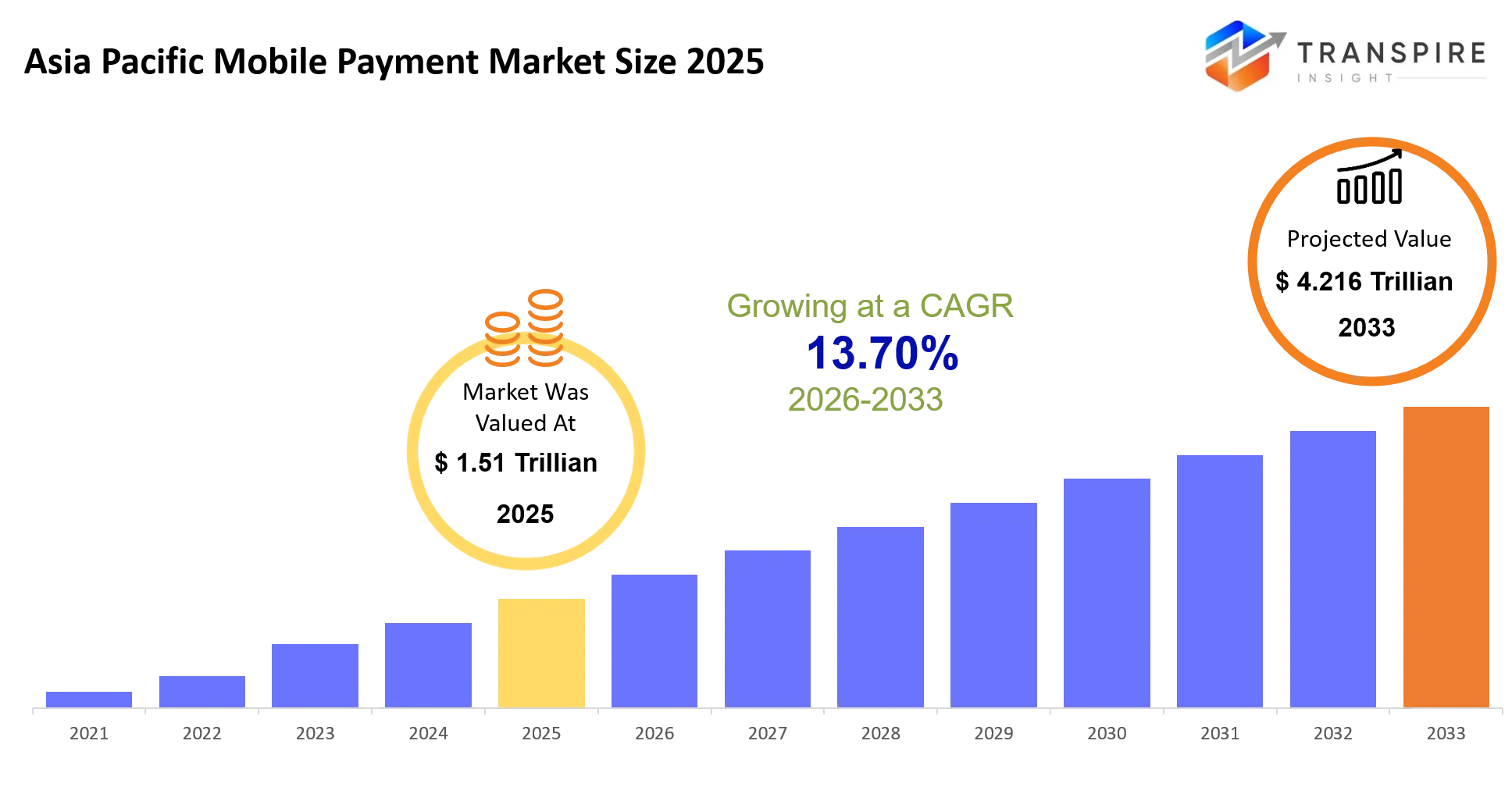
The Asia Pacific Mobile Payment Market was valued at USD USD 1.51 Trillion in 2025. It is forecast to reach USD 4.216 Trillian by 2033. That is a CAGR of 13.70% over the period.
The Asia Pacific Mobile Payment Market lets people make payments right away in stores, when they travel and when they use services. It does this by replacing cash with payments that happen in time through apps. This makes buying things easier every day by connecting banks, wallets and stores through codes and payment systems. It also makes payments faster and more efficient for both people and businesses.
In the last few years the Asia Pacific Mobile Payment Market has changed in a big way. It used to be about payments through wallets. Now it is about systems that work together and connect banks, financial technology apps and government-backed digital payment methods. The COVID-19 pandemic was a reason for this change. It made people want to use payments that do not require anything and this became popular in cities and towns. Because of this more stores started using payments and small businesses had to become digital quickly. As a result the number of payments increased quickly and companies started making money in new ways, such as through fees, for processing payments and lending money to stores. Now the Asia Pacific Mobile Payment Market is growing because payments are becoming a part of daily life, not just something people do occasionally. The Asia Pacific Mobile Payment Market is getting more important as it becomes a part of how people buy things every day.
Key Market Insights
- The Asia Pacific Mobile Payment Market is leading the way in payments globally with almost half of all transactions happening here in 2025. This is because a lot of people in this region use smartphones.
- China is at the top in this region making up 42% of the share in 2025. This is thanks to apps like Alipay and WeChat Pay that offer many services.
- India is growing fast with more and more people using UPI-based payments for things like buying stuff and traveling between 2024 and 2026.
- Payments made through wallets are popular , making up over 55% of all payments. This is because many places have QR code systems that make it easy to pay.
- Real-time payments from one account to another are growing quickly. This is because governments are creating systems to make payments easier.
- Most people use payments to pay merchants making up almost 60% of all usage. This is because more and more retail businesses are using systems.
- People are also using payments to send money to friends and family, especially younger people who are used to using digital technology.
- Retail businesses are the users of mobile payments because people use them every day to buy things.
- Online shopping is the growing area for mobile payments because it's getting easier to buy things from other countries online.
- Some big companies in this market are Alipay, WeChat Pay, Paytm, PhonePe, Google Pay, PayPal and Amazon Pay.
What are the Key Drivers, Restraints, and Opportunities in the Asia Pacific Mobile Payment Market?
The Driver
The Asia Pacific Mobile Payment Market is where people are using ways to pay for things in stores. This is happening because stores are using codes called QR codes and fast payment systems like UPI. The government is helping people get bank accounts and more people are using smartphones so they do not need to use cash much. As more stores start using payments the number of transactions is going up which means companies that help with payments are making more money from fees and other services.
The Restraint
is that different countries have rules for digital payments and it is hard for these systems to work together. This makes it difficult for companies to do business in countries because they have to follow many different rules. It is also expensive for these companies to expand to areas, which means they might not make as much money. Small stores also have trouble when the payment systems are not compatible with each other.
The Opportunity
is that some companies are working together to make a system that will let people pay across borders easily. This is happening in Southeast Asia, where many countries are working together to make a system that will let people use their phones to pay for things when they travel. For example if someone from one country visits another country they can use their phone to pay for things because the systems are connected. This will help companies make money from people buying things in other countries and it will also help small stores do more business.
What Has the Impact of Artificial Intelligence Been on the Asia Pacific Mobile Payment Market?
The Asia Pacific Mobile Payment Market is changing because of intelligence and new digital technologies. These technologies make transactions faster and safer for people. They also help systems understand how people behave when they make payments.
Artificial intelligence is used a lot for finding fraud in time. This means that machine learning models look at how people make transactions to find activity that seems suspicious. This helps stop people from making payments. Payment gateways and digital wallets also use intelligence to score risks. This helps verify who people say they are and makes it easier for merchants and users to get started. It reduces the time it takes to verify people and makes the process of approving them more efficient.
People are using models that can predict things to look at how customers behave. This helps platforms figure out which customers might stop using their service. It also helps them decide who to give cash back to and how to make transactions more successful when a lot of people are using the service. Payment providers are using intelligence to find the best way to process payments. This means they can pick the most cost-efficient way to process payments in real time. It reduces the time it takes to process transactions. Makes it more reliable when money is being transferred between banks and wallets.
All of these changes have made things better for people who process payments. There is fraud and transactions are processed faster. More merchants are using these services and the systems are working better when a lot of people are using them. However there is still a problem with the quality of data, in different regions. This makes it hard for models to be accurate. It is not possible to fully automate the process of assessing risk across borders. There are also rules that make it hard to share data. It is expensive to integrate new systems. This makes it hard for smaller payment providers to use intelligence on a large scale.
Key Market Trends
- The way people use payments has changed a lot. In 2020 only people in cities used payments.. By 2025 more than 70 percent of retail transactions in cities were done using mobile payments.
- medium sized businesses started using QR code payments instead of old payment systems after 2023. This was because QR code payments were cheaper to set up and faster to get started with.
- A new kind of payment system that works in time like UPI started in India and then was used in other countries in Southeast Asia between 2024 and 2026.
- Alipay and WeChat Pay became even stronger after 2023. They added services like lending, insurance and investments to their apps.
- It became much easier for merchants to start using payments after 2022. This meant that small retailers and vendors in markets did not have to use cash much.
- After 2024 more companies started using intelligence to detect fraud. This helped reduce the number of transactions on big fintech platforms in Asia.
- The number of -border e-commerce payments went up steadily since 2023. This was because trade between countries in the region was growing and more people were exporting goods online.
- Google Pay, Paytm and PhonePe made their services work better together between 2024 and 2026. This meant that transactions were more likely to be successful.
- The rules for banking changed after 2023 to make it easier for fintech companies to work with banks.
- By 2025 people were not just using wallets for payments. They were using payments that were part of bigger financial systems. This meant that people were making transactions and staying with the same service longer.
Asia Pacific Mobile Payment Market Segmentation
By Payment Type
People are using Proximity Payments and QR Code Payments more and more because they are easy to set up and do not require a lot of money to get started. QR Code Payments are being used in retail stores and by small merchants and they are replacing the old cash systems that people used to use every day. NFC Payments are getting more popular in cities where people have smartphones. There are contactless terminals everywhere. P2P Payments are increasing because more people are using wallets to send money to each other right away. In-App Payments are also getting more popular as shopping and ride-hailing platforms make it easier for people to pay without leaving the app. Contactless Payments are being used more and more in transport and retail because they make transactions faster. Remote Payments are helping online shopping grow by making it possible for people to buy things from different platforms. Overall people are starting to use easier digital payment methods more often especially in cities and towns.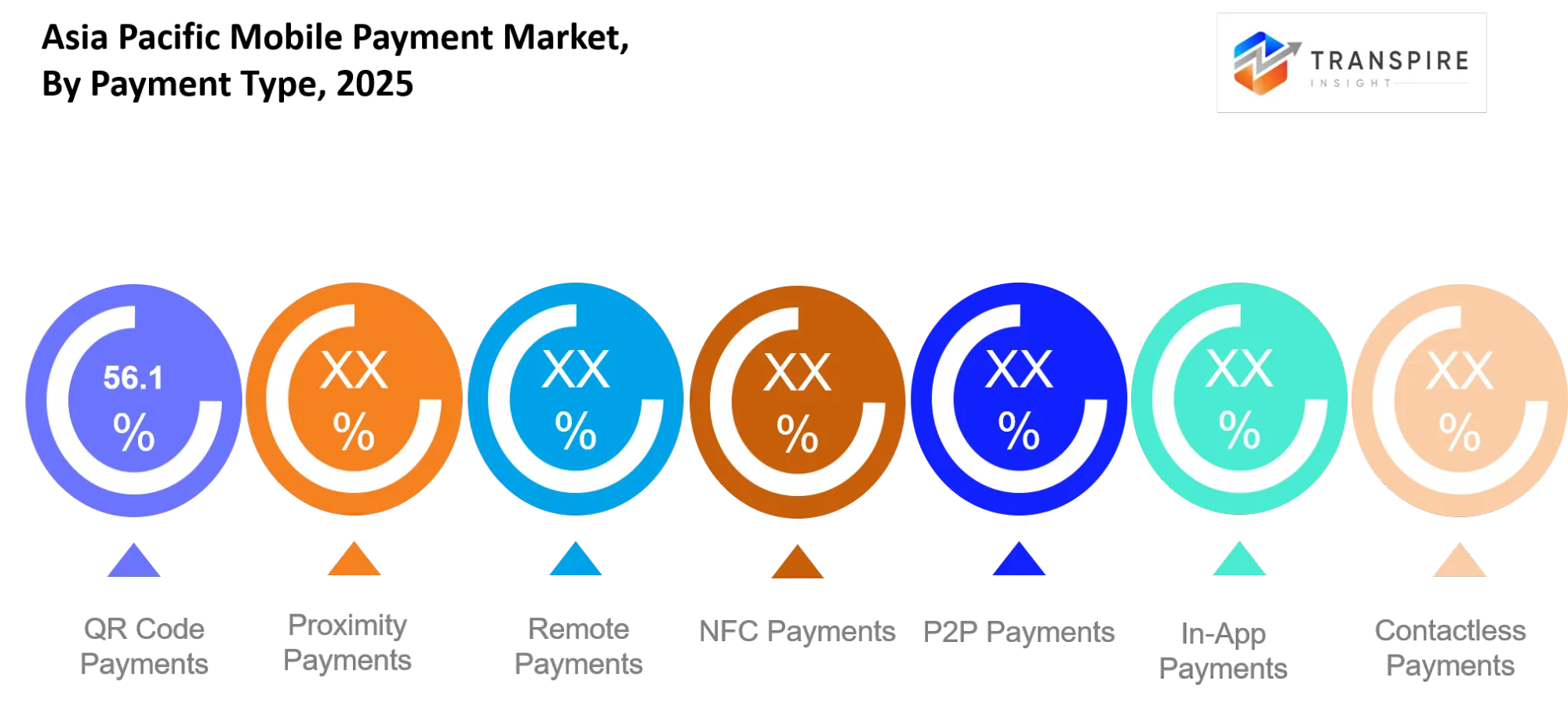
By Technology
NFC technology is being used more in transport systems and in stores where people can just tap their card to pay which makes things more efficient. QR Codes are very popular with merchants because they do not need any special equipment to use them. Mobile Wallets are getting more popular quickly because they can be used for many things, like banking and loyalty programs. Biometrics, like fingerprints and face recognition are being used more to keep people's information safe when they make transactions. Tokenization is also being used to keep peoples information safe by replacing their card numbers with codes. Cloud Payments are helping big financial technology companies process transactions. Blockchain Payments are still not very popular. They are being used to try out new ways of sending money across borders. Companies are trying to make payment systems that are safe, fast and work well together.
By End User
Regular people are starting to use payments more and more because they are convenient and make it possible to pay for things right away. Merchants are starting to use payment systems instead of cash because it helps them sell more things and keep track of their sales better. Small businesses are using QR-based systems because they are cheap and easy to set up. Big companies are using mobile payment systems as part of their financial systems. Governments are starting to use payments to collect taxes and pay subsidies. People who use transport are using contactless and NFC payments to buy tickets faster and avoid waiting in line. People who shop online are using payment systems to pay for things and this is making a lot of transactions happen. More and more people are starting to use payment systems for all of their financial interactions.
By Application
Retail Payments are the most popular because people use them to buy things every day in stores, restaurants and other places. Bill Payments are getting more popular as more people start using systems to pay their bills. Ticketing systems are starting to use first platforms to make it easier for people to get tickets for transport and entertainment. Online shopping is getting more popular. This is making digital payment systems more popular too. People are using wallets to send money to each other, especially migrant workers who want to send money back home. Utility Payments are starting to be automated so people do not have to worry about paying their bills every month. Subscription Payments are getting more popular as more people start using services, like music and software. Overall people are starting to use payment systems more and more for all kinds of things and this is making it possible for them to pay for things automatically and without using cash.
What are the Key Use Cases Driving the Asia Pacific Mobile Payment Market?
The Asia Pacific Mobile Payment Market is really about the retail payment transactions that people make every day. When you go to stores, restaurants and service outlets you usually make a lot of purchases. Using QR codes and wallet-based systems makes it easier to pay for things. It is faster too. This means that more people are using these systems to pay for things and more stores are starting to accept them in smaller towns.
There are some ways that people are using mobile payments too. For example you can use them to pay for things you buy online or to pay your utility bills. It is nice because you can just use your wallet to make these payments and it helps you keep track of what you are spending. Some people also use their payments to buy tickets for the bus or the metro. This is especially helpful in cities because it saves you time and you do not have to wait in line.
Now mobile payments are being used in more ways. Some people are using them to send money to countries, which is really helpful for people who work in another country and need to send money back home. You can also use payments to pay for things like music or software that you use every month. As it gets easier to use payments in different places I think we will see even more people using them for these kinds of things. The Asia Pacific Mobile Payment Market is going to keep growing as more people start using payments, for all sorts of things like retail payment transactions and other things.
|
Report Metrics |
Details |
|
Market size value in 2025 |
USD 1.51 Trillian |
|
Market size value in 2026 |
USD 1.716 Trillian |
|
Revenue forecast in 2033 |
USD 4.216 Trillian |
|
Growth rate |
CAGR of 13.70% from 2026 to 2033 |
|
Base year |
2025 |
|
Historical data |
2021 - 2024 |
|
Forecast period |
2026 - 2033 |
|
Report coverage |
Revenue forecast, competitive landscape, growth factors, and trends |
|
Regional scope |
Asia Pacific (India, China, Japan, Australia, South Korea, Rest of Asia Pacific) |
|
Key company profiled |
Alipay, WeChat Pay, Paytm, PhonePe, Google Pay, Apple Pay, Samsung Pay, PayPal, Razorpay, GrabPay, Line Pay, Kakao Pay, GoPay, TrueMoney, Amazon Pay |
|
Customization scope |
Free report customization (country, regional & segment scope). Avail customized purchase options to meet your exact research needs. |
|
Report Segmentation |
By Payment Type (Proximity Payments, Remote Payments, QR Code Payments, NFC Payments, P2P Payments, In-App Payments, Contactless Payments, Others); By Technology (NFC, QR Codes, Mobile Wallets, Biometrics, Tokenization, Cloud Payments, Blockchain Payments, Others); By End User (Retail Consumers, Merchants, SMEs, Enterprises, Government Users, Transport Users, E-commerce Users, Others); By Application (Retail Payments, Bill Payments, Ticketing, E-commerce, Remittances, Utility Payments, Subscription Payments, Others) |
Which Regions are Driving the Asia Pacific Mobile Payment Market Growth?
Asia Pacific Mobile Payment Market is led by East Asia, where China and surrounding digital economies dominate due to highly developed super-app ecosystems and strong state-backed digital payment infrastructure. Widespread adoption of QR-based payments, deep fintech integration, and strong merchant acceptance networks support large-scale transaction volumes across retail and services. A mature digital banking ecosystem and high smartphone penetration further strengthen continuous usage across urban and semi-urban populations. This environment creates a self-reinforcing system where consumers and merchants both depend on integrated payment platforms for daily financial activity.
Southeast Asia represents a stable second-tier region, supported by consistent fintech investment and gradual digital banking expansion across Indonesia, Thailand, Malaysia, and Vietnam. Unlike East Asia’s highly centralized ecosystems, this region relies on a mix of bank-led and fintech-led platforms, creating a more diversified payment structure. Steady government support for financial inclusion and rising e-commerce penetration ensure stable transaction growth. Continuous merchant onboarding across SMEs strengthens long-term revenue consistency despite varying infrastructure maturity levels.
South Asia, led by India, shows the fastest growth momentum driven by rapid expansion of real-time payment systems and large-scale digital inclusion initiatives. A major shift occurred after widespread adoption of instant payment rails and QR-based merchant systems, which transformed cash-heavy markets into digital-first ecosystems. Rising smartphone usage and low-cost fintech solutions accelerated adoption across rural and urban segments. This growth signals strong long-term opportunity for payment providers as infrastructure deepens and cross-border digital commerce expands through 2026–2033.
Who are the Key Players in the Asia Pacific Mobile Payment Market and How Do They Compete?
The Asia Pacific Mobile Payment Market shows a highly competitive and partially consolidated structure where a few dominant platforms coexist with strong regional fintech challengers. Competition is shaped mainly by technology integration, ecosystem control, and merchant network reach rather than pricing alone. Large incumbents are defending share through super-app ecosystems and embedded financial services, while new entrants disrupt segments using low-cost QR-based payment solutions and rapid merchant onboarding strategies. The market increasingly rewards platforms that can combine payments with lending, commerce, and loyalty services in a single interface.
Alipay and WeChat Pay compete through deeply integrated super-app ecosystems that extend beyond payments into investments, insurance, and lifestyle services. Alipay strengthens its position through advanced AI-based fraud detection and cross-border payment capabilities, enabling seamless transactions for both domestic and international users. WeChat Pay differentiates through social commerce integration, allowing users to transact directly within messaging and social engagement environments. Both platforms expand through global merchant partnerships and cross-border QR interoperability initiatives across Southeast Asia.
Paytm and PhonePe compete in India through large-scale QR adoption and low-cost merchant acquisition strategies. Paytm focuses on building a broad fintech ecosystem that includes lending, insurance, and payment gateways for SMEs, while PhonePe strengthens dominance through high transaction reliability and strong UPI integration. Google Pay expands through ecosystem integration with Android devices and banking partnerships, improving user retention through simplified authentication and fast payments. These companies scale by expanding merchant networks, strengthening bank partnerships, and improving real-time transaction success rates across high-volume markets.
Company List
- Alipay
- WeChat Pay
- Paytm
- PhonePe
- Google Pay
- Apple Pay
- Samsung Pay
- PayPal
- Razorpay
- GrabPay
- LINE Pay
- Kakao Pay
- GoPay
- TrueMoney
- Amazon Pay
Recent Development News
“In September 2025, Saudi Central Bank (SAMA) launched Google Pay in Saudi Arabia and announced a strategic agreement with Ant International to enable Alipay+ acceptance across the country. The initiative strengthens cross-border mobile payment interoperability and expands digital payment acceptance across merchants in the Middle East and Asia-linked trade corridors.”https://timesofindia.indiatimes.com
“In April 2025, PhonePe converted into a public company and restructured ahead of its IPO filing to expand institutional investment access and strengthen its position in India’s UPI-driven mobile payment ecosystem. The move enhances capital availability for scaling merchant payments, lending services, and digital financial products across India’s rapidly expanding fintech market.”https://en.wikipedia.org
“In 2025, Antom expanded its cross-border mobile payment network across Southeast Asia through strategic partnerships with platforms such as AirAsia MOVE and Booking.com, strengthening interoperability for QR-based and wallet-based payments. The expansion enhances merchant acceptance and supports seamless regional payment flows across travel, e-commerce, and digital services.”https://en.wikipedia.org
What Strategic Insights Define the Future of the Asia Pacific Mobile Payment Market?
Over the next 5–7 years, the Asia Pacific Mobile Payment Market will structurally shift toward fully interoperable, platform-agnostic payment ecosystems where wallets, banks, and QR networks function as a unified transaction layer. This direction is driven by rapid expansion of real-time payment rails, rising merchant digitization, and deeper integration of financial services into everyday consumer platforms. As payments become embedded within commerce, revenue models will increasingly depend on ecosystem lock-in rather than standalone transaction processing.
A less visible risk lies in rising platform concentration, where a small number of super-app ecosystems and banking networks control most transaction flows. This can create systemic dependency and limit innovation for smaller fintech players, especially if regulatory changes restrict data sharing or cross-platform interoperability. It may also increase vulnerability to service disruptions within dominant networks.
A strong emerging opportunity exists in cross-border QR interoperability corridors across Southeast Asia and India, supported by regional trade digitization initiatives. Payment providers that enable seamless merchant acceptance across borders will gain early advantage in travel, e-commerce, and SME trade flows. Companies should prioritize building interoperable infrastructure partnerships with banks and national payment networks while investing in AI-driven fraud prevention and real-time settlement optimization to strengthen long-term competitiveness.
Asia Pacific Mobile Payment Market Report Segmentation
By Payment Type
- Proximity Payments
- Remote Payments
- QR Code Payments
- NFC Payments
- Peer-to-Peer (P2P) Payments
- In-App Payments
- Contactless Payments
- Others
By Technology
- Near Field Communication (NFC)
- QR Code Technology
- Mobile Wallets
- Biometric Authentication
- Tokenization
- Cloud-Based Payment Systems
- Blockchain-Based Payments
- Others
By End User
- Retail Consumers
- Merchants
- Small and Medium Enterprises (SMEs)
- Large Enterprises
- Government Institutions
- Transport Operators
- E-commerce Platforms
- Others
By Application
- Retail Payments
- Bill Payments
- Ticketing and Transit Payments
- E-commerce Transactions
- Remittances
- Utility Payments
- Subscription Payments
- Others
Frequently Asked Questions
Find quick answers to common questions.
The expected Asia Pacific Mobile Payment Market size for the market will be USD 4.216 Trillian in 2033.
Key Segments for the Asia Pacific Mobile Payment Market are By Payment Type (Proximity Payments, Remote Payments, QR Code Payments, NFC Payments, P2P Payments, In-App Payments, Contactless Payments, Others); By Technology (NFC, QR Codes, Mobile Wallets, Biometrics, Tokenization, Cloud Payments, Blockchain Payments, Others); By End User (Retail Consumers, Merchants, SMEs, Enterprises, Government Users, Transport Users, E-commerce Users, Others); By Application (Retail Payments, Bill Payments, Ticketing, E-commerce, Remittances, Utility Payments, Subscription Payments, Others).
Major Asia Pacific Mobile Payment Market Players are Alipay, WeChat Pay, Paytm, PhonePe, Google Pay, Apple Pay, Samsung Pay, PayPal, Razorpay, GrabPay, Line Pay, Kakao Pay, GoPay, TrueMoney, Amazon Pay.
The Asia Pacific Mobile Payment Market size is USD 1.51 Trillion in 2025.
The Asia Pacific Mobile Payment Market CAGR is 13.70% from 2026 to 2033.
- Alipay
- WeChat Pay
- Paytm
- PhonePe
- Google Pay
- Apple Pay
- Samsung Pay
- PayPal
- Razorpay
- GrabPay
- LINE Pay
- Kakao Pay
- GoPay
- TrueMoney
- Amazon Pay
About the Authors

Mayur Shinde
I am Mayur Shinde, a Senior Research Analyst at Transpire Insight, specializing in the Automotive & Transportation and Information & Communication Technology (ICT) Industry. My work focuses on analyzing emerging market trends, technological advancements, competitive landscapes, and industry developments to deliver accurate, data-driven insights. I am passionate about transforming complex market information into clear, actionable content that helps businesses, professionals, and decision-makers stay informed and make confident strategic decisions.

Chakradhar Khansole
Chakradhar serves as the Research Director at Transpire Insight, bringing over 8 years of experience in technology, innovation, and strategic market intelligence. He specializes in transforming complex market data into actionable business insights that enable organizations to make informed, growth-oriented decisions. Recognized for his strategic vision and analytical expertise, Chakradhar leads high-impact research initiatives, delivering comprehensive market assessments, competitive intelligence, and forward-looking industry analysis.
Recently Published Reports
-
Apr 2026
3D Optical Profiler Market
3D Optical Profiler Market Size, Share & Analysis Report By Type (Desktop 3D Optical Profiler, and Portable 3D Optical Profiler), By Technology (Confocal Technology, and White Light Interference), By End-Use Industry (Manufacturing, Research Institutions, Automotive, Aerospace and Defense, Medical Devices, and Other), and Geography (North America, Europe, Asia-Pacific, Middle East and Africa, South and Central America), 2021 - 2031
-
Apr 2026
Depth Sensor Market
Depth Sensor Market Size, Share & Analysis Report By Type (Infrared Depth Sensors, Time-of-Flight (ToF) Sensors, Stereo Vision Sensors, Structured Light Sensors, Ultrasonic Depth Sensors), By Application (Automotive, Robotics, Gaming, Consumer Electronics, Industrial Automation, Healthcare, Security & Surveillance, Others), By End Users (Automotive Manufacturers, Consumer Electronics Companies, Healthcare Providers, Industrial Companies, Security Agencies, Gaming Companies, Robotics Companies, Others), and Geography (North America, Europe, Asia-Pacific, Middle East and Africa, South and Central America), 2021 – 2031
-
Apr 2026
Digital Manufacturing Market
Digital Manufacturing Market Size, Share & Analysis Report By Component (Hardware, Software, and Services), By Technology (Robotics, 3D Printing, Internet of Things (IoT), and Others), By Application (Automotive and Transportation, Aerospace and Defense, Consumer Electronics, Industrial Machinery, and Others), By Process Type (Computer-Based Designing, Computer-Based Simulation, Computer 3D Visualization, Analytics, and Others), and Geography (North America, Europe, Asia-Pacific, Middle East and Africa, South and Central America), 2021 – 2031
-
Apr 2026
Digital Visa Services Market
Digital Visa Services Market Size, Share & Analysis Report By Type (Individual Travelers, Group Travelers), By Application (Tourism, Business Travel, Others), and Geography (North America, Europe, Asia-Pacific, Middle East and Africa, South and Central America), 2021 – 2031