

Asia Pacific Microfluidics Market Size & Forecast:
- Asia Pacific Microfluidics Market Size 2025: USD 8.2 Billion
- Asia Pacific Microfluidics Market Size 2033: USD 22.8 Billion
- Asia Pacific Microfluidics Market CAGR: 13.67%
- Asia Pacific Microfluidics Market Segments: By Product Type (Microfluidic Chips, Micropumps, Microneedles, Sensors, Reagents, Lab-on-a-Chip Systems, Microvalves, Others); By Material (Glass, Silicon, Polymer, PDMS, Ceramics, Thermoplastics, Composite Materials, Others); By Application (Diagnostics, Drug Delivery, Research, Point-of-Care Testing, Cell Analysis, Genomics, Proteomics, Others); By End User (Hospitals, Diagnostic Laboratories, Research Institutes, Pharmaceutical Companies, Biotechnology Firms, Academic Institutions, CROs, Others)
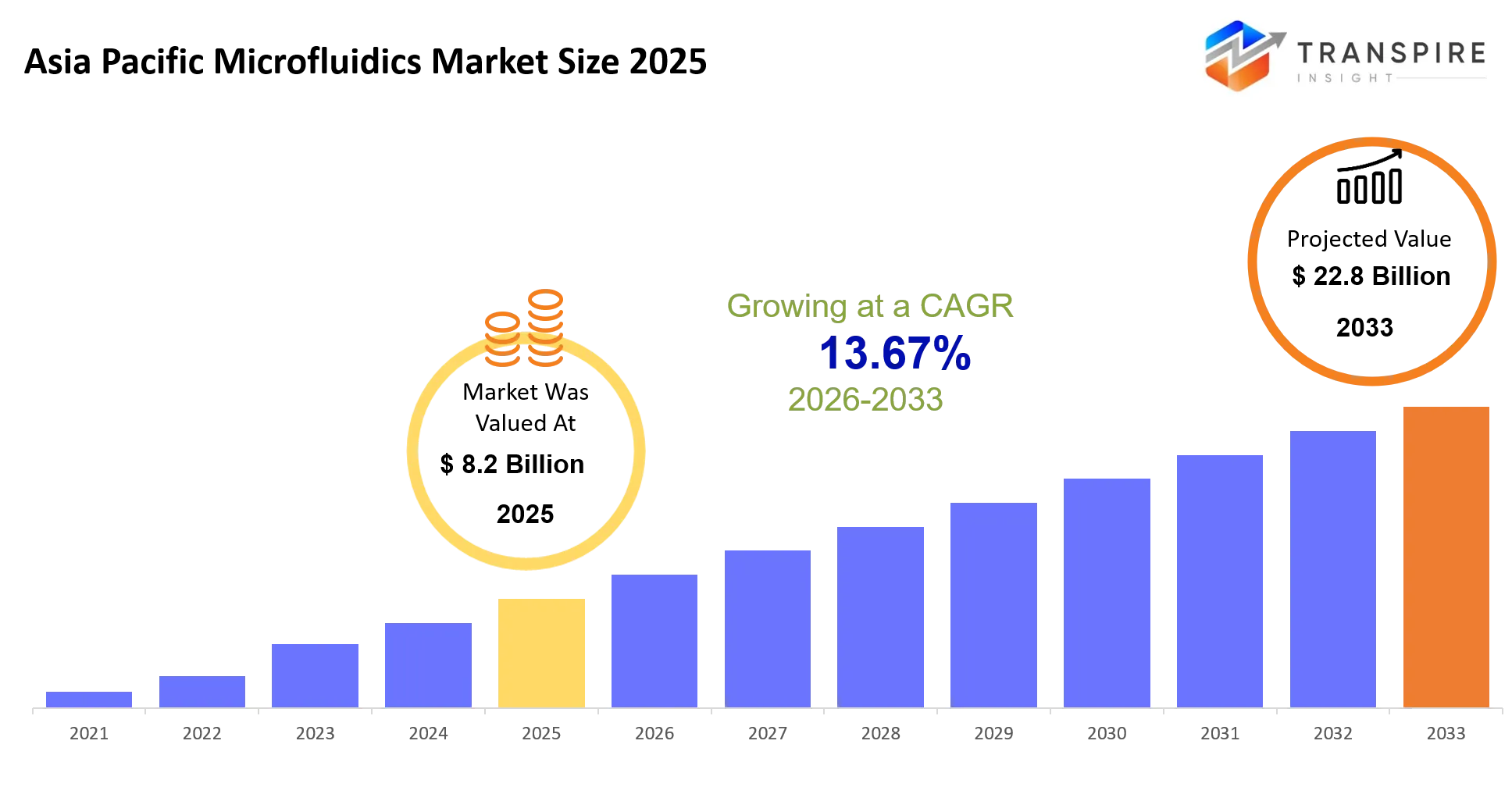
Asia Pacific Microfluidics Market Summary
The Asia Pacific Microfluidics Market was valued at USD 8.2 billion in 2025. It is forecast to reach USD 22.8 billion by 2033. That is a CAGR of 13.67% over the period.
The Asia Pacific Microfluidics Market is really important for healthcare, life sciences and industrial testing because it helps us work with small amounts of fluid. This is useful for doing tests and research quickly. Microfluidic systems use materials that take less time to get results and are more accurate. They are used for things like checking for diseases, finding medicines, making sure the environment is safe and checking food for safety. This helps laboratories and manufacturers do work and save money.In the few years the market has changed a lot. We used to do things the way in laboratories but now we are using smaller devices that can do many things at once. The COVID-19 pandemic made this change happen faster. It showed us that we need to be able to test people easily without needing a big laboratory. This made people realize how useful these small testing devices are and now they are being used more and more in healthcare and research.
The Asia Pacific Microfluidics Market is still growing. This is because we are getting better at tailoring medicine to people and we are learning more about genes and how to diagnose diseases. Healthcare providers, pharmaceutical companies and research institutions want to be able to test things cheaply. Microfluidic technologies are becoming a part of how we do tests and research. This is creating opportunities for companies that make these technologies both in healthcare and in industry. The Asia Pacific Microfluidics Market is helping to make all of this happen.
Key Market Insights
- The Asia Pacific Microfluidics Market is mostly controlled by East Asia with around 45 percent of the market in 2025. This is because East Asia has good biotechnology and diagnostics infrastructure.
- Southeast Asia is going to be the region that grows the fastest until 2033. This is happening because people are investing more in healthcare and laboratories are getting equipment.
- Microfluidic chips are the part of the industry with over 40 percent. This is because they are used a lot in diagnostics and genomics workflows.
- The biggest part is microfluidic pumps and control systems. These are important for research and pharmaceutical applications because they help handle fluids precisely.
- Lab-on-a-chip technologies are going to grow the fastest until 2033. This is because people want to make things smaller and more automatic.
- The Asia Pacific Microfluidics Market is dominated by molecular diagnostics with more than 35 percent of the market. This is because people want to detect diseases
- Point-of-care testing is growing fast. This is because healthcare is becoming more decentralized and people are using diagnostic devices.
- Pharmaceutical and biotechnology companies are the users of the Asia Pacific Microfluidics Market. They spend a lot of money on research that uses microfluidics.
- Academic research institutes and genomics laboratories are also using the Asia Pacific Microfluidics Market more and more. This is because they are getting money to study personalized medicine and biomarkers.
- Companies like Danaher and Thermo Fisher Scientific and Agilent and Bio-Rad and Illumina and Qiagen are trying to make products and work together and expand to other regions. They want to be stronger in the Asia Pacific Microfluidics Market.
What are the Key Drivers, Restraints, and Opportunities in the Asia Pacific Microfluidics Market?
Drivers
The main thing that is making the Asia Pacific Microfluidics Market grow fast is that people want to be able to diagnose diseases more accurately and do tests outside of big hospitals. Because of advances in genetics and molecular biology doctors and researchers need tools that can give them results from just a tiny bit of a sample. Healthcare providers and pharmaceutical companies really like systems because they use less material and give results faster and can test a lot of things at the same time. The COVID-19 pandemic showed everyone how important it's to have fast and reliable diagnostic tools, so hospitals, labs and research centers are buying more of these compact testing machines. This means that more equipment is being sold, people are buying supplies and companies are doing more research in this area.
Restraints
The biggest problem with microfluidics is that it is hard to make and use these devices in labs. To make them you need materials and equipment and you have to be very careful to make sure they work correctly. A lot of hospitals and research centers are also having trouble figuring out how to use these systems with the tests they already do. These problems are not easy to fix because they need knowledge, new equipment and approval from regulators. So smaller labs and hospitals that do not have a lot of money are not using microfluidics much which means it is not being used as widely as it could be.
Opportunities
There is an opportunity for microfluidics to work together with artificial intelligence and new genetics technologies. We are getting closer to having machines that can prepare samples, analyze them and interpret the results by themselves. Because many countries are investing in medicine it is a good time for companies to develop these advanced technologies. Companies that can make platforms that use artificial intelligence and can manufacture microfluidic devices on a large scale will be in a good position to take advantage of the next big growth phase, in the Asia Pacific Microfluidics Market.
What Has the Impact of Artificial Intelligence Been on the Asia Pacific Microfluidics Market?
The Asia Pacific Microfluidics Market is changing because of intelligence and new digital technologies. These technologies are making laboratory work easier by automating tasks, making tests more accurate and helping with analysis. Artificial intelligence is being used with microfluidics to sort cells, analyze drops of liquid and find biomarkers. This means that people do not have to do much work by hand and tests can be done faster in hospitals, genetics labs and places where new medicines are made.
Artificial intelligence is also being used to make sure that liquids flow at the speed that samples are handled correctly and that the right amount of chemicals are used. This helps make sure that test results are consistent even when a lot of tests are being done at the time. People are using machine learning to predict what will happen in tests to design microfluidic chips and to make drug testing and molecular diagnostics more accurate.Researchers are using intelligence to look at large amounts of biological data from microfluidic devices. This helps them find disease markers and targets for treatments more quickly. In development artificial intelligence is helping to reduce the number of experiments that need to be done and making it more likely that new medicines will be successful. This means that laboratories can do tests in a shorter amount of time which saves money and makes results more accurate.
Using intelligence and microfluidics has many benefits, such as using fewer chemicals, getting results faster, using equipment more efficiently and having better quality control. The Asia Pacific Microfluidics Market is benefiting from these changes. However there is a problem. There is no standardized data to train artificial intelligence models to be very accurate. If experiments are not done in the way or if microfluidic chips are different it can be hard to get reliable results. This makes it difficult for laboratories to fully automate their platforms. The Asia Pacific Microfluidics Market needs to find a way to solve this problem to keep moving.
Key Market Trends
- Since 2021 healthcare providers have started using diagnostic devices more moving testing from big labs to smaller care settings.
- Lab-on-a-chip tech became more popular after the pandemic cutting sample processing times by over half in some cases.
- Pharmaceutical companies are replacing screening methods with microfluidic platforms, which improves how much they can test and reduces the chemicals they use.
- Between 2022 and 2025 genomics applications became a reason for demand thanks to more precision medicine initiatives and investments in sequencing.
- Manufacturers are now focusing on systems that combine microfluidics, AI analytics and automation rather than just standalone hardware.
- Companies like Thermo Fisher Scientific, Danaher and Bio-Rad are expanding their diagnostics offerings by investing in tech and improving platforms for clinical labs.
- Biotechnology firms are demanding more from microfluidics as their cell therapy. Biomarker research programs need precise fluid handling and smaller workflows.
- Regulatory agencies are supporting diagnostics more which is helping to validate and commercialize microfluidic testing platforms.
- Companies, like Standard BioTools, Illumina and Qiagen are collaborating more to improve -omics capabilities and expand research applications.
- Supply chains are changing to focus on manufacturing and local sourcing, which reduces risks and makes operations smoother.
Asia Pacific Microfluidics Market Segmentation
By Product Type
Microfluidic Chips help with testing and analysis in healthcare and life sciences. They are really useful. Micropumps help move fluids in a controlled way which's good for labs to handle samples accurately. Microneedles help with cuts for medicine and testing. Sensors make monitoring more accurate in analysis systems. Reagents are still important for reactions in biology. Help get reliable results in diagnostics and research.Lab-on-a-Chip Systems put lab functions into small platforms, which saves time and resources. Microvalves help control paths and make workflows more precise. People keep investing in analysis tools, which makes them popular in research centers and commercial labs. There are also parts for unique testing, advanced diagnostics and custom experiments.
By Material
Glass is still popular because it resists chemicals, is clear and works with analysis. Silicon is good for making and works well with electronic parts. Polymer materials are cheaper and flexible to make which helps with production. PDMS is good for making prototypes because it is clear, stretchy and easy to make.Ceramics are strong and last long in situations. Thermoplastics help make lots of things and save money on devices. Composite Materials mix materials to make things stronger, more flexible and work better. There are also materials for special needs in diagnostics, biology research and industrial testing.
By Application
Diagnostics are big because quick and accurate testing is important in healthcare. Drug Delivery uses fluid control to help with targeted medicine and better treatment. Research uses platforms to make experiments better and use less material. Point-of-Care Testing is growing because healthcare providers want results near patients.Cell Analysis helps with biology studies and understanding cells. Genomics uses systems to make sequencing better and faster. Proteomics benefits from sample processing for protein research and finding biomarkers. There are also testing, food analysis and new scientific applications that need high precision.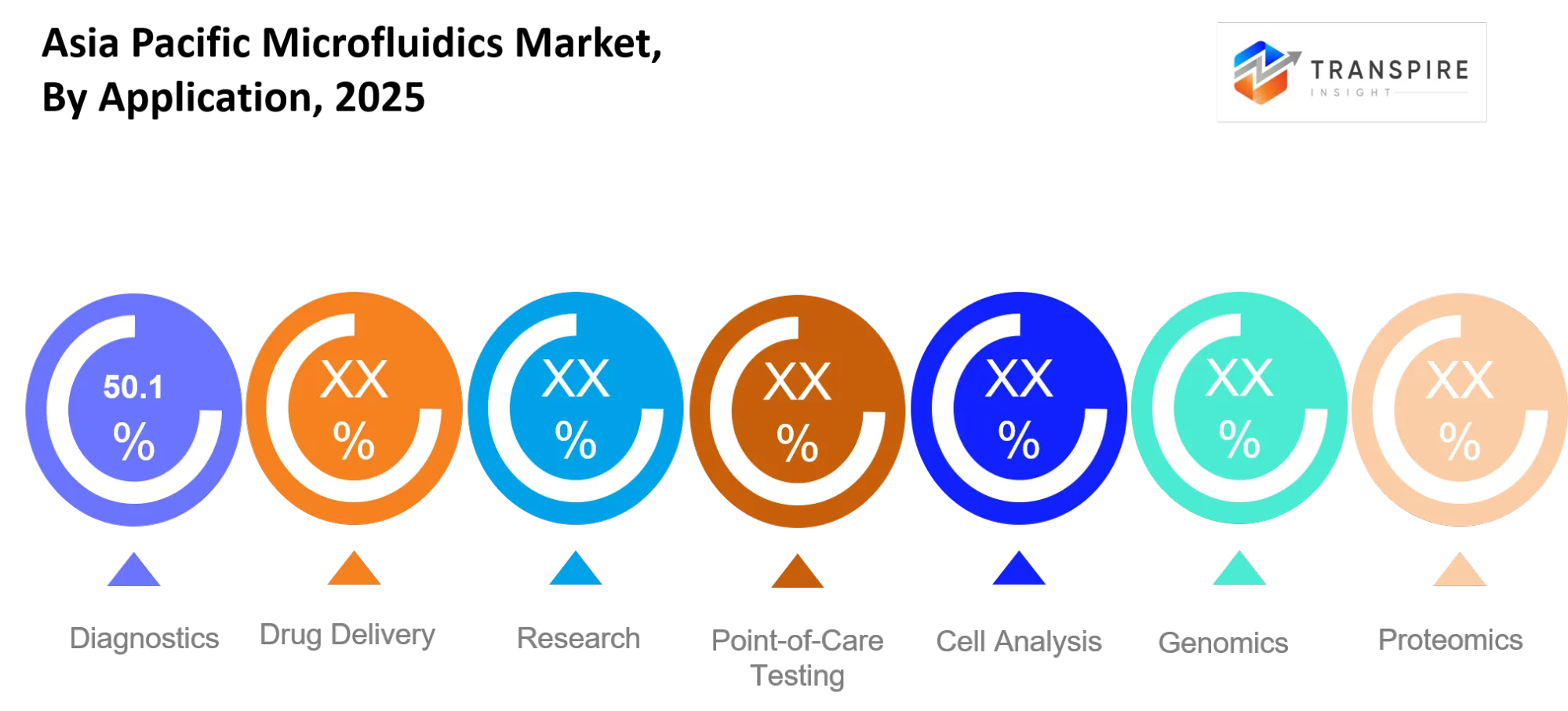
By End User
Hospitals use analysis platforms to make clinical decisions faster and diagnose quicker. Diagnostic Laboratories use automated workflows to handle tests accurately. Research Institutes do studies validate technology and discover science. Pharmaceutical Companies use -scale tech to improve drug development and screening.Biotechnology Firms use fluid-handling systems for product development and biology analysis. Academic Institutions do education, technology advancement and collaborative research. CROs offer testing and development services, for pharmaceutical and biotechnology organizations. There are also labs and testing facilities that need compact, accurate and efficient analysis solutions.
What are the Key Use Cases Driving the Asia Pacific Microfluidics Market?
Diagnostics is the thing that people use because doctors and hospitals need to test people for diseases like cancer and other sicknesses very quickly and accurately. Hospitals and labs are using machines to test people so they can use less blood and get the results back faster. This is a market because people want to know what is wrong with them and they want the best treatment.Drug companies are trying to find medicines and they need to test them quickly. They also want to make the process of finding new medicines easier and faster. People who study cells are also using these machines because they need to be very careful when they are working with cells. These machines help them do their jobs faster. They do not have to use as much stuff.There are things happening in the field of medicine where doctors can treat people based on their specific needs. There are also machines that can test people at home or in a clinic. Some research places are working on machines that can do everything in one step. As doctors try to find diseases and treat people in a special way these machines will become more important and people will buy more of them.
|
Report Metrics |
Details |
|
Market size value in 2025 |
USD 8.2 Billion |
|
Market size value in 2026 |
USD 9.3 Billion |
|
Revenue forecast in 2033 |
USD 22.8 Billion |
|
Growth rate |
CAGR of 13.67% from 2026 to 2033 |
|
Base year |
2025 |
|
Historical data |
2021 - 2024 |
|
Forecast period |
2026 - 2033 |
|
Report coverage |
Revenue forecast, competitive landscape, growth factors, and trends |
|
Regional scope |
Asia Pacific |
|
Key company profiled |
Danaher, Thermo Fisher Scientific, Agilent, PerkinElmer, Bio-Rad, Dolomite Microfluidics, Fluidigm, Abbott, Roche, Illumina, Becton Dickinson, Standard BioTools, Merck, Qiagen, ZEON |
|
Customization scope |
Free report customization (country, regional & segment scope). Avail customized purchase options to meet your exact research needs. |
|
Report Segmentation |
By Product Type (Microfluidic Chips, Micropumps, Microneedles, Sensors, Reagents, Lab-on-a-Chip Systems, Microvalves, Others); By Material (Glass, Silicon, Polymer, PDMS, Ceramics, Thermoplastics, Composite Materials, Others); By Application (Diagnostics, Drug Delivery, Research, Point-of-Care Testing, Cell Analysis, Genomics, Proteomics, Others); By End User (Hospitals, Diagnostic Laboratories, Research Institutes, Pharmaceutical Companies, Biotechnology Firms, Academic Institutions, CROs, Others) |
Which Regions are Driving the Asia Pacific Microfluidics Market Growth?
East Asia is leading the market because it has biotechnology companies, good healthcare systems and invests a lot in genomics research. The government supports innovation. Gives a lot of money for precision medicine, which helps hospitals, research institutes and pharmaceutical organizations use new technology. The region also has a semiconductor and microfabrication industry, which helps make advanced analytical devices. All these factors, including research capacity, production expertise and healthcare spending help East Asia stay ahead.Oceania is the biggest contributor to the market.Its market performance is different from East Asia in some key ways.Oceania has healthcare funding, good regulatory frameworks and consistent investment in clinical research making it a dependable market.Universities and research organizations work closely with biotechnology and pharmaceutical sectors, which helps technologies become commercialized.The regions economy is strong. Policies are predictable making it a reliable source of recurring revenue.Southeast Asia is growing fast because its healthcare infrastructure is expanding and more people have access to diagnostic technologies.
Recently there has been investment in biotechnology parks, research facilities and domestic life science manufacturing, which has accelerated the adoption of miniaturized testing platforms.The push to modernize healthcare has increased demand for diagnostic solutions in both cities and rural areas.This growth will create opportunities for technology developers, contract research providers and investors looking for high-growth markets from 2026 to 2033.Southeast Asia's growth and East Asia's leadership along with Oceania's contributions are key, to the markets future.The market will see changes and growth in the coming years driven by these regions.
Who are the Key Players in the Asia Pacific Microfluidics Market and How Do They Compete?
Competition in the Asia Pacific Microfluidics Market remains moderately consolidated, with global life science companies holding significant positions while specialized technology firms continue to introduce innovative solutions. Technology differentiation serves as the primary basis of competition, particularly in chip design, analytical accuracy, automation capabilities, and integration with genomics and diagnostic platforms. Established participants defend market share through broad product portfolios and strong distribution networks, while emerging innovators focus on niche applications such as single-cell analysis, droplet microfluidics, and advanced biomarker detection. Continuous investment in research and development remains essential for maintaining competitive positioning.
Thermo Fisher Scientific emphasizes technology innovation through integrated workflows that combine sample preparation, molecular analysis, and data management. This approach creates efficiency advantages for clinical laboratories and pharmaceutical research organizations. Danaher strengthens competitiveness through a portfolio of diagnostic and life science businesses that provide complementary analytical technologies. Strategic acquisitions and ongoing investment in precision medicine applications allow expansion into high-value research segments.
Illumina differentiates through strong expertise in sequencing technologies that integrate with microfluidic platforms for genomics applications. Qiagen focuses on molecular diagnostics and sample processing solutions that simplify complex laboratory procedures. Dolomite Microfluidics specializes in droplet generation and custom microfluidic systems, serving research institutions requiring highly tailored experimental platforms. These companies continue expanding through collaborative research programs, product development initiatives, and targeted entry into emerging biotechnology and precision healthcare markets.
Company List
- Danaher
- Thermo Fisher Scientific
- Agilent Technologies
- PerkinElmer
- Bio-Rad Laboratories
- Dolomite Microfluidics
- Fluidigm
- Abbott
- Roche
- Illumina
- Becton Dickinson (BD)
- Standard BioTools
- Merck Life Science
- Qiagen
- ZEON Corporation
Recent Development News
In April 2025, QIAGEN announced plans to launch three new automated sample preparation instruments, including QIAsymphony Connect, QIAsprint, and QIAmini. The launch expands laboratory automation capabilities and strengthens support for genomics, oncology, and high-throughput testing workflows across life science and diagnostic laboratories.https://corporate.qiagen.com
In June 2025, QIAGEN entered a partnership with GENCURIX to develop oncology assays for the QIAcuityDx digital PCR platform. The collaboration expands clinical diagnostic applications and supports broader adoption of advanced molecular testing technologies in precision medicine.https://corporate.qiagen.com
In January 2026, Standard BioTools completed the sale of SomaLogic to Illumina for $350 million upfront with additional earnout potential. The transaction provides significant capital for future investments, acquisitions, and technology expansion across advanced life science and analytical platform markets.https://www.globenewswire.com
What Strategic Insights Define the Future of the Asia Pacific Microfluidics Market?
The Asia Pacific Microfluidics Market is going towards systems that do a lot of things at once. These systems prepare samples, do tests and interpret the results in one place. The reason for this change is that medicine is becoming more precise and genetics are being used more in diagnostics that people can do themselves. This means that tests need to be done more efficiently.
In the five to seven years companies that can make solutions that are scalable and use software will have an advantage over companies that just make hardware. The Asia Pacific Microfluidics Market is looking for solutions like this.There is a risk that not many companies will be making the technology needed for the Asia Pacific Microfluidics Market. If something happens to these companies or the materials they need it could slow down production. Make things more expensive. This could be a problem in the run even if it does not seem like it now.The Asia Pacific Microfluidics Market has an opportunity in analyzing single cells and understanding how they are arranged in space. This is especially true as institutions that do research and biotechnology companies invest more in therapies that are tailored to people. These areas of research are still new. They will likely become big sources of revenue. Companies in the Asia Pacific Microfluidics Market should work together to combine microfluidics, artificial intelligence and the ability to analyze molecules in ways. This will help them make systems that can diagnose diseases and develop drugs. The Asia Pacific Microfluidics Market needs systems like this for the future.
Asia Pacific Microfluidics Market Report Segmentation
-
By Product Type
- Microfluidic Chips
- Micropumps
- Microneedles
- Sensors
- Reagents
- Lab-on-a-Chip Systems
- Microvalves
- Others
-
By Material
- Glass
- Silicon
- Polymer
- PDMS
- Ceramics
- Thermoplastics
- Composite Materials
- Others
-
By Application
- Diagnostics
- Drug Delivery
- Research
- Point-of-Care Testing
- Cell Analysis
- Genomics
- Proteomics
- Others
-
By End User
- Hospitals
- Diagnostic Laboratories
- Research Institutes
- Pharmaceutical Companies
- Biotechnology Firms
- Academic Institutions
- CROs
- Others
Frequently Asked Questions
Find quick answers to common questions.
The Expected Asia Pacific Microfluidics Market size for the Market will be USD 22.8 Billion in 2033.
Key Segments for the Asia Pacific Microfluidics Market are Type By Product Type (Microfluidic Chips, Micropumps, Microneedles, Sensors, Reagents, Lab-on-a-Chip Systems, Microvalves, Others); By Material (Glass, Silicon, Polymer, PDMS, Ceramics, Thermoplastics, Composite Materials, Others); By Application (Diagnostics, Drug Delivery, Research, Point-of-Care Testing, Cell Analysis, Genomics, Proteomics, Others); By End User (Hospitals, Diagnostic Laboratories, Research Institutes, Pharmaceutical Companies, Biotechnology Firms, Academic Institutions, CROs, Others).
Major Asia Pacific Microfluidics Market players are Danaher, Thermo Fisher Scientific, Agilent, PerkinElmer, Bio-Rad, Dolomite Microfluidics, Fluidigm, Abbott, Roche, Illumina, Becton Dickinson, Standard BioTools, Merck, Qiagen, ZEON.
The Current Asia Pacific Microfluidics Market size is USD 8.2 Billion in 2025.
The Asia Pacific Microfluidics Market CAGR is 13.67% from 2026 to 2033.
- Danaher
- Thermo Fisher Scientific
- Agilent Technologies
- PerkinElmer
- Bio-Rad Laboratories
- Dolomite Microfluidics
- Fluidigm
- Abbott
- Roche
- Illumina
- Becton Dickinson (BD)
- Standard BioTools
- Merck Life Science
- Qiagen
- ZEON Corporation
About the Authors

Pankaj Ghogare Patil
I am Pankaj Ghogare Patil, a Senior Research Analyst at Transpire Insight, specializing in the Pharmaceutical, Chemicals & Materials, Healthcare IT, and Biotechnology industry. My expertise lies in conducting comprehensive market research, analyzing industry trends, evaluating competitive landscapes, and translating complex data into actionable insights. At Transpire Insight, I closely follow emerging technologies, regulatory developments, and market innovations to create accurate, well-researched, and informative content that helps businesses and professionals make informed decisions. I am committed to producing credible, evidence-based articles that reflect industry best practices while making technical topics accessible and valuable for a broad audience.

Chakradhar Khansole
Chakradhar serves as the Research Director at Transpire Insight, bringing over 8 years of experience in technology, innovation, and strategic market intelligence. He specializes in transforming complex market data into actionable business insights that enable organizations to make informed, growth-oriented decisions. Recognized for his strategic vision and analytical expertise, Chakradhar leads high-impact research initiatives, delivering comprehensive market assessments, competitive intelligence, and forward-looking industry analysis.
Recently Published Reports
-
Jul 2026
Alopecia Treatment Market
Alopecia Treatment Market Size, Share & Analysis Report By Disease Type (Alopecia Areata, Cicatricial Alopecia, Traction Alopecia, Alopecia Totalis, Androgenetic Alopecia, Alopecia Universalis, and Other Disease Types), By Treatment Type (Topical Treatments, Oral Medications, Injectable Therapies, and Hair Transplantation), By Gender (Male, and Female), By Distribution Channel (Hospitals and Clinics, Retail Pharmacies, and Online Retailers), and Geography (North America, Europe, Asia-Pacific, Middle East and Africa, South and Central America), 2021 - 2031
-
Jul 2026
Medical Ultrasound Probe Market
Medical Ultrasound Probe Market Size, Share & Analysis Report By Type (Linear Type, Convex Type, Endocavitary Probe, Phased Array/Cardiac Probe, Transesophageal (TEE) Probe, and Others), By Application (Ophthalmology, Cardiology, Musculoskeletal, Oncology, Obstetrics & Gynecology, General Imaging, and Others), By End User (Hospitals & Clinics, Diagnostic Centers, Ambulatory Surgical Centers, and Others), and Geography (North America, Europe, Asia-Pacific, Middle East and Africa, South and Central America), 2021 – 2031
-
May 2026
Biosimilars Market
Biosimilars Market By Product Type (Monoclonal Antibodies, Recombinant Hormones, Erythropoietin, G-CSF, Others), By Indication (Oncology, Autoimmune Diseases, Blood Disorders, Diabetes, Others), By Manufacturing Type (In-House Manufacturing, Contract Manufacturing), By Distribution Channel (Hospital Pharmacies, Retail Pharmacies, Online Pharmacies), By Industry Analysis, Size, Share, Growth, Trends, and Forecasts 2021-2033
-
Apr 2026
Gastrointestinal Endoscopy Market
Gastrointestinal Endoscopy Market By Type (Rigid Gastrointestinal Endoscope, Flexible Gastrointestinal Endoscopes, Disposable Gastrointestinal Endoscope), By Procedure Type (Colonoscopy, Gastroscopy, Duodenoscopy, Enteroscopy, Flexible Sigmoidoscopy, Others), By Application (Diagnosis, Treatment), By End-Users (Hospitals, Ambulatory Surgical Centers, Specialty Clinics, Laboratories, Others), By Industry Analysis, Size, Share, Growth, Trends, and Forecasts 2021-2033