
Asia Pacific Machine To Machine Market Size & Forecast:
- Asia Pacific Machine To Machine Market Size 2025: USD 23.6 Billion
- Asia Pacific Machine To Machine Market Size 2033: USD 34.5 Billion
- Asia Pacific Machine To Machine Market CAGR: 4.83%
- Asia Pacific Machine To Machine Market Segments: By Component (Modules, Connectivity Services, Platforms, Software, Hardware, Others); By Technology (Cellular M2M, Satellite M2M, Wired M2M, LPWAN, Others); By Application (Automotive, Utilities, Healthcare, Retail, Industrial Automation, Others); By End User (Telecom, Manufacturing, Energy, Transportation, Others).
Asia Pacific Machine To Machine Market Summary
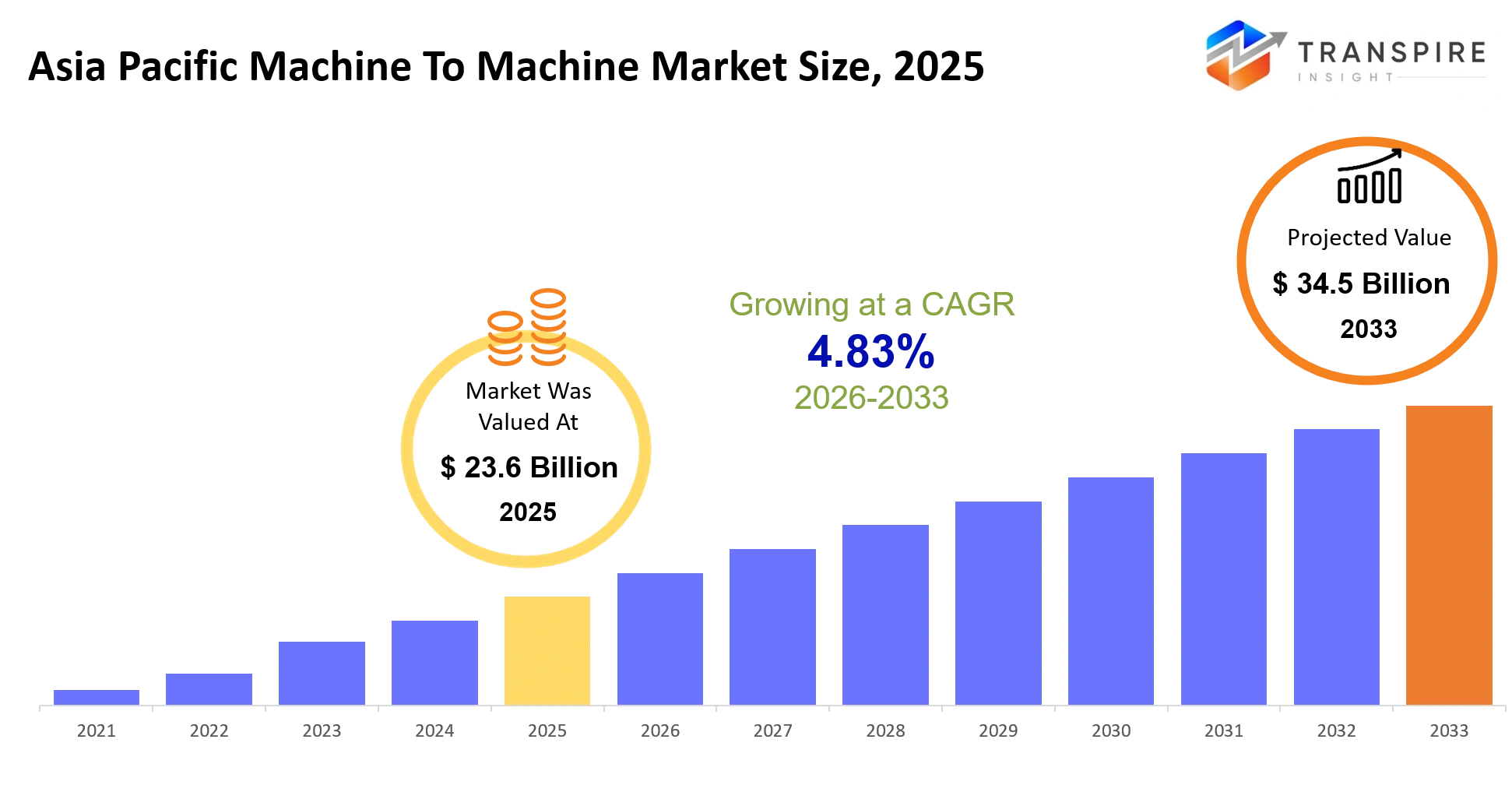
The Asia Pacific Machine To Machine Market was valued at USD 23.6 Billion in 2025. It is forecast to reach USD 34.5 Billion by 2033. That is a CAGR of 4.83% over the period.
The Asia Pacific Machine-to-Machine (M2M) market, lets connected devices trade data on their own, kind of automatically, with no human involvement. That ends up helping businesses keep an eye on assets, run fleets, dial in energy consumption, follow equipment performance, and also automate industrial workflows on a real time basis. In manufacturing plants, utilities, logistics networks, and smart city setups, M2M systems tend to cut down on operational lags, and they also make the decision process better, because the data keeps getting generated by machines, over and over.
In the last five years, the whole market has sort of shifted in a more structural way, away from the older cellular M2M deployments and more toward IoT platforms. Those platforms are usually backed by 4G, 5G, and low-power wide-area networks. Because of this, the ecosystem of connected devices has grown both in size and in overall complexity. A key trigger here was the COVID-19 pandemic disruption, which revealed the weak points of manual monitoring. It also sped up investment in remote operations and clearer asset visibility. Now, as companies chase better operational resilience, they’re actively weaving connectivity into vital infrastructure plus industrial machinery, and this is starting to generate recurring service revenue streams for connectivity providers, platform vendors, and enterprise solution developers, across the region.
Key Market Insights
- China has a part of the market with around 35 to 40 percent of the share in 2025. This is because China is investing a lot in manufacturing and making its digital infrastructure better.
- India is the country that is growing the fastest until 2030. This is happening because India is working on automation projects making smart cities and getting more people connected to the internet.
- Japan and South Korea also have a share of the market. This is because they have good systems for industries and people are using connected technologies a lot.
- The thing that is making the money in the market is connectivity services. In 2025 it will make around 30 percent of the money. This is because a lot of devices are connected to each other and talking to each other.
- The biggest part of the market is platforms. People want platforms that can manage devices look at data and monitor things from away.
- LPWAN technologies are going to grow the fastest until 2030. This is because they are cheap to set up and can connect a lot of devices to the internet.
- Industrial automation is a part of the market with more than 25 percent of the share. This is because it helps people fix problems before they happen and see what is going on in time.
- The part of the market that is growing the fastest is healthcare. This is because medical devices are getting connected to the internet and doctors can monitor patients from away.
- The automotive industry is also using the internet to connect cars and manage fleets of vehicles.
- The companies that provide phone and internet services have the share of the market with more than 30 percent in 2025. This is because they are, in charge of getting people connected to the internet.
What are the Key Drivers, Restraints, and Opportunities in the Asia Pacific Machine To Machine Market?
The most powerful thing pushing the Asia Pacific Machine To Machine Market is the fast spread of 4G, 5G, and low power wide area network infrastructure across industrial sites and busy city zones. Honestly, this change came on strong because of government supported digital transformation programs, plus the cost of connected sensors and communication modules dropping, bit by bit. With connectivity getting steadier and cheaper, manufacturers, logistics operators, utilities, and telecom providers keep rolling out bigger collections of connected units. Then you see more use of remote monitoring, predictive maintenance, and asset tracking tools, and those tend to bring recurring cash via connectivity subscriptions, platform based services, and data analytics applications.
Still, the biggest obstacle stays pretty clear: the region has fragmented connectivity and interoperability, so things don’t always “talk” smoothly. A lot of enterprises run older equipment that was never made to work with modern M2M platforms, so they end up needing costly upgrades and time consuming system integration. This is kind of structural, since industrial assets usually hang around for decades, so swap outs are slow and they burn a lot of capital. Because of that, organizations often postpone deployment choices, which shrinks the reach of connected ecosystems, and it also dampens the revenue chances for technology vendors and service providers.
A big future opportunity is sitting in the meeting point of M2M connectivity with edge computing and, well, artificial intelligence too. You can see it in Countries like China, India, and South Korea, they are putting a lot of money into smart manufacturing infrastructure, and that’s where real time machine intelligence is turning into kind of a competitive requirement. With AI enabled edge devices, operational data gets handled locally, which cuts down the delay and helps decision-making happen quicker. From there, the door opens to newer chances for advanced industrial automation, near autonomous operations, and high value analytics services. So, it’s really supporting the next phase of market expansion across the whole region.
What Has the Impact of Artificial Intelligence Been on the Asia Pacific Machine To Machine Market?
Artificial intelligence plus advanced digital techs are, in a pretty real way, improving machine-to-machine ecosystems across Asia Pacific, by turning connected devices into kind of “intelligent operational assets” that do more than just sit there. AI-powered control systems are slowly getting more common for automating things like equipment monitoring, fleet management, utility networks, and various industrial processes. In logistics and transportation connected sensors keep sending operational data nonstop, so automated platforms can track vehicle performance, driver behavior, route efficiency, and even regulatory compliance, basically without anyone doing the manual checkups.
Also machine learning models are boosting predictive abilities quite a bit. Manufacturers tend to use AI algorithms to look at vibration levels temperature readings, and performance traces from connected machinery, then they try to foresee component failures before they happen. Utilities apply predictive analytics to estimate how equipment will degrade and to tune maintenance cycles, while transportation operators rely on real-time data models to make fuel consumption better, and raise asset utilization. Because of this, unplanned downtime often drops, equipment life usually improves, and maintenance expenses can be lower. Quite a few industrial operators even say they see measurable gains in equipment availability and day-to-day operational efficiency after rolling out predictive maintenance systems.
Advanced analytics and edge computing help with response times, because they process data nearer to connected assets, so decisions can be made quicker on the operational side. But still theres a major snag, the integration of AI with older infrastructure. A lot of industrial settings run older gear that doesn’t support standardized communication protocols, and that makes deployment expensive, and also kind of slow. On top of that, the data quality can be uneven from these split device networks, which can reduce model accuracy and makes it harder to get the full value out of AI-driven automation.
Key Market Trends
- Since 2020 manufacturers have moved away from watching individual machines to using Internet of Things platforms that connect the whole production line, warehouses and supply chains.
- The Internet of Things platforms connect production lines, warehouses and supply chains which really helps manufacturers.
- Deployment of 5G networks really took off after 2021 allowing for communications and supporting more complex industrial automation applications across the Asia Pacific region.
- This means the Internet of Things platforms can work better with the new 5G networks.
- Utilities started using connected metering systems instead of manual meter-reading processes, which gives them a better view of what is going on and reduces the need for people to go out and check things.
- The Internet of Things platforms are used by utilities to connect their metering systems.
- Chinese industrial firms started making connected factory initiatives between 2021 and 2025 which helped the region become a leader in industrial digitalization and the use of Internet of Things platforms.
- Logistics operators used to track their assets every now and then but now they use real-time fleet monitoring, which helps them plan routes better and reduces waste.
- The Internet of Things platforms are used by logistics operators to monitor their fleets in time.
- Telecom providers like Cisco, Huawei, Ericsson and Nokia are working more with businesses to give them connectivity and device management solutions, including the Internet of Things platforms.
- When the cost of connectivity modules went down more people started using LPWAN, which made it possible for utilities and smart cities to use a lot of sensors in a cost- way.
- Buyers are now looking for things that can predict when maintenance is needed than just basic connectivity because they want to see real results and save money, which is what the Internet of Things platforms can provide.
- The Internet of Things platforms can give buyers what they want.
- After 2022 edge computing started being used a lot more because businesses wanted to make decisions without relying solely on big cloud infrastructure.
- Regulatory support for manufacturing and digital infrastructure programs in China, India, Japan and South Korea helped more devices get connected across industries, which is what the Internet of Things platforms are all, about.
- The Internet of Things platforms are used in industries now.
Asia Pacific Machine To Machine Market Segmentation
By Component:
Connectivity services kinda sit right in the middle of machine to machine deployments, because dependable messaging is really the base line for connected activity. Across manufacturing, utilities, transportation, and telecommunications, enterprises keep putting money into secure and scalable connectivity systems, mainly to handle the rising device quantities. The rollout of 4G, 5G, and LPWAN infrastructure has in practice improved the ability to link up assets across wide territories, while still backing real time data exchange.
Platforms are also a big deal, since organizations want more clarity into connected operations, not just raw uptime. Device administration, plus data analytics and remote surveillance features help businesses turn machine made information into something more useful. In many cases, software solutions keep winning attention as automation projects expand, and operational efficiency becomes more of a priority.
Hardware still matters though, since sensors, modules, gateways, and other communication devices make sure data is gathered and then sent. Better affordability and performance in hardware has encouraged wider deployments across industrial plants, utility networks, and transportation systems. Ongoing upgrades across every component area will keep adoption moving forward, and they should open up new chances for solution providers that can bundle everything together.
By Technology:
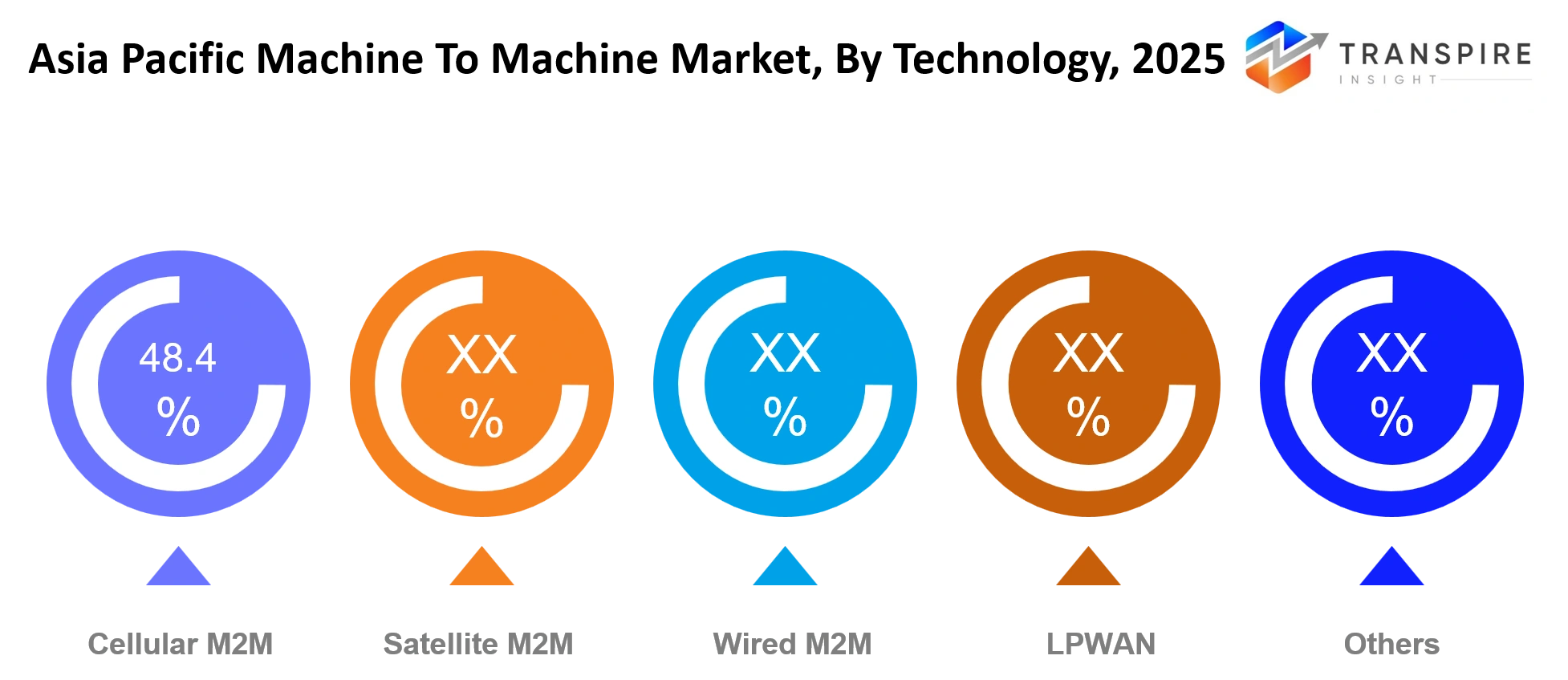
Cellular M2M tech is still very much used, not just because it’s familiar but also because network reach is broad and there is solid backing for both mobile and fixed assets, yknow. As 4G and 5G buildouts keep expanding communication feels faster, more dependable, and handling of data gets a lot better. Big industrial automation programs and connected transportation use cases keep leaning on cellular communication networks, even when new options appear.
Then there’s LPWAN which has basically popped up as a major growth direction, mainly for lower power draw and connectivity that stays affordable when you need huge device counts. Smart metering, monitoring of the environment, and even infrastructure stewardship efforts are increasingly turning toward LPWAN to keep things running long term, with less fuss and fewer service visits. Adoption got even faster once rollout expenses started looking more reasonable for enterprises as well as public sector teams.
Satellite M2M still matters, especially in out of the way regions where standard network coverage is thin or missing. Meanwhile wired M2M solutions still fit well in settings that demand very steady, and frankly secure, communication paths. In practice many organizations combine approaches, so they can choose what fits operational needs geographic realities and connectivity aims, not just one generic pattern.
By Application:
Industrial automation is still one of the big application areas, i mean organizations are chasing more efficiency, productivity, and a stronger grip on day to day operations. Connected equipment gives you real time visibility, it also enables predictive maintenance, and helps with process optimization across manufacturing sites . Automated data exchange, not only cuts downtime, but it also makes decision making smoother through production environments, even when things get a bit complicated.
Automotive use cases are growing too, mainly because telematics systems, fleet management platforms and connected vehicle technologies keep getting upgraded. Transportation operators are leaning on real time information to fine tune route planning, improve vehicle utilization, and line up maintenance schedules. And when connected mobility services keep expanding, adoption usually follows pretty fast through the whole sector.
There’s also momentum in healthcare, utilities, and retail, like these areas are getting more attention than before. Connected medical devices support remote monitoring and can raise operational efficiency in healthcare settings. Utility providers use machine-to-machine communication for smart metering, plus network management, while retailers are putting connected solutions to work for better inventory visibility and asset tracking capabilities.
By End User:
Telecommunications companies still stay at the forefront for end users, mainly because the network infrastructure basically lets communication happen between connected devices and those operational platforms. With more ongoing investment in advanced connectivity technologies, they keep supporting large-scale deployments across many industries, you know. And the expansion of 5G services has already opened up fresh chances for stronger machine communication, plus automation, kind of in a smarter way.
On the other hand, manufacturing organizations are becoming a very fast growing user group as the Industry 4.0 initiatives pick up speed across Asia Pacific countries. Connected production systems give operational information that actually helps with efficiency improvements, predictive upkeep, and quality control. At the same time, digital transformation strategies keep pushing for wider use of intelligent connected solutions, even when teams are unsure at first.
Energy and utility companies also increasingly deploy connected technologies to improve asset oversight, grid performance, and overall service reliability. Meanwhile, transportation and logistics organizations rely on machine-to-machine communication to boost fleet visibility, and coordinate operations more smoothly. If you look ahead, broader digital infrastructure development will keep enabling adoption across a variety of end user industries.
What are the Key Use Cases Driving the Asia Pacific Machine To Machine Market?
Industrial automation is still the main reason, machine-to-machine adoption keeps spreading across Asia Pacific, and honestly it feels like it’s the biggest use case right now. In manufacturing, facilities rely on connected equipment, sensors and control systems to keep an eye on production lines as things happen, they aim to lower the unplanned downtime, and at the same time raise asset utilization. The strong push for smart factory initiatives keeps this application as the biggest driver of deployments, like day after day.
Also, fleet management and smart utility operations are starting to pick up speed in transportation and energy. Logistics firms use connected devices to map where vehicles are, watch fuel usage, and spot maintenance needs earlier than before. Meanwhile, utility providers roll out machine communication for smart metering, grid monitoring, that kind of setup. In practice, these solutions improve operational visibility and help squeeze more efficiency out of resources.
Then there are emerging patterns, AI enabled edge monitoring and autonomous industrial operations are getting more attention. Connected systems are increasingly helping with real-time decision making, especially in advanced manufacturing settings. And beyond that, smart city infrastructure, like intelligent traffic management and connected public services, looks like it has solid long-term promise too, as digital infrastructure investments keep expanding through the region, steadily.
|
Report Metrics |
Details |
|
Market size value in 2025 |
USD 23.6 Billion |
|
Market size value in 2026 |
USD 24.8 Billion |
|
Revenue forecast in 2033 |
USD 34.5 Billion |
|
Growth rate |
CAGR of 4.83% from 2026 to 2033 |
|
Base year |
2025 |
|
Historical data |
2021 - 2024 |
|
Forecast period |
2026 - 2033 |
|
Report coverage |
Revenue forecast, competitive landscape, growth factors, and trends |
|
Regional scope |
Asia Pacific (India, China, Japan, Australia, South Korea, Rest of Asia Pacific) |
|
Key company profiled |
Cisco, Huawei, Ericsson, Nokia, Sierra Wireless, Telit, Thales, Vodafone, AT&T, Verizon, Qualcomm, IBM, SAP, Oracle, Samsung. |
|
Customization scope |
Free report customization (country, regional & segment scope). Avail customized purchase options to meet your exact research needs. |
|
Report Segmentation |
By Component (Modules, Connectivity Services, Platforms, Software, Hardware, Others); By Technology (Cellular M2M, Satellite M2M, Wired M2M, LPWAN, Others); By Application (Automotive, Utilities, Healthcare, Retail, Industrial Automation, Others); By End User (Telecom, Manufacturing, Energy, Transportation, Others). |
Which Regions are Driving the Asia Pacific Machine To Machine Market Growth?
East Asia ends up leading the market, mostly because there are strong industrial digitalization programs, plus advanced telecommunications infrastructure, and then this huge, ongoing scale of manufacturing activity. China, Japan, and South Korea have put serious money into smart factories, connected infrastructure, and next-generation communication networks. That kind of push basically makes it easier for machine-to-machine deployment to happen. On top of that, government initiatives—focused on industrial automation and digital transformation—have sped up adoption not just in manufacturing, but also across transportation and utility sectors too. And there’s this kind of mature ecosystem of technology providers, telecom operators, device manufacturers, and software developers, which keeps reinforcing regional leadership.
Southeast Asia, meanwhile, sits as the second-largest regional contributor, supported by steady economic growth and ongoing investments in digital infrastructure. It’s a little different from East Asia, where advanced industrial automation is the main driver, Southeast Asia seems to lean more on expanding connectivity across emerging manufacturing hubs and logistics networks. Countries like Singapore, Thailand, Malaysia, and Vietnam have rolled out structured digitalization programs that tend to encourage connected operations across several industries. Finally, consistent investment from enterprises and telecom operators gives a fairly stable base, for long term market expansion.
South Asia is expected to see the fastest growth through 2033, mostly because of India’s quick digital transformation moves. There’s been a big expansion of 4G and 5G networks, plus smart city rollouts and industrial modernization programs, which are basically opening fresh pathways for connected device deployment. Also, manufacturers, utilities, and transportation operators are taking up automation technologies more and more, so the growth keeps building momentum. With all this accelerating investment environment happening now, the forecast period should bring really attractive prospects for technology vendors, connectivity providers and investors who want exposure to those fast-growing digital infrastructure markets over time.
Who are the Key Players in the Asia Pacific Machine To Machine Market and How Do They Compete?
Competition in the Asia Pacific Machine To Machine Market is still sort of moderately consolidated, but you can see big global technology firms, telecom operators, and connectivity specialists moving at the same time across infrastructure, platforms and managed services. Lately the real basis is tech capability, kind of the main “ thing” behind how they compete, especially around 5G connectivity, device management, edge computing, and industrial analytics. Established vendors keep defending their share with integrated solutions that bundle together hardware, connectivity, software, and cloud services. Meanwhile, specialized providers are going after specific industry use cases, where tailored deployment and hands on operational expertise give them more of a clear edge, even if the market looks steady overall
Huawei and Ericsson both go head to head with advanced network infrastructure and 5G enabled machine communication solutions. Huawei tends to lean on a solid foothold across many Asian telecommunications markets, and they provide tightly integrated connectivity plus IoT ecosystems, sort of a full stack feeling. Ericsson, on the other hand, tries to stand out via network performance optimization, and through partnerships with telecom operators that want big scale industrial connectivity rollouts. Nokia is more centered on private wireless networks for manufacturing, logistics, and utility setups, so enterprises can preserve secure and reliable communications for mission critical operations, with fewer surprises and more control.
Cisco and IBM seem to stress the “software-first” kind of value creation more than plain connectivity, or so it feels like. Cisco brings its networking craft together with edge computing and cybersecurity strengths, so enterprises can wrangle those complicated, connected-device environments more reliably. IBM, on the other hand leans into artificial intelligence, data analysis, and industrial automation platforms, and it turns machine-generated data into operational insights, kind of like turning static into something actionable. Through strategic collaborations with manufacturers, telecom providers, and cloud service partners, both companies broaden their solution catalogs, and they also push adoption across fast-growing sectors in the region, more or less.
Company List
- Cisco
- Huawei
- Ericsson
- Nokia
- Sierra Wireless
- Telit
- Thales
- Vodafone
- AT&T
- Verizon
- Qualcomm
- IBM
- SAP
- Oracle
- Samsung
Recent Development News
In March 2025, Huawei launched its AI-Centric Network solution at Mobile World Congress 2025. The platform helps telecom operators modernize network infrastructure for higher bandwidth, lower latency, and more efficient operations, supporting large-scale IoT and machine-to-machine deployments across Asia Pacific.
Source URL: https://www.huawei.com
In May 2025, Nokia was recognized as a Champion and Market Momentum Leader in Omdia's 2025 Private 5G Market Radar report. The recognition highlighted Nokia's private wireless portfolio, edge AI capabilities, and industrial connectivity solutions, strengthening its position in industrial machine-to-machine and Industry 4.0 deployments.
Source URL: https://www.nokia.com
What Strategic Insights Define the Future of the Asia Pacific Machine To Machine Market?
Over the next five to seven years, the market is expected to slide beyond just device connectivity into a kind of autonomous, data-guided operational ecosystem where machines not only trade information, but also help with real time decisions. What’s really pushing this shift is the meeting point of 5G networks, edge computing, artificial intelligence and industrial automation, so that organizations can pull more value from connected assets, instead of simply, gathering data. Revenue growth is probably going to lean more on analytics, orchestration platforms, and outcome driven offerings, rather than connectivity by itself.
There’s also a less obvious risk, and it’s kind of hidden in plain sight: the growing reliance on a limited number of network infrastructure, semiconductor and cloud technology providers. If too much concentration shows up in crucial parts of the value chain, it could make enterprises vulnerable to supply interruptions, pricing pressure, and even geopolitical constraints. Meanwhile, at the same time, a newer opportunity is taking shape around private wireless networks for industrial campuses in India and Southeast Asia, since investment in digital infrastructure keeps rising.
Market actors should aim for interoperable platforms and open ecosystem collaborations. Companies that can weave together connectivity, analytics, and automation into one unified approach will likely be in a better spot to secure long-term value as enterprise expectations get more complicated .
Asia Pacific Machine To Machine Market Report Segmentation
By Component
- Modules
- Connectivity Services
- Platforms
- Software
- Hardware
- Others
By Technology
- Cellular M2M
- Satellite M2M
- Wired M2M
- LPWAN
- Others
By Application
- Automotive
- Utilities
- Healthcare
- Retail
- Industrial Automation
- Others
By End User
- Telecom
- Manufacturing
- Energy
- Transportation
- Others
Frequently Asked Questions
Find quick answers to common questions.
The expected Asia Pacific Machine To Machine Market size for the market will be USD 34.5 Billion in 2033.
Key segments for the Asia Pacific Machine To Machine Market are By Component (Modules, Connectivity Services, Platforms, Software, Hardware, Others); By Technology (Cellular M2M, Satellite M2M, Wired M2M, LPWAN, Others); By Application (Automotive, Utilities, Healthcare, Retail, Industrial Automation, Others); By End User (Telecom, Manufacturing, Energy, Transportation, Others).
Major Asia Pacific Machine To Machine Market players are Cisco, Huawei, Ericsson, Nokia, Sierra Wireless, Telit, Thales, Vodafone, AT&T, Verizon, Qualcomm, IBM, SAP, Oracle, Samsung.
The Asia Pacific Machine To Machine Market size is USD 23.6 Billion in 2025.
The Asia Pacific Machine To Machine Market CAGR is 4.83% from 2026 to 2033.
- Cisco
- Huawei
- Ericsson
- Nokia
- Sierra Wireless
- Telit
- Thales
- Vodafone
- AT&T
- Verizon
- Qualcomm
- IBM
- SAP
- Oracle
- Samsung
About the Authors

Avinash Kumar
I’m Avinash Kumar, a Senior Research Analyst at Transpire Insight, with expertise in the Electronics and Semiconductor and Energy & Power industry. My work focuses on analyzing emerging technologies, market trends, industry developments, and innovation across these sectors. I specialize in transforming complex technical and market insights into clear, research-backed content that helps professionals, businesses, and decision-makers stay informed. Through continuous industry research and data-driven analysis, I strive to deliver accurate, reliable, and practical perspectives on the latest advancements shaping the semiconductor and energy landscape.

Chakradhar Khansole
Chakradhar serves as the Research Director at Transpire Insight, bringing over 8 years of experience in technology, innovation, and strategic market intelligence. He specializes in transforming complex market data into actionable business insights that enable organizations to make informed, growth-oriented decisions. Recognized for his strategic vision and analytical expertise, Chakradhar leads high-impact research initiatives, delivering comprehensive market assessments, competitive intelligence, and forward-looking industry analysis.
Recently Published Reports
-
Apr 2026
Fiber Optic Faceplates Market
Fiber Optic Faceplates Market Size, Share & Analysis Report By Type (< 300 mm2, 300-350 mm2, and > 350 mm2, By Application (Night Vision, Holographic Imaging, Medical, and Others), and Geography (North America, Europe, Asia-Pacific, Middle East and Africa, South and Central America), 2021 - 2031
-
Apr 2026
High Temperature Superconductors Market
High Temperature Superconductors Market Size, Share & Analysis Report By Type (1G HTS, and 2G HTS), By Application (Power Cable, Fault Current Limiter, and Transformer), and Geography (North America, Europe, Asia-Pacific, Middle East and Africa, South and Central America), 2021 - 2031
-
Apr 2026
Industrial Plugs and Socket Market
Industrial Plugs and Socket Market Size, Share & Analysis Report By Type (Industrial Plugs, Industrial Sockets), By Current (Up to 32 A, 32 to 125 A, Above 125 A), By Protection (Dustproof and Splash Proof, Waterproof, Explosion Proof), By End User (Heavy Industries, Oil and Gas, Chemicals and Pharmaceuticals, Power Generation, Others), and Geography (North America, Europe, Asia-Pacific, Middle East and Africa, South and Central America), 2021 - 2031
-
Apr 2026
InGaAs Avalanche Photodiodes Market
InGaAs Avalanche Photodiodes Market Size, Share & Analysis Report By Type (1100 - 1700 nm, and 1000 - 1600 nm), By Application (Missile Warning System, Muzzle Flash Detection, Wafer Defect Inspection, Laser Rangefinders, and Others), and Geography (North America, Europe, Asia-Pacific, Middle East and Africa, South and Central America), 2021 - 2031