

Asia Pacific Low-E Glass Market Size & Forecast:
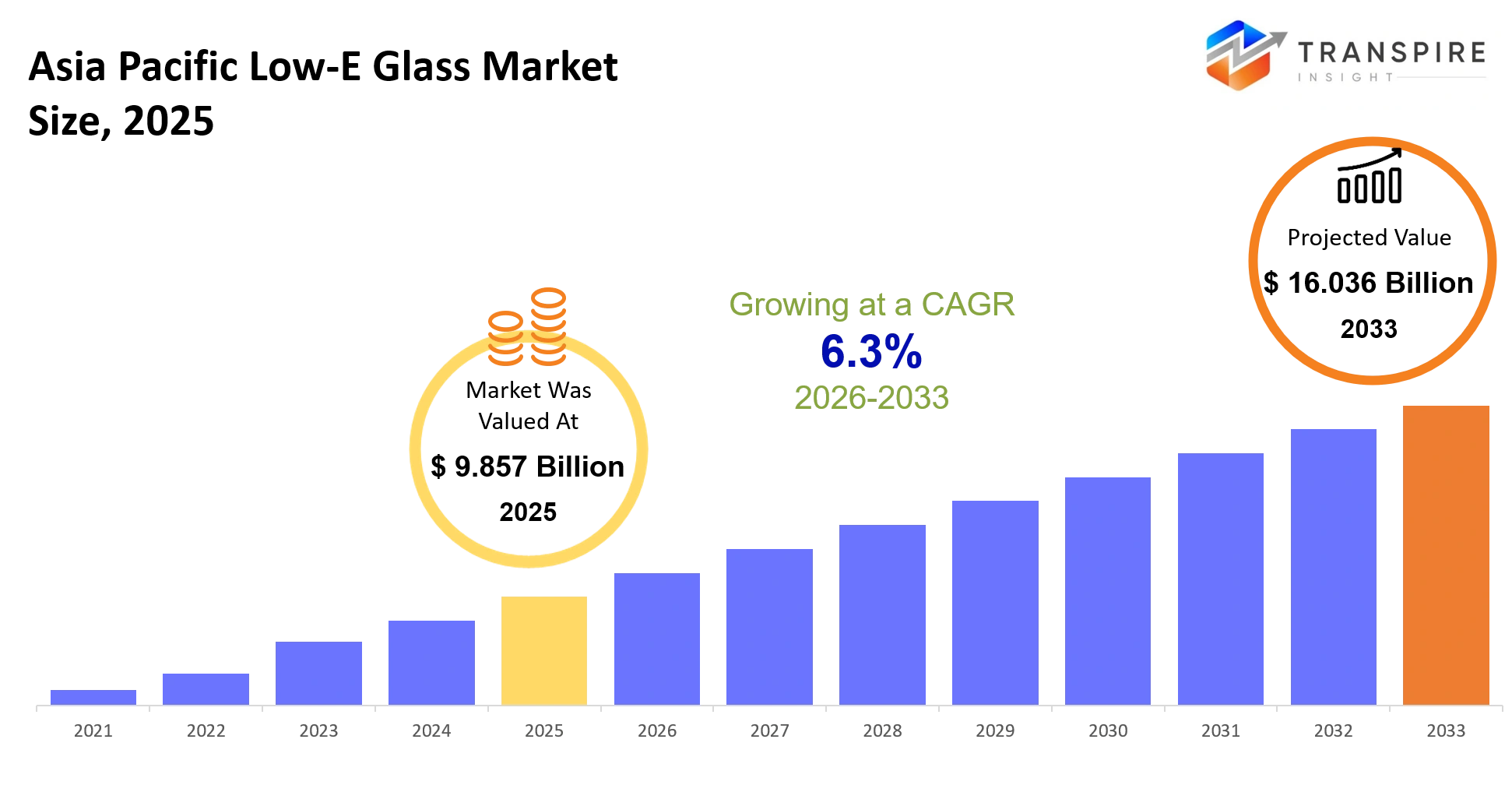
- Asia Pacific Low-E Glass Market Size 2025: USD 9.857 billion
- Asia Pacific Low-E Glass Market Size 2033: USD 16.036 billion
- Asia Pacific Low-E Glass Market CAGR: 6.3%
- Asia Pacific Low-E Glass Market Segments: By Coating Type (Hard Coat, Soft Coat, Double Silver, Triple Silver, Solar Control, Passive Low-E, Others); By Application (Residential Windows, Commercial Buildings, Facades, Skylights, Doors, Others); By End User (Construction, Automotive, Industrial, Others); By Glass Type (Single, Double, Triple Glazed, Others)
Asia Pacific Low-E Glass Market Summary
The Asia Pacific Low-E Glass Market was valued at USD 9.857 billion in 2025. It is forecast to reach USD 16.036 billion by 2033. That is a CAGR of 6.3% over the period.
Indeed, the Asia Pacific Low-E Glass Market is pivotal in ensuring the minimization of heat exchange through building envelopes while at the same time preserving daylight. Practically, it is instrumental in assisting commercial towers, residential structures, airports, as well as industrial facilities in decreasing cooling loads and increasing comfort indoors while meeting rising demands for energy efficiency. Indeed, owing to the continued relevance of high energy prices within the Asia Pacific, Low-E glass has emerged as a practical solution for buildings rather than an aesthetic one.
Over the course of the last five years, the industry experienced a transformation from the usage of standard glass towards more advanced double and triple silver coatings, which were much more effective and did not limit visibility. One of the key factors that pushed for the increased uptake of Low-E glass was the emergence of more stringent energy standards and policies aimed at encouraging green construction in countries like China, India, Australia, and Singapore. With more and more developers considering lifecycle costs and green credentials, Low-E glass became a part of construction from day one of the process.
Key Market Insights
- China is really big in the Asia Pacific Low-E Glass Market. It has a share of around 45 to 50 percent of the market in 2025. This is because China has a lot of cities and is always building new things.
- China keeps its Low-E Glass industry size by always putting money into green buildings and energy-efficient construction materials.
- India is the country that is growing the fastest in the Low-E Glass Market from 2025 to 2030. This is because India is making its cities smart and is being very strict about how much energy buildings can use.
- Some countries in Southeast Asia are also starting to want Low-E Glass because they are building a lot of new commercial buildings and they want these buildings to be safe from bad weather.
- The Double Silver Low-E Glass is the popular type of Low-E Glass. It has 40 percent of the market share in 2025. This is because it is good at keeping buildings cool and warm at the time.
- The Soft Coat Low-E Glass is the most popular type. It is used a lot in commercial and residential buildings because it is very good.
- The Triple Silver Low-E Glass is growing fast and will keep growing until 2030. This is because it is very good at keeping buildings cool and it saves a lot of energy.
- New technologies are making Low-E Glass better by letting in light and keeping out the suns heat. This is making the market for Low-E Glass grow more.
- Most of the Low-E Glass is used in buildings. In 2025 around 45 percent of all the Low-E Glass used was in these buildings.
- Big buildings, like office towers, airports, hotels and shopping centers are where most of the Low-E Glass is used in the Asia Pacific region.
What are the Key Drivers, Restraints, and Opportunities in the Asia Pacific Low-E Glass Market?
The key driver that propels the growth of the Asia Pacific Low-E Glass Market includes increased pressure on building performance and energy standards in major countries such as China, India, Australia, and Singapore. Governments have been increasing the energy efficiency standards for residential and commercial construction activities in order to minimize the use of energy and the release of carbon emissions. As a consequence, the usage of Low-E glass has changed from being an optional high-end product to an essential building material used by developers to conform to energy standards and save money on cooling bills. Consequently, sales volumes and revenues increase significantly due to new buildings and retrofits.
The biggest hindrance to the growth of the Asia Pacific Low-E Glass Market is still the high cost of production compared to ordinary glass. Indeed, there are reasons related to manufacturing processes involved in making such glass products that make them expensive. Cost-sensitive countries such as emerging Southeast Asian economies tend to prioritize the cost of construction over long-term energy savings.
The key opportunity is in the fast-growing segment of super-efficient green buildings being erected in India and Southeast Asia. The increased investment in smart cities and zero-net commercial properties, along with advancements in building envelopes, will create an environment conducive to the adoption of premium-grade double silver and triple silver Low-E glass products. With the increased emphasis on energy efficiency standards, companies able to expand their regional capacities for coated glass are poised to benefit from this opportunity.
What Has the Impact of Artificial Intelligence Been on the Asia Pacific Low-E Glass Market?
The integration of artificial intelligence and advanced digital technologies is significantly reshaping the process of manufacturing and quality checking within the Asia Pacific Low-E Glass Market. In order to ensure that glass production is carried out at optimal efficiency and without interruptions, companies are investing in machine vision systems powered by AI technology to conduct inspections for coating defects and surface irregularities.
Moreover, the incorporation of machine learning algorithms in production processes allows for prediction of equipment failure and better performance optimization of coating systems. Machine learning allows analysis of large amounts of data coming from coating, vacuum system, and sputtering chamber operations, thus helping avoid machine breakdowns. Predictive maintenance helps save on maintenance costs and allows for higher production uptime, extending the life cycle of equipment used in the process. Some manufacturers also employ AI solutions that allow for optimal coating thickness regulation.
Digital twins and advanced analytics systems can now even make the process more efficient through simulation of manufacturing processes, thus enabling the detection of ways of optimizing the use of energy and maximizing output.
The problem is that many industries struggle with the adoption of AI technologies due to high costs of implementation and complexities related to integration of manufacturing equipment with new analytics tools. Also, access to big amounts of quality data for training machine learning algorithms is not always available.
Key Market Trends
- Since 2020 the rules for building energy codes in China, India and Singapore have become stricter. This has made Low-E glass a part of projects, not just a fancy option.
- Developers are now asking for silver and triple-silver coatings more often instead of using the usual glazing systems in commercial projects that want to get higher energy ratings.
- Companies that make things in China have been able to make coatings since 2021. This means that people in the area can get the materials they need easily and do not have to rely as much on imported high-performance glass.
- Programs that certify buildings are having a bigger impact on what people decide to buy now than they were five years ago. This is especially true for commercial developments.
- People who own buildings have been trying to make their buildings more energy efficient since 2022 so they can save money on cooling costs without having to replace the whole of the building.
- Companies like Saint-Gobain, AGC and Guardian Glass are spending money on advanced coating technologies. They want to make their products stand out from the rest not by how well they keep heat out.
- Architects are starting to care about how much light can come into a building along with how well it can control heat. This is changing how products are developed, with a focus on coatings that can do both things well.
- There were problems with getting materials from 2020 to 2022 so companies had to find ways to get what they needed locally and make their production networks stronger in their areas.
- There are projects, in India and Southeast Asia to make cities smarter and these projects need high-performance glazing to be part of energy-efficient city plans.
- Now companies are not just competing on price. On how well their products work. They are talking about how their products can control sun light how durable they are and how much energy they can save over time.
Asia Pacific Low-E Glass Market Segmentation
By Coating Type:
The hard-coat and soft-coat systems continue to play an important role in determining product choice in construction projects. The popularity of hard coat options remains unaltered for applications where durability and ease of manufacturing and installation are required. The soft coat products find wider use in modern buildings due to their better energy-saving and solar heat control properties.
The double and triple silver coatings have found increasing favor in the recent past owing to the increasing need for enhanced energy performances from buildings. There has been a marked shift towards high-performance coating options among commercial projects due to their ability to save on cooling loads and provide comfortable interior environment. Coating manufacturers continue to develop coatings which meet the criteria of energy savings along with optical and physical attributes.
By Application:
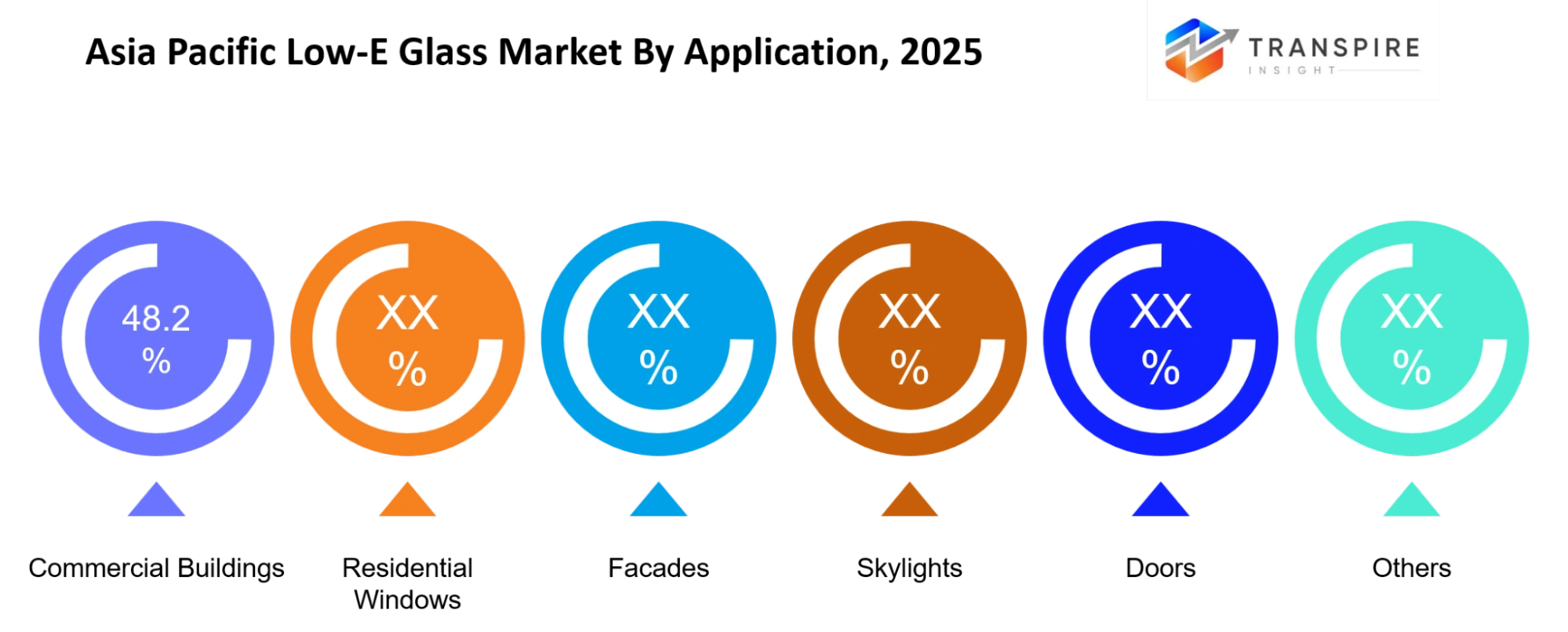
Building structures contribute to a significant portion of product usage owing to the growing popularity of energy-efficient glazing materials. Construction projects are making use of superior glass products to increase energy efficiency and decrease costs in the long term. Projects such as offices, hotels, and commercial buildings require special glazing materials to be used to ensure that sustainable operations are achieved.
Glazing in facades, skylights, and doors is expected to experience continuous growth because modern architecture places emphasis on using light through natural means while increasing efficiency. Infrastructure projects have become part of the glazing market owing to the need for high efficiency in order to improve efficiency. Refurbishment of existing buildings has become part of the market expansion owing to increased focus on reducing energy costs.
By End User:
The construction industry and real estate developers are among the major end users of energy-efficient products because of the considerable use of energy-efficient materials in their constructions. Advanced glazing is often used in large commercial projects as it helps fulfill energy requirements and gain certification as green buildings. Investment in commercial infrastructure ensures a constant demand for the product.
Projects belonging to institutional organizations and government departments are also among major applications of advanced glazing technology. Many airports, hospitals, schools, colleges, and government offices adopt advanced glazing to make their operations more efficient by minimizing energy utilization. Similarly, industrial units are increasingly adopting advanced glazing technology.
By Glass Type:
While single-glazed materials still have some applications due to economic reasons, market preferences have seen a change favoring more advanced systems that deliver better thermal benefits. Standards and regulations have been instrumental in affecting the purchase behavior of consumers within both residential and commercial domains.
Products such as double glazing and triple glazing have enjoyed wider usage in recent times owing to increased energy efficiency and comfort. The trend towards premium construction favors multi-layered glasses for achieving high performance in terms of heat flow reduction and acoustics. In addition, new coating technology is used to increase the efficacy of such glasses. Future investments in sustainable buildings will drive their usage.
What are the Key Use Cases Driving the Asia Pacific Low-E Glass Market?
The main application area for which adoption is driven in the Asia Pacific Low-E Glass Market is that of commercial construction. This refers to office towers, business parks, hotels, shopping malls, and other multi-purpose structures that require energy-efficient glass panes for reducing the cooling load, improving occupant comfort, and meeting energy efficiency codes that govern building design and operation. Given the volume of such buildings and large glass surface area involved, this forms the biggest source of demand.
The next emerging market segment involves residential high-rise buildings and institutional buildings including hospitals, educational institutions, and even airports. The property development companies as well as infrastructure agencies have been increasingly incorporating advanced glazing technologies in their designs to enhance energy performance and ensure optimal temperatures within buildings, while also meeting sustainability guidelines in most regions.
New use cases are also being identified, especially in net-zero buildings, smart cities, and advanced retrofits for older commercial buildings. Building owners have increasingly integrated advanced glazing into their plans as part of an effort to lower costs while meeting carbon reduction goals. While the scale may be much smaller, these markets present interesting possibilities going forward.
|
Report Metrics |
Details |
|
Market size value in 2025 |
USD 9.857 Billion |
|
Market size value in 2026 |
USD 10.458 Billion |
|
Revenue forecast in 2033 |
USD 16.036 Billion |
|
Growth rate |
CAGR of 6.3% from 2026 to 2033 |
|
Base year |
2025 |
|
Historical data |
2021 - 2024 |
|
Forecast period |
2026 - 2033 |
|
Report coverage |
Revenue forecast, competitive landscape, growth factors, and trends |
|
Regional scope |
Asia Pacific (India, China, Japan, Australia, South Korea, Rest of Asia Pacific) |
|
Key company profiled |
Saint-Gobain, AGC, NSG Group, Guardian Glass, Vitro, Sisecam, Central Glass, Xinyi Glass, CSG Holding, Taiwan Glass, Cardinal Glass, Fuyao Glass, SCHOTT, Corning, Nippon Sheet Glass |
|
Customization scope |
Free report customization (country, regional & segment scope). Avail customized purchase options to meet your exact research needs. |
|
Report Segmentation |
By Coating Type (Hard Coat, Soft Coat, Double Silver, Triple Silver, Solar Control, Passive Low-E, Others); By Application (Residential Windows, Commercial Buildings, Facades, Skylights, Doors, Others); By End User (Construction, Automotive, Industrial, Others); By Glass Type (Single, Double, Triple Glazed, Others) |
Which Regions are Driving the Asia Pacific Low-E Glass Market Growth?
East Asia dominates the market, with China playing the role of the key source of regional growth in terms of its demand. Regulations related to building energy efficiency, large-scale development programs in cities, and significant investments into environmentally friendly buildings promote rapid adoption of glazing solutions with advanced performance. Manufacturing centers, coating facilities, and efficient supply chains ensure the stable product delivery and innovations in the industry. Well-developed communities involving glass manufacturers, developers, architects, and regulatory authorities sustain regional leadership.
Oceania remains an important player in the market, but it is characterized by different market dynamics compared to East Asia. Countries like Australia and New Zealand can boast of stable construction processes, advanced building regulations, and commitment to energy efficiency in buildings. The growth rate of demand is supported by constant investments into office buildings, institutions, and luxury housing units without urban development initiatives. Reliable regulation enforcement and high-quality lifecycle building performance underlie the market revenue.
The South Asian region emerges as the most rapidly growing one, driven mainly by the rising construction industry in India. The recent growth is being driven by smart city projects, improved energy efficiency criteria, and investments into commercial infrastructures. The need for modern buildings that help cut down cooling costs amid the hot climatic environment owing to rapid urbanization has made the future very bright for manufacturers, coating technologies suppliers, and investors between 2026 and 2033.
Who are the Key Players in the Asia Pacific Low-E Glass Market and How Do They Compete?
Competitiveness in the Asia Pacific Low-E Glass Market is relatively high since a cluster of foreign giants controls most of the high-performing coated glass manufacturing processes. Technology sophistication and coating efficiency have become significant aspects of competition in the industry compared to prices especially in the commercial and institutional constructions projects. The major established competitors maintain their positions by constantly upgrading their coating processes, whereas regional players try to compete based on cost efficiencies and in emerging constructions markets. Efficiency in production, capacity, and regional network form the core of competition.
Saint-Gobain's competitiveness is rooted in technological innovations and energy efficiency. The company distinguishes itself with a diverse range of glazing products designed for various climatic environments. Development in this case includes expansion into regional manufacturing capacities and closer cooperation with architects and developers to ensure product specifications during large constructions projects. On the other hand, AGC is focused on utilizing technology to improve its products' solar control and thermal performance. Competitive advantage is achieved based on strong manufacturing capacity throughout the Asia region.
For instance, Guardian Glass produces coatings for its glass that have high performance properties meant to ensure proper balance between the transmission of light and heat. Customer service and glazed glass solutions tailored to specific projects promote customer relationships within complicated commercial projects. NSG Group has used its vast R&D capabilities to enhance the performance and durability of its coatings while participating in big infrastructure and green buildings projects.
Company List
- Saint-Gobain
- AGC
- NSG Group
- Guardian Glass
- Vitro
- Sisecam
- Central Glass
- Xinyi Glass
- CSG Holding
- Taiwan Glass
- Cardinal Glass
- Fuyao Glass
- SCHOTT
- Corning
- Nippon Sheet Glass
Recent Development News
Certainly. Here are the developments with the full source links included:
In August 2025, Saint-Gobain began construction of its seventh float glass line and fifth mineral wool insulation line in Oragadam, Chennai. The investment expands manufacturing capacity for high-value construction glass and strengthens regional supply capabilities for energy-efficient glazing products across Asia Pacific. Source:https://www.saint-gobain.co
In April 2026, AGC announced third-party verified Environmental Product Declarations (EPDs) for its Low-Carbon Pyrobel fire-resistant glass range. The certification provides verified environmental performance data and strengthens AGC’s position in low-carbon building materials for sustainable construction projects. Source:https://www.agc-glass.eu
In August 2025, Saint-Gobain committed approximately ₹3,400 crore toward new float glass and insulation manufacturing facilities near Chennai. The expansion increases production capacity, supports local manufacturing, and enhances the company's ability to serve growing demand for advanced construction glass solutions in India. Source:https://money.rediff.com
What Strategic Insights Define the Future of the Asia Pacific Low-E Glass Market?
Within the next five to seven years, the Asia Pacific Low-E Glass Market is anticipated to advance beyond the mere adoption of energy-efficient technologies and into performance-oriented glazing systems that can achieve reductions in operating costs and greenhouse gas emissions in buildings. The reason for such an expected trend is that the current market dynamics are characterized by the intersection of stringent building performance regulations, net-zero building requirements, and increased emphasis on asset efficiency on the part of investors. Therefore, coated glass will account for a bigger proportion of project specifications.
However, one of the threats to the market is the fact that advanced coatings are produced by relatively few companies. Thus, any interruptions in the supply of raw materials and coatings can be detrimental for the market as well as pricing pressures on advanced coatings in particular.
This is an emerging area in which opportunities are arising through building retrofit projects in India and Southeast Asia, as government authorities and building owners are looking for efficient ways to improve energy efficiency in existing structures. Market players need to build up capacity in coatings in this region as well as forge relationships with architects and facade experts.
Asia Pacific Low-E Glass Market Report Segmentation
By Coating Type
- Hard Coat
- Soft Coat
- Double Silver
- Triple Silver
- Solar Control
- Passive Low-E
- Others
By Application
- Residential Windows
- Commercial Buildings
- Facades
- Skylights
- Doors
- Others
By End User
- Construction
- Automotive
- Industrial
- Others
By Glass Type
- Single Glazed
- Double Glazed
- Triple Glazed
- Others
Frequently Asked Questions
Find quick answers to common questions.
The expected Asia Pacific Low-E Glass Market size for the market will be USD 16.036 Billion in 2033.
Key segments for the Asia Pacific Low-E Glass Market are By Coating Type (Hard Coat, Soft Coat, Double Silver, Triple Silver, Solar Control, Passive Low-E, Others); By Application (Residential Windows, Commercial Buildings, Facades, Skylights, Doors, Others); By End User (Construction, Automotive, Industrial, Others); By Glass Type (Single, Double, Triple Glazed, Others).
Major Asia Pacific Low-E Glass Market players are Saint-Gobain, AGC, NSG Group, Guardian Glass, Vitro, Sisecam, Central Glass, Xinyi Glass, CSG Holding, Taiwan Glass, Cardinal Glass, Fuyao Glass, SCHOTT, Corning, Nippon Sheet Glass.
The Asia Pacific Low-E Glass Market size is USD 9.857 billion in 2025.
The Asia Pacific Low-E Glass Market CAGR is 6.3% from 2026 to 2033.
- Saint-Gobain
- AGC
- NSG Group
- Guardian Glass
- Vitro
- Sisecam
- Central Glass
- Xinyi Glass
- CSG Holding
- Taiwan Glass
- Cardinal Glass
- Fuyao Glass
- SCHOTT
- Corning
- Nippon Sheet Glass
About the Authors

Pankaj Ghogare Patil
I am Pankaj Ghogare Patil, a Senior Research Analyst at Transpire Insight, specializing in the Pharmaceutical, Chemicals & Materials, Healthcare IT, and Biotechnology industry. My expertise lies in conducting comprehensive market research, analyzing industry trends, evaluating competitive landscapes, and translating complex data into actionable insights. At Transpire Insight, I closely follow emerging technologies, regulatory developments, and market innovations to create accurate, well-researched, and informative content that helps businesses and professionals make informed decisions. I am committed to producing credible, evidence-based articles that reflect industry best practices while making technical topics accessible and valuable for a broad audience.

Chakradhar Khansole
Chakradhar serves as the Research Director at Transpire Insight, bringing over 8 years of experience in technology, innovation, and strategic market intelligence. He specializes in transforming complex market data into actionable business insights that enable organizations to make informed, growth-oriented decisions. Recognized for his strategic vision and analytical expertise, Chakradhar leads high-impact research initiatives, delivering comprehensive market assessments, competitive intelligence, and forward-looking industry analysis.
Recently Published Reports
-
May 2026
Healthcare Polymer Packaging Market
Healthcare Polymer Packaging Market Size, Share & Analysis Report By Packaging Type (Syringes, IV Bottles and Pouches, Clamshells, Blisters, Bottles & Jars, Containers, Tubes, IV Parental Packaging, Others), By Type (Regulated, Non-regulated), By Polymer Type (LDPE (Low-Density Polyethylene), HDPE (High-Density Polyethylene), Homo-polymer (Homo), Random Copolymer (Random), Block Copolymer (Block), PET, Polystyrene, Polyvinyl Chloride, Polyamide/EVOH, Others), and Geography (North America, Europe, Asia-Pacific, Middle East and Africa, South and Central America), 2021 - 2031
-
Apr 2026
Hydrophilic Tape (Waterstop) Market
Hydrophilic Tape (Waterstop) Market Size, Share & Analysis Report By Type (Bentonite-Based Hydrophilic Tape, Rubber-Based Hydrophilic Tape), By Application (Residential Buildings, Commercial Buildings, Infrastructure Projects), and Geography (North America, Europe, Asia-Pacific, Middle East and Africa, South and Central America), 2021 - 2031
-
Apr 2026
Metalens Market
Metalens Market Size, Share & Analysis Report By Type (Visible Light Metalens, and Infrared Metalens), By Application (Consumer Electronics, Automotive Electronics, Industrial, Medical, and Others), and Geography (North America, Europe, Asia-Pacific, Middle East and Africa, South and Central America), 2021 - 2031
-
Apr 2026
PBT Resin Market
PBT Resin Market Size, Share & Analysis Report By Type (Reinforced PBT Resin, Unreinforced PBT Resin), By Processing Method (Injection Molding, Extrusion, Blow Molding, Others), By End-User (Automotive, Electrical & Electronics, Consumer Appliances, Industrial Machinery, Medical Devices, Packaging, Others), and Geography (North America, Europe, Asia-Pacific, Middle East and Africa, South and Central America), 2021 - 2031