
Asia Pacific Less-than-truckload Market Summary
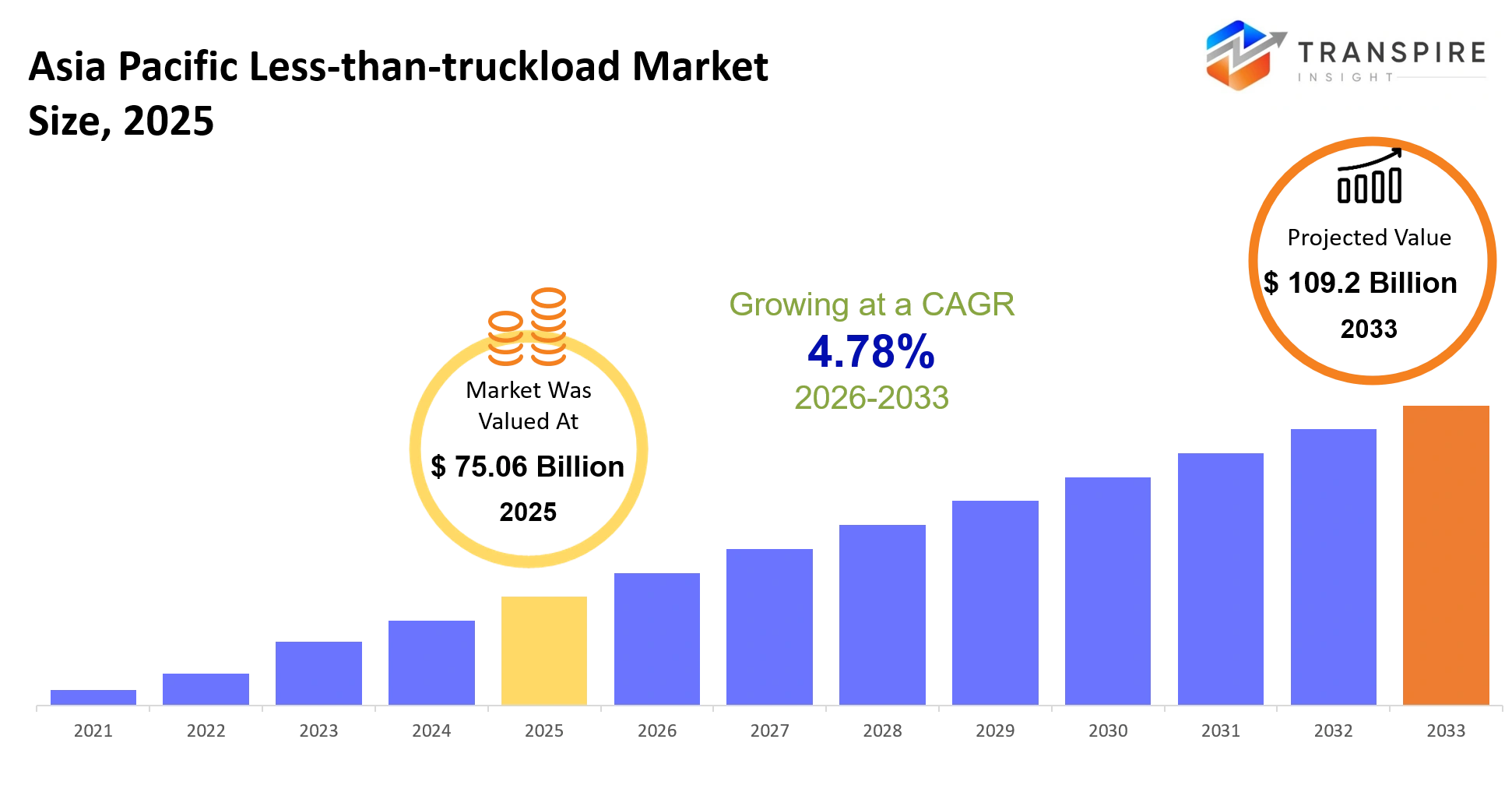
As per Transpire Insight Analysis the Asia Pacific Less-than-truckload Market size is estimated at USD 75.06 Billion in 2025 and is anticipated to reach USD 109.02 Billion by 2033, growing at a CAGR of 4.78% from 2026 to 2033.
The Asia Pacific Less-than-Truckload (LTL) market kind of lets businesses shuffle smaller freight consignments, without shelling out for a whole truck. So, manufacturers, retailers , healthcare providers, and e-commerce players can lower transportation costs while still keeping deliveries coming in more often. That shared-freight setup has sort of turned into a must-have for regional supply chains that want flexibility, plus quicker inventory refresh cycles.
Over the last five years, things have been slowly drifting toward digitally connected freight networks, you know, where AI based route planning, automated freight matching, and live shipment visibility kinda helps the whole operation run smoother, in a way. The COVID-19 pandemic meanwhile made it obvious where the older logistics networks kinda fell short, and it pushed companies to invest more heavily in resilient transport infrastructure plus warehouse automation, across the Asia Pacific area, kind of nonstop.
And yeah, as more businesses keep rolling out omnichannel distribution and just in time inventory tactics, LTL providers are also reaching out with bigger regional hubs. At the very same time they’re tying in digital freight platforms, and squeezing more value from their fleets, which then leads to steadier shipment volumes, better asset productivity, and continued revenue growth across the wider regional logistics ecosystem.
Asia Pacific Less-than-truckload Market Size & Forecast:
- Asia Pacific Less-than-truckload Market Size 2025: USD 75.06 Billion
- Expected Market Value 2033: USD 109.02 Billion
- Forecast CAGR: 4.78%
- Leading region in 2025:
- Fastest Growing region:
- Key Profile: FedEx Freight, XPO Logistics, DHL Supply Chain, UPS Supply Chain Solutions, DB Schenker, Kuehne+Nagel, DSV, Nippon Express, CEVA Logistics, CJ Logistics, Toll Group, Yamato Transport, SF Express, Kerry Logistics, Delhivery
Key Market Insights
- China kind of dominated the Asia Pacific Less-than-Truckload Market in 2025 with about 38% market share, and it is backed by broad manufacturing clusters, an express logistics network, plus really high domestic freight volumes.
- India meanwhile is projected to grow the fastest across the regional scene through 2033, mainly because GST enabled logistics consolidation is taking hold, highways keep expanding, and freight transportation is getting more organized.
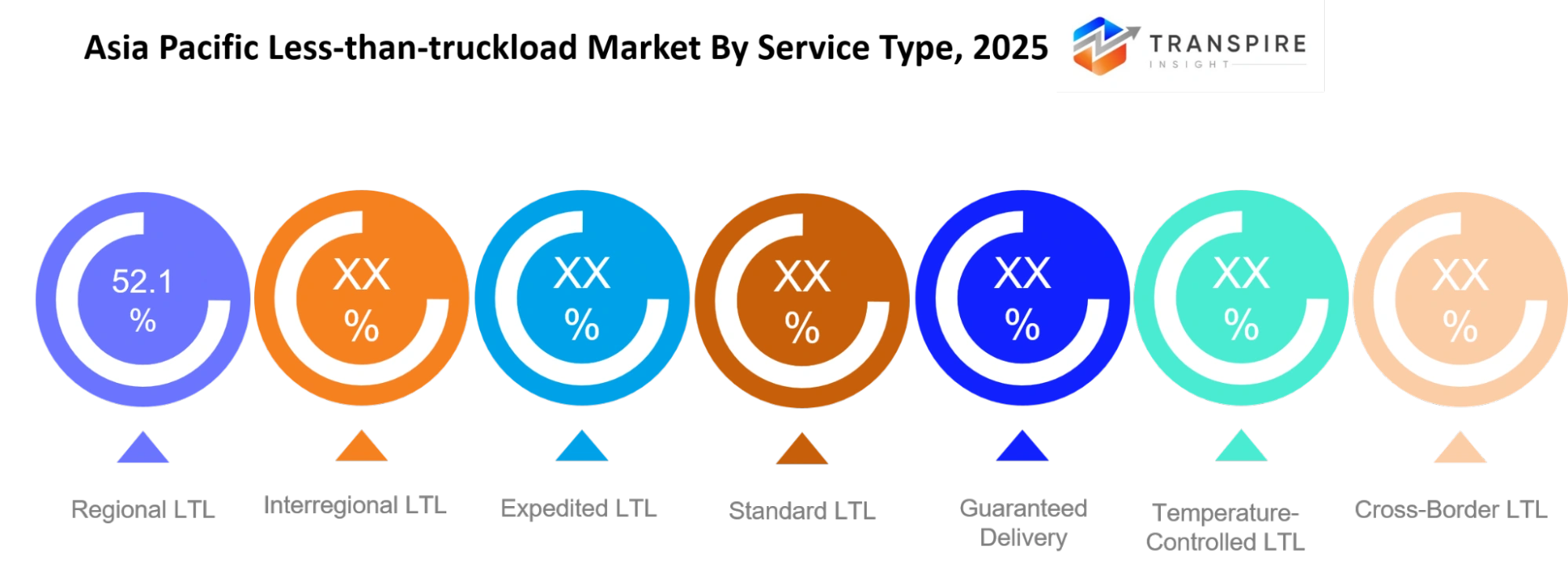
- In 2025, regional LTL services brought in nearly 42% of market revenue , which seems to align with dense industrial corridors and those shorter delivery cycles that customers tend to prefer.
- Interregional LTL stayed as the second biggest service segment too, hovering around 27% share, with help from expanding multimodal freight connectivity across Southeast Asia.
- Cross-border LTL services are expected to end up showing the quickest growth through 2033, and the drivers there are ASEAN trade integration along with customs digitization that keeps improving.
- For freight demand, retail and e-commerce together accounted for roughly 34% in 2025, showing more frequent shipments and a more decentralized fulfillment setup.
- Healthcare and pharmaceutical logistics are also emerging as, sort of, one of the fastest-growing application areas , especially where temperature sensitive deliveries matter and stricter delivery time constraints keep tightening.
- On the provider side, FedEx Freight, DHL Supply Chain, Nippon Express, DB Schenker, CEVA Logistics, and Yamato Transport are still investing in automated terminals, AI powered route optimization, and warehouse digitization.
- And bigger logistics players are increasingly going for strategic alliances, regional distribution hubs, and electric delivery fleets, to speed up delivery times while lowering operating costs, a combination they clearly like.
What are the Key Drivers, Restraints, and Opportunities in the Asia Pacific Less-than-truckload Market?
The strongest growth driver i s the rapid shifting of regional supply chains, kind of via e-commerce expansion , and then also manufacturing diversification too. Businesses end up moving smaller, more frequent orders rather than full truckloads, to back omnichannel retail better , plus decentralized inventory and those shorter replenishment cycles that people keep talking about. On top of that, government spending on logistics parks , expressways, and customs digitization across China , India, and parts of Southeast Asia has cut down transit delays even more, while also boosting freight efficiency. As transport networks get more interlinked through digital freight platforms and warehouse automation, carriers can reach higher truck utilization. Meanwhile shippers get steadier delivery reliability, which then supports bigger freight volumes and revenue generation.
Infrastructure disparities are still, honestly , the biggest structural problem for the market. Many developing economies keep dealing with broken up road networks , mismatched regulatory frameworks, urban congestion , and not enough warehouse capacity beyond the main industrial hubs. These conditions lead to more empty return trips, push operating costs upward, and make scheduling less efficient. And since infrastructure improvements need major public funding , plus longer project timelines , these bottlenecks keep slowing down network optimization. They also keep squeezing profitability for regional carriers, overall.
Artificial intelligence, digital freight exchanges, and electric commercial vehicles are likely the next major chance to expand market reach. Logistics operators are putting money into AI-enabled dispatch systems that automatically bundle shipments , tune routing, and predict delivery capacity.
What Has the Impact of Artificial Intelligence Been on the Asia Pacific Less-than-truckload Market?
Artificial intelligence and advanced digital technologies are, sort of, reshaping freight transportation across the Asia Pacific logistics sector in a deep way, mainly by bumping up planning accuracy, making fleet usage more efficient , and increasing shipment transparency. AI-enabled transportation management systems can kinda automatically group similar shipments , then fine tune delivery routes by pulling in live traffic signals, and also reassign freight space on the fly as customer demand keeps shifting around. Meanwhile machine learning models scan vehicle telemetry, engine diagnostics, tire behavior, and even maintenance records, to anticipate equipment breakdowns before they turn into a whole problem, this tends to lower idle time and supports steadier fleet readiness. Predictive demand can further help carriers stage trucks closer to where shipment volumes are likely to show up , so there’s less deadhead travel and overall better fuel economy.
Digital twins plus IoT sensors, along with cloud-based freight monitoring tools, let operators observe shipment conditions, delivery outcomes, and driver productivity in near real time. That usually improves customer service, and it also helps with more consistent regulatory adherence. Because of all this, there are clear operational wins—reduced transportation costs, stronger on-time delivery results, higher vehicle utilization, and better warehouse coordination.
However AI rollouts are not always smooth, adoption can get slowed by costly implementation work, messy legacy IT setups, uneven digital maturity among smaller transport firms, and inconsistent data quality across regional networks. Those hurdles can stretch integration timelines and can weaken the predictive models too, particularly for cross-border freight, where day to day operating conditions can change a lot from one place to the next.
Key Market Trends
- Since 2021, digital freight platforms have sorta ramped up shipment matching efficiency by a lot, which means fewer empty truck movements and better fleet use across regional logistics networks , not just in one corridor, or whatever.
- In 2025, China made up roughly 38% of regional freight revenue, powered by strong manufacturing output, upgraded logistics infrastructure, and those integrated transportation corridors that keep getting thicker over time.
- India is showing up as the fastest-growing LTL market through 2033, largely because of GST reforms, highway expansion, and quick warehouse growth , kinda all at once.
- Regional LTL services were about 42% of market revenue in 2025, suggesting more frequent shipments among manufacturing and retail businesses, rather than the occasional bulk run.
- Retail plus e-commerce, kind of together, were responsible for roughly 34% of freight volumes in 2025, which is pushing logistics firms to get better at last mile reach and regional distribution .
- At the same time these logistics companies are rolling out more AI guided route optimization, predictive upkeep, and automated dispatch systems, so deliveries stay on point,and the transport costs come down even when demand spikes without warning.
- You can see it in how providers like FedEx Freight, DHL Supply Chain, DB Schenker, Nippon Express, and CEVA Logistics keep expanding automated warehouses and digital freight management capability, with less hesitation than before.
- Meanwhile, cross border freight networks look steadier now, as ASEAN economies keep moving forward with customs digitization, which helps trade move quicker and also makes shipment consolidation a bit more efficient.
- Electric commercial vehicles and low-emission fleet investments have moved beyond pilot projects, toward broader commercial rollout by major logistics providers since 2023, in a more serious way.
- And competition has gradually shifted away from fleet size only, toward technology proficiency, real-time visibility, linked warehousing, and end to end digital logistics solutions, which is honestly harder to copy quickly.
Asia Pacific Less-than-truckload Market Segmentation
By Service Type
Regional LTL has the biggest share because local distribution routes, kind of keep that rhythm going, support frequent deliveries across industrial clusters , retail centers and urban markets. Interregional LTL links production hubs with consumption areas across different states and provinces, so long haul cargo moves with more efficiency. Expedited LTL is for those time sensitive loads where shorter transit schedules matter, while Standard LTL still gets picked a lot for routine freight, it keeps a good balance between cost and delivery timing . Guaranteed Delivery is there for firms that depend on fixed arrival schedules and dependable service reliability, no surprises.
Temperature-Controlled LTL is used when products need stable environmental conditions the whole way, think pharmaceuticals, and also food products. Cross-Border LTL helps international trade across nearby countries by grouping smaller shipments into consolidated loads , but still it has to handle customs procedures. Other service categories cover more specialized logistics needs, based on what the cargo is, how urgent it is, and what the customer-specific transport expectations look like, so carriers can serve a broader set of industries.
By Shipment Type
Palletized Freight is kinda the leading shipment category, because standardized loading helps with warehouse handling, better vehicle usage, and overall delivery speed. Parcel Freight basically fits smaller commercial shipments that come from online retail, plus business distribution networks that keep things moving. Hazardous Goods transportation then, has to follow strict safety rules for chemicals and industrial materials, while Refrigerated Freight keeps product quality by using controlled temperature systems that stay stable. Heavy Equipment transportation supports construction, mining, and infrastructure projects, where secure movement of oversized cargo is non‑negotiable.
Consumer Goods shipments help maintain product availability across retail stores and distribution centers, through regular replenishment cycles. Industrial Goods transportation supports manufacturing facilities with machinery, components, and production materials, these get moved between suppliers and factories. Other shipment categories include specialized cargo, which needs unusual packaging, careful handling methods, or different transport equipment, depending on operational needs.
By End User
Retail and E-commerce ends up with the biggest shipment volume, not surprisingly, since online purchasing and store replenishment keep asking for regular transport of smaller freight consignments, kind of a steady drumbeat. Manufacturing instead leans on scheduled freight movement, for raw materials, components, and then finished goods moving between production facilities. Automotive brands generally move spare parts, assemblies, and accessories, so production continuity stays intact, and also to keep the after-market supply available. Healthcare organizations lean heavily on dependable logistics for medical devices, laboratory supplies, and pharmaceutical products, because delays are a big deal.
Food and Beverage firms usually need consistent, scheduled transportation to support inventory across wholesalers, retailers, and restaurants. Chemical companies often depend on specialized freight services that follow safety rules for industrial materials and related handling. Industrial Equipment manufacturers move machinery and replacement components toward construction , mining, and production sites. Other end users can include agriculture, electronics, textiles, and a few additional commercial sectors, each with their own shifting transportation requirements that don’t really look the same everywhere.
By Booking Channel
Direct Contracts stay the go to booking channel, mostly because the long term agreements give more predictable pricing, reserved transportation capacity, and better day to day operational coordination. Freight Brokers act as the bridge between shippers and carriers that are actually available, and at the same time help raise vehicle utilization across regional freight corridors. Digital Freight Platforms make shipment matching simpler, with automated pricing, real time tracking, and booking that happens more quickly. Logistics Integrators bundle transportation, warehousing and inventory oversight into one combined logistics offering.
Third Party Logistics Providers deliver full supply chain coverage by leaning on transportation planning, plus freight management services. Online Booking systems let businesses schedule shipments fast without the usual manual paperwork, and that tends to improve operational efficiency pretty noticeably. Mobile Apps add convenience since they provide shipment tracking, booking notifications, and digital documentation straight from handheld devices. Other booking methods still matter too, they keep serving customers with specialized operational needs, or specific contractual requirements that don’t really fit the default workflow.
By Vehicle Type
Light commercial vehicles help with urban deliveries where shipment sizes are smaller, and the streets feel tight, so everything has to stay flexible. Medium trucks also step in for regional freight routes, kind of balancing how much you can haul with the day to day operating efficiency over short to medium stretches. Heavy trucks then move larger freight volumes between industrial centers and distribution hubs, and they do it while lowering the cost per shipment, which is the whole point. Refrigerated trucks keep temperatures controlled, so food products, pharmaceuticals, and other temperature sensitive goods can arrive without surprises.
Electric trucks are starting to get much broader acceptance. Logistics companies like them because fuel expenses shrink, and emission reduction targets get easier in metropolitan areas. Multi-axle trucks improve load distribution, letting fleets carry heavier freight across long-distance transportation corridors, even when the roads aren’t exactly friendly. Hybrid trucks mix conventional power with electric power systems, so fuel efficiency improves during mixed driving conditions, not just ideal routes. And then there are other vehicle categories that back specialized freight work, where the cargo task needs customized transportation equipment, or sometimes it needs a whole different setup.
What are the Key Use Cases Driving the Asia Pacific Less-than-truckload Market?
Retail distribution still seems like the biggest use case, mostly because the regular movement of smaller freight loads helps keep stores stocked and keeps online order fulfillment running, without really needing full truck capacity. Distribution centers, supermarkets , and e-commerce fulfillment facilities usually lean on scheduled deliveries so they can hold inventory steady while also keeping transportation costs under control.
In the meantime, healthcare logistics and manufacturing supply chains are still growing their use of shared freight services. Medical equipment suppliers, pharmaceutical distributors, automotive component manufacturers, and industrial production facilities depend on planned shipments. Those shipments help with inventory planning and they also support continuous production across multiple sites, which matters more than people think.
Cross-border trade and electric vehicle component logistics are also showing up as newer applications with pretty strong long-term potential. As customs digitalization expands across Southeast Asia , it supports consolidated international freight. At the same time, battery components, renewable energy equipment, and advanced electronics keep creating fresh transportation opportunities, so there’s a growing need for dependable regional freight networks.
|
Report Metrics |
Details |
|
Market size value in 2025 |
USD 75.06 Billion |
|
Market size value in 2026 |
USD 78.65 Billion |
|
Revenue forecast in 2033 |
USD 109.02 Billion |
|
Growth rate |
CAGR of 4.78% from 2026 to 2033 |
|
Base year |
2025 |
|
Historical data |
2021 - 2024 |
|
Forecast period |
2026 - 2033 |
|
Report coverage |
Revenue forecast, competitive landscape, growth factors, and trends |
|
Regional scope |
United States; Canada; Mexico; United Kingdom; Germany; France; Italy; Spain; Denmark; Sweden; Norway; China; Japan; India; Australia; South Korea; Thailand; Brazil; Argentina; South Africa; Saudi Arabia; United Arab Emirates |
|
Key company profiled |
FedEx Freight, XPO Logistics, DHL Supply Chain, UPS Supply Chain Solutions, DB Schenker, Kuehne+Nagel, DSV, Nippon Express, CEVA Logistics, CJ Logistics, Toll Group, Yamato Transport, SF Express, Kerry Logistics, Delhivery |
|
Customization scope |
Free report customization (country, regional & segment scope). Avail customized purchase options to meet your exact research needs. |
|
Report Segmentation |
By Service Type (Regional LTL, Interregional LTL, Expedited LTL, Standard LTL, Guaranteed Delivery, Temperature-Controlled LTL, Cross-Border LTL, Others); By Shipment Type (Palletized Freight, Parcel Freight, Hazardous Goods, Refrigerated Freight, Heavy Equipment, Consumer Goods, Industrial Goods, Others); By End User (Retail & E-commerce, Manufacturing, Automotive, Healthcare, Food & Beverage, Chemicals, Industrial Equipment, Others); By Booking Channel (Direct Contracts, Freight Brokers, Digital Freight Platforms, Logistics Integrators, Third-Party Logistics Providers, Online Booking, Mobile Apps, Others); By Vehicle Type (Light Commercial Vehicles, Medium Trucks, Heavy Trucks, Refrigerated Trucks, Electric Trucks, Multi-Axle Trucks, Hybrid Trucks, Others) |
Which Regions are Driving the Asia Pacific Less-than-truckload Market Growth?
China is basically leading the regional market, largely due to how massive manufacturing goes along with dense highway networks , plus well developed logistics parks and ports that are pretty world class, so the whole less-than-truckload freight system runs efficiently. On top of that , national funding for digital logistics platforms, intelligent transportation systems , and warehouse automation has helped freight consolidation work better and also made delivery times shorter on several big industrial corridors. Big fleets of commercial vehicles and serious enforcement of transportation regulations also back up dependable freight flows between places where production happens and where distribution is set up. And because there’s a mature mix of logistics providers , technology companies , and industrial clusters, the operational efficiency keeps improving, which helps sustain that leadership.
Japan comes in as the second-largest contributor, but the way it grows is kind of different, more based on operational stability than on fast expansion. There is strong money going into fleet modernization, plus high service quality expectations, and consistent infrastructure upkeep , so freight operations stay reliable even when the overall economy moves slower. Use of advanced warehouse management systems, along with long-term agreements between manufacturers and logistics providers, also keeps shipment volumes steadier through the whole year. Meanwhile, dependable domestic distribution routes and disciplined transportation habits keep generating consistent market revenue across both industrial and commercial sectors.
India is likely to be the fastest mover during the forecast period. The reason is that logistics reforms, expressway construction, and digital freight adoption have changed how efficiently freight transportation gets done.
Who are the Key Players in the Asia Pacific Less-than-truckload Market and How Do They Compete?
Competition is still pretty fragmented because global logistics companies keep showing up next to strong regional transport providers ,and they’ve got huge domestic networks. Cost efficiency matters a lot, but now technology adoption, regional reach, service reliability ,and digital shipment visibility feel more like the real differentiators. Most players continue to fund automated terminals, transportation management platforms, and combined warehousing setups, mostly to stretch fleet utilization and lower day-to-day operating expenses , kind of at the same time.
DHL Supply Chain sets itself apart with contract logistics that’s tightly integrated, warehouse automation, and then end-to-end supply chain orchestration that links transportation decisions to inventory planning. Nippon Express leans into high-value production, electronics, and healthcare movement ,using specialized handling measures, plus solid distribution reach throughout Japan and across Asia. Yamato Transport keeps an edge via dense last-mile delivery infrastructure and really frequent domestic freight services, aimed at retail and e-commerce customers.
DSV has broadened global transport capacity after acquiring DB Schenker, which gives it wider network coverage and stronger multimodal logistics abilities. Delhivery keeps pushing forward in domestic freight by putting money into automated sorting facilities, digital freight tools, and nationwide distribution infrastructure across India. Taken together, these approaches improve shipment visibility, operational efficiency, and overall network scale, while each company can still respond to different customer needs throughout the regional logistics market.
Company List
• FedEx Freight
• XPO Logistics
• DHL Supply Chain
• UPS Supply Chain Solutions
• DB Schenker
• Kuehne+Nagel
• DSV
• Nippon Express
• CEVA Logistics
• CJ Logistics
• Toll Group
• Yamato Transport
• SF Express
• Kerry Logistics
• Delhivery
Recent Development News
In April 2025, DSV completed the acquisition of DB Schenker. The transaction significantly expanded DSV's global transport and logistics network, strengthening freight forwarding and contract logistics capabilities across Asia Pacific and other regions.https://www.dsv.com
In April 2025, CEVA Logistics announced the acquisition of Borusan Tedarik. The USD 440 million agreement expanded CEVA's logistics footprint and enhanced road transportation and contract logistics capabilities across strategic international markets, including Asia-linked operations.https://www.cevalogistics.com
In April 2026, DHL Express appointed Herbert Vongpusanachai as Senior Vice President for Commercial in Asia Pacific. The leadership change supports regional commercial expansion and customer growth strategies across the Asia Pacific logistics network.https://www.dhl.com
What Strategic Insights Define the Future of the Asia Pacific Less-than-truckload Market?
The market is going to keep shifting, toward digitally linked freight ecosystems where artificial intelligence and predictive routing kind of works along with automated warehouses and integrated transportation platforms, they help operational efficiency instead of just leaning on fleet growth. At the same time supply chain diversification across India and Southeast Asia will open up new freight corridors, that back regional distribution and cross border logistics, even when things get complicated. There is also a risk that’s a bit less obvious, like market concentration rising, as the bigger logistics groups keep expanding via acquisitions, then competition becomes harder for smaller regional carriers who do not put much into technology investments.
On the brighter side, an emerging opportunity is AI enabled freight exchanges that can match shipment demand with available vehicle space in real time, especially across logistics markets that are still developing. So companies trying to enter should basically focus on digital freight management, expand regional warehousing, and use data driven transportation planning, to raise asset utilization, improve customer loyalty and build a long term edge that holds up.
Asia Pacific Less-than-truckload Market Report Segmentation
By Service Type
• Regional LTL
• Interregional LTL
• Expedited LTL
• Standard LTL
• Guaranteed Delivery
• Temperature-Controlled LTL
• Cross-Border LTL
• Others
By Shipment Type
• Palletized Freight
• Parcel Freight
• Hazardous Goods
• Refrigerated Freight
• Heavy Equipment
• Consumer Goods
• Industrial Goods
• Others
By End User
• Retail & E-commerce
• Manufacturing
• Automotive
• Healthcare
• Food & Beverage
• Chemicals
• Industrial Equipment
• Others
By Booking Channel
• Direct Contracts
• Freight Brokers
• Digital Freight Platforms
• Logistics Integrators
• Third-Party Logistics Providers
• Online Booking
• Mobile Apps
• Others
By Vehicle Type
• Light Commercial Vehicles
• Medium Trucks
• Heavy Trucks
• Refrigerated Trucks
• Electric Trucks
• Multi-Axle Trucks
• Hybrid Trucks
• Others
Frequently Asked Questions
Find quick answers to common questions.
The expected Asia Pacific Less-than-truckload Market size for the market will be USD 109.02 Billion in 2033.
Key segments for the Asia Pacific Less-than-truckload Market are By Service Type (Regional LTL, Interregional LTL, Expedited LTL, Standard LTL, Guaranteed Delivery, Temperature-Controlled LTL, Cross-Border LTL, Others); By Shipment Type (Palletized Freight, Parcel Freight, Hazardous Goods, Refrigerated Freight, Heavy Equipment, Consumer Goods, Industrial Goods, Others); By End User (Retail & E-commerce, Manufacturing, Automotive, Healthcare, Food & Beverage, Chemicals, Industrial Equipment, Others); By Booking Channel (Direct Contracts, Freight Brokers, Digital Freight Platforms, Logistics Integrators, Third-Party Logistics Providers, Online Booking, Mobile Apps, Others); By Vehicle Type (Light Commercial Vehicles, Medium Trucks, Heavy Trucks, Refrigerated Trucks, Electric Trucks, Multi-Axle Trucks, Hybrid Trucks, Others).
Major Asia Pacific Less-than-truckload Market players are FedEx Freight, XPO Logistics, DHL Supply Chain, UPS Supply Chain Solutions, DB Schenker, Kuehne+Nagel, DSV, Nippon Express, CEVA Logistics, CJ Logistics, Toll Group, Yamato Transport, SF Express, Kerry Logistics, Delhivery.
The Asia Pacific Less-than-truckload Market size is USD 75.06 Billion in 2025.
The Asia Pacific Less-than-truckload Market CAGR is 4.78% from 2026 to 2033.
• FedEx Freight
• XPO Logistics
• DHL Supply Chain
• UPS Supply Chain Solutions
• DB Schenker
• Kuehne+Nagel
• DSV
• Nippon Express
• CEVA Logistics
• CJ Logistics
• Toll Group
• Yamato Transport
• SF Express
• Kerry Logistics
• Delhivery
About the Authors

Mayur Shinde
I am Mayur Shinde, a Senior Research Analyst at Transpire Insight, specializing in the Automotive & Transportation and Information & Communication Technology (ICT) Industry. My work focuses on analyzing emerging market trends, technological advancements, competitive landscapes, and industry developments to deliver accurate, data-driven insights. I am passionate about transforming complex market information into clear, actionable content that helps businesses, professionals, and decision-makers stay informed and make confident strategic decisions.

Chakradhar Khansole
Chakradhar serves as the Research Director at Transpire Insight, bringing over 8 years of experience in technology, innovation, and strategic market intelligence. He specializes in transforming complex market data into actionable business insights that enable organizations to make informed, growth-oriented decisions. Recognized for his strategic vision and analytical expertise, Chakradhar leads high-impact research initiatives, delivering comprehensive market assessments, competitive intelligence, and forward-looking industry analysis.
Recently Published Reports
-
Apr 2026
ATV & UTV Market
ATV & UTV Market Size, Share & Analysis Report By Type (ATV, and UTV), By Variants (Less Than 400 CC, 400 CC To 800 CC, and More Than 800 CC), and Geography (North America, Europe, Asia-Pacific, Middle East and Africa, South and Central America), 2021 - 2031
-
Apr 2026
Automotive Central Gateway Module Market
Automotive Central Gateway Module Market Size, Share & Analysis Report By Type (Ethernet Central Gateway Module, CAN Central Gateway Module, LIN Central Gateway Module, and FlexRay), By Application (Powertrain Control, Body Control, Infotainment System, Advanced Driver Assistance Systems (ADAS), and Others), By End User (Passenger Vehicles, and Commercial Vehicles), and Geography (North America, Europe, Asia-Pacific, Middle East and Africa, South and Central America), 2021 - 2031
-
Apr 2026
Automotive Engine Oil Filter Market
Automotive Engine Oil Filter Market Size, Share & Analysis Report By Filter Type (Fuel Filter, Engine Oil Filter, Hydraulic Oil Filter, and Others), By Filter Media (Cellulose, Synthetic, and Micro), By Sales Channel (OEMs, and Aftermarket), By Vehicle Type (Passenger Cars, Light Commercial Vehicles, Heavy Duty Trucks, Buses and Coaches, and Off-road Vehicles), and Geography (North America, Europe, Asia-Pacific, Middle East and Africa, South and Central America), 2021 - 2031
-
Apr 2026
Automotive Parts Aluminium Die Casting Market
Automotive Parts Aluminium Die Casting Market Size, Share & Analysis Report By Production Process (Pressure Die Casting, Vacuum Die Casting, Squeeze Die Casting, Gravity Die Casting), By Application (Body Parts, Engine Parts, Transmission Parts, Battery And Related Components, Other Application Types), and Geography (North America, Europe, Asia-Pacific, Middle East and Africa, South and Central America), 2021 - 2031
Our Clients



