
Europe Electric Vehicle E-axle Market Size & Forecast:
- Europe Electric Vehicle E-axle Market Size 2025: USD 32.5 Billion
- Europe Electric Vehicle E-axle Market Size 2033: USD 113.8
- Europe Electric Vehicle E-axle Market CAGR: 16.88%
- Europe Electric Vehicle E-axle Market Segments: By Drive Type (Front E-Axle, Rear E-Axle, Integrated E-Axle, Others); By Vehicle Type (Passenger Cars, Commercial Vehicles, Buses, Others); By Component (Motor, Inverter, Transmission, Others); By Propulsion (Battery Electric Vehicles, Plug-in Hybrid Vehicles, Others); By Power Output (Below 100 kW, 100–250 kW, Above 250 kW, Others); By Sales Channel (OEM, Aftermarket, Others)
Europe Electric Vehicle E-axle Market Summary
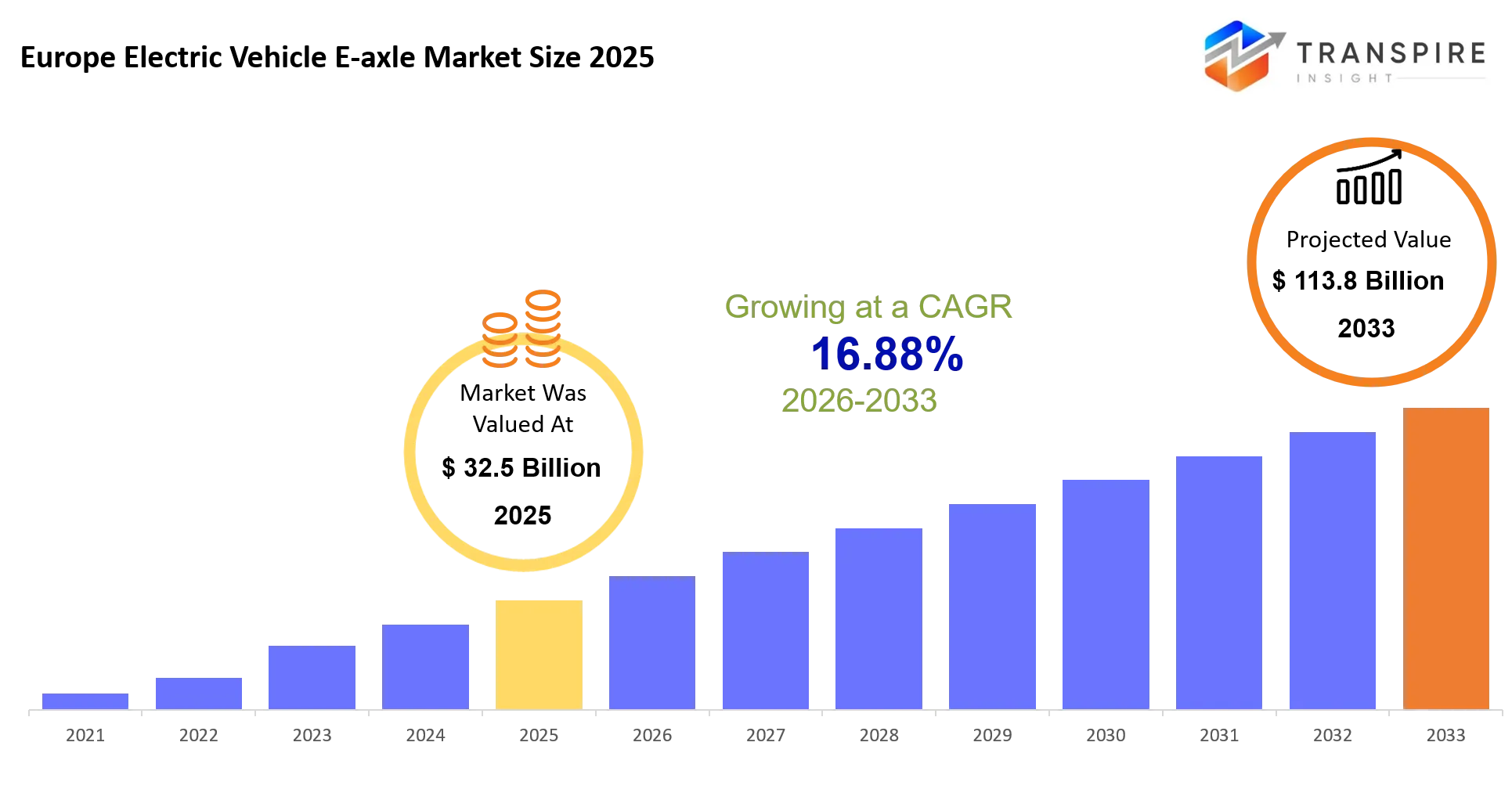
The Europe Electric Vehicle E-axle Market was valued at USD 32.5 billion in 2025. It is forecast to reach USD 113.8 billion by 2033. That is a CAGR of 16.88% over the period.
The Europe Electric Vehicle E-axle Market helps battery hybrid vehicles by combining the electric motor, transmission and power electronics into one small drive unit. This design makes vehicles lighter improves how well the drivetrain works frees up space inside the car and makes it easier for car makers to assemble vehicles. E-axles are important for making electric vehicles go further making it simpler to make vehicles and improving how well vehicles perform, which makes them a key part of electric mobility.
In the 3–5 years the market has changed from using separate electric drivetrain parts to using highly integrated E-axle systems that work better and cost less to make. The European Unions strict CO₂ emission rules and plans to stop selling internal combustion engine vehicles in some European countries led to more investment in electric vehicle platforms and local drivetrain manufacturing. Problems with the supply chain during the semiconductor shortage also made manufacturers want to get parts from suppliers and make production more reliable.
These changes have created chances for E-axle suppliers to make money as car makers use the same electric platforms for many different types of vehicles. More vehicles being made ongoing improvements in efficiency and closer work between car makers and drivetrain suppliers are lowering costs making E-axles widely used in electric passenger and commercial vehicles and helping the market grow in the long term. Electric vehicles and E-axles are becoming more popular. E-axle suppliers are benefiting from this trend. The Europe Electric Vehicle E-axle Market is growing. E-axles are a component in electric vehicles. They help make electric vehicles more efficient. E-axles are used in types of electric vehicles. The demand, for E-axles is increasing. E-axle suppliers are working closely with car makers. They are improving the efficiency of E-axles. E-axles are becoming more affordable. The Europe Electric Vehicle E-axle Market is expected to grow.
Key Market Insights
- The Europe Electric Vehicle E-axle Market is getting bigger because car makers are using electric drive systems that work together to make vehicles more efficient and easier to make.
- Germany has the part of the market because it has a lot of car factories good engineers and makes a lot of electric vehicles.
- Central and Eastern Europe are growing fast because new places that make electric vehicles are being built and companies are investing in these areas until 2033.
- The Europe Electric Vehicle E-axle systems that have everything in one unit are very popular because they put the motor, gearbox and power electronics together in an efficient package.
- The Europe Electric Vehicle E-axle Market is led by passenger battery vehicles because big car companies in Europe are making more of them.
- light commercial vehicles are growing really fast because companies that own a lot of vehicles want to stop polluting the air and meet the rules about emissions.
- Big companies like Bosch, ZF Friedrichshafen, GKN Automotive, Dana Incorporated and Schaeffler are making Europe Electric Vehicle E-axle systems by inventing new things and working together.
- Car makers are putting money into power electronics and lightweight parts for the Europe Electric Vehicle E-axle to make vehicles use less energy and go farther.
- The Europe Electric Vehicle E-axle suppliers and car makers are making long-term agreements to make sure they can make Europe Electric Vehicle E-axle systems in the region and make the supply chain stronger.
- The competition in the Europe Electric Vehicle E- Market is changing because companies want to make better software, for the drive systems make them more powerful and cheaper to make so they can sell more Europe Electric Vehicle E-axle systems in Europe.
What are the Key Drivers, Restraints, and Opportunities in the Europe Electric Vehicle E-axle Market?
Drivers
The main reason for the growth of the Europe Electric Vehicle E- Market is the European Unions strict CO₂ emission rules and the quick shift to battery electric vehicle platforms. Car makers are swapping drivetrain systems for integrated e-axle systems because they make Electric Vehicles more energy efficient, lighter and easier to assemble. E-axle systems help car makers meet emission rules and make profit. As more car platforms use integrated drivetrains E-axle suppliers benefit from higher production and long-term agreements.
Restraints
The biggest problem for the Europe Electric Vehicle E- Market is the reliance on rare materials and advanced semiconductor parts needed for motors, power electronics and permanent magnets. This is a challenge because it takes a lot of money and time to increase mining, refining and semiconductor production. If there are supply issues or price changes it costs more to make Electric Vehicles and delays production, which limits market growth even if people want to buy Electric Vehicles.
Opportunity
A big chance for growth is the use of 800-volt Electric Vehicle systems and silicon carbide power electronics, which make charging and drivetrains more efficient. Europe is investing in battery and Electric Vehicle production, especially in Central and Eastern Europe creating new chances, for suppliers. Companies that invest in E-axle systems software-controlled power management and local production partnerships will be more competitive and benefit from growing Electric Vehicle production.
What Has the Impact of Artificial Intelligence Been on the Europe Electric Vehicle E-axle Market?
The Europe Electric Vehicle E-axle Market is changing because of intelligence and new digital technologies. These technologies are making the design of Europe Electric Vehicle E-axle systems better. They are also making production more accurate. The Europe Electric Vehicle E-axle Market is also using intelligence to manage how well the electric drivetrains are working in real time.In factories artificial intelligence is helping to automate tasks like machining and gear alignment. This means that there are mistakes and the production lines can make more Europe Electric Vehicle E-axle systems. The Europe Electric Vehicle E-axle Market is also using something called twins to test the e-axle systems before they are actually made. This helps to make sure the Europe Electric Vehicle E-axle systems work well and do not break easily.
The Europe Electric Vehicle E-axle Market is using something called machine learning to help predict when parts of the e- system might break. This is done by looking at things like how torque the system is using and how hot it is getting. The Europe Electric Vehicle E-axle Market can use this information to fix problems before they happen which means that the vehicles are more likely to be working and less likely to break down. The people who run fleets of vehicles are also using this information to make their vehicles more efficient and to make the batteries last longer.
All of these technologies are making a big difference in the Europe Electric Vehicle E-axle Market. They are helping to reduce costs and make the e- systems last longer. The companies that make the Europe Electric Vehicle E-axle systems are seeing improvements, in how well their systems are working and how much energy they are using. However it is still hard to use these technologies because they are expensive and can be hard to integrate into the existing systems of the Europe Electric Vehicle E-axle Market.
Key Market Trends
- Since 2022 car makers have changed from using drivetrain parts to fully combined e-axle systems to meet tough EU rules on emissions.
- In 2024 and 2025 European car makers used e-axles 40% more in electric vehicle designs to make assembly easier and improve performance.
- In 2025 Bosch improved how they integrate power electronics in e-axles using silicon carbide, which makes electric vehicles energy efficient and better at managing heat.
- Companies like ZF Friedrichshafen increased production of e-axles from 2023 to 2026 to help make electric vehicles that can be used in many different models.
- After 2024 more car makers wanted e-axles with two motors because they wanted to make performance electric vehicles with all-wheel drive.
- Central and Eastern Europe got investments for making e-axles after 2023 because its cheaper to produce there and some companies moved their supply chains.
- By 2025 over 60% of electric vehicle designs used integrated e-axles instead of separate motor and transmission systems.
- After 2024 car makers started using software to control drivetrains, which helps optimize torque in time and improves energy efficiency.
- During the chip shortage from 2021 to 2023 manufacturers made long-term agreements to secure chip supplies for e-axle production.
- The competition, in e-axles changed to focus on systems that combine motors, electronics and smart software.
Europe Electric Vehicle E-axle Market Segmentation
By Drive Type
The front e-axle systems are really popular because they are small and do not cost a lot in vehicles that many people buy. The rear e-axles are still used a lot in cars that are made for speed and need to be good at sending power to the wheels. The integrated e-axle systems are the most common because car makers want to make cars that're small and use less energy. This makes the cars lighter and easier to put. As car makers start to make all their electric vehicles similar the demand for systems will keep going up. This is because these systems use energy and have fewer parts, which makes it easier to make a lot of them in Europe.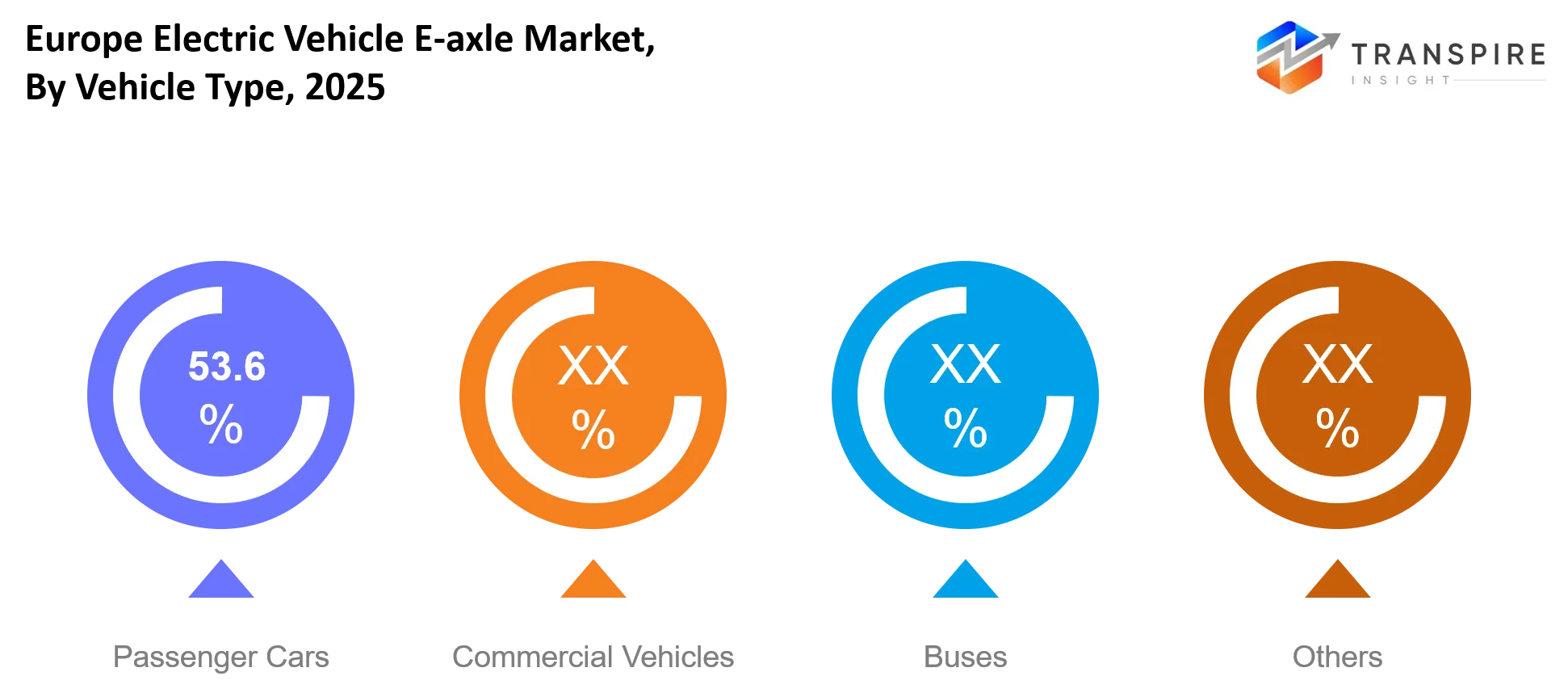
By Component
The motor components are the part of this because they are what make the car move by turning electricity into motion. The inverters are becoming more popular because they help the car use energy in a way and stay cool. The transmission systems are still very important because they help the car send power to the wheels in the way. New and better silicon carbide semiconductors are making the inverters work better and use less energy. As all the parts start to work it makes the system less complicated and easier to make.
By Propulsion
The battery electric vehicles are what people want the most because they do not make any pollution and many countries in Europe are making all cars electric. The plug-in hybrid vehicles are still good for places that do not have charging stations. More and more people are buying battery vehicles because the government is making rules to stop cars that use gas. Car makers are now designing cars that're only electric and have integrated e-axle systems. This means that car makers need to make parts that use less energy for these cars.
By Power Output
The cars that use 100 to 250 kilowatts of power are the common because they are good for regular electric vehicles. The cars that use than 100 kilowatts of power are good for small cars that are used in cities. The cars that use than 250 kilowatts of power are becoming more popular in expensive and fast electric vehicles. These cars need to be able to stay cool and use energy in a way. As people want cars that can go faster and are more fun to drive car makers have to make better e-axle systems.
By Sales Channel
Most e-axles are sold to car makers because they put them in the cars when they are made. The car makers work closely with the companies that make the parts to make sure the cars are good and work well. Some e-axles are sold to people who need to replace them in their cars. Not many. The car makers are working with the companies that make the parts to make long-term plans and design cars together. As all electric vehicles start to be similar the car makers are selling more e-axles, in Europe.
What are the Key Use Cases Driving the Europe Electric Vehicle E-axle Market?
The Europe Electric Vehicle E-axle Market is really driven by passenger vehicles. This is because car makers are making drivetrain units to make the Europe Electric Vehicle E-axle Market more efficient, lighter and to meet the very strict emission rules in the European Union. When car makers make a lot of these vehicles and use the basic design for many models it means they need more of these integrated e-axle systems for the Europe Electric Vehicle E-axle Market.
There are also areas where the Europe Electric Vehicle E-axle Market is growing, like in commercial vehicles that deliver goods and electric buses. This is happening because cities are making rules to reduce emissions and governments are helping to pay for programs that make vehicles electric. The people who run these fleets of vehicles are using e-axles because they save money use energy and are easier to take care of.
Some new areas where the Europe Electric Vehicle E-axle Market is starting to grow include performance electric vehicles and special vehicles that are not used on regular roads. This is especially true for electric vehicles and big machines used in industries. The Europe Electric Vehicle E-axle Market is also growing in areas, like car sharing and self-driving cars, where making the drivetrain smaller helps make the vehicle more flexible and better at managing energy.
|
Report Metrics |
Details |
|
Market size value in 2025 |
USD 32.5 Billion |
|
Market size value in 2026 |
USD 38.2 Billion |
|
Revenue forecast in 2033 |
USD 113.8 Billion |
|
Growth rate |
CAGR of 16.88% from 2026 to 2033 |
|
Base year |
2025 |
|
Historical data |
2021 - 2024 |
|
Forecast period |
2026 - 2033 |
|
Report coverage |
Revenue forecast, competitive landscape, growth factors, and trends |
|
Regional scope |
Europe |
|
Key company profiled |
Bosch, ZF Friedrichshafen, GKN Automotive, Dana Incorporated, Schaeffler, Magna International, Nidec, AVL, BorgWarner, Continental, Hitachi Astemo, Marelli, Vitesco Technologies, Hyundai Transys, AISIN |
|
Customization scope |
Free report customization (country, regional & segment scope). Avail customized purchase options to meet your exact research needs. |
|
Report Segmentation |
By Drive Type (Front E-Axle, Rear E-Axle, Integrated E-Axle, Others); By Vehicle Type (Passenger Cars, Commercial Vehicles, Buses, Others); By Component (Motor, Inverter, Transmission, Others); By Propulsion (Battery Electric Vehicles, Plug-in Hybrid Vehicles, Others); By Power Output (Below 100 kW, 100–250 kW, Above 250 kW, Others); By Sales Channel (OEM, Aftermarket, Others) |
Which Regions are Driving the Europe Electric Vehicle E-axle Market Growth?
The Europe Electric Vehicle E-axle Market is led by Western Europe because of its ability to make cars, its advanced development of Electric Vehicle platforms and its strict rules about emissions under the European Union policy frameworks. Countries like Germany and France are home to car makers and companies that make parts for cars, which helps to put e-axle systems together on a large scale. The fact that there are suppliers and a lot of money is being spent on researching electric mobility makes it easier to make things and leads to better technology. A lot of people in Western Europe are buying Electric Vehicles, which helps the region stay on top and creates a demand for systems that make cars move.
Southern Europe is in place thanks to more and more people buying Electric Vehicles and a growing network of charging stations in countries like Italy and Spain. This region is different from Western Europe because it focuses more on putting cars and using technology from other countries rather than making all the parts itself. The economy is stable. People are getting more interested in electric cars, which helps to create a steady demand. The government is also helping by giving incentives to companies that make cars and by implementing policies to reduce emissions in cities, which helps the market to keep growing and makes the region an important part of the overall European demand.
Eastern Europe is growing the fastest because many foreign companies are investing in making cars and many Electric Vehicle production facilities are being moved to this region. Countries like Poland, Hungary and the Czech Republic are attractive to suppliers because it is cheaper to make things and they are well connected to the rest of Europes supply chain. New policies to support mobility and modernize infrastructure have helped more people to buy Electric Vehicles. Between 2026 and 2033 this region will become a place for making e-axle systems offering advantages in terms of cost and opportunities for companies that make e-axle systems and car makers to work together. The Europe Electric Vehicle E-axle Market will benefit from this growth, in Eastern Europe.
Who are the Key Players in the Europe Electric Vehicle E-axle Market and How Do They Compete?
The Europe Electric Vehicle E-axle Market is made up of a few companies that have been around for a while and some new companies that are really good with technology. These new companies are trying to make the parts that make electric cars move more efficient and lighter. The big companies have been working with car makers for a time and are really good at making the parts that go into the cars.
The companies that can make all the parts that make the car move, like the motor and the transmission and put them together in a package are the ones that are doing well. Car makers want to make cars that are simpler and easier to make.Bosch is a company that's really good at making new technology. They are working on making the parts that control the motor and the transmission more efficient. This means that the cars can go further on a charge and do not get as hot. Bosch is working with car makers in Europe to make sure their parts are used in the electric cars.
ZF Friedrichshafen is another company that is doing well. They make parts that can be used in different types of cars from small cars to big trucks. They are good at making these parts in a way that's easy to assemble and can be changed easily if needed. ZF Friedrichshafen is working with car makers to make the generation of electric cars.Magna International is a company that's good at making parts cheaply and can work with many different types of cars. They have factories around the world and can get parts to car makers quickly. They are working with car makers in Europe to make parts, for cars that are not too expensive.
Company List
- ZF Friedrichshafen
- Dana Incorporated
- Nidec
- AVL
- BorgWarner
- Continental
- Hitachi Astemo
- Marelli
- Vitesco Technologies
- Hyundai Transys
- AISIN
Recent Development News
“In January 2026, ZF Friedrichshafen announced expansion of its e-drive and e-axle production capabilities through new electrified driveline manufacturing investments in Europe. The initiative strengthens ZF’s position in integrated electric axle systems and supports rising demand from European OEMs shifting toward high-efficiency EV platforms.”https://press.zf.com
“In December 2025, GKN Automotive expanded its global ePowertrain production footprint with additional capacity for integrated eDrive and e-axle systems across European supply chains. The move enhances delivery capability for next-generation electric drivetrains and reinforces its leadership in modular e-axle architecture for OEM platforms.”https://www.gknautomotive.com
“In November 2025, Schaeffler launched its dedicated 4-in-1 electric axle system integrating motor, transmission, power electronics, and thermal management for EV platforms. The launch strengthens Schaeffler’s competitiveness in compact, high-efficiency e-axle solutions for European electric vehicle manufacturers.”https://www.schaeffler.com
What Strategic Insights Define the Future of the Europe Electric Vehicle E-axle Market?
The Europe Electric Vehicle E-axle Market will move toward deeper system integration, where drivetrain, power electronics, and software controls merge into unified propulsion platforms. This shift is driven by tightening EU emission targets and OEM demand for simplified vehicle architectures that reduce cost and improve energy efficiency. Over the next 5–7 years, suppliers that cannot transition from component supply to full system integration will lose relevance as platform-based EV design becomes standard.
A key hidden risk lies in supply chain concentration for high-performance semiconductors and rare-earth materials used in motors and inverters. Any geopolitical disruption or export restriction could slow production despite strong vehicle demand, creating bottlenecks across multiple OEM programs. This dependency remains structurally difficult to resolve in the short term due to limited global processing capacity.
A strong emerging opportunity is localized gigafactory-linked drivetrain manufacturing in Eastern and Central Europe, where OEMs are clustering EV production. Suppliers that align with these hubs and invest in co-located e-axle assembly will gain cost and logistics advantages. Strategic focus should shift toward long-term OEM partnerships and scalable modular platforms that can adapt across multiple EV segments while maintaining efficiency and supply security.
Europe Electric Vehicle E-axle Market Report Segmentation
-
By Drive Type
- Front E-Axle
- Rear E-Axle
- Integrated E-Axle
- Others
-
By Vehicle Type
- Passenger Cars
- Commercial Vehicles
- Buses
- Others
-
By Component
- Motor
- Inverter
- Transmission
- Others
-
By Propulsion
- Battery Electric Vehicles
- Plug-in Hybrid Vehicles
- Others
-
By Power Output
- Below 100 kW
- 100–250 kW
- Above 250 kW
- Others
-
By Sales Channel
- OEM
- Aftermarket
- Others
Frequently Asked Questions
Find quick answers to common questions.
The Expected Europe Electric Vehicle E-axle Market size for the Market will be USD 113.8 Billion in 2033.
Key Segments for the Europe Electric Vehicle E-axle Market are By Drive Type (Front E-Axle, Rear E-Axle, Integrated E-Axle, Others); By Vehicle Type (Passenger Cars, Commercial Vehicles, Buses, Others); By Component (Motor, Inverter, Transmission, Others); By Propulsion (Battery Electric Vehicles, Plug-in Hybrid Vehicles, Others); By Power Output (Below 100 kW, 100–250 kW, Above 250 kW, Others); By Sales Channel (OEM, Aftermarket, Others).
Major Europe Electric Vehicle E-axle Market players are Bosch, ZF Friedrichshafen, GKN Automotive, Dana Incorporated, Schaeffler, Magna International, Nidec, AVL, BorgWarner, Continental, Hitachi Astemo, Marelli, Vitesco Technologies, Hyundai Transys, AISIN.
The Current Europe Electric Vehicle E-axle Market size is USD 32.5 Billion in 2025
The Europe Electric Vehicle E-axle Market CAGR is 16.88% from 2026 to 2033.
- Bosch
- ZF Friedrichshafen
- GKN Automotive
- Dana Incorporated
- Schaeffler
- Magna International
- Nidec
- AVL
- BorgWarner
- Continental
- Hitachi Astemo
- Marelli
- Vitesco Technologies
- Hyundai Transys
- AISIN
About the Authors

Mayur Shinde
I am Mayur Shinde, a Senior Research Analyst at Transpire Insight, specializing in the Automotive & Transportation and Information & Communication Technology (ICT) Industry. My work focuses on analyzing emerging market trends, technological advancements, competitive landscapes, and industry developments to deliver accurate, data-driven insights. I am passionate about transforming complex market information into clear, actionable content that helps businesses, professionals, and decision-makers stay informed and make confident strategic decisions.

Chakradhar Khansole
Chakradhar serves as the Research Director at Transpire Insight, bringing over 8 years of experience in technology, innovation, and strategic market intelligence. He specializes in transforming complex market data into actionable business insights that enable organizations to make informed, growth-oriented decisions. Recognized for his strategic vision and analytical expertise, Chakradhar leads high-impact research initiatives, delivering comprehensive market assessments, competitive intelligence, and forward-looking industry analysis.
Recently Published Reports
-
Apr 2026
ATV & UTV Market
ATV & UTV Market Size, Share & Analysis Report By Type (ATV, and UTV), By Variants (Less Than 400 CC, 400 CC To 800 CC, and More Than 800 CC), and Geography (North America, Europe, Asia-Pacific, Middle East and Africa, South and Central America), 2021 - 2031
-
Apr 2026
Automotive Central Gateway Module Market
Automotive Central Gateway Module Market Size, Share & Analysis Report By Type (Ethernet Central Gateway Module, CAN Central Gateway Module, LIN Central Gateway Module, and FlexRay), By Application (Powertrain Control, Body Control, Infotainment System, Advanced Driver Assistance Systems (ADAS), and Others), By End User (Passenger Vehicles, and Commercial Vehicles), and Geography (North America, Europe, Asia-Pacific, Middle East and Africa, South and Central America), 2021 - 2031
-
Apr 2026
Automotive Engine Oil Filter Market
Automotive Engine Oil Filter Market Size, Share & Analysis Report By Filter Type (Fuel Filter, Engine Oil Filter, Hydraulic Oil Filter, and Others), By Filter Media (Cellulose, Synthetic, and Micro), By Sales Channel (OEMs, and Aftermarket), By Vehicle Type (Passenger Cars, Light Commercial Vehicles, Heavy Duty Trucks, Buses and Coaches, and Off-road Vehicles), and Geography (North America, Europe, Asia-Pacific, Middle East and Africa, South and Central America), 2021 - 2031
-
Apr 2026
Automotive Parts Aluminium Die Casting Market
Automotive Parts Aluminium Die Casting Market Size, Share & Analysis Report By Production Process (Pressure Die Casting, Vacuum Die Casting, Squeeze Die Casting, Gravity Die Casting), By Application (Body Parts, Engine Parts, Transmission Parts, Battery And Related Components, Other Application Types), and Geography (North America, Europe, Asia-Pacific, Middle East and Africa, South and Central America), 2021 - 2031
Our Clients



