
Asia Pacific Laboratory Supplies Market Size & Forecast:
- Asia Pacific Laboratory Supplies Market Size 2025: USD 9.8 Billion
- Asia Pacific Laboratory Supplies Market Size 2033: USD 16.5 Billion
- Asia Pacific Laboratory Supplies Market CAGR: 6.82%
- Asia Pacific Laboratory Supplies Market Segments: By Product Type (Glassware, Plasticware, Reagents, Pipettes, Consumables, Chemicals, Filtration Products, Others); By Application (Research Laboratories, Clinical Diagnostics, Pharmaceutical Testing, Academic Research, Environmental Testing, Food Testing, Biotechnology Research, Others); By Distribution Channel (Direct Sales, Distributors, Online Channels, Specialty Suppliers, Procurement Contracts, Scientific Marketplaces, Retail Suppliers, Others); By End User (Hospitals, Research Institutes, Universities, Pharmaceutical Companies, Biotechnology Firms, Diagnostic Labs, Government Labs, Others)
Asia Pacific Laboratory Supplies Market Summary
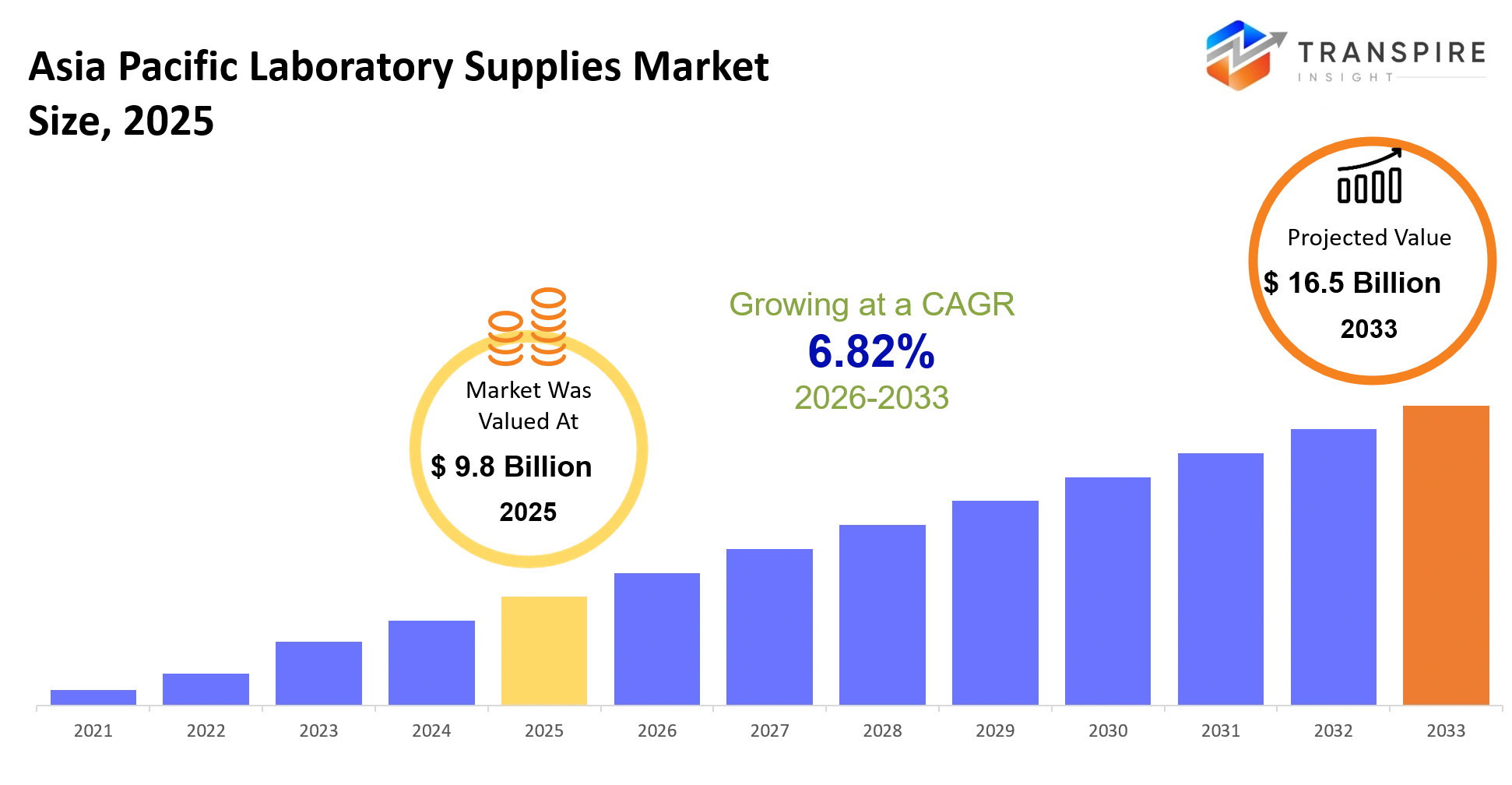
The Asia Pacific Laboratory Supplies Market was valued at USD 9.8 billion in 2025. It is forecast to reach USD 16.5 billion by 2033. That is a CAGR of 6.82% over the period.
The Asia Pacific Laboratory Supplies Market is really important for the work of pharmaceutical companies, biotechnology firms, diagnostic laboratories, research institutes, food testing facilities and industrial quality-control centers. They need things like laboratory consumables, reagents, sample handling products, filtration systems and analytical accessories to do their jobs properly. These things help them test things accurately, make sure products are good, follow rules and do research. If they do not have these things they will be delayed in their research, testing and making sure products are good.In the few years the market has changed a lot. Now people want to use machines to do laboratory work and test things fast. Laboratories are buying things that can be used with robots and computer systems. The COVID-19 pandemic was a reason for this change. It showed that we need to make sure we have medical supplies and that we should buy things from local companies.
Now the market is growing because more pharmaceutical products are being made, people are doing research on biologics and there are more clinical diagnostics and environmental testing programs in the region. As more tests are being done. Rules are getting stricter and organizations need more laboratory products that are certified. This means they will keep buying these products and companies that sell them will have a relationship with their customers and make money for a long time. The Asia Pacific Laboratory Supplies Market is really important for all these things to happen.
Key Market Insights
- The Asia Pacific Laboratory Supplies Market is mostly controlled by East Asia. It is expected to have over 40% share in 2025. This is because East Asia has a lot of pharmaceutical and diagnostics infrastructure.
- Southeast Asia is growing fast. It will be the growing market till 2033. This growth is because of investments in biotechnology, expansion of healthcare and modernization of laboratories.
- Reagents and consumables are the used supplies in laboratories. They make up over 35% of the market in 2025. This is because laboratories always need to do testing.
- Laboratory plastics and products for handling samples are the most used supplies. They are used a lot because many research facilities are doing testing.
- Consumables that work with automation are growing fast. More laboratories are using systems from 2026 to 2033. This is why this segment is growing.
- Clinical diagnostics is the use of laboratory supplies. It makes up 40% of the demand. This is because many disease screening programs are being started.
- Genomics and molecular testing are growing fast. They have been growing since 2021. This is because of precision medicine and sequencing initiatives.
- Pharmaceutical and biotechnology companies use the laboratory supplies. They are making drugs and biologics.
- Contract research organizations are growing fast. Many companies are outsourcing their work to laboratories in Asia.
- Companies like Thermo Fisher Scientific, Merck, Sartorius, Danaher, Agilent and Avantor are expanding. They are making products, automation technologies and working with other companies. They want to be leaders in the Asia Pacific Laboratory Supplies Market.
What are the Key Drivers, Restraints, and Opportunities in the Asia Pacific Laboratory Supplies Market?
Drivers
The main thing that is driving the Asia Pacific Laboratory Supplies Market is that pharmaceutical manufacturing, biologics development and clinical diagnostics capacity are all growing fast. This happened because governments and healthcare systems started investing more in research after the COVID-19 pandemic. At the time people started caring more about the quality of drugs, food and the environment so they did more laboratory tests. When you do tests you need to buy more things like reagents and laboratory equipment which means that companies that sell these things can make money regularly. This also encourages people to use better ways of doing things in laboratories.
Restraints
The biggest problem is that the region still relies much on importing special laboratory materials and equipment from other countries. This is a problem because making these things in the region is hard and requires a lot of money, expertise and approval from the government. When there are problems with getting these things it can cost money and slow down research. This means that smaller laboratories do not buy many things and new technology is adopted more slowly in developing countries.
Opportunity
There is a chance for growth in laboratories that use automation and digital connections. People are investing in robots that can do laboratory work and machines that can help with tests, which means that they need things that can work with these machines. Southeast Asia is a good place for growth because biotechnology, research and pharmaceutical production are all expanding, which means that laboratory suppliers will have new customers to sell to for a long time.
What Has the Impact of Artificial Intelligence Been on the Asia Pacific Laboratory Supplies Market?
Artificial intelligence and digital technologies are changing the way laboratories work by making things more efficient, accurate and better managed throughout the research and testing process. Laboratory information management systems that use intelligence can automatically track inventory register samples, monitor the use of reagents and schedule purchases. These systems can also find out when things are running low, ask for more to be ordered and make sure equipment is used in the way possible without anyone having to do it manually. This helps reduce the amount of work and helps laboratories keep testing going without any interruptions.
Machine learning is being used more and more to help with the maintenance of equipment like chromatography systems, spectrometers and automated liquid handlers. By looking at how these systems are performing, how they are vibrating, their calibration records and how they are being used it is possible to predict when they might fail before they actually do. Laboratories use this information to plan their testing schedules, keep their equipment running and reduce the cost of maintenance. Digital monitoring platforms also help make workflows better by finding out where things are slowing down and making sure resources are being used in the way possible across all the testing facilities.
These technologies make a difference by making things faster, reducing the amount of time equipment is not working, making sure quality standards are met and lowering costs. Laboratories that are automated can handle samples and do it more consistently which helps with research, clinical testing and biotechnology. However one big problem is that it costs a lot to get artificial intelligence working with the equipment laboratories already have. Many facilities also have trouble with data being all over the place and not having enough information from the past to make the predictive algorithms work well when they are first started.There is an opportunity for laboratories to become more automated and connected. More people are investing in laboratory robotics intelligence that helps with sample processing and high-throughput screening platforms, which means there will be a greater need for special supplies that are designed to work with automated systems. Southeast Asia is a good place for this because biotechnology, research and pharmaceutical production are all growing, which will create a long-term need for laboratory suppliers to provide what is needed.
Key Market Trends
- Since 2021 pharmaceutical makers have bought high-throughput consumables as biologics development programs grew in regional research centers.
- Labs now prefer automation- plastics and reagents moving away from manual workflows to robotic sample processing systems.
- From 2022 to 2025 regional buyers reduced reliance on single-source imports. Diversified their supplier networks after supply chain issues.
- Regulatory agencies tightened quality and traceability rules leading to use of certified lab consumables and validated testing materials.
- Thermo Fisher Scientific, Merck and Sartorius increased distribution capabilities to cut delivery times and improve inventory availability.
- Genomics and molecular diagnostics labs have increased use since precision medicine initiatives got more funding in healthcare systems.
- Digital lab management platforms are now more common allowing real-time inventory tracking and reducing procurement inefficiencies.
- Contract research organizations now outsource sourcing through strategic supplier deals making longer-term purchasing commitments.
- Manufacturers have invested more in packaging and waste-reduction programs since 2023 as labs focus on efficiency targets.
- Competition now focuses on integrated service offerings, not product availability with technical support, logistics reliability and digital tools setting companies apart.
Asia Pacific Laboratory Supplies Market Segmentation
By Product Type
Laboratories need Glassware for doing tests and getting samples ready because it lasts a long time and can handle chemicals. Plasticware is good for testing because it is cheap and can be thrown away which helps prevent contamination. Reagents are very important for diagnosing diseases, testing medicines and doing biotechnology work because they need to work the same every time. Pipettes are still used a lot in laboratories for handling amounts of liquid very precisely.Laboratories have to buy Consumables all the time because they need them to do their work. Chemicals are used for testing, making products and checking quality in many industries. Filtration products help keep samples clean and make sure tests are accurate. As laboratories start using automation and do more tests they will need more of all these products, which will help companies that sell them.
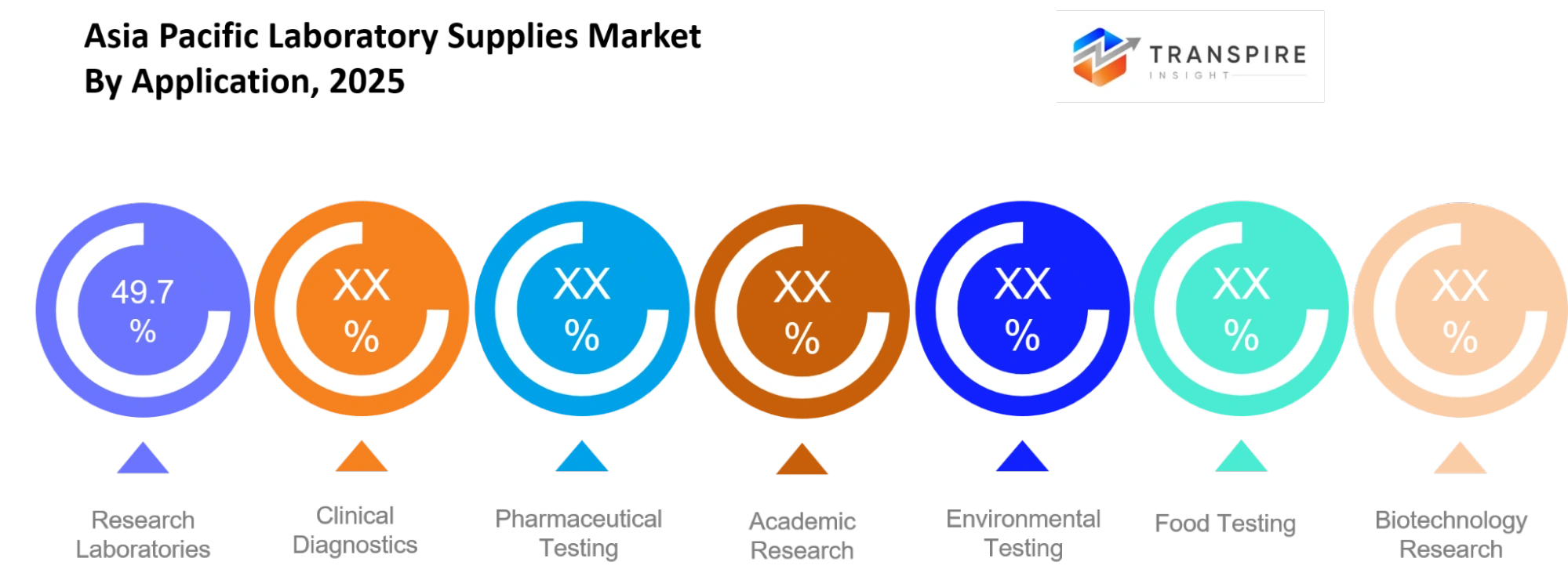
By Application
Research laboratories are a part of this because they do a lot of experiments and develop new products. Clinical diagnostics is important for finding diseases, checking on patients and helping doctors make decisions. Testing medicines is necessary for making sure they are safe and work well. Universities also need laboratory supplies for their projects and research.Checking the environment is becoming more important as governments make rules to keep air, water and soil clean. Food testing laboratories need supplies to make sure food is safe. Does not get contaminated. Biotechnology research also needs laboratory supplies for studying genes, cells and making medicines. As healthcare and life science programs get better more laboratories will need these supplies.
By Distribution Channel
Some companies sell their products directly to organizations that need special help and customized agreements. Distributors sell products and can deliver them to laboratories all over the world. Online stores are becoming popular because they make it easy to buy products and get them quickly. Some suppliers specialize in selling products for types of testing.Companies can sign contracts to buy products for a time, which helps them plan and save money. There are also websites that sell products from companies making it easy for laboratories to find what they need. Some stores sell products to laboratories that need them right away. Companies that sell laboratory supplies will focus on making their websites better, delivering products faster and making sure they can always get the products they need.
By End User
Hospitals need laboratory supplies to do tests, diagnose diseases and take care of patients. Research institutes need high-quality supplies to do their work. Universities need supplies for teaching, training and research. Pharmaceutical companies need laboratory products to develop and test medicines.Biotechnology companies need supplies for their research. Diagnostic laboratories need to buy supplies all the time because they do tests. Government laboratories do tests to keep people healthy and safe and to check on the environment. As hospitals and research centers grow they will need laboratory supplies, which will help companies that sell them.
What are the Key Use Cases Driving the Asia Pacific Laboratory Supplies Market?
Diagnostics is the reason why laboratories use so many supplies. Every day hospitals and laboratories do a lot of blood tests, check for diseases, look at tissues and do health checks.
This means they always need things like test kits, materials to handle samples and other stuff. So diagnostics is the reason why laboratories spend money on supplies.
Some other places that use laboratory supplies are companies that make medicine and do research on living things. These companies need supplies to test how well their medicines work, make sure they are safe and check their quality. They also need supplies to help them study genes, look at cells and develop new treatments.There are some areas where laboratory supplies are being used, like personalized medicine and advanced diagnostics. More people are using machines to look at genes and develop personalized treatment plans. This means laboratories need materials and ways of doing things. Also governments are making rules to check the quality of water and air and to make sure companies are not polluting. This will help laboratories that do testing and it will be good, for a long time.
|
Report Metrics |
Details |
|
Market size value in 2025 |
USD 9.8 Billion |
|
Market size value in 2026 |
USD 10.4 Billion |
|
Revenue forecast in 2033 |
USD 16.5 Billion |
|
Growth rate |
CAGR of 6.82% from 2026 to 2033 |
|
Base year |
2025 |
|
Historical data |
2021 - 2024 |
|
Forecast period |
2026 - 2033 |
|
Report coverage |
Revenue forecast, competitive landscape, growth factors, and trends |
|
Regional scope |
Asia Pacific |
|
Key company profiled |
Thermo Fisher Scientific, Merck, VWR, Corning, Eppendorf, Sartorius, Agilent, Bio-Rad, Danaher, Avantor, Qiagen, PerkinElmer, Shimadzu, Waters, Mettler Toledo |
|
Customization scope |
Free report customization (country, regional & segment scope). Avail customized purchase options to meet your exact research needs. |
|
Report Segmentation |
By Product Type (Glassware, Plasticware, Reagents, Pipettes, Consumables, Chemicals, Filtration Products, Others); By Application (Research Laboratories, Clinical Diagnostics, Pharmaceutical Testing, Academic Research, Environmental Testing, Food Testing, Biotechnology Research, Others); By Distribution Channel (Direct Sales, Distributors, Online Channels, Specialty Suppliers, Procurement Contracts, Scientific Marketplaces, Retail Suppliers, Others); By End User (Hospitals, Research Institutes, Universities, Pharmaceutical Companies, Biotechnology Firms, Diagnostic Labs, Government Labs, Others) |
Which Regions are Driving the Asia Pacific Laboratory Supplies Market Growth?
East Asia holds the largest share of the Asia Pacific Laboratory Supplies Market due to its strong pharmaceutical manufacturing base, extensive biotechnology research activity, and large network of clinical testing facilities. Government-backed investments in life sciences, advanced healthcare infrastructure, and domestic laboratory production capabilities have strengthened demand for laboratory consumables and analytical materials. A mature ecosystem of research institutes, universities, contract research organizations, and pharmaceutical manufacturers supports continuous procurement activity. Strong regulatory oversight and sustained spending on scientific innovation further reinforce regional leadership.
Oceania represents a smaller but highly stable market supported by consistent healthcare expenditure, established research programs, and well-developed quality standards. Unlike East Asia, growth relies less on manufacturing scale and more on steady investment in clinical diagnostics, academic research, and environmental testing. Laboratories in the region prioritize premium-quality products, regulatory compliance, and long-term supplier relationships. This approach creates predictable purchasing patterns and provides a dependable contribution to overall regional revenue.
Southeast Asia is emerging as the fastest-growing region due to expanding pharmaceutical production, rising healthcare investments, and growing biotechnology activity. Several governments have increased support for domestic research capabilities and laboratory modernization initiatives during the past few years. New manufacturing facilities, diagnostic centers, and research partnerships have accelerated procurement of laboratory materials and testing supplies. Growth across this region will create attractive opportunities for suppliers, distributors, and investors seeking exposure to expanding healthcare and life sciences infrastructure between 2026 and 2033.
Who are the Key Players in the Asia Pacific Laboratory Supplies Market and How Do They Compete?
The Asia Pacific Laboratory Supplies Market features moderate consolidation, with global suppliers competing alongside regional distributors and specialized manufacturers. Competition centers on product quality, technical support, distribution efficiency, and the ability to provide complete laboratory workflow solutions rather than standalone products. Established companies continue to defend market share through broad product portfolios and integrated service offerings, while smaller firms target niche research applications and cost-sensitive laboratory segments. Digital procurement capabilities, supply chain reliability, and regulatory compliance have become important differentiators as laboratories seek dependable long-term suppliers.Thermo Fisher Scientific focuses on technology integration by combining laboratory consumables, analytical instruments, and digital workflow solutions within a single ecosystem. This approach reduces procurement complexity for pharmaceutical and research customers. Merck differentiates through specialized reagents, chemicals, and life science materials that support advanced research applications where consistency and purity are critical. Sartorius strengthens its position through expertise in bioprocessing and cell culture workflows, allowing biotechnology companies to streamline research and production activities.
Agilent concentrates on analytical laboratory environments by pairing testing supplies with chromatography and spectroscopy platforms that improve workflow compatibility. Bio-Rad maintains a strong presence in molecular biology and clinical diagnostics through specialized assays and quality control products that support accurate testing outcomes. Avantor expands through strategic distribution partnerships and localized supply networks, helping laboratories secure faster product availability and reducing procurement disruptions across growing healthcare and research markets.
Company List
- Thermo Fisher Scientific
- Merck
- VWR
- Corning
- Eppendorf
- Sartorius
- Agilent
- Bio-Rad
- Danaher
- Avantor
- Qiagen
- PerkinElmer
- Shimadzu
- Waters
- Mettler
- Toledo
Recent Development News
In July 2025, Sartorius completed acquisition of MatTek Corp and Visikol Inc. The acquisition expanded Sartorius’ laboratory products portfolio in cell technology, reagents, and advanced drug development solutions, strengthening capabilities for life science research and laboratory applications.https://www.webdisclosure.com
In July 2025, Sartorius Stedim Biotech entered a partnership with Sensible Biotechnologies. The collaboration supports industrial-scale development of cell-based mRNA manufacturing platforms and increases demand for specialized laboratory consumables, equipment, and process development solutions.https://www.sartorius.com
In August 2025, Sartorius Stedim Biotech entered a partnership with Nanotein Technologies and invested up to USD 3 million through a minority shareholding. The agreement supports commercialization of advanced cell therapy reagents and strengthens the supply ecosystem for biopharmaceutical research and laboratory testing workflows.https://www.sartorius.com
What Strategic Insights Define the Future of the Asia Pacific Laboratory Supplies Market?
The Asia Pacific Laboratory Supplies Market is moving toward highly automated, data-driven laboratory environments where procurement, testing workflows, and inventory management operate as integrated systems. The underlying force behind this transition is the rapid expansion of biopharmaceutical research, molecular diagnostics, and precision medicine programs that require consistent access to specialized reagents, consumables, and analytical materials. Over the next five to seven years, suppliers that support automated and high-throughput laboratory operations will capture a larger share of spending.A less visible risk lies in market concentration across critical raw materials and specialized reagent manufacturing. Dependence on a limited number of suppliers could create supply disruptions, pricing pressure, and procurement delays even when overall demand remains strong. Such constraints may affect laboratory productivity more significantly than short-term economic fluctuations.
An emerging opportunity is the growth of laboratory automation consumables designed for robotic platforms and AI-assisted testing systems, particularly within expanding biotechnology clusters. Market participants should invest in localized production and distribution networks while developing automation-compatible product portfolios. This approach will improve supply resilience, strengthen customer retention, and position suppliers to benefit from the next phase of laboratory modernization across the region.
Asia Pacific Laboratory Supplies Market Report Segmentation
By Product Type
- Glassware
- Plasticware
- Reagents
- Pipettes
- Consumables
- Chemicals
- Filtration Products
- Others
By Application
- Research Laboratories
- Clinical Diagnostics
- Pharmaceutical Testing
- Academic Research
- Environmental Testing
- Food Testing
- Biotechnology Research
- Others
By Distribution Channel
- Direct Sales
- Distributors
- Online Channels
- Specialty Suppliers
- Procurement Contracts
- Scientific Marketplaces
- Retail Suppliers
- Others
By End User
- Hospitals
- Research Institutes
- Universities
- Pharmaceutical Companies
- Biotechnology Firms
- Diagnostic Labs
- Government Labs
- Others
Frequently Asked Questions
Find quick answers to common questions.
The expected Asia Pacific Laboratory Supplies Market size for the market will be USD 16.5 Billion in 2033.
Key segments for the Asia Pacific Laboratory Supplies Market are By Product Type (Glassware, Plasticware, Reagents, Pipettes, Consumables, Chemicals, Filtration Products, Others); By Application (Research Laboratories, Clinical Diagnostics, Pharmaceutical Testing, Academic Research, Environmental Testing, Food Testing, Biotechnology Research, Others); By Distribution Channel (Direct Sales, Distributors, Online Channels, Specialty Suppliers, Procurement Contracts, Scientific Marketplaces, Retail Suppliers, Others); By End User (Hospitals, Research Institutes, Universities, Pharmaceutical Companies, Biotechnology Firms, Diagnostic Labs, Government Labs, Others).
Major Asia Pacific Laboratory Supplies Market players are Thermo Fisher Scientific, Merck, VWR, Corning, Eppendorf, Sartorius, Agilent, Bio-Rad, Danaher, Avantor, Qiagen, PerkinElmer, Shimadzu, Waters, Mettler Toledo.
The Asia Pacific Laboratory Supplies Market size is USD 9.8 Billion in 2025.
The Asia Pacific Laboratory Supplies Market CAGR is 6.82% from 2026 to 2033.
- Thermo Fisher Scientific
- Merck
- VWR
- Corning
- Eppendorf
- Sartorius
- Agilent
- Bio-Rad
- Danaher
- Avantor
- Qiagen
- PerkinElmer
- Shimadzu
- Waters
- Mettler
- Toledo
About the Authors

Pankaj Ghogare Patil
I am Pankaj Ghogare Patil, a Senior Research Analyst at Transpire Insight, specializing in the Pharmaceutical, Chemicals & Materials, Healthcare IT, and Biotechnology industry. My expertise lies in conducting comprehensive market research, analyzing industry trends, evaluating competitive landscapes, and translating complex data into actionable insights. At Transpire Insight, I closely follow emerging technologies, regulatory developments, and market innovations to create accurate, well-researched, and informative content that helps businesses and professionals make informed decisions. I am committed to producing credible, evidence-based articles that reflect industry best practices while making technical topics accessible and valuable for a broad audience.

Chakradhar Khansole
Chakradhar serves as the Research Director at Transpire Insight, bringing over 8 years of experience in technology, innovation, and strategic market intelligence. He specializes in transforming complex market data into actionable business insights that enable organizations to make informed, growth-oriented decisions. Recognized for his strategic vision and analytical expertise, Chakradhar leads high-impact research initiatives, delivering comprehensive market assessments, competitive intelligence, and forward-looking industry analysis.
Recently Published Reports
-
Apr 2026
AI in Diabetic Retinopathy Market
AI in Diabetic Retinopathy Market Size, Share & Analysis Report By Type (Screening AI Systems, Diagnostic AI Systems, and Predictive AI Models), By Application Segment (Hospitals, Ophthalmology Clinics, Diagnostic Centers, and Research and Development), and Geography (North America, Europe, Asia-Pacific, Middle East and Africa, South and Central America), 2021 - 2031
-
Apr 2026
Psychometric Tests Market
Psychometric Tests Market Size, Share & Analysis Report By Type (Personality Tests, Ability/Aptitude Tests, Skill/Knowledge Tests, and Others), By Application (Talent Acquisition and Talent Management), and Geography (North America, Europe, Asia-Pacific, Middle East and Africa, South and Central America), 2021 – 2031
-
Apr 2026
Rare Biological Sample Collection Market
Rare Biological Sample Collection Market Size, Share & Analysis Report By Type (Isolation Kits & Reagent, Blood Collection Tubes, and Others), By Application (Oncology, Transcriptomics, Pharmacogenomics, and Others), and Geography (North America, Europe, Asia-Pacific, Middle East and Africa, South and Central America), 2021 – 2031
-
Jul 2026
Diabetic Retinopathy Market
Diabetic Retinopathy Market Size, Share & Analysis Report By Type (Proliferative Diabetic Retinopathy, and Diabetic Macular Edema (DME)), By Treatment Type (Anti VEGF Drug, Steroid Implants, Laser Surgeries, and Vitrectomy), and Geography (North America, Europe, Asia-Pacific, Middle East and Africa, South and Central America), 2021 – 2031
Our Clients







