
Asia Pacific Intrusion Detection And Prevention Systems Market Size & Forecast:
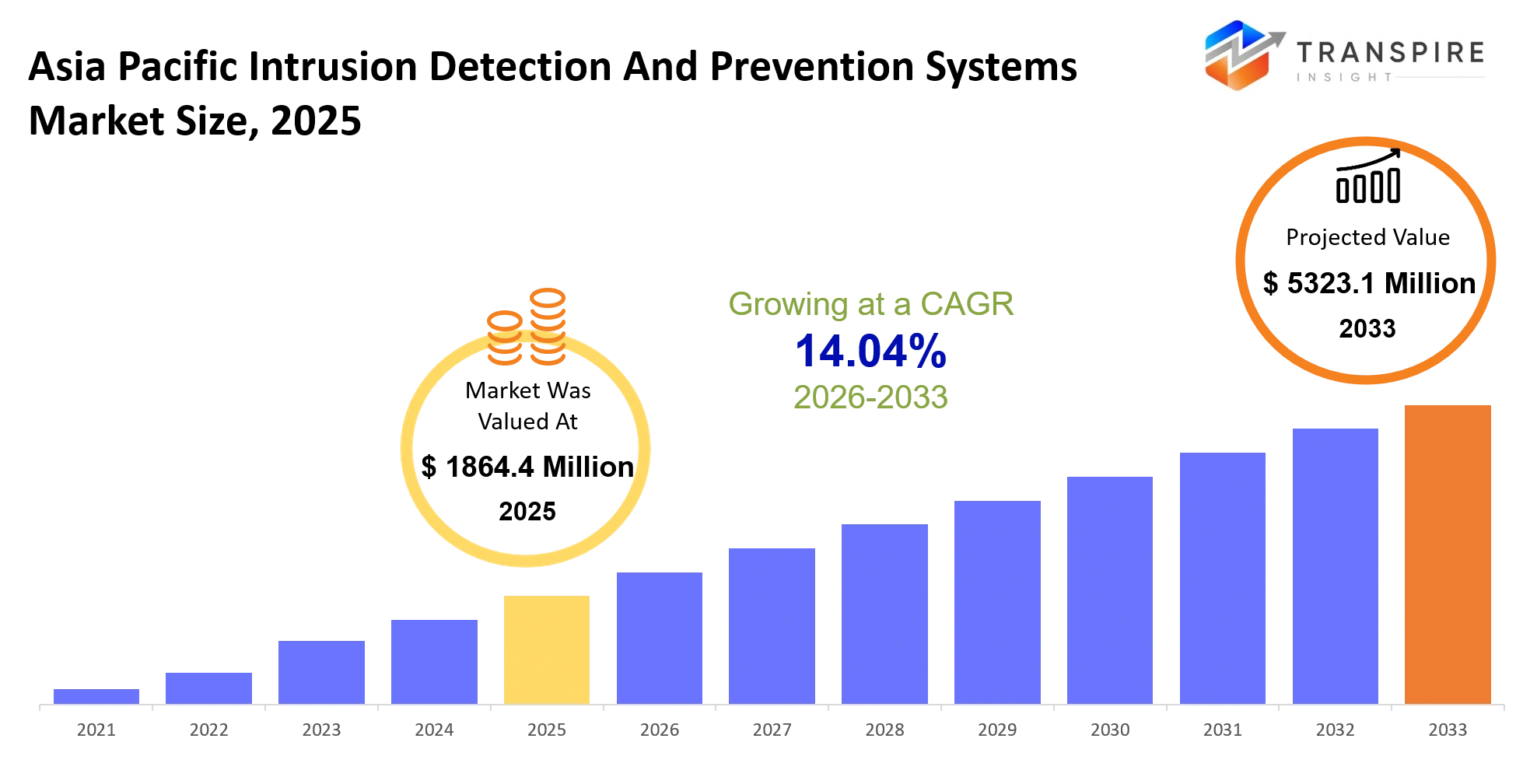
- Asia Pacific Intrusion Detection And Prevention Systems Market Size 2025: USD 1864.4 Million
- Asia Pacific Intrusion Detection And Prevention Systems Market Size 2033:USD 5323.1 Million
- Asia Pacific Intrusion Detection And Prevention Systems Market CAGR:14.04%
- Asia Pacific Intrusion Detection And Prevention Systems Market Segments: By Component (Hardware, Software, Services, Managed Services, Professional Services, Support Services, Consulting Services, Others); By Deployment Mode (Cloud-Based, On-Premise, Hybrid, Virtual Appliances, Network-Based, Host-Based, Wireless-Based, Others); By Enterprise Size (Large Enterprises, Medium Enterprises, Small Enterprises, Government Organizations, Startups, Educational Institutions, Others); By Industry Vertical (BFSI, IT & Telecom, Healthcare, Government, Retail, Manufacturing, Energy & Utilities, Others).
To learn more about this report,  Download Free Sample Report
Asia Pacific Intrusion Detection And Prevention Systems Market Summary
The Asia Pacific Intrusion Detection And Prevention Systems Market was valued at USD 1864.4 Million in 2025. It is forecast to reachUSD 5323.1 Millionby 2033. That is a CAGR of14.04% over the period.
In the Asia Pacific market for Intrusion Detection and Prevention Systems, it’s kind of a big deal for keeping enterprise networks, industrial control systems, and cloud infrastructure safe from unauthorized entry, ransomware, and those coordinated cyberattacks that seem to never stop. Across manufacturing, logistics, banking, telecom, and energy, the idea is that these systems watch network traffic as it happens, then block suspicious behavior right away. So it can stop disruption before it really kicks in, and also helps prevent sensitive information from getting compromised in the process.
What’s interesting is how the market has changed a lot in the last five years. Many organizations moved away from old perimeter-style security thinking, and toward cloud-native, plus AI-enabled threat detection architectures. This move got a faster push after remote work became common, and after the big, high-profile ransomware incidents that hit critical infrastructure during and after the COVID-19 period. On top of that, governments throughout Asia Pacific have also tightened cybersecurity compliance requirements for banks, and for industrial operators. That has basically forced businesses to refresh their legacy security frameworks, even if it wasn’t planned so soon.
And now, since cyberattacks are getting more automated and staying around longer, enterprises are increasingly paying for integrated detection and response platforms. This also means longer-term recurring revenue for vendors, through managed security services and subscription-based deployment models, which sounds a bit boring but it actually matters for budgeting.
Key Market Insights
- China really kinda led the Asia Pacific intrusion Detection and Prevention Systems market, grabbing close to 34% share in 2025 , mostly due to a bunch of enterprise digitization pushes. Japan still kept a pretty notable slice though, supported by stronger industrial cybersecurity spend across automotive, electronics, and even critical infrastructure, specially through 2024-2025. India seems like the fastest expanding regional bet up to 2032 , as cloud adoption keeps rising, fintech security investments keep climbing, and government-led digital transformation programs keep rolling out.
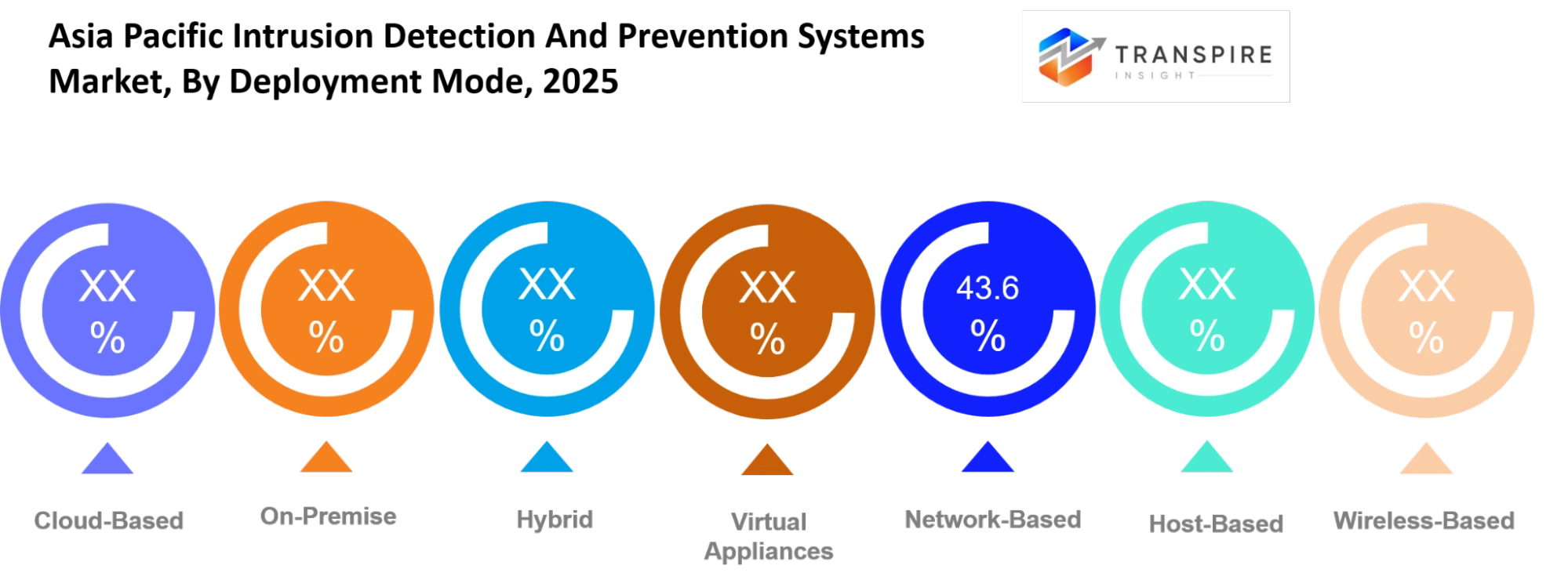
- Meanwhile, Southeast Asian countries are starting to see fresh demand for managed intrusion prevention services across telecom, banking, and e-commerce, more or less. In terms of technology, network based intrusion detection systems stayed on top, with roughly 41% revenue share in 2025, largely tied to company wide traffic monitoring needs. Cloud based deployment became the second biggest segment as organizations shifted workloads toward hybrid and multi cloud setups.
- AI powered intrusion prevention platforms are expected to show the fastest growth between 2026 and 2032, since they can automate threat intelligence and related actions. Managed security services also got serious traction among SMEs, because they want less operational hassle and steady, continuous cybersecurity oversight. In 2025, banking financial services and insurance use cases made up nearly 29% of the Asia Pacific intrusion Detection And Prevention Systems market revenue. And for healthcare, cybersecurity rollouts jumped a lot after hospitals expanded digital patient records, plus connected medical device ecosystems during 2023-2025.
What are the Key Drivers, Restraints, and Opportunities in the Asia Pacific Intrusion Detection And Prevention Systems Market?
The strongest growth driver in the Asia Pacific Intrusion Detection And Prevention Systems Market comes from the fast expansion of cloud computing digital banking, and also connected enterprise infrastructure after 2020. Big ransomware incidents hitting hospitals telecom networks and financial institutions across India, Japan, and Southeast Asia made it pretty clear where older security setups were weak. So organizations had to modernize their network defense architecture, and not slowly. Governments then rolled out stricter cybersecurity compliance rules along with data protection mandates, especially for critical infrastructure as well as financial services. That whole change really pushed enterprise spending upward on AI-enabled intrusion prevention systems, managed detection services, and real-time threat intelligence platforms. On top of that, subscription based cybersecurity deployment models lowered the entry hurdles, so vendors could keep earning recurring service revenue, while adoption rose even among medium sized enterprises.
Still, the biggest structural restraint is the ongoing shortage of advanced cybersecurity know how across many emerging Asia Pacific economies. Intrusion prevention systems need continuous observation, threat analysis, and tight integration with messy enterprise infrastructure yet the local talent pipelines stay thin for broad deployment. A lot of manufacturing plants utilities, and public institutions still run older operational technology networks, that are not aligned with modern cybersecurity architecture. System integration can also turn into a costly infrastructure rework, with longer deployment timelines that drag out budgets. This talent and compatibility gap slows down modernization programs, and it in turn suppresses potential market revenue, particularly within cost sensitive industries and smaller companies.
AI based threat intelligence plus 5G security infrastructure , seems like the most solid long-term door for expansion. Telecom operators in China, South Korea, and India are putting serious money into network monitoring platforms that can safeguard billions of linked devices , and handle decentralized traffic streams too. At the same time, edge computing keeps spreading and industrial Internet of Things deployments are ramping up, which then drives the need for more self-governing intrusion prevention systems . These systems should spot and isolate suspicious activity in real time without needing a human response, ever.
What Has the Impact of Artificial Intelligence Been on the Asia Pacific Intrusion Detection And Prevention Systems Market?
Artificial intelligence and high end digital technologies are reshaping intrusion detection and prevention systems across Asia Pacific, sort of by automating the network surveillance part, speeding up threat assessment , and making the cybersecurity response more precise. In practice, many enterprises roll out AI driven control systems that keep watching network traffic user conduct, and endpoint activity, continuously, without needing so much manual push. Big telecom providers and financial firms also rely on automated threat intelligence platforms to spot questionable traffic patterns and then isolate at once the machines that look compromised. Overall, this approach trims the response latency and supports operational continuity across huge digital infrastructure settings.
Machine learning models are moreover reinforcing predictive cyber safety. More advanced analytics engines sort through old attack behavior, unusual access patterns, and various network irregularities, to forecast likely cyber threats before they cause any real operational disruption. A number of organizations in Japan, Singapore, and South Korea said they saw fewer false positive alerts and quicker incident containment once AI enabled security analytics became part of their enterprise stack. Predictive threat discovery also supports compliance deliverables, and can lower cybersecurity management expenses because repetitive monitoring tasks get handled automatically, rather than by people, day after day.
Still, the upside comes with barriers, especially those annoying integration costs. A lot of industrial plants and public sector networks continue on legacy infrastructure, which doesn’t really play well with modern AI enabled security platforms. On top of that, limited cybersecurity training datasets, across locally managed operating environments , can reduce prediction quality, mainly for region specific attack patterns and multilingual threat intelligence analysis.
Key Market Trends
- Enterprises started shifting from hardware centric security models toward cloud native intrusion prevention platforms , after the hybrid workforce stuff accelerated across Asia Pacific , and that was kind of after 2021.
- China and Japan then tightened the rules around critical infrastructure cybersecurity, between 2022 and 2025 , which pushed more enterprise spending on nonstop network threat monitoring systems .
- Meanwhile telecom operators rolled out AI driven intrusion detection more widely after 5G subscriber growth made the network attack surfaces wider , across India , South Korea and also parts of Southeast Asia.
- Manufacturing firms also increased operational technology cybersecurity budgets after ransomware incidents messed up semiconductor and electronics production facilities during 2023 and 2024 .
- Managed security service adoption jumped for medium enterprises, largely because subscription pricing reduced that big dependence on large upfront cybersecurity infrastructure spending .
- Financial organizations moved toward behavioral analytics plus zero trust architecture , after API led banking ecosystems increased exposure to credential based cyberattacks , especially after 2022.
- Vendors like Cisco Systems and Fortinet expanded regional cloud partnerships too, aiming to improve localized threat intelligence and automate response capabilities, more or less in the same direction.
- Enterprises dialed back reliance on stand alone firewall systems, once integrated detection platforms showed quicker incident containment , and also fewer false positive alerts.
- Government agencies in places like Singapore, India, and Australia sped up modernization projects after data localization mandates, plus public infrastructure attack incidents.
- Finally open source threat intelligence integration went up after enterprises basically asked for faster identification of zero day vulnerabilities and malware patterns that are specific to each region .
Asia Pacific Intrusion Detection And Prevention Systems Market Segmentation
By Component
Hardware solutions still end up being the backbone for enterprise network security, mostly with dedicated appliances that handle traffic inspection and threat filtering in a more direct way. Banks, telecom operators and government facilities keep investing in physical cybersecurity infrastructure, because compliance rules are strict and the network traffic volume is, frankly, huge. Software platforms got more traction once cloud migration spread across a lot of regional industries from 2021 to 2025. AI-enabled analytics, automated threat response, and centralized monitoring together kinda reinforced how software deployments roll out across those complicated digital environments.
Then services started getting more consistent attention , because cybersecurity operations became harder across distributed enterprise systems. Managed services also grew among medium enterprises that want ongoing monitoring and less day to day operational strain. On the side, professional services, and consulting services, backed cloud migration efforts, compliance improvements, and cybersecurity architecture modernization programs. Support services stayed in demand too , since many organizations need continuous updates, vulnerability assessments, and fast incident management, so business continuity doesn’t get derailed.
By Deployment Mode
Cloud based deployment, kind of strengthened market penetration after many enterprises kept expanding remote operations, and uhh digital collaboration infrastructure. The subscription pricing model, plus centralized administration and scalable rollout, seemed to improve overall acceptance in banking, retail, and IT, despite the usual hesitation. Hybrid deployment also got more momentum, because bigger organizations wanted cloud flexibility but still had to keep their existing on site infrastructure protections in place, you know. Enterprise cybersecurity plans then shifted more and more toward unified monitoring across those distributed operational environments, not just isolated segments.
Still, on premise deployment stayed relevant for government agencies , utilities, and regulated industries, where strict data protection rules make external hosting dependency less appealing, or just risky. Virtual appliances helped a cost efficient expansion path without forcing huge hardware investments. Meanwhile, network based systems kept strong demand since centralized traffic analysis gives better visibility across enterprise environments. Host based deployments, and even wireless based options, increased too across connected manufacturing systems , remote workforce operations , and enterprise mobility infrastructure, where practical coverage matters.
To learn more about this report, Download Free Sample Report
By Enterprise Size
Large enterprises generated meaningful cybersecurity spending, because multinational operations created complex network layouts with more exposure to ransomware and unauthorized access attempts. In particular financial institutions, telecom providers, and manufacturing companies ramped up spending on integrated threat monitoring platforms, these tools can support real-time analysis across distributed infrastructure , and it really mattered for their daily operations. Government organizations also leaned into cybersecurity procurement after incidents that targeted public digital systems and crucial infrastructure. Regulatory enforcement then pushed faster adoption in operational environments dealing with sensitive financial and administrative data.
Medium enterprises meanwhile grew cybersecurity budgets because subscription based security platforms lowered the whole deployment friction and gave more operational adaptability. Small enterprises tended to adopt managed detection services to cover limited internal cybersecurity know-how. Startups and educational institutions expanded the use of cloud-native monitoring tools, since digital learning and collaboration platforms boosted network visibility and exposure. Flexible pricing approaches, plus outsourced monitoring services helped smaller organizations access these capabilities without being locked into heavy internal programs.
By Industry Vertical
BFSI kept up a really strong market contribution, mostly because digital banking systems , mobile payment platforms and those API-based financial services ended up being… like, really juicy targets for cyberattack attempts. Financial institutions started rolling out AI-enabled analytics and behavioral monitoring platforms more aggressively after some regional ransomware incidents messed with transaction processing between 2022 and 2025. Meanwhile the IT and telecom sectors also bumped up their cybersecurity spending, especially after big 5G rollouts and cloud infrastructure expansion rolled across China, India, Japan and Southeast Asia. In practice, real-time network traffic monitoring and automated response actions became kind of essential, to safeguard high-volume enterprise data environments.
Healthcare orgs, too, pushed forward cybersecurity modernization after hospitals expanded digital patient management systems, and connected medical infrastructure. Manufacturing sites, on the other hand, tightened up operational technology security following cyberattacks that interrupted semiconductor and electronics production activities across East Asia. Government agencies increased spend on advanced monitoring systems, since national cybersecurity frameworks basically forced stronger protection requirements for public infrastructure. Finally, energy and utilities operators adopted more advanced detection systems, to protect smart grid operations and also reduce operational disruption risk, even when industrial infrastructure is connected.
What are the Key Use Cases Driving the Asia Pacific Intrusion Detection And Prevention Systems Market?
Financial institutions, kind of act as the primary use case for intrusion detection and prevention systems across Asia Pacific. Digital banking platforms mobile payment apps, and real time transaction workflows really do need ongoing network surveillance to block ransomware efforts, phishing attempts , and also those unauthorized access incidents that pop up out of nowhere. With strict cybersecurity rules running through China, Singapore, Japan and India , firms keep putting money into newer threat detection capabilities for the long haul.
Telecom operators and cloud service providers are also scaling up cybersecurity rollouts across 5G setups, edge computing environments, and mixed cloud operations. Manufacturing sites, in particular, started adopting more after cyberattacks caused serious interruptions to semiconductor output and industrial automation workflows across East Asia. Healthcare organizations, meanwhile, tightened up their network monitoring approaches so digital patient records stay safe and connected medical devices don’t end up leaking data.
On top of that, newer scenarios are showing up around smart city infrastructure , connected transportation systems , and industrial Internet of Things environments. AI powered behavioral analytics plus autonomous threat response platforms are getting more attention too , since enterprises want quicker detection of zero-day vulnerabilities and tighter coordination against cyberattacks that spread across distributed digital infrastructure.
|
Report Metrics |
Details |
|
Market size value in 2025 |
USD 1864.4 Million |
|
Market size value in 2026 |
USD 2121.6 Million |
|
Revenue forecast in 2033 |
USD 5323.1 Million |
|
Growth rate |
CAGR of 14.04% from 2026 to 2033 |
|
Base year |
2025 |
|
Historical data |
2021 - 2024 |
|
Forecast period |
2026 - 2033 |
|
Report coverage |
Revenue forecast, competitive landscape, growth factors, and trends |
|
Regional scope |
Asia Pacific (India, China, Japan, Australia, South Korea, Rest of Asia Pacific) |
|
Key company profiled |
Cisco, Palo Alto Networks, Fortinet, Check Point Software, IBM, Trend Micro, McAfee, Broadcom, Juniper Networks, Trellix, FireEye, Sophos, Darktrace, CrowdStrike, SentinelOne. |
|
Customization scope |
Free report customization (country, regional & segment scope). Avail customized purchase options to meet your exact research needs. |
|
Report Segmentation |
By Component (Hardware, Software, Services, Managed Services, Professional Services, Support Services, Consulting Services, Others); By Deployment Mode (Cloud-Based, On-Premise, Hybrid, Virtual Appliances, Network-Based, Host-Based, Wireless-Based, Others); By Enterprise Size (Large Enterprises, Medium Enterprises, Small Enterprises, Government Organizations, Startups, Educational Institutions, Others); By Industry Vertical (BFSI, IT & Telecom, Healthcare, Government, Retail, Manufacturing, Energy & Utilities, Others). |
Which Regions are Driving the Asia Pacific Intrusion Detection And Prevention Systems Market Growth?
China is leading the regional market, kinda because the national cybersecurity rules got much tougher after several attacks hit financial networks, public infrastructure and industrial setups between 2021 and 2025. At the same time, big cloud rollouts, fast 5G deployment, and serious enterprise digitization efforts made sure there’s steady demand for advanced intrusion prevention platforms. This shows up clearly in banking, telecom, and manufacturing. On top of that the government-backed cybersecurity funding initiatives didn’t just help, it also made domestic security infrastructure mature, and it sped up the rollout of AI-enabled monitoring systems. There’s also this pretty solid local ecosystem, telecom operators, cloud service providers, semiconductor manufacturers, and smaller cybersecurity companies all working together. So regional dominance keeps being supported by long-term modernization projects, and not just short-term spending.
Japan is next, it’s the second-largest contributor, though the market vibe is a bit different than China. In Japan growth leans more on operational stability and longer-range enterprise planning, rather than on rapid digital expansion alone. Big manufacturing groups, automotive businesses, and financial institutions keep running cybersecurity budgets on a steady cycle. Their focus is usually on operational continuity and also supply chain protection, not just flashy tech. Strong compliance expectations, plus solid corporate governance approaches, help make sure network monitoring systems get deployed consistently across industrial infrastructure. Japan also benefits from mature digital infrastructure, lower swings in cybersecurity policy, and fairly stable enterprise spending patterns, so it stays a dependable source of long-term revenue in the market.
India seems to be emerging, as the fastest-growing regional market, especially after the big digital infrastructure push really started to pick up speed. Since around 2022, cloud adoption went up, fintech kept expanding, and the national cybersecurity modernization programs also gained traction, a kind of domino effect. With rapid data center rollouts, more 5G infrastructure, and digital payment ecosystems maturing, the overall exposure to ransomware attacks also grew, along with large scale data breaches, across both public and private environments. On top of that, government cybersecurity initiatives are moving forward and more enterprises are taking up managed detection services, which basically opens doors for cloud native security vendors and AI driven threat intelligence providers. If this keeps going, there should be solid expansion upside for cybersecurity investors and technology providers, especially those aiming at mid-sized enterprises and digital infrastructure operators between 2026 and 2033.
Who are the Key Players in the Asia Pacific Intrusion Detection And Prevention Systems Market and How Do They Compete?
Competition across the Asia Pacific intrusion detection and prevention systems landscape is still sort of moderately consolidated, with big global cybersecurity players grabbing a lot of the enterprise deployments in banking , telecom, government, and manufacturing. Lately the competition feels less about plain standalone firewall performance, more about AI-driven threat analytics, cloud-native security structure, and built in platform type capabilities. The large vendors are trying to hold onto share via acquisitions, managed security services, and regional cloud relationships, while the smaller specialized cybersecurity companies are picking up momentum because their incident response is faster and their detection is more automated. Many enterprises now want one unified cybersecurity ecosystem that blends endpoint defense, network monitoring, threat intelligence, and compliance oversight into one operational rhythm.
Cisco Systems shows up with solid enterprise networking integration and broad infrastructure compatibility, especially across telecom and government setups. The deeper tie between network hardware and security analytics gives Cisco a bit of edge when it comes to handling high volume enterprise traffic, like in practice. Palo Alto Networks leans hard into AI enabled threat detection, cloud security, and automated response mechanisms. Some recent acquisitions that focus on AI security infrastructure kind of sharpen platform differentiation and broaden protection for autonomous AI environments. Fortinet instead differentiates through cost effective integrated security appliances, which seem to land well with medium sized enterprises and with distributed operations across Southeast Asia.
CrowdStrike is still pushing forward with cloud native endpoint protection and ai based behavioral analytics, made to fit hybrid workforce infrastructure more or less. The regional cloud expansion, along with data sovereignty spending, helped uptake in highly regulated sectors where people handle sensitive operational data. Meanwhile, Trend Micro holds a solid spot across Japan and much of Asia Pacific by using localized threat intelligence, an industrial cybersecurity specialization, plus real-world know-how protecting enterprise cloud workloads. Check Point Software Technologies keeps competing by leaning on centralized policy management and a compliance heavy cybersecurity architecture, that is used a lot across financial institutions and public infrastructure environments.
Company List
- Cisco
- Palo Alto Networks
- Fortinet
- Check Point Software
- IBM
- Trend Micro
- McAfee
- Broadcom
- Juniper Networks
- Trellix
- FireEye
- Sophos
- Darktrace
- CrowdStrike
- SentinelOne
Recent Development News
In April 2026, Palo Alto Networks announced intent to acquire Portkey. The acquisition strengthened AI Gateway security capabilities for autonomous AI agents and expanded enterprise AI transaction protection infrastructure.
Source: URL (Palo Alto Networks).
In April 2026, Palo Alto Networks completed acquisition of Koi. The transaction introduced Agentic Endpoint Security capabilities designed to secure AI-driven enterprise endpoints and autonomous coding environments.
Source: URL (Palo Alto Networks).
In March 2026, CrowdStrike launched new Falcon platform AI security capabilities. The launch expanded runtime threat detection, AI agent governance, and endpoint-level protection across cloud and SaaS environments.
Source: URL (CrowdStrike).
What Strategic Insights Define the Future of the Asia Pacific Intrusion Detection And Prevention Systems Market?
The market seems to be structurally moving toward AI based autonomous cybersecurity platforms that can find, look into, and react to threats with pretty minimal human intervention. In the next five to seven years, the whole thing will keep getting pushed by the rapid expansion of cloud infrastructure, industrial Internet of Things deployments , and also by how decentralized many enterprise operations have become. There’s another risk that is a bit less visible too, which is growing reliance on just a small set of global cybersecurity platform providers. If the market gets too concentrated, it can turn into an operational weak point, like , if platform outages happen, or if pricing pressure ramps up, or if regulatory conflicts show up, then enterprise cybersecurity ecosystems across multiple industries could get disrupted at the same time.
At the same time, an emerging opportunity is showing up around protective security for AI agents, edge computing systems, and connected industrial infrastructure across India and Southeast Asia. More regional investment in data centers, 5G infrastructure , and digital financial services is fueling demand for localized threat intelligence and compliance-first security design. Firms trying to enter this space will likely do better by assembling integrated platform ecosystems—combining managed security services, AI analytics, and cloud-native monitoring—rather than relying solely on standalone network security products.
Asia Pacific Intrusion Detection And Prevention Systems Market Report Segmentation
By Component
- Hardware
- Software
- Services
- Managed Services
- Professional Services
- Support Services
- Consulting Services
- Others
By Deployment Mode
- Cloud-Based
- On-Premise
- Hybrid
- Virtual Appliances
- Network-Based
- Host-Based
- Wireless-Based
- Others
By Enterprise Size
- Large Enterprises
- Medium Enterprises
- Small Enterprises
- Government Organizations
- Startups
- Educational Institutions
- Others
By Industry Vertical
- BFSI
- IT & Telecom
- Healthcare
- Government
- Retail
- Manufacturing
- Energy & Utilities
- Others
Frequently Asked Questions
Find quick answers to common questions.
The expected Asia Pacific Intrusion Detection And Prevention Systems Market size for the market will be USD 5323.1 Million in 2033.
By Component (Hardware, Software, Services, Managed Services, Professional Services, Support Services, Consulting Services, Others); By Deployment Mode (Cloud-Based, On-Premise, Hybrid, Virtual Appliances, Network-Based, Host-Based, Wireless-Based, Others); By Enterprise Size (Large Enterprises, Medium Enterprises, Small Enterprises, Government Organizations, Startups, Educational Institutions, Others); By Industry Vertical (BFSI, IT & Telecom, Healthcare, Government, Retail, Manufacturing, Energy & Utilities, Others).
Major Asia Pacific Intrusion Detection And Prevention Systems Market players are Cisco, Palo Alto Networks, Fortinet, Check Point Software, IBM, Trend Micro, McAfee, Broadcom, Juniper Networks, Trellix, FireEye, Sophos, Darktrace, CrowdStrike, SentinelOne.
The Asia Pacific Intrusion Detection And Prevention Systems Market size is USD 1864.4 Million in 2025.
The Asia Pacific Intrusion Detection And Prevention Systems Market CAGR is 14.04% from 2026 to 2033.
- Cisco
- Palo Alto Networks
- Fortinet
- Check Point Software
- IBM
- Trend Micro
- McAfee
- Broadcom
- Juniper Networks
- Trellix
- FireEye
- Sophos
- Darktrace
- CrowdStrike
- SentinelOne
About the Authors

Mayur Shinde
I am Mayur Shinde, a Senior Research Analyst at Transpire Insight, specializing in the Automotive & Transportation and Information & Communication Technology (ICT) Industry. My work focuses on analyzing emerging market trends, technological advancements, competitive landscapes, and industry developments to deliver accurate, data-driven insights. I am passionate about transforming complex market information into clear, actionable content that helps businesses, professionals, and decision-makers stay informed and make confident strategic decisions.

Chakradhar Khansole
Chakradhar serves as the Research Director at Transpire Insight, bringing over 8 years of experience in technology, innovation, and strategic market intelligence. He specializes in transforming complex market data into actionable business insights that enable organizations to make informed, growth-oriented decisions. Recognized for his strategic vision and analytical expertise, Chakradhar leads high-impact research initiatives, delivering comprehensive market assessments, competitive intelligence, and forward-looking industry analysis.
Recently Published Reports
-
Apr 2026
3D Optical Profiler Market
3D Optical Profiler Market Size, Share & Analysis Report By Type (Desktop 3D Optical Profiler, and Portable 3D Optical Profiler), By Technology (Confocal Technology, and White Light Interference), By End-Use Industry (Manufacturing, Research Institutions, Automotive, Aerospace and Defense, Medical Devices, and Other), and Geography (North America, Europe, Asia-Pacific, Middle East and Africa, South and Central America), 2021 - 2031
-
Apr 2026
Depth Sensor Market
Depth Sensor Market Size, Share & Analysis Report By Type (Infrared Depth Sensors, Time-of-Flight (ToF) Sensors, Stereo Vision Sensors, Structured Light Sensors, Ultrasonic Depth Sensors), By Application (Automotive, Robotics, Gaming, Consumer Electronics, Industrial Automation, Healthcare, Security & Surveillance, Others), By End Users (Automotive Manufacturers, Consumer Electronics Companies, Healthcare Providers, Industrial Companies, Security Agencies, Gaming Companies, Robotics Companies, Others), and Geography (North America, Europe, Asia-Pacific, Middle East and Africa, South and Central America), 2021 – 2031
-
Apr 2026
Digital Manufacturing Market
Digital Manufacturing Market Size, Share & Analysis Report By Component (Hardware, Software, and Services), By Technology (Robotics, 3D Printing, Internet of Things (IoT), and Others), By Application (Automotive and Transportation, Aerospace and Defense, Consumer Electronics, Industrial Machinery, and Others), By Process Type (Computer-Based Designing, Computer-Based Simulation, Computer 3D Visualization, Analytics, and Others), and Geography (North America, Europe, Asia-Pacific, Middle East and Africa, South and Central America), 2021 – 2031
-
Apr 2026
Digital Visa Services Market
Digital Visa Services Market Size, Share & Analysis Report By Type (Individual Travelers, Group Travelers), By Application (Tourism, Business Travel, Others), and Geography (North America, Europe, Asia-Pacific, Middle East and Africa, South and Central America), 2021 – 2031