
France Audio Visual Hardware Market Size & Forecast:
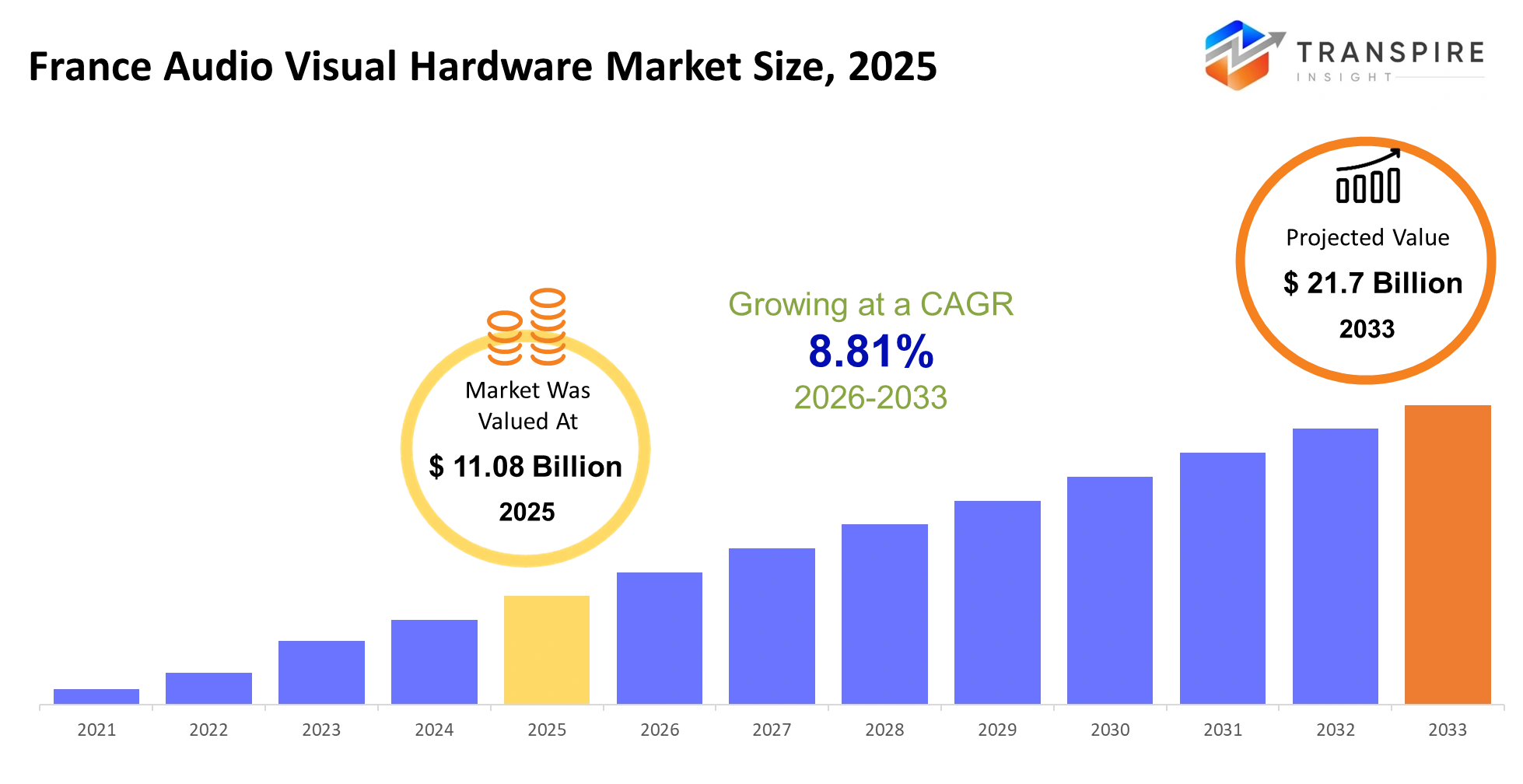
- France Audio Visual Hardware Market Size 2025: USD 11.08 Billion
- France Audio Visual Hardware Market Size 2033: USD 21.7 Billion
- France Audio Visual Hardware Market CAGR: CAGR of 8.81%
- France Audio Visual Hardware Market Segments:By Type (Displays, Projectors, Speakers, Cameras, Others); By Application (Entertainment, Corporate, Education, Events, Healthcare, Others); By End-User (Consumers, Enterprises, Educational Institutions, Media Companies, Healthcare Providers, Others); By Technology (LCD, LED, OLED, 4K/8K, Others).
To learn more about this report,  Download Free Sample Report
France Audio Visual Hardware Market Summary
The France Audio Visual Hardware Market was valued at USD 11.08 Billion in 2025. It is forecast to reach USD 21.7 Billion by 2033. That is a CAGR of 8.81% over the period.
The France Audio Visual Hardware Market is evolving into a software-based cloud ecosystem which combines audiovisual equipment with modern hybrid work and digital public infrastructure and growing demand for immersive communication technologies. The enterprise collaboration sector and smart education sector and public sector modernization sector are driving market growth through their use of integrated displays and AI-enabled conferencing systems and networked AV solutions which they use instead of traditional standalone hardware. The market shows strong preference for scalable energy-efficient systems which can interoperate with other systems while meeting France's digital transformation and sustainability objectives.
Global companies such as Sony and Samsung and LG and Barco and Epson and BenQ operate with high competitive intensity because they develop new LED display and projection system and AI-based audiovisual solutions. Companies differentiate their products by developing integrated ecosystems which include software management tools and comprehensive support for equipment maintenance. The demand for these products has grown to include smart city and healthcare and education sectors which will drive continuous market expansion. The France Audio Visual Hardware Market is developing into an audiovisual system that provides intelligent and connected services through its complete network of audiovisual assets.
Key Market Insights
- The Île-de-France region will lead the France Audio Visual Hardware Market during 2025 with approximately 35 to 40 percent market share because of its corporate headquarters concentration and its development of modern digital infrastructure.
- The Auvergne-Rhône-Alpes region will experience the most rapid growth between 2026 and 2030 because industrial digitalization and ongoing enterprise audio visual upgrades create new opportunities.
- The displays segment controls the largest market share in France Audio Visual Hardware Market because customers increasingly choose LED signage and interactive digital communication systems.
- The projection technology market ranks as the second most valuable sector in France because both educational institutions and budget-conscious organizations heavily utilize projectors for their operations.
- Cameras show the fastest growth among product categories from 2024 to 2028 because AI-based conferencing systems and hybrid work environments have become standard.
- Hybrid work environments and unified communication system upgrades drive corporate applications which control approximately 45 percent of the market share.
- Smart classroom technology and national digital learning investments make education the fastest-growing application segment.
- Enterprises represent the largest end-user segment which accounts for most market revenue because organizations continue to digitize their workspaces and implement collaborative technology.
- The healthcare sector will experience rapid growth as telemedicine services expand and diagnostic visualization systems become more widely used.
- Sony and Samsung maintain their market leadership through advanced display development and extensive LED installations in commercial environments.
- LG and Barco boost their market position through their development of OLED technology and advanced visualization solutions for enterprise control rooms.
- Epson and BenQ operate in France educational market through their development of affordable projection solutions.
- The Audio Visual Hardware Market in France uses AI-based systems together with cloud AV management solutions and subscription services to develop its competing business strategies.
What are the Key Drivers, Restraints, and Opportunities in the France Audio Visual Hardware Market?
The primary driver of the France Audio Visual Hardware Market is the rapid transition toward hybrid work and digitally connected enterprise environments. The standardization of remote collaboration by organizations after 2022 created new investment needs for integrated conferencing systems and AI-enabled display technology and unified communication systems. Organizations demand scalable audiovisual ecosystems because their teams require solutions that support productivity in distributed work environments which they need to operate their offices and government and educational institutions. Organizations now use digital transformation expenditures to determine their hardware needs instead of relying on traditional methods for equipment acquisition.
The complex integration requirements between existing systems and multiple IT systems that have not been unified create a major restriction. French businesses continue to use mixed IT systems which require both outdated audiovisual equipment and modern cloud solutions, thereby creating compatibility challenges and higher operational expenses. The process requires extended time periods, which leads to higher costs for companies that need to perform extensive system upgrades. The expensive initial investment required for advanced LED and AI-driven and networked audiovisual systems creates a barrier for adoption by small and mid-sized businesses which are located outside urban areas.
The development of smart building systems and energy-efficient public sector modernization projects creates a major opportunity. The French government requires low-carbon digital infrastructure which increases demand for intelligent audiovisual systems at transport hubs and educational institutions and municipal buildings. Companies that build modular solutions which operate in cloud environments and consume less energy will gain from this upcoming wave of institutional funding.
What Has the Impact of Artificial Intelligence Been on the France Audio Visual Hardware Market?
Artificial intelligence is transforming the France Audio Visual Hardware Market through its development of software-based systems which replace traditional hardware. The AI system which provides automated camera framing and voice tracking together with real-time audio balancing in enterprise conferencing and control room environments requires fewer manual operations while it enhances meeting productivity. Machine learning now powers content management systems which enhance retail signage display arrangements and timetable creation to boost customer interaction while contracting management needs.
Hardware maintenance operations receive assistance from predictive analytics technology. AV integrators use AI models to monitor device health in large-scale installations such as corporate campuses, universities, and transport hubs, enabling early detection of display failures, projector lamp degradation, or network latency issues. This system enables businesses to perform planned maintenance tasks which decreases their maintenance expenses while increasing system availability. Energy optimization algorithms decrease power usage in LED display networks because they control brightness levels and operational patterns based on present occupancy and surrounding light conditions.
The implementation process faces difficulties because legacy AV systems require significant financial resources while their existing data systems do not support proper system integration. The absence of standardized data streams in numerous installations restricts model performance which results in delayed adoption of complete automated AV management systems.
Key Market Trends
- Enterprise buyers in France have shifted from standalone AV devices to integrated collaboration platforms since 2023 because they see integrated systems as better solutions to their buying requirements which depend on multiple products.
- Retail and public infrastructure sectors now use LED displays which replace LCD systems because of energy efficiency requirements established after 2024.
- Corporate headquarters in Paris now require AI-powered video conferencing systems because hybrid work arrangements became standard after 2022.
- The education sector began purchasing interactive digital classrooms after 2023 because national digital learning modernization programs required these resources.
- Manufacturers increasingly embed cloud-based control software into AV hardware since 2024 which enables them to decrease dependency on revenue sources that depend solely on hardware sales.
- Companies such as Samsung and LG had to develop new sourcing methods for Europe between 2023 and 2025 because semiconductor supply chain problems affected their operations.
- The French government expanded its public sector audiovisual programs after 2024 when smart city funding started because they wanted to establish networked communication systems and transport information networks.
- Since 2025, companies have changed their competitive strategies to focus on service-based differentiation through their AV management platforms, which provide maintenance services and analytics and subscription models.
- Premium corporate spaces and retail environments now demand OLED and 4K displays which have replaced older projection systems that used to operate in urban areas.
France Audio Visual Hardware Market Segmentation
By Type
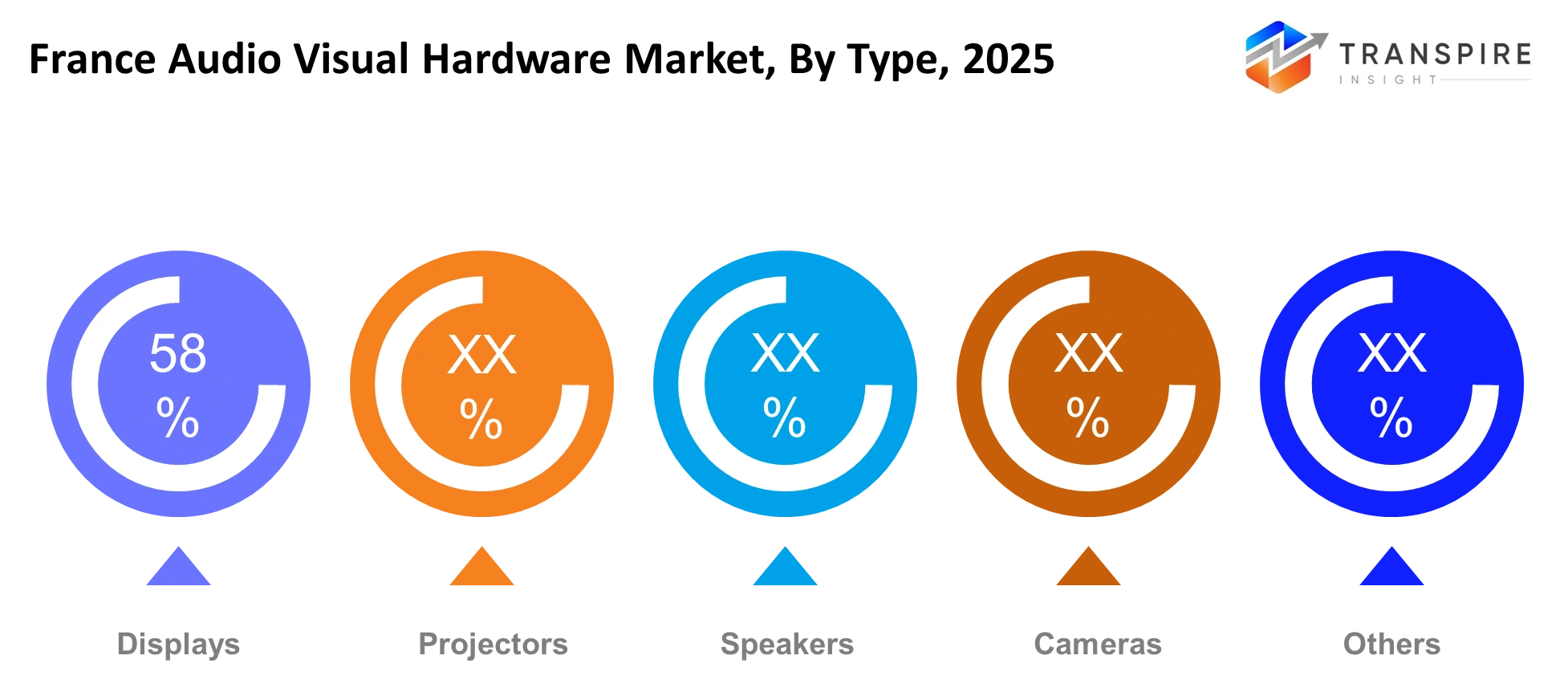
- The France Audio Visual Hardware Market uses displays as its main display technology because corporate offices, retail signage, and public infrastructure systems show high demand for this technology. The market demands large-format LED displays and interactive screens which enable companies to run hybrid communication systems and digital advertisements. The industry experiences growth because businesses need to replace their old equipment with new high-resolution energy-saving displays. Organizations use cloud-based content management systems to enhance their business operations through better system functionalities.
- Educational institutions and conference centers use projectors and speakers as their main audio-visual equipment. Projectors remain cost-effective for budget-conscious projects while speakers enable users to experience high-quality sound during hybrid meetings and events. The market for cameras is growing because video conferencing technology now includes AI-based tracking capabilities. The industry uses display systems and cameras to create value which pushes manufacturers to develop integrated audio-visual packages instead of selling individual products.
To learn more about this report, Download Free Sample Report
By Application
- The primary demand driver for corporate applications exists because French companies and government offices embrace hybrid work solutions. Organizations invest heavily in conferencing systems, collaboration tools, and integrated AV infrastructure to improve communication efficiency. The segment receives continuous upgrades because organizations pursue productivity improvements through their digital transformation efforts.
- Educational institutions and event spaces experience continuous development through the renovation of classrooms and universities and exhibition centers. The healthcare sector experiences increasing telemedicine and digital diagnostics adoption which require visual precision and immediate interaction. The segments depend on audiovisual systems which offer both easy installation and expandable capabilities. The upcoming demand will transition toward connected platforms which integrate various applications into single administrative systems.
By End-User
- The primary demand driver for corporate applications exists because French companies and government offices embrace hybrid work solutions. Organizations invest heavily in conferencing systems, collaboration tools, and integrated AV infrastructure to improve communication efficiency. The segment receives continuous upgrades because organizations pursue productivity improvements through their digital transformation efforts.
- Educational institutions and event spaces experience continuous development through the renovation of classrooms and universities and exhibition centers. The healthcare sector experiences increasing telemedicine and digital diagnostics adoption which require visual precision and immediate interaction. The segments depend on audiovisual systems which offer both easy installation and expandable capabilities. The upcoming demand will transition toward connected platforms which integrate various applications into single administrative systems.
By Technology
- LED technology currently leads the market because it excels in large-format displays and signage systems and high-brightness applications. The system delivers energy-efficient performance with a long operational lifespan which makes it the most suitable choice for commercial and public space installations. Education and small office environments make extensive use of LCD displays because they offer affordable solutions for those settings.
- Premium retail and business spaces are adopting OLED technology because it provides better color precision and contrast performance. The evolution of 4K and 8K technologies continues to drive advancements across all display formats because users now demand higher resolution capabilities for both professional work and entertainment activities. The display industry will evolve toward integrated smart display systems which combine LED technology with high-resolution standards as manufacturers seek to develop more valuable software-based products instead of competing through hardware-only solutions.
What are the Key Use Cases Driving the France Audio Visual Hardware Market?
The France Audio Visual Hardware Market shows its main usage through enterprise collaboration which currently serves as the primary application for hybrid work practices that have become standard in both corporate offices and government institutions. Organizations need integrated conferencing systems and interactive displays and unified communication setups which enable their teams to work together from different locations. Organizations use this use case because they need to update their meeting infrastructure all the time which helps their remote teams work better together while they need to operate their meeting systems.
Digitalization efforts in education and public sector entities currently drive the development of secondary applications which require digital solutions in universities and schools and administrative facilities. The segments use interactive whiteboards and lecture capture systems and immersive learning displays to create modern communication methods which lead to better student engagement. Urban commercial centers see both retail and hospitality businesses expand their audiovisual systems for digital signage and customer experience improvements.
The development of smart city infrastructure and immersive simulation environments introduces new applications. Cities use audiovisual systems to connect their transport terminals with their public information systems while healthcare and defense sectors study advanced visualization techniques for both training and diagnostic purposes. The applications have not reached full development yet but their growth will speed up once artificial intelligence systems combine with government-supported digital transformation projects.
|
Report Metrics |
Details |
|
Market size value in 2025 |
USD 11.08 Billion |
|
Market size value in 2026 |
USD 12.02 Billion |
|
Revenue forecast in 2033 |
USD 21.7 Billion |
|
Growth rate |
CAGR of 8.81% from 2026 to 2033 |
|
Base year |
2025 |
|
Historical data |
2021 - 2024 |
|
Forecast period |
2026 - 2033 |
|
Report coverage |
Revenue forecast, competitive landscape, growth factors, and trends |
|
Regional scope |
France |
|
Key company profiled |
Sony, Samsung, LG, Panasonic, Philips, Bose, Harman, Yamaha, Epson, BenQ, Canon, Nikon, Sharp, Hitachi, Barco. |
|
Customization scope |
Free report customization (country, regional & segment scope). Avail customized purchase options to meet your exact research needs. |
|
Report Segmentation |
By Type (Displays, Projectors, Speakers, Cameras, Others); By Application (Entertainment, Corporate, Education, Events, Healthcare, Others); By End-User (Consumers, Enterprises, Educational Institutions, Media Companies, Healthcare Providers, Others); By Technology (LCD, LED, OLED, 4K/8K, Others). |
Which Regions are Driving the France Audio Visual Hardware Market Growth?
The France Audio Visual Hardware Market today operates under its current system because Île-de-France contains both corporate offices and governmental facilities together with its modern digital systems. The business market in Paris demands enterprise audiovisual equipment because companies have started using hybrid office models together with intelligent meeting room technologies. The area maintains an established system of system integrators and IT service companies which together with high-end retail outlets work to enhance audiovisual systems. Educational institutions and administrative modernization projects create high public procurement demand which leads to consistent need for hardware. The Île-de-France region works as the main center for decision-making and revenue generation because it contains multiple important high-value customers.
The industrial sector together with the diverse commercial operations of Auvergne-Rhône-Alpes position it as a dependable second-tier region. The manufacturing sector, healthcare facilities and universities in the area represent its main sources of AV modernization development which differs from Île-de-France administrative demands. The main business and technological hub in Lyon operates as a key location where companies value reliable solutions that deliver energy savings through cost-efficient implementation. The region establishes stable demand patterns through ongoing corporate reinvestment cycles which results in less demand fluctuations when compared to the capital region. The situation provides an unchanging path which leads to national AV hardware use through regular but controlled TV hardware distribution.
Provence-Alpes-Côte d'Azur has become the fastest developing area because digital transformation through tourism infrastructure development and smart city initiatives and coastal urban growth. Cities such as Marseille and Nice have experienced faster adoption of networked autonomous vehicle solutions because of recent investments in intelligent transport systems and public communication networks. The regional funding increase for digital public services and event infrastructure development has created higher demand for immersive display and communication hardware. The period from 2026 to 2033 will provide substantial growth opportunities for market entrants and investors in this region, especially for scalable cloud-connected autonomous vehicle systems designed for public and commercial hybrid applications.
Who are the Key Players in the France Audio Visual Hardware Market and How Do They Compete?
The France Audio Visual Hardware Market is moderately consolidated at the top but remains fragmented across integrators and niche solution providers. Competition is increasingly shaped by technology differentiation and ecosystem integration rather than pure hardware pricing. Incumbents are defending share by embedding AV systems into broader IT, cloud, and collaboration platforms, while new entrants and specialist brands are gaining traction through software-driven features such as AI-based audio calibration, wireless connectivity, and energy-efficient display systems. Service capability, interoperability, and lifecycle support now matter as much as device performance, especially in enterprise and public sector deployments.
Sony competes through premium imaging and professional display technology, with strength in cinema-grade visuals and broadcast-quality systems that are widely used in high-end French venues. Samsung focuses on large-format LED and smart signage solutions, differentiating through integrated display ecosystems and strong commercial retail penetration. LG leverages OLED leadership and flexible display innovation, targeting immersive retail and corporate environments where visual quality is critical.
Barco emphasizes specialized visualization and control systems for control rooms and enterprise collaboration spaces, expanding through high-value integration partnerships in Europe. Epson strengthens its position with projection technology leadership and cost-efficient installation models, particularly in education and corporate sectors, supported by strong distribution networks across France.
Company List
Recent Development News
In April 2026, German AV manufacturer Loewe acquired French high-end audio brand Cabasse, strengthening its premium audiovisual ecosystem and expanding advanced speaker technology integration into home cinema systems.
Source: https://www.whathifi.com
French and European Pro AV markets saw continued expansion through distributor partnerships and system integration deals, especially supporting hybrid workplace and conferencing hardware demand across France.
Source: https://www.avnetwork.com
What Strategic Insights Define the Future of the France Audio Visual Hardware Market?
The France Audio Visual Hardware Market is moving towards software-focused systems which enable different hardware components to work together with cloud solutions and artificial intelligence analytics and unified communication systems. The ongoing hybrid work model and the digital transformation of public and business systems drive this transformation. The market faces a hidden threat because dedicated AV equipment gets replaced by standard consumer devices and software solutions which will reduce profit margins and decrease how long products remain in use.
The development of AV systems in energy-efficient smart buildings creates a new business chance for companies which the European Union environmental rules and government infrastructure improvements will back. Market players need to develop modular hardware systems which they can upgrade while they establish connections with cloud and software companies to create subscription-based business models that let them adapt to fast changing technology.
France Audio Visual Hardware Market Report Segmentation
By Type
- Displays
- Projectors
- Speakers
- Cameras
- Others
By Application
- Entertainment
- Corporate
- Education
- Events
- Healthcare
- Others
By End-User
- Consumers
- Enterprises
- Educational Institutions
- Media Companies
- Healthcare Providers
- Others
By Technology
- LCD
- LED
- OLED
- 4K/8K
- Others
Frequently Asked Questions
Find quick answers to common questions.
The confirmed 2033 market size is USD 21.7 Billion.
By Type (Displays, Projectors, Speakers, Cameras, Others); By Application (Entertainment, Corporate, Education, Events, Healthcare, Others); By End-User (Consumers, Enterprises, Educational Institutions, Media Companies, Healthcare Providers, Others); By Technology (LCD, LED, OLED, 4K/8K, Others).
Major France Audio Visual Hardware Market players are Sony, Samsung, LG, Panasonic, Philips, Bose, Harman, Yamaha, Epson, BenQ, Canon, Nikon, Sharp, Hitachi, Barco.
The France Audio Visual Hardware Market size is USD USD 11.08 Billion in 2025.
The France Audio Visual Hardware Market CAGR is CAGR of 8.81% from 2026 to 2033.
- Sony
- Samsung
- LG
- Panasonic
- Philips
- Bose
- Harman
- Yamaha
- Epson
- BenQ
- Canon
- Nikon
- Sharp
- Hitachi
- Barco
Recently Published Reports
-
Apr 2026
Fiber Optic Faceplates Market
Fiber Optic Faceplates Market Size, Share & Analysis Report By Type (< 300 mm2, 300-350 mm2, and > 350 mm2, By Application (Night Vision, Holographic Imaging, Medical, and Others), and Geography (North America, Europe, Asia-Pacific, Middle East and Africa, South and Central America), 2021 - 2031
-
Apr 2026
High Temperature Superconductors Market
High Temperature Superconductors Market Size, Share & Analysis Report By Type (1G HTS, and 2G HTS), By Application (Power Cable, Fault Current Limiter, and Transformer), and Geography (North America, Europe, Asia-Pacific, Middle East and Africa, South and Central America), 2021 - 2031
-
Apr 2026
Industrial Plugs and Socket Market
Industrial Plugs and Socket Market Size, Share & Analysis Report By Type (Industrial Plugs, Industrial Sockets), By Current (Up to 32 A, 32 to 125 A, Above 125 A), By Protection (Dustproof and Splash Proof, Waterproof, Explosion Proof), By End User (Heavy Industries, Oil and Gas, Chemicals and Pharmaceuticals, Power Generation, Others), and Geography (North America, Europe, Asia-Pacific, Middle East and Africa, South and Central America), 2021 - 2031
-
Apr 2026
InGaAs Avalanche Photodiodes Market
InGaAs Avalanche Photodiodes Market Size, Share & Analysis Report By Type (1100 - 1700 nm, and 1000 - 1600 nm), By Application (Missile Warning System, Muzzle Flash Detection, Wafer Defect Inspection, Laser Rangefinders, and Others), and Geography (North America, Europe, Asia-Pacific, Middle East and Africa, South and Central America), 2021 - 2031