

Asia Pacific Industrial Filtration Market Size & Forecast:
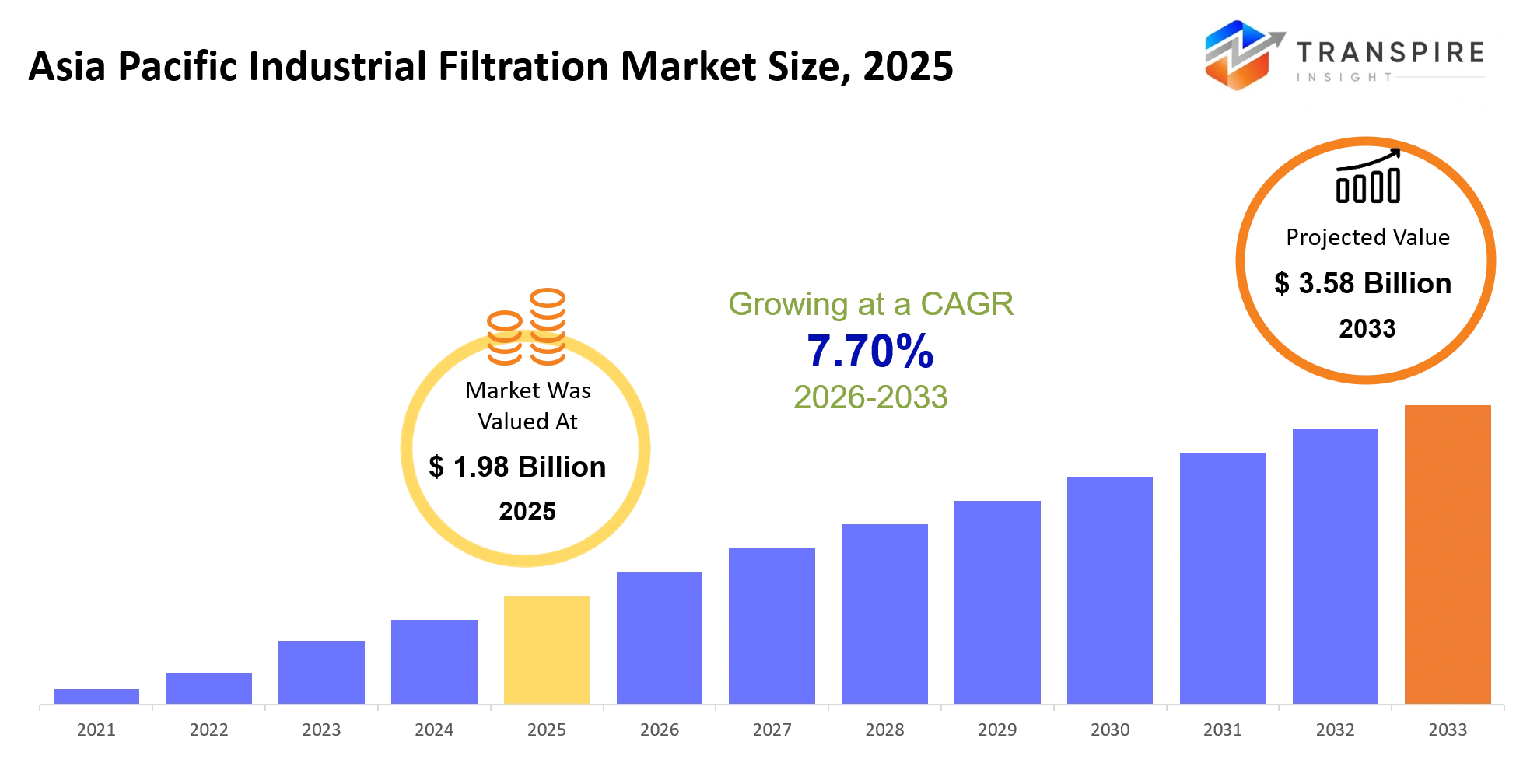
- Asia Pacific Industrial Filtration Market Size 2025: USD 1.98 Billion
- Asia Pacific Industrial Filtration Market Size 2033: USD 3.58 Billion
- Asia Pacific Industrial Filtration Market CAGR: 7.70%
- Asia Pacific Industrial Filtration Market Segments: By Product Type (Air Filtration Systems, Liquid Filtration Systems, Dust Collectors, Membrane Filters, HEPA Filters, Others); By Application (Manufacturing, Power Generation, Oil & Gas, Food & Beverage, Pharmaceuticals, Others); By End User (Industrial Facilities, Power Plants, Oil & Gas Companies, Others).
To learn more about this report,  Download Free Sample Report
Asia Pacific Industrial Filtration Market Summary
The Asia Pacific Industrial Filtration Market was valued at USD 1.98 Billion in 2025. It is forecast to reach USD 3.58 Billionby 2033. That is a CAGR of 7.70% over the period.
The Asia Pacific industrial filtration market sort of, really matters for how well manufacturing plants, power stations, chemical facilities, food processing units, and even water treatment systems stay on track. In a lot of cases filtration systems remove dust , contaminants, oil mist, tiny particulates, and other impurities from air , liquids , and process streams . That helps industries keep product quality steady, defend equipment from premature wear, meet environmental expectations, and lower operational downtime. If filtration is not good enough, then industrial facilities end up dealing with higher upkeep costs, production delays ,and also regulatory penalties.
In the last five years there’s been a noticeable shift toward high efficiency filtration technologies that are also tied to digital monitoring plus predictive maintenance. More strict industrial emissions rules across China, India , Japan, and South Korea have pushed companies to spend on advanced air and liquid filtration systems.During and right after the COVID-19 period, disruptions in the supply chain sort of exposed a few weak points in industrial work, and because of that manufacturers started to lean more on process reliability and contamination control. Meanwhile, as industries upgrade their production lines, and roll out automation, filtration systems are being treated less like a mere compliance expense and more like a strategic operational asset. This whole shift is now driving solid replacement demand, lifting aftermarket revenue, and making it easier for premium filtration solutions to spread across different industrial segments, where people actually notice the results.
Key Market Insights
- The Asia Pacific Industrial Filtration Market is predicted to hit about USD 3.58 billion by 2033, showing continued push into industrial process efficiency, you know the usual.
- East Asia is basically leading the regional scene with a projected share of more than 45% in 2025, backed by big manufacturing and power generation sectors, that kind of heavy demand.
- South Asia is seen as the quickest mover through 2033 as industrial expansion ramps up and pollution-control rules get tighter, a lot tighter actually.
- Air filtration systems make up roughly 40% of total industry revenue so they stay the front-running product slice.
- Liquid filtration is still the second-largest segment, driven by water treatment and chemicals , plus pharmaceuticals and food processing uses.
- Smart filtration solutions that come with sensors and predictive maintenance capabilities are expected to see the quickest adoption climb through 2033.
- Manufacturing industries contribute over 35% of total filtration demand, largely because contamination control matters and equipment protection needs are constant.
- Semiconductor, battery, and electronics production sites are also turning into high-value applications that really need ultra-clean filtration conditions.
- The Asia Pacific Industrial Filtration Market is observing strategic expansion by players like Donaldson Company, Pall Corporation, Camfil, Mann+Hummel, and Alfa Laval.
- These companies are working to lock in market share via improved filter media development, regional manufacturing investments, digital monitoring platforms, and partnerships that are more like long-term alignments, not just one-off deals.
What are the Key Drivers, Restraints, and Opportunities in the Asia Pacific Industrial Filtration Market?
The main engine behind market expansion seems to be the tightening of industrial emissions rules and wastewater discharge requirements across a lot of the Asia Pacific region. In places like China, India, South Korea, and Japan, enforcement of environmental benchmarks has been pushed harder, and it touches everything from power generation through chemicals, metals, food processing and all kinds of manufacturing sites. In practice, operators get pushed to install filtration setups that are a bit more efficient, not just for capturing fine particulate matter, but also for dealing with hazardous emissions and process contaminants. As compliance keeps getting stricter, companies start steering more of their capex money toward filtration infrastructure… and that ends up opening direct revenue lanes for equipment vendors as well as service providers.
On the other hand, the biggest brake is the overall lifecycle expense of advanced industrial filtration systems. And yeah, it’s not only the upfront buying price. Companies also have to plan for filter swaps, regular maintenance, extra energy use, system integration work, and ongoing operational monitoring. This pressure shows up especially with small and medium sized manufacturers, since their budgets are often tight and less flexible. Also, a lot of industrial plants are still running older production machinery, so upgrading filtration frequently means wider plant changes, which drags the adoption pace and, naturally, lowers the market’s revenue capture.
Still, there is a real opportunity coming from the growth of high-purity manufacturing, think semiconductors, lithium ion batteries, electronics, and pharmaceutical output. Those industries need contamination free environments and ultra fine filtration performance. In other words, the demand for precision filtration tends to stay strong, even when regulations get more demanding.
What Has the Impact of Artificial Intelligence Been on the Asia Pacific Industrial Filtration Market?
Artificial intelligence is quietly changing industrial filtration work, moving it away from the usual reactive maintenance habit, and toward something more like data guided performance management systems. Nowadays filtration systems often come with sensors that keep track of airflow, pressure differences, how dirty things are getting , temperature , plus the actual filter loading situation. Then AI analytics software takes all that input and works through it in real time, and it starts changing the system settings automatically, so the filtration stays near the best possible level.
At the same time machine learning is helping with predictive maintenance across manufacturing plants, power stations, and processing facilities too. Instead of swapping filters on a rigid timetable, teams can forecast how the filter will degrade and when it will need service, based on what the equipment is really doing. That tends to cut down on needless replacements, reduces maintenance costs in a more straightforward way, and also limits those annoying, unplanned shutdowns. In areas like semiconductor production and pharmaceuticals, AI monitoring helps keep contamination control steady, while also boosting production uptime in practice.
There are also advanced digital filtration platforms that focus on saving energy, by tuning airflow rates and filtration “strength” depending on what the operation needs at that moment. A lot of industrial sites say they see real reductions in energy use, and also in maintenance spending, after installing these smarter filtration setups.
Still, AI adoption isn’t completely smooth. Plenty of industrial locations run older infrastructure, so it may not have sensors or the digital connectivity that AI requires. The integration expenses can be steep, and machine learning approaches sometimes need big amounts of operational data before the predictions become trustworthy. Because of all that, these tools roll out slower in smaller industrial facilities where budgets and data availability are usually tighter.
Key Market Trends
- Since 2021, industrial operators have started to push faster investment in digital filtration monitoring systems, so as to cut down on unplanned equipment downtime. Basically, it feels like everyone wants less downtime now, not later.
- High-efficiency particulate filtration adoption really widened across electronics and semiconductor sites as contamination control standards got stricter and stricter.
- Meanwhile China’s industrial emissions enforcement programs expanded quite a bit between 2022 and 2025, which bumped up demand for more advanced filtration technologies, pretty directly.
- Smart filter monitoring platforms were able to reduce maintenance-related downtime by as much as 20% in a few big manufacturing facilities. And the demand for HEPA and ultra-fine filtration solutions also climbed strongly, kind of going hand in hand with the increased investments in battery and semiconductor manufacturing.
- More and more companies then shifted away from cheap replacement filters, to premium solutions that offer extended service life and lower energy consumption. At the same time, regional manufacturers expanded local production capacity after the pandemic-era supply chain disruptions made sourcing risks feel a lot more real.
- Digital predictive maintenance applications reached adoption rates above what the industry had previously expected, between 2023 and 2025. Mann+Hummel and Camfil also increased their focus on data center and cleanroom filtration opportunities, because that’s where the growth is.
- And then on the materials side, sustainability-leaning filter media development picked up momentum as manufacturers looked for lower-carbon and PFAS-free filtration materials, you know, in practical terms.
Asia Pacific Industrial Filtration Market Segmentation
By Product Type
Air Filtration Systems take up a big role in industrial operations, since clean air helps equipment run better, keeps workers safer, and meets regulatory compliance without much drama. A lot of the strongest adoption comes from manufacturing plants , power stations , and processing facilities that need the continuous removal of airborne particles and all kinds of contaminants. The Asia Pacific Industrial Filtration Market keeps benefiting from steady investment in emission control technologies and also from production efficiency improvements, so demand stays firm. This is also driven by tighter environmental standards across many of the major industrial economies.
Liquid Filtration Systems back up process quality by getting impurities out of water, chemicals, oils, and other production fluids used across the different parts of industry. Dust Collectors are still essential in spaces where dust , powder, or other particulate generation could mess with worker safety, and at the same time reduce equipment reliability. Membrane Filters offer more precise separation options and they support use cases that demand high purity, plus controlled processing environments. HEPA Filters work well in clean manufacturing settings where removing very fine particles is crucial. And Others covers specialty filtration solutions designed around industry specific operational requirements that don’t fit the standard categories.
By Application
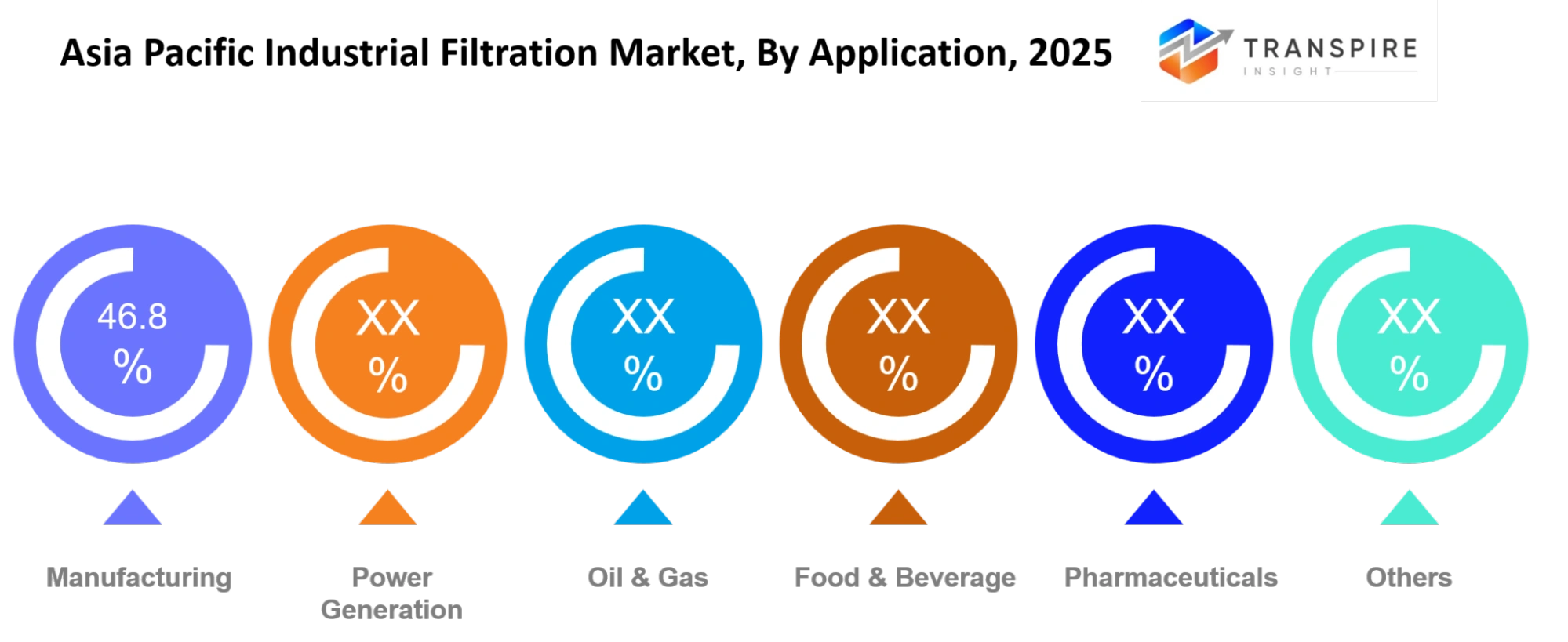
Manufacturing is the bigges t application segment, mostly because there are continuous needs for contamination management, equipment shielding, and better process optimization across industrial sites. Filtration systems help keep the product quality steady while also minimizing those operational hitches that come from airborne and liquid impurities. In the Asia Pacific Industrial Filtration Market, this segment pulls in strong revenue, since industrial output keeps climbing and modernization efforts, kind of everywhere, keep accelerating. Ongoing spending on production efficiency also helps, making the demand feel more durable and stable.
Then there is Power Generation, which leans on advanced filtration systems so the equipment stays efficient and reliability improves even when conditions get tough. Oil & Gas uses filtration technologies to guard machines, elevate fluid quality, and back safe production flow. In Food & Beverage plants, filtration solutions are needed to protect product safety and meet quality rules. Pharmaceuticals, on the other hand, depend on very controlled filtration performance in order to support manufacturing precision and consistency. The “Others” group covers mining, chemicals, electronics, and also specialized industrial processing, with slightly different needs that still fall under filtration coverage.
To learn more about this report, Download Free Sample Report
By End User
Industrial facilities end up taking the biggest chunk of filtration adoption, mostly because in real production settings you really have to handle air quality, process fluids, and operational contaminants in a consistent way. The pull is strong from manufacturing, chemical processing, electronics production, and also from heavy industrial activities. For Asia Pacific, the industrial filtration market is still getting a boost from facility upgrades that aim at productivity, compliance, and asset protection , honestly. Plus the long run operating cycles keep replacement and maintenance work in motion.
Power plants rely on filtration systems to help shield important equipment, keep efficiency stable, and meet the environmental compliance needs that keep showing up. In the oil & gas segment, companies use filtration technologies across extraction, transport, refining, and processing to raise overall system reliability and also lower maintenance expenses. There are other users too—water treatment operators, food processing facilities, pharmaceutical manufacturers, and niche industrial buyers who need dependable contaminant management all the time. As industrial development keeps moving across regional economies, adoption should keep staying fairly steady across these different end-use groups.
What are the Key Use Cases Driving the Asia Pacific Industrial Filtration Market?
The biggest source of demand kind of comes from industrial air filtration that’s used inside manufacturing facilities, power plants, metal processing operations, and also chemical production sites. In those places, airborne contaminants pop up, and they can end up damaging equipment, lowering worker safety levels, and yes, creating regulatory compliance headaches too. With continuous filtration, operations stay steadier, and it also tends to reduce ongoing maintenance costs.
Other uses are spreading into water treatment facilities, food and beverage processing plants, pharmaceutical manufacturing sites, and petrochemical operations. Those industries depend on liquid filtration systems, to pull out impurities, keep product quality in line, and satisfy operational standards that are getting stricter over time.
On top of that, new use cases are emerging in semiconductor fabrication, battery manufacturing, hydrogen production facilities, and data centers. These environments demand exceptionally high purity, plus precise contamination management, so there’s a real opening for advanced filtration technologies that can support next-generation industrial production.
|
Report Metrics |
Details |
|
Market size value in 2025 |
USD 1.98 Billion |
|
Market size value in 2026 |
USD 2.13 Billion |
|
Revenue forecast in 2033 |
USD 3.58 Billion |
|
Growth rate |
CAGR of 7.70% from 2026 to 2033 |
|
Base year |
2025 |
|
Historical data |
2021 - 2024 |
|
Forecast period |
2026 - 2033 |
|
Report coverage |
Revenue forecast, competitive landscape, growth factors, and trends |
|
Regional scope |
Asia Pacific (India, China, Japan, Australia, South Korea, Rest of Asia Pacific) |
|
Key company profiled |
Pall Corporation, Donaldson Company, Eaton, Parker Hannifin, Camfil, 3M, Freudenberg Filtration, Mann+Hummel, Alfa Laval, Ahlstrom, Lenntech, Cummins Filtration, Filtration Group, Veolia, Porvair. |
|
Customization scope |
Free report customization (country, regional & segment scope). Avail customized purchase options to meet your exact research needs. |
|
Report Segmentation |
By Product Type (Air Filtration Systems, Liquid Filtration Systems, Dust Collectors, Membrane Filters, HEPA Filters, Others); By Application (Manufacturing, Power Generation, Oil & Gas, Food & Beverage, Pharmaceuticals, Others); By End User (Industrial Facilities, Power Plants, Oil & Gas Companies, Others). |
Which Regions are Driving the Asia Pacific Industrial Filtration Market Growth?
East Asia remains the main regional market, mostly because it has a huge manufacturing backbone, broad industrial facilities, and pretty tough environmental rule sets. China, Japan, South Korea, and Taiwan together grab a big chunk of the filtration need. Also, a lot of money keeps flowing into electronics, semiconductors, chemicals, and power production, so equipment gets replaced on a fairly regular rhythm . On top of that, the supplier network is already well-developed, which sort of locks in regional leadership.
Southeast Asia ends up being the second biggest contributor, but it’s not really the same as East Asia. It leans more on an export-driven manufacturing approach. Places like Vietnam, Thailand, Malaysia, and Indonesia keep pulling in industrial investment from multinational producers, they want production diversification, basically. Filtration demand also gets a boost from nonstop factory build-outs and industrial park development. With steady economic growth and manufacturing exports that are still climbing, market revenue looks likely to stay solid over the long run.
South Asia is showing up as the quickest-growing regional market across the forecast window. In India, industrial growth is expanding, and at the same time environmental enforcement is getting tighter, plus infrastructure spending keeps rising. That combination has pushed demand toward newer filtration systems. Government programs that back manufacturing scale-up and wastewater management create extra openings for suppliers too. So for investors, and for companies entering the market, South Asia offers one of the strongest growth paths between 2026 and 2033.
Who are the Key Players in the Asia Pacific Industrial Filtration Market and How Do They Compete?
Competition inside the Asia Pacific industrial filtration market still looks kinda moderately fragmented, with big global filtration names showing up right next to regional makers. In practice it often comes down to how well the technology performs, how efficient the filtration is, the full lifecycle cost, and whether service support is actually good when it matters, you know. Even if the well-established firms keep solid footing, digital filtration approaches and more specialized use cases are quietly opening up space for differentiation.
Pall Corporation keeps pushing high performance filtration tech, especially for sensitive applications like pharmaceuticals, electronics, and advanced manufacturing. Their capability to provide contamination control for heavily regulated sectors is a real edge. Donaldson Company meanwhile differentiates via industrial dust collection, compressed air filtration, and predictive maintenance tools that are meant to lift day to day operational efficiency.
Camfil leans hard into energy-efficient air filtration systems , plus sustainability oriented performance measurements. Mann+Hummel is also broadening its reach into industrial air purification, data center filtration, and newer filter materials, while also putting money into AI-assisted product development and local partnerships that feel more “on the ground”. Alfa Laval leverages its strengths in separation and fluid handling to reinforce its presence in industrial liquid filtration. Overall, these players are bumping into each other more often through innovation, localized manufacturing, digital service platforms and expansion into higher-growth industrial segments.
Company List
- Pall Corporation
- Donaldson Company
- Eaton
- Parker Hannifin
- Camfil
- 3M
- Freudenberg Filtration
- Mann+Hummel
- Alfa Laval
- Ahlstrom
- Lenntech
- Cummins Filtration
- Filtration Group
- Veolia
- Porvair
Recent Development News
In March 2025, MANN+HUMMEL launched a new generation of CO₂-reduced filters manufactured with plant-based raw materials and renewable energy. The product supports sustainability goals while maintaining filtration performance and strengthens innovation competition in advanced filtration technologies.
Source: https://www.mann-filter.com
In November 2025, Parker Hannifin announced the acquisition of Filtration Group for approximately USD 9.25 billion. The transaction is expected to create one of the world's largest industrial filtration businesses and strengthen aftermarket filtration capabilities.
Source: https://www.reuters.com
What Strategic Insights Define the Future of the Asia Pacific Industrial Filtration Market?
The Asia Pacific industrial filtration market is kind of moving toward this future where filtration systems stop being only standalone mechanical products and instead turn into integrated operational intelligence platforms. You can see it in the way stricter environmental rules, advanced manufacturing growth, and digital plant operations are coming together and pushing buyers to prefer suppliers who bring connected , predictive, and energy-efficient filtration solutions. So value creation might shift away from just selling hardware and move toward service contracts, monitoring platforms, and performance-based maintenance models.
Still, there’s one risk that gets glossed over a bit. It’s the growing dependence on specialized filtration media and raw materials. If supply gets disrupted or pricing gets wobbly for those materials , margins can get squeezed and project timelines can slip even if demand stays strong. At the same time, there’s an opportunity building alongside it, especially around semiconductor fabrication, battery production, and data center infrastructure, where contamination control needs are way higher than many traditional industrial use cases.
For market participants, the best play is probably to invest in intelligent filtration technologies and localized manufacturing capabilities at the same time. The companies that can blend advanced filtration performance with digital service offerings will likely be the ones that hold the strongest position and grab more long-term market share across Asia Pacific.
Asia Pacific Industrial Filtration Market Report Segmentation
By Product Type
- Air Filtration Systems
- Liquid Filtration Systems
- Dust Collectors
- Membrane Filters
- HEPA Filters
- Others
By Application
- Manufacturing
- Power Generation
- Oil & Gas
- Food & Beverage
- Pharmaceuticals
- Others
By End User
- Industrial Facilities
- Power Plants
- Oil & Gas Companies
- Others
Frequently Asked Questions
Find quick answers to common questions.
The expected Asia Pacific Industrial Filtration Market size for the market will be USD 3.58 Billion in 2033.
Key segments for the Asia Pacific Industrial Filtration Market are By Product Type (Air Filtration Systems, Liquid Filtration Systems, Dust Collectors, Membrane Filters, HEPA Filters, Others); By Application (Manufacturing, Power Generation, Oil & Gas, Food & Beverage, Pharmaceuticals, Others); By End User (Industrial Facilities, Power Plants, Oil & Gas Companies, Others).
Major Asia Pacific Industrial Filtration Market players are Pall Corporation, Donaldson Company, Eaton, Parker Hannifin, Camfil, 3M, Freudenberg Filtration, Mann+Hummel, Alfa Laval, Ahlstrom, Lenntech, Cummins Filtration, Filtration Group, Veolia, Porvair.
The Asia Pacific Industrial Filtration Market size is USD 1.98 Billion in 2025.
The Asia Pacific Industrial Filtration Market CAGR is 7.70% from 2026 to 2033.
- Pall Corporation
- Donaldson Company
- Eaton
- Parker Hannifin
- Camfil
- 3M
- Freudenberg Filtration
- Mann+Hummel
- Alfa Laval
- Ahlstrom
- Lenntech
- Cummins Filtration
- Filtration Group
- Veolia
- Porvair
About the Authors

Pankaj Ghogare Patil
I am Pankaj Ghogare Patil, a Senior Research Analyst at Transpire Insight, specializing in the Pharmaceutical, Chemicals & Materials, Healthcare IT, and Biotechnology industry. My expertise lies in conducting comprehensive market research, analyzing industry trends, evaluating competitive landscapes, and translating complex data into actionable insights. At Transpire Insight, I closely follow emerging technologies, regulatory developments, and market innovations to create accurate, well-researched, and informative content that helps businesses and professionals make informed decisions. I am committed to producing credible, evidence-based articles that reflect industry best practices while making technical topics accessible and valuable for a broad audience.

Chakradhar Khansole
Chakradhar serves as the Research Director at Transpire Insight, bringing over 8 years of experience in technology, innovation, and strategic market intelligence. He specializes in transforming complex market data into actionable business insights that enable organizations to make informed, growth-oriented decisions. Recognized for his strategic vision and analytical expertise, Chakradhar leads high-impact research initiatives, delivering comprehensive market assessments, competitive intelligence, and forward-looking industry analysis.
Recently Published Reports
-
May 2026
Healthcare Polymer Packaging Market
Healthcare Polymer Packaging Market Size, Share & Analysis Report By Packaging Type (Syringes, IV Bottles and Pouches, Clamshells, Blisters, Bottles & Jars, Containers, Tubes, IV Parental Packaging, Others), By Type (Regulated, Non-regulated), By Polymer Type (LDPE (Low-Density Polyethylene), HDPE (High-Density Polyethylene), Homo-polymer (Homo), Random Copolymer (Random), Block Copolymer (Block), PET, Polystyrene, Polyvinyl Chloride, Polyamide/EVOH, Others), and Geography (North America, Europe, Asia-Pacific, Middle East and Africa, South and Central America), 2021 - 2031
-
Apr 2026
Hydrophilic Tape (Waterstop) Market
Hydrophilic Tape (Waterstop) Market Size, Share & Analysis Report By Type (Bentonite-Based Hydrophilic Tape, Rubber-Based Hydrophilic Tape), By Application (Residential Buildings, Commercial Buildings, Infrastructure Projects), and Geography (North America, Europe, Asia-Pacific, Middle East and Africa, South and Central America), 2021 - 2031
-
Apr 2026
Metalens Market
Metalens Market Size, Share & Analysis Report By Type (Visible Light Metalens, and Infrared Metalens), By Application (Consumer Electronics, Automotive Electronics, Industrial, Medical, and Others), and Geography (North America, Europe, Asia-Pacific, Middle East and Africa, South and Central America), 2021 - 2031
-
Apr 2026
PBT Resin Market
PBT Resin Market Size, Share & Analysis Report By Type (Reinforced PBT Resin, Unreinforced PBT Resin), By Processing Method (Injection Molding, Extrusion, Blow Molding, Others), By End-User (Automotive, Electrical & Electronics, Consumer Appliances, Industrial Machinery, Medical Devices, Packaging, Others), and Geography (North America, Europe, Asia-Pacific, Middle East and Africa, South and Central America), 2021 - 2031