

Global Gas Phase Filtration Market Size & Forecast:
- Global Gas Phase Filtration Market Size 2025: USD 12.61 Billion
- Global Gas Phase Filtration Market Size 2033: USD 17.31 Billion
- Global Gas Phase Filtration Market CAGR: 4.04%
- Global Gas Phase Filtration Market Segments: By Type (Activated Carbon, Potassium Permanganate, Blend Media, Impregnated Carbon), By Application (Air Purification, Industrial, Commercial, Healthcare), By End-User (Industrial Plants, Commercial Buildings, Healthcare Facilities, Utilities)

To learn more about this report,  Download Free Sample Report
Global Gas Phase Filtration Market Summary:
The Global Gas Phase Filtration Market size is estimated at USD 12.61 billion in 2025 and is anticipated to reach USD 17.31 billion by 2033, growing at a CAGR of 4.04% from 2026 to 2033. Due to a rise in the number of industrializations and awareness of the toxic gases and pollutants that are transmitted through the air, there is a rise in the adoption of advanced filtration technologies.
The gas-phase filtration market has surged over the past five years, shifting structurally toward eco-friendly, bio-based media to meet stricter green building standards. This evolution was triggered by massive global investments in advanced semiconductor fabs. Consequently, skyrocketing industrial tech production has amplified the demand for micro-contamination control, accelerating market growth to ensure flawless hardware performance.
Key Market Insights:
The global Gas Phase Filtration Market is expanding steadily. It is driven by tightening environmental emission regulations and surging demand for corrosive gas removal in critical cleanrooms, semiconductor fabrication plants, and data centers.
- The market is projected to grow at a CAGR of 4.04% during 2026 to 2033.
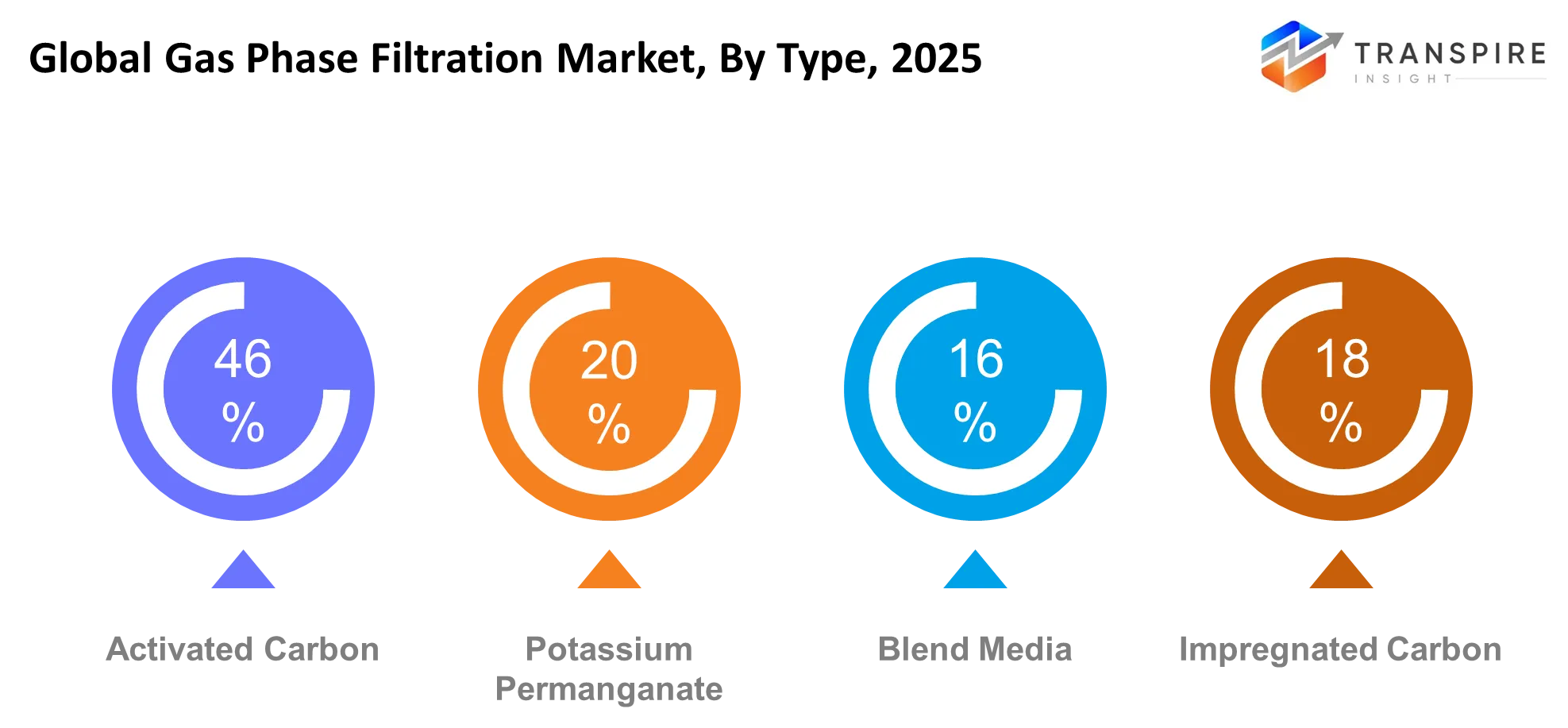
- Activated carbon filters hold 46% market share due to high adsorption efficiency.
- Industrial applications account for nearly 40% of total market demand globally.
- Asia-Pacific holds 45% of the market share, led by China and India.
- Chemical and petrochemical industries represent around 30% of end-user demand.
- More than 60% of new installations focus on VOC and odor control systems.
- Smart monitoring adoption in filtration systems increased by over 25% in recent years.
What are the Key Drivers, Restraints, and Opportunities in the Global Gas Phase Filtration Market?
Drivers:
Stricter air-quality regulations across the manufacturing, chemical processing, and wastewater treatment industries are driving the Global Gas Phase Filtration Market. Governments have strengthened limits on volatile organic compounds (VOCs), hazardous gases, and industrial odors, triggering investments in advanced filtration systems. As facilities seek regulatory compliance and workplace safety improvements, adoption of gas phase filtration technologies rises, supporting equipment upgrades, replacement demand, and long-term service revenue growth.
Restraints:
High installation and maintenance costs remain a major limitation for the Global Gas Phase Filtration Market. Specialized filtration media require regular replacement, while system design often needs customization for specific contaminants. This challenge persists because many industrial sites operate with aging infrastructure and limited capital budgets. Small and medium-sized facilities frequently delay upgrades, slowing market penetration despite regulatory pressure and operational benefits.
Opportunities:
The expansion of smart industrial facilities and digital air-quality management creates a significant growth opportunity. IoT-enabled sensors, remote monitoring platforms, and predictive maintenance technologies allow filtration systems to operate more efficiently and reduce downtime. For example, rapid investments in smart manufacturing projects across China, India, and Southeast Asia are encouraging the deployment of intelligent gas filtration solutions, opening new revenue streams for technology providers.
What Has the Impact of Artificial Intelligence Been on the Global Gas Phase Filtration Market?
AI and filtration systems have worked together to enhance the performance and efficiency of gas phase filtration systems, facilitating smarter monitoring and control of air purification processes. Traditional filtration systems were based on pre-determined maintenance cycles and manual checks. In today's technologically advanced world, these platforms introduce AI capabilities for real-time analysis of data gathered from sensors that monitor gas levels, airflow, temperature, humidity, and filter performance. This enables operators to fine-tune the filtration performance according to the actual operating conditions, and not an assumption.
AI also enhances predictive measures in the industry. Algorithms can detect patterns that can predict filter failure or equipment failure, degradation of media, before a failure. This means that facilities can plan maintenance, minimizing any downtime and decreasing any costly interruptions. Predictive maintenance ultimately helps to maximize asset utilization and prolong filter service life, reducing total operating expenses.
Oxmaint launched an AI-driven predictive maintenance platform explicitly configured for heavy-duty industrial HVAC and air handling units (AHUs). This platform integrates dynamic baseline models and multi-sensor anomaly confirmation to track failure points early, significantly reducing unplanned downtime and optimizing overall energy efficiency. In February 2026, Oxmaint launched an AI-driven predictive maintenance platform explicitly configured for heavy-duty industrial HVAC and air handling units (AHUs).
Key Market Trends:
- The Global Gas Phase Filtration Market is changing from air cleaning to intelligent contamination control.
- Smart and energy-efficient systems are increasingly being embraced by industries to meet increasingly demanding environmental regulations.
- With stricter emission standards in various industries, the focus on VOC control increased.
- Industry's demand for improved gas removal efficiency led to the increased use of activated carbon.
- The use of manual monitoring was reduced when smart sensors were introduced in the filtration systems.
- The use of AI-based monitoring technologies boosted the adoption of predictive maintenance.
- There was an increasing interest in energy-efficient filters as companies sought to cut costs.
- Demand for semiconductors rose, which drove up advanced clean air filter installations.
- The cold chain facilities grew, and there was a need for odor and gas control.
- As industries became more complex in their contamination process, customized filtration solutions developed.
- The number of real-time air quality monitoring systems deployed in manufacturing and commercial facilities rose.
- Asia-Pacific investments increased, driving up smart industrial filtration deployments.
Global Gas Phase Filtration Market Segmentation
By Type
The activated carbon is the largest type segment in the Global Gas Phase Filtration Market, accounting for 46% of the market share. It is known for its exceptional VOC, odour, and harmful gases removal capabilities in industrial and commercial settings. The media is universally used due to its low cost and ability to remove a wide range of contaminants. The demand for activated carbon is anticipated to continue to dominate the market in the future due to the increasingly stringent emission norms and the need for air quality maintenance for industries.
Potassium permanganate is the fastest-growing type segment with a CAGR at 14.0%. Its growth is fueled by its efficiency in removing corrosive gases, sulfur compounds, and formaldehyde, which traditional media may not be able to remove. This technology is being more widely adopted by industrial facilities to meet more stringent environmental compliance regulations. Industries will look toward specialized solutions for more complex gas contamination challenges in the future, which will further drive the need.
Media blending is slightly less popular (16% market share) but is still growing as it can treat multiple contaminants at once. It is designed to use a variety of filtering materials to offer superior efficiency and versatility under different conditions of operation. Blend media is used in industries where more than one stream of pollutants has to be filtered. The demand for blend media will continue to grow steadily as contamination control needs become more complex.
Impregnated carbon represents almost 18% of the market and is gaining popularity in those areas where specific gases must be removed. The chemically treated media is useful in semiconductor, healthcare facilities, and industrial plants for improved performance against specific contaminants. Growing demand for precision air-quality management supports its adoption. Its future usability is projected to grow with the development of new technologies for special filtration applications.
To learn more about this report, Download Free Sample Report
By Application
Air purification remains the largest application area as organizations increasingly invest in indoor air-quality improvement. The segment benefits from growing awareness of airborne pollutants, workplace safety, and environmental health standards. Advanced gas phase filtration systems are being installed in public facilities, transportation hubs, and commercial spaces to improve air quality. Future growth will be supported by smart air-management technologies and stricter building standards, particularly in rapidly urbanizing regions.
Industrial applications continue to represent a major share of the market due to increasing requirements for emission control and workplace safety. Chemical, petrochemical, manufacturing, and processing industries rely on gas phase filtration to manage hazardous gases and maintain regulatory compliance. The shift toward automated production facilities further supports adoption. As industrial modernization accelerates, filtration systems will become increasingly important for operational efficiency and environmental protection.
Commercial applications are expanding as businesses focus on healthier indoor environments and sustainability goals. Offices, shopping centers, hotels, and public buildings are investing in advanced filtration technologies to improve occupant comfort and meet environmental standards. Building operators are also integrating smart monitoring systems to optimize air-quality performance. Future growth will be supported by green building initiatives and increasing demand for intelligent facility management solutions.
Healthcare applications are experiencing strong growth due to the need for contamination-free environments in hospitals, laboratories, and pharmaceutical facilities. Gas phase filtration helps remove chemical pollutants, odors, and airborne contaminants that can affect patient safety and sensitive processes. Expanding healthcare infrastructure and stricter environmental standards are driving adoption. Future investments in advanced healthcare facilities are expected to further strengthen demand for specialized filtration systems.
By End-User
Industrial plants remain the largest end-user segment because they generate significant volumes of gaseous emissions and require continuous contamination control. Industries such as chemicals, oil and gas, food processing, and manufacturing depend on filtration systems to ensure compliance and operational safety. Ongoing industrial expansion continues to support demand. Future adoption will increase as facilities implement smarter and more sustainable production practices.
Commercial buildings represent a rapidly growing end-user category as property owners prioritize indoor air quality and occupant well-being. Modern office complexes, retail centers, airports, and hospitality facilities increasingly deploy advanced filtration technologies. Growing awareness of environmental quality is encouraging investment in air-management systems. Looking ahead, connected building technologies will drive further adoption of intelligent gas phase filtration solutions.
Healthcare facilities are emerging as a critical end-user group due to rising requirements for controlled indoor environments. Hospitals, research centers, and pharmaceutical manufacturing sites rely on filtration systems to maintain strict air-quality standards. Increased healthcare spending and facility modernization are supporting market growth. Future expansion of healthcare infrastructure is expected to create additional opportunities for advanced filtration technologies.
Utilities are becoming increasingly important end users, particularly in water treatment, wastewater management, and power generation operations. These facilities use gas phase filtration to control corrosive gases, odors, and harmful emissions that can affect equipment performance and public safety. Infrastructure modernization projects continue to drive demand. Future investments in sustainable utility networks will further increase the adoption of advanced filtration systems.
What are the Key Use Cases Driving theGlobal Gas Phase Filtration Market?
Among the biggest applications of gas-phase filtration systems is industrial emission control. These systems are employed at chemical plants, petrochemical facilities, pulp and paper mills, and manufacturing facilities to capture and remove harmful gases, such as volatile organic compounds (VOCs), hydrogen sulfide, ammonia, and others. This not only assists businesses in meeting environmental rules but also boosts the safety of workplaces and maximizes efficiency.
A second important application sector is commercial and indoor air quality management. Gas-phase filtration is used in office buildings, airports, shopping centres, hotels, and data centres to remove odours and chemical contaminants such as VOCs. Organizations are increasingly making occupant health and comfort a priority, and advanced filtration technologies are playing an increasingly important role in building management.
Use cases of healthcare and critical infrastructure protection are growing fast. Gas phase filtration is used to create clean air environments in hospitals, laboratories, pharmaceutical manufacturing facilities, water treatment plants, and wastewater treatment facilities to help prevent the damage of sensitive equipment caused by corrosive gases. Investment in healthcare electronics, semiconductors, and utility modernization is driving further demand for high-performance gas phase filtration solutions.
Report Metrics
|
Report Metrics |
Details |
|
Market size value in 2025 |
USD 12.61 Billion |
|
Market size value in 2026 |
USD 13.12 Billion |
|
Revenue forecast in 2033 |
USD 17.31 Billion |
|
Growth rate |
CAGR of 4.04% from 2026 to 2033 |
|
Base year |
2025 |
|
Historical data |
2021 - 2024 |
|
Forecast period |
2026 - 2033 |
|
Report coverage |
Revenue forecast, competitive landscape, growth factors, and trends |
|
Regional scope |
United States; Canada; Mexico; United Kingdom; Germany; France; Italy; Spain; Denmark; Sweden; Norway; China; Japan; India; Australia; South Korea; Thailand; Brazil; Argentina; South Africa; Saudi Arabia; United Arab Emirates |
|
Key company profiled |
Camfil, Donaldson, Parker Hannifin, Honeywell, Freudenberg, 3M, AAF International, Purafil, Bry-Air, Lennox, Mann+Hummel, Koch Filter, Air Products, Filtration Group, Nederman. |
|
Customization scope |
Free report customization (country, regional & segment scope). Avail customized purchase options to meet your exact research needs. |
|
Report Segmentation |
By Type (Activated Carbon, Potassium Permanganate, Blend Media, Impregnated Carbon), By Application (Air Purification, Industrial, Commercial, Healthcare), By End-User (Industrial Plants, Commercial Buildings, Healthcare Facilities, Utilities). |
Which Regions are Driving the Gas Phase Filtration Growth?
Asia Pacific is the leading region in the Global Gas Phase Filtration Market, accounting for 45% market share. The region is dominant because of its high industrialization rate, large-scale manufacturing, and growing chemical processing industries. Market growth is continued by investment in industrial infrastructure, mainly in China, India, Japan, and Southeast Asia. The government's efforts to tackle air pollution and tougher environmental regulations continue to bolster the demand for gas-phase filtration systems. Camfil, a prestigious company of Asia Pacific, started building a huge factory expansion in Malaysia. This will quickly pump out more specialized air filters across Asia to keep electronics factories and data centers completely free of harmful chemical gases.
This development significantly scales up production and R&D capacity to meet the skyrocketing regional demand for molecular and gas-phase filtration systems across Asia-Pacific's semiconductor plants, data centers, and industrial sectors. In May 2026, Camfil Malaysia broke ground on a new 14,400-square-meter facility expansion in Malaysia. This expansion means cleaner air for Asia's massive tech and tech-manufacturing factories, helping them run smoothly without dust or chemical damage.
The second largest regional market with 25% of global revenue is Europe. Growth in Europe is more strongly shaped by environmental requirements and the need for sustainability than in the Asia Pacific, where it is more related to industrial growth. The area has a relatively developed industrial sector and regulations that promote ongoing upgrades to the filtration system. The commercial buildings, healthcare, and utility markets provide the foundation for long-term growth. Adsorbi, one of the greatest companies, has launched Arbomax, recently. This is a new eco-friendly air filter material made from wood. This new invention replaces messy coal-based filters, making it much cleaner and easier for European buildings and factories to trap harmful chemical gases from the air. In April 2026, Adsorbi commercially launched Arbomax, a new eco-friendly air filter material made from wood cellulose. This new material makes gas-phase filtration much more sustainable by replacing traditional coal-based charcoal filters with a clean, long-lasting alternative that traps harmful chemical gases in buildings and factories.
North America is poised to register the highest growth rate of 15.0% CAGR. The recent growth has been fuelled by rising investments in smart manufacturing, semiconductor manufacturing, and advanced air quality management technologies. AI-powered monitoring and predictive maintenance systems are becoming more common in businesses to optimize filtration efficiency and minimize operational costs. Infrastructure modernization, expansion of data centers, and the increasing use of intelligent industrial systems will be additional sources of future opportunities. Some of the finest companies of North America are Pall Corporation, Donaldson Company, Parker Hannifin, and Honeywell. Every company is bringing change to the air and gas filtration system. Recently, Pall Corporation has introduced a product, SepraSol™ Plus HLG Coalescer and High Flow Gas filtration solutions. It helps oil and gas operators lower operational expenses, increase reliability, and optimize plant performance. In February 2026, Pall Corporation launched the SepraSol™ Plus HLG Coalescer and High Flow Gas filtration solutions. The launch helps oil and gas operators reduce capital costs while maintaining high-performance gas filtration.

To learn more about this report, Download Free Sample Report
Who are the Key Players in theGlobal Gas Phase Filtration Market and How do they Compete?
Due to its competitive nature, various companies have differentiated in terms of the filtration efficiency, specialized media technologies, digital monitoring technologies, and industry-specific solutions. Competitive attention is now increasingly turning to compliance with more stringent environmental and industrial air quality standards and energy efficiency targets. Manufacturers are also scaling up their service offerings, custom-engineered systems, and smart filtration technologies to further enhance customer loyalty and identify new industrial applications.
Competitive strategies include innovative filters, such as high-performance filtration media and energy-efficient systems, offered by such companies as Camfil, Donaldson, and Parker Hannifin. Honeywell stands out for combining cutting-edge smart building solutions with filtration, while Freudenberg focuses on the quality of the materials used and their durability. For its part, 3M is known for applying its research expertise to create specialty solutions that address contamination control needs, while AAF International is dedicated to customizing its filtration expertise for industrial and commercial facilities. These businesses grow by inventing new products, partnering in new regions, and investing in high-growth markets.
Both Purafil and Bry-Air take niche strategies, focusing on gas-phase contamination control and industrial air treatment applications. Lennox, Mann Plus Hummel, and Koch Filter enhance their competitive standing with wide distribution and application-specific solutions. Air Products is dedicated to its industrial gas business, and Filtration Group grows via acquisition and diversified filtration offerings. Nederman stands out with its solutions addressing industrial emissions and air quality in work environments. The majority of companies are growing by investing in technology advancements, manufacturing locally, and growing their presence in Asia-Pacific and North America.
Key Global Gas Phase Filtration Market Companies
- Camfil
- Donaldson
- Parker Hannifin
- Honeywell
- Freudenberg
- 3M
- AAF
- International
- Purafil
- Bry-Air
- Lennox
- Mann+Hummel
- Koch Filter
- Air Products
- Filtration Group
- Nederman
Recent Development News
In March 2026, Camfil launched the CC X-Series industrial air cleaners. The launch focuses on real-time air-quality monitoring, energy efficiency, and contamination control in manufacturing and logistics facilities.
Source- https://www.filtnews.com
In May 2026, Pall Corporation launched an additively manufactured flue-gas filtration program. The development aims to improve carbon-capture reliability and support industrial decarbonization efforts.
Source- https://www.pall.com
What Strategic Insights Define the Future of the Global Gas Phase Filtration Market?
The future of the gas-phase filtration market lies in targeted sustainability and high-precision contamination control, driven by massive expansions in regional semiconductor manufacturing and hyperscale data centers. A major emerging opportunity exists in the commercialization of bio-based, renewable filter media, such as wood cellulose innovations, which drastically reduce a company’s carbon footprint while maintaining performance.
Strategic Recommendation: Industry leaders must aggressively pivot R&D investments away from fossil-fuel-dependent media and transition toward circular-economy services, such as filter regeneration centers and biodegradable materials. Embracing these eco-friendly alternatives is no longer just a green selling point; it is the ultimate way to future-proof supply chains against imminent regulatory shifts.
Key Global Gas Phase Filtration Market Segmentation
By Type
- Activated Carbon
- Potassium Permanganate
- Blend Media
- Impregnated Carbon
By Application
- Air Purification
- Industrial
- Commercial
- Healthcare
By End-User
- Industrial Plants
- Commercial Buildings
- Healthcare Facilities
- Utilities
Regional Outlook
North America
- United States
- Canada
- Mexico
Europe
- Germany
- United Kingdom
- France
- Spain
- Italy
- Rest of Europe
Asia Pacific
- Japan
- China
- Australia & New Zealand
- South Korea
- India
- Rest of Asia Pacific
South America
- Brazil
- Argentina
- Rest of South America
Middle East & Africa
- Saudi Arabia
- United Arab Emirates
- South Africa
- Rest of the Middle East & Africa
Frequently Asked Questions
Find quick answers to common questions.
The expected Global Gas Phase Filtration Market size for the market will be USD 17.31 billion in 2033.
Key segments for the Global Gas Phase Filtration Market are By Type (Activated Carbon, Potassium Permanganate, Blend Media, Impregnated Carbon), By Application (Air Purification, Industrial, Commercial, Healthcare), By End-User (Industrial Plants, Commercial Buildings, Healthcare Facilities, Utilities).
Major Keyword players are Camfil, Donaldson, Parker Hannifin, Honeywell, Freudenberg, 3M, AAF International, Purafil, Bry-Air, Lennox, Mann+Hummel, Koch Filter, Air Products, Filtration Group, and Nederman.
The Global Gas Phase Filtration Market size is USD 13.12 Billion in 2026.
The Global Gas Phase Filtration Market CAGR is expected to grow 4.04% during the forecast period.
- Camfil
- Donaldson
- Parker Hannifin
- Honeywell
- Freudenberg
- 3M
- AAF
- International
- Purafil
- Bry-Air
- Lennox
- Mann+Hummel
- Koch Filter
- Air Products
- Filtration Group
- Nederman
About the Authors

Pankaj Ghogare Patil
I am Pankaj Ghogare Patil, a Senior Research Analyst at Transpire Insight, specializing in the Pharmaceutical, Chemicals & Materials, Healthcare IT, and Biotechnology industry. My expertise lies in conducting comprehensive market research, analyzing industry trends, evaluating competitive landscapes, and translating complex data into actionable insights. At Transpire Insight, I closely follow emerging technologies, regulatory developments, and market innovations to create accurate, well-researched, and informative content that helps businesses and professionals make informed decisions. I am committed to producing credible, evidence-based articles that reflect industry best practices while making technical topics accessible and valuable for a broad audience.

Chakradhar Khansole
Chakradhar serves as the Research Director at Transpire Insight, bringing over 8 years of experience in technology, innovation, and strategic market intelligence. He specializes in transforming complex market data into actionable business insights that enable organizations to make informed, growth-oriented decisions. Recognized for his strategic vision and analytical expertise, Chakradhar leads high-impact research initiatives, delivering comprehensive market assessments, competitive intelligence, and forward-looking industry analysis.
Recently Published Reports
-
May 2026
Healthcare Polymer Packaging Market
Healthcare Polymer Packaging Market Size, Share & Analysis Report By Packaging Type (Syringes, IV Bottles and Pouches, Clamshells, Blisters, Bottles & Jars, Containers, Tubes, IV Parental Packaging, Others), By Type (Regulated, Non-regulated), By Polymer Type (LDPE (Low-Density Polyethylene), HDPE (High-Density Polyethylene), Homo-polymer (Homo), Random Copolymer (Random), Block Copolymer (Block), PET, Polystyrene, Polyvinyl Chloride, Polyamide/EVOH, Others), and Geography (North America, Europe, Asia-Pacific, Middle East and Africa, South and Central America), 2021 - 2031
-
Apr 2026
Hydrophilic Tape (Waterstop) Market
Hydrophilic Tape (Waterstop) Market Size, Share & Analysis Report By Type (Bentonite-Based Hydrophilic Tape, Rubber-Based Hydrophilic Tape), By Application (Residential Buildings, Commercial Buildings, Infrastructure Projects), and Geography (North America, Europe, Asia-Pacific, Middle East and Africa, South and Central America), 2021 - 2031
-
Apr 2026
Metalens Market
Metalens Market Size, Share & Analysis Report By Type (Visible Light Metalens, and Infrared Metalens), By Application (Consumer Electronics, Automotive Electronics, Industrial, Medical, and Others), and Geography (North America, Europe, Asia-Pacific, Middle East and Africa, South and Central America), 2021 - 2031
-
Apr 2026
PBT Resin Market
PBT Resin Market Size, Share & Analysis Report By Type (Reinforced PBT Resin, Unreinforced PBT Resin), By Processing Method (Injection Molding, Extrusion, Blow Molding, Others), By End-User (Automotive, Electrical & Electronics, Consumer Appliances, Industrial Machinery, Medical Devices, Packaging, Others), and Geography (North America, Europe, Asia-Pacific, Middle East and Africa, South and Central America), 2021 - 2031