
Asia Pacific Industrial Automation Services Market Summary
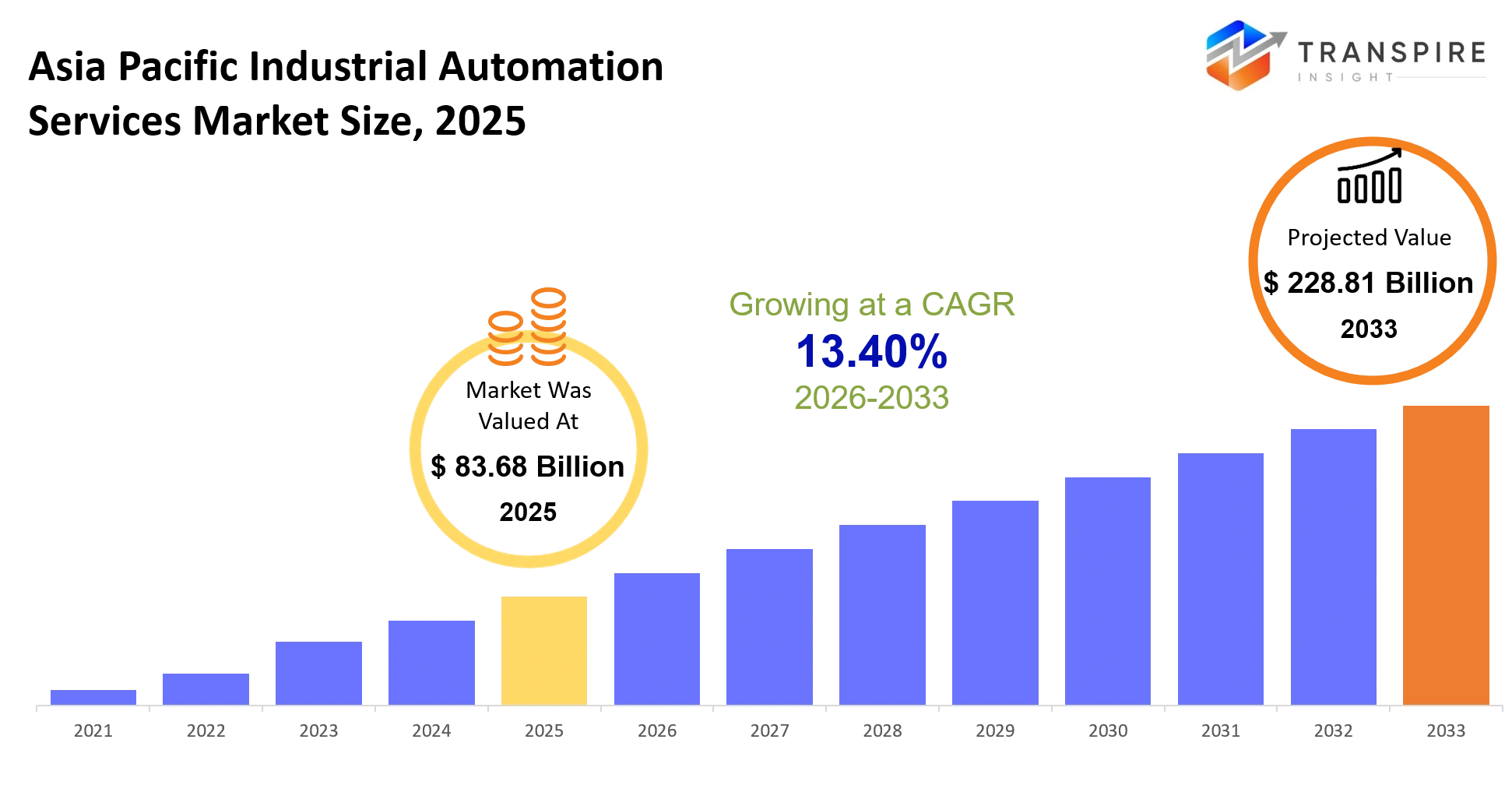
As per Transpire Insight Analysis the Asia Pacific Industrial Automation Services Market size is estimated at USD 20.8 billion in 2025 and is anticipated to reach USD 228.81 Billion by 2033, growing at a CAGR of 13.40% from 2026 to 2033.
The Asia Pacific Industrial Automation Services Market, in a way, supports manufacturers utilities, and other process industries by integrating, maintaining, and optimizing automated production systems, so overall efficiency improves, downtime gets reduced, and operational reliability gets stronger. Industrial automation services also help plants modernize older, legacy equipment, connect digital control platforms, and keep production running with very little disruption. In the last five years , the market has gone from mostly standalone automation projects toward more connected, software driven service ecosystems, and it’s largely being powered by industrial IoT, cloud platforms, plus advanced analytics. Then COVID-19 showed up, followed by global supply chain disruptions, and it kinda pushed factory digitalization faster , because manufacturers wanted more production resilience and better remote operational visibility. So, demand has risen for lifecycle services like predictive maintenance, remote monitoring, and system integration. With industries putting more money into smart manufacturing and digital factories, service providers are also leaning into stronger recurring income, through longer maintenance agreements, automation upgrades, and ongoing performance optimization across a wide range of industrial facilities.
Asia Pacific Industrial Automation Services Market Size & Forecast:
- Asia Pacific Industrial Automation Services Market Size 2025: USD 83.68 Billion
- Expected Market Value 2033: USD 228.81 Billion
- Forecast CAGR: 13.40%
- Leading region in 2025:
- Fastest Growing region:
- Key Profile: Siemens, ABB, Schneider Electric, Rockwell Automation, Honeywell, Emerson Electric, Yokogawa Electric, Mitsubishi Electric, Omron, FANUC, Bosch Rexroth, Hitachi, Toshiba, Wipro, Tata Consultancy Services
Key Market Insights
- The Asia Pacific Industrial Automation Services market is expected to climb up to USD 228.81 billion by 2033, and this basically shows how much stronger digital transformation is becoming across industrial operations, day by day not just on paper.
- China still looks like the main driver in the region, holding roughly 38–40% share in 2025, mainly because of massive manufacturing capacity and those government backed smart factory initiatives, the kind that keep scaling.
- India on the other hand is seen as the fastest growing regional market all the way through 2033. This is linked to industrial expansion , Production Linked Incentive (PLI) programs, and a wave of factory automation purchases that are happening quite quickly.
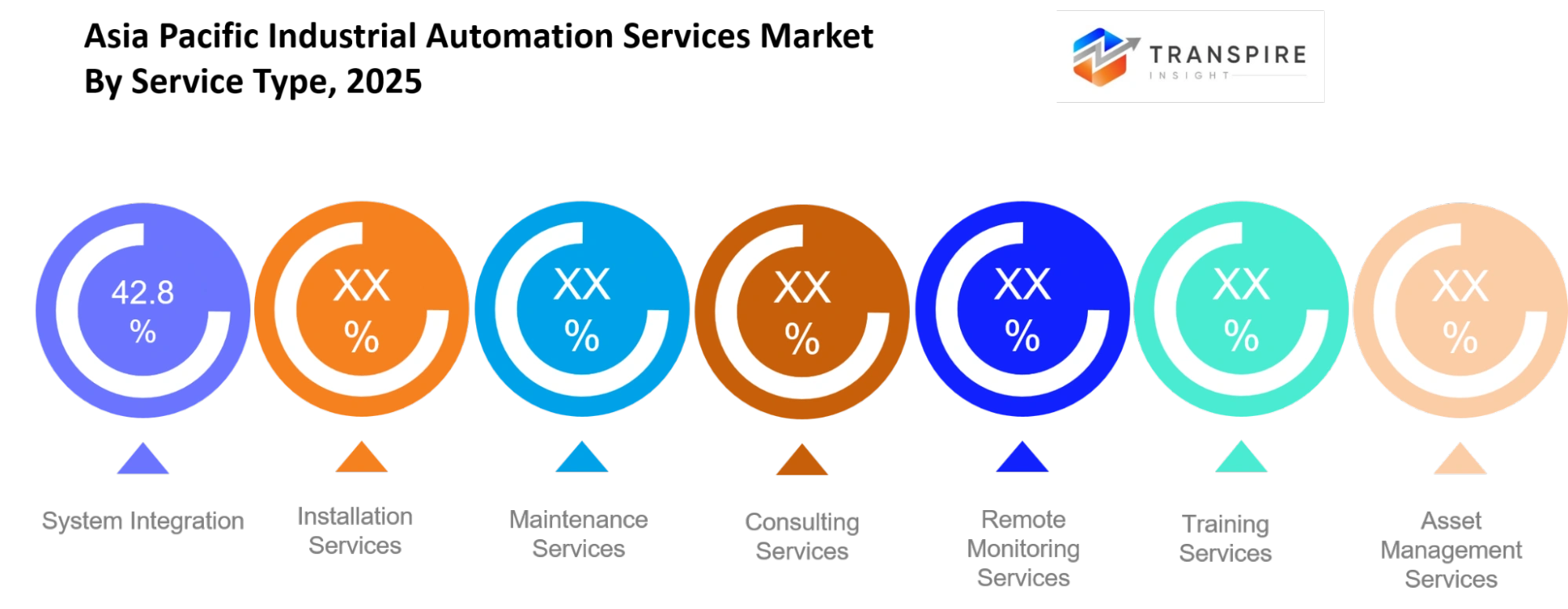
- In terms of type, System Integration Services take up around 30% of market revenue in 2025, and it’s supported by legacy production facility modernization, plus multi-vendor automation environments that businesses don’t really want to replace overnight.
- Maintenance Services stay as the second-largest slice, with nearly 22% market share, while Remote Monitoring Services are projected to grow the quickest during the forecast window.
- For end use, Manufacturing leads adoption with almost 45% revenue share. At the same time pharmaceutical and food processing facilities keep signing automation service contracts, and seems like the momentum is not slowing.
- Large enterprises are responsible for more than 60% of total industry spending, whereas SMEs are stepping up spending too, often through cloud enabled automation and subscription based service models that feel easier to adopt.
- ABB, Siemens, Schneider Electric, Rockwell Automation, Mitsubishi Electric, and Honeywell continue to strengthen their regional positions via digital service platforms, AI enabled diagnostics, and lifecycle support offerings.
- Also, strategic partnerships between automation vendors and industrial software providers have helped accelerate Industrial IoT platform rollouts, digital twin deployments , plus predictive maintenance solutions across Asia Pacific.
What are the Key Drivers, Restraints, and Opportunities in the Asia Pacific Industrial Automation Services Market?
The main driver in the Asia Pacific Industrial Automation Services Market is, basically, the fast shift toward smart manufacturing, supported by Industry 4.0 strategies and a bunch of government-backed industrial modernization programs. Manufacturers are moving away from standalone production setups, and they are putting in connected automation platforms that blend robotics , industrial IoT sensors, and advanced analytics in one direction. At the same time, labor costs are rising in several big manufacturing economies, and quality standards are getting stricter, so automated production is looking more reasonable on the economics side. As plants build out their digital backbone, the need for system integration, lifecycle maintenance, and remote monitoring keeps climbing , which then opens up ongoing revenue streams for automation service providers.
One big restraint however is the whole complexity around integrating newer automation tech with older industrial infrastructure. A lot of sites are still running legacy programmable logic controllers, proprietary software, and dated communication protocols that often demand heavy tailoring before any digital upgrade even becomes realistic. This kind of structural headache pushes the implementation costs up, drags out deployment timelines, and it also slows down adoption for small and medium-sized manufacturers, especially those with tight capital budgets.
A meaningful opportunity sits in AI-enabled predictive maintenance and cloud-based industrial service platforms. Manufacturing hubs across India, Southeast Asia, and various fast-growing ASEAN economies are putting money into digital factories, and those factories need continuous equipment observation, plus ongoing performance fine tuning.
What Has the Impact of Artificial Intelligence Been on the Asia Pacific Industrial Automation Services Market?
Artificial intelligence has , kind of, transformed industrial automation services, by allowing continuous monitoring and predictive maintenance, plus smarter process optimization across manufacturing and process industries. In practice, machine learning algorithms look at data coming from industrial sensors, programmable logic controllers, and industrial IoT platforms, and they try to spot abnormal equipment behavior well before actual failures happen. That helps lower unplanned downtime , it also stretches the usable life of equipment and makes production scheduling more coherent, in general. On top of that, AI-powered quality inspection systems find product defects with better consistency than the more conventional manual inspection approach, which in turn boosts manufacturing efficiency and reduces material waste.
Then there are advanced analytics platforms that optimize production parameters in real time, by weighing equipment performance, energy consumption, and production throughput. Digital twins, when they are combined with AI, can model factory operations before any physical adjustments are made, so commissioning takes less time and operational risks drop. A lot of manufacturers have reported reductions around 20–30% in unplanned maintenance occurrences, and improvements of about 10–20% in equipment availability after adopting AI-enabled predictive maintenance solutions.
Still, even with all these gains, the high integration costs stay a pretty big limitation. Many industrial plants keep using legacy automation infrastructure, which often doesn’t have standardized data architecture, so deploying AI becomes technically complex and also eats more resources than people expect. And then there’s the lack of industrial AI professionals who are really available, which slows things down, especially for small and medium-sized manufacturers that are dealing with budget pressures , and also limited workforce capacity.
Key Market Trends
- Industrial manufacturers have kind of shifted away from one-time automation installs to those multi year lifecycle service arrangements, and the recurring service cashflow has pushed above 40% for several of the big automation providers, since about 2022.
- Also, AI enabled predictive maintenance has been rolling out faster across plants, and it’s brought unexpected equipment downtime down roughly 20–30% , while asset utilization looks better and maintenance planning gets more orderly.
- Cloud based remote monitoring services have grown pretty quickly since 2021, mostly because manufacturers want centralized oversight of several production sites, but without needing as much on site engineering.
- On the regional side, China has doubled down on smart manufacturing spending via national industrial modernization efforts, while India has sped up factory automation through PLI programs and digital manufacturing policies.
- Industrial IoT platforms now show up as the default choice in many brand new automation projects, enabling real time equipment diagnostics, energy tracking, and production analytics across the connected locations.
- Digital twin tech has also moved past pilot setups, and Siemens, ABB, Schneider Electric, and Mitsubishi Electric are now tying virtual asset management into their industrial service offerings.
- Meanwhile, manufacturers are increasingly asking for cybersecurity reviews right along with automation upgrades, since connected production systems create bigger operational technology security needs.
- And robotics automation has gone beyond automotive lines into food processing, pharmaceuticals, electronics, and logistics facilities, which is basically creating more demand for specialized integration work, plus ongoing maintenance support.
Asia Pacific Industrial Automation Services Market Segmentation
By Service Type
System integration kind of forms the base for industrial automation projects, by linking controllers, robotics, sensors, software, and communication networks so it feels like one overall operating space. Installation services then make sure the new automation equipment is actually deployed in a dependable way, not just “installed”, and maintenance services keep the production running by doing preventive checks repairs, plus periodic system upgrades. Consulting services also matter, because they help with technology selection, digital transformation plans, and improvement strategies across industrial plants, usually in a more practical direction.
Remote monitoring services are expanding too, since connected factories need continuous equipment oversight from centralized control centers, and it’s not optional anymore. Training services help the technical teams run automation systems that are getting more advanced, with higher efficiency, and safer day to day operations. Asset management services improve how well equipment gets used through lifecycle planning and performance analysis, while others covers stuff like calibration, migration support, modernization, and specialized engineering services created for industry specific operational needs.
By Automation Type
Factory Automation is kind of the big one, since discrete manufacturing plants need those connected production lines , plus robotics and automated quality control systems . Then there’s Process Automation, which matters a lot in oil and gas , chemicals, food processing , and power generation, because it supports continuous monitoring and process control day to day. Robotics Automation keeps growing too, as manufacturers try to boost productivity, cut down manual interference, and keep production quality steady
After that , Building Automation helps industrial infrastructure with smart command of lighting , ventilation, energy management, and even facility security. Warehouse Automation makes inventory movement more efficient using automated storage and retrieval systems, along with intelligent material handling equipment. AI-Based Automation and Digital Twin Services are starting to feel more essential, as manufacturers take on predictive analytics, virtual production simulation, and real time optimization , while Others covers things like customized automation programs built for specialized industrial use cases
By Industry
Manufacturing takes the biggest share because production facilities need ongoing automation support, modernization of equipment, and lifecycle upkeep, really 24/7 type work most times. Oil & Gas leans on industrial automation services to raise operational safety , boost asset dependability, and push process efficiency across both upstream and downstream sites. Power Generation is also tied pretty directly to automation services, since they help keep operations stable, fine tune energy output, and limit equipment downtime.
Food & Beverage businesses put money into automation services to tighten product consistency , meet hygiene requirements, and raise production throughput at the same time. Pharmaceutical manufacturers, meanwhile, want validated automation systems that back regulatory compliance plus precision manufacturing. Chemicals and Automotive keep expanding automation investments for more throughput , while Others covers mining, electronics, pulp and paper, metals, and cement production facilities, and so on.
By Deployment
On- Site Services still look pretty essential for system commissioning, equipment installation, plant modernization, and those emergency maintenance jobs where you actually need direct engineering support, in the same place. Remote Services have grown a lot too, thanks to secure industrial connectivity, so specialists can diagnose faults , handle software updates, and keep an eye on production performance without having to travel to industrial facilities. Cloud-Based Services, meanwhile, bring centralized analytics, asset visibility, and performance reporting across several production sites.
Then you’ve got Hybrid Services which blend local engineering competence with remote digital assistance, so you get more operational flexibility and usually a quicker fix when something goes wrong. Managed Services shift things toward long-term outsourcing of automation management, cybersecurity, and lifecycle optimization tasks. Predictive Maintenance Services are driven by industrial analytics , they aim to spot upcoming equipment failures before breakdowns happen, and Field Services continue covering inspections, repairs, calibration, and modernization projects throughout various industrial environments.
By End User
Large Enterprises end up leading with automation service investments, mostly because sprawling manufacturing networks need this integrated lifecycle management approach, plus digital platforms that are pretty advanced, and also that ongoing operational optimization thing. Meanwhile, SMEs are, yeah, jumping toward cloud-enabled automation services more often, since it cuts the implementation costs, and it also helps production efficiency, and it makes operational flexibility easier. Government Organizations use industrial automation services too, especially across public utilities, infrastructure works and certain strategic manufacturing initiatives.
Industrial Plants tend to rely on automation specialists for keeping production running smoothly, raising equipment reliability, and backing modernization projects through entire asset lifecycles. Logistics Companies are also putting more money in automation, in order to make warehouse operations better, improve material handling, and push distribution efficiency higher. Utility Providers and EPC Companies keep reinforcing their automation capabilities during infrastructure development and modernization efforts. Others, for example specialized industrial operators, usually want customized engineering along with ongoing support services, and they often treat it as a bit more bespoke.
What are the Key Use Cases Driving the Asia Pacific Industrial Automation Services Market?
Manufacturing is still, like mostly the big main use case for industrial automation services where system integration, predictive maintenance, and production line optimization bring the most noticeable operational value. You see automotive , electronics , and machinery manufacturers leaning on these services to boost equipment availability, cut down those annoying production disruptions and keep a steady product quality, even while pushing high volume output targets.
At the same time, automation services are growing into process industries such as food and beverage, pharmaceuticals, chemicals , and power generation. Remote monitoring and asset management, plus AI enabled diagnostics, are increasingly used so industrial plants can stick to quality standards, fine tune energy consumption, and lower maintenance spend. On the other side logistics providers are also adopting warehouse automation, not just for speed but for better inventory accuracy and smoother material movement.
Looking ahead, emerging applications are starting to show up more, like digital twin deployment, AI driven production scheduling , and cloud based lifecycle management that supports multi site industrial operations. In smart factories across India, China, and Southeast Asia , teams are using these tools to simulate production processes , strengthen operational decisions, and reinforce predictive maintenance approaches. Basically these advanced use cases are expected to spread into broader commercial adoption as industrial IoT infrastructure plus faster connectivity keep maturing across the region.
|
Report Metrics |
Details |
|
Market size value in 2025 |
USD 83.68 Billion |
|
Market size value in 2026 |
USD 94.89 Billion |
|
Revenue forecast in 2033 |
USD 228.81 Billion |
|
Growth rate |
CAGR of 13.40% from 2026 to 2033 |
|
Base year |
2025 |
|
Historical data |
2021 - 2024 |
|
Forecast period |
2026 - 2033 |
|
Report coverage |
Revenue forecast, competitive landscape, growth factors, and trends |
|
Regional scope |
United States; Canada; Mexico; United Kingdom; Germany; France; Italy; Spain; Denmark; Sweden; Norway; China; Japan; India; Australia; South Korea; Thailand; Brazil; Argentina; South Africa; Saudi Arabia; United Arab Emirates |
|
Key company profiled |
Siemens, ABB, Schneider Electric, Rockwell Automation, Honeywell, Emerson Electric, Yokogawa Electric, Mitsubishi Electric, Omron, FANUC, Bosch Rexroth, Hitachi, Toshiba, Wipro, Tata Consultancy Services |
|
Customization scope |
Free report customization (country, regional & segment scope). Avail customized purchase options to meet your exact research needs. |
|
Report Segmentation |
By Service Type (System Integration, Installation Services, Maintenance Services, Consulting Services, Remote Monitoring Services, Training Services, Asset Management Services, Others); By Automation Type (Factory Automation, Process Automation, Robotics Automation, Building Automation, Warehouse Automation, AI-Based Automation, Digital Twin Services, Others); By Industry (Manufacturing, Oil & Gas, Power Generation, Food & Beverage, Pharmaceuticals, Chemicals, Automotive, Others); By Deployment (On-Site Services, Remote Services, Cloud-Based Services, Hybrid Services, Managed Services, Predictive Maintenance Services, Field Services, Others); By End User (Large Enterprises, SMEs, Government Organizations, Industrial Plants, Logistics Companies, Utility Providers, EPC Companies, Others) |
Which Regions are Driving the Asia Pacific Industrial Automation Services Market Growth?
China pretty much takes the lead in the Asia Pacific Industrial Automation Services Market, mainly because it has this huge manufacturing base, and then also strong government backing via the Made in China 2025 initiative, plus steady money going into smart factory modernization . There are large industrial clusters all over the place , like automotive electronics chemicals, and machinery , and they keep generating ongoing needs for things such as system integration, predictive maintenance, and lifecycle automation services. What also matters is the pretty mature mix of players: automation equipment suppliers, software developers, robotics manufacturers and engineering service providers, all of which help advanced industrial technologies get rolled out faster. On top of that , ongoing investment in industrial digitalization, AI-enabled manufacturing, and pushing domestic technology development keeps China positioned as the biggest regional contributor.
Japan comes next as the second-largest market, and it seems to be driven more by stable industrial spending than by sudden capacity expansion. Well established manufacturers continue upgrading their automation infrastructure , mostly to lift operational efficiency, handle workforce shortages , and stay on top of product quality across automotive semiconductor and precision manufacturing. There are strict operational requirements , and factories keep seeing modernization programs , so demand stays recurring for maintenance, system upgrades, and digital engineering services. Also, collaboration between industrial manufacturers, automation vendors and technology developers creates a dependable revenue base even if manufacturing growth is slower than in China.
India is expected to show the fastest growth through 2033 , largely because industrial expansion keeps moving, and the Production Linked Incentive (PLI) schemes , plus the push toward smart manufacturing , are really speeding up automation investment.
Who are the Key Players in the Asia Pacific Industrial Automation Services Market and How Do They Compete?
Competition stays pretty moderately consolidated, and most of the global automation companies seem to go after customers with technology strength, digital service portfolios, and regional engineering know-how, not just by price. Over the long run, maintenance contracts, AI-enabled analytics, cybersecurity, cloud connectivity, and lifecycle management have turned into the key differentiators, because industrial buyers tend to care more about operational continuity than a one-time automation push. Sure, new regional system integrators keep showing up, but the more established vendors usually keep their edge via wider product ecosystems, plus really large service networks, even when the market gets busy.
Siemens shows up by blending industrial software, digital twins, AI, and automation, inside the Siemens Xcelerator platform. They keep expanding cloud partnerships and also ramping up industrial AI capabilities, with the goal to ship integrated digital manufacturing solutions across Asia Pacific. ABB, on the other hand, leans into modular automation platforms, robotics integration, and lifecycle modernization programs so manufacturers can upgrade the existing setup without having to throw out the entire control architecture. On top of that, ABB’s extra investments in regional manufacturing and research facilities keep its localized service capabilities sturdy.
Schneider Electric competes by focusing on energy management integration, EcoStruxure digital platforms, and sustainability-centered industrial automation services, so manufacturers can boost operational efficiency while improving energy performance too. Yokogawa Electric is more specialized toward process industries like oil and gas, chemicals, and power generation, where advanced control systems and cybersecurity-certified automation platforms really stand out, and the differentiation is clearer there.
Company List
• Siemens
• ABB
• Schneider Electric
• Rockwell Automation
• Honeywell
• Emerson Electric
• Yokogawa Electric
• Mitsubishi Electric
• Omron
• FANUC
• Bosch Rexroth
• Hitachi
• Toshiba
• Wipro
• Tata Consultancy Services
Recent Development News
In April 2026, Yokogawa Electric obtained certification to the O-PAS Standard's OPC UA Profile. The certification strengthens interoperability for open industrial automation systems and supports greater flexibility for digital manufacturing deployments.https://www.yokogawa.com
In March 2026, Siemens expanded its partnership with Alibaba and introduced new Industrial AI technologies at its RXD Summit in Beijing. The collaboration brings advanced industrial simulation software to the cloud and accelerates AI adoption across manufacturing and industrial operations.https://press.siemens.com
In March 2026, ABB announced an investment of approximately USD 75 million to expand manufacturing and R&D operations in India. The investment increases localized production of automation and electrification technologies while supporting regional industrial modernization and engineering capacity.https://www.abb.com/
What Strategic Insights Define the Future of the Asia Pacific Industrial Automation Services Market?
The market seems to be moving toward software-driven lifecycle services, where continuous optimization, predictive upkeep, cybersecurity, and AI powered analytics create more value than those standalone automation type projects. Industrial digital transformation, paired with cloud connectivity and smart manufacturing platforms, will probably reshape service business models over the next five to seven years. There’s also one less obvious risk, it’s the increasing reliance on proprietary automation ecosystems, which can push vendor lock-in up, jack migration costs higher, and make interoperability more sluggish across mixed industrial environments.
At the same time there’s a pretty solid opening in AI-enabled digital twin offerings for mid sized manufacturers, especially in India and Southeast Asia. That’s because factory modernization is picking up, but digital maturity is still somewhat low. Firms that build open, interoperable service platforms and put real effort into regional engineering talent, will be in a better spot for securing long term lifecycle contracts. Also strategic partnerships with software vendors, cloud companies, and industrial AI specialists will become, honestly pretty essential, for keeping their edge and growing that recurring service revenue stream.
Asia Pacific Industrial Automation Services Market Report Segmentation
By Service Type
• System Integration
• Installation Services
• Maintenance Services
• Consulting Services
• Remote Monitoring Services
• Training Services
• Asset Management Services
• Others
By Automation Type
• Factory Automation
• Process Automation
• Robotics Automation
• Building Automation
• Warehouse Automation
• AI-Based Automation
• Digital Twin Services
• Others
By Industry
• Manufacturing
• Oil & Gas
• Power Generation
• Food & Beverage
• Pharmaceuticals
• Chemicals
• Automotive
• Others
By Deployment
• On-Site Services
• Remote Services
• Cloud-Based Services
• Hybrid Services
• Managed Services
• Predictive Maintenance Services
• Field Services
• Others
By End User
• Large Enterprises
• SMEs
• Government Organizations
• Industrial Plants
• Logistics Companies
• Utility Providers
• EPC Companies
• Others
Frequently Asked Questions
Find quick answers to common questions.
The expected Asia Pacific Industrial Automation Services Market size for the market will be USD 228.81 Billion in 2033.
Key segments for the Asia Pacific Industrial Automation Services Market are By Service Type (System Integration, Installation Services, Maintenance Services, Consulting Services, Remote Monitoring Services, Training Services, Asset Management Services, Others); By Automation Type (Factory Automation, Process Automation, Robotics Automation, Building Automation, Warehouse Automation, AI-Based Automation, Digital Twin Services, Others); By Industry (Manufacturing, Oil & Gas, Power Generation, Food & Beverage, Pharmaceuticals, Chemicals, Automotive, Others); By Deployment (On-Site Services, Remote Services, Cloud-Based Services, Hybrid Services, Managed Services, Predictive Maintenance Services, Field Services, Others); By End User (Large Enterprises, SMEs, Government Organizations, Industrial Plants, Logistics Companies, Utility Providers, EPC Companies, Others).
Major Asia Pacific Industrial Automation Services Market players are Siemens, ABB, Schneider Electric, Rockwell Automation, Honeywell, Emerson Electric, Yokogawa Electric, Mitsubishi Electric, Omron, FANUC, Bosch Rexroth, Hitachi, Toshiba, Wipro, Tata Consultancy Services.
The Asia Pacific Industrial Automation Services Market size is USD 83.68 Billion in 2025.
The Asia Pacific Industrial Automation Services Market CAGR is 13.40% from 2026 to 2033.
• Siemens
• ABB
• Schneider Electric
• Rockwell Automation
• Honeywell
• Emerson Electric
• Yokogawa Electric
• Mitsubishi Electric
• Omron
• FANUC
• Bosch Rexroth
• Hitachi
• Toshiba
• Wipro
• Tata Consultancy Services
About the Authors

Kartik bhong
I am Kartik Bhong, a Senior Research Analyst at Transpire Insight, specializing in the Packaging, Manufacturing, and Construction industry. My work focuses on analyzing market trends, emerging technologies, industry regulations, and competitive landscapes to deliver accurate, data-driven insights. I am passionate about transforming complex industry information into clear, practical content that helps businesses, professionals, and decision-makers stay informed and make confident strategic decisions. Through continuous research and a strong commitment to accuracy, I strive to create reliable, well-researched content that reflects the latest developments across these dynamic industries and supports the vision of Transpire Insight in delivering valuable market intelligence.

Chakradhar Khansole
Chakradhar serves as the Research Director at Transpire Insight, bringing over 8 years of experience in technology, innovation, and strategic market intelligence. He specializes in transforming complex market data into actionable business insights that enable organizations to make informed, growth-oriented decisions. Recognized for his strategic vision and analytical expertise, Chakradhar leads high-impact research initiatives, delivering comprehensive market assessments, competitive intelligence, and forward-looking industry analysis.
Recently Published Reports
-
Apr 2026
Handling and Lifting Equipment Market
Handling and Lifting Equipment Market Size, Share & Analysis Report By Product (Cranes and Hoists, Forklifts, Conveyor Systems, Aerial Work Platforms, Others), By Application (E-Commerce, Automotive and Railway, Food and Beverages, Aviation, Others), and Geography (North America, Europe, Asia-Pacific, Middle East and Africa, South and Central America), 2021 - 2031
-
Apr 2026
HVAC Equipment Market
HVAC Equipment Market Size, Share & Analysis Report By Heating Equipment Type (Boilers and Furnaces, Heat Pumps, and Unitary Heaters), By Ventilation Equipment (Air Handling Units, Humidifiers and Dehumidifiers, Air Filters, and Fan Coiling Units), By Air Conditioning Equipment (Unitary Air Conditioners, Room Air Conditioners, Packaged Terminal Air Conditioners, and Chillers), By End User (Commercial, Residential, Industrial, and others), and Geography (North America, Europe, Asia-Pacific, Middle East and Africa, South and Central America), 2021 – 2031
-
Apr 2026
Refrigeration Valves Market
Refrigeration Valves Market Size, Share & Analysis Report By Type (Solenoid Valves, Expansion Valves, Check Valves, Service Valves, Others), By Application (Commercial Refrigeration, Industrial Refrigeration, Transport Refrigeration, Residential Refrigeration, Air Conditioning Systems), By End User (Food and Beverage Industry, Pharmaceutical Industry, HVAC Industry, Chemical Industry, Others), and Geography (North America, Europe, Asia-Pacific, Middle East and Africa, South and Central America), 2021 – 2031
-
Apr 2026
E-Commerce Packaging Materials Market
E-Commerce Packaging Materials Market By Material Type (Corrugated Boxes, Paper & Paperboard, Foam & Cushioning Materials, Plastic Packaging, Flexible Packaging, Protective Packaging, Others), By Product(Primary Packaging, Secondary Packaging, Tertiary Packaging), By Packaging Function (Protective Packaging, Branding & Presentation Packaging, Transit & Logistic Packaging, Sustainable Packaging, Tamper Evidence Packaging), By End-User (Retail & Consumer Goods, Electronic Appliances, Food & Beverages, Healthcare & Pharmaceutical, Fashion & Apparel, Home & Furnishing, Others); By Industry Analysis, Size, Share, Growth, Trends, and Forecasts 2021-2033