
Europe Pay-per-click Software Market Size & Forecast:
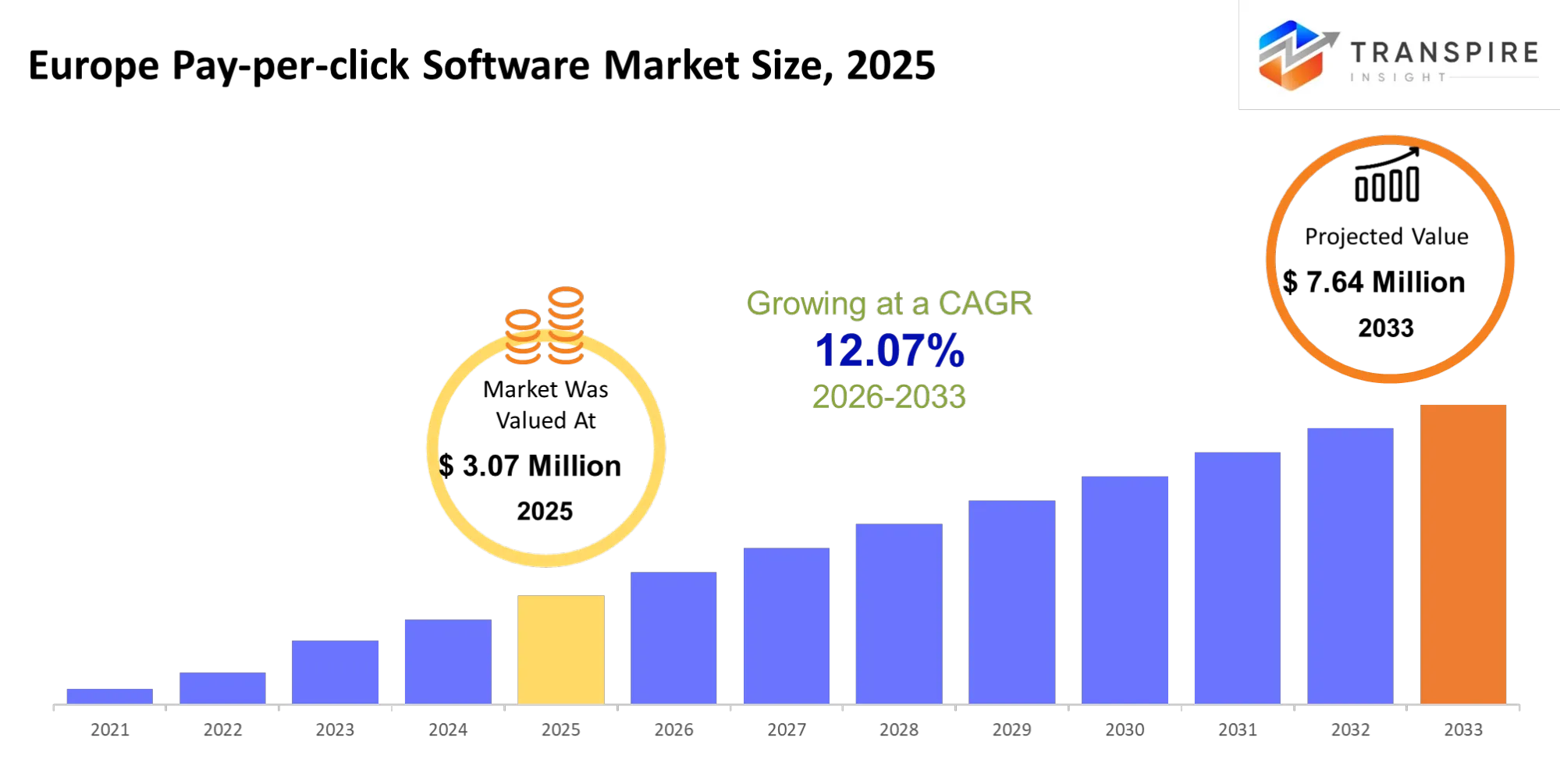
- Europe Pay-per-click Software Market Size 2025: USD 3.07 Billion
- Europe Pay-per-click Software Market Size 2033: USD 7.64 Billion
- Europe Pay-per-click Software Market CAGR: 12.07%
- Europe Pay-per-click Software Market Segments: By Deployment (Cloud, On-Premise, Hybrid, Others); By Application (Campaign Management, Keyword Research, Bid Management, Analytics, Others); By Enterprise Size (Large Enterprises, SMEs, Others); By End User (Retail, BFSI, Media, IT & Telecom, Others); By Platform (Search Ads, Display Ads, Social Ads, Others); By Pricing Model (Subscription, Freemium, Others)
Europe Pay-per-click Software Market Summary
The Europe Pay-per-click Software Market was valued at USD 5.02 billion in 2025. It is forecast to reach USD 7.64. billion by 2033. That is a CAGR of 12.07% over the period.
The Europe Pay-per-click Software Market is really important for businesses. It helps them manage the money they spend on ads, make their ad campaigns work better and turn people who visit their websites into customers. By changing bids and looking at thousands of keywords by hand, marketers use Pay-per-click Software to automate their ad campaigns to get a better return on the money they spend on ads and see how their ads are doing in real time on platforms like Google Ads and Microsoft Advertising. This is very useful because it is getting more expensive to get customers and there is a lot of competition online.
Over the five years the Europe Pay-per-click Software Market has changed a lot. It used to be about managing ad campaigns based on rules. Now it is more about using artificial intelligence to make bids and predict what will work best. The COVID-19 pandemic made a difference because more people started buying things online and businesses had to put more money into digital ads that they could measure. As it got harder to get information about customers because of privacy rules businesses started using Pay-per-click Software to make their ads more accurate and efficient. This change is helping the companies that make Pay-per-click Software make money and more businesses, agencies and small companies are starting to use it because they want to know if their ads are working and make better decisions about their marketing.
Key Market Insights
- The Europe Pay-per-click Software Market is mostly controlled by Western Europe with 45 percent market share in 2025 because people in Western Europe are really good at using digital advertising.
- Central and Eastern Europe are growing fast from 2026 to 2033 because a lot of companies are starting to use digital technology and small businesses are spending more money on advertising.
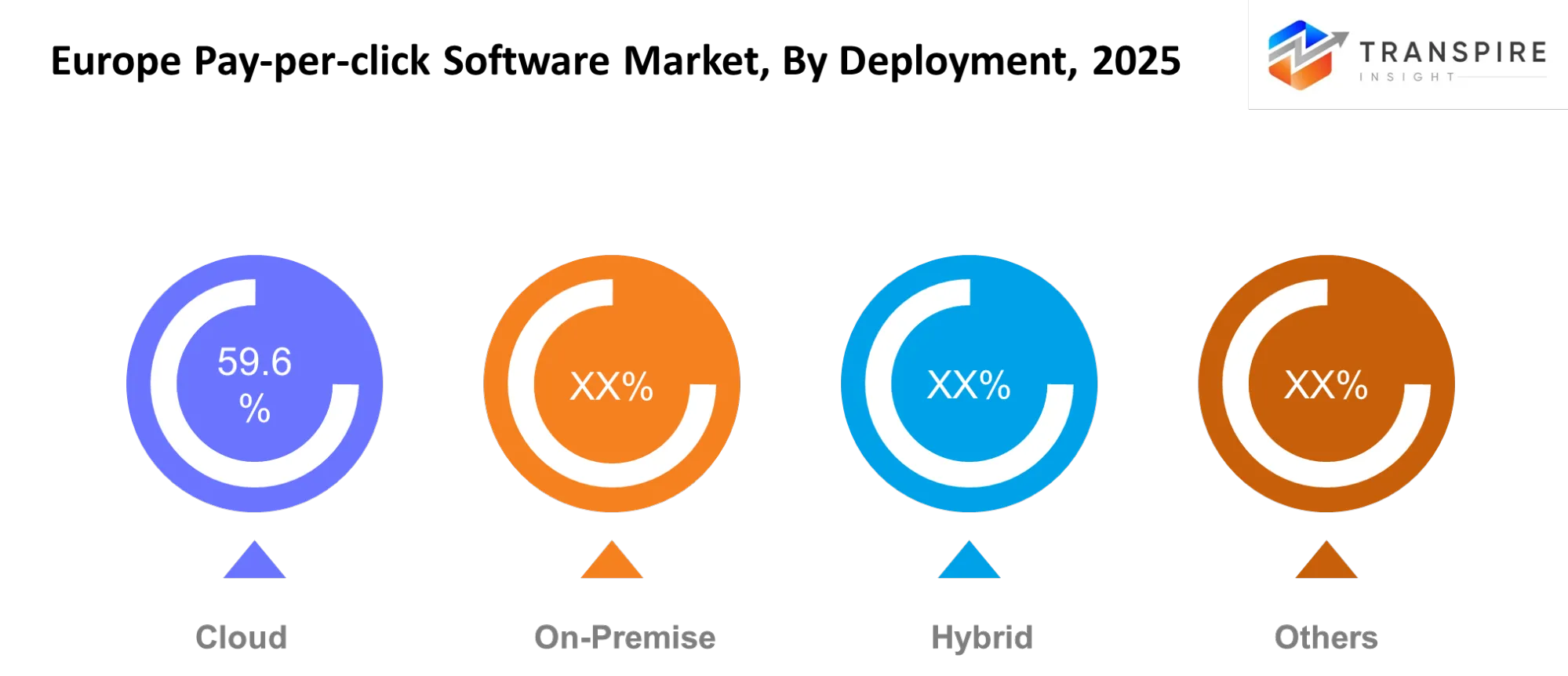
- Most people use cloud-based Pay-per-click software because it is very flexible and you can manage your advertising campaigns in time. This type of software is used by 60 percent of people.
- A lot of marketing companies are using software to manage advertising campaigns for their clients. This is the most popular type of Pay-per-click software.
- The growing type of Pay-per-click software is the one that uses artificial intelligence to help decide how much to pay for advertisements. This type of software is becoming very popular from 2026 to 2033 because it can make decisions automatically.
- Most people use Pay-per-click software to manage search advertising campaigns because they really like using Google Ads and Microsoft Advertising. This type of advertising accounts for over 50 percent of all advertising.
- A new trend is emerging where advertisers want to be able to manage all their advertising campaigns in one place, including search, display, shopping and social media campaigns.
- Big companies use Pay-per-click software the most because they have a lot of money to spend on advertising and their campaigns are very complicated.
- Small businesses are starting to use Pay-per-click software more because it is becoming easier for them to manage their own advertising campaigns.
- Some important companies like Google Ads, Microsoft Advertising, Semrush, Ahrefs, Optmyzr and Marin Software are working hard to make their products better, use artificial intelligence, expand their businesses and provide more detailed analysis to stay ahead of their competitors in the Europe Pay-, per-click Software Market.
What are the Key Drivers, Restraints, and Opportunities in the Europe Pay-per-click Software Market?
Driver
The thing that is really changing the Europe Pay-per-click Software Market is that people are using intelligence to make their ads better. This is happening because online advertising is getting more complicated and it is getting more expensive to get customers. Marketing teams can not handle all the keywords and bids by themselves anymore so companies are buying software that can do these things automatically. This software makes ads work better, helps companies get money from their ads and more companies are starting to use it. When ads work better companies make money from the software they use and the people who make the software get more money too.
Restraint
The biggest problem is that there are rules about how companies can use people's personal information. Rules like GDPR are making it harder for companies to get the information they need to make their ads work. This is a problem because companies need to know who their customers are and what they want but they can not get this information like they used to. This makes it harder for companies to make ads and it costs them more money to follow the rules. This is especially hard for companies that do not have a lot of money or people to help them.
Opportunity
There is a chance for companies that make predictive marketing platforms to grow. These platforms use the information that companies already have artificial intelligence and other tools to help companies make ads. Many companies in Central and Eastern Europe are spending money on online shopping, which makes it a good time for companies that make advertising software. Companies that can help companies manage all their ads in one place will get a bigger share of the money that companies spend on ads. This means that companies that make advertising software will be able to grow and make money in the future.
What Has the Impact of Artificial Intelligence Been on the Europe Pay-per-click Software Market?
The Europe Pay-per-click Software Market is changing because of intelligence and new digital technologies. These technologies are automating the processes that people used to do by hand. AI-powered platforms are always watching how keywords are doing, how people are bidding, how the audience is behaving and how the budget is being used across all the advertising channels.
The bidding systems can change the bids at the time based on how likely it is that someone will buy something, what the competitors are doing and what happened in the past. This means people do not have to get involved much and the campaigns can be more efficient. Big advertisers and agencies are using these systems to manage a lot of campaigns at the time across search engines and digital marketplaces.Machine learning models are also making the advertising software better at predicting things. These models look at what happened in the past to guess how many people will click on something, how likely it is that someone will buy something, how much a customer's worth and how the budget is being used. This helps marketers find the audience that's most likely to buy something before they even start the campaign. It also helps them spend their money on the channels that will give them the results.
A lot of platforms are saying that they are getting results like more people buying things, spending less money to get a customer and being able to make changes to the campaign faster. Advanced analytics dashboards and automated reporting tools are also making things more efficient by reducing the amount of work and helping people make decisions faster.However there is a problem. The rules about privacy and the fact that third-party cookies are being phased out are limiting the amount of data that can be collected about users. This can make it harder for the AI systems to be accurate and to target the people in the complex digital advertising world. The Europe Pay-per-click Software Market is feeling the effects of this change. Artificial intelligence and digital technologies are still important for the Europe Pay-, per-click Software Market.
Key Market Trends
- Since 2021 people who make ads have started to use computers to help them do everything by hand. This has saved them a lot of time. Helped them get better results from their ads.
- There are rules called GDPR that started being enforced in 2022. These rules and some other changes have made companies start using the information they get from their websites to target people with ads. They are also trying to be more careful about people's privacy.
- Google Ads and Microsoft Advertising have made their automated systems better. This has made companies that make software try to improve their own automated systems too.
- From 2020 to 2025 people who make ads started to want to manage all their ads in one place. They wanted to be able to see how all their ads were doing on platforms like search, display, shopping and social media.
- Big companies have started to use one system to manage all their ads. This is using many different systems like they used to.
- medium-sized businesses have started to use special tools to help them with their ads. These tools are cheaper and easier to use because they are online.
- Being able to change your ad budget in time has become very important. This means that the system can move your money around to the ads that are working best.
- After 2023 people who make ads started to use special analysis tools to predict how well their ads would do. This helps them know how many people will buy something from them and how money they will make.
- Some companies, like Semrush, Ahrefs, Optmyzr and Marin Software have added features to their tools. These features use intelligence to help people make ads and reports.
- People who make ads do not just focus on keywords anymore. They also try to understand who their audience is and how to target them better. They use models to see how their ads are working and to make decisions automatically. This is because the world of ads is getting more complicated.
Europe Pay-per-click Software Market Segmentation
By Deployment
Cloud deployment is really popular because marketing teams need to be able to get to things using resources that can grow with them and keep an eye on their campaigns in real time. It is easy to connect cloud deployment with advertising platforms and tools that help with analytics, which makes it easier to manage how work gets done. The fact that software updates happen often and do not require a lot of infrastructure also makes cloud deployment a good choice for organizations of all sizes. Cloud deployment also offers payment plans that help with budgeting and keeping things running smoothly.
On the other hand some organizations like to have more control over how their data is stored and kept safe so they prefer to use on-premise deployment. Big companies that have to follow a lot of rules often keep their systems inside the company to make sure they are doing everything they need to do. Hybrid deployment is a choice for organizations that want to be able to use the cloud but also want to keep some control over things. Hybrid deployment combines the things about cloud deployment with the good things about on-premise deployment. As organizations try to find a way to deploy their systems, the demand for hybrid models will keep growing.
By Application
Managing campaigns is a part of what advertising software is used for because running a good advertising program requires always keeping an eye on things, making sure the budget is being used well and making changes as needed. Having a place to manage campaigns across many different advertising channels makes things a lot easier. Automated workflows help reduce the amount of work that needs to be done and make things more consistent. Because efficiency is so important companies are willing to invest in tools that help them manage their campaigns.
Keyword research is also very important because it helps businesses figure out what people are searching for and what they are interested in. Bid management solutions are getting more popular because they use intelligence to make sure money is being spent in the most effective way possible. Analytics platforms provide a lot of information about how campaigns are performing which helps companies make better decisions and plan their budgets. As advertising gets more complicated companies will need advanced tools to help them understand what is going on.
By Enterprise Size
Big companies use a lot of advertising software because they have budgets for advertising and need sophisticated tools to manage everything. They also need reports to help them understand what is going on. When companies are running campaigns across different regions and parts of the business they need a central platform to help them keep everything straight. Advanced automation features help companies work efficiently and consistently. Big companies are also trying to change how they do things digitally in the term which means they need to invest in software.
Smaller companies are starting to use advertising platforms more and more because cloud-based solutions make it easier for them to get started and do not cost as much to implement. Simple interfaces and payment plans that are based on subscriptions make it easier for smaller companies to use capabilities. Small businesses want to be able to measure how well their advertising is working and make their marketing more efficient. As more European businesses go digital smaller companies will start to use advertising software more.
By End User
Retail companies use advertising software a lot because they want to attract customers, promote their products and sell things online. They need to be adjusting their campaigns and trying to reach their audience in the best way possible. Using data to guide their advertising helps retail companies make money and keep their customers. As consumers change what they want and how they behave retail companies need to use marketing tools to keep up.
Financial institutions use advertising software to get customers while also making sure they are following all the rules and being transparent. Media companies use advertising technology to reach people and get them more engaged with their content. IT and telecom companies focus on getting leads promoting their services and getting new customers in a way that is efficient. Different companies have needs, which means that advertising software needs to be able to do many different things.
By Platform
Search advertising is very popular because people use search engines to look for things they want to buy. When companies target their advertising based on what people're searching for they often get good results. Being able to track how well campaigns are working helps companies make their advertising more effective. Search engines are always getting better which means companies will keep using them for advertising.
Display advertising helps companies get their brand noticed by using images and videos to engage people on websites and other digital platforms. Social advertising is getting more popular as people spend time on social media and use their mobile devices more. Companies can manage their campaigns across different platforms, which helps them reach their audience in a coordinated way. As people move between devices and platforms companies need to be able to advertise across all of them.
By Pricing Model
Most companies prefer to pay a subscription fee because it gives them a cost and they can always use the latest software features. They also get updates and technical support which helps them get the most out of the software. Companies can pay monthly or yearly depending on what they need. This pricing model is good for software companies too because they get a stream of revenue.
Some companies offer a version of their software, for free, which is called a freemium model. This lets companies try out the software without spending a lot of money. If the software works well companies often upgrade to a paid plan that has features. As software companies compete with each other they will keep coming up with innovative pricing models, including both subscription and freemium models.
What are the Key Use Cases Driving the Europe Pay-per-click Software Market?
The main use case is about making search advertising campaigns especially in retail and online shopping. Businesses use PPC software to manage how much they pay for keywords, decide how money to spend and get more conversions on competitive digital channels. This application is in demand because businesses want to know how many customers they are getting and how much money they are making from online sales.Other use cases are growing, like getting customers in banking, financial services and insurance and generating leads in IT and telecom. Financial institutions use tools to get more qualified leads while following rules and regulations.Telecom companies use automated advertising platforms to promote services, get subscribers and market to specific regions.New use cases are emerging, like using AI to forecast the audience and predict how much a customer is worth, over their lifetime.1. These capabilities help advertisers find high-value customer groups before launching campaigns and spend money wisely.2. Another developing application is -channel attribution systems that connect search, social and display advertising performance into one framework supporting more accurate investment decisions.
|
Report Metrics |
Details |
|
Market size value in 2025 |
USD 3.07 Billion |
|
Market size value in 2026 |
USD 3.44 Billion |
|
Revenue forecast in 2033 |
USD 7.64. Billion |
|
Growth rate |
CAGR of 12.07% from 2026 to 2033 |
|
Base year |
2025 |
|
Historical data |
2021 - 2024 |
|
Forecast period |
2026 - 2033 |
|
Report coverage |
Revenue forecast, competitive landscape, growth factors, and trends |
|
Regional scope |
Europe |
|
Key company profiled |
Google Ads, Microsoft Advertising, Semrush, Ahrefs, SpyFu, WordStream, Optmyzr, Marin Software, Adalysis, HubSpot, Similarweb, Adzooma, Skai, Acquisio, Serpstat |
|
Customization scope |
Free report customization (country, regional & segment scope). Avail customized purchase options to meet your exact research needs. |
|
Report Segmentation |
By Deployment (Cloud, On-Premise, Hybrid, Others); By Application (Campaign Management, Keyword Research, Bid Management, Analytics, Others); By Enterprise Size (Large Enterprises, SMEs, Others); By End User (Retail, BFSI, Media, IT & Telecom, Others); By Platform (Search Ads, Display Ads, Social Ads, Others); By Pricing Model (Subscription, Freemium, Others) |
Which Regions are Driving the Europe Pay-per-click Software Market Growth?
Western Europe leads the market due to a highly developed digital advertising ecosystem, strong e-commerce penetration, and substantial enterprise marketing budgets. Countries such as the United Kingdom, Germany, and France host major advertising agencies, technology providers, and multinational brands that rely heavily on performance marketing platforms. Strict data privacy regulations have also encouraged investment in advanced software capable of maintaining compliance while optimizing campaign performance. A mature network of cloud infrastructure providers, analytics specialists, and digital marketing professionals continues to support regional leadership.
Northern Europe represents the second-largest regional contributor and differs from Western Europe through its focus on digital maturity and operational stability rather than market scale alone. High internet penetration, strong technology adoption rates, and resilient business environments create consistent software spending patterns. Organizations across Sweden, Denmark, Finland, and Norway continue investing in data-driven marketing tools as part of broader digital transformation initiatives. Stable regulatory frameworks and predictable technology investments support reliable revenue generation across the region.
Central and Eastern Europe show the strongest growth momentum heading into the 2026–2033 period. Rapid expansion of e-commerce platforms, increasing SME participation in digital advertising, and greater adoption of cloud technologies have transformed market conditions in recent years. Businesses that previously relied on traditional marketing channels are shifting toward measurable online advertising strategies. This acceleration creates attractive opportunities for software vendors, technology investors, and service providers seeking expansion into emerging digital advertising markets.
Who are the Key Players in the Europe Pay-per-click Software Market and How Do They Compete?
Competition in the Europe Pay-per-click Software Market shows a moderately consolidated structure at the top, with major platform providers controlling core ad ecosystems while smaller SaaS vendors compete in specialized optimization tools. Incumbents defend share through ecosystem integration, especially within search and social advertising networks, while new entrants focus on AI-driven automation, cross-channel analytics, and cost-efficient campaign management. The main competitive basis has shifted toward technology capability, particularly predictive bidding accuracy, privacy-compliant targeting, and real-time performance optimization rather than pricing alone.
Google Ads strengthens its position through deep integration with search infrastructure and continuous upgrades in AI-based bidding systems that improve conversion efficiency for large advertisers. Its advantage comes from direct access to search data and advanced automation features, and it expands by integrating analytics tools across YouTube and displaying inventory to create unified campaign ecosystems.
Microsoft Advertising differentiates through access to enterprise audiences across LinkedIn and Bing search, focusing on B2B targeting precision. It expands its capabilities through partnerships with enterprise CRM platforms, improving audience segmentation and lead attribution accuracy.Semrush competes through niche specialization in keyword intelligence and competitive research tools, giving marketers detailed visibility into competitor bidding strategies. Its expansion strategy centers on adding AI-powered content and advertising optimization modules to strengthen its all-in-one marketing platform positioning.
Company List
- Google Ads
- Microsoft Advertising
- Semrush
- Ahrefs
- SpyFu
- WordStream
- Optmyzr
- Marin Software
- Adalysis
- HubSpot
- Similarweb
- Adzooma
- Skai
- Acquisio
- Serpstat
Recent Development News
“In April 2026, Adobe completed its acquisition of Semrush Holdings, Inc. The acquisition strengthened Adobe’s Digital Experience and AI marketing stack by integrating Semrush’s SEO, GEO (Generative Engine Optimization), and brand visibility tools into Adobe’s customer experience ecosystem for improved search and AI-driven discoverability across Europe and global markets.”https://www.semrush.com
“In March 2026, HubSpot announced the acquisition of XFunnel. The move expanded HubSpot’s Answer Engine Optimization (AEO) capabilities, enabling advertisers to better track and optimize visibility in AI-driven search engines and LLM-based discovery systems, strengthening its PPC and inbound marketing ecosystem.”https://www.hubspot.com
What Strategic Insights Define the Future of the Europe Pay-per-click Software Market?
The Europe Pay-per-click Software Market is moving toward a highly automated, AI-orchestrated advertising structure where campaign decisions will increasingly run on predictive bidding systems and cross-channel optimization engines. This shift is driven by tighter privacy rules and rising cost-per-click pressures that force advertisers to extract higher efficiency from every marketing euro. Over the next 5–7 years, platforms that unify search, social, and retail media performance will gain structural advantage as fragmented campaign management becomes less viable.
A hidden risk lies in increasing dependence on a few dominant ad ecosystems such as Google and Microsoft, creating concentration exposure for software vendors and advertisers if policy or pricing models change abruptly. This could compress margins and limit innovation flexibility across smaller PPC tools.
A key emerging opportunity sits in AI-driven “autonomous campaign agents” that manage end-to-end advertising decisions with minimal human input, particularly for SMEs across Central and Eastern Europe. These markets are becoming more receptive due to lower marketing expertise and rising digital adoption. Market participants should prioritize building privacy-compliant AI optimization layers integrated with multi-platform APIs, as control of automated decision infrastructure will define long-term competitive advantage.
Europe Pay-per-click Software Market Report Segmentation
By Deployment
- Cloud
- On-Premise
- Hybrid
- Others
By Application
- Campaign Management
- Keyword Research
- Bid Management
- Analytics
- Others
By Enterprise Size
- Large Enterprises
- SMEs
- Others
By End User
- Retail
- BFSI
- Media
- IT & Telecom
- Others
By Platform
- Search Ads
- Display Ads
- Social Ads
- Others
By Pricing Model
- Subscription
- Freemium
- Others
Frequently Asked Questions
Find quick answers to common questions.
The expected Europe Pay-per-click Software Market size for the market will be USD 7.64 Billion in 2033.
Key segments for the Europe Pay-per-click Software Market are By Deployment (Cloud, On-Premise, Hybrid, Others); By Application (Campaign Management, Keyword Research, Bid Management, Analytics, Others); By Enterprise Size (Large Enterprises, SMEs, Others); By End User (Retail, BFSI, Media, IT & Telecom, Others); By Platform (Search Ads, Display Ads, Social Ads, Others); By Pricing Model (Subscription, Freemium, Others).
Major Europe Pay-per-click Software Market players are Google Ads, Microsoft Advertising, Semrush, Ahrefs, SpyFu, WordStream, Optmyzr, Marin Software, Adalysis, HubSpot, Similarweb, Adzooma, Skai, Acquisio, Serpstat.
The Europe Pay-per-click Software Market size is USD 3.07 Billion in 2025.
The Europe Pay-per-click Software Market CAGR is 12.07% from 2026 to 2033.
- Google Ads
- Microsoft Advertising
- Semrush
- Ahrefs
- SpyFu
- WordStream
- Optmyzr
- Marin Software
- Adalysis
- HubSpot
- Similarweb
- Adzooma
- Skai
- Acquisio
- Serpstat
About the Authors

Mayur Shinde
I am Mayur Shinde, a Senior Research Analyst at Transpire Insight, specializing in the Automotive & Transportation and Information & Communication Technology (ICT) Industry. My work focuses on analyzing emerging market trends, technological advancements, competitive landscapes, and industry developments to deliver accurate, data-driven insights. I am passionate about transforming complex market information into clear, actionable content that helps businesses, professionals, and decision-makers stay informed and make confident strategic decisions.

Chakradhar Khansole
Chakradhar serves as the Research Director at Transpire Insight, bringing over 8 years of experience in technology, innovation, and strategic market intelligence. He specializes in transforming complex market data into actionable business insights that enable organizations to make informed, growth-oriented decisions. Recognized for his strategic vision and analytical expertise, Chakradhar leads high-impact research initiatives, delivering comprehensive market assessments, competitive intelligence, and forward-looking industry analysis.
Recently Published Reports
-
Apr 2026
3D Optical Profiler Market
3D Optical Profiler Market Size, Share & Analysis Report By Type (Desktop 3D Optical Profiler, and Portable 3D Optical Profiler), By Technology (Confocal Technology, and White Light Interference), By End-Use Industry (Manufacturing, Research Institutions, Automotive, Aerospace and Defense, Medical Devices, and Other), and Geography (North America, Europe, Asia-Pacific, Middle East and Africa, South and Central America), 2021 - 2031
-
Apr 2026
Depth Sensor Market
Depth Sensor Market Size, Share & Analysis Report By Type (Infrared Depth Sensors, Time-of-Flight (ToF) Sensors, Stereo Vision Sensors, Structured Light Sensors, Ultrasonic Depth Sensors), By Application (Automotive, Robotics, Gaming, Consumer Electronics, Industrial Automation, Healthcare, Security & Surveillance, Others), By End Users (Automotive Manufacturers, Consumer Electronics Companies, Healthcare Providers, Industrial Companies, Security Agencies, Gaming Companies, Robotics Companies, Others), and Geography (North America, Europe, Asia-Pacific, Middle East and Africa, South and Central America), 2021 – 2031
-
Apr 2026
Digital Manufacturing Market
Digital Manufacturing Market Size, Share & Analysis Report By Component (Hardware, Software, and Services), By Technology (Robotics, 3D Printing, Internet of Things (IoT), and Others), By Application (Automotive and Transportation, Aerospace and Defense, Consumer Electronics, Industrial Machinery, and Others), By Process Type (Computer-Based Designing, Computer-Based Simulation, Computer 3D Visualization, Analytics, and Others), and Geography (North America, Europe, Asia-Pacific, Middle East and Africa, South and Central America), 2021 – 2031
-
Apr 2026
Digital Visa Services Market
Digital Visa Services Market Size, Share & Analysis Report By Type (Individual Travelers, Group Travelers), By Application (Tourism, Business Travel, Others), and Geography (North America, Europe, Asia-Pacific, Middle East and Africa, South and Central America), 2021 – 2031