
Asia Pacific ICT Investment in Government Market Size & Forecast:
- Asia Pacific ICT Investment in Government Market Size 2025: USD 112.35 billion
- Asia Pacific ICT Investment in Government Market Size 2033: USD 222.47 billion
- Asia Pacific ICT Investment in Government Market CAGR: 8.92%
- Asia Pacific ICT Investment in Government Market Segments: By Solution (Cloud Computing, Cybersecurity, Data Centers, AI Solutions, Networking, Analytics, Others); By Deployment (Public Cloud, Private Cloud, Hybrid, Others); By Application (E-Government, Public Safety, Smart Cities, Defense, Healthcare, Others); By End User (Central Government, State Government, Local Authorities, Others)
Asia Pacific ICT Investment in Government Market Summary
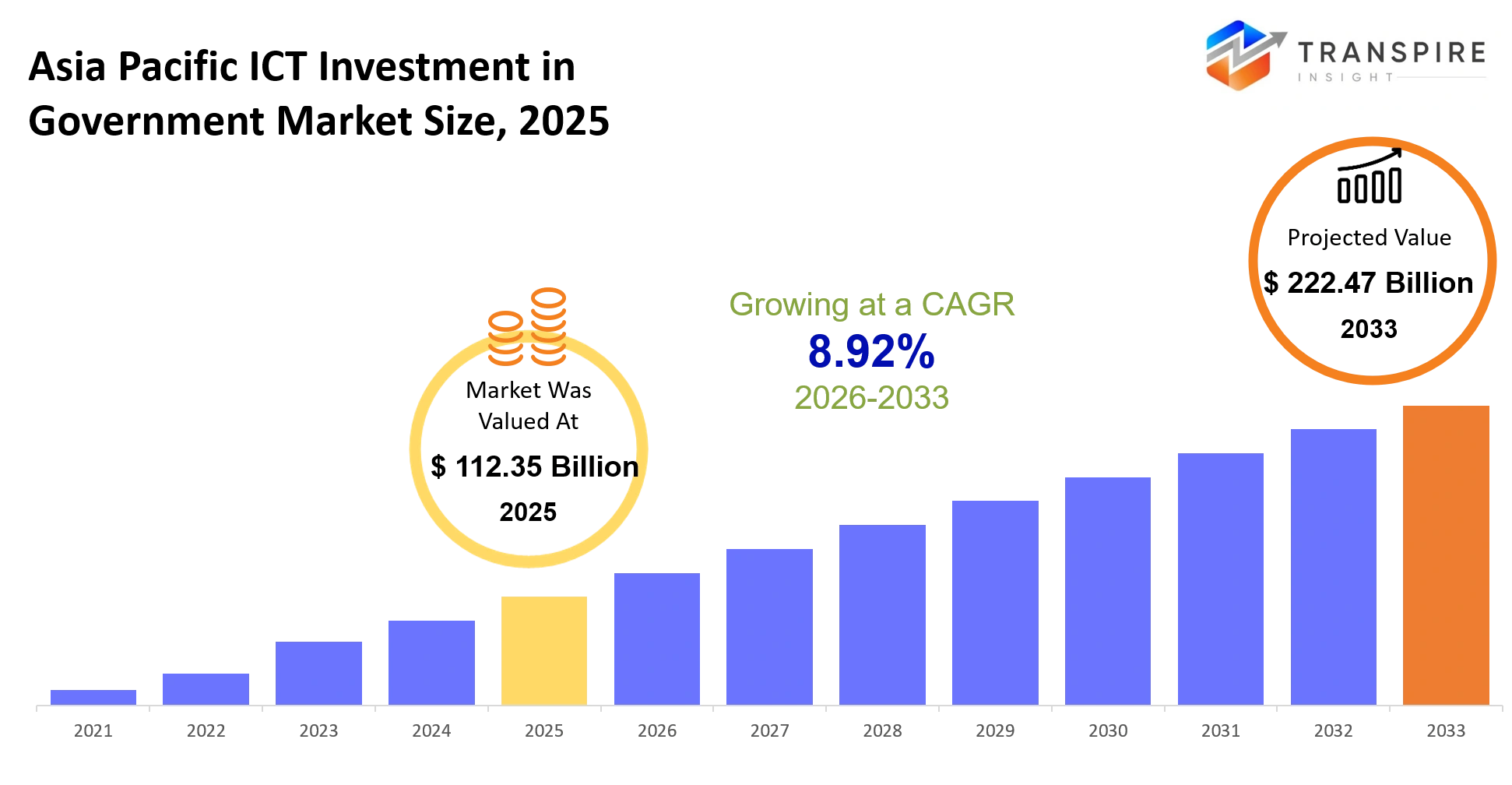
The Asia Pacific ICT Investment in Government Market was valued at USD 112.35 billion in 2025. It is forecast to reach USD 222.47 billion by 2033. That is a CAGR of 8.92% over the period.
The Asia Pacific ICT Investment in Government Market enables public sector agencies to deliver digital services, manage citizen data, strengthen cybersecurity, modernize infrastructure, and improve administrative efficiency. In practice, it supports everything from digital identity systems and smart city platforms to tax administration, public safety networks, and cloud-based government operations. These investments help governments reduce service delivery costs while improving transparency and responsiveness.
Over the last five years, the market has undergone a structural shift from fragmented legacy IT environments toward integrated cloud, AI, and data-driven government platforms. Public sector digital transformation has moved from pilot projects to large-scale modernization programs with measurable service outcomes. A major trigger was the COVID-19 pandemic, which exposed limitations in traditional government systems and accelerated investments in digital public services, remote operations, and secure citizen engagement platforms. As governments expand digital governance initiatives and strengthen cyber resilience, ICT spending increasingly targets scalable platforms that support long-term service modernization, creating sustained opportunities for technology providers and systems integrators across the region.
Key Market Insights
- China dominates the regional market, accounting for approximately 35–40% of total revenue in 2025 through large-scale digital government programs.
- Japan maintains a significant market position, supported by cybersecurity modernization and public sector technology upgrades.
- India is projected to be the fastest-growing country through 2032, driven by digital governance initiatives and smart infrastructure investments.
- Southeast Asia is emerging as a high-potential region due to expanding cloud adoption and digital identity implementation programs.
- Cloud computing solutions lead the market with nearly 30% share in 2025, supported by scalability, flexibility, and cost optimization benefits.
- Cybersecurity solutions represent the second-largest segment as governments prioritize protection of critical infrastructure and citizen data.
- AI and analytics platforms are expected to record the fastest growth through the forecast period, enabling automation and data-driven decision-making.
- Demand for integrated digital platforms continues to rise as agencies replace fragmented legacy systems.
- E-government services hold the largest share, exceeding 40% in 2025, supported by online citizen engagement and administrative digitization.
- Smart city projects are the fastest-growing application area, fueled by investments in connected infrastructure and urban management systems.
What are the Key Drivers, Restraints, and Opportunities in the Asia Pacific ICT Investment in Government Market?
The strongest force accelerating growth in the Asia Pacific ICT Investment in Government Market is the rapid shift toward digital-first public administration. Governments across China, India, Singapore, South Korea, and Australia have introduced national digital governance programs to improve service delivery, reduce administrative costs, and strengthen data-driven decision-making. The widespread adoption of cloud infrastructure, digital identity systems, and AI-enabled public services has transformed ICT spending from discretionary modernization projects into core operational investments. As agencies migrate legacy systems and digitize citizen services, technology vendors benefit from larger contract values, recurring software revenues, and long-term platform deployment opportunities.
The most significant barrier remains the persistence of fragmented legacy infrastructure across government agencies. Many public institutions operate decades-old systems that were developed independently and lack interoperability. Replacing these systems requires substantial capital investment, lengthy procurement cycles, regulatory approvals, and workforce retraining. This challenge is structural because governments cannot disrupt critical public services during modernization efforts. As a result, implementation timelines often extend for years, delaying technology adoption and limiting the speed at which new ICT investments translate into market revenue.
A major opportunity lies in the expansion of sovereign cloud and AI-enabled government platforms. Governments increasingly seek secure environments that keep sensitive public data within national jurisdictions while enabling advanced analytics and automation. India's digital public infrastructure initiatives and Southeast Asia's smart government programs provide strong examples of markets where cloud-native governance platforms are gaining momentum. As regulatory frameworks mature, sovereign cloud ecosystems could unlock the next wave of large-scale government technology investments across the region.
What Has the Impact of Artificial Intelligence Been on the Asia Pacific ICT Investment in Government Market?
Artificial intelligence and advanced digital technologies are reshaping government ICT investments across Asia Pacific by improving administrative efficiency, service delivery, and infrastructure management. Public agencies increasingly deploy AI-powered automation to process citizen applications, verify documents, manage digital identity systems, and monitor cybersecurity events. Intelligent workflow platforms reduce manual intervention in high-volume government operations, enabling faster response times and lower administrative costs.
Machine learning models are also strengthening predictive capabilities across public sector systems. Governments use predictive analytics to forecast service demand, identify potential fraud in welfare and tax programs, optimize traffic management, and anticipate infrastructure maintenance requirements. In smart city environments, AI analyzes data from sensors and connected assets to improve resource allocation and reduce operational disruptions. Advanced analytics platforms help agencies identify emerging risks before they escalate into costly service failures.
These technologies are delivering measurable operational improvements. Automated service platforms shorten processing times, AI-assisted cybersecurity tools improve threat detection rates, and predictive maintenance systems help extend the lifespan of public infrastructure assets while reducing unplanned downtime. Data-driven decision support systems also enhance policy planning and budget allocation efficiency.
A key limitation remains the complexity of integrating AI with legacy government systems. Many agencies operate fragmented databases and outdated infrastructure, making implementation expensive and limiting model accuracy due to inconsistent or incomplete historical data. This challenge continues to slow large-scale AI deployment despite strong investment momentum across the region.
Key Market Trends
- Since 2020, governments have shifted from on-premise infrastructure toward hybrid and sovereign cloud deployments to improve scalability, security, and service continuity.
- AI adoption expanded beyond pilot programs after 2022, with agencies using automated document processing, fraud detection, and citizen service chatbots.
- Cybersecurity spending gained strategic importance as ransomware attacks on public institutions increased, prompting larger investments in zero-trust architectures.
- India accelerated digital public infrastructure deployment between 2021 and 2025, influencing neighboring countries to modernize national digital service platforms.
- Government procurement models increasingly favor subscription-based software and managed services over large upfront technology purchases.
- Smart city investments evolved from standalone projects into integrated urban management platforms combining IoT, analytics, and real-time decision support.
- Microsoft, AWS, Google Cloud, and Oracle expanded regional data center capacity to address data sovereignty and regulatory compliance requirements.
- Cross-agency data sharing initiatives became more common after 2023, reducing information silos and improving public service coordination.
- Public sector buyers increasingly require interoperability standards, reflecting a shift away from vendor-specific systems toward open digital ecosystems.
- Southeast Asian governments strengthened digital identity and citizen authentication programs, enabling broader adoption of online public services and transactions.
Asia Pacific ICT Investment in Government Market Segmentation
By Solution:
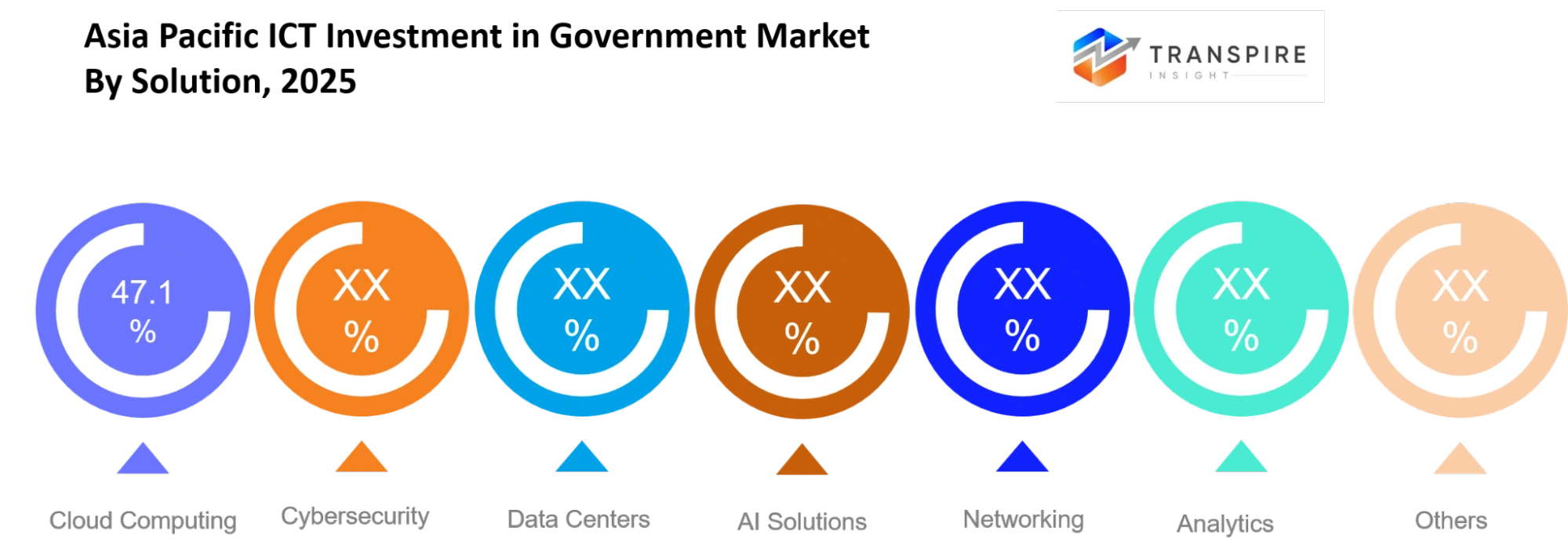
Cloud computing remains a central investment area as public agencies modernize digital infrastructure and improve service delivery. Cloud-based platforms support scalability, faster deployment, and efficient management of government applications. Growing digital governance initiatives continue to encourage migration from traditional systems to flexible cloud environments. Strong investments in secure cloud architecture also support long-term operational efficiency.
Cybersecurity solutions attract substantial funding because government databases, public service platforms, and critical infrastructure require stronger protection against cyber threats. Analytics and artificial intelligence solutions gain wider adoption as agencies seek data-driven decision-making capabilities. Networking technologies, data center modernization, and integrated digital platforms also support large-scale transformation projects. Continued focus on automation and system integration strengthens demand across multiple solution categories.
By Deployment:
Public cloud deployment has gained momentum due to lower infrastructure costs, rapid scalability, and improved accessibility for government departments. Large digital service programs increasingly rely on cloud-based environments to manage workloads and support citizen-facing applications. Public cloud adoption also enables faster implementation of new technologies without extensive hardware investments. Expanding digital transformation agendas continue to support deployment growth.
Private cloud remains important for agencies handling sensitive information and national security data. Strong regulatory requirements encourage investment in controlled and secure computing environments. Hybrid cloud deployment is expanding steadily as organizations seek a balance between security, flexibility, and operational efficiency. Combined deployment strategies allow agencies to optimize workloads while maintaining compliance with data governance requirements.
By Application:
E-government applications represent a major area of technology spending as governments continue to digitize administrative processes and citizen services. Online service portals, digital identity systems, and electronic documentation platforms improve efficiency while reducing processing delays. Continuous modernization efforts encourage broader implementation of integrated digital service ecosystems. Greater emphasis on accessibility also supports investment in citizen-centric platforms.
Smart city initiatives generate substantial technology investments through connected infrastructure, intelligent transportation systems, and urban management platforms. Public safety applications increasingly incorporate advanced analytics, monitoring systems, and emergency response technologies. Healthcare-related digital projects also receive growing attention as governments improve data management and service coordination. Defense and security modernization programs further contribute to technology adoption across public institutions.
By End User:
Central government agencies account for a significant portion of technology investments because national digital transformation programs often require large-scale infrastructure and platform deployment. Major initiatives involving digital governance, cybersecurity, and public administration modernization originate at the national level. Long-term strategic planning and larger budgets support continued investment activity. National programs also encourage technology standardization across multiple departments.
State government organizations continue expanding digital capabilities to improve regional service delivery and administrative efficiency. Local authorities increasingly adopt cloud platforms, data analytics tools, and citizen engagement solutions to address community needs. Greater focus on operational effectiveness supports technology implementation at regional and municipal levels. Ongoing modernization efforts across all government tiers create a broad foundation for future ICT investment.
What are the Key Use Cases Driving the Asia Pacific ICT Investment in Government Market?
Digital government service delivery remains the primary use case driving technology investments across the region. National and regional agencies use cloud-based platforms, digital identity systems, and integrated citizen service portals to manage public services more efficiently. This area generates the highest spending because governments must handle large transaction volumes while improving accessibility and administrative performance.
Cybersecurity modernization and smart city management are gaining traction as important secondary applications. Public sector organizations increasingly deploy threat monitoring systems, secure data platforms, and real-time analytics to protect critical infrastructure. Urban authorities also invest in connected traffic management, public safety networks, and digital infrastructure to support growing urban populations.
Emerging applications include AI-assisted policy planning and predictive public infrastructure management. Advanced analytics platforms can help agencies forecast service demand, identify operational risks, and optimize resource allocation. Digital twins and AI-driven decision support systems also show strong potential as governments pursue more data-centric governance models over the forecast period.
|
Report Metrics |
Details |
|
Market size value in 2025 |
USD 112.35 Billion |
|
Market size value in 2026 |
USD 122.35 Billion |
|
Revenue forecast in 2033 |
USD 222.47 Billion |
|
Growth rate |
CAGR of 8.92% from 2026 to 2033 |
|
Base year |
2025 |
|
Historical data |
2021 - 2024 |
|
Forecast period |
2026 - 2033 |
|
Report coverage |
Revenue forecast, competitive landscape, growth factors, and trends |
|
Regional scope |
Asia Pacific (India, China, Japan, Australia, South Korea, Rest of Asia Pacific) |
|
Key company profiled |
Microsoft, IBM, Oracle, SAP, Cisco, Huawei, NEC, Fujitsu, Hitachi, Dell Technologies, HPE, AWS, Google Cloud, Accenture, TCS |
|
Customization scope |
Free report customization (country, regional & segment scope). Avail customized purchase options to meet your exact research needs. |
|
Report Segmentation |
By Solution (Cloud Computing, Cybersecurity, Data Centers, AI Solutions, Networking, Analytics, Others); By Deployment (Public Cloud, Private Cloud, Hybrid, Others); By Application (E-Government, Public Safety, Smart Cities, Defense, Healthcare, Others); By End User (Central Government, State Government, Local Authorities, Others) |
Which Regions are Driving the Asia Pacific ICT Investment in Government Market Growth?
East Asia holds the largest share of regional government technology spending due to strong policy support, large public-sector budgets, and advanced digital infrastructure. China, Japan, and South Korea continue to invest heavily in digital governance platforms, cybersecurity frameworks, and data-driven public services. National digital transformation programs receive long-term funding, allowing agencies to modernize systems at scale rather than through isolated projects. A mature ecosystem of cloud providers, technology vendors, research institutions, and government agencies helps sustain regional leadership.
Oceania represents a different market profile, with growth supported by institutional stability and consistent technology modernization rather than large-scale population-driven demand. Australia and New Zealand maintain steady investment in secure digital services, cloud migration, and public-sector cybersecurity initiatives. Regulatory frameworks are generally predictable, which allows government departments to plan multi-year technology deployments with lower implementation risk. This stability makes the region a dependable contributor to overall market revenue despite a smaller population base than East Asia.
South Asia is expected to record the fastest growth over the forecast period, led primarily by India’s expanding digital public infrastructure initiatives. Recent investments in digital identity platforms, citizen service portals, cloud infrastructure, and smart governance programs have accelerated technology adoption across multiple government levels. Greater focus on digital inclusion and administrative efficiency has created new opportunities for software providers, systems integrators, and cloud service companies. Continued modernization efforts between 2026 and 2033 are likely to attract additional investment and create favorable conditions for new market entrants.
Who are the Key Players in the Asia Pacific ICT Investment in Government Market and How Do They Compete?
Competition across the Asia Pacific ICT Investment in Government Market is moderately concentrated, with global technology providers competing alongside regional systems integrators and cloud service specialists. The primary basis of competition has shifted from hardware delivery toward cloud capabilities, cybersecurity expertise, data management, and long-term digital transformation support. Large vendors continue to defend market share through integrated technology ecosystems, while specialized providers gain traction in areas such as artificial intelligence, sovereign cloud infrastructure, and government cybersecurity. Procurement requirements, regulatory compliance, and the ability to manage complex public-sector projects increasingly influence contract awards.
Microsoft differentiates itself through a broad cloud ecosystem that combines productivity software, AI tools, cybersecurity solutions, and government-focused cloud services. This integrated approach allows agencies to consolidate multiple technology functions within a single environment. AWS focuses on scalable cloud infrastructure and advanced analytics capabilities, helping government organizations modernize legacy systems while maintaining operational flexibility. Both companies continue expanding regional data center investments and partnerships that support local data residency and compliance requirements.
IBM competes through expertise in hybrid cloud deployment, cybersecurity services, and AI-enabled automation for public administration. Oracle emphasizes database management, cloud applications, and secure data infrastructure, which appeal to agencies managing large volumes of sensitive information. Accenture strengthens market position through digital transformation consulting and large-scale implementation services that connect technology strategy with operational execution. Strategic collaborations with government agencies, cloud providers, and regional technology partners allow these companies to expand project scope, improve service delivery, and strengthen competitive differentiation across Asia Pacific markets.
Company List
- Microsoft
- IBM
- Oracle
- SAP
- Cisco
- Huawei
- NEC
- Fujitsu
- Hitachi
- Dell Technologies
- HPE (Hewlett Packard Enterprise)
- AWS (Amazon Web Services)
- Google Cloud
- Accenture
- TCS (Tata Consultancy Services)
Recent Development News
"In April 2026, Microsoft signed a Memorandum of Understanding with the Australian Government on artificial intelligence collaboration. The agreement supports AI infrastructure development, cloud computing expansion, workforce capability building, and implementation of Australia's National AI Plan, strengthening public-sector digital transformation initiatives. Full Link:https://www.industry.gov.au
"In March 2026, Microsoft announced an investment of more than US$1 billion in Thailand for cloud and AI infrastructure. The investment will expand cloud services, AI capabilities, and digital infrastructure capacity, supporting government modernization and broader digital transformation efforts across Thailand. Full Link:https://news.microsoft.com
What Strategic Insights Define the Future of the Asia Pacific ICT Investment in Government Market?
Over the next five to seven years, the Asia Pacific ICT Investment in Government Market is expected to move beyond basic digital transformation toward integrated digital governance ecosystems built around artificial intelligence, cloud-native infrastructure, and real-time data exchange. The underlying driver will be the growing need for governments to deliver services faster while managing increasingly complex administrative, security, and infrastructure challenges. Future investment decisions are likely to prioritize interoperability and platform integration rather than standalone technology deployments.
A less visible risk lies in market concentration around a limited number of cloud and platform providers. As governments become more dependent on a small group of technology vendors, concerns related to vendor lock-in, data sovereignty, and procurement flexibility could influence future spending patterns and regulatory frameworks.
An emerging opportunity is the development of sovereign AI platforms in countries such as India, Indonesia, and Vietnam, where governments seek greater control over public-sector data and AI deployment. Market participants should prioritize open, interoperable solutions that integrate easily with existing government systems, as flexibility and compliance readiness will become more important competitive advantages than infrastructure scale alone.
Asia Pacific ICT Investment in Government Market Report Segmentation
By Solution
- Cloud Computing
- Cybersecurity
- Data Centers
- AI Solutions
- Networking
- Analytics
- Others
By Deployment
- Public Cloud
- Private Cloud
- Hybrid
- Others
By Application
- E-Government
- Public Safety
- Smart Cities
- Defense
- Healthcare
- Others
By End User
- Central Government
- State Government
- Local Authorities
- Others
Frequently Asked Questions
Find quick answers to common questions.
The expected Asia Pacific ICT Investment in Government Market size for the market will be USD 222.47 Billion in 2033.
Key segments for the Asia Pacific ICT Investment in Government Market are By Solution (Cloud Computing, Cybersecurity, Data Centers, AI Solutions, Networking, Analytics, Others); By Deployment (Public Cloud, Private Cloud, Hybrid, Others); By Application (E-Government, Public Safety, Smart Cities, Defense, Healthcare, Others); By End User (Central Government, State Government, Local Authorities, Others).
Major Asia Pacific ICT Investment in Government Market players are Microsoft, IBM, Oracle, SAP, Cisco, Huawei, NEC, Fujitsu, Hitachi, Dell Technologies, HPE, AWS, Google Cloud, Accenture, TCS.
The Asia Pacific ICT Investment in Government Market size is USD 112.35 billion in 2025.
The Asia Pacific ICT Investment in Government Market CAGR is 8.92% from 2026 to 2033.
- Microsoft
- IBM
- Oracle
- SAP
- Cisco
- Huawei
- NEC
- Fujitsu
- Hitachi
- Dell Technologies
- HPE (Hewlett Packard Enterprise)
- AWS (Amazon Web Services)
- Google Cloud
- Accenture
- TCS (Tata Consultancy Services)
About the Authors

Mayur Shinde
I am Mayur Shinde, a Senior Research Analyst at Transpire Insight, specializing in the Automotive & Transportation and Information & Communication Technology (ICT) Industry. My work focuses on analyzing emerging market trends, technological advancements, competitive landscapes, and industry developments to deliver accurate, data-driven insights. I am passionate about transforming complex market information into clear, actionable content that helps businesses, professionals, and decision-makers stay informed and make confident strategic decisions.

Chakradhar Khansole
Chakradhar serves as the Research Director at Transpire Insight, bringing over 8 years of experience in technology, innovation, and strategic market intelligence. He specializes in transforming complex market data into actionable business insights that enable organizations to make informed, growth-oriented decisions. Recognized for his strategic vision and analytical expertise, Chakradhar leads high-impact research initiatives, delivering comprehensive market assessments, competitive intelligence, and forward-looking industry analysis.
Recently Published Reports
-
Apr 2026
3D Optical Profiler Market
3D Optical Profiler Market Size, Share & Analysis Report By Type (Desktop 3D Optical Profiler, and Portable 3D Optical Profiler), By Technology (Confocal Technology, and White Light Interference), By End-Use Industry (Manufacturing, Research Institutions, Automotive, Aerospace and Defense, Medical Devices, and Other), and Geography (North America, Europe, Asia-Pacific, Middle East and Africa, South and Central America), 2021 - 2031
-
Apr 2026
Depth Sensor Market
Depth Sensor Market Size, Share & Analysis Report By Type (Infrared Depth Sensors, Time-of-Flight (ToF) Sensors, Stereo Vision Sensors, Structured Light Sensors, Ultrasonic Depth Sensors), By Application (Automotive, Robotics, Gaming, Consumer Electronics, Industrial Automation, Healthcare, Security & Surveillance, Others), By End Users (Automotive Manufacturers, Consumer Electronics Companies, Healthcare Providers, Industrial Companies, Security Agencies, Gaming Companies, Robotics Companies, Others), and Geography (North America, Europe, Asia-Pacific, Middle East and Africa, South and Central America), 2021 – 2031
-
Apr 2026
Digital Manufacturing Market
Digital Manufacturing Market Size, Share & Analysis Report By Component (Hardware, Software, and Services), By Technology (Robotics, 3D Printing, Internet of Things (IoT), and Others), By Application (Automotive and Transportation, Aerospace and Defense, Consumer Electronics, Industrial Machinery, and Others), By Process Type (Computer-Based Designing, Computer-Based Simulation, Computer 3D Visualization, Analytics, and Others), and Geography (North America, Europe, Asia-Pacific, Middle East and Africa, South and Central America), 2021 – 2031
-
Apr 2026
Digital Visa Services Market
Digital Visa Services Market Size, Share & Analysis Report By Type (Individual Travelers, Group Travelers), By Application (Tourism, Business Travel, Others), and Geography (North America, Europe, Asia-Pacific, Middle East and Africa, South and Central America), 2021 – 2031