
Asia Pacific Hydrotherapy Equipment Market Size & Forecast:
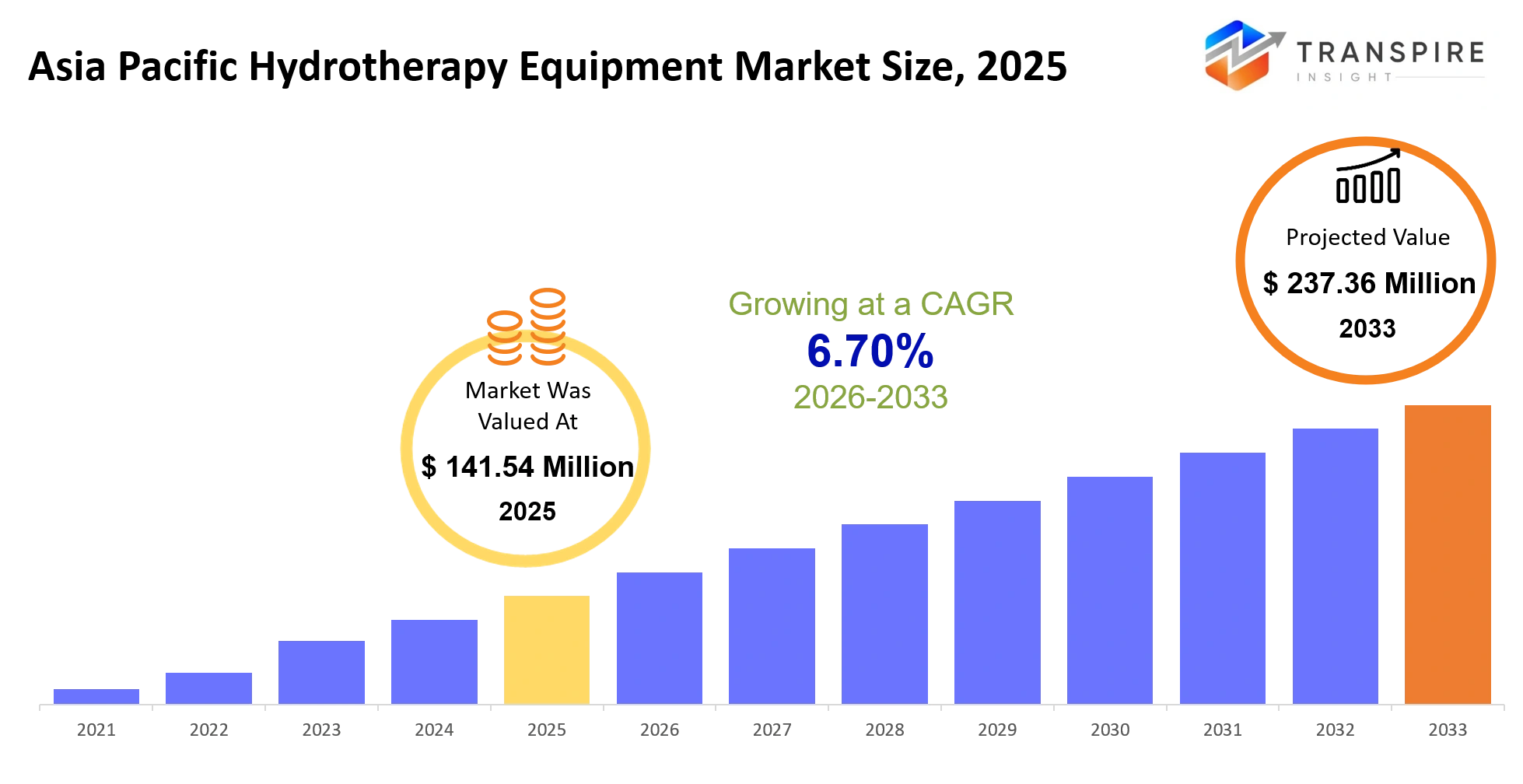
- Asia Pacific Hydrotherapy Equipment Market Size 2025: USD 141.54 Million
- Asia Pacific Hydrotherapy Equipment Market Size 2033: USD 237.36 Million
- Asia Pacific Hydrotherapy Equipment Market CAGR: 6.70%
- Asia Pacific Hydrotherapy Equipment Market Segments: By Product Type (Hydrotherapy Pools, Underwater Treadmills, Whirlpool Baths, Hydrotherapy Chambers, Aquatic Exercise Equipment, Contrast Baths, Therapeutic Showers, Others); By Application (Rehabilitation, Pain Management, Sports Medicine, Neurological Therapy, Orthopedic Therapy, Fitness & Wellness, Others); By End User (Hospitals, Rehabilitation Centers, Sports Clinics, Wellness Centers, Homecare, Others); By Technology (Manual Systems, Automated Systems, Smart Hydrotherapy Systems, Digital Monitoring Systems, Others).
To learn more about this report,  Download Free Sample Report
Asia Pacific Hydrotherapy Equipment Market Summary
The Asia Pacific Hydrotherapy Equipment Market was valued at USD 141.54 Million in 2025. It is forecast to reach USD 237.36 Million by 2033. That is a CAGR of 6.70% over the period.
The Asia Pacific Hydrotherapy Equipment Market sort of plays a critical role in rehabilitation, pain management, sports recovery, and physical therapy, by allowing controlled water based treatment that lowers pressure on joints while also boosting mobility and muscle performance. In practice hospitals, rehab centers, sports medicine facilities, and wellness clinics rely on hydrotherapy systems to help speed up recovery, and they also support more durable therapeutic results over time.
Over the last five years, the scene has moved from plain traditional therapeutic pools toward Over the last five years, the scene has moved from plain traditional therapeutic pools towards hydrotherapy systems that feel more technologically integrated, you know think digital controls and adjustable resistance mechanisms and treatment settings that can be tuned for individual needs. One major push behind this change was the disruption caused by the COVID 19 pandemic which made people pay more attention to rehabilitation services, post treatment recovery programs and physical wellness infrastructure across many healthcare facilities. Since healthcare providers keep expanding their rehab capabilities, and aging populations need options that are less invasive, spending on advanced hydrotherapy solutions keeps climbing. This is showing up as higher adoption rates of equipment, more facility upgrades, and stronger revenue generation across medical as well as wellness oriented end users.
Key Market Insights
- Asia Pacific Hydrotherapy Equipment Market is projected to drift up from USD 141.54 million in 2025, to reach USD 237.36 million by 2033, more or less.
- In 2025, East Asia is still the biggest player, holding around 38% market share , and this is largely backed by healthcare modernization initiatives.
- Meanwhile Southeast Asia looks like the quickest mover through 2033, mainly because private rehabilitation and wellness facilities are expanding more and more.
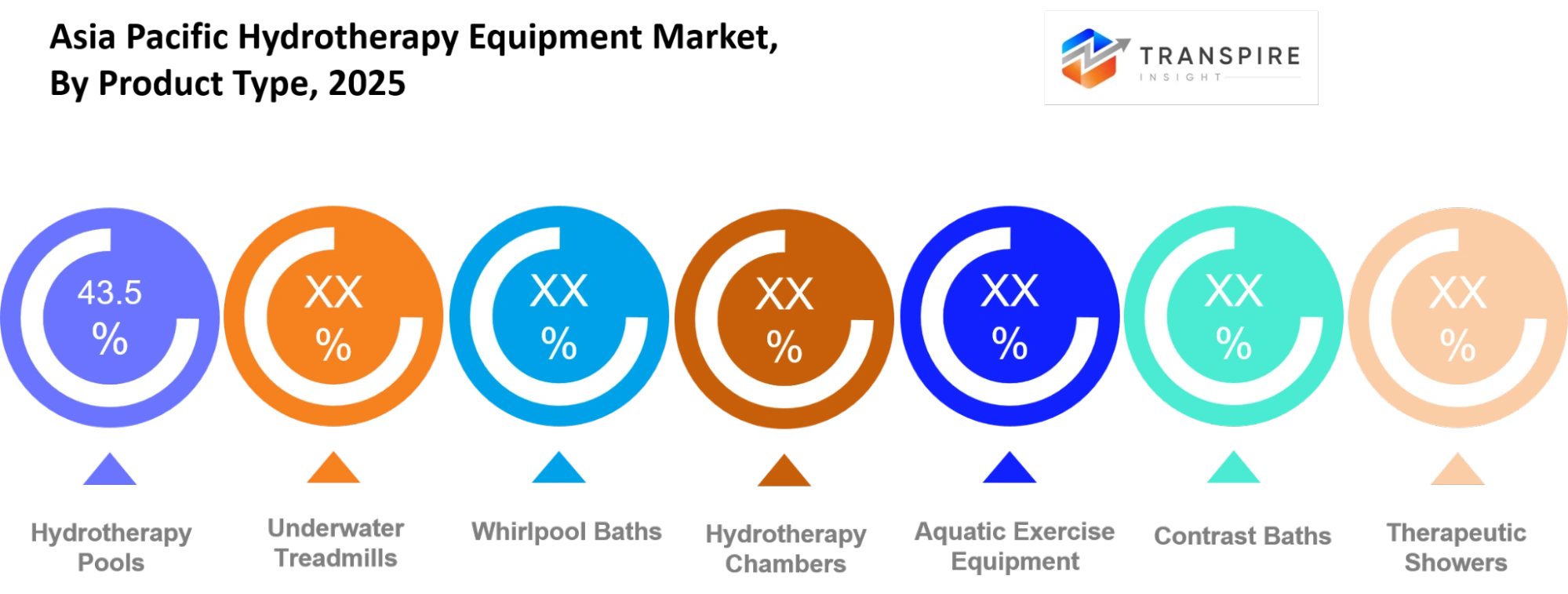
- When you break down the categories, hydrotherapy pools bring in about 42% of the industry revenue in 2025, so they stay in front.
- Underwater treadmills end up as the second-largest slice too, powered by sports medicine, plus orthopedic rehabilitation use cases.
- Smart hydrotherapy systems, those with digital monitoring , are expected to grow at above 8% per year across the forecast window.
- On the application side, rehabilitation centers contribute roughly 35% of overall market revenue which basically makes them the dominant segment.
- Also sports injury recovery programs are starting to show up as a higher growth niche , especially across Australia, Japan, and South Korea.
- For end users, hospitals stay the largest group with close to 40% market share, while wellness clinics are the ones growing fastest.
- Key players—HydroWorx, EWAC Medical, SwimEx, Jacuzzi, Kohler, and Endless Pools—are putting money into product innovation, digital controls , local collaborations , and broader service network expansion to keep their competitive edge.
What are the Key Drivers, Restraints, and Opportunities in the Asia Pacific Hydrotherapy Equipment Market?
Market growth really comes from this fast expansion of rehabilitation and physical therapy services across Asia Pacific healthcare systems. Over time, governments along with private healthcare providers have been putting more money into recovery focused care, especially since populations are aging and chronic musculoskeletal disorders keep showing up more often. Because of that, hospitals and rehab centers are moving toward advanced hydrotherapy setups, things like underwater treadmills , hydrotherapy pools, and aquatic exercise systems. So equipment suppliers end up gaining from new facility installations AND also from the replacement needs of centers that are already running these treatments.
Still, the biggest restraint is the pretty high capital outlay plus ongoing maintenance tied to hydrotherapy infrastructure. Specialized pools, water treatment systems, heating equipment, and all the facility modifications cost a lot up front. This is sort of structural too, because healthcare facilities have to set aside space, hire trained staff, and keep funding daily operations. Smaller clinics, and even some regional hospitals, often push purchases further out, which ends up slowing adoption and reducing market penetration in areas that are more cost sensitive.
There’s also a meaningful opportunity in combining digital rehabilitation technology with hydrotherapy tools. More facilities are testing sensor enabled aquatic therapy systems that monitor patient motion, measure recovery progress, and document treatment outcomes. In places like Singapore, Australia, and Japan there’s a lot of investment going into smart healthcare infrastructure, which creates a decent runway for advanced hydrotherapy platforms. Firms that blend aquatic therapy with data analytics and remote monitoring options could be positioned to win during the next stage of market expansion.
What Has the Impact of Artificial Intelligence Been on the Asia Pacific Hydrotherapy Equipment Market?
Artificial intelligence is slowly, in a way, transforming hydrotherapy gear by making treatment personalization more practical and real, plus helping with equipment management and better day to day operational efficiency. In newer rehabilitation setups, you often see AI enabled motion tracking and sensor tech working together. They look at patient movement patterns during aquatic sessions and sort of build a clearer picture of what’s happening. With that, therapists can fine tune exercise intensity, watch recovery progress more closely, and keep treatment consistency steadier across sessions.
At the same time, machine learning is being put to work for predictive maintenance. When it studies pump performance, water circulation setups, filtration equipment , and general usage trends, operators can often spot possible failures earlier, before they actually create downtime. This kind of strategy improves equipment availability and also cuts down maintenance cost, especially for hospitals and rehabilitation centers. A few newer platforms even create performance analytics that let clinicians adjust rehabilitation protocols more precisely and evaluate patient outcomes in a more accurate way.
Digital tools are also producing tangible operational advantages. Facilities can increase equipment utilization, lower the chance of unplanned maintenance interruptions, and potentially improve therapy results through data driven decision making. AI supported monitoring solutions can additionally help streamline compliance with health and safety rules tied to water quality, as well as overall system performance.
Still, adoption is not moving as fast as it could be, mainly because of integration costs and issues with data availability. Many rehabilitation centers continue to use older infrastructure that does not really connect well. Also, AI models need large volumes of high quality clinical data, and that data is often fragmented across different healthcare providers in multiple Asia Pacific markets.
Key Market Trends
- From 2020 till 2025, rehab providers started putting more money into digitally controlled hydrotherapy systems, mostly to make treatment more steady and to help with patient tracking.
- Smart underwater treadmills also got more attention, you could see adoption in sports medicine facilities rising around 20% in developed markets.
- Hospitals meanwhile moved away from simple aquatic therapy pools, toward more blended rehabilitation platforms that include resistance controls and some performance analytics too, kinda all in one.
- After 2022, private wellness centers expanded their hydrotherapy programs, so they could build extra revenue streams beyond the usual rehabilitation services.
- Japan and South Korea pushed spending on elderly rehabilitation infrastructure, and that helped keep equipment procurement going across healthcare networks.
- At the same time manufacturers rolled out compact hydrotherapy systems for urban clinics, where space limits used to slow adoption in the first place.
- HydroWorx, SwimEx, and Endless Pools leaned harder into multifunctional rehabilitation equipment that basically merges therapy, exercise, and recovery applications.
- Digital monitoring tech became more common too, so facilities could follow patient outcomes, and also show treatment effectiveness in a clearer way.
- Regional distributors got stronger after sales service capabilities , which seems to match what customers wanted: longer maintenance support, plus technical help contracts.
- Since 2023, wellness centered product launches have increasingly fused hydrotherapy with recovery, fitness, and preventive healthcare programs, like one package rather than separate offerings.
Asia Pacific Hydrotherapy Equipment Market Segmentation
By Product Type
The product type segment kind of points to the broad set of equipment that shows up in aquatic therapy, rehab, recovery , and wellness programs. Hydrotherapy Pools have a pretty major role since those controlled water spaces let people do therapeutic movements, boost mobility, and get back on track after injuries. In other words , healthcare facilities and therapy centers keep investing in these systems, mainly to push better treatment results and patient comfort.
Underwater Treadmills keep getting adopted at a solid pace because water resistance helps with low-impact exercise, and it also lessens the load on joints and muscles. Whirlpool Baths are still common for relaxing downtime, improved circulation, and pain relief use cases. Hydrotherapy Chambers offer a more focused treatment setting, so they can support specialized therapeutic procedures. Aquatic Exercise Equipment basically helps both rehabilitation and fitness efforts via structured motion routines. Contrast Baths are getting a bit of attention too, for recovery plans that flip between temperatures, to support circulation and muscle recovery. Therapeutic Showers cover hydro-massage plus targeted water therapy tasks, while Others just means specialized devices made for unusual clinical and wellness needs.
To learn more about this report, Download Free Sample Report
By Application
The app segment shows the wide healing and wellness advantages that hydrotherapy equipment brings into healthcare, plus fitness spaces. Rehabilitation takes up a notable portion, since water therapy supports someone recovering from traumas, surgeries, and also mobility limits. Clinicians lean on water based therapy to help movement quality, lessen physical strain, and also back up longer term recovery aims.
Pain Management stays in steady demand, because hydrotherapy approaches can ease discomfort tied to chronic health issues, muscle tension, and joint problems. Sports Medicine uses more advanced hydrotherapy solutions to support athlete rebound, conditioning, and those injury treatment tracks. Neurological Therapy gets help from carefully controlled aquatic settings, which assist balance and coordination, as well as movement practice. Orthopedic Therapy is still key for musculoskeletal rehab and post operative care. Fitness & Wellness keeps growing too, because wellness centers are adding hydrotherapy into both recovery routines and preventive health programs. Other use cases cover specialized therapeutic needs, created for particular treatment objectives.
By End User
The end user segment kind of mirrors the wide range of orgs and facilities that put hydrotherapy equipment to work for treatment, recuperation, and overall wellness. Hospitals show up as a big slice of that picture, because rehabilitation departments often weave aquatic therapy right into their patient care programs. And there’s still ongoing investment in more advanced treatment infrastructure, which keeps encouraging equipment adoption across different healthcare networks, more or less.
Rehabilitation Centers take up a notable portion too, mainly because they’re specialized in physical recovery, progress with mobility, and longer-term therapy programs. Sports Clinics lean on hydrotherapy systems to help with injury rehabilitation as well as athletic performance recovery. Wellness Centers keep adding installations because therapeutic, recovery oriented services are getting more popular with everyday consumers. Homecare applications also attract interest, usually thanks to compact, easy-to-access hydrotherapy solutions that are meant for individual use at home.
Then there are the “other” users, like specialty care facilities and treatment providers that need tailored aquatic therapy systems, for specific patient groups and needs.
By Technology
The technology segment shows the shift from conventional gear to more advanced, and also connected therapeutic systems. Manual Systems are still around, simply because operation is simple, acquisition costs stay lower and maintenance is pretty straightforward, for a lot of facilities. Even so, dependable performance keeps showing up, and it still helps utilization in smaller healthcare and wellness spaces.
Automated Systems, on the other hand, improve day to day efficiency using programmable controls, steadier treatment results, and a more manageable way to handle equipment. Smart Hydrotherapy Systems are gaining momentum because integrated sensors, performance tracking options, and customized therapy presets make it easier to deliver personalized care. Digital Monitoring Systems, meanwhile, do real time data gathering and it helps therapists and facility operators to judge both progress and system performance. Other solutions also appear, like emerging technologies and specialized control platforms meant to boost therapeutic impact, operational reliability, and overall user experience.
What are the Key Use Cases Driving the Asia Pacific Hydrotherapy Equipment Market?
The biggest use case stays tied to physical rehab and orthopedic recovery like, generally speaking. Hospitals and rehabilitation centers often rely on hydrotherapy systems, they use them to support patients bouncing back after joint replacement operations, spinal injuries, neurological disorders, and a range of musculoskeletal conditions. The way the water buoyancy works means body weight loading feels lower, so people can do therapeutic exercises with a smaller injury risk, and yes it helps a lot.
Sports medicine is also a notable growth direction. Pro athletes, sports academies, and performance hubs are increasingly adopting underwater treadmills and aquatic recovery setups to help with injury rehabilitation but also conditioning. Wellness clinics, even the smaller ones, are starting to stitch hydrotherapy programs into wider recovery and preventive care offerings.
Newer ideas show up too, like aquatic therapy aimed at elderly mobility improvement and neurological rehabilitation programs for stroke recovery patients. On top of that, specialized pediatric rehabilitation programs along with digitally monitored therapy platforms are getting more attention, as healthcare providers look for more personal treatment approaches during the forecast period, rather than one size fits all.
|
Report Metrics |
Details |
|
Market size value in 2025 |
USD 141.54 Million |
|
Market size value in 2026 |
USD 150.74 Million |
|
Revenue forecast in 2033 |
USD 237.36 Million |
|
Growth rate |
CAGR of6.70% from 2026 to 2033 |
|
Base year |
2025 |
|
Historical data |
2021 - 2024 |
|
Forecast period |
2026 - 2033 |
|
Report coverage |
Revenue forecast, competitive landscape, growth factors, and trends |
|
Regional scope |
Asia Pacific (India, China, Japan, Australia, South Korea, Rest of Asia Pacific) |
|
Key company profiled |
HydroWorx, EWAC Medical, SwimEx, Prime Pacific Health, Sidmar, Technomex, Narang Medical, OG Wellness, Jacuzzi, Kohler, Endless Pools, Stas Doyer, BTL, Reval, Physiomed. |
|
Customization scope |
Free report customization (country, regional & segment scope). Avail customized purchase options to meet your exact research needs. |
|
Report Segmentation |
By Product Type (Hydrotherapy Pools, Underwater Treadmills, Whirlpool Baths, Hydrotherapy Chambers, Aquatic Exercise Equipment, Contrast Baths, Therapeutic Showers, Others); By Application (Rehabilitation, Pain Management, Sports Medicine, Neurological Therapy, Orthopedic Therapy, Fitness & Wellness, Others); By End User (Hospitals, Rehabilitation Centers, Sports Clinics, Wellness Centers, Homecare, Others); By Technology (Manual Systems, Automated Systems, Smart Hydrotherapy Systems, Digital Monitoring Systems, Others). |
Which Regions are Driving the Asia Pacific Hydrotherapy Equipment Market Growth?
East Asia really stands out as the dominant regional market and it takes up the biggest slice of industry revenue. Places like China , Japan, and South Korea get a lot of help from advanced healthcare infrastructure , plus solid rehabilitation networks and a steady stream of spending into medical technology. As populations get older, more people need mobility restoration, and also better ways to handle chronic pain. There’s also a mature web of hospitals, rehab centers, and specialized therapy locations that keeps everything moving and supports that leadership position.
Oceania comes next as the second-largest contributor and it seems to grow in a bit of a different way. Australia and New Zealand benefit from fairly stable healthcare spending, strong sports medicine programs, and ongoing uptake of evidence-based rehabilitation technologies. Instead of depending on big population increases, these markets lean more on high treatment standards and continuous facility modernization. This is why they generate a reliable flow of recurring equipment purchases, and routine upgrades rather than just short bursts.
Southeast Asia is projected to show the fastest growth momentum all the way to 2033. Countries such as Singapore , Thailand, Malaysia , and Vietnam have ramped up investment in private healthcare, rehabilitation services, and wellness infrastructure. Better access to care, combined with rising interest in medical tourism, has sped up equipment deployment. From a market perspective, this area can be a strong launchpad, with room for expansion, collaborations, and localized distribution approaches throughout the forecast period.
Who are the Key Players in the Asia Pacific Hydrotherapy Equipment Market and How Do They Compete?
In the Asia Pacific hydrotherapy equipment industry, competition is kinda moderately fragmented , so you see international makers going head to head with regional specialists and distributors all at once. What really pushes buying choices tends to be technology performance , rehab effectiveness, the ability to customize ,and even the after-sales support that comes later. More companies are trying to set themselves apart with specialized therapeutic features and integrated digital tech, rather than just racing on price alone.
HydroWorx is basically centered on technologically advanced rehabilitation systems that bundle underwater treadmills , resistance tech, and therapeutic exercise platforms into one setup. SwimEx sets itself apart with flexible aquatic therapy pools built for clinical rehabilitation, but also for athletic performance uses. EWAC Medical leans heavily on hydrotherapy solutions that are tailored—more or less—directly to rehabilitation centers and medical institutions, so facilities aren’t stuck with one generic layout.
Endless Pools has carved out momentum through compact aquatic fitness and therapy systems, especially ones designed for space constraints yet still supporting rehabilitation and recovery programs. Jacuzzi leans on global brand recognition plus a wide wellness portfolio, and it uses that to grow hydrotherapy adoption across healthcare and non-clinical wellness environments. Kohler, meanwhile, is tightening its wellness-oriented play by putting more effort into therapeutic and recovery-driven product categories, and it’s trying to connect hydrotherapy with broader wellness ecosystems.
Overall, these approaches let manufacturers cover the different needs customers have while also growing their regional market presence, sometimes quietly, sometimes aggressively.
Company List
- HydroWorx
- EWAC Medical
- SwimEx
- Prime Pacific Health
- Sidmar
- Technomex
- Narang Medical
- OG Wellness
- Jacuzzi
- Kohler
- Endless Pools
- Stas Doyer
- BTL
- Reval
- Physiomed
Recent Development News
In July 2025, Kohler announced the launch of its premium indoor and outdoor Kohler Sauna product line. The expansion strengthens Kohler's wellness portfolio and complements its hydrotherapy, steam, and recovery-focused offerings, enhancing its position in therapeutic wellness solutions.
Source: https://www.kohler.com
In February 2025, Kohler showcased new wellness innovations at KBIS 2025, including expanded digital wellness and hydrotherapy-related solutions. The launch supports the company's strategy of integrating water, steam, and recovery technologies into connected wellness environments.
Source: https://www.kohler.com
In October 2025, Kohler launched Kohler Health, a new digital health venture incorporating machine learning and sensor-driven wellness technologies. The initiative highlights growing convergence between rehabilitation, wellness equipment, and data-driven healthcare platforms.
Source: https://hlth.com
What Strategic Insights Define the Future of the Asia Pacific Hydrotherapy Equipment Market?
The Asia Pacific Hydrotherapy Equipment Market is kinda moving toward a more integrated rehab ecosystem where aquatic therapy, digital monitoring, and personalized treatment protocols kinda work together. The strongest force pushing this direction is the healthcare sector’s focus on recovery outcomes that can actually be measured, this is making stakeholders invest in more advanced therapeutic platforms, not just “standalone” hardware. So when providers look for evidence based rehabilitation solutions, systems with tech embedded are likely to get a bigger chunk of the budget.
There’s also a quieter risk though, the concentration of advanced tech is growing, but only within a small set of manufacturers. That could bring pricing pressure, supply constraints, and sometimes limited equipment availability during times of high demand, which is not ideal at all.
An emerging opportunity, more or less, sits in AI enabled rehabilitation platforms that combine hydrotherapy with motion analysis plus outcome tracking. Early uptake in the more developed Asia Pacific healthcare markets hints at wider regional expansion, soon enough.
Market participants should really prioritize partnerships with rehabilitation providers and digital health companies, so they can build integrated therapy solutions that show measurable clinical value and operational value, at the same time.
Asia Pacific Hydrotherapy Equipment Market Report Segmentation
By Product Type
- Hydrotherapy Pools
- Underwater Treadmills
- Whirlpool Baths
- Hydrotherapy Chambers
- Aquatic Exercise Equipment
- Contrast Baths
- Therapeutic Showers
- Others
By Application
- Rehabilitation
- Pain Management
- Sports Medicine
- Neurological Therapy
- Orthopedic Therapy
- Fitness & Wellness
- Others
By End User
- Hospitals
- Rehabilitation Centers
- Sports Clinics
- Wellness Centers
- Homecare
- Others
By Technology
- Manual Systems
- Automated Systems
- Smart Hydrotherapy Systems
- Digital Monitoring Systems
- Others
Frequently Asked Questions
Find quick answers to common questions.
The expected Asia Pacific Hydrotherapy Equipment Market size for the market will be USD 237.36 Million in 2033.
Key segments for the Asia Pacific Hydrotherapy Equipment Market are By Product Type (Hydrotherapy Pools, Underwater Treadmills, Whirlpool Baths, Hydrotherapy Chambers, Aquatic Exercise Equipment, Contrast Baths, Therapeutic Showers, Others); By Application (Rehabilitation, Pain Management, Sports Medicine, Neurological Therapy, Orthopedic Therapy, Fitness & Wellness, Others); By End User (Hospitals, Rehabilitation Centers, Sports Clinics, Wellness Centers, Homecare, Others); By Technology (Manual Systems, Automated Systems, Smart Hydrotherapy Systems, Digital Monitoring Systems, Others).
Major Asia Pacific Hydrotherapy Equipment Market players are HydroWorx, EWAC Medical, SwimEx, Prime Pacific Health, Sidmar, Technomex, Narang Medical, OG Wellness, Jacuzzi, Kohler, Endless Pools, Stas Doyer, BTL, Reval, Physiomed.
The Asia Pacific Hydrotherapy Equipment Market size is USD 141.54 Million in 2025.
The Asia Pacific Hydrotherapy Equipment Market CAGR is 6.70% from 2026 to 2033.
- HydroWorx
- EWAC Medical
- SwimEx
- Prime Pacific Health
- Sidmar
- Technomex
- Narang Medical
- OG Wellness
- Jacuzzi
- Kohler
- Endless Pools
- Stas Doyer
- BTL
- Reval
- Physiomed
About the Authors

Pankaj Ghogare Patil
I am Pankaj Ghogare Patil, a Senior Research Analyst at Transpire Insight, specializing in the Pharmaceutical, Chemicals & Materials, Healthcare IT, and Biotechnology industry. My expertise lies in conducting comprehensive market research, analyzing industry trends, evaluating competitive landscapes, and translating complex data into actionable insights. At Transpire Insight, I closely follow emerging technologies, regulatory developments, and market innovations to create accurate, well-researched, and informative content that helps businesses and professionals make informed decisions. I am committed to producing credible, evidence-based articles that reflect industry best practices while making technical topics accessible and valuable for a broad audience.

Chakradhar Khansole
Chakradhar serves as the Research Director at Transpire Insight, bringing over 8 years of experience in technology, innovation, and strategic market intelligence. He specializes in transforming complex market data into actionable business insights that enable organizations to make informed, growth-oriented decisions. Recognized for his strategic vision and analytical expertise, Chakradhar leads high-impact research initiatives, delivering comprehensive market assessments, competitive intelligence, and forward-looking industry analysis.
Recently Published Reports
-
Apr 2026
AI in Diabetic Retinopathy Market
AI in Diabetic Retinopathy Market Size, Share & Analysis Report By Type (Screening AI Systems, Diagnostic AI Systems, and Predictive AI Models), By Application Segment (Hospitals, Ophthalmology Clinics, Diagnostic Centers, and Research and Development), and Geography (North America, Europe, Asia-Pacific, Middle East and Africa, South and Central America), 2021 - 2031
-
Apr 2026
Psychometric Tests Market
Psychometric Tests Market Size, Share & Analysis Report By Type (Personality Tests, Ability/Aptitude Tests, Skill/Knowledge Tests, and Others), By Application (Talent Acquisition and Talent Management), and Geography (North America, Europe, Asia-Pacific, Middle East and Africa, South and Central America), 2021 – 2031
-
Apr 2026
Rare Biological Sample Collection Market
Rare Biological Sample Collection Market Size, Share & Analysis Report By Type (Isolation Kits & Reagent, Blood Collection Tubes, and Others), By Application (Oncology, Transcriptomics, Pharmacogenomics, and Others), and Geography (North America, Europe, Asia-Pacific, Middle East and Africa, South and Central America), 2021 – 2031
-
Jul 2026
Diabetic Retinopathy Market
Diabetic Retinopathy Market Size, Share & Analysis Report By Type (Proliferative Diabetic Retinopathy, and Diabetic Macular Edema (DME)), By Treatment Type (Anti VEGF Drug, Steroid Implants, Laser Surgeries, and Vitrectomy), and Geography (North America, Europe, Asia-Pacific, Middle East and Africa, South and Central America), 2021 – 2031
Our Clients







