

Asia Pacific Herbal Medicine Market Size & Forecast:
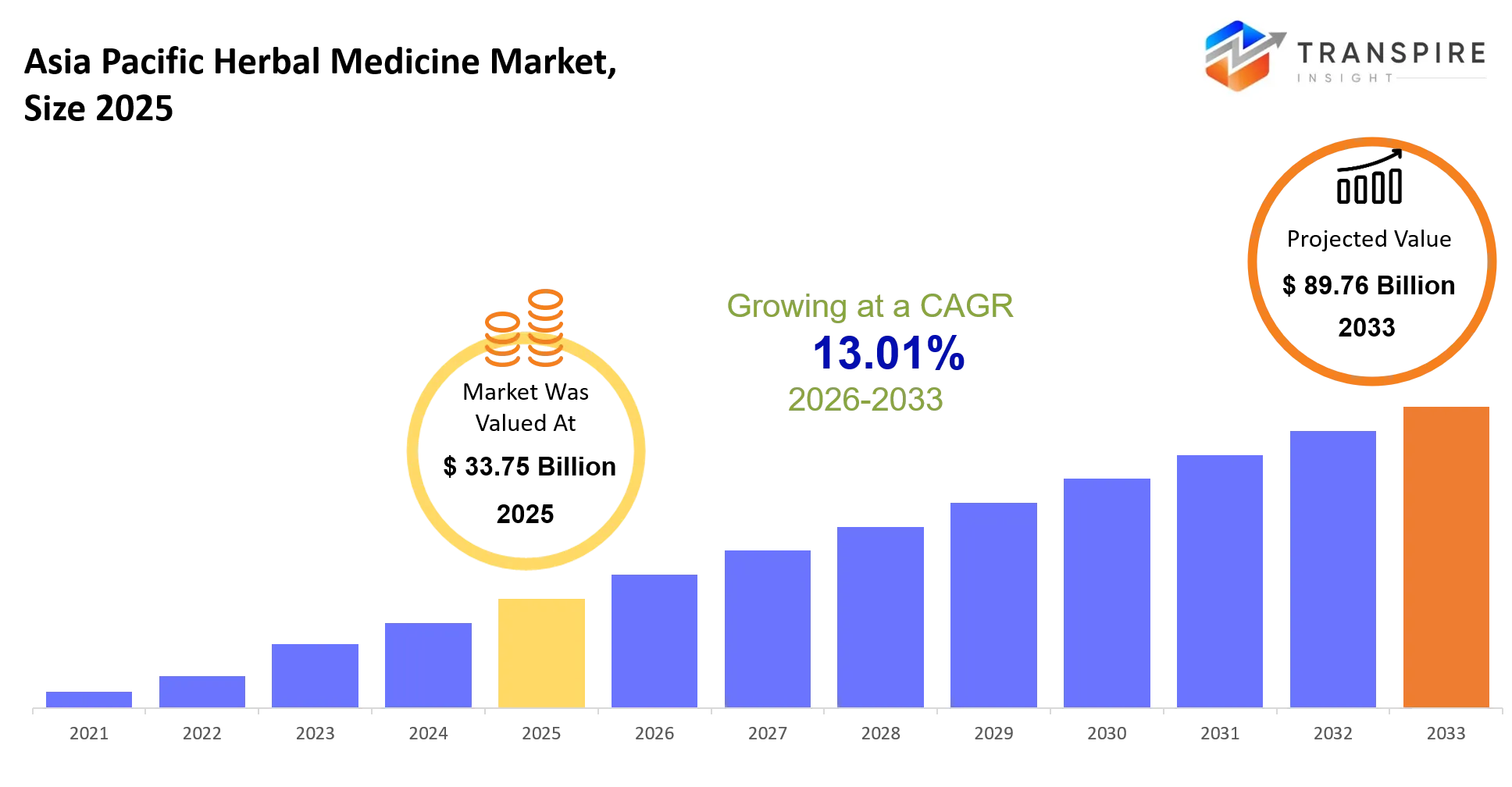
- Asia Pacific Herbal Medicine Market Size 2025: USD 33.75 Billion
- Asia Pacific Herbal Medicine Market Size 2033 89.76 Billion
- Asia Pacific Herbal Medicine Market Segments: By Product Type (Ayurvedic Medicines, Traditional Chinese Medicines, Herbal Supplements, Herbal Extracts, Herbal Teas, Homeopathic Herbal Products, Others); By Form (Tablets, Capsules, Powders, Liquids, Ointments, Others); By Distribution Channel (Pharmacies, Online Retail, Health Stores, Hospitals, Others); By End User (Adults, Geriatrics, Women, Children, Others)
Asia Pacific Herbal Medicine Market Summary
The Asia Pacific Herbal Medicine Market was valued at USD 33.75 billion in 2025. It is forecast to reach USD 89.76 billion by 2033. That is a CAGR of 13.01% over the period. The Asia Pacific Herbal Medicine Market connects healing methods with modern healthcare. It provides plant-based products for long-term health issues boosting immunity and overall wellness. These products are used in hospitals, pharmacies and homes.
In real-life use herbal medicine reduces the need for drugs for long-term conditions. It also supports combined treatment approaches in cities and rural areas.Over the few years the market has changed significantly. There is a shift towards products that are standardized and clinically tested. This change happened because regulators are enforcing quality and safety rules. As a result manufacturers are investing in research, better extraction methods and high-quality production.
The COVID-19 pandemic was a factor in this change. It disrupted the supply of medicines and led people to look for herbal products that could boost their immunity. This led to people and healthcare providers using herbal medicine. Now more than just traditional users are using these products. They are now part of mainstream healthcare, which has improved sales and increased revenue, for both export-focused producers.
Key Market Insights
- The Asia Pacific Herbal Medicine Market is mostly controlled by China, which will have 35 percent of the market by 2025. This is because Traditional Chinese Medicine is a part of the healthcare system in China.
- India is going to be the region that grows the fastest until 2030. This is happening because more people are using Ayurveda, the government is supporting AYUSH and people are taking care of their health more.
- The part of the Asia Pacific Herbal Medicine Market that makes the most money is the extracts and standardized formulations segment. This is because doctors accept these products and companies need to make more of them.
- The herbal supplements segment is the biggest. This is because pharmacies are getting bigger and people want to feel every day.
- The herbal capsules and tablets segment is growing the fastest. This is because these products are easy to use and people know how much to take. They are made to a high standard.
- Herbal medicine is something that people use to treat diseases of the time. Herbal medicine can help people with diabetes and high blood pressure for a while.People use medicine for these kinds of problems. Herbal medicine is used to treat diseases like diabetes and high blood pressure.
- However herbal medicine is also used to boost people's immunity and overall wellness. This is happening because people are more aware of their health, after the pandemic and they want to take care of their health. People want to use medicine to stay healthy.
- People can find medicine at hospitals and clinics.. People are also buying herbal medicine online more and more. This is because online shopping is very popular now and people are using the internet to learn about their health and herbal medicine. People are using the internet to buy medicine and learn about health.
- Some of the companies in this market are Himalaya Wellness, Dabur, Patanjali Ayurved and Blackmores. These companies are trying to grow and expand.
- Other companies like Tong Ren Tang, Schwabe are focusing on research working with other companies and expanding globally to compete with others in the Asia Pacific Herbal Medicine Market.
What are the Key Drivers, Restraints, and Opportunities in the Asia Pacific Herbal Medicine Market?
Driver
The Asia Pacific Herbal Medicine Market is doing well. This is because traditional medicine is now a part of healthcare. Governments in countries like India and China are supporting Ayurveda and Traditional Chinese Medicine. They have programs and rules in place that help hospitals and doctors feel more confident about using the Asia Pacific Herbal Medicine.The Asia Pacific Herbal Medicine Market is doing well because of this support. Hospitals and pharmacies are now buying more of the Asia Pacific Herbal Medicine, which's good for the people who make the Asia Pacific Herbal Medicine.
The Asia Pacific Herbal Medicine Market is also growing because companies are making medicines that are more standardized and backed by research. They are doing tests and using better technology to make sure their medicines are good quality. This means that doctors and patients are more likely to trust and use these medicines. More people, like adults, are using herbal medicines to help with long-term health problems.
Restraint
One thing that is slowing down the Asia Pacific Herbal Medicine Market is that the quality of medicines is not always the same. This is because the plants used to make the medicines are not always. Processed in the same way. This can make it hard for hospitals and pharmacies to trust the medicines, which means they do not buy many.
Another problem is that there is no research to prove that many herbal medicines work. Even though people have been using these medicines for a time, doctors and hospitals need to see more proof before they will use them. This means that it is harder for companies to sell their medicines to hospitals and pharmacies which can limit how much money they can make.
Opportunity
There is a chance for the Asia Pacific Herbal Medicine Market to expand by using technology.Online stores and telemedicine services are making it simpler for people to buy medicines.This is especially helpful for people in cities.It is also helping adults who may not have been able to get these herbal medicines before.
The use of technology is making a big difference in the Asia Pacific Herbal Medicine Market.
Companies are also using technology, like artificial intelligence to make better herbal medicines. Countries like China and India are using technology to make traditional medicine more accessible and efficient. This is creating ways for companies to make money and is helping the market to grow in the long term. The Asia Pacific Herbal Medicine Market is likely to keep growing, as more people use technology to buy and sell herbal medicines.
What Has the Impact of Artificial Intelligence Been on the Asia Pacific Herbal Medicine Market?
The topic is about monitoring systems for fleets, which is related to cleaning the air from big ships. This is not about medicine made from plants. In the marine business computers are being used more and more to control the things that come out of ships. This helps ships run better and follow the rules accurately especially in the Asia Pacific area.
Now computers can check how well the systems that clean the air are working. They can check the things that come out of ships like SOx and NOx and adjust how much cleaning stuff is used. They can also make reports to show that ships are following the rules. Ship owners use sensors and computers to make sure the systems that clean the air are working well even when the ships are in different sea conditions.
Computers can also predict when things might go wrong with the systems that clean the air. They use data to guess when something might break or not work well. This helps ships run more and reduces the cost of fixing things by 10 to 20 percent. It also helps ships use fuel when they are on long trips.
There is a problem. Sometimes ships do not have a connection to the internet when they are at sea. This means that computers do not have the data they need to work well. This limits how well the systems that predict things can work. It takes longer to put these systems on all ships, especially older or smaller ones that do not have good digital systems yet. Marine fleet systems like these need data to work well so this is a big issue, for marine emission control systems and scrubber monitoring.
Key Market Trends
- China started to enforce rules strictly after 2022. This made companies that make Traditional Chinese Medicine move towards making herbal products that meet GMP rules.
- India began adding AYUSH to hospitals in 2021. This move helped more people use medicines and herbal extracts with a doctor's prescription.
- 2020 made people want to improve their immunity. As a result more city dwellers in Asia Pacific started taking supplements and capsules.
- Himalaya Wellness began to invest more in research from 2023. This helped people accept Tablets that meet standards in global markets.
- Online shopping became very popular after 2021. Herbal Teas and Powders became 30% more popular on retail sites.
- Dabur started to make herbal products for export from 2022. The goal was to meet the growing demand for wellness products in Southeast Asia.
- In China and India hospitals started to use Pharmaceutical-grade Herbal Extracts. They replaced powders because of new quality rules.
- New platforms that use AI to track where botanicals come from started to appear from 2023. They helped companies that make Herbal Medicines get materials more reliably.
- Blackmores changed its strategy to focus on supplements that help prevent illness. It expanded in areas that focus on women's wellness in Asia Pacific.
- Countries in ASEAN started to make regulations the same from 2022. This made it easier to trade Herbal Medicines across borders and reduced delays in approving products.
Asia Pacific Herbal Medicine Market Segmentation
By Product Type
The performance of product types shows a slow but steady change from old-style herbal products to more modern and researched herbal categories. Ayurvedic Medicines and Traditional Chinese Medicines are still in demand in India and China because they are part of the national healthcare systems. Herbal Extracts are becoming more popular because they are more potent and work well in high-quality pharmaceutical applications. Herbal Supplements are selling rapidly in cities as people are more focused on preventing illnesses. Herbal Teas are doing well in retail as younger people are choosing a lifestyle. Homeopathic Herbal Products still have a customer base and are prescribed regularly in some markets. The industry is moving towards processed and clinically tested products. Stronger regulations are helping to standardize products and make them more trustworthy in trade. The way products are made is also changing to allow for mass production and commercialization in the Asia Pacific Herbal Medicine Market.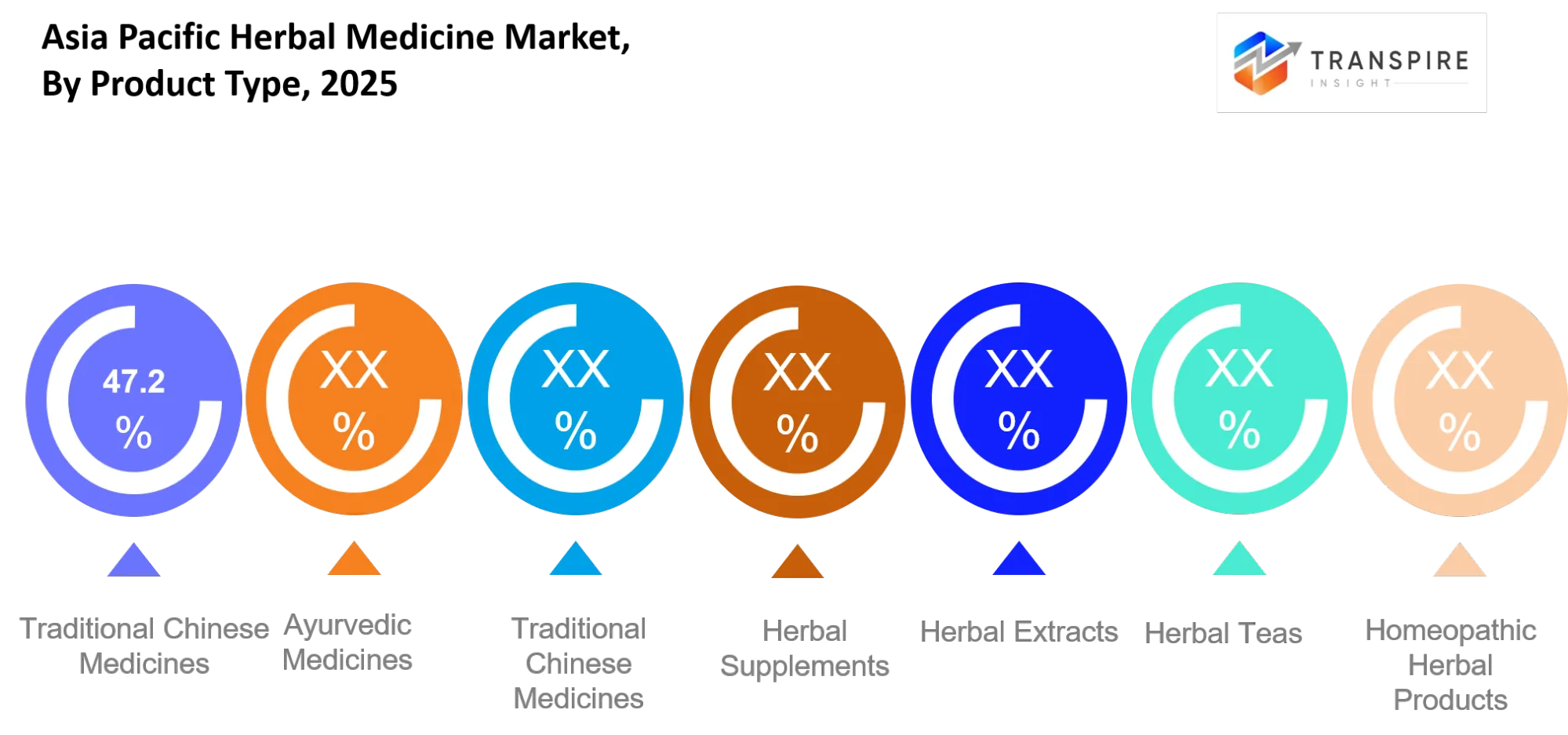
By Form
When looking at the forms of herbal products people are preferring solid forms like tablets and capsules because they are easy to take and last longer. Tablets and Capsules are being used more in pharmacies and hospitals because they provide dosing. Powders are not growing fast because they can be hard to prepare and are not as convenient for city dwellers. Liquids are still in demand for children and older adults because they are absorbed quickly and can be easily dosed. Ointments are still used regularly for applications like pain relief and skin care. The industry is moving towards making encapsulated and compressed products using advanced technology. Regulations are also focusing on dosing, which is driving demand for standardized forms. Consumers are choosing formats that're convenient and clinically accepted in the Asia Pacific Herbal Medicine Market.
By Distribution Channel
The way herbal products are distributed is changing rapidly with online platforms becoming more influential. Pharmacies are still the place to buy prescription herbal products, especially in cities. Hospitals are buying standardized herbal products for treatment programs. Online retail is growing fast after 2021 because of improved payments and more e-pharmacies. Health stores are still popular with people who focus on wellness and prevention. The growth of channels is reducing the need for traditional retailers and making supply chains more transparent. Manufacturers are selling directly to consumers with the help of optimized logistics and digital inventory. The expansion of health infrastructure is making herbal products more accessible in smaller regions creating new demand pathways in the Asia Pacific Herbal Medicine Market.
By End User
The people using products are changing, with more adults using them for prevention and lifestyle-related issues. Older adults are using products more as they deal with chronic diseases and prefer treatments with fewer side effects. Herbal products for women are gaining traction in areas like balance and nutrition. The use of products in children is stable with controlled formulations for immunity and digestive health. The industry is moving towards personalized herbal therapies based on age-specific needs. Healthcare providers are incorporating products into treatment plans for long-term conditions. Product development is focusing on safety, dosing and clinical validation to gain acceptance across all user groups. The demand for products across all age groups is reinforcing broader adoption patterns, in the Asia Pacific Herbal Medicine Market healthcare ecosystems.
What are the Key Use Cases Driving the Asia Pacific Herbal Medicine Market?
The main thing people use medicine for in the Asia Pacific area is to manage chronic diseases. This is done in hospitals and clinics where they use medicine to help treat diabetes, high blood pressure and other health problems. They like to use medicine because it has fewer side effects and the government supports it.You can buy medicine at pharmacies and online stores. People are taking supplements, capsules and tablets every day to stay healthy. There are also products for women that help with hormonal balance and nutrition.It is easier for people to buy medicine now because of online stores and health food stores.
Now people are starting to use medicine in new ways. Some people are using tools to track their health and figure out what herbal medicine they should take. Doctors are starting to recommend herbal plans for kids and people with chronic diseases. This is happening in hospitals and online doctor visits. The government is also starting to use medicine in public health programs especially in India and China. They are making it easier for people to get medicine by using digital prescriptions.
|
Report Metrics |
Details |
|
Market size value in 2025 |
USD 33.75 Billion |
|
Market size value in 2026 |
USD 38.14 Billion |
|
Revenue forecast in 2033 |
USD 89.76 Billion |
|
Growth rate |
CAGR of.13.01% from 2026 to 2033 |
|
Base year |
2025 |
|
Historical data |
2021 - 2024 |
|
Forecast period |
2026 - 2033 |
|
Report coverage |
Revenue forecast, competitive landscape, growth factors, and trends |
|
Regional scope |
Asia Pacific |
|
Key company profiled |
Himalaya Wellness, Dabur, Patanjali, Tong Ren Tang, Tasly, Blackmores, Nature's Way, Amway, Herbalife, Baidu Pharma, Schwabe, Arkopharma, Integria, Charak Pharma, Zandu |
|
Customization scope |
Free report customization (country, regional & segment scope). Avail customized purchase options to meet your exact research needs. |
|
Report Segmentation |
By Product Type (Ayurvedic Medicines, Traditional Chinese Medicines, Herbal Supplements, Herbal Extracts, Herbal Teas, Homeopathic Herbal Products, Others); By Form (Tablets, Capsules, Powders, Liquids, Ointments, Others); By Distribution Channel (Pharmacies, Online Retail, Health Stores, Hospitals, Others); By End User (Adults, Geriatrics, Women, Children, Others) |
Which Regions are Driving the Asia Pacific Herbal Medicine Market Growth?
China is the leader of the Asia Pacific Herbal Medicine Market because it has a strong Traditional Chinese Medicine system that is a big part of its national healthcare. The government is very supportive. Has made rules to license and integrate these medicines into hospitals and big factories. This helps China make a lot of Herbal Extracts and Traditional Chinese Medicines that it can sell at home and abroad. China also has a lot of hospitals and pharmacies that follow the rules, which helps the country sell more of these medicines. All of this means that China can make a lot of herbal medicines and sell them all over the world.
India is in place and it is doing very well with its own way of growing the Herbal Medicine Market. India is focused on Ayurveda and the government is supporting it with programs. India's system is different from China's because it is not just the government that is involved but private companies. The government has made rules to help the market grow. Companies are investing money to make sure that Herbal Medicines are always available in pharmacies and health stores. A lot of people in areas of India use Herbal Medicines to take care of their basic health needs. This means that India has a stable market for Herbal Medicines.
The Southeast Asia region is growing fast because it has improved its healthcare system and more people are using standardized herbal formulations. Countries like Indonesia, Vietnam and Thailand have made their rules clearer. Are now including herbal medicines in their national health systems. It is also easier for people to buy Herbal Supplements and Capsules online or from countries. This is an opportunity for companies that make Herbal Medicines to sell their products in this region. Between 2026 and 2033 Southeast Asia is expected to get investment because it has a large population and more people are taking care of their health to prevent illnesses. The Herbal Medicine Market in this region is expected to keep growing.
Who are the Key Players in the Asia Pacific Herbal Medicine Market and How Do They Compete?
The Asia Pacific Herbal Medicine Market is pretty split up with local companies competing with global brands that make supplements and medicine. What makes one company better than another is how well they make their products if they follow the rules and how good they are at getting their products to pharmacies, hospitals and websites. The big companies that have been around for a while try to keep their customers by showing that their products are quality, that they have been tested and that they are available in lots of stores. At the time new companies and companies that focus on wellness use the internet and low prices to get people to notice them especially in cities where people try to stay healthy.
Companies like Himalaya Wellness make products that are backed by science and have been tested, which helps people trust them and buy them. Dabur is good at keeping costs down because it has a big network of stores and it also sells expensive herbal products in other countries. Tong Ren Tang is a company that has been around for a time and has a strong connection to Traditional Chinese Medicine, which helps it sell products to hospitals and open up shops in other countries. Blackmores focuses on helping people stay healthy, women and old people and it sells products in stores all over the Asia Pacific region. Schwabe makes products that're like medicine but are also herbal and it works with doctors and hospitals to make new products.
There are also companies like Patanjali Ayurved that try to compete by keeping prices low and making products that lots of people can buy. Tasly is a company that makes interesting Traditional Chinese Medicine products using the latest technology. Integria Healthcare sells products to natural medicine clinics and Charak Pharma and Zandu Realty make products that help with digestion, immunity and pain which're all important for people's health. The Asia Pacific Herbal Medicine Market has lots of companies, like Dabur and Himalaya Wellness that are all trying to make and sell herbal products in different ways.
Company List
- Tasly
- Blackmores
- Nature's Way
- Amway
- Herbalife
- Baiyu Pharma
- Schwabe
- Arkopharma
- Integria Healthcare
- Charak Pharma
- Zandu Realty (Emami Group)
Recent Development News
“In January 2026, academic research published on arXiv demonstrated plasma-activated water applications enhancing bioactivity of herbal infusions such as neem and tulsi. The study showed improved antioxidant and antimicrobial performance after controlled treatment, supporting innovation in herbal extraction and preservation techniques. This development indicates potential future integration of advanced processing technologies into herbal product manufacturing.https://arxiv.org
What Strategic Insights Define the Future of the Asia Pacific Herbal Medicine Market?
The Asia Pacific Herbal Medicine Market is going to be more organized and based on facts over the 5 to 7 years. This is happening because healthcare is becoming more connected and people want treatments that are standardized. The Asia Pacific Herbal Medicine Market is growing because the governments of China and India are supporting medicine. Also more people are using healthcare, which makes it easier for doctors to prescribe treatments and for people to get them. This means that the Asia Pacific Herbal Medicine Market is slowly moving away from people just buying medicine on their own to hospitals and pharmacies using them more.
There is a problem that's not very obvious. The Asia Pacific Herbal Medicine Market relies much on herbal supply chains that are not very stable. This means that changes in the weather and problems with farming can make it hard to get the plants that are used to make medicine. This can make the cost of medicine go up and down a lot for companies that make it. At the time people are starting to use synthetic biologics instead of herbal medicine for some treatments. This could mean that fewer people use medicine for advanced treatments.
There is an opportunity in the Asia Pacific Herbal Medicine Market. This is to use intelligence to study the chemicals in plants and to grow plants in specific regions of Southeast Asia. Southeast Asia has a lot of plants that can be used to make standardized herbal medicine. Companies that invest in growing plants in a way that can be tracked and in partnerships to test medicine will be stronger, in the long term. A good plan is to control the process of growing and selling herbal medicine. This includes growing the plants, tracking them digitally and following the rules to reduce risk and make it easier to sell medicine to hospitals and pharmacies. The Asia Pacific Herbal Medicine Market will benefit from this approach.
Asia Pacific Herbal Medicine Market Report Segmentation
By Product Type
- Ayurvedic Medicines
- Traditional Chinese Medicines
- Herbal Supplements
- Herbal Extracts
- Herbal Teas
- Homeopathic Herbal Products
- Others
By Form
- Tablets
- Capsules
- Powders
- Liquids
- Ointments
- Others
By Distribution Channel
- Pharmacies
- Online Retail
- Health Stores
- Hospitals
- Others
By End User
- Adults
- Geriatrics
- Women
- Children
- Others
Frequently Asked Questions
Find quick answers to common questions.
The Expected Asia Pacific Herbal Medicine Market size for the Market will be USD 89.76 Billion in 2033.
Key Segments for the Asia Pacific Herbal Medicine Market are By Product Type (Ayurvedic Medicines, Traditional Chinese Medicines, Herbal Supplements, Herbal Extracts, Herbal Teas, Homeopathic Herbal Products, Others); By Form (Tablets, Capsules, Powders, Liquids, Ointments, Others); By Distribution Channel (Pharmacies, Online Retail, Health Stores, Hospitals, Others); By End User (Adults, Geriatrics, Women, Children, Others).
Major Asia Pacific Herbal Medicine Market Players are Himalaya Wellness, Dabur, Patanjali, Tong Ren Tang, Tasly, Blackmores, Nature's Way, Amway, Herbalife, Baidu Pharma, Schwabe, Arkopharma, Integria, Charak Pharma, Zandu.
The Current Asia Pacific Herbal Medicine Market size is USD 33.75 Billion in 2025.
The Asia Pacific Herbal Medicine Market CAGR is 13.01% from 2026 to 2033.
- Himalaya Wellness
- Dabur
- Patanjali Ayurved
- Tong Ren Tang
- Tasly
- Blackmores
- Nature's Way
- Amway
- Herbalife
- Baiyu Pharma
- Schwabe
- Arkopharma
- Integria Healthcare
- Charak Pharma
- Zandu Realty (Emami Group)
About the Authors

Pankaj Ghogare Patil
I am Pankaj Ghogare Patil, a Senior Research Analyst at Transpire Insight, specializing in the Pharmaceutical, Chemicals & Materials, Healthcare IT, and Biotechnology industry. My expertise lies in conducting comprehensive market research, analyzing industry trends, evaluating competitive landscapes, and translating complex data into actionable insights. At Transpire Insight, I closely follow emerging technologies, regulatory developments, and market innovations to create accurate, well-researched, and informative content that helps businesses and professionals make informed decisions. I am committed to producing credible, evidence-based articles that reflect industry best practices while making technical topics accessible and valuable for a broad audience.

Chakradhar Khansole
Chakradhar serves as the Research Director at Transpire Insight, bringing over 8 years of experience in technology, innovation, and strategic market intelligence. He specializes in transforming complex market data into actionable business insights that enable organizations to make informed, growth-oriented decisions. Recognized for his strategic vision and analytical expertise, Chakradhar leads high-impact research initiatives, delivering comprehensive market assessments, competitive intelligence, and forward-looking industry analysis.
Recently Published Reports
-
Jul 2026
Alopecia Treatment Market
Alopecia Treatment Market Size, Share & Analysis Report By Disease Type (Alopecia Areata, Cicatricial Alopecia, Traction Alopecia, Alopecia Totalis, Androgenetic Alopecia, Alopecia Universalis, and Other Disease Types), By Treatment Type (Topical Treatments, Oral Medications, Injectable Therapies, and Hair Transplantation), By Gender (Male, and Female), By Distribution Channel (Hospitals and Clinics, Retail Pharmacies, and Online Retailers), and Geography (North America, Europe, Asia-Pacific, Middle East and Africa, South and Central America), 2021 - 2031
-
Jul 2026
Medical Ultrasound Probe Market
Medical Ultrasound Probe Market Size, Share & Analysis Report By Type (Linear Type, Convex Type, Endocavitary Probe, Phased Array/Cardiac Probe, Transesophageal (TEE) Probe, and Others), By Application (Ophthalmology, Cardiology, Musculoskeletal, Oncology, Obstetrics & Gynecology, General Imaging, and Others), By End User (Hospitals & Clinics, Diagnostic Centers, Ambulatory Surgical Centers, and Others), and Geography (North America, Europe, Asia-Pacific, Middle East and Africa, South and Central America), 2021 – 2031
-
May 2026
Biosimilars Market
Biosimilars Market By Product Type (Monoclonal Antibodies, Recombinant Hormones, Erythropoietin, G-CSF, Others), By Indication (Oncology, Autoimmune Diseases, Blood Disorders, Diabetes, Others), By Manufacturing Type (In-House Manufacturing, Contract Manufacturing), By Distribution Channel (Hospital Pharmacies, Retail Pharmacies, Online Pharmacies), By Industry Analysis, Size, Share, Growth, Trends, and Forecasts 2021-2033
-
Apr 2026
Gastrointestinal Endoscopy Market
Gastrointestinal Endoscopy Market By Type (Rigid Gastrointestinal Endoscope, Flexible Gastrointestinal Endoscopes, Disposable Gastrointestinal Endoscope), By Procedure Type (Colonoscopy, Gastroscopy, Duodenoscopy, Enteroscopy, Flexible Sigmoidoscopy, Others), By Application (Diagnosis, Treatment), By End-Users (Hospitals, Ambulatory Surgical Centers, Specialty Clinics, Laboratories, Others), By Industry Analysis, Size, Share, Growth, Trends, and Forecasts 2021-2033