
Middle East and Africa Complementary And Alternative Medicine For Anti-aging & Longevity Market Size & Forecast:
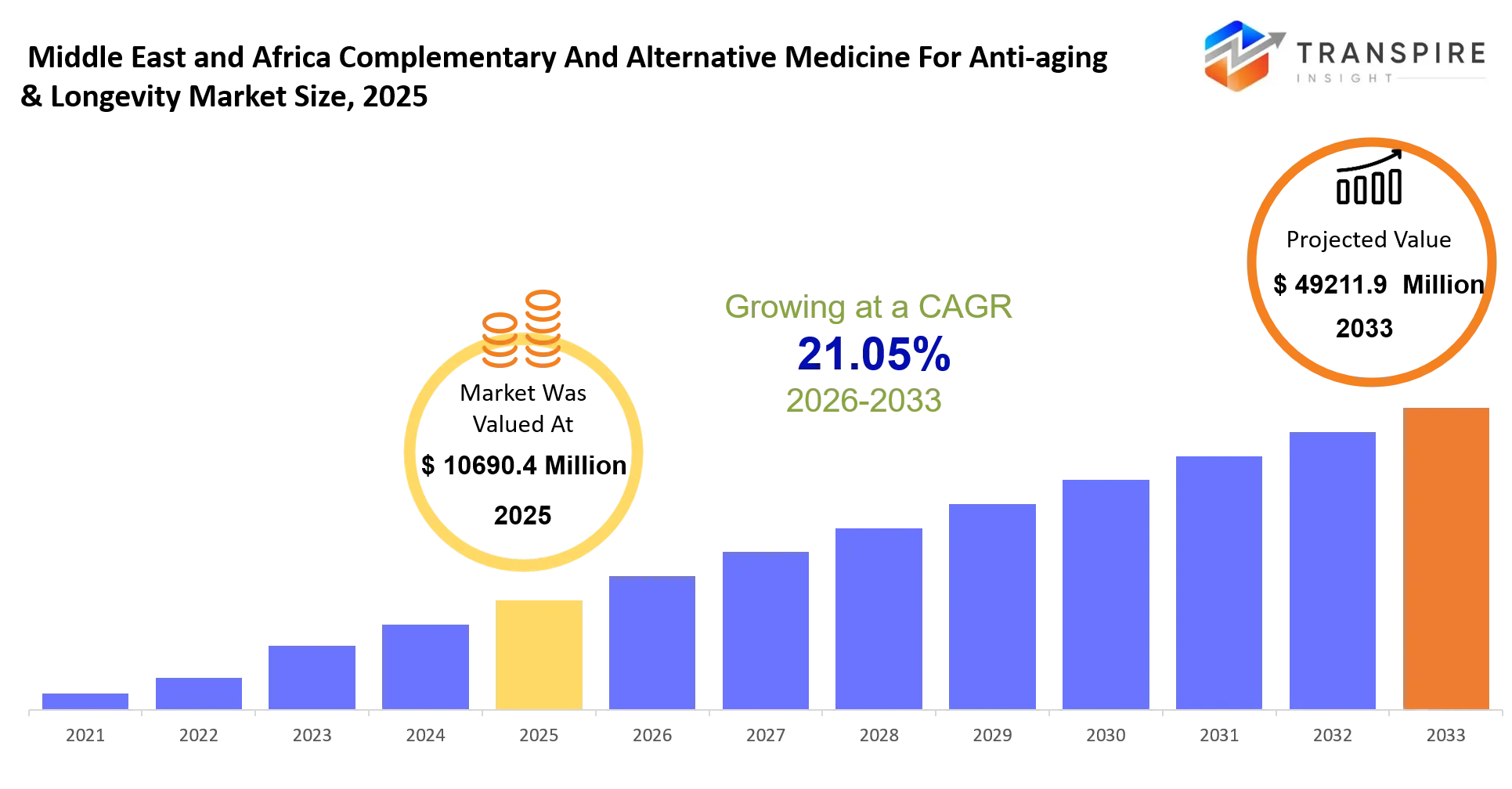
- Middle East and Africa Complementary And Alternative Medicine For Anti-aging & Longevity Market Size 2025: USD 10690.4 Million
- Middle East and Africa Complementary And Alternative Medicine For Anti-aging & Longevity Market Size 2033: USD 49211.9 Million
- Middle East and Africa Complementary And Alternative Medicine For Anti-aging & Longevity Market CAGR: 21.05%
- Middle East and Africa Complementary And Alternative Medicine For Anti-aging & Longevity Market Segments: By Therapy Type (Herbal Medicine, Acupuncture, Ayurveda, Homeopathy, Nutraceuticals, Others); By Application (Anti-aging, Longevity, Wellness, Preventive Care, Others); By Distribution Channel (Clinics, Wellness Centers, Online, Others); By End User (Adults, Elderly, Others)
To learn more about this report,  Download Free Sample Report
Middle East and Africa Complementary And Alternative Medicine For Anti-aging & Longevity Market Summary
The Middle East and Africa Complementary And Alternative Medicine For Anti-aging & Longevity Market was valued at USD 10690.4 Million in 2025. It is forecast to reach USD 49211.9 Million by 2033. That is a CAGR of 21.05% over the period.
In the Middle East and Africa, the Complementary And Alternative Medicine for Anti-aging & Longevity Market really helps “healthy aging” by leaning on non-conventional remedies, nutrition based interventions, herbal formulations and kind of preventive well-being programs that are supposed to improve quality of life, keep physical function steady and extend health span, you know. Over the last five years, this area has clearly moved away from plain traditional symptom handling toward more science-backed longevity ideas, more credible ones. These ideas usually mix nutraceuticals with customized wellness plans, then they wrap it all into an integrative care approach. It feels almost like one living ecosystem, in a way.
A big structural shift has been the increasing pull of alternative therapies into private healthcare networks as well as broader wellness ecosystems across Gulf countries and South Africa. The COVID-19 pandemic also played a clear role, acting like a catalyst , pushing consumers to focus more on immunity, prevention, and longer-term wellness management. And since aging populations are growing while healthcare systems keep dealing with escalating chronic disease loads, people are increasingly hunting for preventive steps that may lower future healthcare expenses. Because of that, spending is going up on wellness services, premium supplements, and complementary therapies that are backed by evidence, which then creates steady revenue pathways across the region.
Key Market Insights
- Gulf Cooperation Council countries racked up nearly 45% of the regional revenue in 2025 , kind of driven by premium wellness spending, plus medical tourism which keeps pulling demand in.
- South Africa still sits as the second biggest regional contributor, mainly because supplement distribution networks are already established and preventive healthcare adoption is getting more traction each year.
- Herbal Medicine was the therapy leader in 2025, holding around 32% market share, and that happened thanks to cultural acceptance and broad accessibility, basically it feels easier to reach than a lot of alternatives.
- Nutraceuticals then took the next slot as the second-largest segment. This was supported by increased investments in healthy aging formulations, and functional nutrition products that people can actually stick with.
- Nutraceutical based longevity solutions are expected to become the fastest-growing therapy category through 2033, even if the pace is a bit unclear year to year.
- Anti-aging applications generated more than 38% of market revenue in 2025, fueled by preventive health management and appearance oriented wellness spending, not just general “health” in a broad sense.
- Longevity-focused programs are expanding faster than traditional wellness services, since consumers want measurable health-span outcomes, not only vague benefits.
- Adults accounted for nearly 60% of total spending in 2025. This suggests strong participation in preventive wellness and nutritional programs, rather than limited trial use.
- Online distribution channels recorded annual growth above 20% from 2022 to 2025, as digital wellness platforms kept extending their regional reach, step by step.
- Companies such as Herbalife, Amway, Nestle Health Science, Bayer, DSM-Firmenich, and GNC continue strategic expansion through product innovation, clinical validation and regional partnerships , though each firm has its own method.
What are the Key Drivers, Restraints, and Opportunities in the Middle East and Africa Complementary And Alternative Medicine For Anti-aging & Longevity Market?
The strongest growth driver is the move from reactive healthcare toward preventive health management, and it’s kind of obvious why. Healthcare costs tied to diabetes, cardiovascular disease, obesity, and age related conditions have risen a lot across the Middle East and Africa. In response, governments, insurers, and private healthcare providers are increasingly backing wellness programs that lean prevention first, instead of waiting for treatment. Because of that, you see more and more adoption of nutraceuticals, herbal therapies, wellness consultations, plus integrative medicine services. When preventive care spending goes up, revenue tends to follow, directly too, across clinics, wellness centers, and supplement providers, even if margins vary.
Now, the big issue that still holds things back is the fragmented regulatory framework for complementary and alternative therapies. The rules aren’t just different, they vary quite a bit between countries, which makes it harder for product approvals, quality verification, labeling requirements, and clinical validation. It’s not the kind of structural problem you can fix fast, because it needs coordination between healthcare authorities, regulators, and industry participants. So product launches often get delayed, market entry costs stay high, and consumer trust is not uniform across jurisdictions, sometimes it feels like one place is fine and the next isn’t.
On the opportunity side, there is a major opening in personalized longevity programs backed by biomarker testing, genetic screening, and digital wellness platforms. Some countries, like the UAE and Saudi Arabia, are investing heavily in preventive healthcare infrastructure and health technology ecosystems. If nutraceutical recommendations get integrated with digital health monitoring, you can build more customized wellness pathways that help outcomes, and also support stronger customer retention.
What Has the Impact of Artificial Intelligence Been on the Middle East and Africa Complementary And Alternative Medicine For Anti-aging & Longevity Market?
Artificial intelligence is increasingly nudging the anti aging and longevity space along, mostly by boosting personalization, speeding up operations, and giving more clinical decision support. In practice, wellness providers often use AI algorithms to sort through health assessments, biomarker readings, nutritional profiles, plus day to day lifestyle details, and then craft more individualized wellness advice. Meanwhile digital platforms can sort of automatically line up consumers with supplement regimens, diet structures, and preventive health programs—shaped around age, risk factors, and the person’s wellness aims.
On the manufacturing side, machine learning models are also lending a hand, by improving how products get developed. Predictive analytics helps companies spot ingredient pairings that tend to relate with healthy aging outcomes, and it also lets them judge formulation performance more quickly, with less trial and error. And then there are AI powered customer engagement setups, which can strengthen retention using personalized suggestions along with automated wellness coaching.
There are operational wins too, like quicker product innovation cycles, smoother inventory planning, and marketing messages that feel more targeted rather than generic. A lot of wellness orgs say they’ve seen steadier customer engagement and better adherence to programs once they bring in digital health monitoring plus AI driven recommendation tools.
Still, adoption is not exactly everywhere because implementation costs are high, healthcare data is messy and fragmented, and access to standardized clinical datasets is inconsistent. Many regional providers simply don’t have enough longitudinal health information to train advanced predictive models, which, in turn, lowers accuracy and makes it harder to scale AI based longevity solutions across different settings.
Key Market Trends
- From 2020 through 2025 , premium nutraceutical launches went up by over 25% throughout Gulf markets, mostly aiming at people who care about healthy aging. And yeah, there was a noticeable push toward “wellness that lasts”, not just quick fixes.
- Digital wellness consultations really took off after 2021, and they made alternative therapies easier to reach, even outside the usual clinic walls, like at-home formats and remote check ins.
- At the same time, clinical validation needs got heavier , as healthcare providers looked for interventions that were evidence-backed for anti aging routines. Not long after that, herbal medicine providers started blending age-old formulations with modern quality control expectations, roughly from 2022 to 2025.
- Longevity focused wellness packages also spread across UAE wellness centers. Premium service offerings within those centers grew by almost 30% since 2021, which is pretty strong.
- Personalized supplement subscriptions showed up as a standout business model, usually backed by health assessments and biometric tracking, basically turning “one size fits none” into “tailored for you”.
- Cross border e-commerce for wellness products accelerated a lot too, especially across Gulf countries and South Africa, more than before, as customers started shopping beyond local shelves.
- After 2023 , strategic partnerships between supplement manufacturers and wellness clinics increased in a pretty clear way, like they were trying to lock in trust and continuity.
- Big companies then expanded their investment in functional nutrition products aimed at cellular health, immunity support, and healthy aging benefits, all tied together.
- Finally, preventive health spending became a priority for middle income and affluent consumers, who want long-term health optimization, even when it means planning ahead.
Middle East and Africa Complementary And Alternative Medicine For Anti-aging & Longevity Market Segmentation
By Therapy Type
Herbal Medicine still keeps a pretty solid position, mostly because people have deep cultural acceptance and it’s broadly available across many countries in the region. Traditional botanical formulations keep bringing in consumers who want natural routes for healthy aging and general wellness support, even if it’s not always fully explained the exact same way everywhere. Product manufacturers are now paying more attention to quality assurance, standardized extracts, and clinically supported formulations, so it doesn’t really feel like it’s just “anything goes”. Strong retail availability also helps with steady market penetration, and uhm, continued visibility too.
Acupuncture, and Ayurveda are still sort of picking up traction, particularly inside wellness centers and integrative health facilities. Acupuncture seems to pull in people who are after stress coping, pain relief, and a general upshift in wellness, not only one single outcome. Ayurveda is benefiting too , from the rising curiosity in whole health programs where nutrition, lifestyle management, and natural therapies get mixed together. Homeopathy stays a bit more niche, but it does matter for a specific group of consumers who are actively looking for complementary approaches , running side by side with regular medical care.
On another note, nutraceuticals look like one of the most dynamic categories, mostly because of new scientific progress around ingredients tied to healthy aging. Functional supplements that bring together vitamins, minerals, probiotics, antioxidants, and longevity minded compounds keep showing up—through retail shelves and online, pretty consistently. Other approaches include meditation based wellness programs, naturopathy, and newer integrative health methods that aim at long term wellness objectives rather than short-term fixes.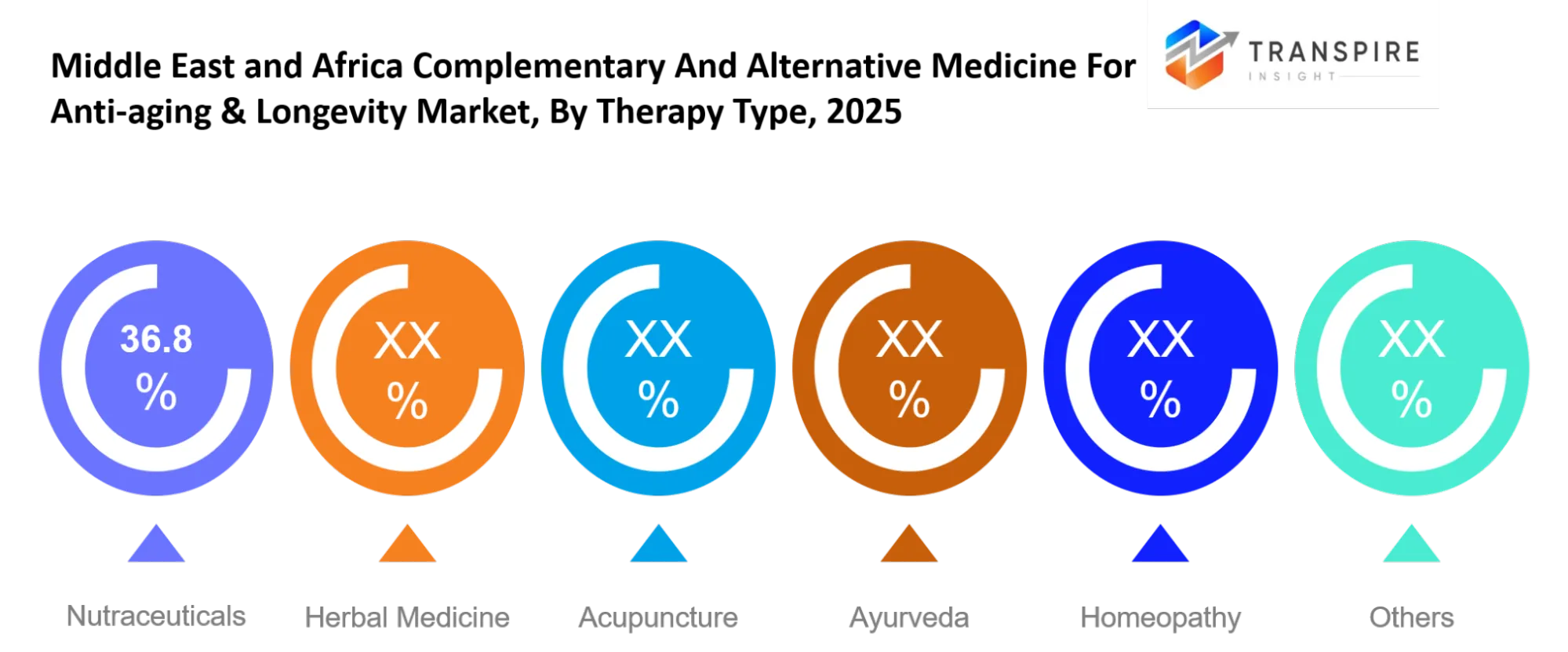
To learn more about this report, Download Free Sample Report
By Application
Anti-aging applications make up quite a large chunk of market activity because people are really into keeping up their physical look, their energy level, and that whole overall “I feel good” vitality thing. More and more wellness providers combine nutritional interventions with herbal therapies, and then fold in personalized plans to deal with both the obvious signs of aging and the functional ones too. A lot of premium offerings also bring in health assessments, after which they give customized recommendations, like a more tailored pathway.
Longevity applications keep widening too, mostly because the healthcare talk is now shifting toward extending health span, not just living longer. Customers tend to look for programs that help with mobility, cognitive performance, metabolic balance, and also long-term wellness results. When scientific research keeps adding evidence for healthy aging interventions, it naturally boosts confidence in these kinds of programs.
Meanwhile wellness and preventive care applications stay as key market pillars. Wellness services usually aim at holistic health fine-tuning , stress reduction and practical lifestyle management. Preventive care programs tend to center on lowering risk and keeping proactive health maintenance, kind of before problems show up. There are also other approaches, like rehabilitation support and specialized wellness interventions that are matched to what the person is trying to achieve with their own health goals.
By Distribution Channel
Clinics are still kinda a key distribution spot, because healthcare pros can offer guidance, do assessments, and then suggest a more tailored therapy path. Integrative care spaces are also trending toward mixing standard medical care with complementary options, sort of like a blended approach. And yeah, clinical locations add extra comfort for consumers since there is professional oversight, so people feel less unsure about what’s happening.
Meanwhile, wellness centers keep pushing their service catalogs further, adding longevity programs, diet coaching, fitness assistance, and alternative modalities. A lot of consumers get pulled in by the idea of a full wellness experience, all under one platform. In the Gulf countries, premium wellness tourism efforts are also giving the segment a boost, helping it grow faster.
Online channels have reshaped access across the region too. Digital platforms let people buy supplements, book consultations, and get personalized wellness guidance. Besides that, there are pharmacies, specialty retail outlets, and direct-selling networks, which help move products into more neighborhoods, including urban and semi-urban markets.
By End User
Adults still seem to be the biggest end-user crowd, partly because more people are jumping into preventive wellness and healthy aging type initiatives. I mean the working-age groups keep putting money into nutritional supplement routines, fitness centered wellness plans, and those longer-term “health optimization” efforts. Also, with higher disposable income in many places , people are more likely to go for premium wellness services, not just the basic stuff.
Meanwhile the elderly population keeps pushing demand for therapies that are more about mobility support, cognitive steadiness, cardiovascular well-being, and just a better overall quality of life. Since life expectancy is rising in several regions, you see more spending on longevity oriented interventions. Healthcare providers too are adjusting, so the programs fit the age related complications better.
Then there are other end users, like younger consumers who are wellness-minded, and also people involved in focused preventive health programs. This group tends to benefit from wider access to digital wellness tools, along with more tailored health solutions. And as wellness offerings keep diversifying, it should make future uptake easier across multiple demographic segments, more or less.
What are the Key Use Cases Driving the Middle East and Africa Complementary And Alternative Medicine For Anti-aging & Longevity Market?
The main use case seems to center on healthy aging handling, mostly through dietary supplements, herbal remedies, and more personalized wellness plans. This app generates the highest demand , because people increasingly want answers that help with energy levels, metabolic function, physical capability, and even appearance as they get older.
There are also extra use cases around preventive health management and general wellness boosting. Adults joining corporate wellness programs, or broader lifestyle management efforts, are using complementary therapies more and more , to help with stress relief, weight management, and overall health performance. Wellness centers kind of play a key role in getting these services delivered.
What’s emerging now includes biomarker-guided longevity programs and digitally supported wellness optimization routines. When personalized nutrition, wearable health tracking, and preventive wellness analytics are brought together, it’s creating fresh avenues for advanced, longevity- focused services across higher-end healthcare markets.
|
Report Metrics |
Details |
|
Market size value in 2025 |
USD 10690.4 Million |
|
Market size value in 2026 |
USD 12925.1 Million |
|
Revenue forecast in 2033 |
USD 49211.9 Million |
|
Growth rate |
CAGR of 21.05% from 2026 to 2033 |
|
Base year |
2025 |
|
Historical data |
2021 - 2024 |
|
Forecast period |
2026 - 2033 |
|
Report coverage |
Revenue forecast, competitive landscape, growth factors, and trends |
|
Regional scope |
Middle East and Africa (Saudi Arabia, United Arab Emirates, South Africa, Rest of Middle East and Africa) |
|
Key company profiled |
Herbalife, Amway, Himalaya, Dabur, Patanjali, Gaia Herbs, Nature's Way, NOW Foods, GNC, Nestle Health Science, DSM-Firmenich, Bayer, Blackmores, Swisse, USANA |
|
Customization scope |
Free report customization (country, regional & segment scope). Avail customized purchase options to meet your exact research needs. |
|
Report Segmentation |
By Therapy Type (Herbal Medicine, Acupuncture, Ayurveda, Homeopathy, Nutraceuticals, Others); By Application (Anti-aging, Longevity, Wellness, Preventive Care, Others); By Distribution Channel (Clinics, Wellness Centers, Online, Others); By End User (Adults, Elderly, Others) |
Which Regions are Driving the Middle East and Africa Complementary And Alternative Medicine For Anti-aging & Longevity Market Growth?
The Gulf area ends up leading overall market revenue generation, especially in the UAE, and Saudi Arabia. There’s also a big push from strong healthcare investment, premium well-being spending, plus government backing for preventative health programs, and that combination feels like it really sets the stage for business. On top of that medical tourism keeps adding weight too, because patients are looking for higher-grade wellness and longevity type services. Basically there’s a mature web of wellness centers, clinics, and specialty retailers, which helps the region stay in front for the long run
South Africa shows up as the second-largest regional contributor and it’s a bit different from the Gulf scene. You can see it in its established supplement industry, along with a wider retail distribution setup. Here consumer behavior seems more tied to ongoing wellness management, rather than luxury style wellness outings. At the same time steady healthcare involvement, plus nutraceuticals becoming easier to find, keeps market performance fairly consistent. Strong pharmacy plus retail networks also make products easier to access, across many major city hubs
Meanwhile the fastest growth should show up across up-and-coming Gulf markets and a few selected North African countries. Investments in healthcare modernization, digital health platforms, and preventive care activities have basically sped things up since 2023. New wellness locations and integrated healthcare projects are springing up, so premium longevity services can grow in that space. If this keeps moving, it should give manufacturers, wellness providers, and investors solid expansion prospects through 2033.
Who are the Key Players in the Middle East and Africa Complementary And Alternative Medicine For Anti-aging & Longevity Market and How Do They Compete?
Competition is still pretty fragmented, you’ve got multinational nutrition companies, older school wellness brands, and niche supplement providers all chasing different consumer segments. The big competitive drivers seem to be product quality, the level of scientific proof, brand reputation, how far distribution really goes, plus those personalized wellness features. The more established players keep trying to hold on to share by pushing innovation and expanding their health-forward product lines, even if it’s not always uniform.
Herbalife stands out mainly because of its direct-selling structure, and an almost like personalized nutrition ecosystem. They don’t just sell products, they pair it with wellness coaching and community engagement programs, which feels kind of baked into the model. Amway runs a similar playbook, but leans harder on a wide distributor network and a very broad nutritional catalog. GNC, by contrast, tends to compete from the retail angle, using premium supplement positioning and a mix of different wellness offerings.
Nestlé Health Science is more about clinically supported nutritional solutions, with evidence-based health products. DSM-Firmenich leans into scientific research, ingredient innovation, and nutrition technologies meant to support healthy aging use cases. Bayer keeps its position strong through trusted healthcare branding and a big consumer health distribution footprint. Himalaya and Dabur lean on herbal heritage, natural ingredient know-how, and the steady rise in consumer interest in traditional wellness solutions, which is kind of helping them keep momentum.
Company List
- Herbalife
- Amway
- Himalaya
- Dabur
- Patanjali
- Gaia Herbs
- Nature's Way
- NOW Foods
- GNC
- Nestlé Health Science
- DSM-Firmenich
- Bayer
- Blackmores
- Swisse
- USANA
Recent Development News
In June 2026, Nestlé Health Science announced the acquisition of the remaining shares of food Labs. The transaction strengthens Nestlé's position in functional nutrition and healthy lifestyle products while expanding access to fast-growing wellness nutrition categories.https://www.reuters.com
In April 2025, DSM-Firmenich entered a strategic partnership with Inscripta to develop biotechnology-based well-aging skincare ingredients. The collaboration supports innovation in healthy aging solutions and expands advanced wellness product development capabilities.https://www.dsm-firmenich.com
In February 2025, Herbalife announced a two-year partnership with the TATA Women's Premier League (WPL) as Official Nutrition Partner. The initiative strengthens brand visibility, promotes nutrition-focused wellness engagement, and expands consumer outreach across health-conscious audiences.https://www.herbalife.com
What Strategic Insights Define the Future of the Middle East and Africa Complementary And Alternative Medicine For Anti-aging & Longevity Market?
The market is drifting toward a more interconnected healthcare setup where preventive medicine, individualized nutrition, digital health tracking, and longevity science somehow end up in one wellness ecosystem. What really drives this shift is the escalating economic pressure from long term chronic disease plus aging populations, so key healthcare players are leaning to long horizon health optimization instead of only showing up for episodic treatment.
There is also a quieter hazard too, regulatory tightening around health claims and product efficacy standards, it can be easy to miss. As regulators roll out tougher requirements for clinical proof, firms that don’t have solid scientific backing could get hit with heavier compliance costs and end up with less market access.
An interesting opening is AI enabled personalized longevity programs. These efforts merge biomarker testing, nutritional interventions, and digital wellness monitoring together. Early take up is still somewhat limited, but as technology improves and healthcare digitization keeps moving forward, commercialization will probably ramp up faster.
Market participants should put money into clinical research, proof driven formulations, and collaborations across digital health platforms. The organizations that blend scientific credibility with tailored wellness delivery models, will likely be the ones that capture the next wave of growth and keep a more sustainable competitive edge.
Middle East and Africa Complementary And Alternative Medicine For Anti-aging & Longevity Market Report Segmentation
By Therapy Type
- Herbal Medicine
- Acupuncture
- Ayurveda
- Homeopathy
- Nutraceuticals
- Others
By Application
- Anti-aging
- Longevity
- Wellness
- Preventive Care
- Others
By Distribution Channel
- Clinics
- Wellness Centers
- Online
- Others
By End User
- Adults
- Elderly
- Others
Frequently Asked Questions
Find quick answers to common questions.
The Expected Middle East and Africa Complementary And Alternative Medicine For Anti-aging & Longevity Market size for the market will be USD 49211.9 Million in 2033.
Key Segments for the Middle East and Africa Complementary And Alternative Medicine For Anti-aging & Longevity Market are By Therapy Type (Herbal Medicine, Acupuncture, Ayurveda, Homeopathy, Nutraceuticals, Others); By Application (Anti-aging, Longevity, Wellness, Preventive Care, Others); By Distribution Channel (Clinics, Wellness Centers, Online, Others); By End User (Adults, Elderly, Others).
Major Middle East and Africa Complementary And Alternative Medicine For Anti-aging & Longevity Market players are Herbalife, Amway, Himalaya, Dabur, Patanjali, Gaia Herbs, Nature's Way, NOW Foods, GNC, Nestle Health Science, DSM-Firmenich, Bayer, Blackmores, Swisse, USANA.
The Current Middle East and Africa Complementary And Alternative Medicine For Anti-aging & Longevity Market size is USD 10690.4 Million in 2025.
The Middle East and Africa Complementary And Alternative Medicine For Anti-aging & Longevity Market CAGR is 21.05% from 2026 to 2033.
- Herbalife
- Amway
- Himalaya
- Dabur
- Patanjali
- Gaia Herbs
- Nature's Way
- NOW Foods
- GNC
- Nestlé Health Science
- DSM-Firmenich
- Bayer
- Blackmores
- Swisse
- USANA
About the Authors

Chetan Dhatrak
I’m Chetan Dhatrak, a Senior Research Analyst at Transpire Insight, specializing in the Consumer Goods, Foods and Beverages industry. I focus on analyzing market trends, consumer behavior, competitive landscapes, and industry developments to deliver accurate, data-driven insights. My research at Transpire Insight is built on credible sources and in-depth analysis, helping businesses and readers better understand market dynamics, emerging opportunities, and evolving consumer preferences. I’m committed to creating reliable, well-researched content that supports informed decision-making and reflects the latest developments in the consumer goods and food & beverage sectors.

Chakradhar Khansole
Chakradhar serves as the Research Director at Transpire Insight, bringing over 8 years of experience in technology, innovation, and strategic market intelligence. He specializes in transforming complex market data into actionable business insights that enable organizations to make informed, growth-oriented decisions. Recognized for his strategic vision and analytical expertise, Chakradhar leads high-impact research initiatives, delivering comprehensive market assessments, competitive intelligence, and forward-looking industry analysis.
Recently Published Reports
-
Apr 2026
Bottled Water Market
Bottled Water Market Size, Share & Analysis Report By Product Type (Still Bottled Water, Carbonated Bottled Water, Functional Bottled Water, and Others), By Packaging (PET, Cans, and Others), By Sales Channel (Supermarkets/Hypermarkets, Convenience Stores/Drug Stores, Grocery Stores/Club Stores, Foodservice, and Others) and Geography (North America, Europe, Asia-Pacific, Middle East and Africa, South and Central America), 2021 - 2032
-
Apr 2026
Color Cosmetic Packaging Market
Color Cosmetic Packaging Market Size, Share & Analysis Report By Application (Mascara Packaging, Liquid Packaging, and Liquid Face), By Type (Tubes & Bottles, Pens & Markers, Compacts & Containers, and Droppers & Pumps), and Geography (North America, Europe, Asia-Pacific, Middle East and Africa, South and Central America), 2021 - 2031
-
Apr 2026
External Microphone For Camera Market
External Microphone For Camera Market Size, Share & Analysis Report By Type (Shotgun Microphone, Lavalier Microphone, and Others), By Application (Digital Camera, Professional Video Camera, and Others), and Geography (North America, Europe, Asia-Pacific, Middle East and Africa, South and Central America), 2021 - 2031
-
Apr 2026
Foot Orthotic Insoles Market
Foot Orthotic Insoles Market Size, Share & Analysis Report By Type (Pre-fabricated, and Custom-made), By Material (Thermoplastic, Composite Carbon Fiber, and Others), By Distribution Channel (Drug Stores, Hospitals & Clinics, and Others), and Geography (North America, Europe, Asia-Pacific, Middle East and Africa, South and Central America), 2021 - 2031