
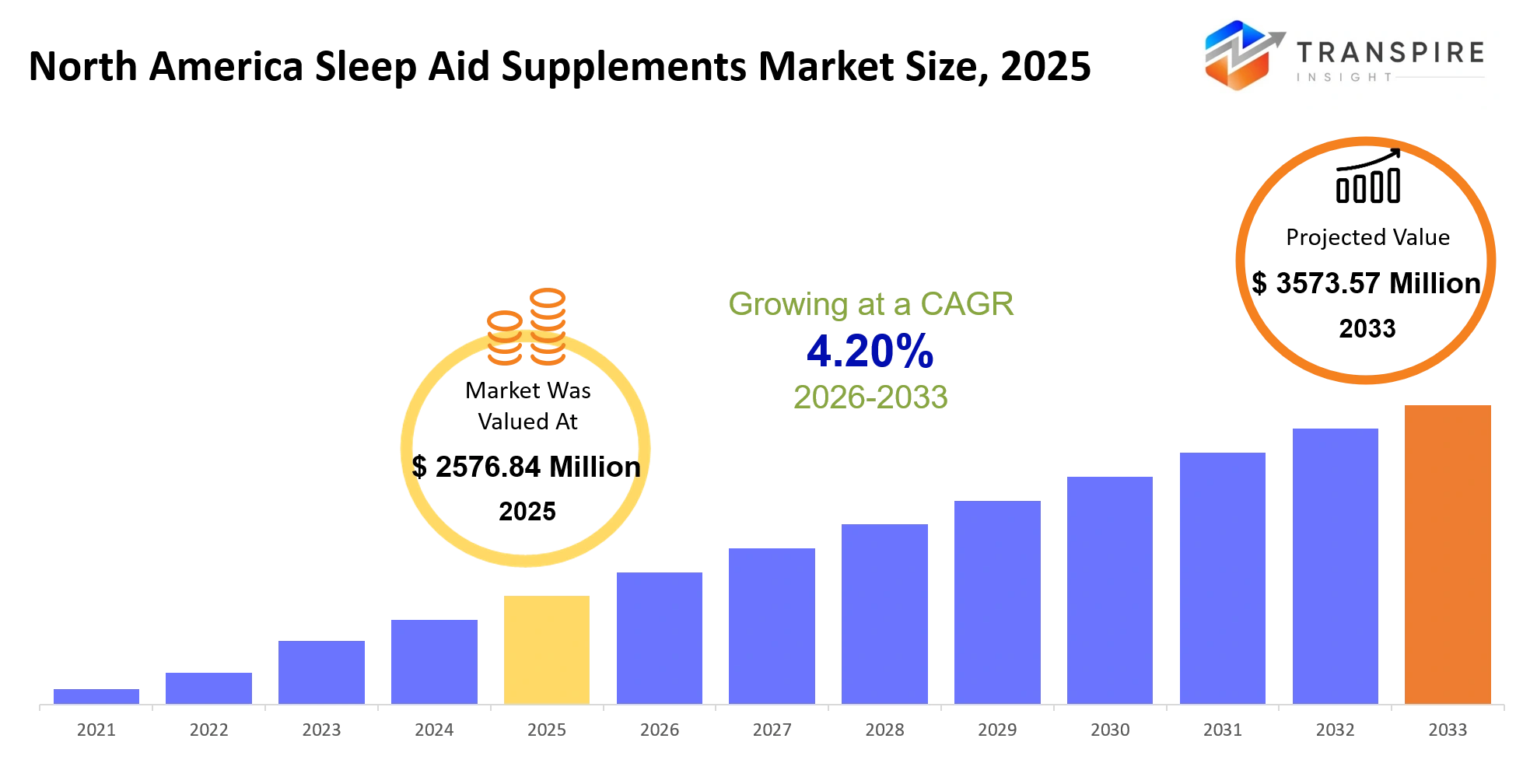
North America Sleep Aid Supplements Market Size & Forecast:
- North America Sleep Aid Supplements Market Size 2025: USD 2576.84 Million
- North America Sleep Aid Supplements Market Size 2033: USD 3573.57 Million
- North America Sleep Aid Supplements Market CAGR: 4.20%
- North America Sleep Aid Supplements Market Segments: By Product Type (Melatonin Supplements, Herbal Supplements, Magnesium Supplements, CBD-based Supplements, Amino Acid Supplements, Others), By Form (Capsules, Gummies, Powders, Tablets, Liquid Supplements, Others), By Distribution Channel (Pharmacies, Online Retail, Supermarkets, Specialty Stores, Others), By Application (Insomnia Management, Stress Reduction, Sleep Cycle Regulation, Jet Lag Management, Others).
To learn more about this report,  Download Free Sample Report
North America Sleep Aid Supplements Market Summary:
The North America Sleep Aid Supplements Market size is estimated at USD 2576.84 Million in 2025 and is anticipated to reach USD 3573.57 Million by 2033, growing at a CAGR of 4.20% from 2026 to 2033.In North America, the Sleep Aid Supplements market is basically dealing with a common, very real problem that a lot of consumers plus healthcare groups feel every day: how to improve sleep quality without leaning on prescription medicines. People are turning to various supplements like melatonin, magnesium, herbal blends, and even amino acid mixtures, as a way to back up sleep onset, sleep staying power, and recovery. This is especially true for groups coping with stress, irregular shift work, and lifestyle driven sleep issues that seem to stack up over time.
In the last three to five years, the market has shifted in a more “systems” direction, kind of moving away from just one ingredient bottles, toward more science-informed, multifunctional blends. These products tend to do more than one thing, sort of, like helping with sleep while also assisting stress handling, relaxation rhythms, and just general wellness gains. Then COVID-19 showed up, and it really acted like a catalyst, throwing off the usual routines, and making sleep issues feel much more pressing across the region. That change in behavior pushed more people to try preventive health solutions, sometimes sooner than they planned. And as sleep is being treated less like an optional thing and more like a core health pillar long term, supplement companies are expanding their premium product lines, which opens up fresh revenue paths, and it also helps products spread wider through both retail shelves and digital channels.
Key Market Insights
- In 2024, the United States pretty much dominates the North America Sleep Aid Supplements Market, holding something like 80%+ market share, mainly because people spend a lot, on wellness products. And then again it’s not just one thing, it’s more like a stack of factors, but yeah, consumer spending really pushes it.
- Canada meanwhile is the fastest growing regional market all the way through 2032. This growth is tied to wider adoption of wellness supplements, also to smoother retail distribution networks that keep showing up in more and more places.
- Across North America, digital health engagement is still strong, and that keeps speeding up industry expansion, while also making products easier to find. So availability improves, and overall market size tends to rise.
- Melatonin based supplements are the big leader, with nearly 45% market share in 2024. The main reason is broad clinical acceptance and the fact that consumers are already familiar with melatonin, like they’ve heard of it before, and they trust it.
- Herbal sleep supplements—things like valerian root and chamomile formulations—sit in second place across the regional market overall. They’re popular, mainly because consumers like the “natural” angle, even if they phrase it differently.
- Multi ingredient sleep support formulations are expected to grow the quickest during the forecast period. This is helped by demand for holistic wellness products, where buyers want one approach but more than one benefit, at the same time.
- Gummies and chewable formats are gaining meaningful share too. Consumers seem to prioritize convenience and a more pleasant product experience, instead of dealing with tablets or powders all the time.
- For application areas, sleep onset support is still the dominant segment, contributing more than 40% of total market revenue in 2024. Stress related sleep management is moving the fastest though, likely because lifestyle pressures and irregular schedules mess with sleep patterns.
- Recovery focused sleep supplements are also starting to attract more interest, especially among fitness minded and working age consumers who want support around training or day to day strain.
- Looking at end users, adults aged 25–54 are leading, and they account for a significant portion of North America Sleep Aid Supplements Market revenue. Older adults remain a major group as well, partly due to age related sleep challenges, and also because many manage long term sleep health over time.
What are the Key Drivers, Restraints, and Opportunities in the North America Sleep Aid Supplements Market?
The strongest growth driver in the North America Sleep Aid Supplements Market is that gradual turn toward non-prescription sleep management, because healthcare systems and consumers are looking for alternatives to long-term pharmaceutical use. This trend really seemed to speed up after the pandemic, since sleep patterns got disrupted for working professionals, shift workers , and also older adults. Meanwhile, e-commerce platforms and direct-to-consumer wellness brands made it simpler to move products to people by lowering distribution barriers , and they also increased product visibility in a very noticeable way. So, supplement manufacturers can target larger customer groups, get more repeat buys, and pull in steadier, stronger revenue especially when they build premium formulations that blend melatonin , magnesium, adaptogens , plus botanical ingredients.
Still, the biggest brake is the fragmented regulatory and scientific landscape around dietary supplements. Unlike prescription sleep medications, supplement efficacy and even dosage standards can swing a lot from brand to brand , and also between different formulations. And this kinda underlying issue cannot be corrected quickly, because it hinges on long-term clinical validation, regulatory alignment , and, honestly, more consumer trust. As a result, adoption moves slower among healthcare providers, and consumers tend to stay a little cautious when purchasing, which then caps how far these products can penetrate higher-value clinical or medically guided wellness channels.
A really big future opening sits in personalized sleep nutrition, with digital health tech kinda behind it. Wearable devices and sleep-tracking apps now put out all kinds of granular sleep data, so it becomes possible to steer tailored supplement ideas. The companies that blend biometric insights with customized formulations can really grab the premium market slices, and not just the basics. This meeting point between nutrition plus digital health could even shape a whole new category of higher-margin sleep support solutions across North America, overall.
What Has the Impact of Artificial Intelligence Been on the North America Sleep Aid Supplements Market?
Artificial intelligence and advanced digital technologies are, sort of re-shaping the North America Sleep Aid Supplements Market, mainly by tweaking how products get developed, how companies target consumers, and how the supply chain runs more smoothly. Supplement producers are leaning more and more on AI-driven analytics platforms to sift through consumer health records, purchase behavior, and sleep tracking signals from wearable devices. In practice, these tools automate the whole formulation research process by spotting ingredient pairings that seem tied to better sleep results. That shortens the time to develop a product, and also tends to lift the chances of a successful launch.
Machine learning is being used too, especially for demand forecasts and inventory adjustments. When companies look into seasonal purchase rhythms, online traffic, and demographic changes, they can figure out what product needs are, with more clarity, and honestly it feels a bit more precise than before. This helps avoid both stockouts and excess inventory, not always perfectly, but closer than before. And in marketing and customer engagement, AI-powered recommendation engines bring in personalized supplement suggestions. They look at sleep routines, age, stress markers, and lifestyle conditions. This kind of personalization usually supports better retention, plus more repeat buying over time.
On the operations side, these technologies can lower inventory carrying expenses, speed up commercialization, and raise conversion rates across digital sales channels. Some manufacturers are even blending sleep-tracking data with personalized nutrition platforms, in order to build customized supplement regimens. Those regimens then can justify higher price points, because they feel more relevant to the individual.
Still, there is a major constraint that keeps coming up, data quality and systems integration. Consumer sleep information often arrives from multiple devices and apps, and those sources can vary in accuracy. Because of that, it becomes harder to maintain AI models that stay consistently reliable. It also slows down wider adoption throughout the industry, even if interest keeps growing.
Key Market Trends
- Since 2020, multi ingredient formulations that blend melatonin, magnesium, and adaptogens have been gaining share kind of steadily, as people look for wider sleep help and stress support.
- E-commerce sales actually pushed much higher after the pandemic, so manufacturers started leaning harder into direct-to-consumer routes, plus subscription style purchasing models too.
- Between 2021 and 2025 sleep tracking devices went more normal, more common, which then nudged brands to build personalized supplement guidance based on behavioral data, and not just general claims.
- More premium sleep supplement launches showed up as buyers drifted away from cheaper single-ingredient options and toward something that feels more clinically positioned, like evidence leaning wellness.
- Companies like Natrol and OLLY kept pushing their gummy offerings along, sort of expanding the lineup, trying to make it more convenient and honestly that also helps user compliance a bit.
- In retail , shelf space started to lean more toward clean-label and non-GMO products, like there was extra scrutiny around ingredient transparency since 2022. Customers have been paying closer attention to what’s in there.
- Manufacturers then moved faster on clinical studies and evidence backed claims mostly so they could stand out in a packed and competitive market where it seems like everyone is saying very similar stuff.
- After 2021 younger consumers came into the category at higher rates , so marketing plans shifted toward stress management themes and digital wellness routines.
- Artificial intelligence adoption also broadened across product development and demand forecasting, which helps brands dodge inventory headaches and make launches go smoother, or at least perform better in practice.
- Finally, strategic partnerships grew between supplement brands, digital health platforms, and wellness retailers, because companies wanted stronger customer touchpoints, plus more recurring revenue sources, that kind of loop.
North America Sleep Aid Supplements Market Segmentation
By Product Type
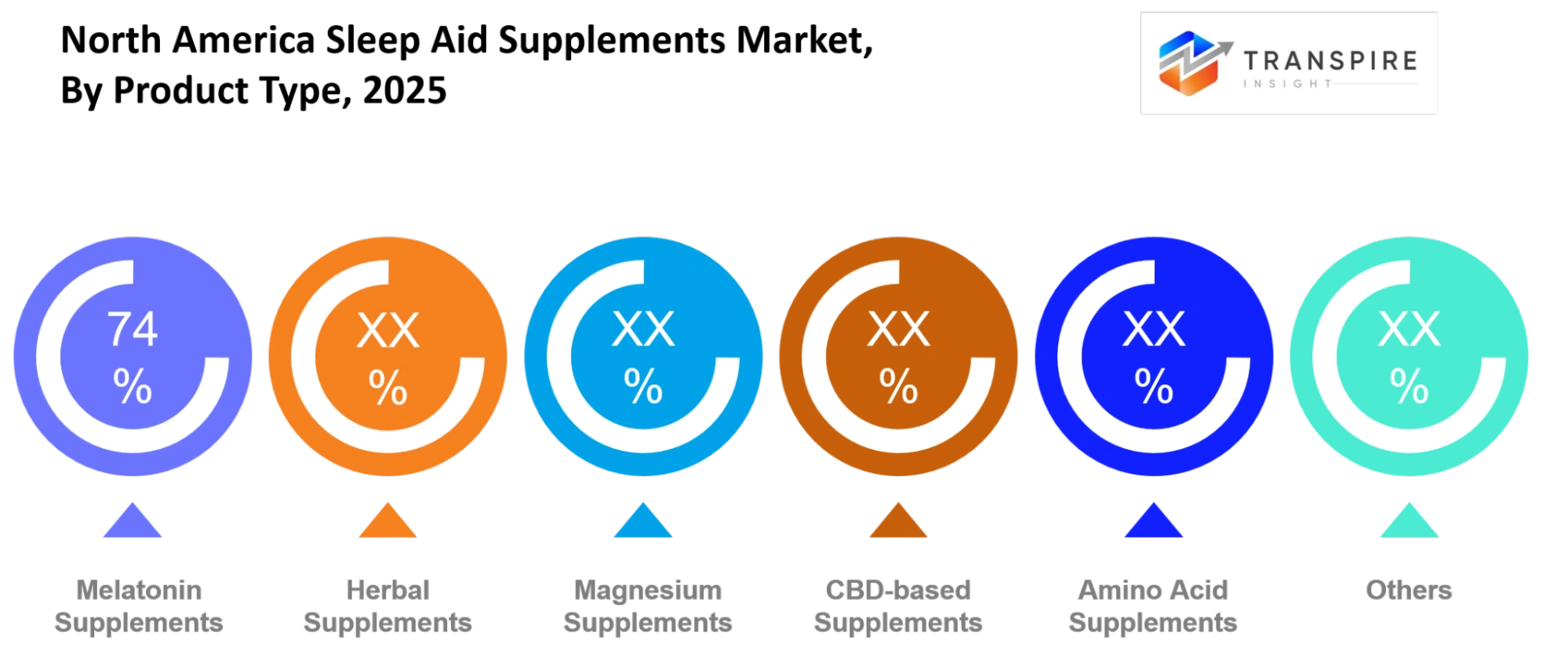
By product type, melatonin supplements kinda hold the leading market spot, mainly because consumers are already familiar with them, they’re widely sold in retail places and they have that established reputation for supporting sleep onset and tweaking the sleep cycle. Herbal supplements, like valerian root, chamomile, and passionflower, still keep a meaningful share, because a lot of people prefer plant-based alternatives instead of the more traditional sleep products, or something in that area. Magnesium supplements keep climbing too , since interest keeps building around items that support both relaxation and sleep quality, you know, kind of a two for one angle.
CBD-based supplements sit in a smaller slice but it’s expanding, helped by product innovation and shifts in what people want to buy , even if regulatory uncertainty kind of slows the pace and limits broader adoption. Amino acid supplements, like L-theanine and other close relatives, seem to pull in people who are basically hunting for more targeted help with stress and sleep. If we look ahead, the next wave of growth should tilt toward multifunctional blends , where several active ingredients are mixed together in one go. Firms that can create pairings with solid evidence, and also keep a premium brand feel, will likely grab more value. This is even more true since shoppers are starting to ask for full on sleep wellness solutions, not just single-ingredient answers.
To learn more about this report, Download Free Sample Report
By Form
By form, capsules and tablets are still kind of the ones in charge, mostly because there’s already consumer trust, steadier dosage, and those cost friendly manufacturing processes that make everything feel predictable. In general, these formats keep getting spread out across pharmacies and big box retail outlets, which helps keep a pretty solid market presence. Gummies are showing up as one of the more rapidly expanding sub segments, since convenience, flavor, and that easy to take format really land with younger audiences and with folks trying supplements for the first time.
Powder formulations seem to pull in health minded consumers who like the concept of adjustable dosing, and then blending it into everyday wellness routines. Liquid supplements stay a bit niche, especially for older adults or for anyone who finds swallowing solid forms a hassle. There are also other formats that keep popping up, as brands go after differentiated delivery approaches, and they’re not just sitting there staying the same. Overall, the segment is slowly drifting toward more user friendly, lifestyle oriented options. What comes next in competition will likely emphasize making things even more convenient, improving ingredient stability, and building premium delivery systems that can reinforce brand differentiation and, importantly, push repeat purchases.
By Distribution Channel
By distribution channel, pharmacies still sort of stay the leading sales avenue, mainly because shoppers often connect these places with product credibility, pharmacist advice, and consistent quality rules. Supermarkets also keep a notable footprint by offering wide access to goods, and they help nudge impulsive buys for more typical, everyday customers. Online retail meanwhile is the fastest-growing channel, since digital platforms bring more assortment, subscription programs, customer reviews, and some direct brand interaction.
Specialty stores keep pulling in those who want premium options, organic choices, or more condition- focused sleep support products. Other routes add smaller but steady sales via extra wellness and health-care networks. Overall, the growth kind of shows a shift in buying behaviors, especially among digitally active people, who want convenience , and also more tailored suggestions and such. More money going into the e-commerce backbone, the digital promotion pieces, and direct-to-consumer attempts is expected to gently bend the competitive landscape as time passes. Companies that have a strong omnichannel setup are likely to form firmer customer bonds , and that should also support long-term revenue stability.
By Application
By application, insomnia management takes the largest slice, maybe because sleep onset and upkeep problems still count as the main reason people buy sleep aid supplement. Sleep cycle regulation also gets a solid share, especially for shift workers, people who travel a lot, and those who keep a messy routine. Stress reduction, however, is picking up steam, since more consumers link mental wellness with rest quality and recovery time. Jet lag management feels smaller but still matters, it rides on re-bouncing travel again and on the growing awareness around circadian rhythm support products.
The rest of the applications add extra demand through more specialized wellness aims. Market movement seems to shift away from just symptom chasing and toward wider sleep optimization plus recovery goals. Looking ahead, new chances may show up in personalized sleep programs that blend behavioral data, wearable technology signals, and focused supplementation , which should open fresh value routes for manufacturers , investors, and health minded buyers.
What are the Key Use Cases Driving the North America Sleep Aid Supplements Market?
The main use case for sleep aid supplements is insomnia management across working age adults, and also for older consumers. Kind of the biggest driver here is that persistent trouble getting to sleep, or staying asleep, really messes with productivity, recovery, and overall health so people tend to use these supplements more consistently
Then there’s the secondary side of it that’s getting bigger, especially stress related sleep support and sleep cycle regulation. Folks with demanding schedules, shift workers and even frequent business travelers are using melatonin, magnesium, or herbal formulations to handle disturbed sleep patterns. And because online retail keeps expanding, it’s become easier to find and buy these more specialized products for those needs
More emerging applications include personalized sleep nutrition programs that connect with wearable sleep trackers and recovery focused supplementation for fitness oriented consumers. Digital health platforms are also starting to fold sleep data into customized supplement recommendations, which opens the door for premium products, tuned to how a person sleeps and what wellness goals they actually have
|
Report Metrics |
Details |
|
Market size value in 2025 |
USD 2576.84 Million |
|
Market size value in 2026 |
USD 2679.79 Million |
|
Revenue forecast in 2033 |
USD 3573.57 Million |
|
Growth rate |
CAGR of 4.20% from 2026 to 2033 |
|
Base year |
2025 |
|
Historical data |
2021 - 2024 |
|
Forecast period |
2026 - 2033 |
|
Report coverage |
Revenue forecast, competitive landscape, growth factors, and trends |
|
Country scope |
North America (Canada, The United States, and Mexico) |
|
Key company profiled |
Nature’s Bounty, Natrol, Olly, NOW Foods, GNC, Herbalife, Swisse, Himalaya Wellness, Unilever, Nestlé Health Science, Jarrow Formulas, Thorne HealthTech, Solgar, CVS Health, Walgreens. |
|
Customization scope |
Free report customization (country, regional & segment scope). Avail customized purchase options to meet your exact research needs. |
|
Report Segmentation |
By Product Type (Melatonin Supplements, Herbal Supplements, Magnesium Supplements, CBD-based Supplements, Amino Acid Supplements, Others), By Form (Capsules, Gummies, Powders, Tablets, Liquid Supplements, Others), By Distribution Channel (Pharmacies, Online Retail, Supermarkets, Specialty Stores, Others), By Application (Insomnia Management, Stress Reduction, Sleep Cycle Regulation, Jet Lag Management, Others). |
Which Regions are Driving the North America Sleep Aid Supplements Market Growth?
In the North America Sleep Aid Supplements Market , the United States ends up acting as the dominant region, mainly because it has such a big consumer base , a more developed retail setup, plus a solid foothold for leading supplement companies. There’s also a fairly well established dietary supplement regulatory structure, that kind of keeps things open for many types of products while still giving room for ongoing tweaks and betterments across sleep wellness groups. With huge e-commerce networks , national pharmacy chains, and direct-to-consumer options running in parallel, companies get easier market access whether they’re long standing brands or brand new entrants. In practice, this whole setup helps firms roll out new items faster and keep their lead by continuing to invest in formulation progress and brand expansion.
Canada is usually considered the second largest regional market, though the growth pattern isn’t the same as what you see in the United States. Market stability comes from steady consumer spending on preventive health products , a healthcare system that’s already mature, and a consistent take up of evidence based wellbeing approaches. Retailers and pharmacies still hold a lot of influence over what people actually buy, so manufacturers get a more dependable sales baseline. Overall, this more even structure supports predictable revenue over time and makes it easier to commit to long term development, especially for premium and more clinically positioned sleep support products.
Mexico is starting to look like the fastest-growing regional market, as modern retail networks and digital commerce platforms keep widening access to wellness supplements . Over the last several years, rising urbanization, shifting work routines, and more people buying through organized retail have really sped up the take up of sleep support products. At the same time, international supplement brands are getting more serious about regional distribution collaborations , and they’re rolling out items that match local consumer tastes and habits, not just a one-size approach. With growth across Mexico , there are solid openings for new market entrants and investors who want exposure to segments that are still underpenetrated during the 2026–2033 period.
Who are the Key Players in the North America Sleep Aid Supplements Market and How Do They Compete?
Competition in the North America Sleep Aid Supplements Market stays moderately fragmented, basically with long standing supplement brands rubbing shoulders with digital first wellness companies and also some sleep-only specialists. Market share usually isn’t driven most by price. Instead the fight is more about formulation quality, practical clinical support, ingredient transparency, and those delivery format innovations that make usage feel easier. Brand credibility matters a lot too. Older players keep defending their place using wide distribution networks, plus they expand the product assortment. Meanwhile newer entrants often zero in on specific consumer groups, using personalized formulations, clean-label promises, and a direct-to-consumer setup that feels more hands-on.
Natrol stands out by putting extra emphasis on melatonin based products and rapid dissolve delivery formats meant to improve convenience and, honestly, consumer compliance. The company pushes ahead by adding more flavor options, rolling out combination formulations, and leaning into extensive retail reach across pharmacies and mass merchandise channels. OLLY competes with this lifestyle type branding, plus gummy based sleep products that tend to pull in the younger crowd. They also sort of win on easy product availability, eye-catching packaging, and omnichannel distribution, which in combination keep customer engagement high and lead to repeat purchases over and over.
Life Extension kinda leans on science-first formulations, backed by ingredient research, and this premium positioning stuff. It pulls in people who want evidence-led wellness support, not those entry level supplements that feel sort of basic. NOW Foods on the other hand differentiates through a wide spread of products, big manufacturing capacity, and pricing that feels value oriented, yet they still keep quality certifications that help build consumer trust. Garden of Life really goes after organic , non-GMO, and clean-label formulations, and that becomes a competitive angle for buyers who are more health minded. All three keep pushing forward via e-commerce investments, retailer partnerships, and fresh product launches. In practice they combine sleep support with stress management and other wellness benefits, even if it sounds similar across the board, they keep adjusting the approach.
Company List
- Nature’s Bounty
- Natrol
- Olly
- NOW Foods
- GNC
- Herbalife
- Swisse
- Himalaya Wellness
- Unilever
- Nestlé Health Science
- Jarrow Formulas
- Thorne HealthTech
- Solgar
- CVS Health
- Walgreens
Recent Development News
In May 2026, Natrol launched Ultra Sleep and Ultra Energy supplements in partnership with Calm app: Natrol, a major U.S. sleep supplement brand, introduced Ultra Sleep, a new 3-in-1 formula combining melatonin, GABA, and botanical ingredients. The company also announced a strategic partnership with the Calm app to provide sleep-focused digital wellness content, expanding its sleep-health ecosystem beyond supplements.
Source: https://nutraceuticalbusinessreview.com
In January 2026, Olly Nutrition Extra Strength Sleep TV Spot, 'Wellness on Your Terms: Sleep: OLLY expanded marketing support for its sleep supplement line through a national advertising campaign centered on Extra Strength Sleep Gummies. While not a new product launch, the campaign represents a significant commercial initiative supporting one of the company's core sleep-aid products in North America.
Source: https://www.ispot.tv
What Strategic Insights Define the Future of the North America Sleep Aid Supplements Market?
The North America Sleep Aid Supplements Market is slowly, but steadily moving toward more customized and data-first sleep wellness solutions over the next five to seven years. What is pushing this change is basically the coming together of nutritional supplementation , wearable health technologies and what consumers are actually asking for, like proofable, measurable results instead of the usual generalized wellness promises. Firms that can link sleep tracking signals with specific and targeted formulations are probably going to grab a bigger slice of premium spending, and also, in a way that’s hard to imitate, build stronger customer retention models.
There’s also a risk that’s a bit less noticeable at first, tied to the growing attention on how effective supplements really are , especially when claims get scrutinized. Regulators and healthcare professionals are putting more weight on clinical validation. So brands that lean on marketing differentiation without solid scientific support could end up dealing with higher compliance costs, needing product reformulations , or losing consumer trust altogether. In the end this situation may even lead to a more concentrated market where the companies with better research know-how win more often.
One emerging chance, is the creation of AI-enabled personalized sleep platforms. These systems would mix biometric monitoring with customized supplement regimens. Market participants should start earlier than later with clinical research collaborations and digital health integrations, so they can form protective ecosystems. Competitors will then find it much harder to copy the whole setup , even if they have similar products or branding angles.
North America Sleep Aid Supplements Market Report Segmentation
By Product Type
- Melatonin Supplements
- Herbal Supplements
- Magnesium Supplements
- CBD-based Supplements
- Amino Acid Supplements
- Others
By Form
- Capsules
- Gummies
- Powders
- Tablets
- Liquid Supplements
- Others
By Distribution Channel
- Pharmacies
- Online Retail
- Supermarkets
- Specialty Stores
- Others
By Application
- Insomnia Management
- Stress Reduction
- Sleep Cycle Regulation
- Jet Lag Management
- Others
Frequently Asked Questions
Find quick answers to common questions.
The expected North America Sleep Aid Supplements Market size for the market will be USD 3573.57 Million in 2033.
The key segments of the North America Sleep Aid Supplements Market are By Product Type (Melatonin Supplements, Herbal Supplements, Magnesium Supplements, CBD-based Supplements, Amino Acid Supplements, Others), By Form (Capsules, Gummies, Powders, Tablets, Liquid Supplements, Others), By Distribution Channel (Pharmacies, Online Retail, Supermarkets, Specialty Stores, Others), By Application (Insomnia Management, Stress Reduction, Sleep Cycle Regulation, Jet Lag Management, Others).
Major players in the North America Sleep Aid Supplements Market are Nature’s Bounty, Natrol, Olly, NOW Foods, GNC, Herbalife, Swisse, Himalaya Wellness, Unilever, Nestlé Health Science, Jarrow Formulas, Thorne HealthTech, Solgar, CVS Health, Walgreens.
The current market size of the North America Sleep Aid Supplements Market is USD 2576.84 Million in 2025.
The North America Sleep Aid Supplements Market CAGR is 4.20%.
- Nature’s Bounty
- Natrol
- Olly
- NOW Foods
- GNC
- Herbalife
- Swisse
- Himalaya Wellness
- Unilever
- Nestlé Health Science
- Jarrow Formulas
- Thorne HealthTech
- Solgar
- CVS Health
- Walgreens
About the Authors

Chetan Dhatrak
I’m Chetan Dhatrak, a Senior Research Analyst at Transpire Insight, specializing in the Consumer Goods, Foods and Beverages industry. I focus on analyzing market trends, consumer behavior, competitive landscapes, and industry developments to deliver accurate, data-driven insights. My research at Transpire Insight is built on credible sources and in-depth analysis, helping businesses and readers better understand market dynamics, emerging opportunities, and evolving consumer preferences. I’m committed to creating reliable, well-researched content that supports informed decision-making and reflects the latest developments in the consumer goods and food & beverage sectors.

Chakradhar Khansole
Chakradhar serves as the Research Director at Transpire Insight, bringing over 8 years of experience in technology, innovation, and strategic market intelligence. He specializes in transforming complex market data into actionable business insights that enable organizations to make informed, growth-oriented decisions. Recognized for his strategic vision and analytical expertise, Chakradhar leads high-impact research initiatives, delivering comprehensive market assessments, competitive intelligence, and forward-looking industry analysis.
Recently Published Reports
-
Apr 2026
Baby Infant Formula Market
Baby Infant Formula Market Size, Share & Analysis Report By ype (Infant Milk, Follow On Milk, Specialty Baby Milk, Growing-Up Milk), By Ingredient (Carbohydrate, Fat, Protein, Minerals, Vitamins, and Others), By Product Form (Powder, Liquid, and Ready-to-feed), By Distribution Channels (Supermarket/Hypermarket, Specialty Store, Pharmacies, Online Retail, and Others), and Geography (North America, Europe, Asia-Pacific, Middle East and Africa, South and Central America), 2021 - 2031
-
Apr 2026
Edible Insects for Animal Feed Market
Edible Insects for Animal Feed Market Size, Share & Analysis Report By Type (Insect Powder, Insect Meal, Insect Bar, Insect Paste, Insect Oil, and Others), By Insect Type (Beetles, Cricket, Caterpillar, Hymenoptera, Orthoptera, Tree Bugs, and Others), By Application (Livestock, Pet Food, and Aquaculture), By Livestock Type (Poultry, Swine, and Others), and Geography (North America, Europe, Asia-Pacific, Middle East and Africa, South and Central America), 2021 - 2031
-
Apr 2026
Food Industry Disinfection and Bacterial Control Market
Food Industry Disinfection and Bacterial Control Market Size, Share & Analysis Report By Type (Chemical Disinfectants, Physical Disinfectants, and Biocides and Antimicrobials), By Application (Food Processing Equipment Surface Disinfection, Food Preparation Areas Surface Disinfection, Storage Areas Surface Disinfection, Anti-microbial Coatings Food Preservation, and Preservative Solutions Food Preservation), By End User (Meat and Poultry Processing, Dairy Processing, Seafood Processing, Bakery and Confectionery, Restaurants and Commercial Kitchens, and Food Service Providers), By Sales Channel (Online, Offline), and Geography (North America, Europe, Asia-Pacific, Middle East and Africa, South and Central America), 2021 - 2031
-
May 2026
Freeze Dried Food Market
Freeze Dried Food Market Size, Share & Analysis Report By Product Type (Fruits, Vegetables, Freeze-Dried Dairy Products, Freeze-Dried Meat and Seafood, Freeze-Dried Pet Food, and Prepared Meal), By Nature (Organic, and Conventional), By Form (Powdered, Granules, and Diced), By End Use (Breakfast Cereals, Dairy Products, Bakery & Confectionery, Nutritional Bars & Supplements, Powdered Beverages, Snacks, and Retail (Household)), and Geography (North America, Europe, Asia-Pacific, Middle East and Africa, South and Central America), 2021 - 2031