
Europe Magnesium Market Size & Forecast:
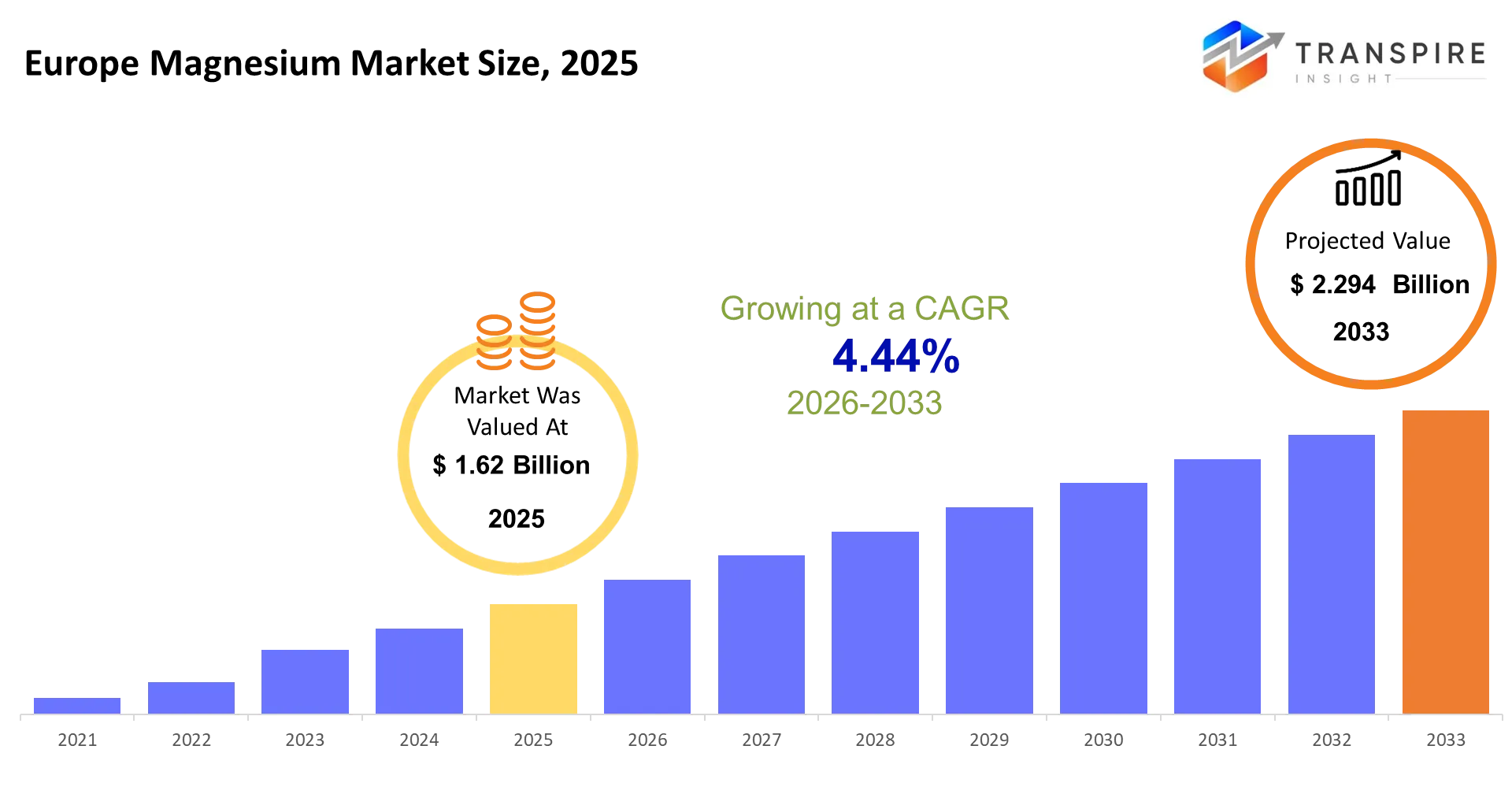
- Europe Magnesium Market Size 2025: USD 1.62 Billion
- Europe Magnesium Market Size 2033: USD 2.294 Billion
- Europe Magnesium Market CAGR: 4.44%
- Europe Magnesium Market Segments: By Type (Primary Magnesium, Secondary Magnesium, Alloys, Others), By Application (Automotive, Aerospace, Electronics, Construction, Others), By End-User (Automotive Industry, Aerospace Industry, Electronics Industry, Industrial Sector, Others), By Form (Ingots, Powder, Sheets, Others).
To learn more about this report,  Download Free Sample Report
Europe Magnesium Market Summary:
The Europe Magnesium Market size is estimated at USD 1.62 Billion in 2025 and is anticipated to reach USD 2.294 Billion by 2033, growing at a CAGR of 4.44% from 2026 to 2033.
The magnesium market in Europe provides essential support because it helps automotive and aerospace and marine industries to develop lightweight products which also resist corrosion while achieving fuel efficiency and increased payload capacity and improved emission results through their weight reduction efforts. It protects maritime infrastructure through its cathodic protection system which helps equipment to survive harsh saltwater conditions for extended periods.
The market has developed a new pattern in the past three to five years because manufacturers now depend on local sources and recycled materials to supply their magnesium needs while they implement systems for circular material use. The magnesium supply chain in Europe became exposed when the 2021 through 2022 energy crisis occurred together with China supply disruptions which forced industries to rethink their procurement methods.
The company has achieved growth through product replacement and redesign efforts as OEMs create new designs which use magnesium alloys instead of their previous aluminum and steel components. The company generates revenue growth through two channels because customers use its transport products more frequently while they generate income through their dependable supply networks which operate from regional production sites.
Key Market Insights
- Germany controls more than 28% of the European magnesium market during 2024 because its automotive sector and alloy development capabilities drive its market presence.
- Eastern Europe will experience its fastest growth period until 2030 because metal processing facilities expand their operations across the region while companies establish new industrial bases at lower expenses.
- Structural alloys and die-casting applications drive primary magnesium to maintain a market share above 55% throughout 2024.
- The second largest market segment magnesium alloys benefits from increased usage in aerospace and high-performance automotive component manufacturing.
- The recycled magnesium segment will experience rapid growth until 2030 because circular economy policies will change how raw materials are obtained.
- Automotive applications hold the largest market share in 2024 with approximately 40% because original equipment manufacturers (OEMs) use weight reduction strategies to achieve emission standards.
- Offshore infrastructure development together with corrosion protection needs is generating increased market interest for marine and cathodic protection solutions.
- The Europe Magnesium Market receives its highest market share from the transportation sector which accounts for over 45% because electric vehicle manufacturing requires lightweight materials.
- Aerospace represents a fast-growing end-user market which requires high strength-to-weight ratio materials for developing new aircraft.
What are the Key Drivers, Restraints, and Opportunities in the Europe Magnesium Market?
The European Union is implementing stricter emission limits for vehicles while promoting complete electric vehicle adoption which has led to increased use of magnesium as a lighter material that replaces steel and aluminum. The EU established stricter CO₂ regulations after 2020 which required automakers to develop new vehicle parts that meet weight reduction standards. The use of magnesium alloys allows components to achieve weight reductions of 30% which leads to better electric vehicle battery performance and increased driving distances. As original equipment manufacturers (OEMs) boost their electric vehicle (EV) production capacity they use magnesium for their transmission cases and seat structures and battery housings which results in higher material worth for each vehicle while increasing vendor earnings throughout the casting and alloying process.
The market remains constrained by Europe’s structural dependence on imported primary magnesium, particularly from China. The industry faces challenges to solve this issue because magnesium smelting operations need high levels of energy to function and there are insufficient domestic production facilities. The construction of new smelters requires both long-term energy agreements and large financial expenditures which results in extended delays for localizing production activities. Manufacturers who face supply fluctuations experience higher costs for their inputs which leads to difficulties in acquiring necessary materials thus they must either decrease their magnesium usage or return to using aluminum which prevents them from reaching their full market potential and decreases their pace of market entry.
The European Union develops circular material systems through recycling programs which create a sustainable pathway to expand magnesium supply from recycling. German and Scandinavian markets witness increasing adoption of advanced scrap recovery technologies together with alloy separation systems. The automotive industry uses closed-loop recycling systems to transform production waste into fresh parts which helps manufacturers decrease material imports and maintain stable operational expenses. The supply security improvement from this model creates a high-value market for environmentally friendly magnesium which generates new business opportunities that support industrial decarbonization goals.
What Has the Impact of Artificial Intelligence Been on the Europe Magnesium Market?
Artificial intelligence and advanced digital systems are starting to transform magnesium production and processing operations throughout Europe because they enhance process stability and energy efficiency and asset utilization. AI-driven control systems for smelting and refining operations use continuous monitoring to track furnace temperature and electrolyte balance and impurity levels, which result in automated input adjustments that sustain optimal reaction conditions. The system decreases manual work requirements while it maintains stable output quality for energy-intensive electrolysis processes.
Predictive maintenance capabilities across casting and alloying lines receive support from machine learning models. The systems use vibration pattern analysis and thermal data assessment and historical failure record review to predict equipment degradation, which enables them to plan maintenance activities before equipment breakdowns happen. The operators observe measurable improvements, which include a 15–20% reduction in unplanned downtime and enhanced yield consistency. AI-based forecasting tools achieve energy consumption optimization by synchronizing production cycles with electricity price changes, which serves as a crucial element in Europe's unpredictable energy market.
The technologies deliver measurable benefits that include reduced operating expenses and increased equipment availability and enhanced compliance with environmental standards. The process of adoption faces challenges because organizations need to spend significant money for system integration while they manage their existing fragmented legacy systems. The absence of standardized data systems in many facilities restricts model performance and hinders the widespread implementation of smart technologies.
Key Market Trends
- European automakers increased magnesium alloy usage in EV components by more than 20% since the year 2021 because of more stringent CO₂ emission rules together with their need to enhance battery performance.
- The 2022 energy crisis forced multiple European smelters to reduce output capacity which led manufacturers to explore new sourcing options while evaluating their existing supply agreements.
- The recycling-based magnesium supply system achieved a supply increase which exceeded 25% until 2024 because original equipment manufacturers (OEMs) implemented closed-loop systems for material management which helped them control expenses while minimizing their need for foreign shipments.
- After 2021 buyers chose to enter into long-term supply contracts because they had experienced price fluctuations which led them to value supply reliability more than they sought to minimize costs in their procurement activities.
- Eastern Europe became a processing center after 2020 because lower energy expenses attracted investments in alloy production together with downstream component manufacturing.
- AMG Advanced Metallurgical Group and Norsk Hydro both increased their research efforts toward low-carbon magnesium solutions which help them meet European Union industrial decarbonization requirements.
- Aerospace manufacturers started to use magnesium in their production processes after 2022 because they wanted to use lightweight alloys for their structural elements which would help them lower fuel consumption and improve their operational capacity.
- Digital process optimization tools decreased energy usage at magnesium casting facilities by as much as 15% since 2020 which enabled better financial management of operations that consumed large amounts of energy.
- Environmental regulations established more stringent industrial emissions standards after 2020 which forced manufacturers to adopt cleaner smelting methods that raised their investment costs but supported them in meeting future compliance requirements.
Europe Magnesium Market Segmentation
By Type
Primary magnesium maintains its market lead because it delivers reliable purity which meets the structural requirements of automotive and aerospace manufacturing. The market for secondary magnesium is expanding because recycling technologies have advanced and manufacturers require less imported raw materials. The demand for high strength-to-weight ratios in transport and industrial components drives the growth of magnesium alloys, which constitute an essential value-added market segment.
The primary production process faces two critical limitations because of cost fluctuations and the high energy requirements needed for production. The industry is moving toward secondary magnesium and alloy materials because these options deliver both superior performance and environmentally friendly benefits. The transition shows that producers who put resources into alloy research and recycling system development will achieve more enduring business advantages.
By Application
The application of automotive technology demonstrates its lead position because magnesium alloys are used to create lightweight components which include seat frames and transmission housings and battery enclosures. The aerospace industry operates as a valuable market because weight reduction delivers benefits for both fuel efficiency and increased payload capacity. Electronics and construction contribute smaller shares but show steady adoption in niche use cases such as casings and structural fittings.
The automotive industry needs to meet emission standards while the aerospace sector demands better performance. The future growth of manufacturers will depend on their ability to develop alloy properties which meet the specific needs of different industry sectors. The specialized suppliers can create competitive advantages through their development of new materials and their ability to make precise engineering products.
By End-User
The automotive industry has become the leading sector through customer demand because it maintains large operations and continuously develops new designs to meet electric vehicle requirements. The aerospace industry functions as a smaller market that charges high prices for its products which leads to greater profit margins despite having fewer customers. The electronics industry maintains steady demand for its products because lightweight materials enhance the usability of portable devices.
The industrial sector uses machinery and tooling applications which require users to balance equipment costs against performance requirements instead of following specific weight restrictions. Automotive growth occurs through increased sales volume while aerospace expansion comes from higher value per unit sold. Material suppliers and OEMs will establish more effective collaboration procedures because end-users require customized alloys and secure supply chains for their production requirements.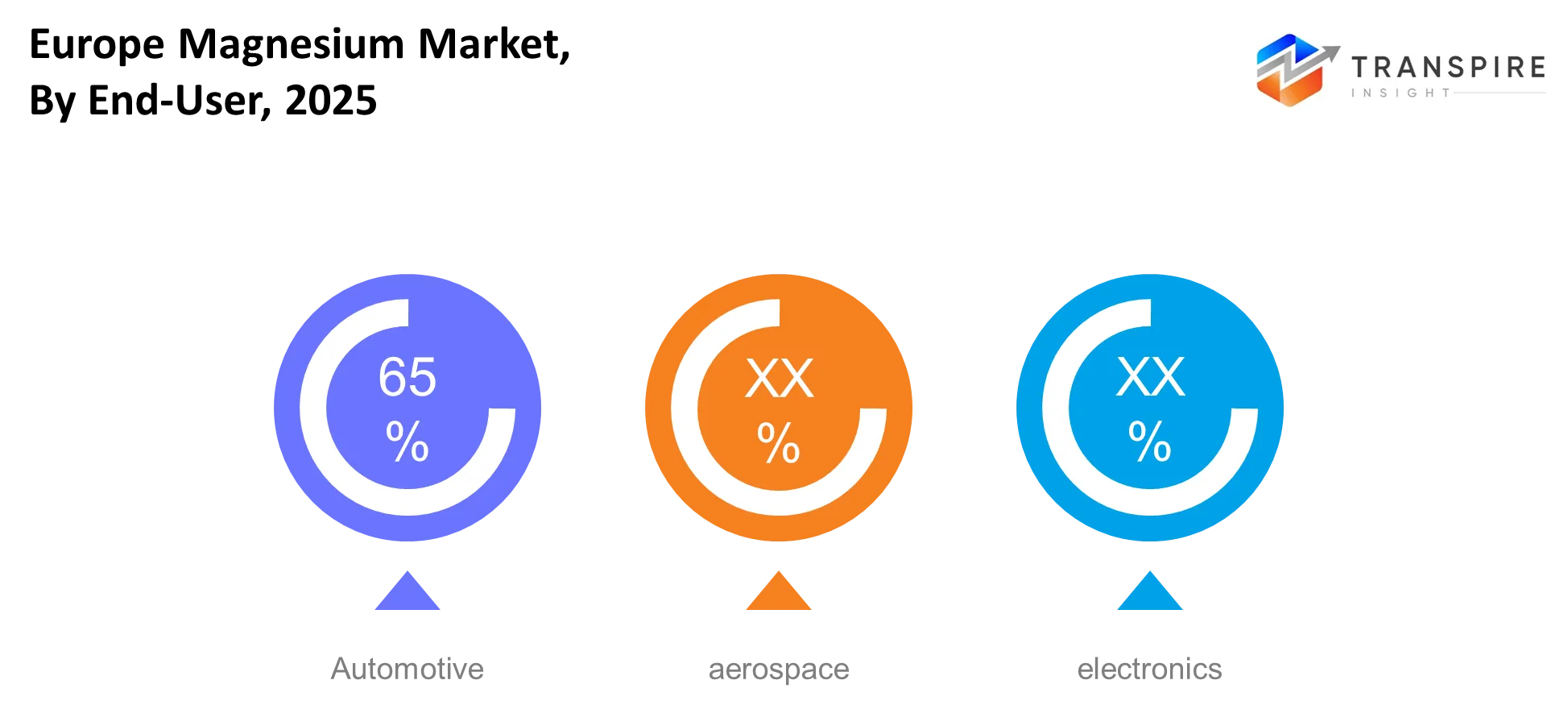
To learn more about this report, Download Free Sample Report
By Form
Ingot materials represent the most substantial percentage of primary materials which industrial processes use for both casting and alloy production. Sheets and plates are gaining importance because specialized applications require them to provide both uniform surface appearance and consistent structural properties. Advanced manufacturing techniques have a niche use for powder form which is currently growing in both additive manufacturing and powder metallurgy applications.
The value chain contains different stages which each produce distinct forms of materials, while ingots meet bulk requirements and powders serve high-precision needs. The different material types face challenges in their adoption because processing expenses and technical difficulties determine their market acceptance. The upcoming technologies will lead to new material development which will create demand for both powders and engineered forms, these changes will force producers to develop their downstream processing abilities.
What are the Key Use Cases Driving the Europe Magnesium Market?
The primary application of the core use case originates from the field of automotive manufacturing because magnesium alloys create lightweight structures which electric vehicles need. Car manufacturers implement magnesium in battery housings and seat frames and transmission cases because it helps them achieve weight reduction which results in longer vehicle operating distances. The highest demand for this application arises because companies select materials based on their need to meet emission standards and their goals for energy efficiency.
Aerospace and marine infrastructure currently use magnesium in increasing amounts for their various operational needs. Aircraft manufacturers use magnesium parts to create better fuel efficiency and higher payload capacities. Magnesium functions as a protective measure in marine environments by keeping offshore platforms and ship hulls safe from saltwater corrosion which helps extend their operational lifespan.
The development of new applications has created demand for additive manufacturing and portable electronics. The 3D printing process uses powder-based magnesium to create components which meet the needs of high-performance industries. The electronics industry evaluates ultra-lightweight casings which will help devices achieve better portability and thermal management capabilities.
|
Report Metrics |
Details |
|
Market size value in 2025 |
USD 1.62 Billion |
|
Market size value in 2026 |
USD 1.692 Billion |
|
Revenue forecast in 2033 |
USD 2.294 Billion |
|
Growth rate |
CAGR of 4.44% from 2026 to 2033 |
|
Base year |
2025 |
|
Historical data |
2021 - 2024 |
|
Forecast period |
2026 - 2033 |
|
Report coverage |
Revenue forecast, competitive landscape, growth factors, and trends |
|
Regional scope |
Europe (Germany, United Kingdom, France, Italy, Spain and Rest of Europe) |
|
Key company profiled |
US Magnesium, RIMA Group, Norsk Hydro, POSCO, Alcoa, Magontec, China Magnesium Corp, Latrobe Magnesium, Western Magnesium, Dead Sea Magnesium, Shanxi Wenxi, Taiyuan Tongxiang, Qinghai Salt Lake, Magnesium Elektron, Solikamsk |
|
Customization scope |
Free report customization (country, regional & segment scope). Avail customized purchase options to meet your exact research needs. |
|
Report Segmentation |
By Type (Primary Magnesium, Secondary Magnesium, Alloys, Others), By Application (Automotive, Aerospace, Electronics, Construction, Others), By End-User (Automotive Industry, Aerospace Industry, Electronics Industry, Industrial Sector, Others), By Form (Ingots, Powder, Sheets, Others) |
Which Regions are Driving the Europe Magnesium Market Growth?
The production and consumption market of Western Europe operates under the leadership of Germany and Norway and the Netherlands which serve as its central production and consumption bases. EU climate policies and industrial emission standards create a strong requirement which drives manufacturers to use lightweight and low-carbon materials that include magnesium alloys. The presence of advanced automotive clusters together with established industrial corridors which connect to ports enables businesses to achieve smooth material movement and efficient processing operations. The ecosystem which exists between recyclers and alloy developers and OEM partnerships maintains industry leadership while providing stable support for supply chain operations.
The automotive components and marine applications market function as the primary demand driver for Southern Europe which Italy and Spain lead. The region receives infrastructure funding which occurs consistently while its industrial base contains multiple sectors that protect it from risks associated with market downturns. The shipbuilding industry and offshore maintenance operations generate constant demand for magnesium-based corrosion protection solutions. The combination of industrial strength and regulatory alignment progress creates Southern Europe as a dependable market force which helps drive regional revenue growth.
Poland together with the Czech Republic and Hungary leads Eastern Europe which experiences its fastest development as these countries establish themselves as new manufacturing centers. Since 2022 alloy processing and component production investments have increased because of decreased energy expenses and specific industrial policies. Automotive suppliers are relocating parts of the value chain to this region to improve cost efficiency and proximity to EU markets. The period between 2026 and 2033 will create multiple chances for newcomers and investors to enter the market especially through localized production and recycling infrastructure development.
Who are the Key Players in the Europe Magnesium Market and How Do They Compete?
The European magnesium market displays moderately fragmented competition since both global metal producers and specialized alloy suppliers compete at multiple stages of the value chain. The established players maintain their market position through long-term supply agreements which they established with automotive original equipment manufacturers. The new market entrants concentrate their efforts on establishing recycling operations and developing products that need less energy to create. Businesses still concentrate their efforts on reducing operational costs through energy-efficient practices. The importance of technology that improves alloy performance and reduces carbon emissions now competes with existing methods of competition which focus on energy expenses. The choice of suppliers depends on geographical factors because manufacturing sites close to Europe now determine how efficient companies can handle their supply chain processes.
AMG Advanced Metallurgical Group concentrates on technological development for its recycling and specialized alloy processes which enable the company to deliver high-performance products to automotive and aerospace sectors. The company built distinct recycling systems which operate on a closed-loop basis to achieve two goals. The systems enable the company to recycle materials without needing to acquire foreign raw materials. The systems also help the company achieve EU environmental sustainability objectives. Norsk Hydro uses its knowledge of low-carbon metal production to develop new magnesium alternative products which use renewable energy for their manufacturing processes. The company aims to capture markets that require environmental regulations for their operations. The two companies develop their businesses through partnerships with original equipment manufacturers while they invest in systems that create closed-loop material. This approach builds stronger supply chains by developing more resilient business operations.
Rio Tinto uses its extensive resources and operational scale to manage costs and ensure dependable supply services in worldwide markets. The company improves its market position by producing low-emission metals which help it comply with European Union regulations. Rusal uses its complete operational control to create unique market offerings yet the company faces challenges in expanding its European business because of current international political conditions. Dead Sea Magnesium operates in a specialized market because it delivers high-purity magnesium to industrial customers who need consistent and superior product quality instead of lower prices.
Company List
- US Magnesium
- RIMA Group
- Norsk Hydro
- POSCO
- Alcoa
- Magontec
- China Magnesium Corp
- Latrobe Magnesium
- Western Magnesium
- Dead Sea Magnesium
- Shanxi Wenxi
- Taiyuan Tongxiang
- Qinghai Salt Lake
- Magnesium Elektron
- Solikamsk
Recent Development News
In April 2026, Europe restarting magnesium mining projects to reduce import dependency: European industrial policy continues to accelerate domestic magnesium sourcing efforts, including restarting dormant mining and processing capacity to reduce dependency on China-based supply chains for magnesium used in automotive and aluminum alloys.
Source: https://www.ft.com/
In April 2026, Aperam completes Magnetec Group takeover: In a parallel regulatory filing, Aperam confirmed integration of Magnetec’s European production sites, strengthening its vertically integrated supply chain across Hungary, Moldova, and Germany. The move enhances Europe’s access to advanced magnetic materials used in automotive and energy applications where magnesium alloys are critical inputs.
Source: https://live.euronext.com
What Strategic Insights Define the Future of the Europe Magnesium Market?
The Europe magnesium market is moving toward a structurally regionalized and low-carbon supply model which exists because of ongoing energy instability together with rising industrial decarbonization requirements. Growth during the next five to seven years will depend on the ability of producers to adopt recycling techniques together with renewable energy sources and new alloy technologies instead of relying on volume growth to achieve their objectives. The new development will create advantages for businesses that can provide both high-quality materials and proof of sustainable carbon reduction which exists because OEMs now use Scope 3 requirements to determine their purchasing choices.
The hidden danger of material substitution occurs through the use of advanced aluminum alloys together with composite materials which provide equivalent performance at reduced weight and create more dependable supply chains. The ongoing cost fluctuations of magnesium will drive buyers to create new designs which use different materials thus preventing magnesium from achieving widespread use.
The field of magnesium powders for additive manufacturing creates an opportunity which shows potential in the aerospace and defense sectors because weight reduction enables justifying expensive processing expenses. Market participants should invest early in downstream processing and secure partnerships with OEMs to lock in application-specific demand before substitution risks intensify.
Europe Magnesium Market Report Segmentation
By Type
- Primary Magnesium
- Secondary Magnesium
- Alloys
- Others
By Application
- Automotive
- Aerospace
- Electronics
- Construction
- Others
By End-User
- Automotive Industry
- Aerospace Industry
- Electronics Industry
- Industrial Sector
- Others
By Form
- Ingots
- Powder
- Sheets
- Others
Frequently Asked Questions
Find quick answers to common questions.
The Approximate Europe Magnesium Market size for the Market will be USD 2.294 Billion in 2033.
The key Segments of the Europe Magnesium Market are By Type (Primary Magnesium, Secondary Magnesium, Alloys, Others), By Application (Automotive, Aerospace, Electronics, Construction, Others), By End-User (Automotive Industry, Aerospace Industry, Electronics Industry, Industrial Sector, Others), By Form (Ingots, Powder, Sheets, Others).
Major Players in the Europe Magnesium Market are US Magnesium, RIMA Group, Norsk Hydro, POSCO, Alcoa, Magontec, China Magnesium Corp, Latrobe Magnesium, Western Magnesium, Dead Sea Magnesium, Shanxi Wenxi, Taiyuan Tongxiang, Qinghai Salt Lake, Magnesium Elektron, Solikamsk.
The Current Market size of the Europe Magnesium Market is USD 1.62 Billion in 2025.
The Europe Magnesium Market CAGR is 4.44%.
- US Magnesium
- RIMA Group
- Norsk Hydro
- POSCO
- Alcoa
- Magontec
- China Magnesium Corp
- Latrobe Magnesium
- Western Magnesium
- Dead Sea Magnesium
- Shanxi Wenxi
- Taiyuan Tongxiang
- Qinghai Salt Lake
- Magnesium Elektron
- Solikamsk
Recently Published Reports
-
Apr 2026
Healthcare Polymer Packaging Market
Healthcare Polymer Packaging Market Size, Share & Analysis Report By Packaging Type (Syringes, IV Bottles and Pouches, Clamshells, Blisters, Bottles & Jars, Containers, Tubes, IV Parental Packaging, Others), By Type (Regulated, Non-regulated), By Polymer Type (LDPE (Low-Density Polyethylene), HDPE (High-Density Polyethylene), Homo-polymer (Homo), Random Copolymer (Random), Block Copolymer (Block), PET, Polystyrene, Polyvinyl Chloride, Polyamide/EVOH, Others), and Geography (North America, Europe, Asia-Pacific, Middle East and Africa, South and Central America), 2021 - 2031
-
Apr 2026
Hydrophilic Tape (Waterstop) Market
Hydrophilic Tape (Waterstop) Market Size, Share & Analysis Report By Type (Bentonite-Based Hydrophilic Tape, Rubber-Based Hydrophilic Tape), By Application (Residential Buildings, Commercial Buildings, Infrastructure Projects), and Geography (North America, Europe, Asia-Pacific, Middle East and Africa, South and Central America), 2021 - 2031
-
Apr 2026
Metalens Market
Metalens Market Size, Share & Analysis Report By Type (Visible Light Metalens, and Infrared Metalens), By Application (Consumer Electronics, Automotive Electronics, Industrial, Medical, and Others), and Geography (North America, Europe, Asia-Pacific, Middle East and Africa, South and Central America), 2021 - 2031
-
Apr 2026
PBT Resin Market
PBT Resin Market Size, Share & Analysis Report By Type (Reinforced PBT Resin, Unreinforced PBT Resin), By Processing Method (Injection Molding, Extrusion, Blow Molding, Others), By End-User (Automotive, Electrical & Electronics, Consumer Appliances, Industrial Machinery, Medical Devices, Packaging, Others), and Geography (North America, Europe, Asia-Pacific, Middle East and Africa, South and Central America), 2021 - 2031