
Asia Pacific Glioblastoma Pleuromorphic (GBM) Treatment Market Size & Forecast:
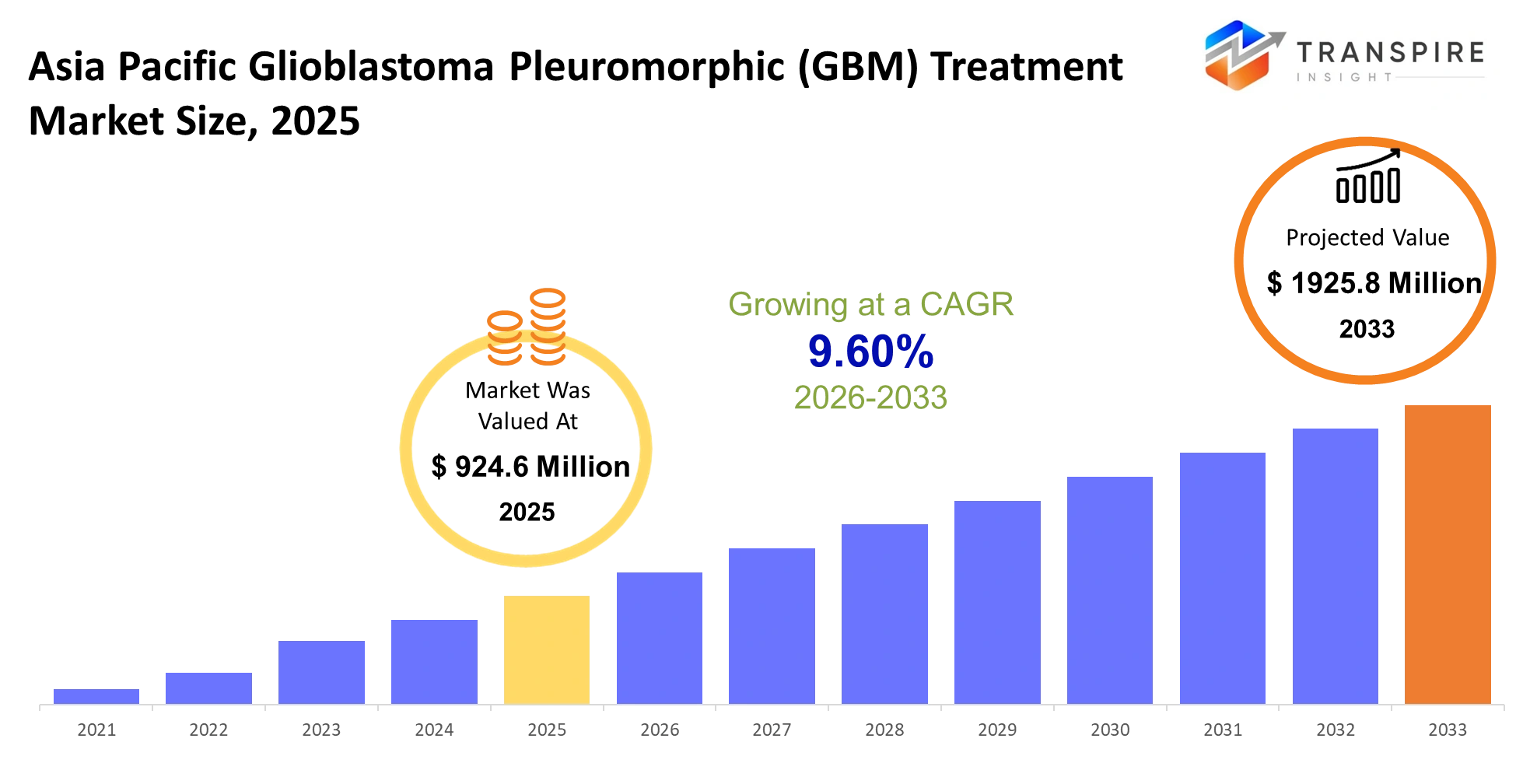
- Asia Pacific Glioblastoma Pleuromorphic (GBM) Treatment Market Size 2025: USD 924.6 Million
- Asia Pacific Glioblastoma Pleuromorphic (GBM) Treatment Market Size 2033: USD 1925.8 Million
- Asia Pacific Glioblastoma Pleuromorphic (GBM) Treatment Market CAGR: 9.60%
- Asia Pacific Glioblastoma Pleuromorphic (GBM) Treatment Market Segments: By Type (Chemotherapy, Radiotherapy, Immunotherapy, Targeted Therapy, Surgery, Others); By Application (Primary GBM, Secondary GBM, Recurrent GBM, Newly Diagnosed, Clinical Trials, Others); By End-User (Hospitals, Cancer Centers, Clinics, Research Institutes, Specialty Centers, Others); By Drug Type (Temozolomide, Bevacizumab, Carmustine, Lomustine, Combination Drugs, Others).
To learn more about this report,  Download Free Sample Report
Asia Pacific Glioblastoma Pleuromorphic (GBM) Treatment Market Summary:
The Asia Pacific Glioblastoma Pleuromorphic (GBM) Treatment Market size is estimated at USD 924.6 Million in 2025 and is anticipated to reach USD 1925.8 Million by 2033, growing at a CAGR of 9.60% from 2026 to 2033. The GBM treatment market for the asia pacific glioblastoma pleuromorphic market in the regional oncology therapeutics industry is likely to be impacted by the ongoing trend towards precise medicine in the healthcare industry. As hospitals and specialized medical centers in countries such as Japan, India, and Australia move towards providing personalized treatment for patients, there is an expectation for therapies that increase the lifespan of patients without negatively impacting their quality of life.
The need for personalized care will lead to increased use of technology and diagnosis during the treatment process. There is likely to be increased use of technologies such as targeted therapies and immunotherapy combinations, alongside AI-supported treatment plans, as more evidence supporting their use emerges. Governments across the Asia Pacific region will be expected to tighten standards required for therapy approval but also facilitate the development of fast-track programs to allow innovations into the market. There will also be shifting expectations among patients and caregivers who expect minimally invasive treatment and support care alongside the current aggressive treatment approaches.
What Has the Impact of Artificial Intelligence Been on the Asia Pacific Glioblastoma Pleuromorphic (GBM) Treatment Market?
The deployment of artificial intelligence will lead to significant changes in the way decisions are made and treatments become more precise in the asia pacific glioblastoma pleuromorphic (GBM) treatment market, placing the data at the heart of the innovation process. The application of AI in the asia pacific glioblastoma pleuromorphic (GBM) treatment market will help improve the quality of market research and analysis, detecting important patterns in patients' results, outcomes of clinical trials, and effectiveness of treatments. The use of machine learning algorithms analyzing big oncology data will facilitate better demand prediction and recognition of upcoming trends in the Asia Pacific glioblastoma pleuromorphic (GBM) treatment market.
Artificial intelligence will improve operational efficiency through its two main functions, which are intelligent automation and resource management optimization. Automated systems in the Asia Pacific glioblastoma pleuromorphic (GBM) treatment market will shorten drug development timelines, improve diagnostic precision, and reduce supply chain costs. Predictive tools will enhance inventory control and distribution operations, ensuring that advanced therapies become available on schedule. AI-based personalization systems will help doctors develop customized treatment plans that use both genetic information and clinical data, which will give healthcare providers a significant business edge. The combination of technology with medical treatment systems will drive the Asia Pacific glioblastoma pleuromorphic (GBM) treatment market toward the development of healthcare systems that provide better patient experiences through personalized medical treatment.
Key Market Trends & Insights:
- Japan has the largest market share in the Asia Pacific glioblastoma pleuromorphic (GBM) treatment market, with an estimated 32% share in 2025, owing to well-developed oncology facilities and heavy investment in R&D.
- India is the fastest-growing market, driven by increased diagnosis and improved access to healthcare services, with a forecast CAGR of more than 11% for 2025-2030.
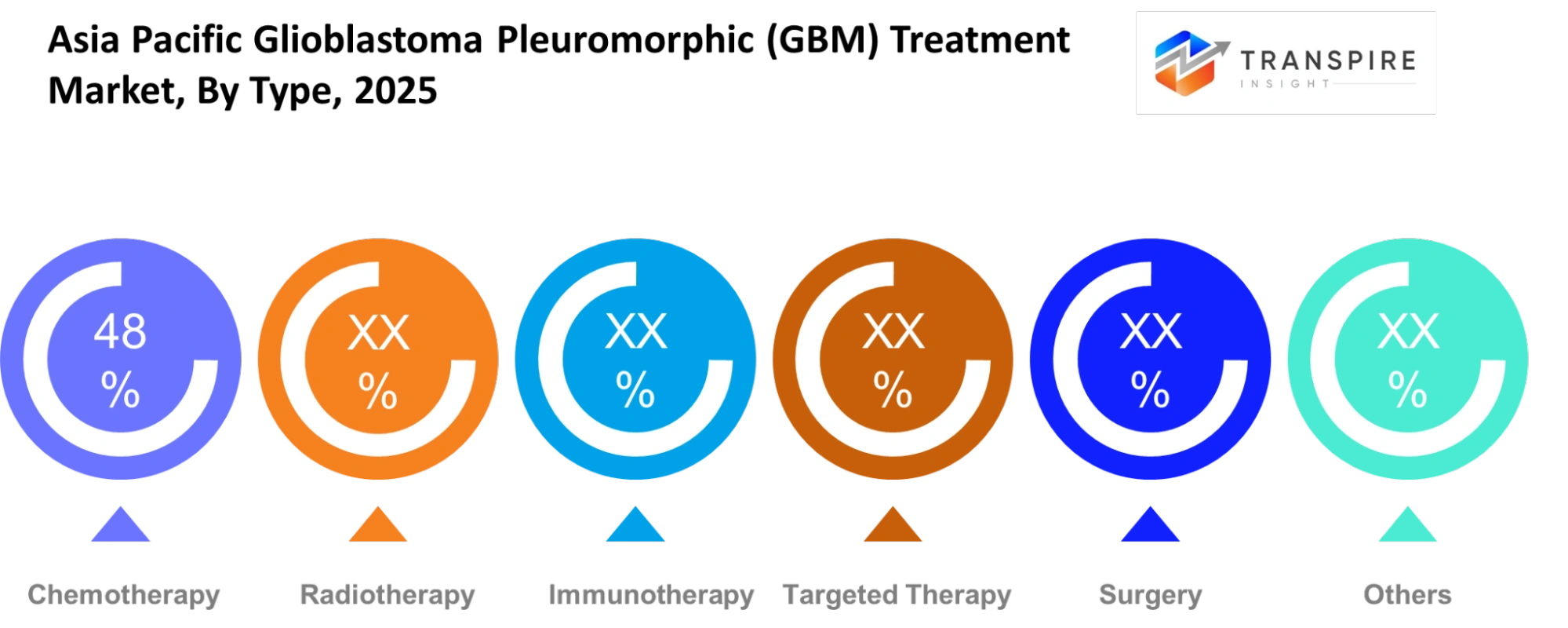
- Targeted Therapy has the largest share in the market with an estimated market share of about 38% in 2025, owing to growing personalized medicine trend.
- Chemotherapy is the second largest segment with a market share of approximately 27% owing to its significance.
- Immunotherapy has been the fastest-growing segment due to significant advancements in the field.
- Hospital-based treatment is the largest application segment, with a market share of over 60%, owing to superior infrastructure and strong demand.
- Outpatient and Ambulatory care has become the fastest-growing application, driven by demand for cost-effective, minimally invasive treatments.
- Hospitals dominate the Asia Pacific glioblastoma pleuromorphic (GBM) treatment market, with a nearly 58% market share.
Asia Pacific Glioblastoma Pleuromorphic (GBM) Treatment Market Segmentation
By Type
The use of chemotherapy will remain widespread because of its proven ability to delay cancer progression and complement other treatments. The use of radiotherapy will be sustained as a key treatment method, usually combined with chemotherapy to increase the probability of survival. Surgery will also be sustained as an essential procedure for tumor resection when possible, particularly during early diagnosis or in cases of controlled metastasis.
Immunotherapy and targeted therapy will be given more consideration as medical science moves towards personalized medicine. This treatment modality will rely on the identification of particular tumor markers and immune response. Other treatments will evolve gradually as more clinical trials are performed within the regional health-care network.
To learn more about this report, Download Free Sample Report
By Application
Primary GMB will be dominant because of greater awareness, and the need for immediate treatment strategies becomes imperative. New primary cases will involve the use of a combination of different treatment approaches such as surgery, chemotherapy, and radiation therapy. The secondary GMBs will be difficult to treat since they come from low-grade malignancies.
The recurrence of GMBs will lead to an increase of the need for more sophisticated treatments because traditional treatment methods are not effective for treating the condition for a prolonged period. Clinical trials will be necessary to test different drug combinations and other innovative approaches to treating the condition.
By End-User
Leading end-users will be hospitals, owing to their availability of advanced technology and professional staff for proper treatment and facilities. The cancer centers will take a close second place because of the provision of expert services. Clinics that will provide early diagnosis and general support for treatment will also follow.
The research institutes are expected to play a role in developing advanced treatment procedures and conducting clinical trials. Specialized centers will gradually grow as they provide specialized and advanced treatment procedures. Other end users are expected to emerge as new healthcare establishments.
By Drug Type
Temozolomide is going to be used as a first-choice treatment because of its success in treating the condition. Bevacizumab will be used in certain cases to inhibit tumor growth through blood vessels formation. Carmustine and Lomustine will serve as other chemotherapy drugs.
Combined drugs are expected to become significant treatment strategies because of changes in treatment strategy from using single drugs. Combined drugs are expected to have a positive impact on patients' life span and recurrence of cancer. New drugs will develop through research.
What are the Main Challenges for the Asia Pacific Glioblastoma Pleuromorphic (GBM) Treatment Market Growth?
There are a number of technical and operational obstacles that will hinder progress in the asia pacific glioblastoma pleuromorphic (GBM) treatment market. The effectiveness of treatments will continue to be hampered by tumor resistance, genetic differences, and low response rates. Advanced treatment methods, such as those involving multiple stages and dosage requirements will place increased pressure on medical practitioners. Furthermore, interruptions in the supply of essential drugs and diagnostic equipment will further limit this market, especially where health care is not evenly distributed.
Some obstacles related to manufacturing and commercialization will prevent growth in the asia pacific glioblastoma pleuromorphic (GBM) treatment market. The manufacture of advanced treatments, specifically biologic and targeted drugs, will require strict adherence to regulations such as GMP. Approval times will be lengthy, as products must be proven efficacious and safe through clinical trials. High costs associated with manufacturing, research, and development will remain persistent.
The adoption problems are likely to remain due to infrastructural inadequacies and lack of availability of the skilled workforce. The majority of the new economies in the Asia Pacific glioblastoma pleuromorphic (GBM) treatment market are expected to face a shortage of access to state-of-the-art diagnostic equipment and oncology facilities. Lack of awareness, financial limitations, and unaffordability will significantly limit patients' access to new innovations.
The competitive environment and risk factors will play an important role in determining the future dynamics of the Asia Pacific glioblastoma pleuromorphic (GBM) treatment market. The asia pacific glioblastoma pleuromorphic (GBM) treatment market will be facing competition in the form of alternative solutions and newer technologies that are likely to perform better than current technologies. Pricing competition and technological evolution are also likely to introduce significant uncertainty into the asia pacific glioblastoma pleuromorphic (GBM) treatment market.
Regional Insights
Japan is set to remain at the forefront thanks to effective hospital chains, sophisticated imaging technologies, and timely access to cutting-edge treatments. With high levels of healthcare expenditure and organized clinical research, there will be reliable access to treatment services. In urban medical settings, treatment will continue to be based on precision, ensuring better patient care and higher standards of treatment nationwide.
China is expected to advance steadily as larger numbers of patients prompt greater interest in specialized oncology treatment. There will be adequate government involvement in expanding healthcare services, resulting in improved hospital capabilities and diagnostic capabilities. Production of medication will be localized, eliminating reliance on foreign products. Investments in research facilities will boost clinical trials and treatment options.
India will demonstrate its status as a rapidly expanding market because people now understand health issues better and the nation has improved its infrastructure and private health care sector continues to grow. Cost-effective treatment options will pave way for effective treatment methods, while specialty hospitals will offer advanced treatments. Better diagnostic facilities along with higher education levels will help provide better treatment in tier II and tier III cities.
Both Australia and South Korea will exhibit stable growth due to better regulation and innovative treatment methods adoption rates. Research collaborations and clinical studies would help introduce newer treatment methodologies. Existing healthcare infrastructure would ensure better healthcare delivery, while technology would help better manage patients' health.
Recent Development News
In April 2026, Telix Pharmaceuticals announced a strategic collaboration expansion with global clinical partners to advance its glioblastoma therapy pipeline. The move will strengthen its late-stage development capabilities and accelerate commercialization planning for targeted radiopharmaceutical treatments.
Source: https://www.stocktitan.net
In March 2026, Everfront Biotech entered a partnership agreement with research collaborators to support late-stage development of its Cerebraca® wafer therapy. The agreement will focus on scaling clinical trials and preparing for future commercialization in brain tumor treatment segments.
Source: https://www.efbiotech.com/
|
Report Metrics |
Details |
|
Market size value in 2025 |
USD 924.6 Million |
|
Market size value in 2026 |
USD 1013.5 Million |
|
Revenue forecast in 2033 |
USD 1925.8 Million |
|
Growth rate |
CAGR of 9.60% from 2026 to 2033 |
|
Base year |
2025 |
|
Historical data |
2021 - 2024 |
|
Forecast period |
2026 - 2033 |
|
Report coverage |
Revenue forecast, competitive landscape, growth factors, and trends |
|
Regional scope |
Asia Pacific (China, India, Japan, South Korea, Australia, Rest of Asia Pacific) |
|
Key company profiled |
Roche, Novartis, Pfizer, Merck, Bristol Myers Squibb, AstraZeneca, Eli Lilly, Amgen, Sanofi, GSK, Takeda, Bayer, AbbVie, Johnson & Johnson, Boehringer Ingelheim. |
|
Customization scope |
Free report customization (country, regional & segment scope). Avail customized purchase options to meet your exact research needs. |
|
Report Segmentation |
By Type (Chemotherapy, Radiotherapy, Immunotherapy, Targeted Therapy, Surgery, Others); By Application (Primary GBM, Secondary GBM, Recurrent GBM, Newly Diagnosed, Clinical Trials, Others); By End-User (Hospitals, Cancer Centers, Clinics, Research Institutes, Specialty Centers, Others); By Drug Type (Temozolomide, Bevacizumab, Carmustine, Lomustine, Combination Drugs, Others). |
How Can New Companies Establish a Strong Foothold in the Asia Pacific Glioblastoma Pleuromorphic (GBM) Treatment Market?
The asia pacific glioblastoma pleuromorphic (GBM) treatment market gives new entrants a chance to build a strong market position through their efforts to treat high-need medical areas which current treatments cannot address. The market needs precision medicine solutions which recurrent and treatment-resistant cases allow emerging companies to address with their products. The asia pacific glioblastoma pleuromorphic (GBM) treatment market will benefit from companies that develop strong innovation strategies through their work on biomarker-based therapies and localized drug delivery systems. Companies will establish their market presence through technology differentiation which serves as their primary strategy for business development.
The companies that develop AI-based systems for diagnostics along with predictive analytics and personalized treatment strategies will achieve better clinical results and faster decision-making processes. The asia pacific glioblastoma pleuromorphic (GBM) treatment market will benefit from partnerships between hospitals and research institutes and biotech companies which will speed up product validation processes and regulatory approval timelines. The strategic collaborations will create entry barriers through their provision of clinical data and infrastructure and distribution networks.
The impact of focused innovation efforts demonstrates their value for emerging companies. The company Telix Pharmaceuticals develops targeted radiopharmaceutical therapies while Kazia Therapeutics creates new brain tumor drugs. The system solves major problems which result from weak drug absorption and minimal survival improvement. New companies will strengthen their market position through targeted research and development and regional partnerships and flexible pricing models which will help them establish market presence in this niche sector.
Key Asia Pacific Glioblastoma Pleuromorphic (GBM) Treatment Market Company Insights
The period between their establishment in 1930 and the present day shows that Johnson and Johnson have become one of the largest healthcare corporations worldwide. Johnson and Johnson will use R&D targets to drive their healthcare expense reduction and creation of innovative medical products. The company will create an advanced healthcare system using their current medical operations framework.
The partnership between the two organizations will work toward establishing a universal platform for cancer treatment development. The need to develop more efficient metabolic solutions for diabetes treatment. Johnson and Johnson needs to create an advanced digital platform for healthcare service at home. The company aims to develop a comprehensive healthcare system that uses their existing medical services framework. The company intends to create a new operational system that will connect their existing healthcare services with their future medical products.
The company collaborates with healthcare institutions to establish new operational procedures which enable them to create medical solutions that meet actual healthcare system requirements. The organization works with academic institutions to find new healthcare treatment solutions while developing operational systems which will enhance their network of healthcare facilities. Industrial partnerships with hospitals and research facilities will enable organizations to achieve their clinical validation objectives at an accelerated pace. The use of research partnerships and licensing contracts will serve as the essential methods through which organizations expand their market presence while gaining access to new technologies. The two companies will join forces to exchange knowledge and decrease their product development expenses until they can launch their products.
Company List
- Roche
- Novartis
- Pfizer
- Merck
- Bristol Myers Squibb
- AstraZeneca
- Eli Lilly
- Amgen
- Sanofi
- GSK
- Takeda
- Bayer
- AbbVie
- Johnson & Johnson
- Boehringer Ingelheim
What are the Key Use-Cases Driving the Growth of the Asia Pacific Glioblastoma Pleuromorphic (GBM) Treatment Market?
Asia Pacific glioblastoma pleuromorphic (GBM) treatment market growth is being witnessed due to certain key use-cases focusing on cutting-edge healthcare and oncological treatment approaches. First, one can mention integration into clinical pathways encompassing surgery, radiation treatment, and chemotherapy to increase patient survival rate. This particular approach is quite widespread in advanced healthcare facilities, thereby contributing to stable demand for the Asia Pacific glioblastoma pleuromorphic (GBM) treatment market.
Second, there is a growing need for personalized medicine involving use of genetic profiles and molecular diagnostics. There is a tendency towards the increasing use of targeted drugs and immunotherapy that rely on specific markers to improve therapeutic efficacy. This trend results in growing adoption of Asia Pacific glioblastoma pleuromorphic (GBM) treatment market services.
Clinical trials and applications based on research activities have proven to be equally important factors in market expansion. There are pharmaceutical firms and research organizations that are working on new formulations and advanced treatments that can overcome the challenges posed by treatment-resistant patients. Not only will this provide an improvement in terms of therapy, but also pave ways for future scalability within the asia pacific glioblastoma pleuromorphic (GBM) treatment market.
Another promising application lies in the area of digital health, where artificial intelligence can be utilized in diagnosing and developing plans for the treatment of patients.
Asia Pacific Glioblastoma Pleuromorphic (GBM) Treatment Market Report Segmentation
By Type
- Chemotherapy
- Radiotherapy
- Immunotherapy
- Targeted Therapy
- Surgery
- Others
By Application
- Primary GBM
- Secondary GBM
- Recurrent GBM
- Newly Diagnosed
- Clinical Trials
- Others
By End-User
- Hospitals,
- Cancer Centers,
- Clinics
- Research Institutes
- Specialty Centers
- Others
By Drug Type
- Temozolomide
- Bevacizumab
- Carmustine
- Lomustine
- Combination Drugs
- Others
Frequently Asked Questions
Find quick answers to common questions.
The approximate Asia Pacific Glioblastoma Pleuromorphic (GBM) Treatment Market size for the market will be USD 1925.8 Million in 2033.
Key segments for the Asia Pacific Glioblastoma Pleuromorphic (GBM) Treatment Market are By Type (Chemotherapy, Radiotherapy, Immunotherapy, Targeted Therapy, Surgery, Others); By Application (Primary GBM, Secondary GBM, Recurrent GBM, Newly Diagnosed, Clinical Trials, Others); By End-User (Hospitals, Cancer Centers, Clinics, Research Institutes, Specialty Centers, Others); By Drug Type (Temozolomide, Bevacizumab, Carmustine, Lomustine, Combination Drugs, Others).
Major Asia Pacific Glioblastoma Pleuromorphic (GBM) Treatment Market players are Roche, Novartis, Pfizer, Merck, Bristol Myers Squibb, AstraZeneca, Eli Lilly, Amgen, Sanofi, GSK, Takeda, Bayer, AbbVie, Johnson & Johnson, Boehringer Ingelheim.
The Asia Pacific Glioblastoma Pleuromorphic (GBM) Treatment Market size is USD 924.6 Million in 2025.
The Asia Pacific Glioblastoma Pleuromorphic (GBM) Treatment Market CAGR is 9.60%.
- Roche
- Novartis
- Pfizer
- Merck
- Bristol Myers Squibb
- AstraZeneca
- Eli Lilly
- Amgen
- Sanofi
- GSK
- Takeda
- Bayer
- AbbVie
- Johnson & Johnson
- Boehringer Ingelheim
Recently Published Reports
-
Apr 2026
Biosimilars Market
Biosimilars Market By Product Type (Monoclonal Antibodies, Recombinant Hormones, Erythropoietin, G-CSF, Others), By Indication (Oncology, Autoimmune Diseases, Blood Disorders, Diabetes, Others), By Manufacturing Type (In-House Manufacturing, Contract Manufacturing), By Distribution Channel (Hospital Pharmacies, Retail Pharmacies, Online Pharmacies), By Industry Analysis, Size, Share, Growth, Trends, and Forecasts 2021-2033
-
Apr 2026
Gastrointestinal Endoscopy Market
Gastrointestinal Endoscopy Market By Type (Rigid Gastrointestinal Endoscope, Flexible Gastrointestinal Endoscopes, Disposable Gastrointestinal Endoscope), By Procedure Type (Colonoscopy, Gastroscopy, Duodenoscopy, Enteroscopy, Flexible Sigmoidoscopy, Others), By Application (Diagnosis, Treatment), By End-Users (Hospitals, Ambulatory Surgical Centers, Specialty Clinics, Laboratories, Others), By Industry Analysis, Size, Share, Growth, Trends, and Forecasts 2021-2033
-
Apr 2026
Rare Inherited Metabolic Disorder Drug Market
Rare Inherited Metabolic Disorder Drug Market By Drug Class (Enzyme Replacement Drugs, Gene Therapy Drugs, Substrate Reduction Drugs, Small Module Drugs, Protein Drugs), By Route of Administration(Parenteral, Oral, Intrathecal), By Clinical Development (Marketed Drugs, Late Stage Clinical Phase III, Early Stage Clinical Phase I-II, Preclinical Candidates), By Indication (Lysosomal Storage Disorders, Urea Cycle Disorders, Amino Acid Metabolic Disorders, organic Acidemias, Peroximal Disorders), By Industry Analysis, Size, Share, Growth, Trends, and Forecasts 2021-2033
-
Jan 2026
Pharmaceutical Cleanroom Technology Market
Pharmaceutical Cleanroom Technology Market By Product (Equipment, Consumables, Services); By Cleanroom Type (Standard Cleanrooms, Modular Cleanrooms); By End Use (Pharmaceutical Companies, Biotechnology Companies), By Industry Analysis, Size, Share, Growth, Trends, and Forecasts 2021-2033