
Asia Pacific Glass Curtain Wall Market Summary
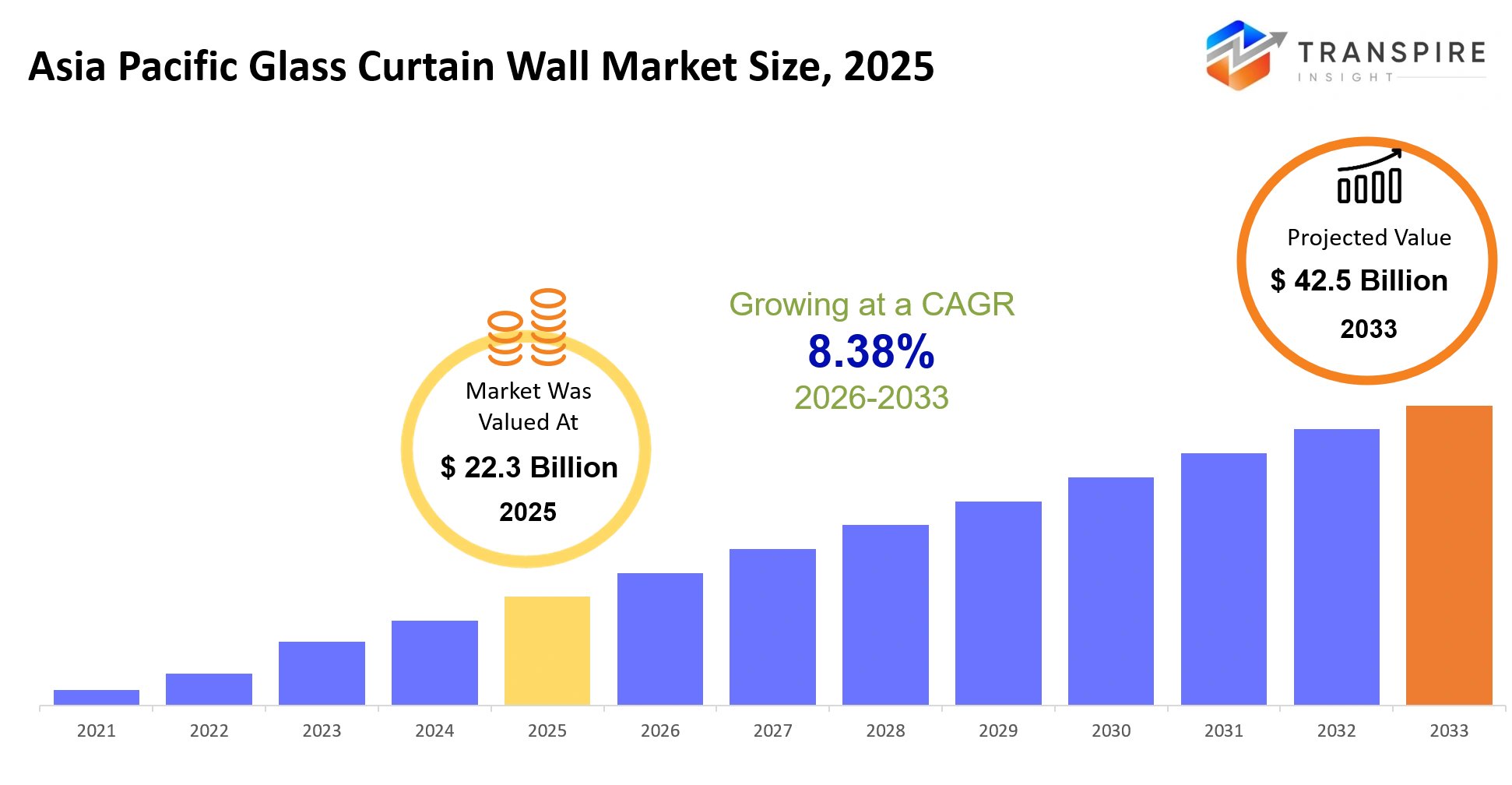
As per Transpire Insight Analysis the Asia Pacific Glass Curtain Wall Market size is estimated at USD 22.3 Billion in 2025 and is anticipated to reach USD 42.5 Billion by 2033, growing at a CAGR of 8.38% from 2026 to 2033.
The Asia Pacific Glass Curtain Wall Market helps commercial towers, mixed use developments, airports, hospitals, and institutional buildings get energy savvy façades , while also aiming for more natural daylight, solid weather protection, and that modern architectural look. Developers and owners often lean on these systems to cut down long-term operating costs, boost occupant comfort , and still satisfy tighter building performance requirements without really limiting design creativity. In the last few years, the market seems to have moved away from conventional glazing and toward higher performance insulated, low emissivity, and smart glass curtain wall systems, which in turn support sustainability aims plus premium building certifications.
This shift sort of sped up once governments across the region tightened green building rules, and pushed stronger carbon reduction policies. Meanwhile, pandemic related supply chain woes influenced other participants to source locally and bolster their region’s manufacturing expertise. Consequently as builders today begin to measure total building cost against installation, more designers and architects consider these higher performing systems to be smart investments that are now driving use in both new construction and retro-fit scenarios too.
Asia Pacific Glass Curtain Wall Market Size & Forecast:
- Asia Pacific Glass Curtain Wall Market Size 2025: USD 22.3 Billion
- Expected Market Value 2033: USD 42.5 Billion
- Forecast CAGR: 8.38%
- Leading region in 2025: China
- Fastest Growing region: India
- Key Profile: Schüco, Saint-Gobain, AGC Inc., Nippon Sheet Glass, Guardian Glass, YKK AP, Jangho Group, Permasteelisa, Kawneer, China Glass Holdings, Vitro Architectural Glass, Apogee Enterprises, Oldcastle BuildingEnvelope, Central Glass, CSR Limited.
Key Market Insights
- China held approximately 48% of the market in Asia Pacific Glass Curtain Wall Market in 2025 because of increased construction of tall buildings and city regeneration projects.
- In 2025-2033, India is likely to be the fastest growing region due to high investment in commercial property, smart city development projects.
- In 2025, Unitized Glass Curtain Wall Systems is projected to be the largest market product segment with approx. 57% market share by enabling quick installation thus lowering on-site labor and time needed to complete projects.
- Stick built curtain wall systems followed as the second largest product segment used for mid-rise commercial projects where custom design takes precedence over installation speeds.
- The fastest-growing segment is projected to be double skin and smart glass curtain wall systems from 2025 to 2033 due to increasing energy efficiency norms.
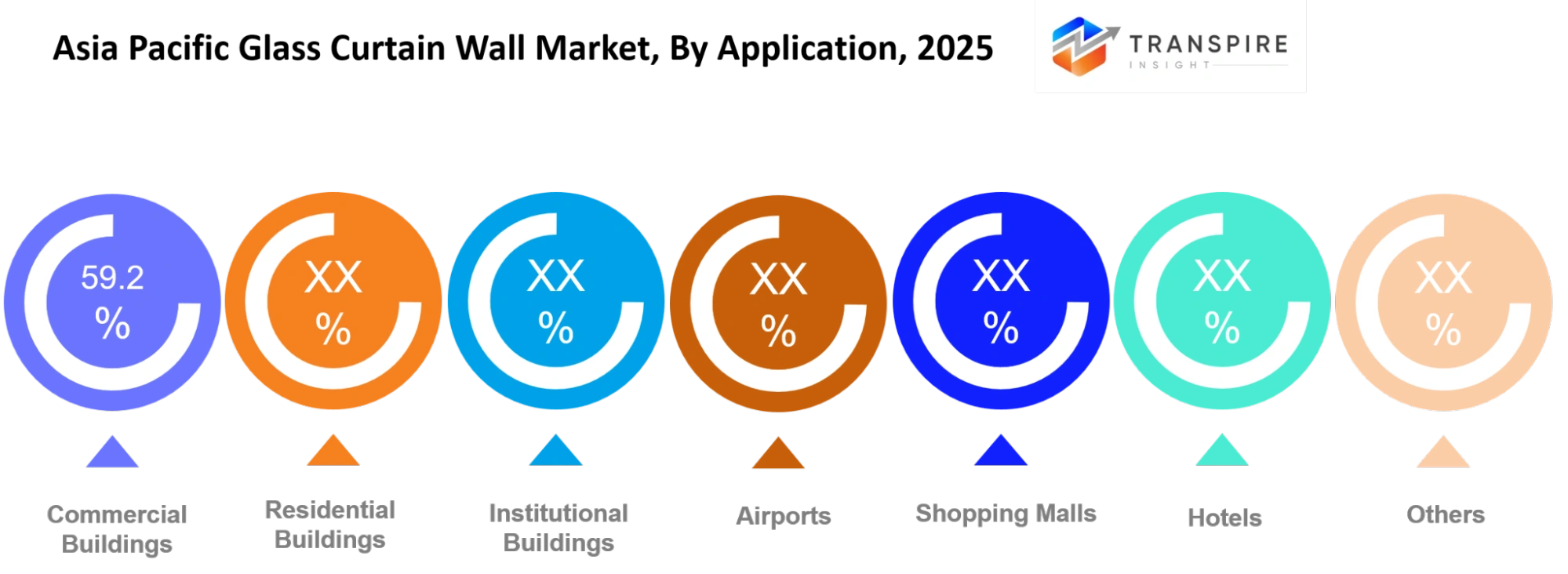
- Commercial office buildings accounted for almost 42% of applications in 2025 and have gained traction due to substantial investment in premium business centers and mixed-use developments.
- Airport terminals, hospitals and institutional buildings are the fastest-growing application segments throughout the forecast period on the back of enhanced public infrastructure investments.
- Commercial real estate developers were the leading end user with almost 55% of market share in 2025 owing to premier office and retail developments.
- Public infrastructure authorities are predicted to be the fastest growing end user segments through 2033 as governments continue to prioritize the development of civic buildings
What are the Key Drivers, Restraints, and Opportunities in the Asia Pacific Glass Curtain Wall Market?
Leading the way will be the increased stringency of energy efficiency regulations and green construction standards throughout the key Asia Pacific markets. Today, designers will specify high-performance glazing at the beginning of the design phase, as compliance is a contractual mandate not an upscale choice. Reduced cooling loads in buildings contribute to lower operating costs over the lifecycle of the building, offsetting premium pricing and improving project returns. Higher incidence rates for insulated glazing, unitized systems and smart glass offer increased revenue streams in both new build and retrofit segments.
Still the largest restraint is volatile input material prices and the reliance on specialized façade elements that require lengthy qualification periods. Supply chain consolidation presents the biggest risk in implementation, according to a review by Transpire Insight of announcements in procurement and product launch across the region. The local supply side is limited because it requires substantial capital expenditure, certification, and training to create new production capabilities; any lead time delays are detrimental to commercial completion schedules, contractor margins, and timely façade installation which leads to annual revenue being postponed in several construction projects.
The future phase will emerge from the introduction of intelligence within façades that can be tied to digital buildings. Electro-chromic glazing, sensors and digital twins will allow for on-going optimization post installation; the considerable investment in smart districts in India and Southeast Asia create optimal circumstances for deployment. Corporations that offer a blended solution of smart glass and software-driven building systems are best positioned to achieve premium value contracts, in addition to sustained service contracts.
What Has the Impact of Artificial Intelligence Been on the Asia Pacific Glass Curtain Wall Market?
The architectural faade development process is being enhanced through artificial intelligence (AI) and digital engineering tools that improve the accuracy of design, execution of project, and building performance over the life of the asset.AI-enhanced building information modeling (BIM) systems can automate checks for faade geometry, thermal performance, daylighting and structural loads prior to manufacture, thereby decreasing engineering redesigns and material waste. Machine learning (ML) models can predict glass and aluminum consumption through analyzing project pipeline, purchasing cycles, and prior construction activity to help manufacturers better balance production capacity with inventory availability. Once buildings are in service, smart monitoring systems can analyze sensor data for thermal issues,seal failure,and unanticipated movement, allowing for predictive maintenance rather than reactive repair.
Such system enhancements increase operational efficiency, decrease maintenance planning cycles and reduce life cycle cost, while providing increased facility to monitor compliance with emerging building performance targets.
Digital quality control via computer vision further contributes to accuracy and documentation during construction for intricate high-rise projects. Adoption has been slowed, however, by prohibitively high initial integration costs, coupled with unreliable data in older commercial buildings, and by building's inability to accommodate sensors and electronic records, which limits AI model performance and full adoption in the regional architectural glass industry.
Key Market Trends
- Unitized curtain wall systems have been taking share since 2023 as faster installation and lower on site labor requirement has been emphasized by contractors.
- Low-emissivity and triple-insulated glazing adoption have been accelerated since the updating building efficiency codes became stronger in China, Singapore and Australia.
- India: Biggest growth construction market since 2024 by booming commercial office development and robust investment into public infrastructure investmentKey.
- Manufacturers have already fast-tracked investment into their regional production centres between 2024-2026 to not be reliant on imports, and to gain supply redundancy and to secure supply within regions.
- BIM application is becoming the norm in luxury commercial projects to ensure coordination between facade design, fabrication and installation.
- Electrochromic and smart glazing technology are expanding from flagship developments into mainstream commercial projects by 2033 as life-cycle cost-benefit becomes more obvious for investment decision making.
- Manufacturers are increasingly integrating facade engineering and digital monitoring platforms as differentiated value offerings besides conventional products supply.
- Carbon reporting mandates are pushing architects to use recyclable aluminum frames and lower-carbon glass manufacturing processes for new projects.
- Saint-Gobain, AGC, and YKK AP continue to strategically grow through facility upgrades, technology investment and local partnerships to strengthen competitive edge.
Asia Pacific Glass Curtain Wall Market Segmentation
By Product Type :
Stick Curtain Wall System continues to maintain its position in supporting projects with flexibility during on-site construction, modification, and design. Unitized Curtain Wall System is the popular choice for large commercial building projects due to its efficient installation and assembly. The semi-unitized Curtain Wall System, offers balance between onsite flexibility and speedy erection for medium to large buildings.Structural Glazing Curtain Wall System has emerged to address the needs for contemporary architectural designs where visual purity in external finishes, expansive glass surfaces are essential.
Double Skin Curtain Wall System helps enhance energy efficiency and improved thermal regulation, suitable for premier office buildings and green construction projects. Other products address specific architectural requirements where special shapes, materials or technical engineering aspects play a role. With ongoing investment in high rise projects, commercial developments and public infrastructures, an increasing number of architects and contractors will leverage sophisticated curtain wall technology. The decision on the right system selection will be dictated by installation speed, project size, maintenance requirements and lifecycle costs.
By Material :
Still, Aluminum is popular for large-scale projects that need lightweight, weather-resistant, and easy-to-manufacture construction solutions. And Glass takes prominence as natural light gains access to buildings with an improved aesthetic from outside and a higher degree of comfortable living inside. Steel is generally used for stronger building foundations as it’s crucial for taller structures with specific design constraints.Properties remain consistent for thermal resistance and prolonged service life.
Whereas the Composite materials’ acceptability increases thanks to their lightness and thermal resistance benefits which contributes in energy reduction while offering structural solidity to buildings. Other materials cover building requirements that revolve around resistance against environmental exposure, cost reductions, or exclusive finishing elements. And more specifically, in construction methods where recyclable or energy-saving properties are highly recommended for new construction projects. We should expect a considerable evolution for materials which could make buildings much more performance-oriented whilst satisfying modern architecture aesthetics.
By Application :
In commercial buildings, demand is driven by high-rise offices, business parks, and multi-purpose buildings needing sleek designs with the performance that modern curtain wall systems provide. Modern curtain wall systems have gained traction in the housing sector as developers focus on developing high-rise residential buildings in urban areas that prioritize look and feel, sunlight access, and better thermal comfort and energy efficiency. Hospitals and universities-both examples of institutional buildings-are deploying cutting-edge facade solutions to enhance longevity and lower maintenance costs in the future.The strong level of investment in publicly owned projects remains positive in key city markets.
Airports, malls, and hotels also seek large, transparent facade solutions that offer an open feel, maximize natural light and enhance overall occupant experience. Cultural facilities, exhibition centres, and entertainment sites also value their architectural qualities. Ultimately, owners want to improve their building’s energy efficiency, occupant comfort, and its exterior look, with sustained future demand across these application sectors.
By End User :
Construction companies comprise one of the primary end-user groups, due to large scale projects requiring efficient construction completion and stable facade installation. Real estate developers are investing in up market commercial & residential buildings which will require modern facade solutions in order to enhance the marketability and the overall value of the building. Government projects comprise a reliable source of demand for construction of public buildings such as institutions, educational facilities, transportation centers, public works etc, while maintaining a focus on adequate planning and required specifications.The decision to purchase building materials for these types of projects relies on adequate planning and quality standards.
Commercial property owners invest in efficient buildings and facades with lower operational costs and higher tenant satisfaction, while investors in industrial properties and specific facilities require specific facade solutions for their projects, with considerations for lower long term maintenance costs and building efficiency and environmental impact. Future construction growth within urban areas will maintain stability for all categories of end users.
By Glazing Type :
Single glazing will still be appropriate for developments where initial capital expenditure is more important than energy efficiency performance. Double glazing will continue to be used in many schemes as the inherent better insulation, acoustic performance, and lower energy consumption characteristics are increasingly aligned with building codes and sustainability requirements. Triple glazing has gained considerable traction on higher-value schemes where temperature control and indoor environment are more important.As new building performance standards become stricter, it will become increasingly common on projects as they will influence the choice of glazing.
Low-E glass has also attracted interest, the unique properties of the coatings block and reflected heat from entering while still letting daylight through so building running costs is also a consideration in terms of reduced energy demand. In addition there are specialist glasses for specific applications for instance privacy, security, decoration or unique operating environmental conditions. Building legislation and the push to meet global climate change targets is likely to drive further uptake of innovative glazing systems in the next few years. We will also need to evaluate the upfront costs of construction vs long term energy saving, together with occupant satisfaction.
What are the Key Use Cases Driving the Asia Pacific Glass Curtain Wall Market?
Commercial office towers will lead the way because business districts in most developing nations continue to look for visual appearance of buildings and daylight opportunities, together with higher building performance. Construction contractors and real estate developers account for the largest share as luxury commercial developments continue to demand sustainable, efficient building faade systems to maximize the value and operational efficiency. The use in luxury housing high rise developments, as well as hotel applications, are growing as these properties also recognize the benefits of high performance building envelope systems in order to create better visual effect and indoor conditions.
The construction and redevelopment of educational facilities, as well as medical centers and hospitals, will also provide a solid and continuous market as these structures require more energy efficient building design.
Future opportunities are appearing in the smart public infrastructure market, in the green building retrofit projects. More and more of governments’ entities are seeking opportunities to revamp old buildings and replace them with efficient buildings. Owners of existing buildings looking for a high-performance solution for renovations will be investing in building facade systems.
|
Report Metrics |
Details |
|
Market size value in 2025 |
USD 22.3 Billion |
|
Market size value in 2026 |
USD 24.2 Billion |
|
Revenue forecast in 2033 |
USD 42.5 Billion |
|
Growth rate |
CAGR of 8.38% from 2026 to 2033 |
|
Base year |
2025 |
|
Historical data |
2021 - 2024 |
|
Forecast period |
2026 - 2033 |
|
Report coverage |
Revenue forecast, competitive landscape, growth factors, and trends |
|
Regional scope |
Asia Pacific (India, China, Japan, Australia, South Korea, Rest of Asia Pacific) |
|
Key company profiled |
Schüco, Saint-Gobain, AGC Inc., Nippon Sheet Glass, Guardian Glass, YKK AP, Jangho Group, Permasteelisa, Kawneer, China Glass Holdings, Vitro Architectural Glass, Apogee Enterprises, Oldcastle BuildingEnvelope, Central Glass, CSR Limited. |
|
Customization scope |
Free report customization (country, regional & segment scope). Avail customized purchase options to meet your exact research needs. |
|
Report Segmentation |
By Product Type (Stick Curtain Wall, Unitized Curtain Wall, Semi-Unitized Curtain Wall, Structural Glazing, Double-Skin Curtain Wall, Others); By Material (Aluminum, Glass, Steel, Composite Materials, Others); By Application (Commercial Buildings, Residential Buildings, Institutional Buildings, Airports, Shopping Malls, Hotels, Others); By End User (Construction Companies, Real Estate Developers, Government, Commercial Property Owners, Others); By Glazing Type (Single Glazing, Double Glazing, Triple Glazing, Low-E Glass, Others). |
Which Regions are Driving the Asia Pacific Glass Curtain Wall Market Growth?
Dominating the market East Asia holds an estimated regional revenue share of around 45%. Urban redevelopment, green building requirements, and high-rise construction efforts by government initiatives are boosting broad faade application across leading urban centres. An integrated region with a well-established glass manufacturing capacity, a network of suppliers, construction companies, and aluminium formulators will support steady and continued regional dominance, spurred on by ongoing commercial development and investment into new transport infrastructure.
Southeast Asia continues a more diversified structural growth trajectory driven by steady urbanization trends, investment balanced across residential, mixed use, and commercial property sectors, and a reliable supply chain backed by sound policies and foreign investment flows.
Ongoing urban development, commercial expansion and government infrastructure programs will result in sustainable demand from both construction companies and commercial real estate operators. Fast-developing South Asia will prove the fastest-growing regional market as swift urban expansion initiatives and government infrastructure programs stimulate demand for contemporary building solutions, such as Smart City projects, Airports, andMetrolines, and public and commercial construction will be strengthened by green building regulations and a focus on building efficiency. The years 2026 to 2033 in the region are expected to present an inviting climate for business growth.
Who are the Key Players in the Asia Pacific Glass Curtain Wall Market and How Do They Compete?
The market remained moderately fragmented, with global faade firms battling it out with regional manufacturers and engineering contractors in the commercial and infrastructure space. Key competitive factors include cost-effectiveness, engineering prowess, product quality, project delivery, and customized faade solutions. Major companies in the market are increasingly working on protecting market share through manufacturing facilities, technical expertise and strong client relationships.Meanwhile, Regional players are attempting to improve market share through the local manufacturing of components, faster completion times.
Key Companies to watch include: AGC Inc.AGC’s competitive strategy involves an increasing focus on advanced architectural glass with heavy emphasis on efficient glazing technology that meets building performance standards. Nippon Sheet Glass Co., Ltd. The company's competitive edge comes from its research capabilities, manufacturing scale and offering high-performance glass products suitable for huge construction projects around the world. Schco International KG The aluminum faade supplier of Schco aims at offering premium facade solutions to complex commercial structures in collaboration with designers, engineers, and contractors.
In doing so, Schco International KG’s competitive strategy involves increasing engineering expertise, building certification for systems and top quality of components.Saint-Gobain Saint-Gobain, a well known French company is increasing its sustainable glass offerings and capacity to achieve greater responsiveness and speed with regard to customer delivery to its partners in the construction industry. YKK AP Inc. The company offers integrated faade and window systems for commercial construction and seeks a solid balance of precision, manufacturing and reliable building installation processes.
The constant innovation and product development, strategic relationships with architects and builders, and entry in new and rapidly growing cities and regions are allowing these firms to enhance competitiveness and respond to modern trends in the building performance arena.
Company List
- Schüco
- Saint-Gobain
- AGC Inc.
- Nippon Sheet Glass
- Guardian Glass
- YKK AP
- Jangho Group
- Permasteelisa
- Kawneer
- China Glass Holdings
- Vitro Architectural Glass
- Apogee Enterprises
- Oldcastle BuildingEnvelope
- Central Glass
- CSR Limited
Recent Development News
In July 2025, AGC’s group company PT Asahimas Chemical obtained ISCC PLUS Certification for its Indonesian production facility. The certification expanded the company's portfolio of internationally certified sustainable materials, strengthening supply chain support for environmentally focused construction and façade projects across Asia Pacific.
Source: https://www.agc-asiapacific.com/
In November 2025, Glasstech Asia and Fenestration Asia organized the Asia Façade & Glass Conference with participation from companies including Asahimas, Schüco, Seele Singapore, Guardian Glass, and other façade specialists. The event strengthened industry partnerships and technology collaboration, supporting wider adoption of advanced curtain wall and façade solutions across the Asia Pacific construction sector.
Source: https://glasstechasia.com.sg/
What Strategic Insights Define the Future of the Asia Pacific Glass Curtain Wall Market?
In the five to seven years ahead, Asia Pacific Glass Curtain Wall Market should transition towards higher-value faade solutions capable of delivering on energy-saving benefits, seamless digital integration, and more stringent sustainability standards. Stricter building code mandates should emerge as the largest structural imperative while urban commercial investments and upscale, mixed-use building projects will continue to stimulate market demand. Lesser, but more volatile risks involve an increased reliance on aluminum, speciality glass, and imported coating chemicals, which could pose potential cost hikes and construction delays if trade disruptions occur or policies shift.
A nascent but growing opportunity lies in large-scale retrofit projects, targeting aging commercial buildings in particular and especially those where governments have introduced more aggressive carbon reduction and energy-saving initiatives.
Firms will bolster themselves to these emerging threats by bolstering their renovation expertise, securing diverse regional sourcing channels, and pursuing advanced glazing technologies that support future demands of both the new build and modernization sectors.
Asia Pacific Glass Curtain Wall Market Report Segmentation
By Product Type
- Stick Curtain Wall
- Unitized Curtain Wall
- Semi-Unitized Curtain Wall
- Structural Glazing
- Double-Skin Curtain Wall
By Material
- Aluminum
- Glass
- Steel
- Composite Materials
By Application
- Commercial Buildings
- Residential Buildings
- Institutional Buildings
- Airports
- Shopping Malls
- Hotels
By End User
- Construction Companies
- Real Estate Developers
- Government
- Commercial Property Owners
By Glazing Type
- Single Glazing
- Double Glazing
- Triple Glazing
- Low-E Glass
Frequently Asked Questions
Find quick answers to common questions.
The expected Asia Pacific Glass Curtain Wall Market size for the market will be USD 42.5 Billion in 2033.
Key segments for the Asia Pacific Glass Curtain Wall Market are By Product Type (Stick Curtain Wall, Unitized Curtain Wall, Semi-Unitized Curtain Wall, Structural Glazing, Double-Skin Curtain Wall, Others); By Material (Aluminum, Glass, Steel, Composite Materials, Others); By Application (Commercial Buildings, Residential Buildings, Institutional Buildings, Airports, Shopping Malls, Hotels, Others); By End User (Construction Companies, Real Estate Developers, Government, Commercial Property Owners, Others); By Glazing Type (Single Glazing, Double Glazing, Triple Glazing, Low-E Glass, Others).
Major Asia Pacific Glass Curtain Wall Market players are Schüco, Saint-Gobain, AGC Inc., Nippon Sheet Glass, Guardian Glass, YKK AP, Jangho Group, Permasteelisa, Kawneer, China Glass Holdings, Vitro Architectural Glass, Apogee Enterprises, Oldcastle BuildingEnvelope, Central Glass, CSR Limited.
The Asia Pacific Glass Curtain Wall Market size is USD 22.3 Billion in 2025.
The Asia Pacific Glass Curtain Wall Market CAGR is 8.38% from 2026 to 2033.
- Schüco
- Saint-Gobain
- AGC Inc.
- Nippon Sheet Glass
- Guardian Glass
- YKK AP
- Jangho Group
- Permasteelisa
- Kawneer
- China Glass Holdings
- Vitro Architectural Glass
- Apogee Enterprises
- Oldcastle BuildingEnvelope
- Central Glass
- CSR Limited
About the Authors

Pankaj Ghogare Patil
I am Pankaj Ghogare Patil, a Senior Research Analyst at Transpire Insight, specializing in the Pharmaceutical, Chemicals & Materials, Healthcare IT, and Biotechnology industry. My expertise lies in conducting comprehensive market research, analyzing industry trends, evaluating competitive landscapes, and translating complex data into actionable insights. At Transpire Insight, I closely follow emerging technologies, regulatory developments, and market innovations to create accurate, well-researched, and informative content that helps businesses and professionals make informed decisions. I am committed to producing credible, evidence-based articles that reflect industry best practices while making technical topics accessible and valuable for a broad audience.

Chakradhar Khansole
Chakradhar serves as the Research Director at Transpire Insight, bringing over 8 years of experience in technology, innovation, and strategic market intelligence. He specializes in transforming complex market data into actionable business insights that enable organizations to make informed, growth-oriented decisions. Recognized for his strategic vision and analytical expertise, Chakradhar leads high-impact research initiatives, delivering comprehensive market assessments, competitive intelligence, and forward-looking industry analysis.
Recently Published Reports
-
May 2026
Healthcare Polymer Packaging Market
Healthcare Polymer Packaging Market Size, Share & Analysis Report By Packaging Type (Syringes, IV Bottles and Pouches, Clamshells, Blisters, Bottles & Jars, Containers, Tubes, IV Parental Packaging, Others), By Type (Regulated, Non-regulated), By Polymer Type (LDPE (Low-Density Polyethylene), HDPE (High-Density Polyethylene), Homo-polymer (Homo), Random Copolymer (Random), Block Copolymer (Block), PET, Polystyrene, Polyvinyl Chloride, Polyamide/EVOH, Others), and Geography (North America, Europe, Asia-Pacific, Middle East and Africa, South and Central America), 2021 - 2031
-
Apr 2026
Hydrophilic Tape (Waterstop) Market
Hydrophilic Tape (Waterstop) Market Size, Share & Analysis Report By Type (Bentonite-Based Hydrophilic Tape, Rubber-Based Hydrophilic Tape), By Application (Residential Buildings, Commercial Buildings, Infrastructure Projects), and Geography (North America, Europe, Asia-Pacific, Middle East and Africa, South and Central America), 2021 - 2031
-
Apr 2026
Metalens Market
Metalens Market Size, Share & Analysis Report By Type (Visible Light Metalens, and Infrared Metalens), By Application (Consumer Electronics, Automotive Electronics, Industrial, Medical, and Others), and Geography (North America, Europe, Asia-Pacific, Middle East and Africa, South and Central America), 2021 - 2031
-
Apr 2026
PBT Resin Market
PBT Resin Market Size, Share & Analysis Report By Type (Reinforced PBT Resin, Unreinforced PBT Resin), By Processing Method (Injection Molding, Extrusion, Blow Molding, Others), By End-User (Automotive, Electrical & Electronics, Consumer Appliances, Industrial Machinery, Medical Devices, Packaging, Others), and Geography (North America, Europe, Asia-Pacific, Middle East and Africa, South and Central America), 2021 - 2031