

Asia Pacific Gaming Market Summary
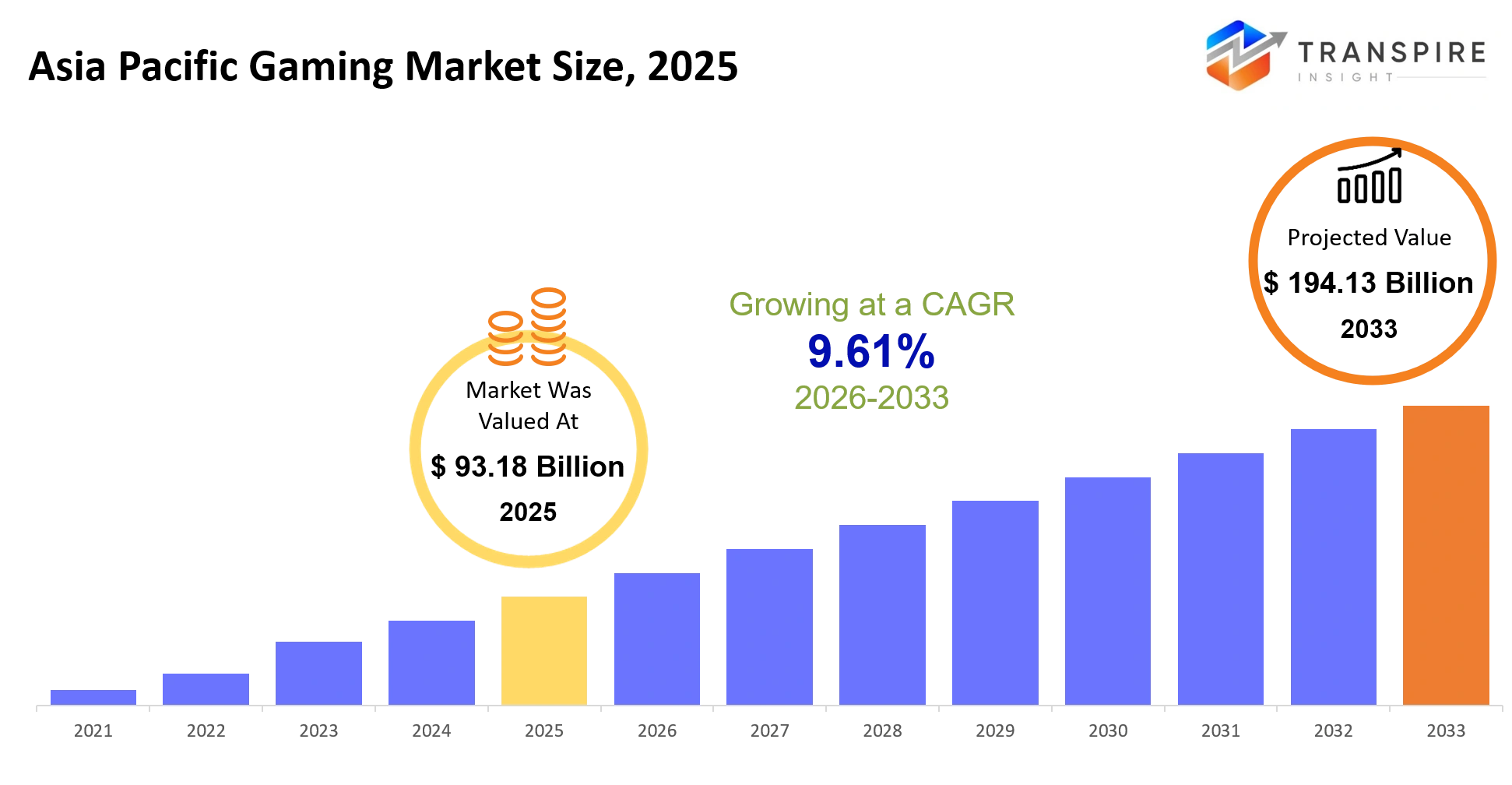
As per Transpire Insight Analysis the Asia Pacific Gaming Market size is estimated at USD 93.18 Billion in 2025 and is anticipated to reach USD 194.13 Billion by 2033, growing at a CAGR of 9.61% from 2026 to 2033.
The Asia Pacific Gaming Market keeps digital entertainment going, across smartphones, PCs, consoles,and even cloud platforms, so customers get more interactive moments while publishers, developers , advertisers and esports orgs can keep earning recurring revenue streams from game sales , subscriptions, in-game purchases and live services. In the past five years , things started to move away from one-off purchases, and more toward ongoing content delivery that relies on live operations, cross platform play,and cloud delivery. The COVID-19 pandemic basically worked like a big catalyst, it sped up digital downloads, boosted online multiplayer participation ,and pushed virtual social interaction. Even when travel limits eased, player habits just stayed kinda altered. Because of that , a lot of developers leaned into longer term retention moves rather than only doing standalone releases, which ends up smoothing revenue a bit, you know. Meanwhile the rollout of 5G networks, stronger regional development pipelines,and more localized content, have widened the circle of who can play and what they can enjoy. This lets companies scale their monetization playbooks across different markets while still keeping steady investment flowing into both premium and free-to-play gaming ecosystems.
Asia Pacific Gaming Market Size & Forecast:
- Asia Pacific Gaming Market Size 2025: USD 93.18 Billion
- Expected Market Value 2033: USD 194.13 Billion
- Forecast CAGR: 9.61%
- Leading region in 2025: China
- Fastest Growing region: India
- Key Profile: Tencent, Sony Interactive Entertainment, Nintendo, Microsoft Xbox, NetEase, Krafton, Bandai Namco, Electronic Arts, Ubisoft, Nexon, Garena, miHoYo (HoYoverse), Square Enix, Sega, NCSoft
Key Market Insights
- China kind of dominated the Asia Pacific gaming industry in 2025, with around 43% market share—mostly because the mobile ecosystem was already mature and the domestic publishing ability stayed strong, and yeah it helped a lot.
- India is expected to grow the quickest across 2025–2033. That’s tied to affordable phones, more 5G coverage, plus digital payment adoption, which makes gameplay purchases easier and more frequent.
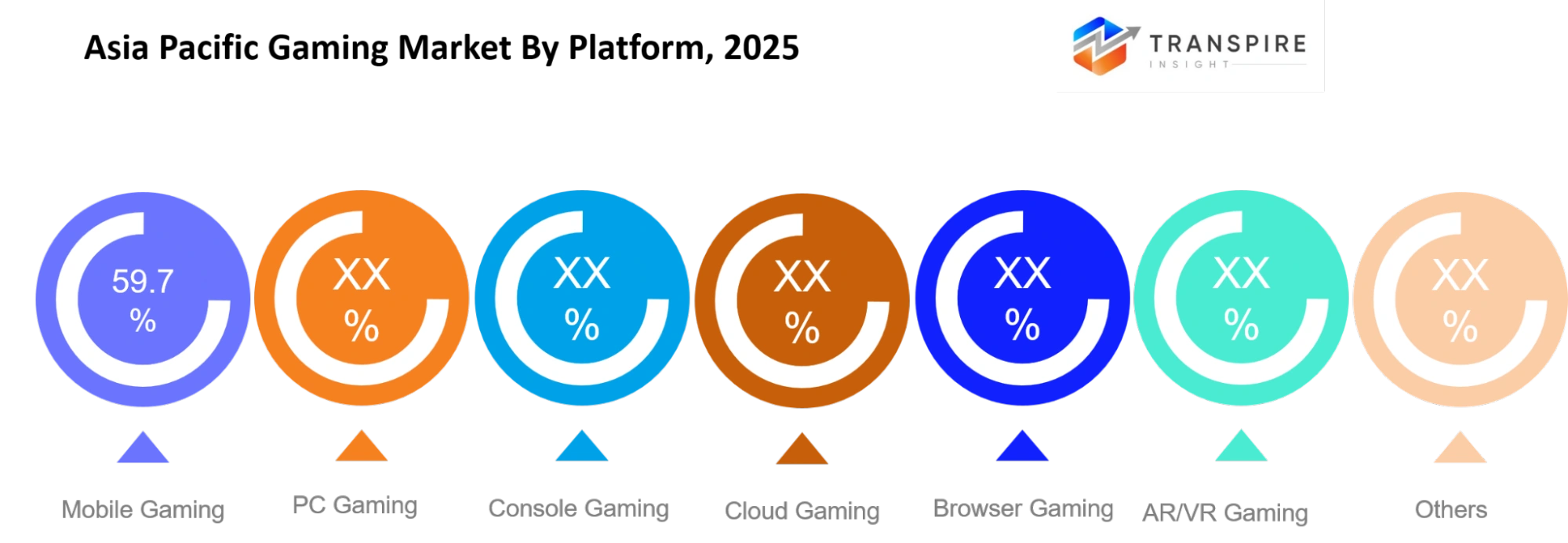
- For products, mobile gaming kind of led the whole segment, taking roughly 58% market share in 2025, and yeah it felt like the main driver. Publishers leaned harder into free to play monetization and also kept rolling out live content updates almost constantly, like day after day.
- PC gaming stayed as the second biggest slice, mainly because esports participation and premium multiplayer titles kept pulling in a loyal community, especially across China, and South Korea too.
- Cloud gaming services are projected to grow at the fastest pace through 2033. The reason is low-latency networks, plus subscription driven gaming platforms, so users can jump in without much friction.
- On applications, entertainment and casual gaming were the top demand drivers with about 67% market share in 2025. This was bolstered by live-service stickiness, and creator-led communities too, they really pull users in.
- Esports and competitive gaming are set to remain the fastest-growing application category across the forecast period, as spending on tournaments and sponsorships keeps expanding, and not slowing down.
- When it comes to end users, individual consumers held the leading share, near 91% in 2025. That figure basically reflects how widespread smartphone and console ownership is across the region.
- Looking further ahead, professional esports organizations, and gaming enterprises are expected to become, kind of the fastest growing end user group by 2033, mostly because commercial leagues keep expanding and the whole tournament ecosystem gets more organized.
What are the Key Drivers, Restraints, and Opportunities in the Asia Pacific Gaming Market?
Market expansion is mostly driven by a bit of a shift to mobile-first digital entertainment, mostly because 5G is getting everywhere, smartphones are far more affordable, and digital payments are built in. With faster connectivity now, players get smoother high-quality multiplayer sessions, and cloud based gameplay feels more normal without needing premium hardware. At the same time, publishers are not just dropping a game and calling it done, they’re putting out games as long term services instead, kinda like ongoing ecosystems that don’t really stop. They do continued updates for fresh content, so players stay longer, and that usually helps boost recurring revenue, via subscriptions, battle passes, and purchases inside the game.Because of that setup, studios tend to invest more, both in development work and in regional publishing teams, pretty consistently.
The biggest structural brake is still the patchwork regulation across the major Asia Pacific markets, especially around game approvals, monetization limits, and youth gaming rules. Requirements aren’t only different by country, they also shift pretty often. So developers end up having to localize content, adjust monetization mechanics, and then complete separate approval tracks before anything launches. All of this causes delays that push back commercial releases, and it also weakens revenue chances right during those important launch windows. Also, in a Transpire Insight style review of regional procurement announcements and launch timing, supply chain concentration looks like the main execution risk. On top of that, limited semiconductor supply, plus cloud infrastructure being concentrated in fewer places, tends to slow hardware expansion and makes platform scaling harder.
Artificial intelligence, cloud native game development, and regional investment into immersive technologies kinda line up as the clearest opportunity for the next growth phase. AI assisted content creation can reduce development cycles, and then personalized recommendations make player engagement go up, not just a little. Big investments in cloud infrastructure across India and Southeast Asia really set the stage so streaming high performance games becomes more practical. Also cross platform ecosystems, mixed reality experiences, and creator driven gaming communities will kind of unlock new monetization ways beyond the older traditional software sales model.
What Has the Impact of Artificial Intelligence Been on the Asia Pacific Gaming Market?
Artificial intelligence is kind of reshaping the Asia Pacific gaming ecosystem, by automating player behavior analysis , fraud detection, moderation of in-game communication, and dynamic content management. AI systems keep monitoring gameplay patterns to spot cheating, tune multiplayer environments, and support player retention without so much manual effort. Publishers also tend to automate customer support with conversational AI, so response times go down while operating costs get smaller too.
Machine learning models then forecast player engagement, spending behavior, and server demand by using historical gameplay data. With these predictive abilities, developers can optimize event timing, distribute cloud resources in a more efficient way, and tailor offers before user activity starts to fall off. AI-driven analytics also help with game balancing, suggest content updates, and make matchmaking more accurate, which results in stronger engagement and steadier monetization. Digital technologies, like cloud computing and edge infrastructure, further reduce latency and enable cross-platform experiences across smartphones , PCs, and consoles.
Operational efficiency has improved a lot through automated testing, quicker content rollouts, and real-time monitoring of live service games, which helps publishers lower maintenance costs while keeping uptime and service reliability higher. Still, widespread AI adoption hits limits. Integration costs can be high, player data gets fragmented across platforms , privacy rules complicate things, and inconsistent data quality reduces how accurate the models are. Smaller studios, in particular, often don’t have the infrastructure or specialized expertise needed to deploy advanced AI at commercial scale. This slows adoption even if the long-term benefits are pretty clear.
Key Market Trends
- By 2025, mobile gaming kind of moved away from just casual fun into the main revenue engine, mostly because in-game monetization got stronger, and regional payment integration was smoother too.
- Cloud gaming adoption really picked up after 5G rolled out everywhere, so streaming with high performance became possible even without premium gaming hardware, especially in newer markets.
- From 2023 up to 2026, AI-driven personalization grew a lot, and it helped keep players around with adaptive suggestions, and also smarter matchmaking , like it learned what people were likely to enjoy next.
- At the same time, big publishers started doing cross-platform launches more often, so gameplay could stay in sync across phones, PCs and consoles, while also widening the audience that can actually be reached.
- India also popped up as a key development hub after 2024, and that came along with more gaming studios, more esports investment, and upgrades in digital infrastructure.
- Tencent, NetEase, and Garena upped their spending on regional live-service titles, and they extended game lifecycles through ongoing seasonal updates plus premium digital content.
- Subscription based gaming services got noticeably stronger competitively, since publishers bundled exclusive items, cloud access, and multiplayer benefits into recurring revenue patterns.
- Between 2024 and 2026, esports sponsorship spending spread across Southeast Asia, and that pulled in non-endemic brands too, basically into the competitive gaming ecosystems.
- Finally, developers leaned more into localization , like languages and local payment choices, which improved both player acquisition and monetization across culturally diverse Asia Pacific markets.
Asia Pacific Gaming Market Segmentation
By Platform :
Mobile gaming still seems to take the top slot, mostly because smartphones remain the most reachable device for play across a lot of countries. Low cost mobile internet, smoother digital payment services and regular content drops keep players busy, or at least coming back. On top of that, developers often push live events plus seasonal stuff, so the money stream stays fairly steady during the whole year… not always the same, but close.
PC gaming keeps a solid foothold too, mainly via competitive franchises, online multiplayer, and dedicated communities that feel a little more committed. Console gaming leans on premium exclusive releases and the fact that digital storefronts keep getting bigger and easier to use. Cloud gaming is also getting more attention, since high speed connectivity keeps improving in more places. Meanwhile browser games, AR/VR gaming, and other options can serve smaller groups by offering more specialized play styles, and that ends up adding variety to how platforms are adopted across the regional industry.
By Genre :
Action games bring in the most revenue, mostly because the gameplay is fast paced, there’s head to head multiplayer, and the ongoing updates sort of keep people around in longer sessions. Adventure games, and role-playing titles still attract players too, they want a bit more story depth and real character growth, like progression that feels meaningful in a straightforward way.Plus, frequent downloadable content stretches the lifespan of a game and usually helps with retention, even when players start wavering a bit.
Strategy and sports games hold strong popularity in esports circles and among competitive players. Simulation and casual categories pull in a broader crowd, since the mechanics are simpler and can fit different ages or different play routines. Other genres also keep moving forward, especially when independent developers deliver new ideas, localized content, and slightly different expectations for regional audiences, so adoption doesn’t stall, even when trends shift.
By Revenue Model :
Free-to-play is still the main revenue model, mostly because jumping in without any upfront payment brings in a bigger crowd of players. In-game purchases make up a lot of the earnings via cosmetic items, battle passes, and virtual goods which can meaningfully boost player involvement or immersion. Also, regular content drops seem to keep pushing spending along, more like a steady stream rather than a single big purchase and done.
Premium games keep doing well too, especially with people who want the full experience right away, usually with strong production quality. Subscription services are also growing, since publishers bundle huge collections of games into recurring payment structures. Then there’s advertising and other revenue streams , which often help mobile titles create extra income while still not forcing players out of the game itself.
By End User :
Casual gamers are the biggest end-user group, because mobile devices make play easier during everyday routines. Adults are the largest spending slice, driven by purchases, subscriptions, and premium content across multiple platforms. Broad accessibility keeps expanding participation, including across different income groups and locations, which sounds simple but it really moves the numbers.
Professional gamers and esports players keep growing as organized tournaments, sponsorship arrangements, and streaming platforms open up commercial pathways. Children remain a notable audience for family-friendly games, helped by parental controls and educational themes. Other end-user groups also shape the market in different directions, with niche tastes and community-led involvement that makes the whole space feel more varied.
By Device :
Smartphones kind of dominate the way people use devices, because they’re portable , reasonably priced, and they have those huge application stores so gaming can reach a broad group of consumers. At the same time there are continuous upgrades in the processors, the screens and the battery efficiency which more and more allow advanced game experiences. Mobile devices also seem to get solid developer attention and quick software upgrades, so it feels like things keep moving.
PCs still pull in enthusiasts who want top tier graphics and competitive gameplay, and that’s a steady reason they’re not going anywhere. Consoles stay relevant too, mostly since they offer premium exclusive titles and those limited releases. Tablets as well as smart TVs broaden the gaming reach through bigger displays and a connected entertainment environment. And then there are other devices that enable specialized forms of play, which opens extra opportunities for hardware manufacturers and software creators.
What are the Key Use Cases Driving the Asia Pacific Gaming Market?
Mobile gaming is still the main thing, honestly because publishers go for the biggest pool of casual players that already carry smartphones around. Telecom operators , digital payment providers, and game studios help that whole setup by keeping connectivity stable, offering localized payment ways, and pushing new content over time. It kinda keeps people coming back, for a long run.
At the same time, competitive esports and cloud gaming keep growing among pro players and organized tournament people. Media companies , sponsors, and streaming platforms put money into these options to pull in viewers, while educational institutions and training organizations are starting to lean on more structured gaming environments too, mostly for esports development tracks.
Then you have AI-driven personalized gaming and also immersive AR/VR applications, which look like the next wave, with real staying power. Enterprise training providers, retail entertainment spots, and location-based experience operators are experimenting with these ideas as device performance improves and the digital infrastructure keeps spreading through the region.
|
Report Metrics |
Details |
|
Market size value in 2025 |
USD 93.18 Billion |
|
Market size value in 2026 |
USD 102.13 Billion |
|
Revenue forecast in 2033 |
USD 194.13 Billion |
|
Growth rate |
CAGR of 9.61% from 2026 to 2033 |
|
Base year |
2025 |
|
Historical data |
2021 - 2024 |
|
Forecast period |
2026 - 2033 |
|
Report coverage |
Revenue forecast, competitive landscape, growth factors, and trends |
|
Regional scope |
Asia Pacific (India, China, Japan, Australia, South Korea, Rest of Asia Pacific) |
|
Key company profiled |
Tencent, Sony Interactive Entertainment, Nintendo, Microsoft Xbox, NetEase, Krafton, Bandai Namco, Electronic Arts, Ubisoft, Nexon, Garena, miHoYo (HoYoverse), Square Enix, Sega, NCSoft . |
|
Customization scope |
Free report customization (country, regional & segment scope). Avail customized purchase options to meet your exact research needs. |
|
Report Segmentation |
By Platform (Mobile Gaming, PC Gaming, Console Gaming, Cloud Gaming, Browser Gaming, AR/VR Gaming, Others); By Genre (Action, Adventure, RPG, Strategy, Sports, Simulation, Casual, Others); By Revenue Model (Free-to-Play, Premium Games, Subscription, In-Game Purchases, Advertising, Others); By End User (Casual Gamers, Professional Gamers, Esports Players, Children, Adults, Others); By Device (Smartphones, PCs, Consoles, Tablets, Smart TVs, Others) |
Which Regions are Driving the Asia Pacific Gaming Market Growth?
China makes up roughly 43% of the regional market, and it is still kind of the main country inside the Asia Pacific Gaming Market. There is a more organized game approval framework, plus advanced digital infrastructure, and a lot of 5G being rolled out, which together helped large-scale digital game distribution continue even though regulations sometimes get tweaked. Strong local publishers, cloud service providers, esports organizers, and payment platform operators all blend into one rather connected ecosystem, so game development and monetization can keep running. Also, high consumer spending, localized content creation, and ongoing investment in cloud gaming along with artificial intelligence should keep this leadership in place over most of the forecast window.
Japan, on the other hand, is the second biggest regional contributor, powered by a balanced mix of console, mobile, and premium game spending. Intellectual property protection remains steady, digital commerce rules stay consistent, and consumer buying habits are fairly resilient, so publishers and hardware manufacturers get relatively predictable conditions. There are long-running gaming brands, well seasoned development studios, and loyal player communities, which creates dependable income in multiple gaming categories, not just one. If the market keeps putting money into premium content, digital distribution, and international publishing partnerships, this should translate into steady long-term performance as well.
India should end up being the quickest regional market, since budget smartphones are getting more common and the nationwide 5G rollout keeps moving, plus digital payments keep widening access to gaming. In practice, a lot of momentum is also coming from fresh money going into digital infrastructure, startup financing, and esports work, so more players are joining in, in big cities and also in the newer, emerging areas. At the same time, localized game creation and government backing for digital innovation have made it easier for new commercial activity to grow all the way across the gaming ecosystem, not just one segment. Taken together, these kind of structural shifts will likely unlock appealing opportunities for publishers, cloud platform providers, and investors, who are looking to expand during the 2026–2033 period.
Who are the Key Players in the Asia Pacific Gaming Market and How Do They Compete?
Competition across the Asia Pacific Gaming Market is kinda moderately consolidated, where global publishers show up alongside strong regional developers and it can feel like everyone is moving at the same time. In most cases, technology innovation, exclusive content, live-service capabilities, and geographic reach stay the main competitive levers rather than price, even though people talk about pricing. Established publishers keep defending their market share using long-term player engagement approaches, and newer developers start pushing localized titles along with flexible monetization models, which seems to fit the rapidly expanding gaming communities better.
Tencent improves its competitive position with a huge portfolio of mobile and PC titles, and that is backed by cloud infrastructure plus artificial intelligence. Ongoing investment in live-service operations, combined with strategic studio partnerships, helps them ship updates quicker and keep players more engaged across multiple countries. NetEase, on the other hand, leans into cross-platform game development and global publishing collaborations, so international reach grows farther than the domestic market alone. Microsoft builds its presence by driving Game Pass subscriptions and cloud gaming features forward, giving broader access without forcing players to buy premium gaming hardware.
Sony Interactive Entertainment tends to focus on premium exclusive content, which in turn reinforces loyalty to the PlayStation ecosystem across Japan and other Asia Pacific markets. Nintendo keeps a different lane, built around family-oriented intellectual property and exclusive hardware integration, and that setup tends to stretch product lifecycles out longer. Garena boosts regional influence through localized publishing, esports tournaments, and consistent community involvement across Southeast Asia, so it can maintain stronger audience retention while still supporting long-term digital content monetization.
Company List
- Tencent
- Sony Interactive Entertainment
- Nintendo
- Microsoft Xbox
- NetEase
- Krafton
- Bandai Namco
- Electronic Arts
- Ubisoft
- Nexon
- Garena
- miHoYo (HoYoverse)
- Square Enix
- Sega
- NCSoft
Recent Development News
In May 2026, Tencent signed strategic partnership agreements with the Services Export Promotion Council (SEPC) and the Game Developer Association of India (GDAI). The three-year collaboration will invest more than ₹100 million in gaming talent development, startup support, and industry capability building, strengthening India's game development ecosystem.
Source https://www.tencent.com/
In April 2026, Sony Interactive Entertainment acquired Cinemersive Labs. The acquisition expands Sony's interactive entertainment capabilities and supports the development of more immersive gaming experiences across its PlayStation ecosystem.
Source https://sonyinteractive.com/
What Strategic Insights Define the Future of the Asia Pacific Gaming Market?
The Asia Pacific Gaming Market is slowly moving toward an ecosystem that relies on cloud-native delivery, artificial intelligence, and ongoing cross-platform play rather than just isolated, one-off game releases. This shift in how everything is built is going to be nudged forward by the continuing expansion of digital infrastructure, a bigger set of regional development capabilities, and business approaches that focus on recurring digital services, not only one-time purchases. There’s also a quieter danger that people tend to miss: more and more cloud infrastructure, game distribution, and even payment channels are getting concentrated among a small group of technology providers. That can raise operational dependence, and if regulations , or platform rules change, flexibility can shrink quite fast.
At the same time, there’s an emerging opening. Think AI-assisted game creation alongside localized content, especially in fast-growing places like India and Southeast Asia, where digital infrastructure is still improving. Players in the market can do well by putting money into regional development partnerships, widening their distribution pathways, and building proprietary intellectual property. This is a practical way to lower platform dependence while also supporting longer-term revenue durability.
Asia Pacific Gaming Market Report Segmentation
By Platform
- Mobile Gaming
- PC Gaming
- Console Gaming
- Cloud Gaming
- Browser Gaming
- AR/VR Gaming
By Genre
- Action
- Adventure
- RPG
- Strategy
- Sports
- Simulation
- Casual
By Revenue Model
- Free-to-Play
- Premium Games
- Subscription
- In-Game Purchases
- Advertising
By End User
- Casual Gamers
- Professional Gamers
- Esports Players
- Children
- Adults
By Device
- Smartphones
- PCs
- Consoles
- Tablets
- Smart TVs
Frequently Asked Questions
Find quick answers to common questions.
The expected Asia Pacific Gaming Market size for the market will be USD 194.13 Billion in 2033.
Key segments for the Asia Pacific Gaming Market are By Platform (Mobile Gaming, PC Gaming, Console Gaming, Cloud Gaming, Browser Gaming, AR/VR Gaming, Others); By Genre (Action, Adventure, RPG, Strategy, Sports, Simulation, Casual, Others); By Revenue Model (Free-to-Play, Premium Games, Subscription, In-Game Purchases, Advertising, Others); By End User (Casual Gamers, Professional Gamers, Esports Players, Children, Adults, Others); By Device (Smartphones, PCs, Consoles, Tablets, Smart TVs, Others).
Major Asia Pacific Gaming Market players are Tencent, Sony Interactive Entertainment, Nintendo, Microsoft Xbox, NetEase, Krafton, Bandai Namco, Electronic Arts, Ubisoft, Nexon, Garena, miHoYo (HoYoverse), Square Enix, Sega, NCSoft.
The Asia Pacific Gaming Market size is USD 93.18 Billion in 2025.
The Asia Pacific Gaming Market CAGR is 9.61% from 2026 to 2033.
- Tencent
- Sony Interactive Entertainment
- Nintendo
- Microsoft Xbox
- NetEase
- Krafton
- Bandai Namco
- Electronic Arts
- Ubisoft
- Nexon
- Garena
- miHoYo (HoYoverse)
- Square Enix
- Sega
- NCSoft
About the Authors

Mayur Shinde
I am Mayur Shinde, a Senior Research Analyst at Transpire Insight, specializing in the Automotive & Transportation and Information & Communication Technology (ICT) Industry. My work focuses on analyzing emerging market trends, technological advancements, competitive landscapes, and industry developments to deliver accurate, data-driven insights. I am passionate about transforming complex market information into clear, actionable content that helps businesses, professionals, and decision-makers stay informed and make confident strategic decisions.

Chakradhar Khansole
Chakradhar serves as the Research Director at Transpire Insight, bringing over 8 years of experience in technology, innovation, and strategic market intelligence. He specializes in transforming complex market data into actionable business insights that enable organizations to make informed, growth-oriented decisions. Recognized for his strategic vision and analytical expertise, Chakradhar leads high-impact research initiatives, delivering comprehensive market assessments, competitive intelligence, and forward-looking industry analysis.
Recently Published Reports
-
Apr 2026
3D Optical Profiler Market
3D Optical Profiler Market Size, Share & Analysis Report By Type (Desktop 3D Optical Profiler, and Portable 3D Optical Profiler), By Technology (Confocal Technology, and White Light Interference), By End-Use Industry (Manufacturing, Research Institutions, Automotive, Aerospace and Defense, Medical Devices, and Other), and Geography (North America, Europe, Asia-Pacific, Middle East and Africa, South and Central America), 2021 - 2031
-
Apr 2026
Depth Sensor Market
Depth Sensor Market Size, Share & Analysis Report By Type (Infrared Depth Sensors, Time-of-Flight (ToF) Sensors, Stereo Vision Sensors, Structured Light Sensors, Ultrasonic Depth Sensors), By Application (Automotive, Robotics, Gaming, Consumer Electronics, Industrial Automation, Healthcare, Security & Surveillance, Others), By End Users (Automotive Manufacturers, Consumer Electronics Companies, Healthcare Providers, Industrial Companies, Security Agencies, Gaming Companies, Robotics Companies, Others), and Geography (North America, Europe, Asia-Pacific, Middle East and Africa, South and Central America), 2021 – 2031
-
Apr 2026
Digital Manufacturing Market
Digital Manufacturing Market Size, Share & Analysis Report By Component (Hardware, Software, and Services), By Technology (Robotics, 3D Printing, Internet of Things (IoT), and Others), By Application (Automotive and Transportation, Aerospace and Defense, Consumer Electronics, Industrial Machinery, and Others), By Process Type (Computer-Based Designing, Computer-Based Simulation, Computer 3D Visualization, Analytics, and Others), and Geography (North America, Europe, Asia-Pacific, Middle East and Africa, South and Central America), 2021 – 2031
-
Apr 2026
Digital Visa Services Market
Digital Visa Services Market Size, Share & Analysis Report By Type (Individual Travelers, Group Travelers), By Application (Tourism, Business Travel, Others), and Geography (North America, Europe, Asia-Pacific, Middle East and Africa, South and Central America), 2021 – 2031