

Asia Pacific Fresh Vegetables Market Size & Forecast:
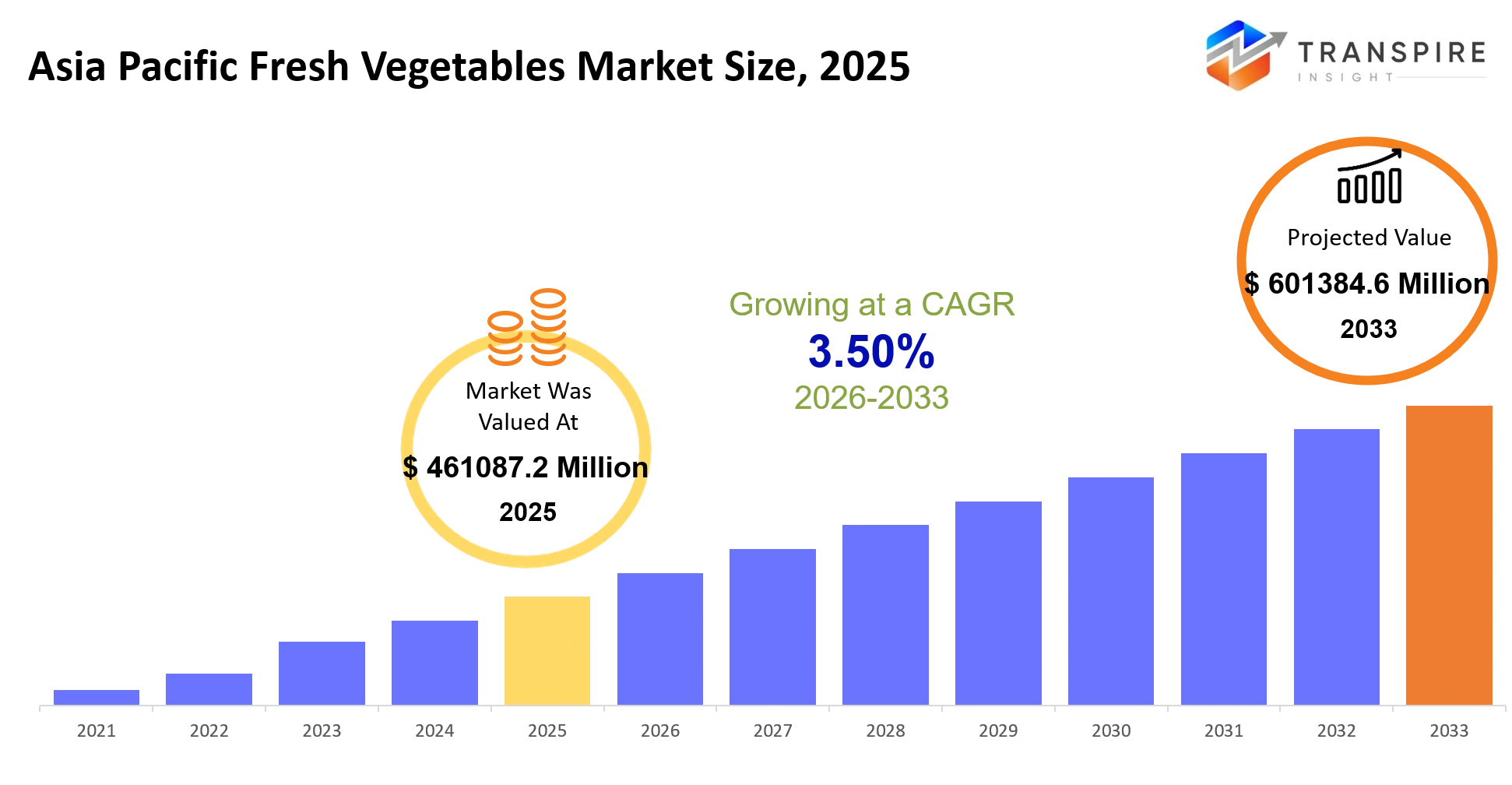
- Asia Pacific Fresh Vegetables Market Size 2025: USD 461087.2 Million
- Asia Pacific Fresh Vegetables Market Size 2033: USD 601384.6 Million
- Asia Pacific Fresh Vegetables Market CAGR: 3.50%
- Asia Pacific Fresh Vegetables Market Segments: By Product Type (Leafy Vegetables, Root Vegetables, Cruciferous Vegetables, Allium Vegetables, Legumes, Cucurbits, Exotic Vegetables, Others); By Distribution Channel (Supermarkets, Traditional Markets, Online Grocery, Convenience Stores, Wholesale Markets, Hypermarkets, Export Channels, Others); By Farming Type (Conventional Farming, Organic Farming, Greenhouse Farming, Hydroponics, Vertical Farming, Precision Farming, Urban Farming, Others); By End User (Households, Foodservice, Food Processing, Hospitality, Retail Chains, Exporters, Institutional Buyers, Others).
Asia Pacific Fresh Vegetables Market Summary
The Asia Pacific Fresh Vegetables Market was valued at USD 461087.2 Million in 2025. It is forecast to reach USD 601384.6 Million by 2033. That is a CAGR of 3.50% over the period.
The Asia Pacific Fresh Vegetables Market makes sure that people get vegetables all the time. It does this by taking care of things like getting the vegetables from farms, checking their quality, storing them in places and getting them to stores quickly. This way the vegetables stay good from the time they are picked until they are eaten in cities.
The Asia Pacific Fresh Vegetables Market has changed a lot in the five years. Now it uses systems for keeping vegetables cold and checking their quality. This is the old way of doing things, where different people did their own thing. What made this change happen was when the pandemic caused problems with getting food from one place to another. This showed that the old way was not working well especially when it came to handling vegetables by hand and storing them. So the people, in charge of getting vegetables from one place to another, started using computers to track things, keep the vegetables cold while they were moving and get them from one place.
This has made it easier to get vegetables for people. Has reduced the amount of vegetables that go bad. This means that the people who grow and sell vegetables have a stable income. It has also made big stores and restaurants want to buy vegetables in an organized way instead of just buying what they need at the moment. As the system gets better the Asia Pacific Fresh Vegetables Market will keep changing to make sure that vegetables get from farms to stores in an efficient way using computers and machines to help plan and organize everything.
Key Market Insights
- China had a share of the Asia Pacific Fresh Vegetables Market in 2025, almost 38% because it produces a lot of vegetables and has strong retail networks.
- India is expected to grow fast in this market until 2033 helped by more organized retail stores and better ways to get vegetables from farms to markets.
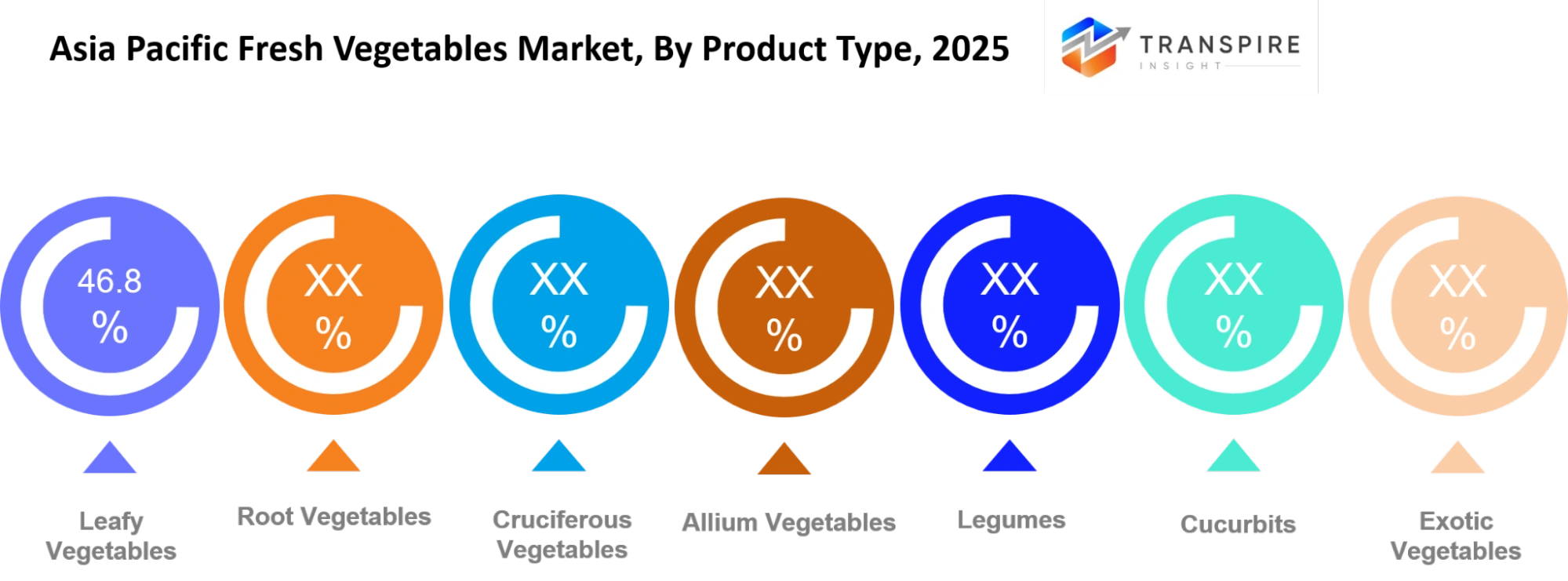
- Leafy vegetables were the most popular in 2025 making up over 40% of demand because people eat them a lot at home and restaurants buy them too.
- Root vegetables came in second, staying popular all year round because they are easy to store.
- Organic vegetables are becoming more popular fast from 2026 to 2033 as people want vegetables that are free from pesticides and have clear origins.
- Most vegetables, over 55%, were bought from stores in 2025 because supermarkets are expanding and offering packaged vegetables.
- More and more people are using vegetables for food processing like pre-frozen and ready-to-cook formats.
- Households still buy the vegetables but restaurants and fast food places are growing really fast because there are more of them.
- Companies, like Dole, Fresh Del Monte, Chiquita, Greenyard, Olam and Zespri are working on making their supply chains better. They are also investing in storage.The Asia Pacific Fresh Vegetables Market is starting to use technology to improve.
- They are using Artificial Intelligence or AI to predict demand.This helps them track vegetables from farms to stores.It reduces waste. Makes things more efficient.
What are the Key Drivers, Restraints, and Opportunities in the Asia Pacific Fresh Vegetables Market?
Driver
The main thing that is helping the Asia Pacific Fresh Vegetables Market is that stores are getting more organized. They have systems for keeping things. This is happening because city people want food. The government and private companies invested in trucks and storage. They also invested in ways to buy food from farms. Now the Asia Pacific Fresh Vegetables Market sells vegetables in a controlled way. This means the Asia Pacific Fresh Vegetables Market has vegetables going bad. The Asia Pacific Fresh Vegetables Market gets vegetables to the stores reliably. This means that the people who grow the Asia Pacific Fresh Vegetables Market vegetables, distribute the Asia Pacific Fresh Vegetables Market vegetables and export the Asia Pacific Fresh Vegetables Market vegetables can make money. They can sell the Asia Pacific Fresh Vegetables Market vegetables to places. They can also keep the Asia Pacific Fresh Vegetables Market vegetables fresh for longer.
Restraint
The biggest problem is that a lot of vegetables go bad after they are picked because the farms are small and the storage facilities are not good. This is an issue because a lot of the vegetables are still grown on small farms that do not have access to special storage and modern ways of getting the food to the stores. As a result a lot of the vegetables go bad before they can be sold which means that the market is not working well as it could and the people who grow and sell the vegetables are not making as much money as they could even though more people want to buy them.
Opportunity
One good thing that could happen is if farms and stores could work together better using technology to track the food and predict how much people will want to buy. Some companies are investing in platforms that connect farms directly with stores, especially in big cities where a lot of people buy vegetables. For example, using computers to predict how much people will want to buy and special trucks to keep the vegetables cold could mean that less food goes bad and the prices are more stable. This would make the whole system work better and mean that the people who grow, distribute and export the vegetables could make money. The Asia Pacific Fresh Vegetables Market would be more efficient and the people who sell the vegetables could make profits.
What Has the Impact of Artificial Intelligence Been on the Asia Pacific Fresh Vegetables Market?
Fresh vegetables are getting to us in a way because of artificial intelligence and digital technologies. These things are helping farmers make decisions about when to pick their vegetables and they are also helping with getting the vegetables from the farm to the store. Artificial intelligence is used on farms to check if the vegetables are ready to be picked, to find diseases and to make a schedule for picking. This means that we do not waste many vegetables and the ones we do get are better.
When it comes to getting the vegetables from the farm to the store artificial intelligence is helping with that too. It is making sure that the vegetables are kept cool and that they get to the store on time. Artificial intelligence is also used to guess how many vegetables people will want to buy in cities and in restaurants. This helps the people who sell the vegetables to have the amount so they do not have too many or too few.This means that the people who store the vegetables in coolers can sell them faster and they do not have to throw away as many. They can also keep the prices steady even when a lot of people want to buy vegetables. There are also tools that help make sure the vegetables are kept cool so they are safe to eat.There is a problem. It is very expensive to use intelligence on farms, especially for small farmers. A lot of farmers do not know how to use computers and the internet. They do not have the right information to make artificial intelligence work well. This means that not all farmers are using intelligence even though it could help them a lot. This is a problem in the Asia Pacific Fresh Vegetables Market, where a lot of farmers are growing vegetables.
Key Market Trends
- Since 2022 retail chains have increased their use of contract farming by 30 percent. They want to change how they buy vegetables from different places in urban markets.
- The cold chain infrastructure got much better after 2021. This means vegetables do not spoil much and it is easier to send them to places.
- In 2023 new websites and platforms came up. They allow farmers to sell vegetables directly to chains. This helps reduce the number of people between the farmer and the retail chain.
- After 2022 people started to want vegetables. This is because food safety rules got stricter. People want to eat vegetables without pesticides.
- Retail chains started using intelligence to guess how vegetables they will sell after 2023. This helps them not have vegetables they cannot sell.
- Food service operators like restaurants started buying vegetables after 2024. They want to buy vegetables that are already sorted and packed.
- Companies like Fresh Del Monte, Dole, Olam, Greenyard and Chiquita invested in storage. This helps keep their vegetables fresh.
- Small farmers started working in groups after 2021. This helps them get deals with chains and send vegetables more easily.
- Vegetable suppliers had to make changes after problems arose. Now they must show where their vegetables come from and that they are of quality.
- The Asia Pacific Fresh Vegetables Markets use technology to track vegetables in time. This helps them send vegetables to the place and not waste time and money.
Asia Pacific Fresh Vegetables Market Segmentation
By Product Type
The Asia Pacific Fresh Vegetables Market is led by vegetables like spinach, lettuce and cabbage. These vegetables are used in meals and are in high demand. People always need them and restaurants use them a lot too. Because they do not last long, stores have to get supplies all the time. As more people move to cities and more stores open the demand for vegetables will keep going up.Root vegetables like carrots, potatoes and radish are also popular. They can be stored for a time and can be used in many different ways. People use them for cooking at home. Restaurants use them too. Because they do not spoil easily it is easier to get them to stores. As storage systems get better more people will start selling these vegetables.
Some people are also starting to like vegetables like broccoli, garlic and other specialty vegetables. These vegetables are sold in high-end stores. They are popular with people who care about their health. As people learn more about how important it's to eat a variety of foods, the demand for these vegetables will keep going up. The Asia Pacific Fresh Vegetables Market will see people buying these high-value vegetables.
By Distribution Channel
Most vegetables in the Asia Pacific Fresh Vegetables Market are sold in supermarkets and hypermarkets. These stores get their vegetables from organized suppliers. Make sure they are always fresh. People like to buy vegetables from these stores because they're clean and convenient. As more cities get bigger these stores will keep selling vegetables.In some areas people still buy vegetables from markets. These markets are popular in areas where people can buy vegetables directly from farmers. The prices are flexible. People can get fresh vegetables every day. However as stores get more modern people will start to prefer them over markets.Some people are also starting to buy vegetables from stores that export them to other countries. Online stores make it easy to get vegetables delivered to your home and export stores make sure the vegetables are of quality. The Asia Pacific Fresh Vegetables Market will start to rely on online and export sales.
By Farming Type
vegetables in the Asia Pacific Fresh Vegetables Market are grown using conventional farming methods. This way of farming is good for producing a lot of vegetables at a cost. It helps supply vegetables to stores and wholesalers. However the weather can affect how many vegetables are produced. As farming methods get better the Asia Pacific Fresh Vegetables Market will be able to produce vegetables.Some farmers are also starting to use farming methods. This way of farming does not use chemicals or pesticides. People who care about their health like to buy vegetables and some stores only sell organic produce. As people learn more about how important it's to eat healthy, the demand for organic vegetables will keep going up.Some farmers are also using methods like hydroponics and vertical farming. These methods use water and can produce vegetables all year round. They are popular in cities where land's limited. The Asia Pacific Fresh Vegetables Market will start to use more of these farming methods.
By End User
Most vegetables in the Asia Pacific Fresh Vegetables Market are bought by households. People use vegetables in their meals and the demand is always high. As the population grows the demand for vegetables will keep going up.Some vegetables are also bought by restaurants and hotels. These businesses need a lot of vegetables. They need them to be of high quality. They like to buy from suppliers who can deliver vegetables on time. As the food industry grows the demand for vegetables will keep going up.Some companies also buy vegetables to export or to use in their products. They like to buy from suppliers who can provide high-quality vegetables all the time. The Asia Pacific Fresh Vegetables Market will keep growing as more people start to buy vegetables from these companies.
What are the Key Use Cases Driving the Asia Pacific Fresh Vegetables Market?
Household consumption is still the use of fresh vegetables in the Asia Pacific market. People buy vegetables every day because they need them for their daily meals. As more people move to cities the demand for vegetables in households keeps growing. This makes household consumption the biggest source of demand for fresh vegetables.Retail stores make sure to restock vegetables often so they stay fresh and don't go to waste.This is especially important in cities where people live lives.The foodservice and hospitality industries are using fresh vegetables too. Restaurants, hotels and catering services are buying vegetables in bulk.They need a lot of vegetables so they want them to be of quality and delivered on time.Retail chains are also helping to increase demand by selling packaged and pre- vegetables.These are convenient and hygienic which is what customers want.Some new trends are emerging in the market.These include using vegetables to make frozen vegetables, ready-to-cook packs and pre-cut vegetable mixes.Institutional buyers, like schools, hospitals and corporate cafeterias are also buying vegetables in a structured way.As more people want food and organized distribution systems these trends are expected to grow.
|
Report Metrics |
Details |
|
Market size value in 2025 |
USD 461087.2 Million |
|
Market size value in 2026 |
USD 472591.7 Million |
|
Revenue forecast in 2033 |
USD 601384.6 Million |
|
Growth rate |
CAGR of 3.50% from 2026 to 2033 |
|
Base year |
2025 |
|
Historical data |
2021 - 2024 |
|
Forecast period |
2026 - 2033 |
|
Report coverage |
Revenue forecast, competitive landscape, growth factors, and trends |
|
Regional scope |
Asia Pacific |
|
Key company profiled |
Dole, Fresh Del Monte, Greenyard, Costa Group, Olam, Driscoll's, Chiquita, Fyffes, Freshmax, Zespri, Joy Wing Mau, Pagoda, Sumifru, IG International, Total Produce. |
|
Customization scope |
Free report customization (country, regional & segment scope). Avail customized purchase options to meet your exact research needs. |
|
Report Segmentation |
By Product Type (Leafy Vegetables, Root Vegetables, Cruciferous Vegetables, Allium Vegetables, Legumes, Cucurbits, Exotic Vegetables, Others); By Distribution Channel (Supermarkets, Traditional Markets, Online Grocery, Convenience Stores, Wholesale Markets, Hypermarkets, Export Channels, Others); By Farming Type (Conventional Farming, Organic Farming, Greenhouse Farming, Hydroponics, Vertical Farming, Precision Farming, Urban Farming, Others); By End User (Households, Foodservice, Food Processing, Hospitality, Retail Chains, Exporters, Institutional Buyers, Others). |
Which Regions are Driving the Asia Pacific Fresh Vegetables Market Growth?
Household consumption remains the core use case in the Asia Pacific Fresh Vegetables Market, driven by daily dietary requirements and steady urban population growth. Fresh vegetables support routine cooking across households, making this channel the largest source of consistent demand. Retail supply chains prioritize frequent replenishment to maintain freshness and reduce wastage in fast-moving urban environments.
Foodservice and hospitality sectors are expanding use cases, with restaurants, hotels, and catering services increasing bulk procurement of standardized vegetable supplies. Retail chains also strengthen demand through packaged and pre-sorted vegetables designed for convenience and hygiene. These segments rely heavily on consistent quality and temperature-controlled logistics.
Emerging use cases include food processing applications such as frozen vegetables, ready-to-cook packs, and pre-cut vegetable mixes for urban consumers. Institutional buyers in schools, hospitals, and corporate cafeterias are also increasing structured sourcing. These applications are expected to grow as convenience-driven consumption and organized food distribution systems continue to expand.
Who are the Key Players in the Asia Pacific Fresh Vegetables Market and How Do They Compete?
Competition in the Asia Pacific fresh vegetables market remains highly fragmented at the production level, with thousands of smallholder farmers supplying regional hubs, while midstream trade is more concentrated among multinational traders and integrated agribusiness firms. Incumbents defend share by strengthening cold chain logistics and securing long term sourcing contracts, while new entrants disrupt through digital procurement platforms and farm to retail traceability models. Competition is primarily driven by distribution efficiency, price volatility management, and access to certified sustainable supply chains.
Dole Asia Holdings uses vertically integrated sourcing across Southeast Asia to control quality and reduce costs supported by strict food safety certification compliance. Fresh Del Monte Produce diversifies sourcing across countries and invests in cold chain and post harvest technologies to maintain shelf life and stabilize supply during seasonal shifts.
Sumitomo Corporation and Itochu Corporation leverage trading networks and logistics partnerships to secure stable cross border vegetable flows focusing on reliability and supplier integration in Japan and wider Asia. Olam Agri emphasizes origin level control and sustainability programs to meet retail traceability demands. COFCO strengthens domestic distribution in China through scale driven procurement and cold chain expansion to reduce post harvest losses.
Company List
- Greenyard
- Costa Group
- Chiquita
- Fyffes
- Freshmax
- Zespri
- Joy Wing Mau
- Pagoda
- Sumifru
- IG International
- Total Produce
Recent Development News
In December 2025, BASF | Nunhems announced the acquisition of Noble Seeds Pvt. Ltd. This strategic acquisition strengthens its vegetable seed business in India by expanding its cauliflower and radish crop portfolio and improving regional market penetration across North India.
Source: https://www.basf.com
In December 2025, BASF | Nunhems entered into an agreement to acquire Noble Seeds Pvt. Ltd. The deal enhances its vegetable seed footprint in India, strengthens supply chains for fresh produce crops, and supports expansion of hybrid vegetable varieties for growers.
Source: https://www.fruitnet.com
In April 2026, BASF | Nunhems completed the acquisition of Noble Seeds Pvt. Ltd. This completion formalized full ownership, enabling stronger pan-India vegetable seed operations and integration of cauliflower and radish genetics into its regional portfolio.
Source: https://www.nunhems.com
What Strategic Insights Define the Future of the Asia Pacific Fresh Vegetables Market?
Over the next 5–7 years, the Asia Pacific fresh vegetables market is structurally shifting toward controlled-environment and contract-based cultivation, driven by climate volatility, urban demand concentration, and retailer pressure for consistent quality and traceability. This reduces reliance on traditional open-field farming and strengthens integrated supply chains. A less visible risk is increasing dependency on a small cluster of proprietary seed genetics and protected cultivation inputs, which could create supply-side concentration and pricing pressure if access is disrupted or regulated. An emerging opportunity lies in AI-enabled precision horticulture in Southeast Asia, particularly Indonesia and Vietnam, where fragmented farming systems are rapidly digitalizing through agri-platforms and sensor-based irrigation models. This could unlock productivity gains without large-scale land consolidation. Market participants should prioritize building vertically integrated seed-to-retail ecosystems or strategic partnerships with protected farming networks to secure supply continuity and capture premium urban retail demand as quality differentiation becomes the primary growth lever.
Asia Pacific Fresh Vegetables Market Report Segmentation
By Product Type
- Leafy Vegetables
- Root Vegetables
- Cruciferous Vegetables
- Allium Vegetables
- Legumes
- Cucurbits
- Exotic Vegetables
- Others
By Distribution Channel
- Supermarkets
- Traditional Markets
- Online Grocery
- Convenience Stores
- Wholesale Markets
- Hypermarkets
- Export Channels
- Others
By Farming Type
- Conventional Farming
- Organic Farming
- Greenhouse Farming
- Hydroponics
- Vertical Farming
- Precision Farming
- Urban Farming
- Others
By End User
- Households
- Foodservice
- Food Processing
- Hospitality
- Retail Chains
- Exporters
- Institutional Buyers
- Others
Frequently Asked Questions
Find quick answers to common questions.
The expected Asia Pacific Fresh Vegetables Market size for the market will be USD 601384.6 Million in 2033.
Key segments for the Asia Pacific Fresh Vegetables Market are By Product Type (Leafy Vegetables, Root Vegetables, Cruciferous Vegetables, Allium Vegetables, Legumes, Cucurbits, Exotic Vegetables, Others); By Distribution Channel (Supermarkets, Traditional Markets, Online Grocery, Convenience Stores, Wholesale Markets, Hypermarkets, Export Channels, Others); By Farming Type (Conventional Farming, Organic Farming, Greenhouse Farming, Hydroponics, Vertical Farming, Precision Farming, Urban Farming, Others); By End User (Households, Foodservice, Food Processing, Hospitality, Retail Chains, Exporters, Institutional Buyers, Others).
Major Asia Pacific Fresh Vegetables Market players are Dole, Fresh Del Monte, Greenyard, Costa Group, Olam, Driscoll's, Chiquita, Fyffes, Freshmax, Zespri, Joy Wing Mau, Pagoda, Sumifru, IG International, Total Produce.
The Asia Pacific Fresh Vegetables Market size is USD 461087.2 Million in 2025.
The Asia Pacific Fresh Vegetables Market CAGR is 3.50% from 2026 to 2033.
- Dole Food Company
- Fresh Del Monte Produce
- Greenyard
- Costa Group
- Olam Group
- Driscoll's
- Chiquita
- Fyffes
- Freshmax
- Zespri
- Joy Wing Mau
- Pagoda
- Sumifru
- IG International
- Total Produce
About the Authors

Chetan Dhatrak
I’m Chetan Dhatrak, a Senior Research Analyst at Transpire Insight, specializing in the Consumer Goods, Foods and Beverages industry. I focus on analyzing market trends, consumer behavior, competitive landscapes, and industry developments to deliver accurate, data-driven insights. My research at Transpire Insight is built on credible sources and in-depth analysis, helping businesses and readers better understand market dynamics, emerging opportunities, and evolving consumer preferences. I’m committed to creating reliable, well-researched content that supports informed decision-making and reflects the latest developments in the consumer goods and food & beverage sectors.

Chakradhar Khansole
Chakradhar serves as the Research Director at Transpire Insight, bringing over 8 years of experience in technology, innovation, and strategic market intelligence. He specializes in transforming complex market data into actionable business insights that enable organizations to make informed, growth-oriented decisions. Recognized for his strategic vision and analytical expertise, Chakradhar leads high-impact research initiatives, delivering comprehensive market assessments, competitive intelligence, and forward-looking industry analysis.
Recently Published Reports
-
Apr 2026
Baby Infant Formula Market
Baby Infant Formula Market Size, Share & Analysis Report By ype (Infant Milk, Follow On Milk, Specialty Baby Milk, Growing-Up Milk), By Ingredient (Carbohydrate, Fat, Protein, Minerals, Vitamins, and Others), By Product Form (Powder, Liquid, and Ready-to-feed), By Distribution Channels (Supermarket/Hypermarket, Specialty Store, Pharmacies, Online Retail, and Others), and Geography (North America, Europe, Asia-Pacific, Middle East and Africa, South and Central America), 2021 - 2031
-
Apr 2026
Edible Insects for Animal Feed Market
Edible Insects for Animal Feed Market Size, Share & Analysis Report By Type (Insect Powder, Insect Meal, Insect Bar, Insect Paste, Insect Oil, and Others), By Insect Type (Beetles, Cricket, Caterpillar, Hymenoptera, Orthoptera, Tree Bugs, and Others), By Application (Livestock, Pet Food, and Aquaculture), By Livestock Type (Poultry, Swine, and Others), and Geography (North America, Europe, Asia-Pacific, Middle East and Africa, South and Central America), 2021 - 2031
-
Apr 2026
Food Industry Disinfection and Bacterial Control Market
Food Industry Disinfection and Bacterial Control Market Size, Share & Analysis Report By Type (Chemical Disinfectants, Physical Disinfectants, and Biocides and Antimicrobials), By Application (Food Processing Equipment Surface Disinfection, Food Preparation Areas Surface Disinfection, Storage Areas Surface Disinfection, Anti-microbial Coatings Food Preservation, and Preservative Solutions Food Preservation), By End User (Meat and Poultry Processing, Dairy Processing, Seafood Processing, Bakery and Confectionery, Restaurants and Commercial Kitchens, and Food Service Providers), By Sales Channel (Online, Offline), and Geography (North America, Europe, Asia-Pacific, Middle East and Africa, South and Central America), 2021 - 2031
-
May 2026
Freeze Dried Food Market
Freeze Dried Food Market Size, Share & Analysis Report By Product Type (Fruits, Vegetables, Freeze-Dried Dairy Products, Freeze-Dried Meat and Seafood, Freeze-Dried Pet Food, and Prepared Meal), By Nature (Organic, and Conventional), By Form (Powdered, Granules, and Diced), By End Use (Breakfast Cereals, Dairy Products, Bakery & Confectionery, Nutritional Bars & Supplements, Powdered Beverages, Snacks, and Retail (Household)), and Geography (North America, Europe, Asia-Pacific, Middle East and Africa, South and Central America), 2021 - 2031