
Asia Pacific Frequency Healing Market Summary
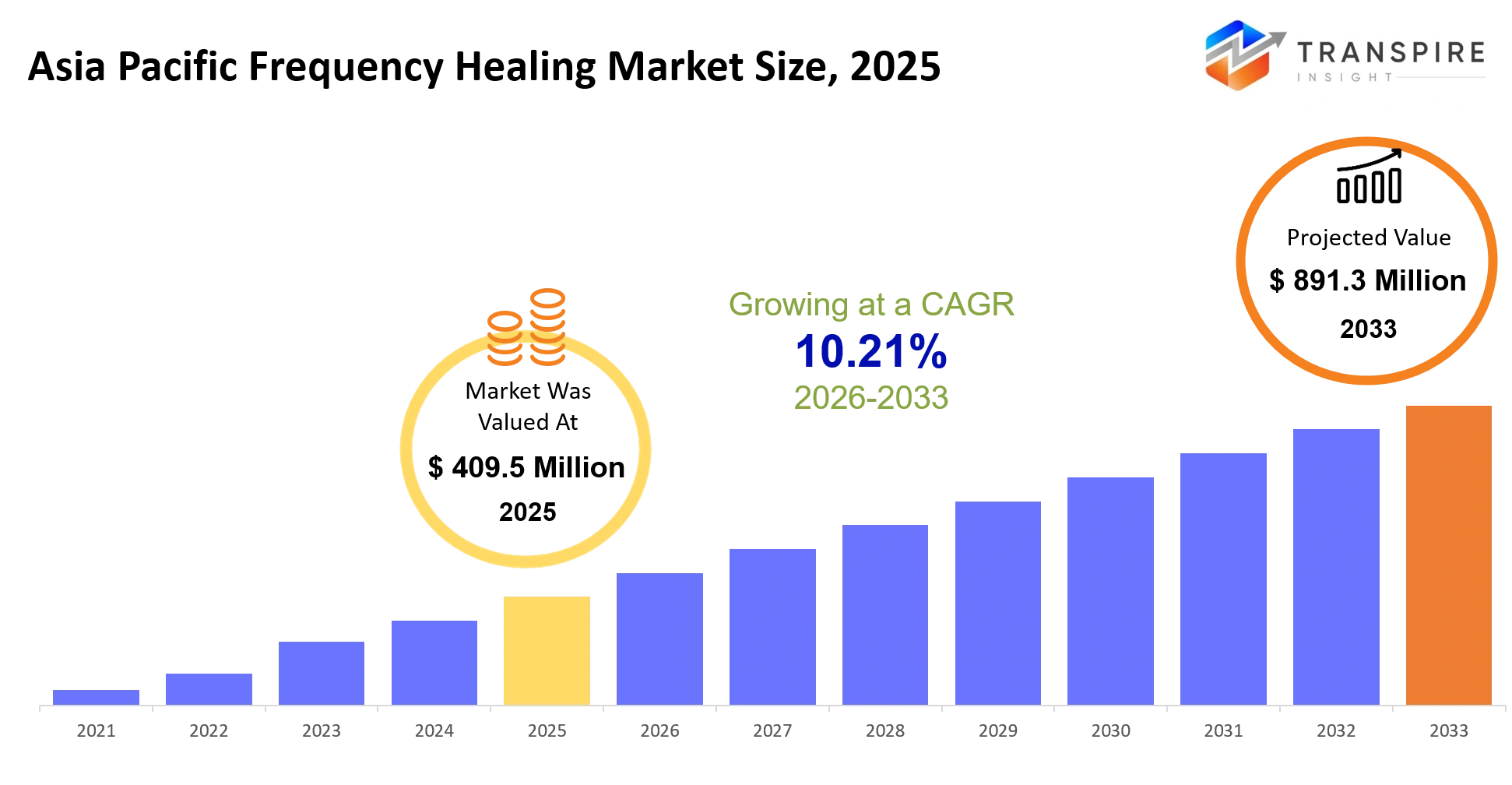
As per Transpire Insight Analysis the Asia Pacific Frequency Healing Market size is estimated at USD 409.5 Million in 2025 and is anticipated to reach USD 891.3 Million by 2033, growing at a CAGR of 10.21% from 2026 to 2033.
The Asia Pacific Frequency Healing Market kind of serves people as well as wellness providers who are looking for non-invasive approaches that sort of sit alongside standard health management, you know, via sound, electromagnetic, vibrational, and biofrequency based technologies. In practice clinics, wellness centres, rehabilitation facilities, plus home users end up using these systems for relaxation, stress management, better sleep, and recovery programmes, so it becomes this wider ecosystem where digital health blends with holistic wellness services. Over the last five years the market has moved away from more niche alternative therapy offerings and more toward technology-enabled wellness platforms , with connected devices, mobile apps, and personalised treatment protocols that feel more tailored. The COVID-19 pandemic pushed things along faster too , mainly because more people wanted home based wellness solutions and remote health monitoring during that time. As providers put money into digital delivery models, and consumers started adopting connected wellness devices, recurring service revenue plus device sales also grew. Because of all this, the whole direction seems to be nudging manufacturers toward developing evidence backed products, improving regulatory compliance, and creating partnerships with healthcare and wellness organisations across the Asia Pacific region.
Asia Pacific Frequency Healing Market Size & Forecast:
- Asia Pacific Frequency Healing Market Size 2025: USD 409.5 Million
- Expected Market Value 2033: USD 891.3 Million
- Forecast CAGR: 10.21%
- Leading region in 2025: East Asia
- Fastest Growing region: South Asia
- Key Profile: Pulse Centers, EarthPulse, iMRS (Swiss Bionic Solutions), HealthyLine, BioBalance Systems, Sound Oasis, BrainTap, Healy World, PEMF Supply, Omnium1, Medithera, Theragem, QRS International, BEMER Group, Bio-Well.
Key Market Insights
- East Asia still seemed to dominate the Asia Pacific Frequency Healing Market, with about 46% market share in 2025, and you can mostly pin that on more mature wellness infrastructure and people spending more on digital health technologies than elsewhere.
- South Asia is expected to show up as the fastest-growing regional market during 2025–2033, mostly because private wellness clinics keep expanding, and access to connected therapeutic devices is getting, kind of, easier.
- For the product side, Biofrequency therapy devices took the lead, holding nearly 41% share in 2025. This was helped along by ongoing technology upgrades and also by wider clinical integration, step by step.
- Sound frequency therapy systems sat in the second position, as wellness centres rolled out more multisensory treatment portfolios across metropolitan markets through 2025.
- Wearable frequency healing devices are forecast to grow the quickest through 2033. That growth is tied to mobile health integration and personalised wellness programmes, which are becoming common.
- On the application front, stress management and mental wellness made up roughly 38% market share in 2025. Employers and healthcare providers kept expanding preventive wellness initiatives, and it showed.
- Sleep improvement applications are predicted to grow the fastest during 2025–2033, backed by digital monitoring platforms and the shift toward home-based therapy adoption.
- Looking at end users, wellness clinics and holistic therapy centres represented around 44% end-user market share in 2025. They’re also boosting recurring service revenues through integrated treatment offerings, rather than just one-off sessions.
- Finally, home users are expected to be the fastest-growing end-user category through 2033, reflecting wider availability of connected frequency healing technologies and, of course, subscription-based wellness services.
What are the Key Drivers, Restraints, and Opportunities in the Asia Pacific Frequency Healing Market?
The main growth driver seems to be the coming together of digital health tools with preventive wellness programs. Cheaper wearable electronics , smartphone connectivity, and cloud health platforms have already reduced deployment costs over the last five years. With that shift in place, wellness providers can personalize therapy sessions using live user signals and remote observation. When users stay more involved, recurring subscription income grows too , and the connected devices also open up extra service paths. So overall you see quicker commercial adoption across clinics, rehab centres, and home wellness setups.
The biggest thing that still holds it back is the lack of harmonised clinical proof and regulatory expectations across Asia Pacific markets. What counts as evidence varies quite a lot from one country to another, and that tends to slow down product approvals plus broader commercial rollout. From the Transpire Insight review of regional procurement notices and launch timings, the concentration of supply chain partners is still the top execution risk. Manufacturers also have to commit to expensive clinical studies, certification work, and practitioner training before they can scale. All those steps delay market entry, trim upside revenue, and push back new releases, especially for smaller technology developers .
The most powerful long term chance kind of sits in merging artificial intelligence with biofrequency platforms, and also wearable monitoring gadgets. With AI‑assisted personalization, therapy protocols can be tuned in real time using biometric signals, while cloud based analytics helps with longer horizon treatment planning. Funding digital therapeutics across Japan, South Korea, Australia and Singapore seems to set up the more favourable commercial conditions. And then, strategic collaborations between wellness tech businesses, healthcare providers, and software developers could basically open the next phase of industry expansion.
What Has the Impact of Artificial Intelligence Been on the Asia Pacific Frequency Healing Market?
Artificial intelligence and digital techs are reshaping frequency healing platforms in a kinda quiet way, mostly by automating how treatment gets set up, how patients are observed, and even how device performance gets managed, without too much fuss. Newer systems sift through biometric signals coming from wearable sensors. That means practitioners can tune the session intensity, the frequency cadence, and the therapy length with very little hand-work. On top of that, cloud-linked software handles compliance papers, usage logs, and remote firmware updates, so the day to day admin load drops a bit across multi-site wellness providers.
Machine learning models are also getting used more often to guess user engagement levels, tailor therapy protocols in a more “one person at a time” fashion, and estimate when connected devices will need maintenance. Providers can use past treatment records to polish wellness programmes, and spot patterns in how people use the devices, especially when those patterns line up with better user outcomes. Altogether this boosts equipment utilisation, cuts down service stop-and-start moments, and supports operating efficiency, while still fitting subscription based revenue cycles. Manufacturers, meanwhile, lean on predictive analytics for inventory strategy and regional routing too, which helps lower fulfilment delays as Asia Pacific markets keep expanding.
Even so, AI rollout still hits real limits, mainly because clinical data is scattered and validation standards are not consistent. A lot of wellness providers have restricted interoperability between hardware systems, and this can cut into algorithm reliability across different patient groups. Also, integration expenses stay high for smaller clinics, so they often pause on advanced analytics until standardised digital health frameworks spread more widely.
Key Market Trends
- After 2022, connected wearable frequency healing devices kind of became mainstream, and then product development kinda leaned into mobile apps more, plus continuous biometric monitoring, sort of as a default direction.
- From 2023 to 2025, AI driven therapy personalisation really got more room to grow. Providers could adjust treatment protocols with real time physiological feedback, which made the whole thing feel more adaptive, and less static.
- At the same time, wellness providers started weaving in cloud based patient management systems more and more, so things like remote session scheduling treatment tracking and subscription retention got a noticeable boost.
- Japan and South Korea manufacturers also put more money into technology for smart wellness devices, and that helped regional innovation, while also improving export competitiveness.
- Strategic partnerships between software developers and wellness technology companies accelerated after 2023, so digital therapeutic ecosystems expanded, kind of like a domino effect, across multiple channels.
- Home based treatment solutions got stronger commercial traction too, because compact wearable devices reduced dependence on clinic only therapy sessions, which probably matters for day to day adoption.
- Overall product development moved toward evidence supported wellness platforms, with manufacturers spending more on clinical validation and regulatory documentation.
- In 2024 to 2025, cross border distribution networks expanded across Southeast Asia, which improved product availability in a bunch of emerging healthcare markets.
- Also companies increasingly built Bluetooth cloud analytics and mobile dashboards into new product launches, this improved user engagement, and helped generate long term service revenue.
Asia Pacific Frequency Healing Market Segmentation
By Therapy Type :
Sound Frequency Therapy still seems to hold a big spot in wellness because providers keep rolling out more planned relaxation and recovery programmes, and a lot of it is backed by digital audio tech. You can also see wider take-up across wellness centres as well as at home setups which should keep things steady over the next few years. Meanwhile Binaural Beats Therapy keeps drawing interest especially via mobile platforms, where guided sessions feel easier to use day to day. And honestly, better smartphone connectivity has made it simpler to reach personalized wellness routines.
On the other hand PEMF Therapy keeps strengthening its market value, since it’s being used more widely for pain management, rehabilitation , and recovery programmes. Clinics and rehabilitation centres are likely to grow adoption too, as device performance improves and treatment consistency becomes more reliable. Rife Frequency Therapy and Vibroacoustic Therapy remain more niche, but they still have ongoing demand inside alternative wellness services, where customised treatment plans really matter. Plus, other therapy categories keep sliding into the market through product innovation, so people get more treatment options, and that tends to support longer-term commercial expansion.
By Device Type :
Wearable devices kinda represent one of the strongest product categories, mainly because the compact designs can support continuous wellness without too much impact on mobility. In addition, better battery performance, wireless connectivity, and sensor integration should make the product value feel more direct across personal wellness programmes. Portable devices stay in solid demand too, because convenient transportation lets users switch between clinics, wellness centres, and residential spaces pretty easily. Overall, product improvements keep making these systems simpler to run and to maintain.
Clinical equipment still matters a lot for more structured treatment environments, where professional supervision helps therapy quality stay consistent and predictable. Home therapy systems are also picking up, since digital wellness platforms encourage self-managed treatment schedules. Mobile applications support the connected wellness ecosystem in a practical way, because they help with session tracking, personalised recommendations, and remote monitoring features. Other device categories likewise benefit from ongoing technological upgrades that extend treatment flexibility across different user groups.
By Application :
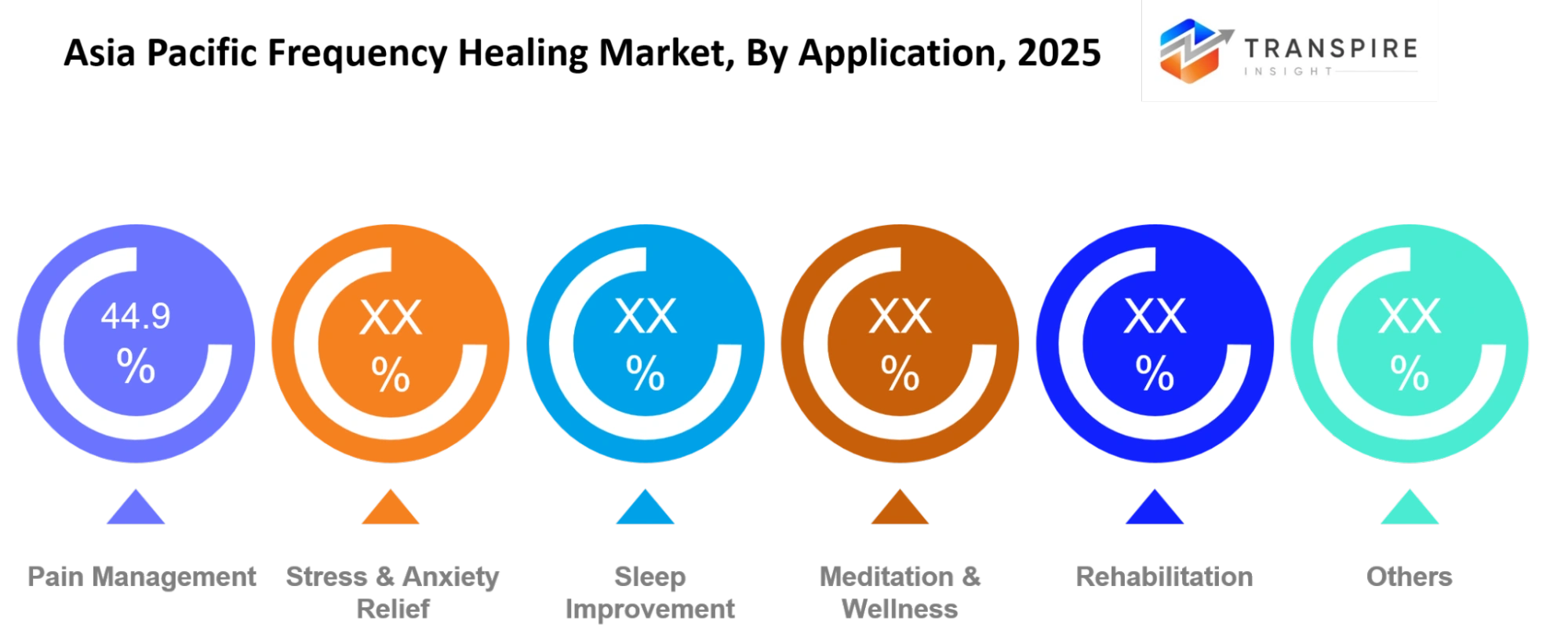
Pain management is still a leading use case because non-invasive wellbeing methods keep filling in the gaps for wider rehab and recuperation programmes. Clinicians, plus wellness centres, are likely to widen their treatment menus as more patients look for supportive therapies with quick, easy access. Stress and anxiety relief drives a lot of market motion too, mostly via organised wellness sessions that are meant for workplace health and personal peace of mind. Sleep improvement keeps pulling in fresh users thanks to connected monitoring tech and step by step guided therapy paths.
Meditation, and sort of the broader wellbeing apps, keep growing because digital platforms make it easier to show up often, via personalised wellness plans. Rehabilitation programmes also start using frequency based technologies more often, to pair with physical recovery services, especially in specialised care facilities. Meanwhile other app types keep surfacing through product creativity and expanding therapeutic research. Overall service integration should open more commercial doors across wellness and preventive healthcare spaces.
By End User :
Wellness centres hold a pretty big share I suppose, because integrated therapy programmes mix a bunch of wellness services inside one single treatment setting, not really split up. Ongoing investment in linked health technologies should help keep customer attention higher, and also makes service revenue come in again and again. Hospitals usually keep adopting steadily thanks to rehab and supportive care programmes that fit together, where the structured treatment pathways still matter a lot. Meanwhile rehabilitation clinics go on expanding their offerings, because recovery oriented wellness solutions are getting more mainstream acceptance.
Homecare users are the quickest growing customer group too, since compact devices make treatment easier outside the usual healthcare facilities. Fitness centres are also rolling out wellness technologies, mainly to pair with recovery, relaxation, and performance improvement programmes. Other end users keep looking at more specialised treatment models, often supported by connected digital platforms. And yeah broader commercial partnerships will likely boost product availability across several customer segments at the same time.
By Distribution Channel :
Direct sales still matter, mostly because manufacturers end up building stronger bonds with healthcare practitioners, wellness operators, and institutional buyers through customised product help. In practice, dedicated sales groups will keep pushing customer confidence higher, by giving technical guidance, helping with setup, and handling after sales services , too. Meanwhile healthcare distributors keep playing a key part by widening regional product availability, using their well-known commercial networks. When distribution partnerships stay solid, operational efficiency gets better across several countries, not just one market.
Online retail keeps growing quickly because digital buying platforms make it easier to compare product options and they also improve how customers get to those products. Specialty wellness stores boost product visibility by offering demonstration moments and more tailored purchasing support, especially for wellness focused consumers. Other routes continue forming via regional cooperation and digital commerce initiatives, which helps the supply chain reach farther. With improved logistics and wider retail access, future market expansion should be supported in a more steady way.
What are the Key Use Cases Driving the Asia Pacific Frequency Healing Market?
Pain management still seems like the main use case, basically because rehabilitation clinics , wellness centres , and specialised therapy providers carry on investing in non-invasive treatment options that sit alongside conventional care. You see a steady pull from the facilities that want wider service portfolios, and also better patient engagement, without having to add those more complex treatment procedures. It’s kind of a practical fit, you know.
Then there’s stress management and sleep improvement, which are growing at a steady pace through corporate wellness programmes, fitness centres, and even homecare environments. Digital wellness providers and private clinics are rolling out connected therapy approaches that help keep treatment plans more personalized, while employers, more and more, fold wellness services into workforce health initiatives, sort of as a standard inclusion.
New opportunities are also starting to appear in cognitive wellness programmes and post-recovery support tied to preventive healthcare services. Research organisations along with technology developers are looking into AI-assisted frequency customisation , and wearable monitoring platforms too, which could translate into future commercial potential as clinical validation gets stronger and regional regulatory frameworks feel more defined.
|
Report Metrics |
Details |
|
Market size value in 2025 |
USD 409.5 Million |
|
Market size value in 2026 |
USD 451.3 Million |
|
Revenue forecast in 2033 |
USD 891.3 Million |
|
Growth rate |
CAGR of 10.21% from 2026 to 2033 |
|
Base year |
2025 |
|
Historical data |
2021 - 2024 |
|
Forecast period |
2026 - 2033 |
|
Report coverage |
Revenue forecast, competitive landscape, growth factors, and trends |
|
Regional scope |
Asia Pacific (India, China, Japan, Australia, South Korea, Rest of Asia Pacific) |
|
Key company profiled |
Pulse Centers, EarthPulse, iMRS (Swiss Bionic Solutions), HealthyLine, BioBalance Systems, Sound Oasis, BrainTap, Healy World, PEMF Supply, Omnium1, Medithera, Theragem, QRS International, BEMER Group, Bio-Well. |
|
Customization scope |
Free report customization (country, regional & segment scope). Avail customized purchase options to meet your exact research needs. |
|
Report Segmentation |
By Therapy Type (Sound Frequency Therapy, PEMF Therapy, Rife Frequency Therapy, Binaural Beats Therapy, Vibroacoustic Therapy, Others); By Device Type (Wearable Devices, Portable Devices, Clinical Equipment, Home Therapy Systems, Mobile Applications, Others); By Application (Pain Management, Stress & Anxiety Relief, Sleep Improvement, Meditation & Wellness, Rehabilitation, Others); By End User (Hospitals, Wellness Centers, Rehabilitation Clinics, Homecare Users, Fitness Centers, Others); By Distribution Channel (Direct Sales, Online Retail, Specialty Wellness Stores, Healthcare Distributors, Others). |
Which Regions are Driving the Asia Pacific Frequency Healing Market Growth?
East Asia accounts for roughly 46% of the overall revenue, so it stays the main regional market. There are strong digital health frameworks, plus fairly supportive wellness regulations and a highly developed healthcare infrastructure, and all of this has sped up commercial uptake in Japan and South Korea. There is also a pretty mature ecosystem of wellness technology developers, along with connected device manufacturers, research institutions, and specialised clinics, which basically keeps feeding new product iterations and smooth distribution. Continued spend on digital therapeutics, clinical validation, and technology integration is likely to keep the region in the lead, throughout the whole forecast stretch.
Oceania, by contrast, gives a more steady contribution, because healthcare spending, regulatory transparency, and consumer trust help maintain consistent commercial momentum. Australia and New Zealand tend to get predictable regulatory pathways, which in turn encourages product launches and private investment in wellness technologies. Private healthcare providers, rehabilitation centres, and wellness operators keep widening their service menus without relying on sudden policy pivots. This kind of measured investment climate generates dependable revenue prospects, and it also helps keep long-term market results stable, even if the customer base is smaller than some other regions.
South Asia is projected to see the quickest expansion across 2026–2033, after broader digital healthcare investment and, kind of, better wellness infrastructure development. More private money flowing into healthcare facilities,telehealth services getting bigger, and the growing supply of connected wellness devices has pushed commercial momentum forward across India and nearby markets. Local distributors, along with tech providers are also stretching their regional reach using online sales channels and more focused wellness partnerships. All of this, together, tends to open up appealing opportunities for new entrants and investors who want scalable growth, especially through affordable products, digital platforms, and the widening urban healthcare networks.
Who are the Key Players in the Asia Pacific Frequency Healing Market and How Do They Compete?
Competition still looks kinda fragmented, since international wellness tech firms sit side by side with region focused manufacturers, plus a bunch of digital health innovators. What really sets people apart isn’t just cost alone, it’s tech differentiation, how well software actually integrates, and the personalized service approach that ends up shaping where each player lands competitively. At the same time, bigger businesses keep building out their product ecosystems, and newer companies roll in with connected wellness platforms, and they start putting pressure on older treatment models. It’s mostly through more flexible delivery and easier digital access, kind of overall.
Healy World leans into connected biofrequency devices that work alongside mobile applications, which then supports personalised wellness programmes using cloud based software updates. BrainTap goes another direction, using neurotechnology that pairs light stimulation with guided audio sessions, and it’s trying to grow by leaning on ongoing product refinements and practitioner collaborations. AmpCoil invests in artificial intelligence plus software development, so it can deliver tailored wellness experiences, and it boosts staying power with subscription based digital services.
Sensate builds a competitive edge using wearable relaxation technology meant for home use, and it pushes further across regions by using wider distribution partnerships across Asia Pacific markets. NeuroVizr concentrates on immersive neurostimulation, combining wearable hardware with digital therapeutic content, which creates that pretty distinctive user experience. Nue Life keeps strengthening its presence through technology collaborations, where digital wellness platforms get tied into broader mental wellness programmes, and that also helps it move into fresh customer segments, plus healthcare partnerships.
Company List
- Pulse Centers
- EarthPulse
- iMRS (Swiss Bionic Solutions)
- HealthyLine
- BioBalance Systems
- Sound Oasis
- BrainTap
- Healy World
- PEMF Supply
- Omnium1
- Medithera
- Theragem
- QRS International
- BEMER Group
- Bio-Well
Recent Development News
In February 2025, BrainTap launched its mental wellness technology platform in India. The product launch expanded BrainTap's presence in the Asia-Pacific region and increased access to digital neurotechnology solutions for stress management and cognitive wellness.
Source: https://theindianpractitioner.com/
In January 2026, BrainTap announced that users completed 2.2 million full sessions during 2025 while highlighting continued investment in its digital wellness platform and content library. The milestone reflected sustained product adoption and reinforced the company's strategy of expanding AI-enabled and app-based brain wellness services.
Source: https://braintap.com/
What Strategic Insights Define the Future of the Asia Pacific Frequency Healing Market?
The Asia Pacific Frequency Healing Market is likely to move steadily toward digitally connected wellness platforms that kind of blend wearable technologies, artificial intelligence, and personalized therapy delivery, over the next five to seven years. The strongest force behind this shift will be the way wellness services get folded into broader digital healthcare ecosystems, so providers can manage continuous monitoring, run subscription-based services, and tune treatment optimization using data in a more precise manner.
One less obvious risk is the lack of consistent regulatory and clinical validation standards across the various regional markets , and this might slow commercial expansion even while consumer adoption still stays pretty strong.
An opportunity that is starting to show up will come from clinically supported digital therapeutics, where biofeedback gets combined with frequency based technologies, especially in more advanced healthcare environments like Japan , South Korea, and Singapore. Market participants should probably gain value by investing early in clinical evidence, making sure regulatory compliance is handled correctly, and building strategic partnerships with healthcare providers, because stronger scientific validation is going to turn into a real competitive edge as commercial standards keep maturing.
Asia Pacific Frequency Healing Market Report Segmentation
By Therapy Type
- Sound Frequency Therapy
- PEMF Therapy
- Rife Frequency Therapy
- Binaural Beats Therapy
- Vibroacoustic Therapy
By Device Type
- Wearable Devices
- Portable Devices
- Clinical Equipment
- Home Therapy Systems
- Mobile Applications
By Application
- Pain Management
- Stress & Anxiety Relief
- Sleep Improvement
- Meditation & Wellness
- Rehabilitation
By End User
- Hospitals
- Wellness Centers
- Rehabilitation Clinics
- Homecare Users
- Fitness Centers
By Distribution Channel
- Direct Sales
- Online Retail
- Specialty Wellness Stores
- Healthcare Distributors
Frequently Asked Questions
Find quick answers to common questions.
The expected Asia Pacific Frequency Healing Market size for the market will be USD 891.3 Million in 2033.
Key segments for the Asia Pacific Frequency Healing Market are By Therapy Type (Sound Frequency Therapy, PEMF Therapy, Rife Frequency Therapy, Binaural Beats Therapy, Vibroacoustic Therapy, Others); By Device Type (Wearable Devices, Portable Devices, Clinical Equipment, Home Therapy Systems, Mobile Applications, Others); By Application (Pain Management, Stress & Anxiety Relief, Sleep Improvement, Meditation & Wellness, Rehabilitation, Others); By End User (Hospitals, Wellness Centers, Rehabilitation Clinics, Homecare Users, Fitness Centers, Others); By Distribution Channel (Direct Sales, Online Retail, Specialty Wellness Stores, Healthcare Distributors, Others).
Major Asia Pacific Frequency Healing Market players are Pulse Centers, EarthPulse, iMRS (Swiss Bionic Solutions), HealthyLine, BioBalance Systems, Sound Oasis, BrainTap, Healy World, PEMF Supply, Omnium1, Medithera, Theragem, QRS International, BEMER Group, Bio-Well.
The Asia Pacific Frequency Healing Market size is USD 409.5 Million in 2025.
The Asia Pacific Frequency Healing Market CAGR is 10.21% from 2026 to 2033.
- Pulse Centers
- EarthPulse
- iMRS (Swiss Bionic Solutions)
- HealthyLine
- BioBalance Systems
- Sound Oasis
- BrainTap
- Healy World
- PEMF Supply
- Omnium1
- Medithera
- Theragem
- QRS International
- BEMER Group
- Bio-Well
About the Authors

Pankaj Ghogare Patil
I am Pankaj Ghogare Patil, a Senior Research Analyst at Transpire Insight, specializing in the Pharmaceutical, Chemicals & Materials, Healthcare IT, and Biotechnology industry. My expertise lies in conducting comprehensive market research, analyzing industry trends, evaluating competitive landscapes, and translating complex data into actionable insights. At Transpire Insight, I closely follow emerging technologies, regulatory developments, and market innovations to create accurate, well-researched, and informative content that helps businesses and professionals make informed decisions. I am committed to producing credible, evidence-based articles that reflect industry best practices while making technical topics accessible and valuable for a broad audience.

Chakradhar Khansole
Chakradhar serves as the Research Director at Transpire Insight, bringing over 8 years of experience in technology, innovation, and strategic market intelligence. He specializes in transforming complex market data into actionable business insights that enable organizations to make informed, growth-oriented decisions. Recognized for his strategic vision and analytical expertise, Chakradhar leads high-impact research initiatives, delivering comprehensive market assessments, competitive intelligence, and forward-looking industry analysis.
Recently Published Reports
-
Jul 2026
Alopecia Treatment Market
Alopecia Treatment Market Size, Share & Analysis Report By Disease Type (Alopecia Areata, Cicatricial Alopecia, Traction Alopecia, Alopecia Totalis, Androgenetic Alopecia, Alopecia Universalis, and Other Disease Types), By Treatment Type (Topical Treatments, Oral Medications, Injectable Therapies, and Hair Transplantation), By Gender (Male, and Female), By Distribution Channel (Hospitals and Clinics, Retail Pharmacies, and Online Retailers), and Geography (North America, Europe, Asia-Pacific, Middle East and Africa, South and Central America), 2021 - 2031
-
Jul 2026
Medical Ultrasound Probe Market
Medical Ultrasound Probe Market Size, Share & Analysis Report By Type (Linear Type, Convex Type, Endocavitary Probe, Phased Array/Cardiac Probe, Transesophageal (TEE) Probe, and Others), By Application (Ophthalmology, Cardiology, Musculoskeletal, Oncology, Obstetrics & Gynecology, General Imaging, and Others), By End User (Hospitals & Clinics, Diagnostic Centers, Ambulatory Surgical Centers, and Others), and Geography (North America, Europe, Asia-Pacific, Middle East and Africa, South and Central America), 2021 – 2031
-
May 2026
Biosimilars Market
Biosimilars Market By Product Type (Monoclonal Antibodies, Recombinant Hormones, Erythropoietin, G-CSF, Others), By Indication (Oncology, Autoimmune Diseases, Blood Disorders, Diabetes, Others), By Manufacturing Type (In-House Manufacturing, Contract Manufacturing), By Distribution Channel (Hospital Pharmacies, Retail Pharmacies, Online Pharmacies), By Industry Analysis, Size, Share, Growth, Trends, and Forecasts 2021-2033
-
Apr 2026
Gastrointestinal Endoscopy Market
Gastrointestinal Endoscopy Market By Type (Rigid Gastrointestinal Endoscope, Flexible Gastrointestinal Endoscopes, Disposable Gastrointestinal Endoscope), By Procedure Type (Colonoscopy, Gastroscopy, Duodenoscopy, Enteroscopy, Flexible Sigmoidoscopy, Others), By Application (Diagnosis, Treatment), By End-Users (Hospitals, Ambulatory Surgical Centers, Specialty Clinics, Laboratories, Others), By Industry Analysis, Size, Share, Growth, Trends, and Forecasts 2021-2033