

Asia Pacific Equine Artificial Insemination Market Size & Forecast:
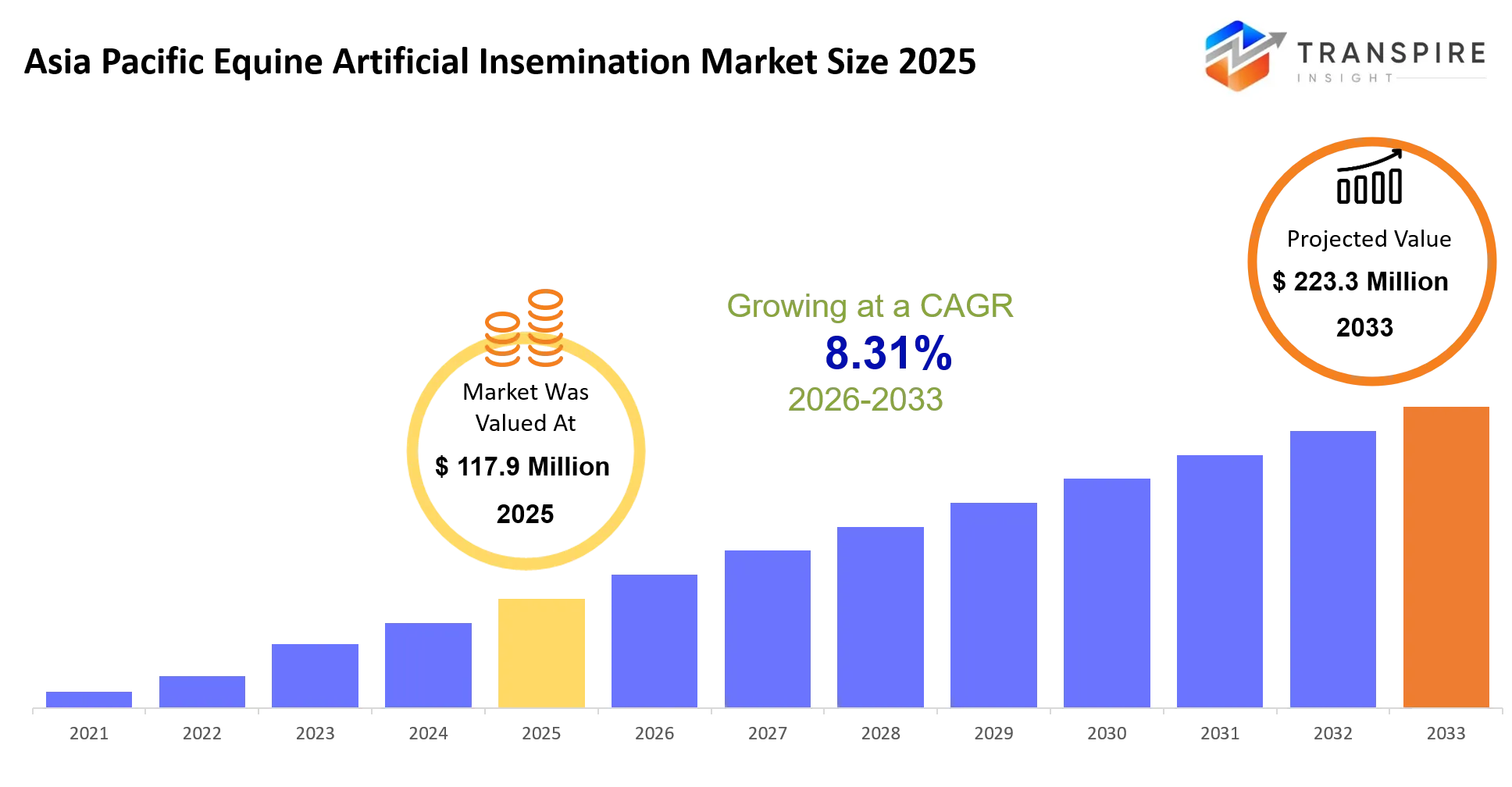
- Asia Pacific Equine Artificial Insemination Market Size 2025: USD 117.9 Million
- Asia Pacific Equine Artificial Insemination Market Size 2033: USD 223.3 Million
- Asia Pacific Equine Artificial Insemination Market CAGR: 8.31%
- Asia Pacific Equine Artificial Insemination Market Segments: By Semen Type (Fresh Semen, Chilled Semen, Frozen Semen, Sexed Semen, Others); By Service Type (Artificial Insemination Services, Semen Collection, Embryo Transfer, Genetic Testing, Breeding Consultation, Others); By Horse Type (Sport Horses, Racing Horses, Breeding Horses, Recreational Horses, Others); By End User (Breeding Farms, Veterinary Clinics, Equine Centers, Others)
Asia Pacific Equine Artificial Insemination Market Summary
The Asia Pacific Equine Artificial Insemination Market was valued at USD 117.9 Million in 2025. It is forecast to reach USD 223.3 Million by 2033. That is a CAGR of 8.31% over the period.
The Asia Pacific Equine Artificial Insemination Market helps equine breeders gain access to improved breeds and bloodlines that cannot be easily transported over great distances thereby increasing productivity and lowering cost. Racing stables, sport horse breeders and equine farms can better utilize available breeding risks and disease control by accessing valuable bloodlines and reducing their breeding expenditures. The region is rapidly transitioning from the use of natural breeding practices to technology-driven breeding technologies which involve artificial insemination combined with semen preservation, fertility assessment and breeding selection. The recent pandemic accelerated this shift by hindering travel of horses to and from countries which forced many breeders to rely on artificial insemination for remote breeding options and therefore altered revenue generation within the region. Because breeding for improved foal quality and wider breeding range is of key concern, the region is seeing a growth in commercial breeding farms in addition to elite racing farms, allowing new opportunities for equine reproduction and veterinary clinics and equine genetics centers.
Key Market Insights
- Australia holds the largest share in Asia Pacific Equine Artificial Insemination Market with expected 38% of market share in 2025 owing to its sophisticated racing ecosystem.
- China is considered the fastest growing regional market till 2032 owing to massive investment in equestrian sport and advanced breeding facilities.
- Japan and New Zealand hold a good market share as farmers readily accept advanced fertility management and sperm preservation technologies.
- Frozen semen leads in the market with more than 45% of share in 2025 due to long-distance breeding facilitation and sperm storage for superior stallions.
- Chilled semen held the second largest market share due to higher rate of conception and short traveling distance within the domestic market.
- Sexed semen is identified as the fastest growing market through 2032 due to an increase in breeders' control on the foal and breeding outcome.
- Sport Horse breeding held a market share of over 40% owing to burgeoning equestrian activities and increasing demand for performance horses.
- Racing Horse breeding is predicted as the fastest emerging market segment due to investment by horse owners to gain improved velocity, endurance and commercial breeding value.
- Equine Breeding Farms generated maximum revenue (over 50% of share in 2025) in comparison to all end users due to its massive horse breeding operations.
- Veterinary Fertility Clinics are registered as the fastest emerging end-users due to easy accessibility of reproductive expertise in the Asia Pacific region.
What are the Key Drivers, Restraints, and Opportunities in the Asia Pacific Equine Artificial Insemination Market?
The biggest driver of the Asia Pacific Equine Artificial Insemination Market is the increasing commercialization of equine breeding and the rising monetary value of superior equine genetics. Racing clubs, sport horse breeders and other equestrian organizations are looking to control breeding practices in an effort to achieve maximum genetic output while simultaneously minimizing travel expenses and the risk of disease transmission. The development of improved cryopreservation technologies and pregnancy diagnostics have contributed to enhanced fertilization rates of chilled semen. Such advancements are enabling artificial insemination practices to become commercially viable in larger commercial breeding operations than in the past. With breeders gaining access to high-value stallions outside of their home countries, the cycles of breeding shorten and revenue increases by allowing access to higher-priced offspring.
The most significant hurdle is the disjointed nature of equine breeding regulations and import requirements of semen in the Asia Pacific region. There are a plethora of varied veterinary protocols, quarantine requirements, and breeding guidelines throughout each country that hinder transborder genetic transfer and add to business costs for breeders. This structural obstacle ultimately delays technology uptake and commercialization, especially for developing equine industries in which breeding infrastructure does not yet exist.
A critical growth area is the combination of genomic testing and artificial insemination. Breeders in Australia, China and Japan have steadily increased spending on genetic screening technologies that allow them to choose desirable qualities in their desired offspring prior to mating. The marriage of genomic analysis and artificial insemination holds the key to the next generation of market growth in the Asia Pacific region.
What Has the Impact of Artificial Intelligence Been on the Asia Pacific Equine Artificial Insemination Market?
AI and sophisticated digital technologies have begun to revolutionize the equine reproduction services across Asia Pacific through enhancing the accuracy of breeding and streamlining operations. The use of AI image analysis technologies for determining sperm morphology, motility and viability is advancing, and is performing consistently greater than manual evaluations. Automated laboratory facilities further enable the faster processing of semen samples with reduced human error, leading to increased efficiencies for breeding centers and veterinary clinics.
Furthermore, the use of machine learning models are aiding veterinary surgeons in accurately determining mares for insemination, through hormone and ultrasound imaging as well as reproductive records, hence increasing conceptions, and decreasing the number of insemination cycles required to obtain pregnancy. Digital reproductive management programs also contribute to assisted breeding by tracking stallion fertility, mare fertility, and artificial insemination success, in real-time. This contributes to improved breeding decisions and reduced operational expenditure.
Despite the benefits associated with the use of these new technologies, there are still several drawbacks regarding AI implementation in equine reproduction services. A large proportion of equine operations in the Asia Pacific are family-owned, small operations which do not have the necessary standardized data to adequately train AI systems. The overall costs involved in implementing such technologies and limited reproductive data available are contributing to a slow rate of adoption, especially in developing equine countries where the digital infrastructure is less readily available.
Key Market Trends
- Since 2020, breeders both in Australia and Japan have switched from natural covering to using frozen semen programs allowing for greater access to top stallion genetics worldwide.
- Cross-border semen trading rebounded after its disruption by COVID, prompting breeders to move away from solely utilizing one country's source for their semen to spreading out supply.
- Genomic testing has entered mainstream breeding practices after 2021, helping breeders detect desirable performance traits and achieve a better conception success.
- Veterinary fertility clinics in Asia extended reproductive service offerings by over 30% since 2020, introducing more combined programs of diagnostic ultrasound and semen insemination techniques.
- Market leaders, IMV Technologies and ST Genetics, invested more capital into cryopreservation technology in an effort to increase semen lifespan, while also enhancing efficient transport for semen across great distances.
- Data driven reproductive management is growing in popularity among breeders, leading to digital fertility tracking systems being widely adopted throughout commercial equine farms since 2022.
- Concerns over animal health and semen certification became more heightened among the entire Asia Pacific region, calling for an elevation in laboratory standards and traceability within breeding networks.
- breeders detect desirable performance traits and achieve a better conception success.
Asia Pacific Equine Artificial Insemination Market Segmentation
By Semen Type :
Fresh semen is acquired and is therefore not stored; this is beneficial for breedings near a stallion facility. Chilled semen is good for transport over short to medium distance while still retaining fertility, this is beneficial to allow regional access for breedings.
Frozen semen can be kept for extended lengths of time without significant loss of value, allowing for long distance as well as international breedings. Sexed semen allows for the breeding of a specific gender, which can be beneficial for breedings aiming for a specific outcome. Additional types of semen also exist, tailored to fit individual breeding and animal needs.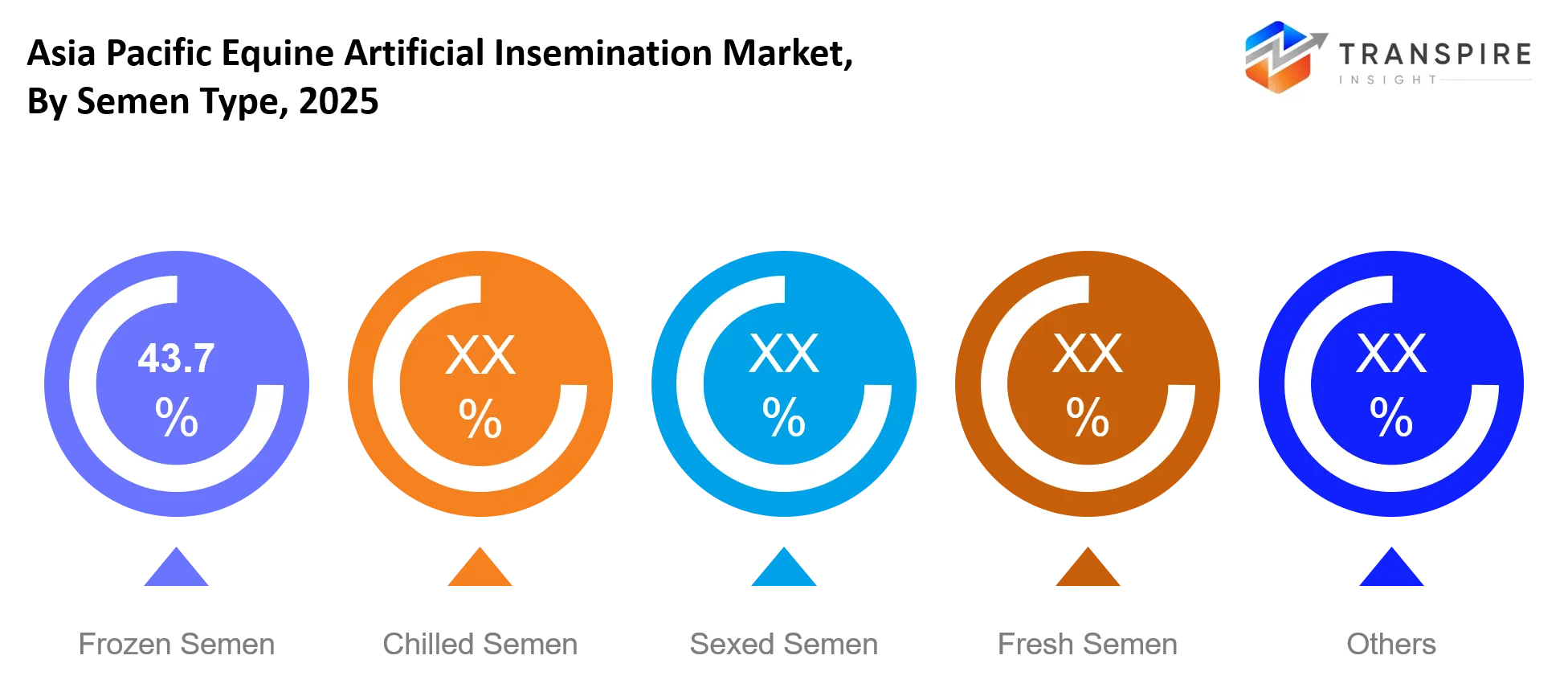
By Service Type :
Artificial insemination services create the structure for breeding programs; through this a breeding is managed under controlled conditions. Semen collection services provide the means by which the genetic material is collected and stored, using standard veterinary procedures that preserve fertility and quality.
Embryo transfer services are used to allow good mares to have more then one foal during a year using advanced techniques, genetics testing allows for the determination of genetic markers or desired performance indicators and breeding consults offer advice regarding mating and reproduction.
By Horse Type :
Sport horses have an increasing significance due to the interest in horses having agility, stamina and suitability for riding disciplines. Race horses breeding demands management of high speed, stamina and bloodline enhancement.
Horses of breeding lines are chosen for their ability to be a good genetic component, and reproductive potential in the long term. Pleasure horses are chosen for their capacity in recreational and sport free riding with good temperament and adaptability of the riding behavior, hence requiring controlled breeding for suitable traits. Horse categories such as working horses and specialized breeds also need a precise selection approach for preservation of genetic features.
By End User :
Major end-users are breeding farms due to a widespread reproductive processes, gene selection program and horse foal breeding are managed in commercial farms. Well-managed breeding organizations take advantage of modern reproduction technologies to increase breeding efficiency and quality of the horse foal.
Veterinary clinics provide expertise in breeding services like fertility assessment and insemination, with an advanced use of reproductive technologies by veterinarians and experts. The equine centers employ artificial insemination for managing breeding and horse colt training and for developing the herd. Other end-users include private owners interested in breeding controlled programs, research centers and schools.
What are the Key Use Cases Driving the Asia Pacific Equine Artificial Insemination Market?
The major application for equine artificial insemination in the Asia Pacific is still the breeding of sport horses. In breeding schemes for show jumpers, dressage horses and eventers, advanced breeding technologies are used to facilitate the inclusion of superior bloodlines without the need to transport the entire stallion. This significantly reduces the risks involved and improves efficiency for the selection of genetically superior horses for athletic performance.
Racing horse breeding and breeding ranches are showing a notable increase in adoption. Horse owners and farm managers make use of artificial insemination in conjunction with embryo transfer and genetic testing to achieve increases in endurance and speed and enhanced reproductive performance while ensuring increased optimization of breeding schedules and minimizing transportation of animals.
Other niche and emerging applications are the breeding for the preservation of endangered horse breeds and the prediction of hereditary traits by genomic analysis before reproduction. These are minor applications at present, but these trends should increase as technologies evolve to be more reliable.
|
Report Metrics |
Details |
|
Market size value in 2025 |
USD 117.9 Million |
|
Market size value in 2026 |
USD 127.7 Million |
|
Revenue forecast in 2033 |
USD 223.3 Million |
|
Growth rate |
CAGR of 8.31% from 2026 to 2033 |
|
Base year |
2025 |
|
Historical data |
2021 - 2024 |
|
Forecast period |
2026 - 2033 |
|
Report coverage |
Revenue forecast, competitive landscape, growth factors, and trends |
|
Regional scope |
Asia Pacific (India, China, Japan, Australia, South Korea, Rest of Asia Pacific) |
|
Key company profiled |
Select Breeders Services, Equine-Reproduction.com, Weatherbys, Hagyard Equine, Equibreed, Stallion AI Services, Genus, CRV, Zoetis, Merck Animal Health, Boehringer Ingelheim, Dechra, IMV Technologies, Minitube, Equitech |
|
Customization scope |
Free report customization (country, regional & segment scope). Avail customized purchase options to meet your exact research needs. |
|
Report Segmentation |
By Semen Type (Fresh Semen, Chilled Semen, Frozen Semen, Sexed Semen, Others); By Service Type (Artificial Insemination Services, Semen Collection, Embryo Transfer, Genetic Testing, Breeding Consultation, Others); By Horse Type (Sport Horses, Racing Horses, Breeding Horses, Recreational Horses, Others); By End User (Breeding Farms, Veterinary Clinics, Equine Centers, Others) |
Which Regions are Driving the Asia Pacific Equine Artificial Insemination Market Growth?
Australia dominates the market share due to a robust horse racing industry, advanced veterinary facilities, and well-defined breeding regulations. National breeding associations have set benchmarks for semen handling, genetic testing and breeding management to instill confidence in breeders and investors. Large breeding farms and dedicated equine veterinary hospitals enable consistent utilization of artificial insemination across racing and sports horse breeds, and a mature market provides continuous funding for breeding research, ensuring Australia leads regional breeding innovation.
Japan, the second-largest market, operates under distinct principles compared to Australia. The market's growth hinges less on the scale of breeding, and more on precise breeding techniques, advanced veterinary care, and sustained funding for horse genetics. The country's economic stability, combined with the long-held appreciation of equestrian sports, instills breeders with confidence in adopting reproductive technologies such as fertility monitoring, embryo transfer, and genomic testing. Collaboration among veterinary experts and breeding facilities generates a stable income, and enables consistent market growth.
China leads the fastest-growing markets in the region, on account of increasing interest in equestrianism and an influx of investment in commercial breeding operations. The market has benefited immensely from the increasing demand for horse training centers, as well as consistent growth in sports horse breeding in recent years, promoting the adoption of sophisticated breeding technologies. Emerging breeding operations and the infusion of capital for genetics research continually transform the landscape of the market. From 2026 to 2033, this growth is anticipated to yield profitable prospects for technology suppliers, veterinary firms and foreign breeders.
Who are the Key Players in the Asia Pacific Equine Artificial Insemination Market and How Do They Compete?
There is a moderate fragmentation in the Asia Pacific Equine Artificial Insemination Market; global reproductive technology companies compete along with local breeding farms and local veterinary services providers. Technology, reproductive success and premium genetics are the primary factors that support competition among each other. Some leading players are maintaining their market share by increasing R & D into semen preservation, fertility and smaller players tend to specialize in breeding service and local alliances.
IMV Technologies-IMV Technologies relies heavily on breeding technology innovations and an effective system of semen preservation that has increased the semen storage duration as well as their transportation ease to breeding farm and veterinary practice throughout the world by investing in cryopreservation media and lab equipment to provide integrated breeding solutions to the market. Select Breeders Services-Select Breeders Services differentiate from others by specializing in certain breeding programs and superior stallion genetics for breeders to improve bloodline quality across different classes of horses.
ST Genetics-ST Genetics concentrates on providing genomic breeding tools to the breeder, improving the precision breeding with effective analysis of offspring from respective genetic candidates. The companies continue to increase their market share by alliance with breeding organizations, and investment into genetic screening abilities. Neogen Corporation-Neogen Corporation leverages its genomic tests with the expert in animal health by providing the breeders with comprehensive genetic information about their horses, this gives them a strong competitive position across the Asia Pacific developing market.
Company List
- Select Breeders Services
- Equine-Reproduction.com
- Weatherbys
- Hagyard Equine
- Equibreed
- Stallion AI Services
- Genus
- CRV
- Zoetis
- Merck Animal Health
- Boehringer Ingelheim
- Dechra
- IMV Technologies
- Minitube
- Equitech
Recent Development News
In April 2025, IMV Technologies won the Sommets d'Or Award for BovIntel, its AI-assisted reproductive decision-making platform. The recognition strengthened IMV Technologies' position in animal reproduction technologies and highlighted growing adoption of digital fertility management tools that can also support equine breeding programs.
Source https://www.imv-technologies.com/
In January 2025, IMV Technologies announced acquisition of Conception Ro-Main Inc. Conception Ro-Main joined IMV Technologies’ Farm Animal business, strengthening the company’s reproductive biotechnology portfolio and expanding innovation capabilities across artificial insemination and breeding technologies. Sourcehttps://www.imv-technologies.com/
What Strategic Insights Define the Future of the Asia Pacific Equine Artificial Insemination Market?
The Asia Pacific Equine Artificial Insemination Market is set to develop into sophisticated breeding systems built on an ecosystem of reproduction technology, genetics analysis and digital management of reproductive systems. These systems are being driven by increasing commercial values placed on elite horse genetics and a need to improve efficiency in breeding with greater prediction. In 5-7 years time pedigree will be a secondary factor in breeding choices and the market will move toward data driven selection.
A lesser highlighted risk is market focus narrowing to the bloodlines of elite stallions. Too much reliance on a small gene pool could bring down gene pools and have significant cost implications for breeding while increasing exposure to regulatory authorities with respect to animal welfare and gene pool size.
An untapped opportunity exists in combining genomic selection with AI in prediction of future traits in Australia and China. Participants in this market will likely benefit from investing now in the right collaborations with veterinarians and genetic testing suppliers, as integrated breeding systems will be a competitive asset for the future.
Asia Pacific Equine Artificial Insemination Market Report Segmentation
By Semen Type
- Fresh Semen
- Chilled Semen
- Frozen Semen
- Sexed Semen
By Service Type
- Artificial Insemination Services
- Semen Collection
- Embryo Transfer
- Genetic Testing
- Breeding Consultation
By Horse Type
- Sport Horses
- Racing Horses
- Breeding Horses
- Recreational Horses
By End User
- Breeding Farms
- Veterinary Clinics
- Equine Centers
Frequently Asked Questions
Find quick answers to common questions.
The Asia Pacific Equine Artificial Insemination Market size is USD 223.3 Million in 2033.
Key Segments for the Asia Pacific Equine Artificial Insemination Market are By Semen Type (Fresh Semen, Chilled Semen, Frozen Semen, Sexed Semen, Others); By Service Type (Artificial Insemination Services, Semen Collection, Embryo Transfer, Genetic Testing, Breeding Consultation, Others); By Horse Type (Sport Horses, Racing Horses, Breeding Horses, Recreational Horses, Others); By End User (Breeding Farms, Veterinary Clinics, Equine Centers, Others).
Major Asia Pacific Equine Artificial Insemination Market Players are Select Breeders Services, Equine-Reproduction.com, Weatherbys, Hagyard Equine, Equibreed, Stallion AI Services, Genus, CRV, Zoetis, Merck Animal Health, Boehringer Ingelheim, Dechra, IMV Technologies, Minitube, Equitech.
The Current Asia Pacific Equine Artificial Insemination Market size is USD 117.9 Million in 2025.
The Asia Pacific Equine Artificial Insemination Market CAGR is 8.31% from 2026 to 2033.
- Select Breeders Services
- Equine-Reproduction.com
- Weatherbys
- Hagyard Equine
- Equibreed
- Stallion AI Services
- Genus
- CRV
- Zoetis
- Merck Animal Health
- Boehringer Ingelheim
- Dechra
- IMV Technologies
- Minitube
- Equitech
About the Authors

Pankaj Ghogare Patil
I am Pankaj Ghogare Patil, a Senior Research Analyst at Transpire Insight, specializing in the Pharmaceutical, Chemicals & Materials, Healthcare IT, and Biotechnology industry. My expertise lies in conducting comprehensive market research, analyzing industry trends, evaluating competitive landscapes, and translating complex data into actionable insights. At Transpire Insight, I closely follow emerging technologies, regulatory developments, and market innovations to create accurate, well-researched, and informative content that helps businesses and professionals make informed decisions. I am committed to producing credible, evidence-based articles that reflect industry best practices while making technical topics accessible and valuable for a broad audience.

Chakradhar Khansole
Chakradhar serves as the Research Director at Transpire Insight, bringing over 8 years of experience in technology, innovation, and strategic market intelligence. He specializes in transforming complex market data into actionable business insights that enable organizations to make informed, growth-oriented decisions. Recognized for his strategic vision and analytical expertise, Chakradhar leads high-impact research initiatives, delivering comprehensive market assessments, competitive intelligence, and forward-looking industry analysis.
Recently Published Reports
-
Jul 2026
Alopecia Treatment Market
Alopecia Treatment Market Size, Share & Analysis Report By Disease Type (Alopecia Areata, Cicatricial Alopecia, Traction Alopecia, Alopecia Totalis, Androgenetic Alopecia, Alopecia Universalis, and Other Disease Types), By Treatment Type (Topical Treatments, Oral Medications, Injectable Therapies, and Hair Transplantation), By Gender (Male, and Female), By Distribution Channel (Hospitals and Clinics, Retail Pharmacies, and Online Retailers), and Geography (North America, Europe, Asia-Pacific, Middle East and Africa, South and Central America), 2021 - 2031
-
Jul 2026
Medical Ultrasound Probe Market
Medical Ultrasound Probe Market Size, Share & Analysis Report By Type (Linear Type, Convex Type, Endocavitary Probe, Phased Array/Cardiac Probe, Transesophageal (TEE) Probe, and Others), By Application (Ophthalmology, Cardiology, Musculoskeletal, Oncology, Obstetrics & Gynecology, General Imaging, and Others), By End User (Hospitals & Clinics, Diagnostic Centers, Ambulatory Surgical Centers, and Others), and Geography (North America, Europe, Asia-Pacific, Middle East and Africa, South and Central America), 2021 – 2031
-
May 2026
Biosimilars Market
Biosimilars Market By Product Type (Monoclonal Antibodies, Recombinant Hormones, Erythropoietin, G-CSF, Others), By Indication (Oncology, Autoimmune Diseases, Blood Disorders, Diabetes, Others), By Manufacturing Type (In-House Manufacturing, Contract Manufacturing), By Distribution Channel (Hospital Pharmacies, Retail Pharmacies, Online Pharmacies), By Industry Analysis, Size, Share, Growth, Trends, and Forecasts 2021-2033
-
Apr 2026
Gastrointestinal Endoscopy Market
Gastrointestinal Endoscopy Market By Type (Rigid Gastrointestinal Endoscope, Flexible Gastrointestinal Endoscopes, Disposable Gastrointestinal Endoscope), By Procedure Type (Colonoscopy, Gastroscopy, Duodenoscopy, Enteroscopy, Flexible Sigmoidoscopy, Others), By Application (Diagnosis, Treatment), By End-Users (Hospitals, Ambulatory Surgical Centers, Specialty Clinics, Laboratories, Others), By Industry Analysis, Size, Share, Growth, Trends, and Forecasts 2021-2033