
Asia Pacific Electrotherapy Market Size & Forecast:
- Asia Pacific Electrotherapy Market Size 2025: USD 354.8 Million
- Asia Pacific Electrotherapy Market Size 2033: USD 1799.21 Million
- Asia Pacific Electrotherapy Market CAGR: 22.50%
- Asia Pacific Electrotherapy Market Segments: By Type (TENS Devices, Ultrasound Therapy, Laser Therapy, PEMF Therapy, NMES Devices, Others); By Application (Pain Management, Neurology, Musculoskeletal Disorders, Rehabilitation, Sports Injuries, Others); By End-User (Hospitals, Clinics, Rehab Centers, Homecare, Physiotherapy Centers, Others); By Technology (Portable Devices, Wearable Devices, Fixed Devices, Digital Devices, Smart Devices, Others)
To learn more about this report,  Download Free Sample Report
Asia Pacific Electrotherapy Market Summary
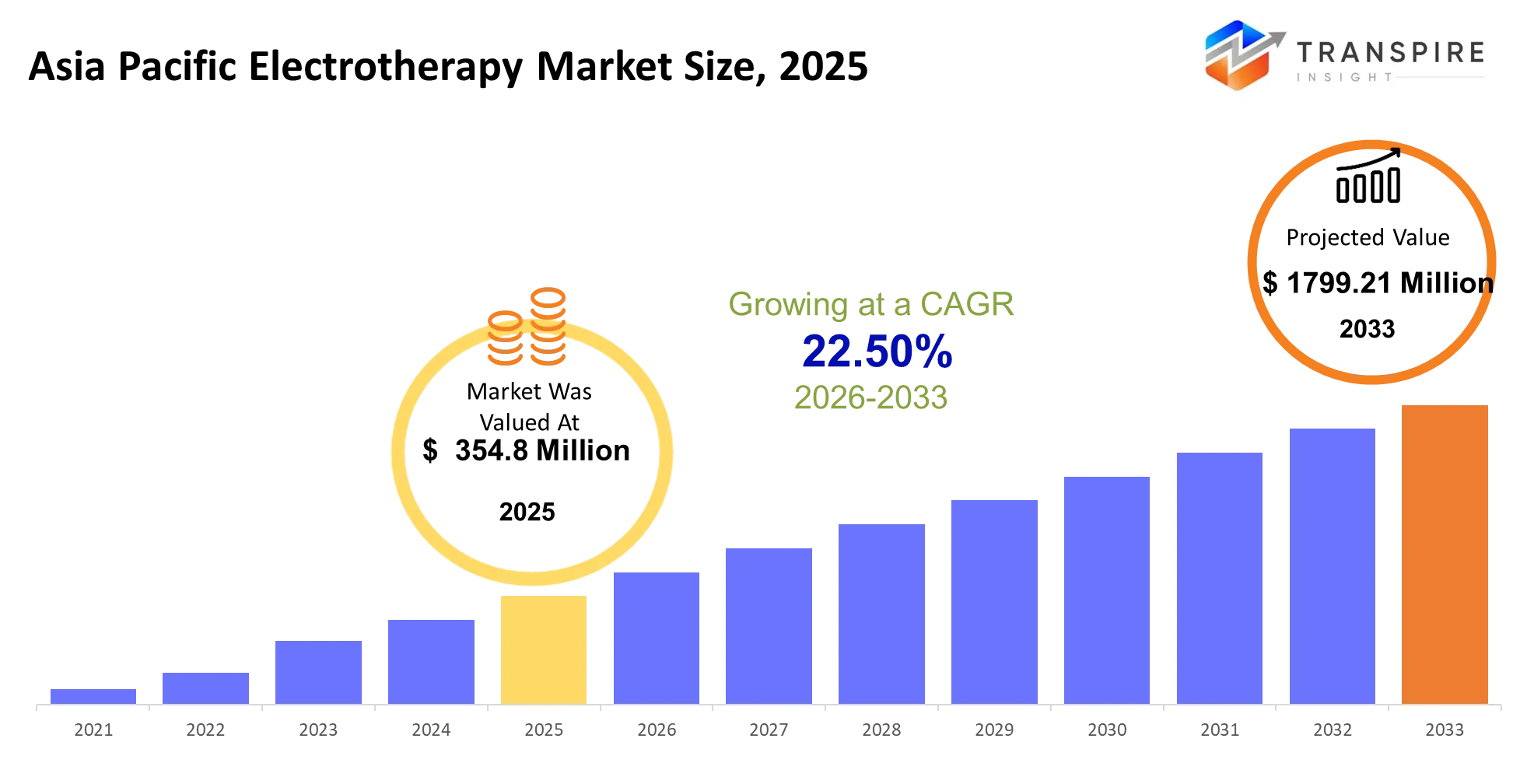
The Asia Pacific Electrotherapy Market was valued at USD 354.8 Million in 2025. It is forecast to reach USD 1799.21 Million by 2033. That is a CAGR of 22.50% over the period.
The Asia Pacific electrotherapy market focuses on products which use controlled electrical impulses for three purposes to treat pain and to induce muscle activity and to aid users in their recovery process from surgical procedure and medical treatment. The system enables patients to recover their movement abilities through non-drug methods which do not need medical interventions, thus making it a vital component of contemporary physical recovery programs used by elderly patients in this area. The market has experienced a transformation because medical equipment which doctors used to treat patients in hospitals has now evolved into portable devices which people can wear and which connect to digital networks to enable them to receive medical treatment at home.
The providers and patients started using remote rehabilitation solutions because the COVID-19 pandemic disrupted their ability to perform outpatient physiotherapy. The increasing number of musculoskeletal disorders among older adults in Japan and China and South Korea has created a need for ongoing pain management solutions which have minimal risk. The manufacturers have developed new home-compatible devices which doctors can prescribe to patients, which has enabled them to generate income from multiple sources instead of relying on hospital equipment sales.
Key Market Insights
- The Asia Pacific Electrotherapy Market receives its primary leadership from China and Japan which together account for approximately 40% of the market share because both countries possess advanced healthcare systems and their populations are experiencing demographic aging.
- The Indian market will develop into its fastest-growing regional market because people will gain better access to physiotherapy treatments while chronic pain cases continue to increase until 2030.
- South Korea and Australia demonstrate high levels of adoption for digital rehabilitation systems while their clinics expand their electrotherapy treatment services.
- The Asia Pacific Electrotherapy Market receives its main market share from TENS (Transcutaneous Electrical Nerve Stimulation) devices which hold an estimated market share of approximately 35% because both medical facilities and home users widely use these devices.
- Post-surgical rehabilitation uses neuromuscular electrical stimulation (NMES) as its second most popular method.
- The home healthcare industry and remote physiotherapy services create a market for wearable and portable electrotherapy devices which represent the fastest-expanding segment in this industry.
- The main purpose of Electrotherapy in clinical settings throughout the Asia Pacific region is to treat pain which constitutes almost 50% of all medical applications in this area.
- The application of musculoskeletal rehabilitation shows the highest growth rate because sports injuries and orthopedic recovery needs continue to increase.
- The hospital and physiotherapy clinic sectors maintain their position as the primary market segment which accounts for approximately 45% of total end-user market share because these facilities treat large numbers of patients and implement various medical procedures.
- The home healthcare segment experiences the highest growth rate because both tele-rehabilitation and patient self-care practices have become more popular among users.
What are the Key Drivers, Restraints, and Opportunities in the Asia Pacific Electrotherapy Market?
The Asia Pacific Electrotherapy Market experiences its primary growth driver from the increasing requirement for non-invasive rehabilitation services which occurs because of rising cases of musculoskeletal disorders and post-surgical recovery demands. The healthcare systems in Japan, China, and South Korea adopted new rehabilitation models which helped their hospitals decrease patient numbers and lower medical expenses. The usage of electrotherapy devices has increased because clinics now recommend them as the primary method for supporting their patients. The organization's procurement activities increased because of this process while its income streams expanded because of both item sales and digital therapy unit upgrades.
The healthcare systems in Asia Pacific emerging economies particularly India and Southeast Asia face a significant structural barrier because of their inconsistent reimbursement policies. Patients experience high out-of-pocket expenses because healthcare providers consider electrotherapy to be a supplementary treatment instead of fundamental medical care. The healthcare system faces challenges because it requires resources to achieve permanent operational capacity for all facilities. The healthcare system faces challenges because it requires resources to achieve permanent operational capacity for all facilities.
A major opportunity is emerging through integration of wearable electrotherapy with remote patient monitoring platforms. Companies like Omron Healthcare are already advancing app-connected devices in Japan that enable physiotherapists to track patient adherence in real time.India and Australia tele-rehabilitation ecosystems will develop tele-rehabilitation systems which will create new home-based treatment methods and establish permanent income through subscription services.
What Has the Impact of Artificial Intelligence Been on the Asia Pacific Electrotherapy Market?
The Asia Pacific electrotherapy field experiences transformation through artificial intelligence and digital technology advancements which develop personalized rehabilitation methods that enable measurement and remote access. AI-enabled electrotherapy devices use built-in sensors and cloud connections to adjust stimulation levels automatically in response to patient muscle activity and their recovery development during clinical use. The system cuts down on the therapist's need for manual system adjustments while maintaining treatment uniformity throughout all treatment appointments.
Machine learning models currently function to forecast patient recovery paths by examining usage statistics and pain results and movement information obtained from connected physiotherapy equipment. The predictive data empowers clinicians to create better therapy plans which decrease treatment duration while achieving higher efficiency in post-orthopedic surgery rehabilitation. Digital electrotherapy platforms enable clinics to achieve higher patient compliance levels which results in better patient flow and enhanced operational efficiency while creating steady revenue streams.
The combination of tele-rehabilitation platforms with healthcare systems enables better patient treatment continuity through distance monitoring which lessens the need for unnecessary in-person clinic appointments across urban medical facilities. The main obstacle for smaller physiotherapy centers exists because they need to spend excessive amounts on integrating AI systems into their operations. The accuracy of models suffers when used on different patient groups because healthcare systems in the Asia Pacific region lack sufficient clinical training data from different areas which makes it difficult to implement standard practices.
Key Market Trends
- The hospitals in Japan and China changed their physical therapy services from providing treatment inside hospitals to offering outpatient electrotherapy services after the 2022 healthcare cost optimization reforms.
- The use of portable electrotherapy devices increased dramatically after 2021 which resulted in a transition from using large clinic systems to portable devices throughout urban rehabilitation centers in Asia Pacific.
- The AI-stimulation system enables device-based therapy intensity adjustment through patient input which operates in real-time.
- The adoption of tele-rehabilitation systems grew substantially after COVID-19, with urban clinics implementing remote electrotherapy monitoring systems in 30% of their facilities by 2025.
- The medical device manufacturers developed app-based systems which enable hardware functions through software that enhances patient compliance monitoring while generating ongoing digital revenue streams.
- The demand for neuromuscular electrical stimulation devices increased because sports injuries among young people continued to rise in both India and Australia.
- The medical device safety regulations in South Korea and Japan became stricter which resulted in manufacturers needing to enhance their products to comply with regulations between 2022 and 2025.
- The battle for market supremacy became more difficult when Omron Healthcare established local manufacturing operations and formed digital health partnerships throughout Asia Pacific markets.
- The trend of home healthcare electrotherapy use showed continuous growth which resulted in decreased clinic visits and changed revenue patterns to prioritize sales of consumer-oriented medical devices.
Asia Pacific Electrotherapy Market Segmentation
By Type :
Electrotherapy equipment includes several methods used for pain relief and tissue recovery. TENS devices support nerve stimulation whereas ultrasound therapy delivers deep tissue healing and laser therapy enables specific recovery treatment and PEMF devices provide cellular stimulation whereas NMES devices deliver muscle rehabilitation support for both home and clinical environments.
The increasing need for non-invasive treatments will drive their implementation in hospitals and clinics. The development of portable and wearable devices will allow more people to receive home-based treatment while the introduction of advanced devices will enhance rehabilitation treatment accuracy and patient comfort during their recovery from pain and their long-term rehabilitation process which will continue to grow in usage across medical facilities and patient treatments.
By Application :
Electrotherapy works as a medical treatment that doctors use in different healthcare areas. Doctors use electrotherapy for treating both chronic and acute pain conditions. Neurology applications assist nerve-related recovery, while musculoskeletal disorders benefit from improved movement and strength restoration in clinical rehabilitation settings worldwide.
The rising popularity of fitness activities will lead to increased rehabilitation services and sports injury treatments. Electrotherapy enables patients to recover more quickly while their recovery time decreases. The adoption of specialized care devices continues to expand because advancements in technology have made devices safer to operate while delivering more effective treatments to healthcare facilities and patient homes.
By End-User :
Hospitals serve as primary users because they handle large patient volumes while providing complex medical services. Clinics and physiotherapy centers use these devices for their standard medical procedures and their treatment sessions. Rehab centers implement their recovery programs through established treatment methods while homecare services expand because patients can now use mobile medical devices.
Clinics and physiotherapy centers use these devices for routine treatment and therapy sessions. Rehab centers implement their recovery programs through established treatment methods. Homecare adoption grows with portable devices, which enable patients to receive care at home while maintaining their therapy schedule outside of clinical settings, thus enhancing their treatment compliance.
By Technology :
Patients can use portable devices and wearable devices for better mobility and user-friendly operation. Hospitals continue to use fixed devices for their ability to provide structured treatment sessions. Digital devices enhance therapy setting monitoring and control, whereas smart devices provide connected functionality that improves treatment assessment and system adjustment.
The rising adoption of smart and digital technologies will enhance therapeutic accuracy during medical procedures. Home healthcare will see increased adoption of portable and wearable devices, while clinical settings will continue to need fixed systems for their intensive treatment requirements, which will create equal distribution of technology across different healthcare service delivery models.
What are the Key Use Cases Driving the Asia Pacific Electrotherapy Market?
The Asia Pacific electrotherapy market primarily uses electrical stimulation for chronic musculoskeletal pain and post-surgical recovery and arthritis treatment. Electrotherapy functions as a vital treatment method in hospitals and physiotherapy clinics because it enables Japanese and Chinese elderly patients to achieve faster recovery without depending on continuous medication.
Physiotherapy centers and sports medicine facilities use neuromuscular stimulation for their treatment of sports injury rehabilitation and recovery after orthopedic surgery. Home healthcare providers have started using portable devices to supervise recovery programs, which helps patients stick to their treatment plans while they recover at home, reducing the number of hospital visits that patients need in urban healthcare systems.
Corporate health setups and occupational therapy units adopt emerging use cases that focus on preventive wellness and workplace rehabilitation programs. Tele-rehabilitation platforms that combine electrotherapy with remote monitoring have gained early adoption, which enables clinicians to oversee patient recovery in rural areas of India and Southeast Asia, where access to specialists remains limited.
|
Report Metrics |
Details |
|
Market size value in 2025 |
USD 354.8 Million |
|
Market size value in 2026 |
USD 434.64 Million |
|
Revenue forecast in 2033 |
USD 1799.21 Million |
|
Growth rate |
CAGR of 22.50% from 2026 to 2033 |
|
Base year |
2025 |
|
Historical data |
2021 - 2024 |
|
Forecast period |
2026 - 2033 |
|
Report coverage |
Revenue forecast, competitive landscape, growth factors, and trends |
|
Regional scope |
India, China, Japan, and Australia |
|
Key company profiled |
DJO Global, Zynex, EMS Physio, Omron, BTL Industries, Medtronic, Philips, GE Healthcare, BioMedical Life Systems, Richmar, ITO Co., Chattanooga, Enraf-Nonius, Zimmer Medizin, HMS Medical |
|
Customization scope |
Free report customization (country, regional & segment scope). Avail customized purchase options to meet your exact research needs. |
|
Report Segmentation |
By Type (TENS Devices, Ultrasound Therapy, Laser Therapy, PEMF Therapy, NMES Devices, Others); By Application (Pain Management, Neurology, Musculoskeletal Disorders, Rehabilitation, Sports Injuries, Others); By End-User (Hospitals, Clinics, Rehab Centers, Homecare, Physiotherapy Centers, Others); By Technology (Portable Devices, Wearable Devices, Fixed Devices, Digital Devices, Smart Devices, Others) |
Which Regions are Driving the Asia Pacific Electrotherapy Market Growth?
The Asia Pacific electrotherapy market goes to China because the country has developed extensive hospital networks which are currently building rehabilitation centers throughout its urban areas and tier-two cities. Public healthcare facilities show increasing use of non-invasive pain relief technologies because government programs support chronic disease management. Domestic manufacturers also benefit from integrated supply chains that lower production costs and improve device availability at scale. China maintains its ability to conduct numerous medical procedures while continuously replacing equipment throughout its various clinical facilities.
Japan serves as a stable but established market player who supports existing market operations through its senior citizen demographic and its modern rehabilitation protocols. The market in this region grows through the development of high-end electrotherapy devices which use precise technology for use in extended medical treatment facilities according to organizational standards. Hospitals and eldercare facilities prioritize clinically validated equipment with high safety compliance and digital monitoring features. The system generates consistent demand patterns which receive backing from strong reimbursement systems and healthcare spending control methods.
The region of India experiences its fastest growth because more people can access physiotherapy services combined with growing knowledge about non-invasive rehabilitation methods. The recent development of hospital facilities together with the expansion of private physiotherapy networks has enabled healthcare providers to reach a larger patient base. The market currently experiences rapid growth because customers prefer to buy budget-friendly portable devices which they can use outside of large urban areas. India offers new businesses and investors a chance to achieve growth through distribution and tele-rehabilitation system development which will provide benefits until 2033.
Who are the Key Players in the Asia Pacific Electrotherapy Market and How Do They Compete?
The Asia Pacific electrotherapy market shows moderate competitive fragmentation because international medical device companies and local physiotherapy producers are active in the market. The present situation shows a movement away from device pricing assessment toward rehabilitation systems that use hardware software and remote monitoring to make use of their integrated capabilities. New market entrants introduce portable devices which connect to mobile applications while existing companies depend on their hospital agreements and distribution power. The present time period uses digital outcome evidence and clinical validation data to establish product differences between products.
Medtronic leads high-end neurostimulation and pain management systems through its clinical partnerships which enable stronger hospital ties in Japan and Australia. DJO Global (Enovis) develops orthopedic rehabilitation packages that provide electrotherapy together with recovery solutions which patients need after surgery. Omron Healthcare controls the market for portable home devices by using its consumer distribution networks and application-based tracking system throughout the Asia Pacific region.
BTL Industries helps hospitals increase their physiotherapy services through its clinical-grade equipment and training programs which it provides to therapists throughout Asia. Zynex develops electrotherapy systems which link to doctor prescriptions and operate through reimbursement frameworks so that outpatient treatments become more budget-friendly. The two companies use distributor relationships to develop their business while they specifically target rehabilitation centers in both India and Southeast Asia.
Company List
- DJO Global
- Zynex
- EMS Physio
- Omron
- BTL Industries
- Medtronic
- Philips
- GE Healthcare
- BioMedical Life Systems
- Richmar
- ITO Co.
- Chattanooga
- Enraf-Nonius
- Zimmer Medizin
- HMS Medical
Recent Development News
In March 2026, Electrome Corp entered a strategic partnership with BioElectronics Corp to launch the PAINKILLER bioelectric pain management platform. The collaboration integrates AI-driven bioelectric therapy with FDA-cleared wearable electrotherapy devices and supports deployment across clinical networks and approximately 3,700 pharmacies, expanding non-pharmacologic pain management access.Source https://www.prnewswire.com/
In April 2026, Medtronic India launched an Adaptive Deep Brain Stimulation system for Parkinson’s disease patients, expanding its neurostimulation-based electrotherapy offerings in the Asia Pacific region. The system enhances personalized neurological treatment through adaptive stimulation, improving clinical precision in movement disorder management.
Source https://news.medtronic.com/
What Strategic Insights Define the Future of the Asia Pacific Electrotherapy Market?
The electrotherapy market in Asia Pacific is developing toward a rehabilitation system which combines digital technology with remote medical services for home-based patient treatment. The healthcare system needs to develop new treatment methods because increasing numbers of elderly people need care for their musculoskeletal disorders. The next 5 to 7 years will see organizations create value through their software-based therapy optimization methods instead of their hardware products.
The increasing use of app-based systems and cloud networks creates a hidden danger which results in Asian Pacific healthcare organizations losing their ability to exchange data between different medical technology systems. The standardization process will encounter delays because different hospital systems need to develop their own operating procedures while the process of scaling up overseas will face limitations especially in controlled hospital settings.
Insurer-backed digital rehabilitation programs which Japanese and Australian markets have begun to develop represent an emerging business opportunity for companies which want to enter these markets. Companies which create systems that connect electrotherapy devices with outcome-tracking platforms will establish themselves as leaders in their industry. Market participants should prioritize building clinically validated, data-driven therapy ecosystems rather than competing solely on device performance.
Asia Pacific Electrotherapy Market Report Segmentation
By Type
- TENS Devices
- Ultrasound Therapy
- Laser Therapy
- PEMF Therapy
- NMES Devices
By Application
- Pain Management
- Neurology
- Musculoskeletal Disorders
- Rehabilitation
- Sports Injuries
By End-User
- Hospitals
- Clinics
- Rehab Centers
- Homecare
- Physiotherapy Centers
By Technology
- Portable Devices
- Wearable Devices
- Fixed Devices
- Digital Devices
- Smart Devices
Frequently Asked Questions
Find quick answers to common questions.
The Asia Pacific Electrotherapy Market size is USD 1799.21 Million in 2033.
Key segments for the Asia Pacific Electrotherapy Market are By Type (TENS Devices, Ultrasound Therapy, Laser Therapy, PEMF Therapy, NMES Devices, Others); By Application (Pain Management, Neurology, Musculoskeletal Disorders, Rehabilitation, Sports Injuries, Others); By End-User (Hospitals, Clinics, Rehab Centers, Homecare, Physiotherapy Centers, Others); By Technology (Portable Devices, Wearable Devices, Fixed Devices, Digital Devices, Smart Devices, Others).
Major Asia Pacific Electrotherapy Market players are DJO Global, Zynex, EMS Physio, Omron, BTL Industries, Medtronic, Philips, GE Healthcare, BioMedical Life Systems, Richmar, ITO Co., Chattanooga, Enraf-Nonius, Zimmer Medizin, HMS Medical.
The Asia Pacific Electrotherapy Market size is USD 354.8 Million in 2025.
The Asia Pacific Electrotherapy Market CAGR is 22.50% from 2026 to 2033.
- DJO Global
- Zynex
- EMS Physio
- Omron
- BTL Industries
- Medtronic
- Philips
- GE Healthcare
- BioMedical Life Systems
- Richmar
- ITO Co.
- Chattanooga
- Enraf-Nonius
- Zimmer Medizin
- HMS Medical
Recently Published Reports
-
Apr 2026
Biosimilars Market
Biosimilars Market By Product Type (Monoclonal Antibodies, Recombinant Hormones, Erythropoietin, G-CSF, Others), By Indication (Oncology, Autoimmune Diseases, Blood Disorders, Diabetes, Others), By Manufacturing Type (In-House Manufacturing, Contract Manufacturing), By Distribution Channel (Hospital Pharmacies, Retail Pharmacies, Online Pharmacies), By Industry Analysis, Size, Share, Growth, Trends, and Forecasts 2021-2033
-
Apr 2026
Gastrointestinal Endoscopy Market
Gastrointestinal Endoscopy Market By Type (Rigid Gastrointestinal Endoscope, Flexible Gastrointestinal Endoscopes, Disposable Gastrointestinal Endoscope), By Procedure Type (Colonoscopy, Gastroscopy, Duodenoscopy, Enteroscopy, Flexible Sigmoidoscopy, Others), By Application (Diagnosis, Treatment), By End-Users (Hospitals, Ambulatory Surgical Centers, Specialty Clinics, Laboratories, Others), By Industry Analysis, Size, Share, Growth, Trends, and Forecasts 2021-2033
-
Apr 2026
Rare Inherited Metabolic Disorder Drug Market
Rare Inherited Metabolic Disorder Drug Market By Drug Class (Enzyme Replacement Drugs, Gene Therapy Drugs, Substrate Reduction Drugs, Small Module Drugs, Protein Drugs), By Route of Administration(Parenteral, Oral, Intrathecal), By Clinical Development (Marketed Drugs, Late Stage Clinical Phase III, Early Stage Clinical Phase I-II, Preclinical Candidates), By Indication (Lysosomal Storage Disorders, Urea Cycle Disorders, Amino Acid Metabolic Disorders, organic Acidemias, Peroximal Disorders), By Industry Analysis, Size, Share, Growth, Trends, and Forecasts 2021-2033
-
Jan 2026
Pharmaceutical Cleanroom Technology Market
Pharmaceutical Cleanroom Technology Market By Product (Equipment, Consumables, Services); By Cleanroom Type (Standard Cleanrooms, Modular Cleanrooms); By End Use (Pharmaceutical Companies, Biotechnology Companies), By Industry Analysis, Size, Share, Growth, Trends, and Forecasts 2021-2033