
Asia Pacific Culinary Tourism Market Size & Forecast:
- Asia Pacific Culinary Tourism Market Size 2025: USD 3.3 Billion
- Asia Pacific Culinary Tourism Market Size 2033: USD 17.8 Billion
- Asia Pacific Culinary Tourism Market CAGR: 23.34%
- Asia Pacific Culinary Tourism Market Segments: By Tourism Type (Food Tours, Cooking Classes, Wine Tourism, Street Food Tourism, Farm-to-Table Experiences, Gourmet Tourism, Cultural Food Experiences, Others); By Booking Channel (Travel Agencies, Online Platforms, Direct Booking, Others); By Traveler Type (Domestic Tourists, International Tourists, Food Enthusiasts, Others); By End User (Individuals, Groups, Corporates, Others).
Asia Pacific Culinary Tourism Market Summary
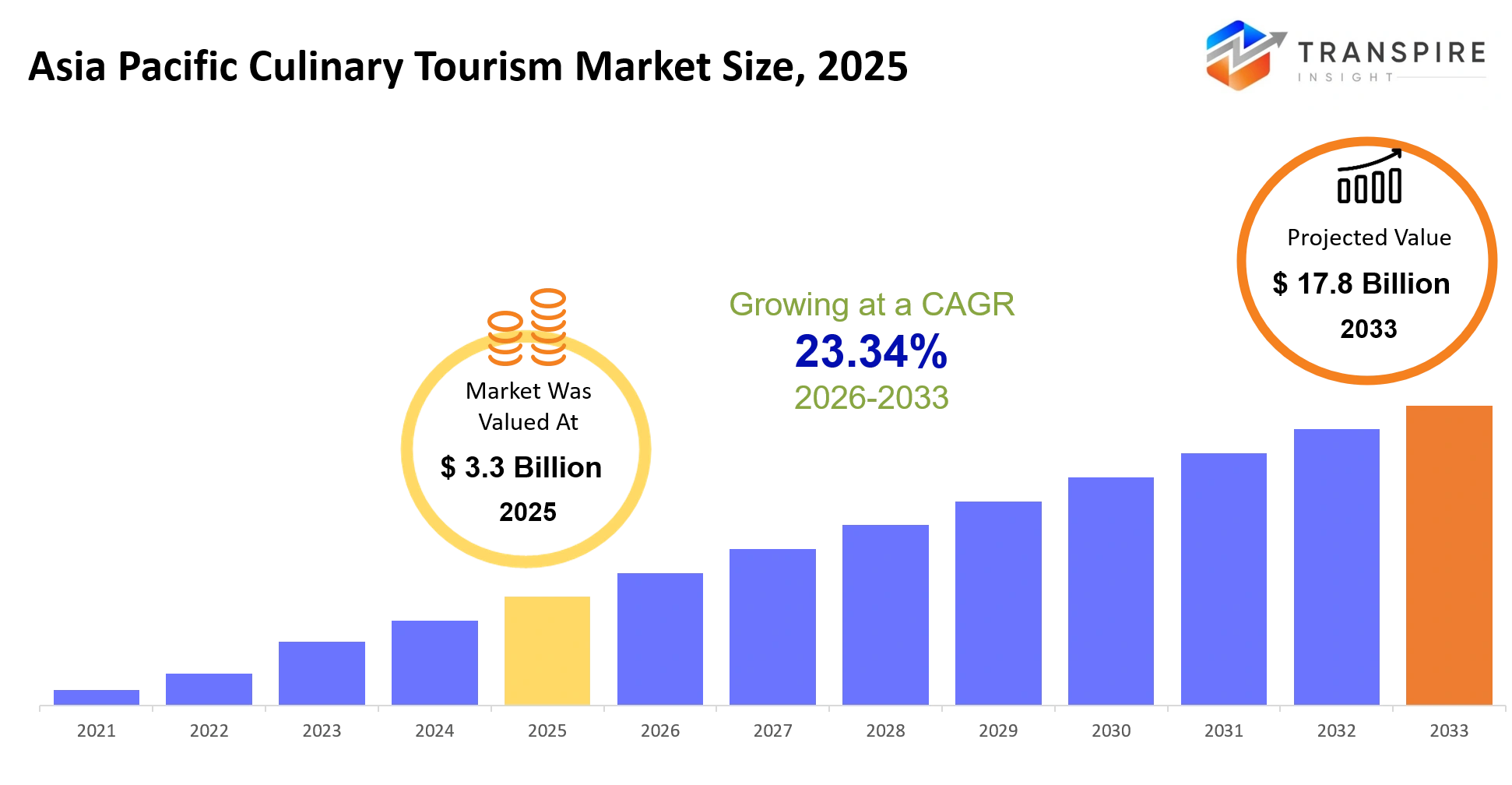
The Asia Pacific Culinary Tourism Market was valued at USD 3.3 Billion in 2025. It is forecast to reach USD 17.8 Billion by 2033. That is a CAGR of 23.34% over the period.
The Asia Pacific Culinary Tourism Market links travelers with real, taste-based experiences, kinda helps places convert local cuisine, agricultural heritage and food traditions into actual tourism income. Like, in practice it lets tourism boards, tour operators, eateries, farms, and hospitality providers build visitor moments that feel more distinct and less generic, plus it supports pushing spending beyond just lodging, and transport.
Over the last 3 to 5 years, the market has sort of backed away from the usual sightseeing-led routes and it leaned into experience-led trips where food becomes a primary reason people pick a place. Digital booking tools, social media discovery and creator powered travel content made regional cuisines easier to spot, and also easier to reach. One major nudge was the post pandemic rebound in international travel, it made a lot of travelers want culturally immersive, locally rooted moments, not those standardized tourism packages.
This shift is widening revenue openings across the tourism value chain too. Destinations are bundling food trails, cooking classes, and farm visits as premium encounters, so operators can lift visitor participation, make stays longer, and collect more revenue per trip while still supporting local food ecosystems and, you know, trying to keep things sustainable overall.
Key Market Insights
- East Asia is leading the Asia Pacific Culinary Tourism Market with a share, around 38 to 42 percent expected in 2025. This is mainly because of countries like Japan, China and South Korea.
- Southeast Asia is growing fast in this market from 2025 to 2032. Countries like Thailand, Vietnam, Malaysia and Singapore are supporting this growth.
- Governments are helping to promote tourism by making their destinations sound appealing and highlighting their food heritage. This helps to increase tourism. The money visitors spend in the region.
- More and more people traveling internationally are looking for food experiences. This creates opportunities for businesses.
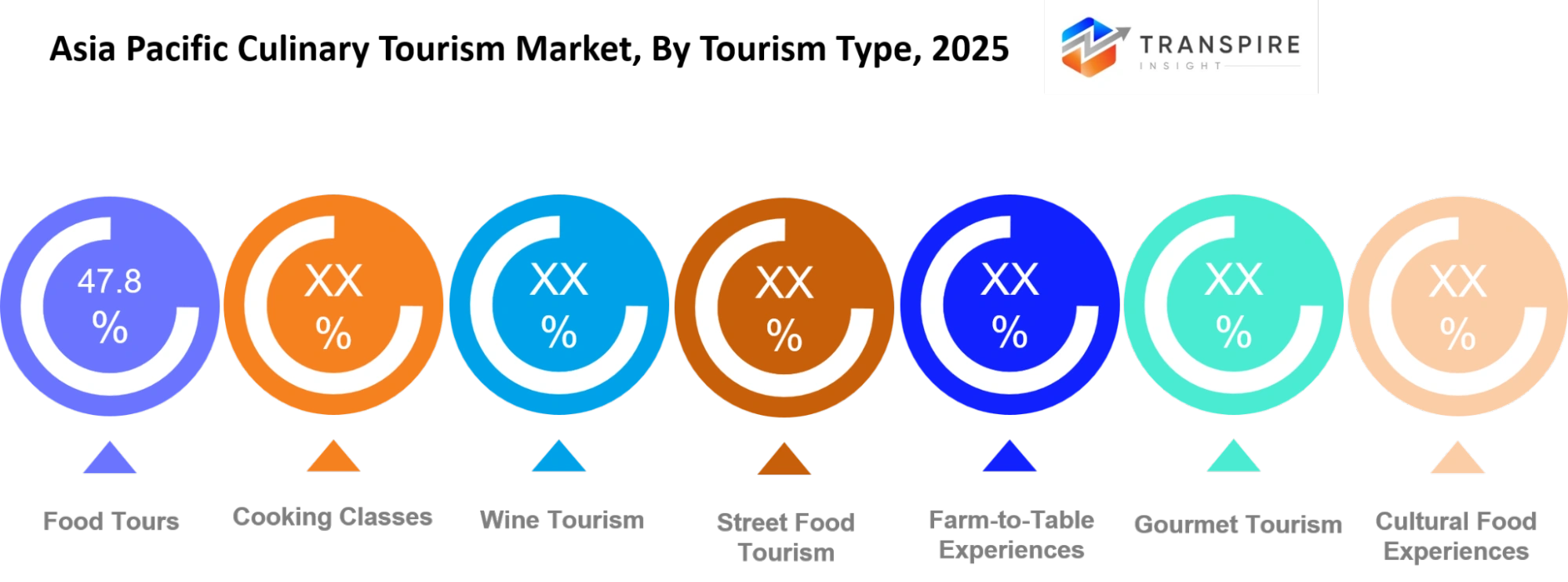
- Food tours are super popular making up around 30 to 35 percent of the market in 2025. People love taking guided tours to learn about cultures.
- Cooking classes and workshops are also popular. They attract travelers who want to learn things and have fun at the same time.
- Farm-to-table experiences are expected to grow fast by 2032. This is because more people are looking for travel options.
- High-end food packages are becoming more popular. Travel companies are targeting people who're willing to spend more money on their trips.
- Most tourists, around 60 percent are people on vacation in 2025. They are interested in experiencing cultures.
- Cultural and heritage tourism is growing fast. It is expected to be a growing area, in the forecast period.
What are the Key Drivers, Restraints, and Opportunities in the Asia Pacific Culinary Tourism Market?
The strongest force pushing the Asia Pacific Culinary Tourism Market is that big shift toward experience-led travel , where food isn’t just a side thing anymore, it’s become the main destination selection factor, not only a complement. This change really started to pick up pace after international tourism recovered, when travelers began choosing authentic cultural moments over the usual sightseeing routine. Social media platforms, short form travel posts, and digital booking ecosystems have made regional cuisines and local food traditions way more visible. So, in turn, destinations can monetize their culinary assets via food trails, chef hosted activities, hands-on cooking workshops, and farm visits, even when the logistics are a bit messy. That generally lifts average visitor spending , lengthens the time people stay, and opens extra revenue paths for hospitality providers, restaurants, and tourism operators.
The market’s biggest obstacle is the fragmented nature of culinary tourism supply chains across the region . A lot of the experiences are delivered by small eateries , family run businesses , local guides , and informal operators that don’t have standardized service quality, nor scalable distribution channels. This is a structural sort of issue, because it means long-term investment is needed for training, certification, infrastructure, and destination coordination. The fragmentation also weakens package consistency, reduces how easily it sells in international markets , and basically suppresses revenue potential by making it harder for operators to serve bigger tourist volumes efficiently.
A big growth opportunity is in mashing up culinary tourism with digital experience platforms, and also leaning into rural tourism development. Some countries—like Thailand and Vietnam—are pushing more investment into community based travel, which means there’s room to bundle local food moments with cultural things and agricultural attractions. Meanwhile, more advanced booking platforms, powered by AI personalization, can link travelers with very niche culinary offerings, that should improve conversion rates. It also helps smaller operators reach international audiences at a larger scale, even if they have limited reach right now, and, yes it can feel a bit awkward at first.
What Has the Impact of Artificial Intelligence Been on the Asia Pacific Culinary Tourism Market?
The prompt seems like it has maritime stuff in it, like scrubber monitoring, fleet compliance tracking, and marine emission control systems , so it dose not really fit the Asia Pacific Culinary Tourism Market. Here is a more in the kitchen, more food tourism aligned version. AI plus advanced digital tools are quietly reshaping the Asia Pacific Culinary Tourism Market by making it easier for travelers to find ideas, get more tailored suggestions, and run operations with less friction. More and more travel platforms are using AI driven recommendation engines, they scan browsing actions, spend patterns, dietary needs, and even trip history. Then they sort of auto match visitors with food tour experiences, cooking sessions, restaurant moments, and local culinary trails. As a result, bookings tend to convert faster , and customers feel more satisfied, which is nice really.
Machine learning models are also giving a predictive kind of power across the whole tourism eco system. Destination management orgs and travel platforms lean on demand forecasting tools ,so they can estimate visitor flows, find those seasonal booking peaks, and spot consumer preferences earlier. With those signals, operators can tune staffing levels, plan inventory, set up event timing, and decide where marketing budgets actually go. In the end, businesses manage to cut down operational inefficiencies, use their resources better, and pull higher revenue per visitor when it’s peak season.
At the same time advanced digital tech… like mobile booking platforms, real time translation tools, and AI itinerary planners, makes traveler engagement feel more smooth, almost end to end, in a single stream. These approaches also help smaller culinary operators reach international audiences, which allows them to compete , more or less, on an equal footing with the bigger tourism brands.
Still, AI adoption has some constraints. Quite a few local restaurants, street food vendors, and community run tourism operators don’t really have the budget ,or the digital foundation,or enough data volume to run sophisticated AI systems. So this kind of fragmentation restrains both the accuracy and the scaling of predictive models across many emerging culinary tourism destinations in the area.
Key Market Trends
- Since 2021 people who travel have become really interested in food-focused itineraries more than sightseeing packages. So tourism boards have started to spend money on culinary branding initiatives.
- They want to make food a big part of the travel experience.
- The use of intelligence to make recommendations on platforms such as Trip.com and Klook has made it easier for travelers to find food experiences that are just right for them.
- For example between 2020 and 2025 cooking classes and workshops with chefs have become very popular in destinations.
- In Southeast Asia people are combining food experiences with cultural heritage attractions to create tourism packages and make visitors stay longer.
- After the pandemic travelers started spending money on local dining experiences and less on international restaurant chains in popular tourist spots.
- Food-based experiences have been introduced in areas of Thailand, Vietnam and Indonesia since 2022 to spread tourism revenue to areas beyond cities.
- Social media and short videos are influencing where people choose to travel they are helping to make known regional cuisines and food trails more well-known.
- Tourism operators are working closely with farms and food businesses to create experiences that allow visitors to see where their food comes from.
- More and more people are using their phones to book travel plans since 2021 so operators are making it easier to book and pay for things
- The way tourism operators compete with each other has changed they are now focusing on experiences like food than just advertising their hotels and big travel platforms are emphasizing how they can give travelers special access to local food and authentic experiences like food experiences.
- This is a change, in the way people travel and experience food and food experiences are becoming a major part of the travel experience.
Asia Pacific Culinary Tourism Market Segmentation
By Tourism Type:
Food-focused travel isn’t just about grabbing a meal in a nice restaurant anymore, it’s kinda gone further into real cultural involvement, you know, like actually meeting the local rhythm. Because of that, Food Tours still pull in strong numbers, part of it is that a guided walkthrough makes it easier for visitors to get why regional culinary traditions feel the way they do, and it also nudges money toward local businesses, rather than some generic spot. Street Food Tourism has gotten more mainstream too, travelers are chasing those real flavors, plus casual places to eat, the ones that quietly mirror local everyday life. And then Cultural Food Experiences keep growing, since destinations package cuisine alongside heritage moments, festivals, and community happenings too.
Cooking Classes and Farm-to-Table Experiences feel even more important nowadays, because people want hands on participation, not just standing there watching. Wine Tourism and Gourmet Tourism still bring in premium travelers who want carefully planned activities, specialized tastings, and smooth high quality service. Tourism operators are also mixing several food related things into one itinerary, so visitors stay engaged longer, and it tends to lift spending. More varied offerings overall have helped destinations reach a wider range of traveler preferences, and different budget levels as well.
By Booking Channel:
Digital transformation really has shifted how people discover and buy culinary experiences across different regional tourism markets, sort of overall. Online platforms now take up more of the booking share because travelers can compare options, skim reviews and lock in reservations right away. Mobile apps, plus integrated payment systems , make the whole purchasing thing smoother, and it also helps international visitors feel more accessible. Platform visibility has mattered too, it even lets smaller operators find wider audiences without as much friction.
Travel agencies still matter, especially when it comes to packaged itineraries and group travel arrangements, in a more human way. Direct booking is still quite relevant for premium restaurants, cooking schools, and specialized experience providers, mainly because they want stronger customer relationships. A lot of businesses use a mix of channels too, to raise occupancy rates and pull in more revenue opportunities at the same time. The competitive pressure basically pushes providers to invest in digital marketing, customer engagement tools , and more personalized offers.
By Traveler Type:
Domestic Tourists are getting to be this bigger deal, especially for culinary tourism activity across Asia Pacific, you know, in a real practical way. People are doing more local wandering, the trips are often not that long distance wise, and there’s this rising curiosity about what regional cuisine actually tastes like. Because of all that, more residents are stepping into food-first experiences, kinda naturally. Tourism authorities have also leaned into this movement, running destination campaigns that point at local specialties plus culinary heritage. When domestic demand stays consistent , it basically gives a steadier base during times when international travel gets disrupted.
International Tourists still bring in major spending though , mostly because culinary plans are frequently bundled inside wider itineraries. Travelers want authentic dining, they also like traditional cooking methods, and they genuinely enjoy regional food culture, so participation stays strong in many of the biggest destinations. As cross border travel starts coming back, it has supported bookings for guided tastings, workshops, and those culinary events. Meanwhile, market participants are designing their experiences with lots of variety in mind , so they can match different cultural preferences as well as dietary needs.
By End User:
Individual Travelers seem to hold a big chunk of participation, mainly because flexible itineraries let people do that more personal food journey, kinda tailored to what they actually want to taste. Solo visitors, and small groups too, often pick food tours, cooking workshops, and neighborhood dining moments that match their own curiosity. At the same time, digital recommendations , and those social media posts have really nudged people toward buying decisions and they end up planning trips on their own, like without waiting for much guidance. And yes , customized experiences are still getting more traction among travelers who want unusual local touchpoints, the kind that feel, more real.
On the other side, Corporate Groups and Organized Travel Groups have also increased their involvement in food centered activities, especially for team building events , incentive travel, and packaged tours. Educational institutions, plus special-interest organizations, are folding culinary experiences into their schedules too, so cultural learning feels more hands on. Event organizers are also working more often with restaurants, chefs, and local producers, to put together those memorable group moments. Overall, this wider mix of end users has strengthened revenue chances across the whole tourism value chain.
What are the Key Use Cases Driving the Asia Pacific Culinary Tourism Market?
Guided culinary experiences still feel like the main reason people are actually adopting this across destinations in Asia Pacific, kind of by default. Food centered itineraries seem to pull the most participation because they blend local culture, dining, and destination wandering into one cohesive moment. Tourism operators, hospitality brands, and destination management organizations rely on these experiences to nudge visitor spend upward and to make the average trip run longer.
Cooking workshops and community based food experiences are also getting more traction, especially with cultural travelers and organized travel groups. Hospitality providers are starting to slot culinary activities into resort bundles, heritage tourism programs, and even corporate travel schedules. Meanwhile agricultural tourism operators often lean on food oriented experiences to open extra revenue lanes tied directly to local production, and regional specialties too, in a pretty natural way.
On the newer side there are emerging applications like AI assisted personalized culinary itineraries, plus rural gastronomy networks that link travelers with small scale producers. Sustainable food tourism programs, centered on indigenous cuisine and regenerative agriculture are getting attention as well. These concepts are still rather niche, but they look promising, as destinations try to stand out with more differentiated visitor experiences, and also aim for broader economic gains for local communities.
|
Report Metrics |
Details |
|
Market size value in 2025 |
USD 3.3 Billion |
|
Market size value in 2026 |
USD 4.1 Billion |
|
Revenue forecast in 2033 |
USD 17.8 Billion |
|
Growth rate |
CAGR of 23.34% from 2026 to 2033 |
|
Base year |
2025 |
|
Historical data |
2021 - 2024 |
|
Forecast period |
2026 - 2033 |
|
Report coverage |
Revenue forecast, competitive landscape, growth factors, and trends |
|
Regional scope |
Asia Pacific (India, China, Japan, Australia, South Korea, Rest of Asia Pacific) |
|
Key company profiled |
Trip.com, Expedia, Booking Holdings, MakeMyTrip, Airbnb Experiences, Klook, Traveloka, TUI, Intrepid Travel, G Adventures, JTB, HIS Travel, Yatra, Kesari Tours, Cox & Kings. |
|
Customization scope |
Free report customization (country, regional & segment scope). Avail customized purchase options to meet your exact research needs. |
|
Report Segmentation |
By Tourism Type (Food Tours, Cooking Classes, Wine Tourism, Street Food Tourism, Farm-to-Table Experiences, Gourmet Tourism, Cultural Food Experiences, Others); By Booking Channel (Travel Agencies, Online Platforms, Direct Booking, Others); By Traveler Type (Domestic Tourists, International Tourists, Food Enthusiasts, Others); By End User (Individuals, Groups, Corporates, Others). |
Which Regions are Driving the Asia Pacific Culinary Tourism Market Growth?
East Asia still feels like the most leading region in the Asia Pacific Culinary Tourism Market, mostly because it has that already in place tourism infrastructure, food cultures people everywhere know , and then also solid government backing for destination branding. Japan, South Korea, and China have been putting a lot of money into pushing regional cuisine as a travel advantage, and that ends up building culinary ecosystems that really link restaurants , food markets, cultural attractions and hospitality services together. On top of that, strong transportation networks make it easier to reach these culinary moments across both big cities and smaller regional places. And then there’s the ongoing investment in tourism promotion and in refining the visitor experience, which makes it possible to keep the regional leadership steady , and it also supports high visitor spending.
Southeast Asia, meanwhile, shows up as the second-largest contributor, but the growth rhythm is a bit different than what East Asia is doing. Thailand, Singapore, Malaysia , and Indonesia gain from diversified tourism economies where leisure travel, cultural tourism, and food-focused experiences come side by side. Competitive pricing, a pretty mature hospitality sector, and regular tourism development programs keep things stable even when international travel demand wobbles. Plus, long-running collaborations between tourism authorities , local businesses and travel platforms help keep a dependable stream of visitors, so market revenue stays more or less steady.
South Asia seems to be coming up as the fastest-growing regional market, more or less due to tourism infrastructure that keeps expanding, and also better promotion of regional culinary heritage. India, Sri Lanka, and a few neighboring destinations have, in recent years, ramped up investment in cultural tourism circuits, where local cuisine basically becomes the center of the visitors experiences. At the same time digital travel platforms have improved visibility for regional food destinations that before got limited international attention, kind of like they were always there but not really seen. This kind of momentum leaves room for tourism operators, investors, and hospitality providers who want exposure to high-growth spots, roughly between 2026 and 2033, with a few new chances that are easy to miss if you do not look closely.
Who are the Key Players in the Asia Pacific Culinary Tourism Market and How Do They Compete?
Competition in the Asia Pacific Culinary Tourism Market is still kinda moderately fragmented, like you have global travel platforms in the mix , but also regional specialists , destination-centric operators, and experience providers. Service differentiation feels more important than price alone now, because travelers are really trying to find something less generic, more “locally authentic” and special. Digital discovery with personalized recommendations , plus the ability to get exclusive access to culinary activities , is shaping how companies try to position themselves. New entrants keep showing up too, often through niche food experiences, or community based tourism models , meanwhile the bigger platforms are tightening their distribution networks and leaning into booking convenience, so they can hold onto market share.
Trip.com Group leans hard into technology driven travel planning, and it benefits from solid access to Asian travel demand. It tries to stand out with integrated booking capabilities, like it brings accommodation, transportation, and local experiences together inside one platform. Klook is more about curated activities and local experiences , so travelers can actually book food tours, cooking classes, and destination specific culinary attractions. For growth, Klook’s expansion includes partnerships with local operators and tourism organizations, aiming to broaden the menu of experiences across emerging destinations, even when the location is new or less known.
Airbnb Experiences competes by focusing on host led activities that kinda link visitors right away with local chefs, food artisans, and community specialists. That setup creates a degree of cultural immersion which feels different from those usual standardized vacation bundles. Intrepid Travel, on the other hand, is really about small group travel and it folds culinary moments into wider cultural routes, so it targets travelers who want more direct involvement with the local neighborhoods and not just sightseeing. Meanwhile, Booking Holdings keeps pushing experience based travel by making platform upgrades and forming partnerships that raise visibility for food related activities, in turn helping regional providers reach an international crowd.
Company List
- Trip.com
- Expedia
- Booking Holdings
- MakeMyTrip
- Airbnb Experiences
- Klook
- Traveloka
- TUI
- Intrepid Travel
- G Adventures
- JTB
- HIS Travel
- Yatra
- Kesari Tours
- Cox & Kings
Recent Development News
In March 2026, the Andhra Pradesh Tourism Authority entered a partnership with the Indian Culinary Institute (ICI), Tirupati. The collaboration aims to promote Telugu cuisine through culinary tourism programs, food festivals, and skills development initiatives, strengthening the state's position as a culinary tourism destination.
Source: https://travel.economictimes.indiatimes.com
In March 2026, the Andhra Pradesh Tourism Authority signed a Memorandum of Understanding with the Indian Culinary Institute to develop Andhra Pradesh as a culinary tourism hub. The agreement includes promotion of regional food traditions, organization of food festivals, and culinary workforce development, supporting long-term tourism revenue generation.
Source: https://timesofindia.indiatimes.com
In March 2026, the Andhra Pradesh government formalized a strategic collaboration with the Indian Culinary Institute under the supervision of Chief Minister N. Chandrababu Naidu. The initiative will promote food-based tourism experiences and enhance the state's culinary identity through national and international outreach programs.
Source: https://www.deccanchronicle.com
What Strategic Insights Define the Future of the Asia Pacific Culinary Tourism Market?
Over the next five to seven years, the Asia Pacific Culinary Tourism Market is expected to shift toward more individualized, experience-driven travel ecosystems where food is used as a major lever for destination distinction not so much as a side tourism thing. What’s really pushing this change is kind of messy but it comes down to the coming together of digital discovery platforms, cultural tourism investment, and destinations facing tougher competition to attract higher-value travelers. So, going forward growth is going to rely less on just more visitor numbers, and more on whether players can craft distinctive experiences that are actually bookable and that nudge spending upward per traveler.
There’s also a risk that doesn’t look obvious at first, a sort of concentration problem within digital distribution channels. When only a few platforms end up steering customer acquisition and booking traffic, smaller local operators can end up paying more in commissions and they may lose some pricing strength. That situation might squeeze margins even if overall demand stays strong.
At the same time, there’s a newer opening showing up around rural gastronomy networks across South and Southeast Asia, these are backed by digital booking tools, and also by community-based tourism initiatives. In practice, these setups can route travelers more directly to local producers and to specific culinary heritage. Market players should start early, meaning invest in exclusive local relationships and build data-informed personalization abilities. Because as time goes on, the most differentiated experiences will decide competitive edge and also long-term revenue growth, not just generic attractiveness.
Asia Pacific Culinary Tourism Market Report Segmentation
By Tourism Type
- Food Tours
- Cooking Classes
- Wine Tourism
- Street Food Tourism
- Farm-to-Table Experiences
- Gourmet Tourism
- Cultural Food Experiences
- Others
By Booking Channel
- Travel Agencies
- Online Platforms
- Direct Booking
- Others
By Traveler Type
- Domestic Tourists
- International Tourists
- Food Enthusiasts
- Others
By End User
- Individuals
- Groups
- Corporates
- Others
Frequently Asked Questions
Find quick answers to common questions.
The expected Asia Pacific Culinary Tourism Market size for the market will be USD 17.8 Billion in 2033.
Key segments for the Asia Pacific Culinary Tourism Market are By Tourism Type (Food Tours, Cooking Classes, Wine Tourism, Street Food Tourism, Farm-to-Table Experiences, Gourmet Tourism, Cultural Food Experiences, Others); By Booking Channel (Travel Agencies, Online Platforms, Direct Booking, Others); By Traveler Type (Domestic Tourists, International Tourists, Food Enthusiasts, Others); By End User (Individuals, Groups, Corporates, Others).
Major Asia Pacific Culinary Tourism Market players are Trip.com, Expedia, Booking Holdings, MakeMyTrip, Airbnb Experiences, Klook, Traveloka, TUI, Intrepid Travel, G Adventures, JTB, HIS Travel, Yatra, Kesari Tours, Cox & Kings.
The Asia Pacific Culinary Tourism Market size is USD 3.3 Billion in 2025.
The Asia Pacific Culinary Tourism Market CAGR is 23.34% from 2026 to 2033.
- Trip.com
- Expedia
- Booking Holdings
- MakeMyTrip
- Airbnb Experiences
- Klook
- Traveloka
- TUI
- Intrepid Travel
- G Adventures
- JTB
- HIS Travel
- Yatra
- Kesari Tours
- Cox & Kings
About the Authors

Chetan Dhatrak
I’m Chetan Dhatrak, a Senior Research Analyst at Transpire Insight, specializing in the Consumer Goods, Foods and Beverages industry. I focus on analyzing market trends, consumer behavior, competitive landscapes, and industry developments to deliver accurate, data-driven insights. My research at Transpire Insight is built on credible sources and in-depth analysis, helping businesses and readers better understand market dynamics, emerging opportunities, and evolving consumer preferences. I’m committed to creating reliable, well-researched content that supports informed decision-making and reflects the latest developments in the consumer goods and food & beverage sectors.

Chakradhar Khansole
Chakradhar serves as the Research Director at Transpire Insight, bringing over 8 years of experience in technology, innovation, and strategic market intelligence. He specializes in transforming complex market data into actionable business insights that enable organizations to make informed, growth-oriented decisions. Recognized for his strategic vision and analytical expertise, Chakradhar leads high-impact research initiatives, delivering comprehensive market assessments, competitive intelligence, and forward-looking industry analysis.
Recently Published Reports
-
Apr 2026
Bottled Water Market
Bottled Water Market Size, Share & Analysis Report By Product Type (Still Bottled Water, Carbonated Bottled Water, Functional Bottled Water, and Others), By Packaging (PET, Cans, and Others), By Sales Channel (Supermarkets/Hypermarkets, Convenience Stores/Drug Stores, Grocery Stores/Club Stores, Foodservice, and Others) and Geography (North America, Europe, Asia-Pacific, Middle East and Africa, South and Central America), 2021 - 2032
-
Apr 2026
Color Cosmetic Packaging Market
Color Cosmetic Packaging Market Size, Share & Analysis Report By Application (Mascara Packaging, Liquid Packaging, and Liquid Face), By Type (Tubes & Bottles, Pens & Markers, Compacts & Containers, and Droppers & Pumps), and Geography (North America, Europe, Asia-Pacific, Middle East and Africa, South and Central America), 2021 - 2031
-
Apr 2026
External Microphone For Camera Market
External Microphone For Camera Market Size, Share & Analysis Report By Type (Shotgun Microphone, Lavalier Microphone, and Others), By Application (Digital Camera, Professional Video Camera, and Others), and Geography (North America, Europe, Asia-Pacific, Middle East and Africa, South and Central America), 2021 - 2031
-
Apr 2026
Foot Orthotic Insoles Market
Foot Orthotic Insoles Market Size, Share & Analysis Report By Type (Pre-fabricated, and Custom-made), By Material (Thermoplastic, Composite Carbon Fiber, and Others), By Distribution Channel (Drug Stores, Hospitals & Clinics, and Others), and Geography (North America, Europe, Asia-Pacific, Middle East and Africa, South and Central America), 2021 - 2031