

Asia Pacific Contextual Advertising Market Size & Forecast
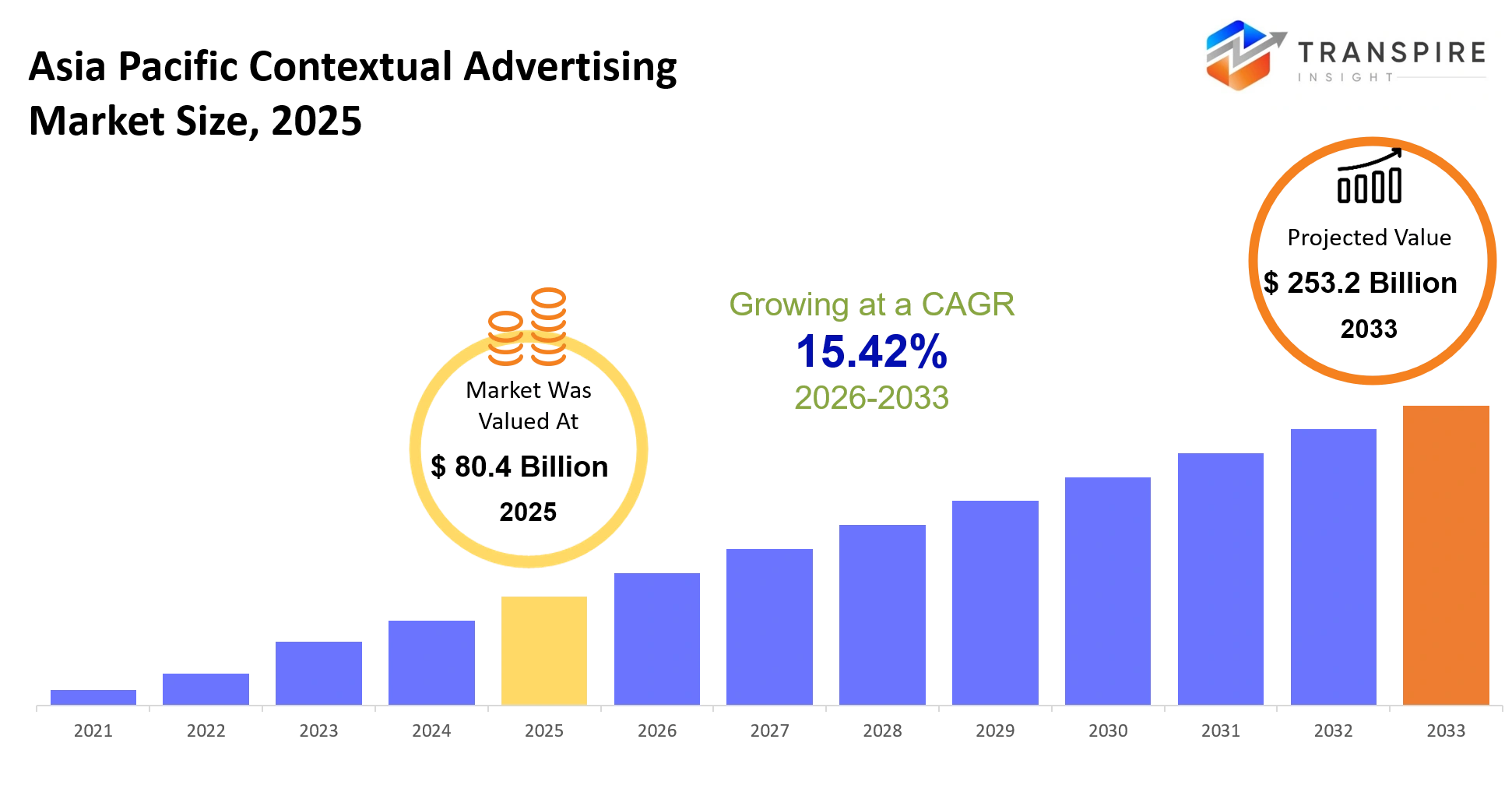
- Asia Pacific Contextual Advertising Market Size 2025: USD 80.4 Billion
- Asia Pacific Contextual Advertising Market Size 2026: USD 92.8 Billion
- Asia Pacific Contextual Advertising Market Size 2033: USD 253.2 Billion
- Asia Pacific Contextual Advertising Market CAGR: 15.42%
- Asia Pacific Contextual Advertising Market Segments: By Component (Software, Services, AI Platforms, Analytics Solutions, Campaign Management Tools, API Solutions, Optimization Platforms, Others); By Deployment (Cloud-Based, On-Premise, Hybrid, SaaS, Private Cloud, Public Cloud, Multi-Cloud, Others); By Advertising Type (Display Advertising, Native Advertising, Video Advertising, Mobile Advertising, In-App Advertising, Search Advertising, Connected TV Advertising, Others); By End User (Retail & E-commerce, BFSI, Media & Entertainment, Healthcare, Travel & Hospitality, Automotive, Telecom, Others); By Enterprise Size (Large Enterprises, Medium Enterprises, Small Enterprises, Advertising Agencies, Publishers, Startups, Government Organizations, Others)
Asia Pacific Contextual Advertising Market Summary
As per Transpire Insight Analysis the Asia Pacific Contextual Advertising Market size is estimated at USD 80.4 billion in 2025 and is anticipated to reach USD 253.2 Billion by 2033, growing at a CAGR of 15.42% from 2026 to 2033.
Contextual advertising places ads based on the content a person is actively viewing rather than on tracked personal history. A shopper reading a running shoe review sees a sportswear ad; a viewer streaming a cooking show sees a kitchen appliance spot. Across Asia Pacific, publishers, agencies, and retail platforms use contextual engines to scan page content, video frames, and app environments in real time, then match that context to advertiser inventory without pulling identity data from a cookie or device ID.
This growth is defined by a major structural change - the whole region moved away from third-party cookies and device-level tracking. Google's gradual removal of third-party cookies from Chrome, coupled with Apple's App Tracking Transparency framework starting in 2021, blocked the behavioral targeting data that programmatic advertisers in markets such as Japan, South Korea, and Australia relied upon for over ten years. Contextual targeting doesn't need that information itself, so it basically became the default alternative almost instantly for publishers in very regulated markets.
The event that caused adoption to speed up the most was the strengthening of data protection legislation all over the region. India's Digital Personal Data Protection Act, China's Personal Information Protection Law, and South Korea's revised Personal Information Protection Act each significantly increased the cost of compliance with identity-based ad targeting between 2021 and 2023. Advertisers threatened with heavy fines for handling personal data incorrectly shifted their budgets towards contextual placements that completely avoid consent management, and that shift is directly responsible for the market's present growth rate instead of just a general increase in digital ad spending.
Key Asia Pacific Contextual Advertising Market Insights
- China has the biggest chunk of the Asia-Pacific contextual advertising market - about 31% in 2025 - thanks to an enormous domestic publisher network and super-tight data localisation rules that really favour non-identity-based ad models.
- India is the fastest-growing country market in this part of the world, expanding at a compound annual growth rate (CAGR) of over 19% through to 2033, since mobile-first advertisers are scaling up their contextual campaigns all over regional-language content platforms.
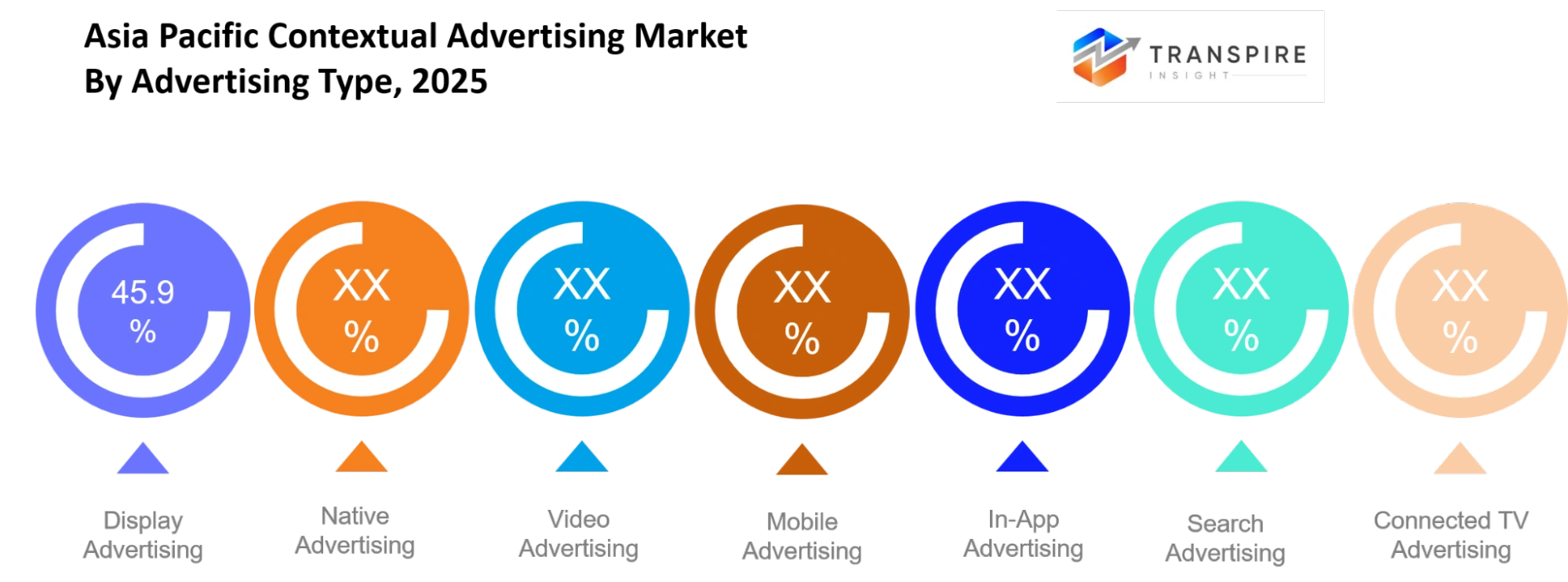
- Display Advertising is the leader among the different types of ads, making up around 45. 9% of regional revenue in 2025 - showing just how dominant it is across news publishers, e-commerce marketplaces, and content platforms itself.
- Software solutions make up the biggest piece of the puzzle, because publishers and agencies are licensing contextual classification engines instead of building their own natural language processing capabilities in-house.
- Cloud-Based deployment really stands out in the deployment segment, chosen because of its ability to process content signals at the massive scale needed by high-traffic Asian publishers and app networks themselves.
- Retail & E-commerce is the number one end-user vertical, pushed by marketplaces in China, India, and Southeast Asia putting contextual ad units right into product and search results pages themselves.
- Large Enterprises create the most share of contextual advertising spend, although Advertising Agencies are taking up contextual platforms at the quickest rate as they rebuild their targeting stacks post-cookie era.
- Google and Amazon Ads together hold a pretty big share of regional contextual inventory, leveraging first-party content and retail data that don't need any third-party tracking at all.
- The Trade Desk and PubMatic are expanding their contextual capabilities in Japan and Australia through partnerships with local publisher groups looking for cookieless monetisation tools themselves.
- Connected TV Advertising is growing the fastest among the different types of ads in this region, as streaming platforms in South Korea and Australia start using scene-level contextual targeting for their video inventory itself.
What are the Key Drivers, Restraints, and Opportunities in the Asia Pacific Contextual Advertising Market?
The driver: regulatory pressure on identity-based tracking really is the number one force pushing budgets into contextual advertising all over the region. India's Digital Personal Data Protection Act and China's Personal Information Protection Law both require consent and localization - making cookie-based retargeting practically difficult to operate. Contextual targeting completely bypasses this issue because it reads the page or app content instead of a user's profile itself. Advertisers in BFSI and healthcare - sectors with the most stringent compliance requirements - have shifted a growing portion of their programmatic spending to contextual formats since 2022, and that reallocation is a very direct, measurable revenue generator - not just a result of digital ad growth overall.
Restraint: there's a significant problem with the accuracy of contextual classification across Asia's numerous languages and scripts, a fundamental limitation that won't disappear anytime soon. Models trained primarily on English and Mandarin content don't always perform well on Thai, Vietnamese, Bahasa Indonesian, or regional Indian languages, resulting in misaligned ad placements that further erode advertiser confidence. Creating language-specific classification models for each of Asia Pacific's key markets necessitates ongoing data collection and local-language annotation efforts that smaller ad-tech companies often can't afford, keeping high-quality contextual inventory mostly held by a few major platforms - thus slowing down adoption among mid-sized regional publishers even further.
Opportunity: retail media networks offer the most apparent opportunity for growth in contextual advertising over the coming years. Platforms like Alibaba's Taobao ecosystem and Flipkart in India actually have access to first-party purchase and browsing data at the product-page level, allowing them to monetize this as contextual ad inventory without ever having to touch identity information. Amazon Ads has already established a considerable contextual retail media business using this model in India and Australia. As even more regional marketplaces begin opening their ad APIs to third-party demand, contextual inventory linked directly to shopping intent should really become one of the highest value formats in the region itself.
What Has the Impact of Artificial Intelligence Been on the Asia Pacific Contextual Advertising Market?
Artificial intelligence underpins nearly every layer of modern contextual advertising in Asia Pacific, starting with content classification. Large language models now parse full-page text, video transcripts, and even in-image objects to build a contextual profile of content in under a second, a task that earlier keyword-matching systems could not do accurately across mixed-language pages common in markets like Singapore and Malaysia. Google's contextual signals within its Ad Manager platform and Taboola's content graph both rely on transformer-based models trained on region-specific content corpora.
Predictive relevance scoring is the second major AI application. Instead of matching ads to content by topic alone, machine learning models now predict how likely a specific ad-content pairing is to drive engagement, factoring in signals such as time of day, device type, and aggregate content category performance, all without using personal identifiers. PubMatic and Magnite have both rolled out predictive contextual scoring across their Asia Pacific supply-side platforms since 2023, reporting engagement lifts in the range of 15 to 20 percent over static keyword-based contextual matching.
The clearest limitation is language coverage. Most contextual AI models perform best on English, Mandarin, Japanese, and Korean content, leaving classification accuracy meaningfully weaker across Southeast Asian and South Asian regional languages where training data is scarcer, which forces advertisers in those markets to accept a higher rate of mismatched placements or invest in custom language model fine-tuning.
Key Market Trends
The Asia Pacific Contextual Advertising Market is expanding from USD 80.4 Billion in 2025 to USD 253.2 Billion by 2033, propelled by cookie deprecation, tightening data protection law, and the rise of retail media networks that monetize first-party page context directly.
- China's share of regional contextual ad revenue rose from under 25% in 2021 to approximately 31% in 2025 as domestic publishers adopted non-tracking ad models ahead of stricter data rules.
- Display Advertising held 45.9% of advertising type revenue in 2025, though Connected TV Advertising grew over 28% year-over-year in 2024 as streaming platforms adopted scene-level targeting.
- Retail media contextual inventory from Amazon Ads and Alibaba-linked platforms expanded sharply between 2022 and 2025, turning product pages into a standalone high-margin ad category.
- India's contextual ad spend grew faster than any other country in the region in 2024, driven by regional-language content platforms scaling mobile-first contextual campaigns.
- Cloud-Based deployment overtook On-Premise as the default choice for mid-sized publishers between 2022 and 2024, cutting classification infrastructure costs by roughly a third.
- Google's Chrome cookie deprecation timeline, revised multiple times since 2020, kept contextual advertising vendors in a state of elevated demand as advertisers hedged against sudden targeting loss.
- The Trade Desk expanded its Asia Pacific contextual partnerships in 2023 and 2024, signing publisher agreements across Japan and Australia to source cookieless inventory at scale.
- Taboola and Outbrain both reported double-digit contextual revenue growth in Southeast Asia in 2024, aided by native advertising formats gaining traction on regional news publisher sites.
- BFSI advertisers increased contextual ad allocation by over 20% between 2022 and 2025 as compliance teams pushed marketing away from identity-based retargeting.
- StackAdapt and InMobi both launched new contextual targeting products for in-app inventory in 2024, responding to Apple's App Tracking Transparency reducing available mobile identifiers.
Asia Pacific Contextual Advertising Market Segmentation
By Component
Software leads the component segment because publishers and agencies prefer licensing a contextual classification engine over building natural language processing capability in-house. Vendors such as Google and PubMatic supply this software as an ongoing platform relationship rather than a one-time purchase, which keeps renewal rates high once a publisher integrates a classification engine into its ad server. Services, covering integration, model tuning, and campaign management support, form the second-largest component as regional-language markets require custom configuration work that off-the-shelf software cannot handle alone. AI Platforms and Analytics Solutions are growing faster than the base software segment, reflecting demand for predictive relevance scoring layered on top of standard contextual matching, while API Solutions are gaining traction among retail media networks that need to expose contextual inventory to external demand partners.
By Deployment
Cloud-Based deployment dominates because contextual classification at regional publisher scale, often processing millions of pages daily across multiple languages, requires elastic compute that on-premise infrastructure cannot cost-effectively match. SaaS delivery is the preferred purchasing model for mid-sized publishers who want classification capability without managing servers. On-Premise deployment persists mainly among large state-linked media groups in China and government-adjacent publishers with data residency mandates that cloud vendors cannot always satisfy. Hybrid and Private Cloud models are growing among BFSI-adjacent advertisers who want cloud-level scalability but retain certain data processing within controlled environments, a compromise that satisfies both performance needs and the compliance requirements introduced by recent regional data protection legislation.
By Advertising Type
Display Advertising holds 45.9% of advertising type revenue, the largest share in the segment, because banner and native display formats remain the default contextual unit across news publishers and marketplaces region-wide. Native Advertising ranks second, benefiting from Taboola and Outbrain's strong publisher network across Southeast Asia and India. Video Advertising and Connected TV Advertising are the fastest-growing formats as streaming adoption accelerates in South Korea, Australia, and Japan, with scene-level content analysis enabling contextual matching within video frames rather than just surrounding text. Mobile and In-App Advertising remain critical given the region's mobile-first user base, while Search Advertising retains a smaller but stable contextual role tied to query-content matching on regional search engines.
By End User
Retail & E-commerce is the leading end-user vertical, as marketplaces across China, India, and Southeast Asia embed contextual ad units directly into product listing and search result pages, converting shopping intent into ad inventory without needing identity data. BFSI follows closely, driven by compliance-motivated migration away from behavioral targeting toward content-based placement. Media & Entertainment platforms, particularly streaming services, are expanding contextual adoption fastest among all verticals as Connected TV inventory scales. Healthcare, Travel & Hospitality, Automotive, and Telecom round out demand, each applying contextual targeting to sidestep sector-specific data handling restrictions that limit traditional behavioral advertising in their respective regulatory environments.
By Enterprise Size
Large Enterprises generate the highest absolute contextual ad spend, reflecting their scale across multiple markets and product lines, but Advertising Agencies are adopting contextual platforms at the fastest relative rate as they rebuild client targeting stacks after losing cookie-based tools. Medium Enterprises and Small Enterprises are increasing contextual spend as platform costs decline and self-serve tools lower the barrier to entry. Publishers deploy contextual technology primarily as a monetization layer rather than a demand-side tool, while Startups in the ad-tech space are building differentiated contextual products targeting regional-language gaps that larger incumbents have not yet addressed.
What are the Key Use Cases Driving the Asia Pacific Contextual Advertising Market?
The core use case is publisher content monetization without identity tracking. News sites, blogs, and digital magazines across the region scan their own content in real time and sell contextually matched ad space, which lets them retain advertising revenue even as third-party cookies disappear from browsers. This use case anchors the Display Advertising segment and explains why software licensing to publishers remains the largest component category.
A fast-expanding secondary use case is retail media contextual placement, where e-commerce platforms sell ad space on product and category pages based on what a shopper is currently browsing. Amazon Ads and Alibaba-linked marketplaces have scaled this model across India, China, and Southeast Asia, turning first-party shopping context into one of the highest-margin ad formats in the region and pulling BFSI and travel advertisers toward retail-adjacent placements.
An emerging use case is contextual targeting within Connected TV and streaming environments, where scene-level video analysis matches ads to on-screen content rather than viewer profiles. South Korean and Australian streaming platforms are piloting this approach as viewership shifts from broadcast to app-based consumption, a shift that positions video-context matching as a meaningful growth category through 2033.
|
Report Metrics |
Details |
|
Market size value in 2025 |
USD 80.4 Billion |
|
Market size value in 2026 |
USD 92.8 Billion |
|
Revenue forecast in 2033 |
USD 253.2 Billion |
|
Growth rate |
CAGR of 15.42% from 2026 to 2033 |
|
Base year |
2025 |
|
Historical data |
2021 - 2024 |
|
Forecast period |
2026 - 2033 |
|
Report coverage |
Revenue forecast, competitive landscape, growth factors, and trends |
|
Regional scope |
China; Japan; India; Australia; South Korea; Indonesia; Thailand; Malaysia; Singapore; Vietnam; Philippines; New Zealand; Rest of Asia Pacific |
|
Key companies profiled |
Google, Microsoft Advertising, Amazon Ads, Meta Platforms, Taboola, Outbrain, Criteo, The Trade Desk, PubMatic, Magnite, OpenX, Yahoo Advertising, Adform, StackAdapt, InMobi |
|
Customization scope |
Free report customization (country, regional & segment scope). Avail customized purchase options to meet your exact research needs. |
|
Report Segmentation |
By Component (Software, Services, AI Platforms, Analytics Solutions, Campaign Management Tools, API Solutions, Optimization Platforms, Others); By Deployment (Cloud-Based, On-Premise, Hybrid, SaaS, Private Cloud, Public Cloud, Multi-Cloud, Others); By Advertising Type (Display Advertising, Native Advertising, Video Advertising, Mobile Advertising, In-App Advertising, Search Advertising, Connected TV Advertising, Others); By End User (Retail & E-commerce, BFSI, Media & Entertainment, Healthcare, Travel & Hospitality, Automotive, Telecom, Others); By Enterprise Size (Large Enterprises, Medium Enterprises, Small Enterprises, Advertising Agencies, Publishers, Startups, Government Organizations, Others) |
Which Countries are Driving the Asia Pacific Contextual Advertising Market Growth?
China leads the regional market with approximately 31% of revenue in 2025. The country's scale of domestic digital publishers, combined with the Personal Information Protection Law's strict limits on cross-border and identity-based data use, pushed Chinese ad-tech platforms toward contextual models years ahead of most Western markets. Baidu, Tencent, and Alibaba-affiliated ad networks built contextual classification into their core ad serving infrastructure well before cookie deprecation became a global concern, giving China a first-mover technical advantage that keeps it structurally ahead of other regional markets on both volume and platform sophistication.
Japan and South Korea form a stable second tier, together contributing close to a quarter of regional revenue. Both markets combine high digital ad spend per capita with mature publisher ecosystems and, in South Korea's case, an amended Personal Information Protection Act that raised compliance costs for behavioral targeting starting in 2023. Rather than explosive growth, these markets deliver dependable, high-value contextual inventory, particularly in Connected TV and premium display formats, supported by advertisers with established digital budgets rather than newly reallocated spend.
India is the fastest-growing country market in the region, expanding above 19% annually through 2033. The Digital Personal Data Protection Act, passed in 2023, created fresh urgency for advertisers to adopt non-identity targeting, but the deeper driver is India's mobile-first, multi-language digital content boom. Regional-language platforms serving Hindi, Tamil, Telugu, and Bengali audiences are scaling contextual ad products to monetize a user base that mostly bypassed desktop advertising entirely, positioning India as the market entrants and investors should watch most closely through the forecast period.
Who are the Key Players in the Asia Pacific Contextual Advertising Market and How Do They Compete?
The market is moderately consolidated among a small group of global ad-tech giants, with Google, Amazon Ads, and Meta Platforms together controlling a substantial share of contextual and near-contextual inventory across the region. Below this tier, specialized contextual and native advertising vendors compete on publisher network depth, language coverage, and format innovation rather than raw scale. Competitive intensity is rising as vendors race to build accurate non-English contextual classification before regional publishers commit to a single long-term platform partner.
Google competes through breadth, embedding contextual targeting options directly into Google Ad Manager and reaching nearly every major publisher in the region through existing ad server relationships. Amazon Ads differentiates through retail-context inventory built on first-party shopping data, giving it a contextual advantage that pure content-classification vendors cannot replicate. Taboola and Outbrain compete on native advertising specialization, having built the largest publisher recommendation-widget networks across Southeast Asian and Indian news sites over the past decade. The Trade Desk and PubMatic pursue programmatic supply-side partnerships with premium publishers in Japan and Australia, positioning themselves as the neutral, non-walled-garden alternative to Google and Amazon for agencies wary of platform lock-in. InMobi, headquartered in India, holds a distinct regional advantage in mobile and in-app contextual targeting, an area where its home-market data and product focus give it credibility that global entrants have struggled to match.
Asia Pacific Contextual Advertising Market Companies
- Microsoft Advertising
- Amazon Ads
- Meta Platforms
- Taboola
- Outbrain
- Criteo
- The Trade Desk
- PubMatic
- Magnite
- OpenX
- Yahoo Advertising
- Adform
- StackAdapt
- InMobi
Recent Developments
In March 2026, PubMatic announced an expanded partnership with a major Japanese publisher consortium to deploy predictive contextual scoring across premium news and lifestyle inventory, aiming to improve advertiser yield without relying on cookie-based identifiers. https://www.pubmatic.com/news
In February 2026, Amazon Ads launched an expanded contextual retail media product for advertisers in India, allowing brands to bid on product-page placements matched to real-time browsing context rather than historical purchase profiles. https://advertising.amazon.com/blog
In January 2026, InMobi entered a strategic partnership with a Southeast Asian mobile publisher network to extend its in-app contextual targeting engine to Bahasa Indonesia and Vietnamese language content, addressing a gap in regional-language classification accuracy. https://www.inmobi.com/newsroom
What Strategic Insights Define the Future of the Asia Pacific Contextual Advertising Market?
Over the next five to seven years, the Asia Pacific Contextual Advertising Market will shift from a cookie-replacement technology to a primary targeting strategy in its own right, driven by the region's tightening data protection regime rather than any single platform's roadmap decision.
The hidden risk is language classification inequality. As advertisers increasingly favor markets and publishers with strong contextual accuracy, regional-language content in Southeast Asia and South Asia could see reduced ad monetization relative to English, Mandarin, and Japanese content, creating a two-tier publisher economy that current growth forecasts do not distinguish between.
The emerging opportunity lies in retail media contextual inventory, where first-party shopping context lets platforms like Amazon Ads and Alibaba-linked marketplaces sell premium contextual placements without any privacy exposure. Vendors and investors should prioritize retail media API partnerships now, before major regional marketplaces lock in exclusive demand-side relationships. The clearest strategic recommendation for market entrants is to invest in regional-language classification models ahead of competitors, since language accuracy, not platform scale, will determine which contextual vendors win publisher trust in India and Southeast Asia through 2033.
Asia Pacific Contextual Advertising Market Report Segmentation
By Component
- Software
- Services
- AI Platforms
- Analytics Solutions
- Campaign Management Tools
- API Solutions
- Optimization Platforms
- Others
By Deployment
- Cloud-Based
- On-Premise
- Hybrid
- SaaS
- Private Cloud
- Public Cloud
- Multi-Cloud
- Others
By Advertising Type
- Display Advertising
- Native Advertising
- Video Advertising
- Mobile Advertising
- In-App Advertising
- Search Advertising
- Connected TV Advertising
- Others
By End User
- Retail & E-commerce
- BFSI
- Media & Entertainment
- Healthcare
- Travel & Hospitality
- Automotive
- Telecom
- Others
By Enterprise Size
- Large Enterprises
- Medium Enterprises
- Small Enterprises
- Advertising Agencies
- Publishers
- Startups
- Government Organizations
- Others
Frequently Asked Questions
Find quick answers to common questions.
The Asia Pacific Contextual Advertising Market size is expected to reach USD 253.2 Billion by 2033.
The key segments of the Asia Pacific Contextual Advertising Market are By Component (Software, Services, AI Platforms, Analytics Solutions, Campaign Management Tools, API Solutions, Optimization Platforms, Others), By Deployment (Cloud-Based, On-Premise, Hybrid, SaaS, Private Cloud, Public Cloud, Multi-Cloud, Others), By Advertising Type (Display Advertising, Native Advertising, Video Advertising, Mobile Advertising, In-App Advertising, Search Advertising, Connected TV Advertising, Others), By End User (Retail & E-commerce, BFSI, Media & Entertainment, Healthcare, Travel & Hospitality, Automotive, Telecom, Others), and By Enterprise Size (Large Enterprises, Medium Enterprises, Small Enterprises, Advertising Agencies, Publishers, Startups, Government Organizations, Others).
Major players in the Asia Pacific Contextual Advertising Market include Google, Microsoft Advertising, Amazon Ads, Meta Platforms, Taboola, Outbrain, Criteo, The Trade Desk, PubMatic, Magnite, OpenX, Yahoo Advertising, Adform, StackAdapt, and InMobi.
The Asia Pacific Contextual Advertising Market size is USD 80.4 Billion in 2025.
The Asia Pacific Contextual Advertising Market CAGR is 15.42% from 2026 to 2033.
- Microsoft Advertising
- Amazon Ads
- Meta Platforms
- Taboola
- Outbrain
- Criteo
- The Trade Desk
- PubMatic
- Magnite
- OpenX
- Yahoo Advertising
- Adform
- StackAdapt
- InMobi
About the Authors

Mayur Shinde
I am Mayur Shinde, a Senior Research Analyst at Transpire Insight, specializing in the Automotive & Transportation and Information & Communication Technology (ICT) Industry. My work focuses on analyzing emerging market trends, technological advancements, competitive landscapes, and industry developments to deliver accurate, data-driven insights. I am passionate about transforming complex market information into clear, actionable content that helps businesses, professionals, and decision-makers stay informed and make confident strategic decisions.

Chakradhar Khansole
Chakradhar serves as the Research Director at Transpire Insight, bringing over 8 years of experience in technology, innovation, and strategic market intelligence. He specializes in transforming complex market data into actionable business insights that enable organizations to make informed, growth-oriented decisions. Recognized for his strategic vision and analytical expertise, Chakradhar leads high-impact research initiatives, delivering comprehensive market assessments, competitive intelligence, and forward-looking industry analysis.
Recently Published Reports
-
Apr 2026
3D Optical Profiler Market
3D Optical Profiler Market Size, Share & Analysis Report By Type (Desktop 3D Optical Profiler, and Portable 3D Optical Profiler), By Technology (Confocal Technology, and White Light Interference), By End-Use Industry (Manufacturing, Research Institutions, Automotive, Aerospace and Defense, Medical Devices, and Other), and Geography (North America, Europe, Asia-Pacific, Middle East and Africa, South and Central America), 2021 - 2031
-
Apr 2026
Depth Sensor Market
Depth Sensor Market Size, Share & Analysis Report By Type (Infrared Depth Sensors, Time-of-Flight (ToF) Sensors, Stereo Vision Sensors, Structured Light Sensors, Ultrasonic Depth Sensors), By Application (Automotive, Robotics, Gaming, Consumer Electronics, Industrial Automation, Healthcare, Security & Surveillance, Others), By End Users (Automotive Manufacturers, Consumer Electronics Companies, Healthcare Providers, Industrial Companies, Security Agencies, Gaming Companies, Robotics Companies, Others), and Geography (North America, Europe, Asia-Pacific, Middle East and Africa, South and Central America), 2021 – 2031
-
Apr 2026
Digital Manufacturing Market
Digital Manufacturing Market Size, Share & Analysis Report By Component (Hardware, Software, and Services), By Technology (Robotics, 3D Printing, Internet of Things (IoT), and Others), By Application (Automotive and Transportation, Aerospace and Defense, Consumer Electronics, Industrial Machinery, and Others), By Process Type (Computer-Based Designing, Computer-Based Simulation, Computer 3D Visualization, Analytics, and Others), and Geography (North America, Europe, Asia-Pacific, Middle East and Africa, South and Central America), 2021 – 2031
-
Apr 2026
Digital Visa Services Market
Digital Visa Services Market Size, Share & Analysis Report By Type (Individual Travelers, Group Travelers), By Application (Tourism, Business Travel, Others), and Geography (North America, Europe, Asia-Pacific, Middle East and Africa, South and Central America), 2021 – 2031