

Europe Contextual Marketing Solution Market Size & Forecast:
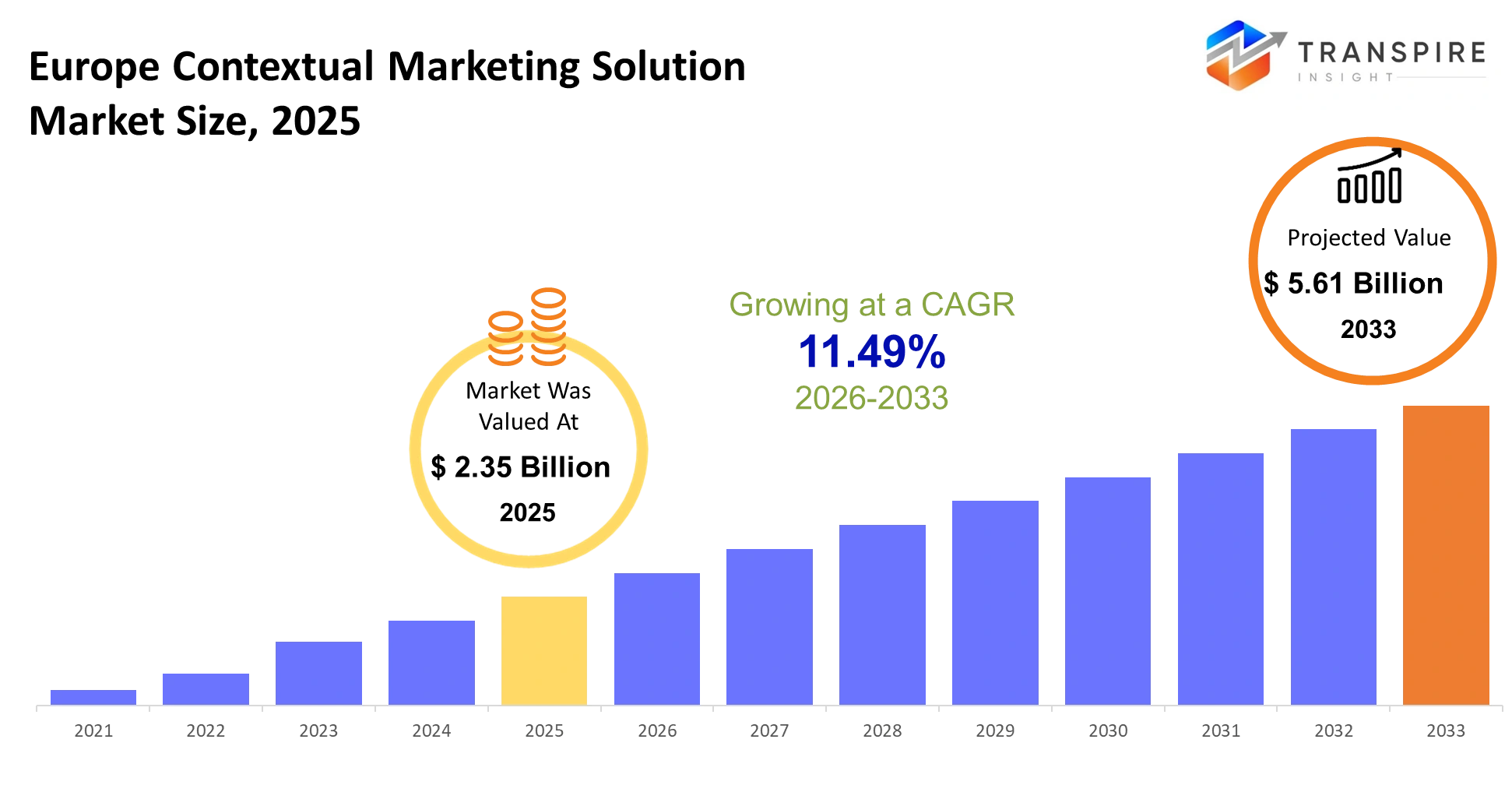
- Europe Contextual Marketing Solution Market Size 2025: USD 2.35 Billion
- Europe Contextual Marketing Solution Market Size 2033: USD 5.61 Billion
- Europe Contextual Marketing Solution Market CAGR: 11.49%
- Europe Contextual Marketing Solution Market Segments: By Type (AI-based Marketing, Data Analytics, Personalization Tools, Others), By Application (Advertising, Customer Engagement, Content Marketing, Others), By End-User (Retail, BFSI, Media, Healthcare, Others), By Deployment (Cloud, On-premise, Hybrid, Others).
To learn more about this report,  Download Free Sample Report
Europe Contextual Marketing Solution Market Summary:
The Europe Contextual Marketing Solution Market size is estimated at USD 2.35 Billion in 2025 and is anticipated to reach USD 5.61 Billion by 2033, growing at a CAGR of 11.49% from 2026 to 2033.The Europe contextual marketing solution market has evolved from a niche advertising tool into a core customer intelligence layer for retailers banks telecom operators and digital commerce platforms.
Brands use these solutions to deliver offers and recommendations and messages which customers receive according to their current activities and their current location and their online browsing activities and their past purchases. The solution enables businesses to decrease unnecessary advertising expenses while they boost the effectiveness of their conversion process and provide customized customer experiences throughout their mobile applications and online shopping platforms and linked devices.
First-party data ecosystems with AI-driven personalization engines have replaced cookie-based targeting as the primary market approach because of European data privacy regulations which restrict third-party tracking. Companies needed to create new customer acquisition methods during the COVID-19 pandemic because digital commerce growth required them to focus on measurable customer engagement instead of attempting to reach all potential customers. Organizations today build contextual intelligence platforms which function in privacy-compliant systems to enhance their campaign accuracy and customer loyalty and their ability to generate revenue through multiple channels.
Key Market Insights
- The Europe Contextual Marketing Solution Market Market in 2025 saw Western Europe take the lead with 46% market share which Germany, the UK, and France created.
- The Nordic countries maintain their status as the fastest-growing regional cluster until 2031 because of their growing cloud marketing adoption together with their superior digital infrastructure.
- The German market maintains its considerable presence because retail companies and automotive manufacturers and BFSI organizations make substantial investments in customer data intelligence platforms.
- Southern Europe is witnessing emerging demand as SMEs accelerate digital advertising transformation and mobile-first customer engagement strategies.
- The market for cloud-based contextual marketing platforms reached 62% market share in 2025 because businesses chose deployment methods that offered both scalability and cost efficiency.
- The analytics and customer data management solutions sector grew to become the second-largest market segment because businesses needed precise behavioral targeting solutions.
- AI-driven predictive marketing tools represent the fastest-growing market segment which will develop during the forecast period because businesses need to deliver personalized experiences in real time.
- The Europe Contextual Marketing Solution Market Market trends show increasing adoption of machine learning engines for dynamic content optimization and campaign automation.
- The retail and e-commerce sector secured 38% market share in 2025 because brands used conversion optimization methods together with personalized promotional strategies.
- Mobile marketing applications have become the fastest-growing market segment because more people use smartphones for shopping and businesses develop strategies based customer location data.
- BFSI institutions are increasing their spending on contextual advertising to improve their digital onboarding systems while increasing customer retention and success in cross-selling products.
What are the Key Drivers, Restraints, and Opportunities in the Europe Contextual Marketing Solution Market?
The European Contextual Marketing Solution Market experiences its most significant growth through the shift from third-party cookie-based targeting toward first-party data and AI-based contextual intelligence solutions. The advertising industry experienced an interruption because the stricter GDPR rules and browser privacy controls from Google and Apple blocked standard practices in digital marketing. Brands can no longer rely on passive tracking across websites which forces retailers banks telecom operators and media companies to invest in contextual engines that analyze real-time consumer behavior within their owned ecosystems.The new measurement method which evaluates marketing performance through conversion quality and customer lifetime value has led to increased investment in customer data platforms and predictive analytics and omnichannel personalization tools.
European enterprises create their most significant market constraint through their incomplete enterprise data systems. Organizations continue to use isolated CRM systems and outdated ERP solutions and separate customer databases which do not support immediate contextual advertising. The solution requires organizations to spend multiple years on infrastructure upgrades while facing substantial integration expenses and the need to meet various regulatory requirements. The restricted use of contextual capabilities by mid-sized enterprises leads to their delayed technology adoption which results in lost potential revenue from full-scale platform implementation.
The marketing automation tools which use generative AI technology present Central and Eastern Europe with their largest growth opportunity. Companies are increasingly deploying AI models that create dynamic offers. The AI models generate multilingual campaigns and provide product recommendations in real time without requiring extensive manual work. The SaaS and cloud infrastructure investments in Poland and the Czech Republic create a favorable environment for fast-growing digital commerce companies to implement contextual marketing strategies.
What Has the Impact of Artificial Intelligence Been on the Europe Contextual Marketing Solution Market?
The Europe Contextual Marketing Solution Market undergoes fundamental transformation through artificial intelligence and advanced digital technologies which enable marketers to make instant choices and handle automated campaign operations while providing customers with individualized digital interactions. AI-powered contextual engines now automate audience segmentation, content placement, bid optimization, and customer journey orchestration without requiring continuous manual intervention. Machine learning algorithms enable retailers and telecom operators and financial institutions to evaluate browsing patterns and transaction records and geolocation data and in-app interactions for the purpose of generating customized promotions that activate within milliseconds. The automation process leads to campaign efficiency improvements while the system provides exact conversion results across multiple customer channels.
Organizations use predictive analytics models to enhance their marketing performance capabilities. Companies deploy machine learning systems to forecast customer churn, identify high-value purchase intent, and estimate campaign response rates before launch. The enterprise solutions provide businesses with enhanced advertising budget allocation and better customer retention strategy development. AI-driven personalization systems deployed in European retail and e-commerce operations have achieved double-digit increases in click-through rates while reducing customer acquisition expenses through better targeting accuracy.
The main obstacle that organizations encounter when adopting artificial intelligence involves their separate data systems for enterprise operations. Organizations use multiple disconnected systems which include CRM and ERP and customer data platforms that create challenges for developing large-scale predictive models.
Key Market Trends
- The enforcement of stricter GDPR regulations together with browser tracking restrictions which began in 2022 led European brands to decrease their use of third-party cookies.
- Retailers began to allocate more of their marketing budgets to AI-based recommendation systems because personalized campaigns produced better conversion results when compared to traditional advertising methods.
- Enterprise adoption of cloud-based marketing platforms increased after 2021 because organizations needed platforms which could handle multiple marketing channels while they ran their business operations.
- Telecom operators throughout Germany and the UK raised their spending on real-time customer analytics to enhance their ability to retain subscribers and sell digital services.
- Financial institutions started to implement contextual engagement systems in 2023 to create personalized mobile banking experiences which would help them sell additional services through digital platforms.
- Adobe and Salesforce expanded their AI capabilities throughout their marketing platforms to create automatic systems which would handle customer segmentation and predictive marketing activities.
- The period from 2022 to 2025 saw European e-commerce platforms implement multilingual AI content engines to create localized promotions for multiple regional consumer markets.
- Mid-sized enterprises adopted software-as-a-service contextual marketing solutions after subscription-based pricing models made it cheaper to implement systems which required both infrastructure and integration expenses.
- Mobile-first engagement strategies grew stronger after smartphone commerce transactions exceeded desktop-driven purchases across several Western European retail categories.
- The strategic alliances between cloud providers and marketing software companies enabled both parties to expand into new markets while establishing direct connections to real-time user behavior tracking systems.
Europe Contextual Marketing Solution Market Segmentation
By Type
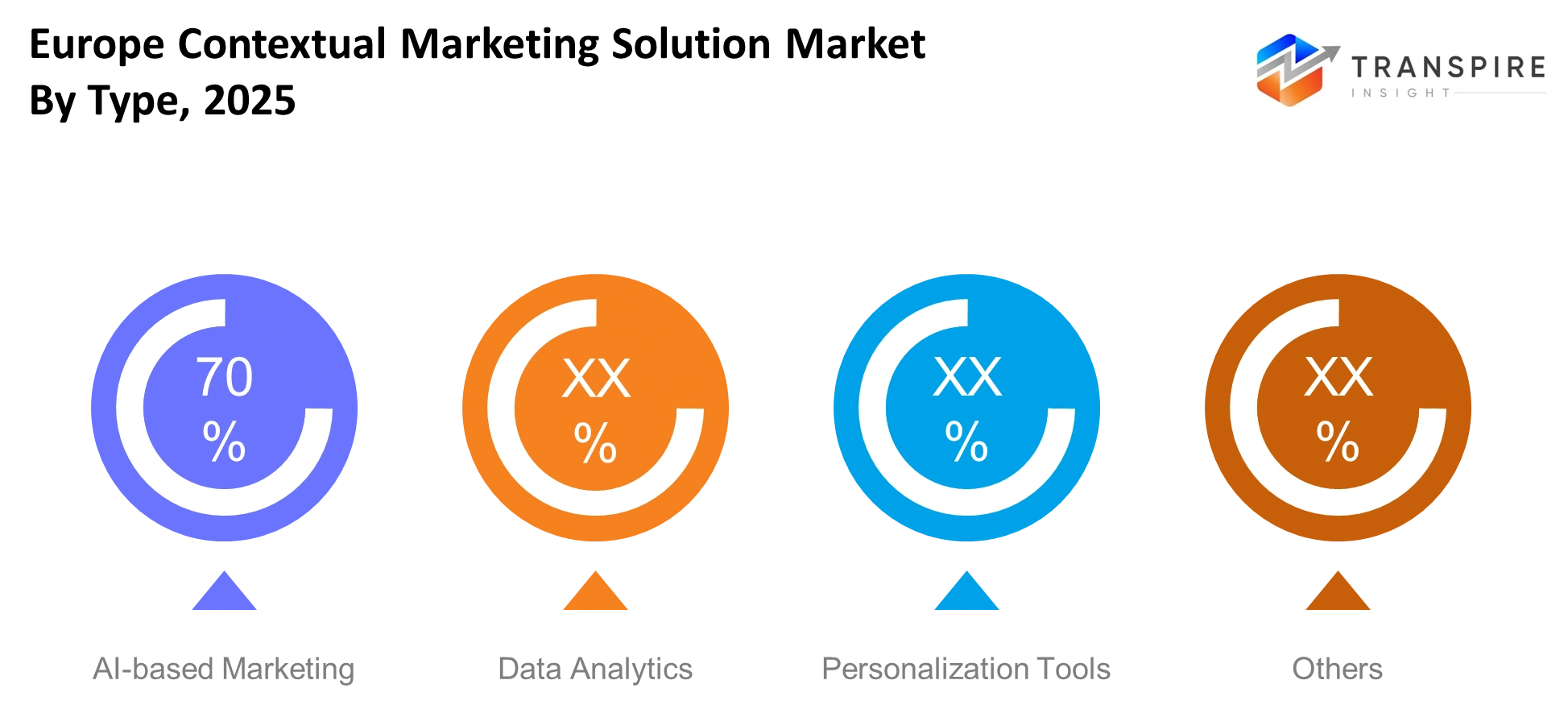
The type segment currently sees AI-based marketing solutions as the leading solution because businesses now focus on three key automated solutions which include personalized marketing and targeted advertising and real-time campaign management. Large retailers and telecom operators and financial institutions spend more on technology because they invest in AI-powered recommendation systems which enhance their ability to convert sales and keep customers. Data analytics platforms maintain the second-largest position since companies require unified behavioral intelligence to support audience segmentation and cross-channel engagement.
The usage of personalization tools has risen across Europe because mobile commerce and digital subscription services continue to grow their presence in European markets. Workflow orchestration and campaign monitoring tools belong to smaller categories which help specific operational needs but their adoption rate remains low because of their integration challenges. Businesses require first-party data for their operations since new privacy laws mandate this requirement. Companies will achieve future success through their ability to develop integrated platforms that combine generative AI and multilingual automation and predictive analytics for reduced costs and improved campaign results.
To learn more about this report, Download Free Sample Report
By Application
The current advertising applications dominate the market because brands need contextual engagement strategies to boost their conversion rates and manage their advertising expenditures. Digital advertising platforms now use behavioral analytics in real time to deliver targeted ads across e-commerce websites, streaming platforms, and mobile applications. Customer engagement solutions hold the second-largest market position because enterprises focus on building relationships with existing customers rather than acquiring new customers from different target markets. Content marketing applications are experiencing rapid growth because businesses now use AI-generated recommendations together with automated campaign localization and dynamic messaging systems.
Media companies and online retailers increasingly use contextual engines which modify their advertising content based on user browsing patterns and users' physical locations and users' past purchases. Businesses are developing their smaller application areas which include loyalty management and customer support integration, but these areas have lower priority for business investments. The upcoming competitive landscape will enter a new phase which favors platforms that can create smooth user experiences for social media and connected television and mobile application and digital storefront interactions while they comply with European data privacy regulations.
By End-User
E-commerce businesses and consumer brands continue to allocate substantial resources toward developing contextual targeting technologies which help them boost their online sales and customer retention efforts. Businesses that operate at high transaction levels while their customers interact with their digital platforms create an ideal environment for implementing advanced recommendation systems and predictive analytics technologies. Digital onboarding and fraud alerts and financial product promotions receive personalized solutions from BFSI institutions which serve as the second-largest market segment after banks.
Media companies show rapid growth because streaming services and digital publishing and online advertising markets have become more competitive. Healthcare organizations are also increasing adoption of privacy-focused engagement platforms that support compliant patient communication and digital outreach initiatives. The travel and hospitality sectors continue to grow their investment in mobile booking systems because those systems now drive the majority of customer acquisition efforts. Future market expansion will favor technology vendors capable of delivering sector-specific AI models, secure customer data integration, and measurable return-on-investment metrics across highly regulated industries.
By Deployment
Enterprises select cloud deployment as their primary deployment method because they value superior scalability which brings lower costs and enables quicker software updates. Subscription-based cloud platforms enable businesses to implement contextual intelligence tools throughout multiple regions with minimal hardware expenses. Organizations that need to maintain complete data control and follow strict regulatory standards continue to depend on on-premise systems which provide essential functions for their operations. The need for data protection drives enterprises to adopt hybrid deployment models which provide them with operational flexibility. Organizations now implement cloud-based campaign orchestration together with on-premise customer databases to enhance security measures while preserving compliance requirements.
Organizations now implement cloud-based campaign orchestration together with on-premise customer databases to enhance security measures while preserving compliance requirements. Smaller deployment methods that include edge-based and decentralized architectures encounter difficulties because they require complex operations which lead to high maintenance costs. Future growth within deployment models will likely center on hybrid cloud ecosystems that support real-time analytics AI-powered personalization and secure first-party data processing without compromising scalability or cross-border compliance standards.
What are the Key Use Cases Driving the Europe Contextual Marketing Solution Market?
Retail and e-commerce platforms represent the primary use case because brands utilize contextual intelligence to create personalized marketing content that includes promotions and product recommendations and mobile advertising which they deliver to customers during specific moments. The combination of high transaction volumes and strong digital competition forces retailers to implement AI-based engagement systems which will help them increase their sales and customer loyalty.
BFSI and telecom sectors are experiencing growth through their development of secondary applications. Contextual marketing tools enable banks to create customized loan offers and fraud alerts and digital onboarding experiences while telecom operators use predictive engagement systems to decrease subscriber churn and enhance their upselling capabilities. Media companies and streaming platforms use behavioral analytics to improve their content recommendation systems and advertising revenue generation processes.
The development of new applications combines AI-powered multilingual advertising campaigns with immediate user interaction through connected television systems and voice-activated shopping platforms. Healthcare organizations are currently examining privacy-compliant contextual communication systems to enhance their ability to reach patients through appointment reminders and customized health management interactions within regulated digital spaces.
|
Report Metrics |
Details |
|
Market size value in 2025 |
USD 2.35 Billion |
|
Market size value in 2026 |
USD 2.62 Billion |
|
Revenue forecast in 2033 |
USD 5.61 Billion |
|
Growth rate |
CAGR of 11.49% from 2026 to 2033 |
|
Base year |
2025 |
|
Historical data |
2021 - 2024 |
|
Forecast period |
2026 - 2033 |
|
Report coverage |
Revenue forecast, competitive landscape, growth factors, and trends |
|
Regional scope |
Europe (Germany, United Kingdom, France, Italy, Spain and Rest of Europe) |
|
Key company profiled |
Google, Adobe, Salesforce, Oracle, SAP, IBM, HubSpot, SAS Institute, Zoho, CleverTap, MoEngage, Braze, Insider, Dynamic Yield, Amplitude |
|
Customization scope |
Free report customization (country, regional & segment scope). Avail customized purchase options to meet your exact research needs. |
|
Report Segmentation |
By Type (AI-based Marketing, Data Analytics, Personalization Tools, Others), By Application (Advertising, Customer Engagement, Content Marketing, Others), By End-User (Retail, BFSI, Media, Healthcare, Others), By Deployment (Cloud, On-premise, Hybrid, Others) |
Which Regions are Driving the Europe Contextual Marketing Solution Market Growth?
The Western European market reaches its highest point because Germany and the United Kingdom and France together create the area with most digital commerce enterprises and financial institutions and advanced advertising technology companies. The strict enforcement of GDPR regulations required businesses to select their first-party data systems and privacy-compliant contextual engagement solutions before they started their data collection operations. The combination of advanced cloud infrastructure and widespread internet access and established AI research centers enables companies to quickly implement predictive marketing technologies in their retail and telecom operations. The presence of major technology vendors and digital agencies and enterprise software integrators in the region boosts two things which help the region maintain its market position through faster platform development and better enterprise customer acquisition.
The second biggest contribution from Northern Europe occurs because the region achieves growth through digital maturity instead of relying on its market size which Western Europe uses as its main growth factor. Sweden Denmark and Finland maintain consumer ecosystems that provide complete connectivity while their companies continuously develop cloud-based enterprise systems. Regional companies focus on three main areas which include improving operational efficiency and protecting their systems and developing their technologies for future needs instead of pursuing aggressive growth plans. Digital transformation receives strong backing from governments while enterprises show high readiness levels which establishes a steady income stream for SaaS-based contextual marketing companies that provide analytics and personalized content solutions.
Central and Eastern Europe experience their fastest growth period because Poland and the Czech Republic and Romania are currently increasing their spending on digital commerce and cloud infrastructure development.
Who are the Key Players in the Europe Contextual Marketing Solution Market and How Do They Compete?
The current competitive environment shows moderate market consolidation because global software companies control most major system implementations while specialized AI marketing companies develop their own niche markets. Competition focuses on three factors which include technology depth and first-party data integration and real-time personalization capabilities instead of only pricing. The major companies in the industry use their unified cloud platforms which include analytics and customer data management and campaign orchestration and AI automation to maintain their market dominance. Mid-sized businesses prefer emerging SaaS providers because these companies deliver quick deployment solutions at reduced infrastructure expenses while providing specific tools for privacy-compliant digital marketing.
Adobe achieves market differentiation through its complete integration of analytics and creative content production together with AI-driven customer journey management. The company establishes a competitive edge by integrating generative AI solutions into its marketing processes which enable businesses to create personalized multilingual content in large volumes. The company develops its customer relationship intelligence system through cloud-based technology that provides real-time customer engagement automation. Salesforce establishes market superiority through its system which combines CRM technology with predictive marketing solutions to help telecom companies and financial institutions achieve complete customer experience management across multiple platforms.
Company List
- Adobe
- Salesforce
- Oracle
- SAP
- IBM
- HubSpot
- SAS Institute
- Zoho
- CleverTap
- MoEngage
- Braze
- Insider
- Dynamic Yield
- Amplitude
Recent Development News
In April 2026, OpenAI Partners with Smartly to Develop Conversational Advertising Tools: Finnish-origin marketing automation company Smartly became one of OpenAI’s first adtech partners focused on optimizing contextual ad experiences inside AI-driven environments. The partnership aims to create interactive, conversational advertising formats that adapt in real time, strengthening Europe-linked innovation in contextual marketing solutions.
Source: https://www.businessinsider.com
In April 2026,Seedtag Launches “NeuroX” for AI-Driven Contextual Advertising Expansion: Spain-based adtech company Seedtag introduced “NeuroX,” a neuro-contextual advertising exchange designed to improve media planning and activation using AI and neuroscience-based audience analysis. The launch reflects Europe’s accelerating shift toward privacy-first contextual marketing technologies as advertisers reduce reliance on third-party cookies.
Source: https://www.prnewswire.com
What Strategic Insights Define the Future of the Europe Contextual Marketing Solution Market?
The Europe Contextual Marketing Solution Market is currently developing toward engagement ecosystems which use real-time contextual intelligence to replace traditional audience tracking systems through AI-driven privacy-protecting technologies. Between five to seven years from now organizations will gain competitive advantage through their possession of superior first-party data and multilingual generative AI abilities and their capacity to connect different platforms used in commerce and media and customer service operations. The permanent removal of third-party cookies together with stricter European digital governance regulations creates the fundamental driver for this transformation.
The actual market risk develops when a few cloud providers and enterprise software companies gain control over important customer data infrastructure. The system would create proprietary AI ecosystems which would restrict access to other systems while creating vendor dependency which would result in higher future costs for businesses. Central and Eastern Europe show developing potential through connected television advertising and AI-powered voice commerce because digital infrastructure investment keeps growing in these regions.
The optimal solution for market participants requires them to pursue API-based platforms which enable safe integration with CRM systems and analytics tools and commerce systems instead of using closed systems that restrict their operational possibilities.
Europe Contextual Marketing Solution Market Report Segmentation
By Type
- AI-based Marketing
- Data Analytics
- Personalization Tools
- Others
By Application
- Advertising
- Customer Engagement
- Content Marketing
- Others
By End-User
- Retail
- BFSI
- Media
- Healthcare
- Others
By Deployment
- Cloud
- On-premise
- Hybrid
- Others
Frequently Asked Questions
Find quick answers to common questions.
The approximate Europe Contextual Marketing Solution Market size for the market will be USD 5.61 Billion in 2033.
The key segments of the Europe Contextual Marketing Solution Market are By Type (AI-based Marketing, Data Analytics, Personalization Tools, Others), By Application (Advertising, Customer Engagement, Content Marketing, Others), By End-User (Retail, BFSI, Media, Healthcare, Others), By Deployment (Cloud, On-premise, Hybrid, Others).
Major players in the Europe Contextual Marketing Solution Market are Google, Adobe, Salesforce, Oracle, SAP, IBM, HubSpot, SAS Institute, Zoho, CleverTap, MoEngage, Braze, Insider, Dynamic Yield, Amplitude.
The current market size of the Europe Contextual Marketing Solution Market is USD 2.35 Billion in 2025.
The Europe Contextual Marketing Solution Market CAGR is 11.49%.
- Adobe
- Salesforce
- Oracle
- SAP
- IBM
- HubSpot
- SAS Institute
- Zoho
- CleverTap
- MoEngage
- Braze
- Insider
- Dynamic Yield
- Amplitude
Recently Published Reports
-
Apr 2026
Bottled Water Market
Bottled Water Market Size, Share & Analysis Report By Product Type (Still Bottled Water, Carbonated Bottled Water, Functional Bottled Water, and Others), By Packaging (PET, Cans, and Others), By Sales Channel (Supermarkets/Hypermarkets, Convenience Stores/Drug Stores, Grocery Stores/Club Stores, Foodservice, and Others) and Geography (North America, Europe, Asia-Pacific, Middle East and Africa, South and Central America), 2021 - 2032
-
Apr 2026
Color Cosmetic Packaging Market
Color Cosmetic Packaging Market Size, Share & Analysis Report By Application (Mascara Packaging, Liquid Packaging, and Liquid Face), By Type (Tubes & Bottles, Pens & Markers, Compacts & Containers, and Droppers & Pumps), and Geography (North America, Europe, Asia-Pacific, Middle East and Africa, South and Central America), 2021 - 2031
-
Apr 2026
External Microphone For Camera Market
External Microphone For Camera Market Size, Share & Analysis Report By Type (Shotgun Microphone, Lavalier Microphone, and Others), By Application (Digital Camera, Professional Video Camera, and Others), and Geography (North America, Europe, Asia-Pacific, Middle East and Africa, South and Central America), 2021 - 2031
-
Apr 2026
Foot Orthotic Insoles Market
Foot Orthotic Insoles Market Size, Share & Analysis Report By Type (Pre-fabricated, and Custom-made), By Material (Thermoplastic, Composite Carbon Fiber, and Others), By Distribution Channel (Drug Stores, Hospitals & Clinics, and Others), and Geography (North America, Europe, Asia-Pacific, Middle East and Africa, South and Central America), 2021 - 2031