
Asia Pacific Contact Lenses Market Size & Forecast:
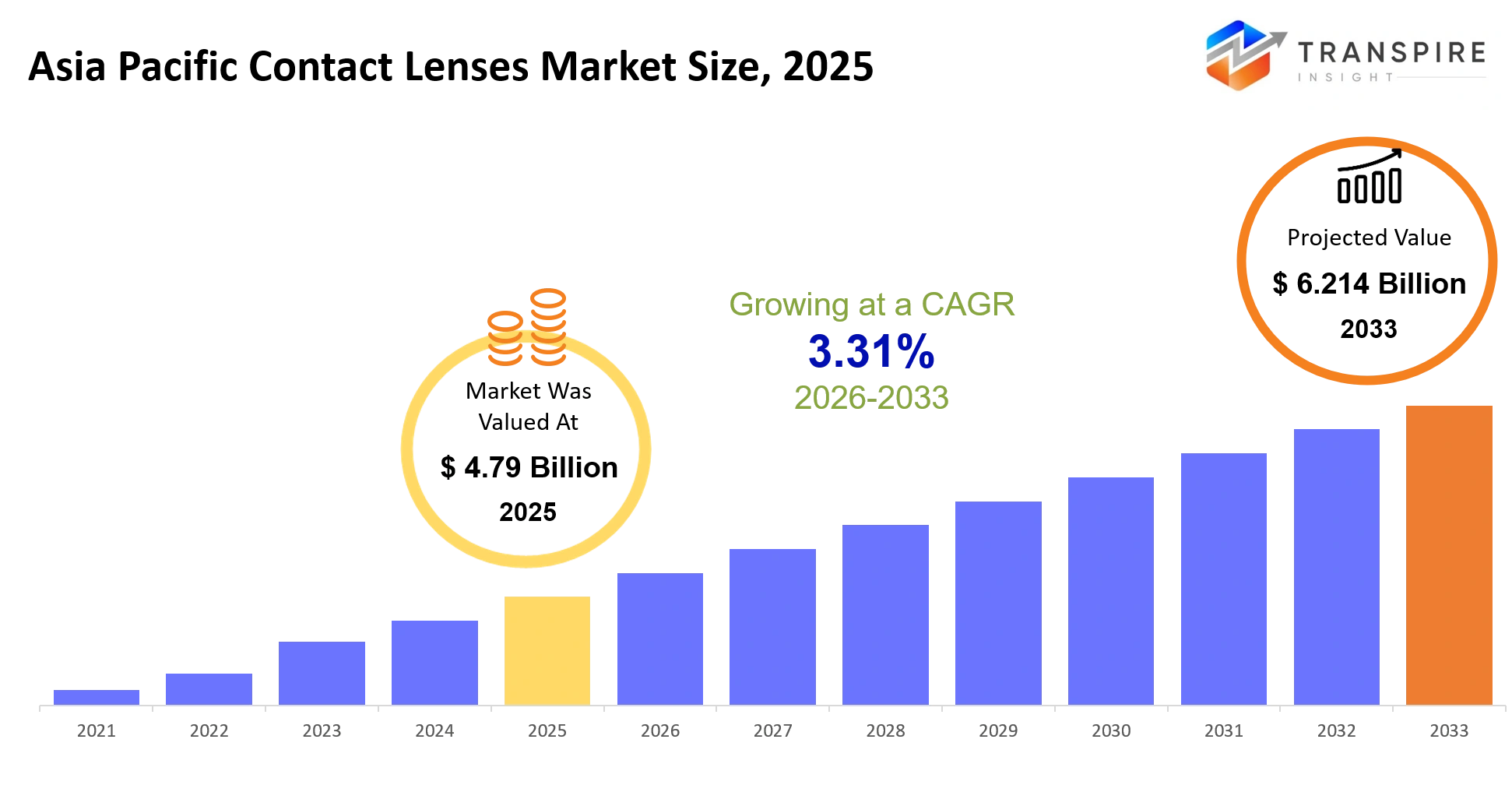
- Asia Pacific Contact Lenses Market Size 2025: USD 4.79 Billion
- Asia Pacific Contact Lenses Market Size 2033: USD 6.214 Billion
- Asia Pacific Contact Lenses Market CAGR: 3.31%
- Asia Pacific Contact Lenses Market Segments: By Product Type (Soft Contact Lenses, Rigid Gas Permeable Lenses, Hybrid Lenses, Scleral Lenses, Cosmetic Lenses, Others); By Usage (Daily Disposable, Weekly Disposable, Monthly Disposable, Annual Replacement, Others); By Distribution Channel (Optical Stores, Hospitals, Online Retail, Clinics, Others); By End User (Adults, Teenagers, Elderly, Others).
To learn more about this report,  Download Free Sample Report
Asia Pacific Contact Lenses Market Summary
The Asia Pacific Contact Lenses Market was valued at USD 4.79 Billion in 2025. It is forecast to reach USD 6.214 Billion by 2033. That is a CAGR of 3.31% over the period.
The Asia Pacific contact lenses market plays a kind of practical role in helping users correct vision, while also fitting lifestyle needs that regular eyeglasses often cannot really deal with. Contact lenses are used commonly for myopia, hyperopia, astigmatism, and even for cosmetic enhancement,so they sit inside the region’s wider vision-care ecosystem in a meaningful way. Their ease for work, sports, and day-to-day routines involving lots of digital devices has pushed them past “just” eyesight adjustment.
In the last three to five years, the whole market has kinda moved structurally toward silicone hydrogel, daily disposable formats, and specialty lenses that promise more comfort, better oxygen flow, and general ocular well-being advantages. The COVID-19 pandemic was a big pivot point, at first it disrupted eye care appointments and supply lines,then it also helped speed up e-commerce and direct-to-consumer shopping paths. Since screen exposure keeps stretching out, and myopia trends keep rising in large markets like China, Japan,and South Korea, people are looking for more advanced refractive solutions. That shift is encouraging premium purchases, it supports repeat buying ,and it opens up richer revenue streams for manufacturers, plus optical and eye care providers.
Key Market Insights
- East Asia kinda dominates the Asia Pacific Contact Lenses Market, it is roughly 55–60% market share in 2025, and it's mostly led by China, Japan, and South Korea.
- Southeast Asia is moving the quickest during the forecast years , backed by expanding urban populations and better access to vision care services, overall.
- Soft contact lenses are still the main part of the market, with about 80–85% share in 2025, and that's because of comfort, convenience, and wide consumer acceptance.
- Reusable lenses are next in line, basically the second-largest segment, supported by cost minded buyers and long-term users in more mature markets.
- Daily disposable lenses are the fastest-growing segment through 2030, they benefit from hygiene advantages and less maintenance hassles.
- Silicone hydrogel lenses keep gaining share too, mainly due to better oxygen transmission, and improved wearer comfort too.
- Vision correction really takes the lead, and it’s responsible for roughly 85–90% of the whole market revenue in 2025. You can see it pretty clearly.
- Meanwhile myopia management is creeping up as one of the most rapidly expanding applications, especially with children and adolescents across East Asia, where demand is rising.
- Also specialty lenses aimed at astigmatism and presbyopia are showing solid momentum, partly because aging populations are expanding through the region at a steady pace.
- For end users, adults still dominate the scene, they hold over 70% of the market share in 2025. That’s mostly tied to stronger purchasing power, plus a higher level of product familiarity overall.
What are the Key Drivers, Restraints, and Opportunities in the Asia Pacific Contact Lenses Market?
The strongest growth driver in the Asia Pacific contact lenses market is the quick lift in myopia and other refractive issues, mainly across city dwellers in China, South Korea, Japan, and Singapore. More time in front of screens, dense schooling environments , and longer stretches spent indoors have basically widened the pool of potential wearers. On top of that, improvements in silicone hydrogel materials , plus daily disposable lenses, have made wearing them easier and safer, so fewer people stop using them partway through. In the end, this mix of a larger vision correction audience and more people switching to premium options has boosted repeat buying, which lets manufacturers earn more revenue per individual.
The biggest drag though is the built in reliance on professional eye tests and fitting services. Contact lens use really depends on continuous clinical supervision, to confirm the correct lens choice and to keep monitoring eye well-being. A lot of emerging Asia Pacific areas still struggle with uneven availability of optometrists and specialized eye-care facilities outside major urban centers. That problem is not going to get fixed soon , because it takes longer term investment in healthcare capability, staff learning, and distribution systems. Because of this, many potential users either postpone adoption or stick with cheaper, lower-value vision correction alternatives.
A major opportunity sits with myopia-management lenses for children and teenagers. Specialty soft lenses as well as orthokeratology options, which are meant to slow myopia progression, are getting broader clinical buy-in across East Asia. As public health bodies and clinics put more emphasis on kids' vision health, companies that back evidence-based myopia-control technology can tap into a faster growing lane, with premium margins and strong long-term patient retention , even if that sounds slower at first, it usually compounds over time.
What Has the Impact of Artificial Intelligence Been on the Asia Pacific Contact Lenses Market?
Artificial intelligence is now, kind of quietly, reshaping the contact lens value chain, mostly across eye-care diagnostics, manufacturing, and day to day patient management. With AI enabled retinal imaging and vision-screening platforms, clinics can read through eye scans much faster and flag refractive irregularities sooner. This, in turn, helps them spot who is likely a solid candidate for contact lens wear. As a result, screening doesn’t drag on as much and the workflow feels a bit smoother, especially when the eye-care centers are hectic and running high volume.
On the manufacturing side companies are leaning into machine learning to smooth out day-to-day production routines, too. Predictive quality control setups can catch microscopic defects in lens materials before the products ever reach the packaging line, so things stay steady and less chaotic. Less scrap, better yield, more consistency. And then there is AI driven demand forecasting which helps align inventory with regional buying behaviors. That means fewer stockouts and also fewer losses tied to overstock, even when purchasing patterns shift.
Clinically, predictive analytics can back more tailored lens suggestions. Instead of a generic approach, the system weighs tear film stability, corneal geometry, prescription history, and even wearing habits. That tends to lift fitting accuracy, and it can support better long term user retention. Digital customer engagement tools also play a role, they can boost reorder rates using automated nudges and product suggestions that feel more personal.
Still, AI rollouts don’t happen without friction. Integration costs can be high, healthcare data systems are often fragmented, and data quality can vary across Asia Pacific markets, which may push down model performance and slow down implementation. Smaller clinics, in particular, may not have the digital setup required to really benefit from advanced AI driven eye-care solutions. So adoption stays uneven, region by region, rather than leveling out quickly.
Key Market Trends
- Since 2020, daily disposable lenses have been gaining share, because more consumers seem to care about hygiene and convenience, and they feel the infection risk is lower now after the whole pandemic thing .
- Silicone hydrogel lenses have basically kept moving conventional hydrogel products out of the way, aided by higher oxygen permeability, plus a comfort profile that stays stable for longer wear sessions, as well.
- Between 2021 and 2025, major players like Johnson & Johnson Vision and Alcon continued to ramp up spending on premium specialty lens portfolios not only the standard, general options.
- Myopia control lenses kind of shifted from a niche offering into more of a strategic growth lane, as childhood myopia rates kept climbing across multiple East Asian markets.
- Online contact lens purchases took a bigger chunk of the sales pie after lockdown disruptions, in a way that sped up digital eye-care, and also direct-to-consumer routes.
- Manufacturers are rolling out AI-enabled production monitoring, together with automated quality checks so they can reduce defects and also bump up manufacturing efficiency , without relying on so much manual checking.
- Regional supply chains got more diversified after pandemic-related disruptions, made it obvious how risky concentrated sourcing can be, and how brittle logistics networks sometimes are.
- Eye-care providers more and more recommend personalized lens fitting, plus specialty design options , because the market is shifting toward patient-specific vision correction.
- Since 2022, companies have been tightening collaborations with optical chains and healthcare providers, mainly to boost customer retention, and get more recurring purchases.
- Competitive differentiation has moved away from basic vision correction alone, toward comfort, eye-health benefits, and myopia-management tech that’s clinically backed.
Asia Pacific Contact Lenses Market Segmentation
By Product Type :
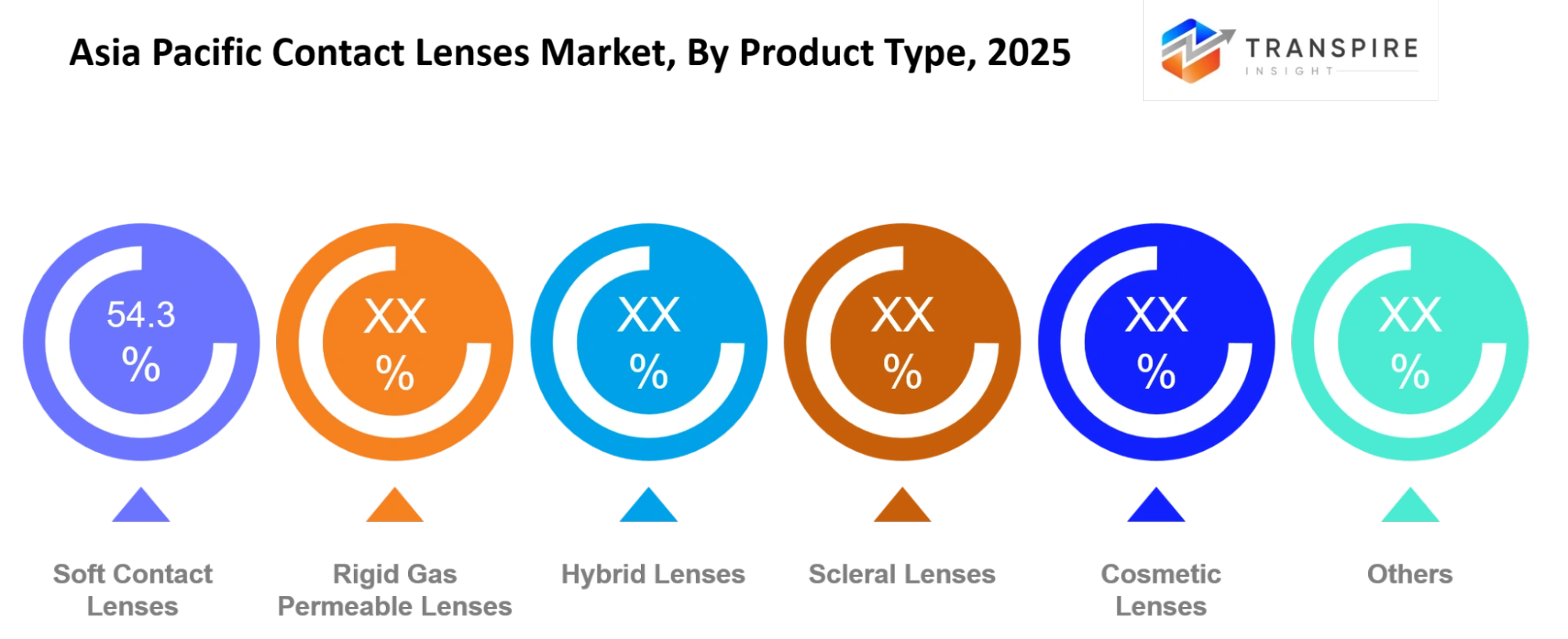
Soft contact lenses still hold a major spot, mainly thanks to comfort, flexibility and that easier adaptation for people trying them for the first time. For everyday tasks, long stretches at work, and the general wish for convenient vision correction, adoption in many countries of the region keeps moving forward. At the same time, lens material improvements keep making a real difference, especially for moisture retention and that overall wearing comfort, it feels a bit smoother over time.
Rigid gas permeable lenses on the other hand, are known for crisp vision and durability, so they work well for certain vision conditions. Hybrid lenses are kind of a midway solution, they bring the comfort you associate with soft lenses together with the visual sharpness you expect from more rigid designs. Scleral lenses go another direction and serve people with complex corneal issues, yes, for them it can be more suitable. Cosmetic lenses also remain in demand for aesthetic reasons, especially for younger consumers. And then there are other specialty options, these cover distinctive visual requirements and help expand market development overall.
To learn more about this report, Download Free Sample Report
By Usage :
Daily disposable lenses really caught on because they remove that whole cleaning routine and you just get a fresh pair every single time. People are paying more attention to eye hygiene, and honestly the convenience matters every day, so many consumers drift toward these single use products. You can notice the shift more clearly in urban areas, where hectic schedules shape what people pick up and when they pick it up.
Weekly and monthly disposable lenses keep attracting users who want a sort of middle ground between cost and performance. Annual replacement lenses stay relevant too, mostly among long-term wearers who actually follow recommended maintenance routines. Beyond that there are other usage categories, including specialty replacement schedules created for specific medical needs or lifestyle habits. With different replacement cycles available, manufacturers can serve varied consumer preferences, and also match different spending patterns without making it so complicated.
By Distribution Channel :
Optical stores stay a pretty big sales avenue, because shoppers often want some professional guidance before they buy contact lenses. There’s product selection, fitting help, and then after-sales support too, so physical retail locations still matter. A lot of people just feel better doing in person consultations when they’re picking lens types and prescriptions, even if online is easier.
Hospitals and clinics also help the distribution side through eye exams and professional suggestions. At the same time, online retail has been growing a lot, mainly from digital shopping convenience, more choices on hand, and subscription based purchasing options. Other channels include specialized healthcare providers and independent retailers which makes products more accessible in both big cities and also in developing areas across the region.
By End User :
Adults are the biggest end user group, since vision correction needs are widespread, professional requirements matter, and many people keep an active lifestyle. Regular use for work, schooling, and recreational activities keeps purchasing patterns steadier. Premium lens adoption is also more common here because spending capacity is higher, and long term usage habits are more established.
Teenagers make up another important consumer segment, because myopia rates keep climbing across several Asia Pacific countries. Older users are also increasingly choosing contact lenses made for age related vision issues, plus better comfort. Other end users include people who have specialized sight needs or medical conditions, and they often benefit from customized contact lens solutions that fit their specific situation.
What are the Key Use Cases Driving the Asia Pacific Contact Lenses Market?
Vision correction is still the main thing pushing the Asia Pacific Contact Lenses Market forward. Most people who adopt them are dealing with myopia, hyperopia, astigmatism, and a range of other refractive errors, so the use case is pretty steady. Contact lenses hold strong appeal because they keep sight clear and unobscured, they also fit well with active lifestyles, plus they’re a more convenient pick than eyeglasses for work, schooling, and everyday routines, even when you’re moving around a lot.
Past the basic vision correction angle, cosmetic plus lifestyle oriented uses are starting to get more attention, particularly with younger buyers. Colored lenses , and other look enhancing options have been showing up more often in fashion and personal care circles. Meanwhile, specialty lenses aimed at astigmatism and presbyopia are also getting broader adoption among adults who want a more tailored visual solution rather than something generic.
There are also new and emerging uses, like myopia control lenses made for children and adolescents, especially in nations seeing high levels of childhood vision decline. Another area is the rise of advanced therapeutic contact lenses, designed to handle particular corneal issues and to help with post surgical recovery. With clinical proof gradually getting stronger, and eye care infrastructure improving, these specialized applications should unlock fresh growth chances over the forecast period, not just in volume but also in product mix.
|
Report Metrics |
Details |
|
Market size value in 2025 |
USD 4.79 Billion |
|
Market size value in 2026 |
USD 4.948 Billion |
|
Revenue forecast in 2033 |
USD 6.214 Billion |
|
Growth rate |
CAGR of 3.31% from 2026 to 2033 |
|
Base year |
2025 |
|
Historical data |
2021 - 2024 |
|
Forecast period |
2026 - 2033 |
|
Report coverage |
Revenue forecast, competitive landscape, growth factors, and trends |
|
Regional scope |
Asia Pacific (India, China, Japan, Australia, South Korea, Rest of Asia Pacific) |
|
Key company profiled |
Johnson & Johnson Vision, Alcon, CooperVision, Bausch + Lomb, Menicon, Carl Zeiss, EssilorLuxottica, SEED, Hoya, BenQ Materials, St.Shine, Pegavision, Neo Vision, Clearlab, Camax. |
|
Customization scope |
Free report customization (country, regional & segment scope). Avail customized purchase options to meet your exact research needs. |
|
Report Segmentation |
By Product Type (Soft Contact Lenses, Rigid Gas Permeable Lenses, Hybrid Lenses, Scleral Lenses, Cosmetic Lenses, Others); By Usage (Daily Disposable, Weekly Disposable, Monthly Disposable, Annual Replacement, Others); By Distribution Channel (Optical Stores, Hospitals, Online Retail, Clinics, Others); By End User (Adults, Teenagers, Elderly, Others). |
Which Regions are Driving the Asia Pacific Contact Lenses Market Growth?
East Asia still kind of remains the main region in the Asia Pacific Contact Lenses Market,mostly pushed by China , Japan and South Korea. There’s a lot of factors behind it, like high myopia rates , more developed eye-care infrastructure and just broad access to optometry services. Together they form a solid base for continued take up. You can also see the advantage of large retail and e-commerce channels,which means premium and special purpose lenses are easy to find. And then there is continuous product innovation , plus consumers that genuinely accept advanced vision-care solutions,so East Asia keeps its leading position.
Japan is the second most influential regional market, but it’s also a bit different from the wider East Asia narrative. Instead of only volume growth,it leans more toward premiumization and longer-term product loyalty. People tend to care a lot about comfort , safety , and lens technologies that are clinically proven. This naturally keeps demand steadier for higher-value products. Japan also has a mature healthcare system and fairly consistent eye-care habits, which supports routine lens replacement and follow-up appointments. So even if the broader economic picture changes, Japan still acts like a dependable source of regional revenue.
Southeast Asia is, right now, the fastest growing region, mainly because healthcare access is getting better, disposable incomes keep rising and optical retail networks keep expanding. Markets like Indonesia , Vietnam, Thailand and the Philippines have shown stronger penetration of both international as well as regional contact lens brands in the last few years. On top of that, digital commerce platforms are expanding quickly, making products more reachable even beyond major cities. Over the 2026–2033 period, this momentum should turn into real and attractive openings for manufacturers, distributors and investors, especially those trying to reach vision-care markets that are still underpenetrated.
Who are the Key Players in the Asia Pacific Contact Lenses Market and How Do They Compete?
In the Asia Pacific contact lenses market, competition looks moderately consolidated, like there are just a few multinational manufacturers that take a big chunk of the regional revenue. The rivalry isn’t only about price, more about material technology, comfort performance, specialty lens development, and how far distribution really goes in practice. Existing players keep market share by pouring money into research and development, while regional brands try to win by matching local tastes and hopping into niche product categories Sometimes it feels very specific.
Johnson & Johnson Vision leans hard on advanced daily disposable and silicone hydrogel technologies that are meant to support better comfort and eye health. This kind of premium lens performance gives them a clearer edge in more mature markets. Alcon instead plays with a wider portfolio, covering contact lenses and eye-care products at the same time, so it can tie in more tightly with clinical channels and optical retailers. Ongoing upgrades plus distribution partnerships across the region help reinforce its market footing.
CooperVision has carved out an advantage with specialty products, especially lenses made for myopia control and other complex vision correction requirements. Bausch + Lomb stands out by mixing its contact lens line with a broader eye-health offering, so healthcare professionals can create cross-selling momentum. Menicon, meanwhile, uses strong brand presence in Japan and stays focused on high-quality lens technologies that are tuned to what local consumers tend to expect. These firms keep going forward through product innovation, digital engagement approaches, and deeper movement into parts of emerging Southeast Asia where contact lens adoption is still comparatively limited.
Company List
- Johnson & Johnson Vision
- Alcon
- CooperVision
- Bausch + Lomb
- Menicon
- Carl Zeiss
- EssilorLuxottica
- SEED
- Hoya
- BenQ Materials
- St.Shine
- Pegavision
- Neo Vision
- Clearlab
- Carmax
Recent Development News
In March 2026,CooperVision launched MyDay® MiSight® 1 day myopia control soft contact lenses and announced phased expansion across Asia Pacific markets. The launch combines silicone hydrogel material with myopia-control technology, strengthening the company's position in the rapidly growing pediatric vision-care segment and expanding access to advanced contact lens solutions across the region.
Source: https://www.prnewswire.com/
In August 2025,CooperVision secured approval from Japan's Ministry of Health, Labour and Welfare for the manufacture and sale of MiSight® 1 day contact lenses. The approval made MiSight® 1 day the first soft contact lens authorized in Japan for myopia control in children, expanding the company's regulatory footprint in one of Asia Pacific's largest contact lens markets.
Source: https://coopervision.com/
What Strategic Insights Define the Future of the Asia Pacific Contact Lenses Market?
The Asia Pacific Contact Lenses Market is kinda moving toward a more specialized and clinically driven future, instead of that volume-led expansion thing. In the next five to seven years, growth should increasingly come from the premium lanes like myopia management, therapeutic lenses, and solutions that are tuned for customized vision correction. The real driver behind this change is basically the rising presence of complicated vision conditions, along with a more steady acceptance of evidence-based eye-care interventions. So, value creation is going to rely more on clinical results and product differentiation than on the simple “replace lenses, repeat” demand.
One sneaky risk is how advanced lens manufacturing , and even the sourcing of raw materials, is getting concentrated among a smaller bunch of suppliers. If anything disrupts specialty materials or manufacturing capacity, it could trigger supply issues and also squeeze margins across the regional market.
A big emerging opportunity is the expansion of digitally connected myopia-control programs in Southeast Asia . There, healthcare infrastructure and pediatric vision screening efforts are moving forward. Market players should look into investing early, in partnerships with eye-care providers, schools, and digital health platforms. The idea is to build long term patient ecosystems before the competition gets louder in these developing but high-value segments.
Asia Pacific Contact Lenses Market Report Segmentation
By Product Type
- Soft Contact Lenses
- Rigid Gas Permeable Lenses
- Hybrid Lenses
- Scleral Lenses
- Cosmetic Lenses
By Usage
- Daily Disposable
- Weekly Disposable
- Monthly Disposable
- Annual Replacement
By Distribution Channel
- Optical Stores
- Hospitals
- Online Retail
- Clinics
By End User
- Adults
- Teenagers
- Elderly
Frequently Asked Questions
Find quick answers to common questions.
The Asia Pacific Contact Lenses Market size is USD 6.214 Billion in 2033.
Key segments for the Asia Pacific Contact Lenses Market are By Product Type (Soft Contact Lenses, Rigid Gas Permeable Lenses, Hybrid Lenses, Scleral Lenses, Cosmetic Lenses, Others); By Usage (Daily Disposable, Weekly Disposable, Monthly Disposable, Annual Replacement, Others); By Distribution Channel (Optical Stores, Hospitals, Online Retail, Clinics, Others); By End User (Adults, Teenagers, Elderly, Others).
Major Asia Pacific Contact Lenses Market players are Johnson & Johnson Vision, Alcon, CooperVision, Bausch + Lomb, Menicon, Carl Zeiss, EssilorLuxottica, SEED, Hoya, BenQ Materials, St.Shine, Pegavision, Neo Vision, Clearlab, Camax.
The Asia Pacific Contact Lenses Market size is USD 4.79 Billion in 2025.
The Asia Pacific Contact Lenses Market CAGR is 3.31% from 2026 to 2033.
- Johnson & Johnson Vision
- Alcon
- CooperVision
- Bausch + Lomb
- Menicon
- Carl Zeiss
- EssilorLuxottica
- SEED
- Hoya
- BenQ Materials
- St.Shine
- Pegavision
- Neo Vision
- Clearlab
- Carmax
About the Authors

Pankaj Ghogare Patil
I am Pankaj Ghogare Patil, a Senior Research Analyst at Transpire Insight, specializing in the Pharmaceutical, Chemicals & Materials, Healthcare IT, and Biotechnology industry. My expertise lies in conducting comprehensive market research, analyzing industry trends, evaluating competitive landscapes, and translating complex data into actionable insights. At Transpire Insight, I closely follow emerging technologies, regulatory developments, and market innovations to create accurate, well-researched, and informative content that helps businesses and professionals make informed decisions. I am committed to producing credible, evidence-based articles that reflect industry best practices while making technical topics accessible and valuable for a broad audience.

Chakradhar Khansole
Chakradhar serves as the Research Director at Transpire Insight, bringing over 8 years of experience in technology, innovation, and strategic market intelligence. He specializes in transforming complex market data into actionable business insights that enable organizations to make informed, growth-oriented decisions. Recognized for his strategic vision and analytical expertise, Chakradhar leads high-impact research initiatives, delivering comprehensive market assessments, competitive intelligence, and forward-looking industry analysis.
Recently Published Reports
-
Apr 2026
AI in Diabetic Retinopathy Market
AI in Diabetic Retinopathy Market Size, Share & Analysis Report By Type (Screening AI Systems, Diagnostic AI Systems, and Predictive AI Models), By Application Segment (Hospitals, Ophthalmology Clinics, Diagnostic Centers, and Research and Development), and Geography (North America, Europe, Asia-Pacific, Middle East and Africa, South and Central America), 2021 - 2031
-
Apr 2026
Psychometric Tests Market
Psychometric Tests Market Size, Share & Analysis Report By Type (Personality Tests, Ability/Aptitude Tests, Skill/Knowledge Tests, and Others), By Application (Talent Acquisition and Talent Management), and Geography (North America, Europe, Asia-Pacific, Middle East and Africa, South and Central America), 2021 – 2031
-
Apr 2026
Rare Biological Sample Collection Market
Rare Biological Sample Collection Market Size, Share & Analysis Report By Type (Isolation Kits & Reagent, Blood Collection Tubes, and Others), By Application (Oncology, Transcriptomics, Pharmacogenomics, and Others), and Geography (North America, Europe, Asia-Pacific, Middle East and Africa, South and Central America), 2021 – 2031
-
Jul 2026
Diabetic Retinopathy Market
Diabetic Retinopathy Market Size, Share & Analysis Report By Type (Proliferative Diabetic Retinopathy, and Diabetic Macular Edema (DME)), By Treatment Type (Anti VEGF Drug, Steroid Implants, Laser Surgeries, and Vitrectomy), and Geography (North America, Europe, Asia-Pacific, Middle East and Africa, South and Central America), 2021 – 2031
Our Clients







