South Korea Disposable Contact Lenses Market Size & Forecast:
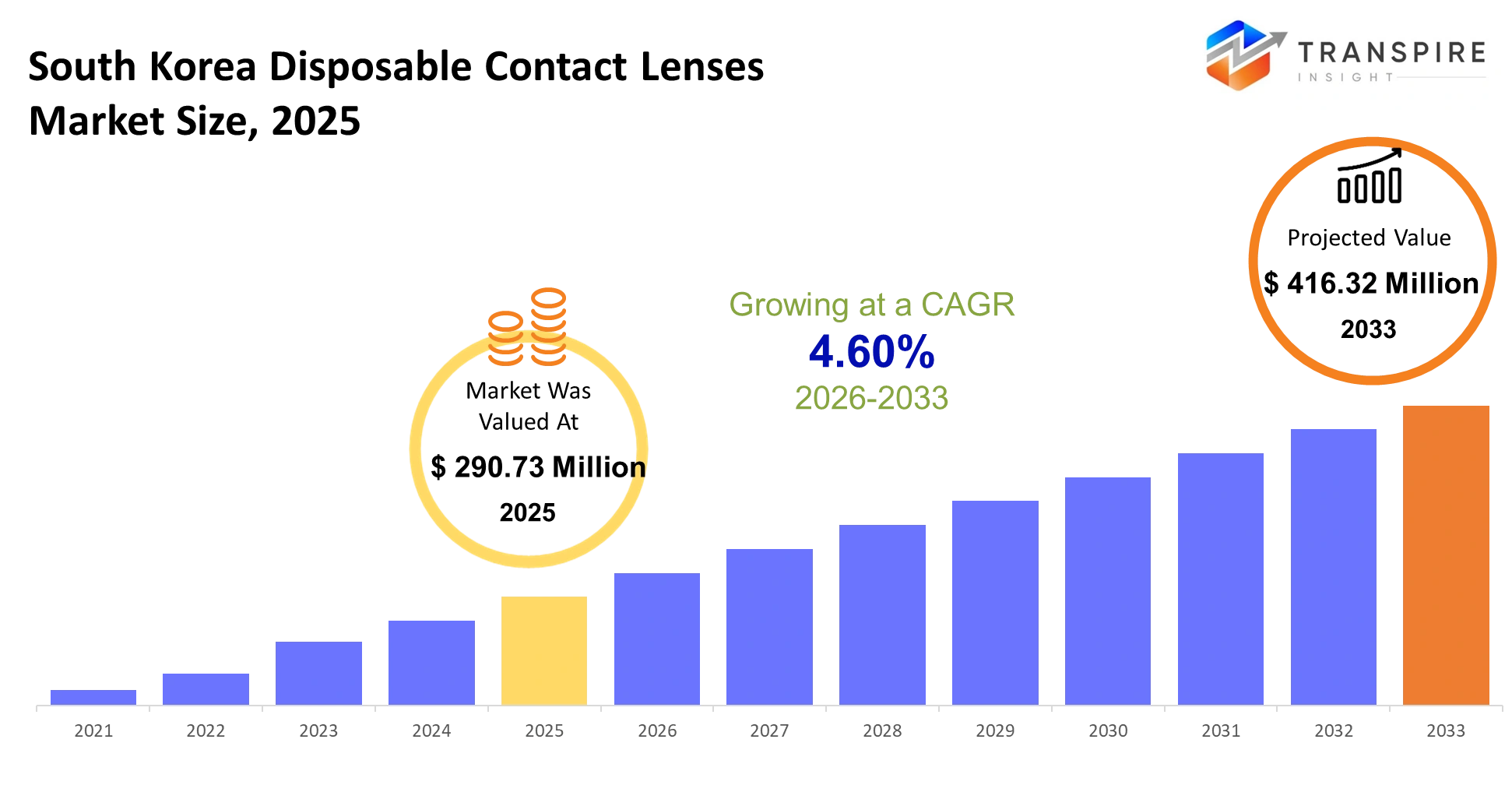
- South Korea Disposable Contact Lenses Market Size 2025: USD 290.73 Million
- South Korea Disposable Contact Lenses Market Size 2033: USD 416.32 Million
- South Korea Disposable Contact Lenses Market CAGR: 4.60%
- South Korea Disposable Contact Lenses Market Segments: By Product Type (Daily Disposable Lenses, Weekly Disposable Lenses, Monthly Disposable Lenses, Toric Lenses, Multifocal Lenses, Others); By Material (Silicone Hydrogel Lenses, Hydrogel Lenses, Hybrid Lenses, Others); By Application (Vision Correction, Cosmetic Use, Therapeutic Use, Others); By Distribution Channel (Optical Stores, Online Retail, Hospitals & Clinics, Others); By End User (Adults, Teenagers, Elderly Consumers, Others)
To learn more about this report,  Download Free Sample Report
South Korea Disposable Contact Lenses Market Summary
The South Korea Disposable Contact Lenses Market was valued at USD 290.73 Million in 2025. It is forecast to reach USD 416.32 Million by 2033. That is a CAGR of 4.60% over the period.
Disposable contact lenses cover a real day to day vision correction need for people who want sharp eyesight without leaning on traditional spectacles, or sticking with reusable lenses for long term. In general the market seems to back daily convenience, quick sports participation, lots of digital device time, and even cosmetic appearance improvement for many people living in towns and cities. In the last five years, things moved pretty decisively toward daily disposable silicone hydrogel products because customers kept putting weight on hygiene factors , oxygen flow through the lens, and a simpler routine with less hassle overall. Then the COVID-19 pandemic showed up and pushed that same shift forward, partly because people started paying closer attention to eye safety contamination control and personal wellbeing, especially during those longer stretches of mask wearing and screen sessions.
Now, market expansion is tied to a sort of direct link between digital lifestyles and worsening refractive conditions among teenagers plus working professionals. More screen time tends to raise eyestrain and can contribute to myopia development, and that in turn drives frequent rebuys, along with more premium lens choices. On top of that, e-commerce connections, AI supported eye testing tools that feel more accessible, and subscription based replenishment models make buying less troublesome, which then boosts customer staying power and gives manufacturers and retailers more recurring revenue.
Key Market Insights
- In 2025 the Seoul metropolitan area was basically around 48% market share, mainly because the optical retail networks are so dense, and people tend to spend more on premium lenses.
- Busan and Incheon show the quickest rise as regional anchors, driven by expanding online retail penetration, and also younger cosmetic lens buyers who are more active on shopping platforms.
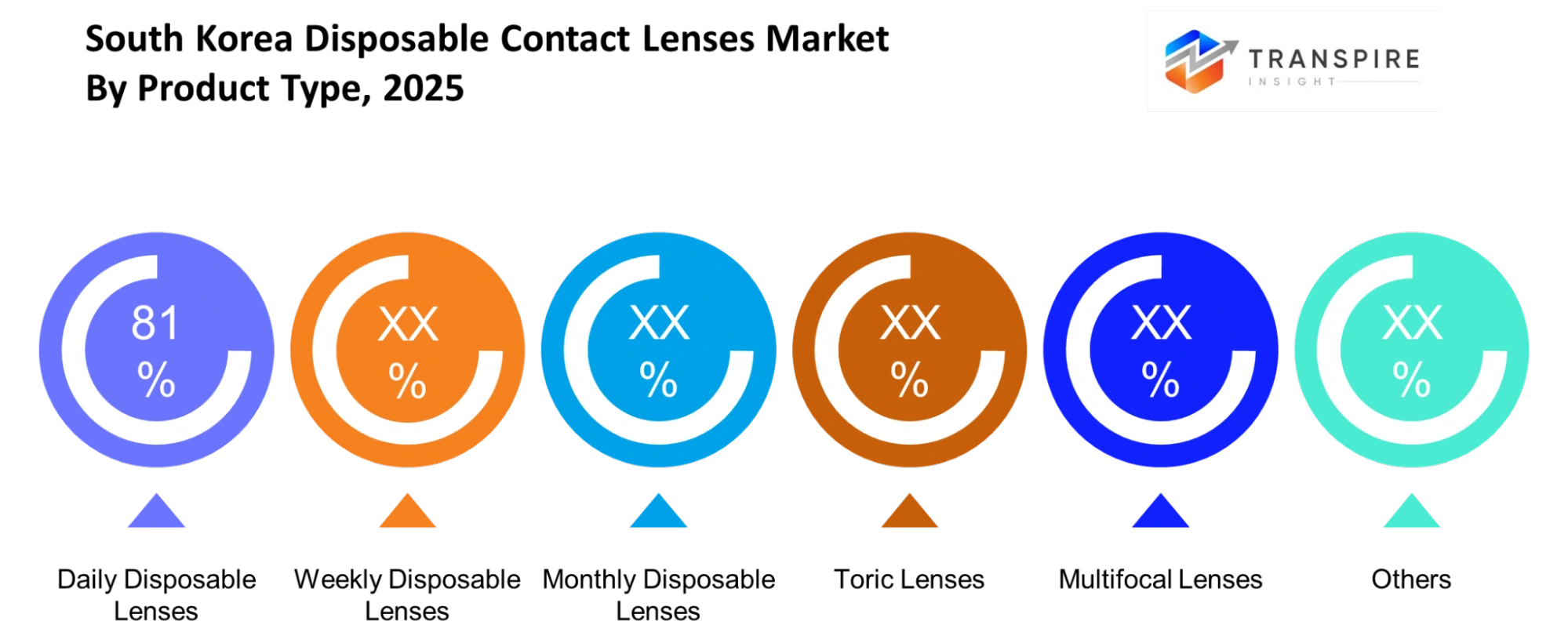
- Daily disposable lenses took the lead with roughly 42% share in 2025 , since hygiene-minded customers liked the single use replacement convenience, especially after the COVID-19 disruptions kind of reshaped habits.
- For the 2025 to 2033 window, toric lenses turned out to be the fastest-growing category, largely tied to more astigmatism diagnoses among digital device users.
- When it comes to revenue, vision correction applications contributed more than 64% , with prolonged screen time pushing myopia rates higher among both students and working professionals.
- Cosmetic-use lenses were also gaining serious momentum among consumers aged 18–30, because K-beauty vibes, influencer marketing, and fashion-first purchase decisions keep pulling demand forward.
- Adults held close to 55% of the end-user share in 2025, for the simple reason that working professionals repeatedly choose premium breathable, moisture-retaining disposable lenses.
- Teenagers are the fastest-growing group, mostly because myopia seems to start earlier, and smartphone usage over 5–6 hours daily is often linked to that.
- Johnson & Johnson Vision, Alcon, Bausch + Lomb, CooperVision, and Menicon are working to expand silicone hydrogel lineups while also building subscription-based retail partnerships.
- Meanwhile, the top manufacturers are increasing investment in AI supported fitting systems , moisture-lock technologies, and localized e-commerce collaborations to keep customers coming back more often and strengthening recurring retention.
What are the Key Drivers, Restraints, and Opportunities in the South Korea Disposable Contact Lenses Market?
The main force pushing market expansion seems to come from the fast rise in digital screen exposure among students, office workers, and the mobile-first crowd. South Korea still sits among the world’s highest smartphone penetration numbers, and that has basically made myopia and digital eye strain more common over the past ten years. This kind of behavior then nudges people toward more recurring purchases of disposable lenses, since consumers want lightweight, spectacle-free vision correction during work, gaming, and commuting. Premium daily disposable items also tend to bring stronger average selling prices, so manufacturers and optical retailers get a real boost in revenue momentum.
Still, the biggest holdback is the structural cost barrier tied to premium silicone hydrogel and daily replacement lenses. Imported raw materials, more advanced manufacturing methods, and branded distribution channels keep the retail price higher than what reusable alternatives can offer. Because of that, price-sensitive buyers struggle to adopt at scale, especially teenagers and lower-income households, so full-category penetration doesn’t fully translate even if awareness stays high. On top of that, there’s a structural dependence on imported lens technologies and specialized production equipment, which makes short-term pricing flexibility pretty limited.
One major opportunity is starting to appear via AI-enabled digital eye care ecosystems that connect with e-commerce, plus tele-optometry platforms. Firms are rolling out smartphone-based vision testing applications and personalized fitting systems, reducing the need for physical optical store visits. Subscription commerce models paired with automated replenishment services are also expanding quickly, particularly across dense urban areas.
What Has the Impact of Artificial Intelligence Been on the South Korea Disposable Contact Lenses Market?
Artificial intelligence and advanced digital technologies are kinda reshaping manufacturing efficiency, retail personalization, and clinical eye assessment within the disposable lens industry. In fact, manufacturers are using AI-powered production monitoring systems more and more, to pick up microscopic surface defects, hydration inconsistencies, and those small material irregularities that pop up during lens fabrication. Automated inspection platforms lower product rejection rates, and they make manufacturing precision more consistent, which ends up boosting operational efficiency plus helping meet quality compliance standards, better than before.
Then there’s machine learning, it’s improving demand estimating and inventory optimization not only for optical retailers but also for e-commerce distributors. Retailers look at how often people purchase, prescription renewal behaviors, and seasonal demand swings to time replenishment cycles more accurately, without as much guesswork. At optical stores, AI-assisted eye measurement tools can deliver faster lens fitting recommendations, and they also do a personalized comfort analysis. This reduces consultation time sometimes a lot, while also improving conversion rates. Some smart retail platforms even use predictive analytics to suggest replacement schedules, which supports recurring subscription revenue and helps customer retention
From an operational standpoint, these technologies help with supply chain responsiveness, cut inventory waste, and improve prescription matching accuracy. Still, AI adoption today has limitations, mostly because integration costs are high, and because clinical data standardization is fragmented across smaller optical retailers. A lot of independent stores don’t have the infrastructure needed for real time AI-supported diagnostics, or cloud-connected customer management systems, so deployment across the market, overall, moves slower than it should.
Key Market Trends
- Daily disposable lenses sorta accounted for nearly 42% of total market revenue in 2025, and it seems like hygiene-first replacement habits kinda bounced back post-pandemic, especially among urban buyers.
- Silicone hydrogel lenses took over 48% market share roughly between 2021 and 2025, mainly because of better oxygen permeability, improved hydration staying-power, and that longer wearing comfort thing people keep asking for.
- Online contact lens sales also grew by more than 30% after 2022, subscription style replenishment and smartphone prescription management platforms made it easier, so repeat purchases felt more routine and less annoying.
- For cosmetic lenses, consumers aged 18–30 were basically responsible for almost 45% of purchases in 2025, fueled by K-beauty tie-ins, influencer pushes, and social commerce led product discovery.
- Toric and multifocal lenses saw demand rise about 20% from 2023 to 2025, likely tied to more astigmatism diagnoses, plus presbyopia correction needs that kept climbing.
- AI supported fitting systems reduced in-store consultation time by around 25% after 2023, which made it easier for optical retailers to boost conversion rates and also customer retention performance.
- Major manufacturers like Alcon and CooperVision increased R&D spending on moisture-retention technologies, to tackle digital eye fatigue, linked to prolonged screen exposure and all that staring.
- E-commerce platforms improved digital prescription verification accuracy by over 35% after they rolled in virtual consultation plus automated customer management systems.
- Domestic inventory localization initiatives trimmed average delivery lead times by nearly 15% after pandemic-era disruptions showed how fragile imported supply chains could be.
- And later, sustainable blister packaging trials launched after 2024, helped premium lens brands reduce plastic use by an estimated 10–12% across selected product lines, not perfectly everywhere but in the trial zones, at least.
South Korea Disposable Contact Lenses Market Segmentation
By Product Type
Daily Disposable Lenses are still in the lead, mainly because more people are thinking about hygiene, and because convenience kinda matters a lot in city life, so purchasing choices keep getting shaped that way. A lot of new lens users plus working professionals keep picking them up, which means replacement demand stays steady, and manufacturers can often keep premium pricing too. Monthly Disposable Lenses sit in the second spot , mostly since people see lower long-term costs and they can find them in more optical retail locations. Weekly Disposable Lenses, Toric Lenses, Multifocal Lenses and other types keep pushing forward as specialized vision needs show up more often, and also because product accessibility keeps widening in general.
Daily Disposable Lenses keep gaining traction since consumers focus on infection prevention, comfort, and honestly less hassle, especially when schedules are packed. Toric Lenses are growing the quickest, because astigmatism diagnosis is on the rise , and at the same time better precision-fit designs are becoming easier to get. Multifocal Lenses still look strong over the longer run, supported by aging demographics who want non-surgical presbyopia care, rather than procedures. Through the forecast window, companies will likely invest more in breathable materials, features aimed at digital eye strain reduction, and even subscription-based replacement programs so they can boost retention and keep a more premium market position , which is where the competition tends to get intense.
To learn more about this report, Download Free Sample Report
By Material
Silicone Hydrogel Lenses seem to keep the leading position because higher oxygen permeability actually boosts wearing comfort when people are using them for longer daily stretches. There’s a strong preference from eye care professionals and premium consumers , so adoption keeps moving further across both daily and monthly replacement categories. Hydrogel Lenses end up in second place, mostly because pricing is still more affordable and demand stays steady among cost sensitive users who are just entering the contact lens category for the first time. Hybrid Lenses and Others also keep expanding, usually through those niche applications where specialized vision correction is needed, along with enhanced visual clarity that feels, a bit, more reliable.
Silicone Hydrogel Lenses continue strengthening market share as digital screen exposure rises and that, in turn, brings more attention to eye fatigue and long-duration lens wear. Hybrid Lenses are the fastest-growing material segment since advanced lens combinations tend to deliver sharper vision performance, especially for irregular corneal conditions and complicated prescriptions. Hydrogel Lenses, meanwhile, run into moderate growth constraints because oxygen transmission performance is lower compared to newer silicone-based options. Over the forecast period , product developers will increasingly lean toward moisture retention technologies, sustainable material innovation, and thinner lens structures that can better support longer and safer wearing experiences.
By Application
Vision Correction still seems to hold the main spot , mainly because myopia, hyperopia, and astigmatism cases are still showing up more often across both younger people and adults. There’s also this strong reliance on contact lenses as a substitute for spectacles which keeps creating that repeat replacement pull, across a bunch of prescription groups. Cosmetic Use is in second place, kind of, because more people are leaning toward appearance enhancement products. That shift is often tied to social media trends , and fashion-aware consumers who care about how things look. Therapeutic Use and Others keep moving forward too, driven by actual medical treatment uses and more specialized ophthalmic care needs.
Vision Correction is still broadening, and the usual story is prolonged screen exposure along with the urban way of living which helps push up the prevalence of refractive errors. Cosmetic Use looks like the quickest growing portion, since colored, and design focused lenses are becoming a bigger deal among younger consumers who want aesthetic personalization. Therapeutic Use keeps a fairly steady trajectory too , with more adoption in post-surgical recovery and corneal treatment procedures. Through the forecast period, manufacturers will likely build more multifunctional lenses that blend visual correction with cosmetic appeal plus eye health support, so they can catch a wider range of shoppers and also sharpen product differentiation plans.
By Distribution Channel
Optical Stores keep the dominant position because customers still fall back on professional eye checks and that hands on, personalized fitting guidance before they buy contact lenses. There is strong confidence in optometrists and also in-store consultation, which helps keep customers coming back and drives repeat, prescription-based purchases. Online Retail sits in second place mostly because digital shopping feels easier now, along with subscription services, and easier price comparison options especially for younger buyers. Hospitals & Clinics along with Others are still contributing too, through medical-grade lens prescriptions and more specialized ophthalmic treatment pathways.
Online Retail is really picking up speed as e-commerce platforms speed up delivery, make digital prescription verification smoother, and manage recurring orders more reliably. Hospitals & Clinics appear to be the fastest-growing channel, since therapeutic lens needs and post-operative eye care routines are rising in a steady way. Optical Stores stay relevant long term via in-person consultation services, plus complicated prescription management, which online channels can not fully mimic. During the forecast window, retailers will start blending omnichannel approaches more often, using virtual consultation features, and leaning on automated replenishment systems to boost customer involvement and support stronger recurring revenue.
By End User
Adults keep the dominant position, mostly because working professionals plus the university crowd still make up the biggest chunk of recurring vision correction demand. With higher purchasing power and a real liking for convenience oriented vision solutions, adoption keeps feeling strong across daily and monthly disposable categories. Teenagers land in second place, not surprising, since early myopia prevalence is climbing, tied to more academic pressure and heavy digital device usage. Elderly consumers and others are also growing, driven by specialized vision correction requirements and the broader awareness of advanced lens technologies, which people are just hearing more about lately.
Teenagers are also the fastest-growing end-user segment, basically due to screen intense lifestyles and the fashion linked shift toward contact lenses that is still rising, especially across urban populations. Elderly consumers hold steady growth, helped by demand for multifocal lenses for presbyopia management, plus active aging routines that keep sight needs on the agenda. Adults continue to push premium sales because they are more likely to spend on comfort enhancing and eye health focused lens technologies. Through the forecast period, manufacturers and retailers will likely fine tune product development, marketing campaigns, and even subscription services toward age specific comfort requirements, digital usage habits, and preferences for long term eye health care.
What are the Key Use Cases Driving the South Korea Disposable Contact Lenses Market?
The dominant use case is still basically everyday vision correction among working professionals and university students who spend a lot of time staring at screens during office work, education, gaming, and general mobile device usage. Disposable lenses stay popular because they’re convenient, easy to carry, and deliver continuous visual clarity without all the upkeep that comes with reusable lens systems.
Secondary uses are also getting bigger, especially for cosmetic enhancement and sports-related activities. Colored disposable lenses are starting to pick up more interest among younger consumers, driven by beauty trends plus social media styling culture. Athletes and fitness-focused users tend to like disposable lenses too. They seem to deliver steadier peripheral vision and more comfort while moving around compared with traditional spectacles.
Newer use cases are showing up as well, like therapeutic ophthalmic needs and AI-supported personalized fitting ecosystems that get connected to digital eye care platforms. More specialized disposable lenses, such as those meant for dry eye management, post-surgical recovery, and longer periods of digital device exposure, are slowly entering premium urban healthcare channels and advanced optical clinics.
|
Report Metrics |
Details |
|
Market size value in 2025 |
USD 290.73 Million |
|
Market size value in 2026 |
USD 303.81 Million |
|
Revenue forecast in 2033 |
USD 416.32 Million |
|
Growth rate |
CAGR of 4.60% from 2026 to 2033 |
|
Base year |
2025 |
|
Historical data |
2021 - 2024 |
|
Forecast period |
2026 - 2033 |
|
Report coverage |
Revenue forecast, competitive landscape, growth factors, and trends |
|
Regional scope |
South Korea |
|
Key company profiled |
Johnson & Johnson Vision, Alcon, CooperVision, Bausch + Lomb, Menicon, Seed Co., Hoya Corporation, Carl Zeiss Vision, Neo Vision, Clearlab, Vision Path, Camax Optical, EssilorLuxottica, Interojo, Miacare |
|
Customization scope |
Free report customization (country, regional & segment scope). Avail customized purchase options to meet your exact research needs. |
|
Report Segmentation |
By Product Type (Daily Disposable Lenses, Weekly Disposable Lenses, Monthly Disposable Lenses, Toric Lenses, Multifocal Lenses, Others); By Material (Silicone Hydrogel Lenses, Hydrogel Lenses, Hybrid Lenses, Others); By Application (Vision Correction, Cosmetic Use, Therapeutic Use, Others); By Distribution Channel (Optical Stores, Online Retail, Hospitals & Clinics, Others); By End User (Adults, Teenagers, Elderly Consumers, Others) |
Which Regions are Driving the South Korea Disposable Contact Lenses Market Growth?
The Seoul Capital Area keeps the dominant spot in the South Korea Disposable Contact Lenses Market, because this region kind of blends high consumer purchasing power, a dense optical retail setup, and also wider acceptance of premium eye care products. Seoul, Incheon and Gyeonggi Province show the largest cluster of ophthalmology clinics , optometry chains , and even AI-enabled vision testing centers across the country. On top of that the area also leans on well-built e-commerce logistics, so same-day lens delivery works smoothly, and subscription based replenishment models become pretty normal. A big student population plus lots of working professionals basically feeds recurring demand for daily disposable, and silicone hydrogel lenses, which are tied to prolonged digital device use , or at least that’s what most consumers are doing anyway.
Meanwhile, Busan along with the southeastern industrial corridor is the second-largest contributor, but the growth patterns there look different. In that part of the country, demand is more steady replacement driven from working-age consumers in manufacturing, logistics, healthcare, and maritime roles, instead of being led by fashion oriented cosmetic lens buying. Local optical retailers usually keep customers longer through long term prescription management and in-store consultation services, not necessarily via very digitalized retail platforms. With consistent healthcare spending, ongoing urbanization, and dependable regional ophthalmic care networks, the market keeps producing steady revenue across Busan, Daegu, and Ulsan.
Jeju, plus a few emerging secondary urban regions are showing the fastest growth momentum, partly because digital retail access keeps expanding, and younger consumers keep increasing their uptake of cosmetics, also premium disposable lenses , more and more over time.
Who are the Key Players in the South Korea Disposable Contact Lenses Market and How Do They Compete?
Competition in the South Korea Disposable Contact Lenses Market stays fairly consolidated, sort of, because multinational eye care companies hold the premium, technology led parts of the business while regional brands still push harder on affordability plus distribution reach. At the same time, the way they compete is mostly driven by product updates, oxygen permeability performance , digital retail integration, and comfort improving material technologies, even more than pricing alone. International players keep defending their premium market share using advanced silicone hydrogel products, and the local or regional brands tend to lean into cosmetic lenses and value oriented replacement categories. Also, online subscription systems and AI supported fitting technologies are slowly reshaping competitive positioning across urban consumer markets, not instantly but noticeably.
Johnson & Johnson Vision stands out with moisture-lock technology and it has a strong presence in daily disposable lens categories that target digital eye strain users. They also improve loyalty through partnerships with optical clinics and premium optometrist networks, focused on long duration comfort solutions. Alcon, meanwhile, relies on water gradient lens technologies and it continues rolling out specialized toric and multifocal innovations aimed at aging consumers and astigmatism management. Its more recent launches, especially the multifocal toric lens set, help reinforce its position in those specialized correction segments where fewer competitors maintain broad product portfolios. CooperVision keeps expanding by widening customized toric lens ranges and by using silicone hydrogel technologies tuned for complex prescriptions plus extended comfort performance.
Company List
- Johnson & Johnson Vision
- Alcon
- CooperVision
- Bausch + Lomb
- Menicon
- Seed Co.
- Hoya Corporation
- Carl Zeiss Vision
- Neo Vision
- Clearlab
- Vision Path
- Camax Optical
- EssilorLuxottica
- Interojo
- Miacare
Recent Development News
“In February 2026, Alcon launched TOTAL30 Multifocal for Astigmatism, a monthly multifocal toric contact lens with Water Gradient Technology. The product launch expanded advanced presbyopia and astigmatism correction options while strengthening Alcon’s premium disposable lens portfolio in global vision care markets.http://investor.alcon.com
“In June 2025, CooperVision showcased new clinical and sustainability-focused contact lens innovations at the BCLA 2025 Clinical Conference & Exhibition. The initiative reinforced the company’s investment in advanced lens science, specialty correction technologies, and environmentally focused product development strategies.http://coopervision.com
“In May 2025, Alcon secured the U.S. FDA approval for Tryptyr, a new dry-eye treatment designed to stimulate natural tear production. The approval strengthened Alcon’s broader eye care portfolio and supported expansion opportunities across ophthalmic and contact lens-related eye health solutions.http://reuters.com
What Strategic Insights Define the Future of the South Korea Disposable Contact Lenses Market?
The South Korea Disposable Contact Lenses Market looks like it is slowly, but really clearly, shifting toward premium daily replacement products that are tied in with AI‑assisted eye care ecosystems, plus subscription based digital buying habits. You can see the main durable growth driver as this combination of more screen time, the ongoing worsening of myopia numbers, and people just wanting that simpler convenience style of vision correction. Still, there is a sort of behind-the-scenes risk that keeps showing up, meaning the market is getting more reliant on imported silicone hydrogel materials and those specialized manufacturing methods, so in the long run it can make pricing more sensitive to supply chain swings and currency shifts.
At the same time, there is a growing chance around smart personalized eye care platforms, like systems that blend digital prescription monitoring with AI fitting assistance, and then also automated re‑order services, especially for younger mobile-first users. For companies in the space, it’s likely smart to focus on local inventory setup and to build strategic connections with tele‑optometry providers, because speed, that personalized fit, and staying in recurring contact with customers will matter more over the next five to seven years.
South Korea Disposable Contact Lenses Market Report Segmentation
By Product Type
- Daily Disposable Lenses
- Weekly Disposable Lenses
- Monthly Disposable Lenses
- Toric Lenses
- Multifocal Lenses
- Others
By Material
- Silicone Hydrogel Lenses
- Hydrogel Lenses
- Hybrid Lenses
- Others
By Application
- Vision Correction
- Cosmetic Use
- Therapeutic Use
- Others
By Distribution Channel
- Optical Stores
- Online Retail
- Hospitals & Clinics
- Others
By End User
- Adults
- Teenagers
- Elderly Consumers
- Others
Frequently Asked Questions
Find quick answers to common questions.
The expected South Korea Disposable Contact Lenses Market size for the market will be USD 416.32 Million in 2033.
Key segments for the South Korea Disposable Contact Lenses Market are By Product Type (Daily Disposable Lenses, Weekly Disposable Lenses, Monthly Disposable Lenses, Toric Lenses, Multifocal Lenses, Others); By Material (Silicone Hydrogel Lenses, Hydrogel Lenses, Hybrid Lenses, Others); By Application (Vision Correction, Cosmetic Use, Therapeutic Use, Others); By Distribution Channel (Optical Stores, Online Retail, Hospitals & Clinics, Others); By End User (Adults, Teenagers, Elderly Consumers, Others).
Major South Korea Disposable Contact Lenses Market players are Johnson & Johnson Vision, Alcon, CooperVision, Bausch + Lomb, Menicon, Seed Co., Hoya Corporation, Carl Zeiss Vision, Neo Vision, Clearlab, Vision Path, Camax Optical, EssilorLuxottica, Interojo, Miacare.
The South Korea Disposable Contact Lenses Market size is USD 290.73 Million in 2025.
The South Korea Disposable Contact Lenses Market CAGR is 4.60% from 2026 to 2033.
- Johnson & Johnson Vision
- Alcon
- CooperVision
- Bausch + Lomb
- Menicon
- Seed Co.
- Hoya Corporation
- Carl Zeiss Vision
- Neo Vision
- Clearlab
- Vision Path
- Camax Optical
- EssilorLuxottica
- Interojo
- Miacare
Recently Published Reports
-
Apr 2026
AI in Diabetic Retinopathy Market
AI in Diabetic Retinopathy Market Size, Share & Analysis Report By Type (Screening AI Systems, Diagnostic AI Systems, and Predictive AI Models), By Application Segment (Hospitals, Ophthalmology Clinics, Diagnostic Centers, and Research and Development), and Geography (North America, Europe, Asia-Pacific, Middle East and Africa, South and Central America), 2021 - 2031
-
Apr 2026
Psychometric Tests Market
Psychometric Tests Market Size, Share & Analysis Report By Type (Personality Tests, Ability/Aptitude Tests, Skill/Knowledge Tests, and Others), By Application (Talent Acquisition and Talent Management), and Geography (North America, Europe, Asia-Pacific, Middle East and Africa, South and Central America), 2021 – 2031
-
Apr 2026
Rare Biological Sample Collection Market
Rare Biological Sample Collection Market Size, Share & Analysis Report By Type (Isolation Kits & Reagent, Blood Collection Tubes, and Others), By Application (Oncology, Transcriptomics, Pharmacogenomics, and Others), and Geography (North America, Europe, Asia-Pacific, Middle East and Africa, South and Central America), 2021 – 2031
-
May 2026
Patient Lift Pendant Market
Patient Lift Pendant Market By Product Type (Wired Pendants, Wireless, Programmable), By Operation Type(Manual, Electric), By End-Users (Healthcare Professionals, Patients), By Application (Hospitals, Homecare, Rehabilitation Centers, Others), By Industry Analysis, Size, Share, Growth, Trends, and Forecasts 2021-2033
Our Clients
.jpg)