

Japan Optical Glass Market Size & Forecast:
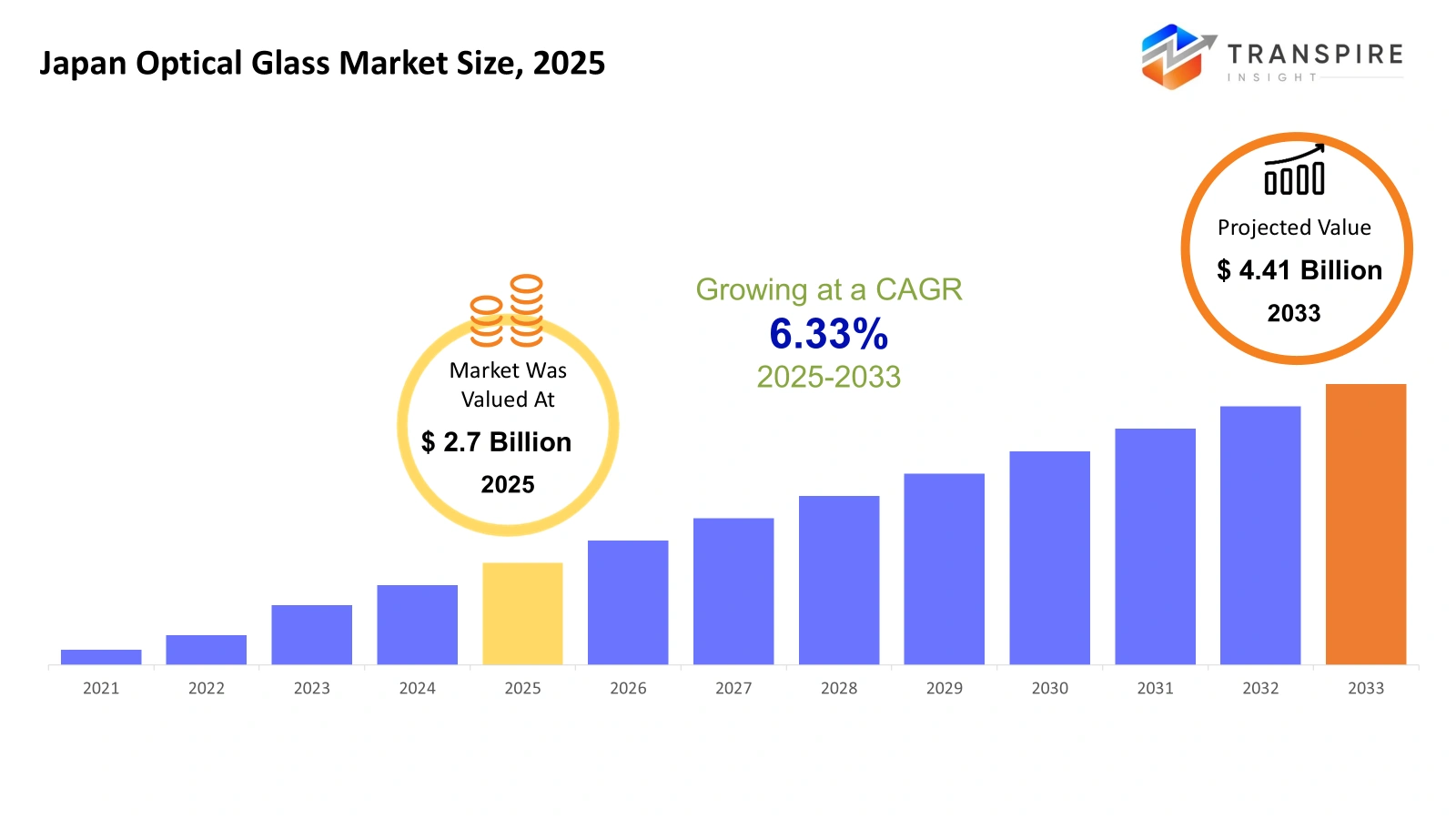
- Japan Optical Glass Market Size 2025: USD 2.7 Billion
- Japan Optical Glass Market Size 2033: USD 4.41 Billion
- Japan Optical Glass Market CAGR: 6.33%
- Japan Optical Glass Market Segments:By Product Type (Borosilicate Glass, Fused Silica Glass, Sapphire Glass), By Application (Consumer Electronics, Medical Devices, Optical Instruments, Automotive).
To learn more about this report,  Download Free Sample Report
Japan Optical Glass Market Summary:
The Japan Optical Glass Market size is estimated at USD 2.7 Billion in 2025 and is anticipated to reach USD 4.41 Billion by 2033, growing at a CAGR of 6.33% from 2026 to 2033. The Japan optical glass market exhibits exceptional precision and innovative technologies and displays a strong dedication to its manufacturing traditions. Japanese companies have built a global reputation for producing high-quality optical glass used in cameras, medical devices, semiconductors, and advanced imaging systems. The market experiences consistent growth because of research and development investments, which combine with rising demand from electronics and automotive sectors. The expansion of AR/VR technologies and autonomous vehicle systems and high-resolution sensors will sustain Japan's optical glass industry as a crucial part of the country's advanced materials sector.
Key Market Trends & Insights:
- The demand for precision optical glass in Japan, which serves as a centre for advanced cameras, smartphones and imaging equipment, continues to increase. The need for specialised glass types drives companies to create new glass materials which serve their specific needs.
- Manufacturers are developing new materials which show improved light transmission and durability properties to meet the needs of AR/VR and autonomous vehicles and medical imaging applications. The new combination improves both performance and reliability of advanced technologies.
- The automotive industry experiences rising demand for precise lenses and sensors because of increasing interest in autonomous and electric vehicle technology.
- The optical glass industry develops new products which meet design specifications of small advanced devices while maintaining their original visual performance.
- Japanese optical glass companies are developing international partnerships with tech companies to expand their market presence while supporting Japan's status as a top optical glass producer.
- The company are investigating environmentally friendly production methods and recycling processes which will help them cut down their environmental footprint yet still deliver products of high quality.
Japan Optical Glass Market Segmentation
By Product Type
- Borosilicate Glass: Borosilicate glass functions as an ideal material for precision instruments and laboratory equipment because of its ability to endure extreme temperatures and maintain high durability. Japanese manufacturers use their production capabilities to create high-quality products which fulfil industrial requirements and consumer demands, providing the electronics and scientific research fields with dependable optical materials that have extended service life.
- Fused Silica Glass: Fused silica glass provides excellent visual clarity and minimal thermal expansion properties, which makes it essential for both advanced imaging systems and semiconductor manufacturing processes. Japanese companies apply their knowledge to manufacture ultra-pure fused silica, which serves high-tech needs in laser equipment and photonics and next-generation electronic devices.
- Sapphire Glass: Sapphire glass delivers unmatched hardness and scratch resistance, which makes it a popular material for high-end smartphones and wearable technology and optical lenses. Japan leads the development of sapphire manufacturing methods which produce lightweight and durable components that fulfil strict quality requirements for consumer electronics and industrial use.
By Application
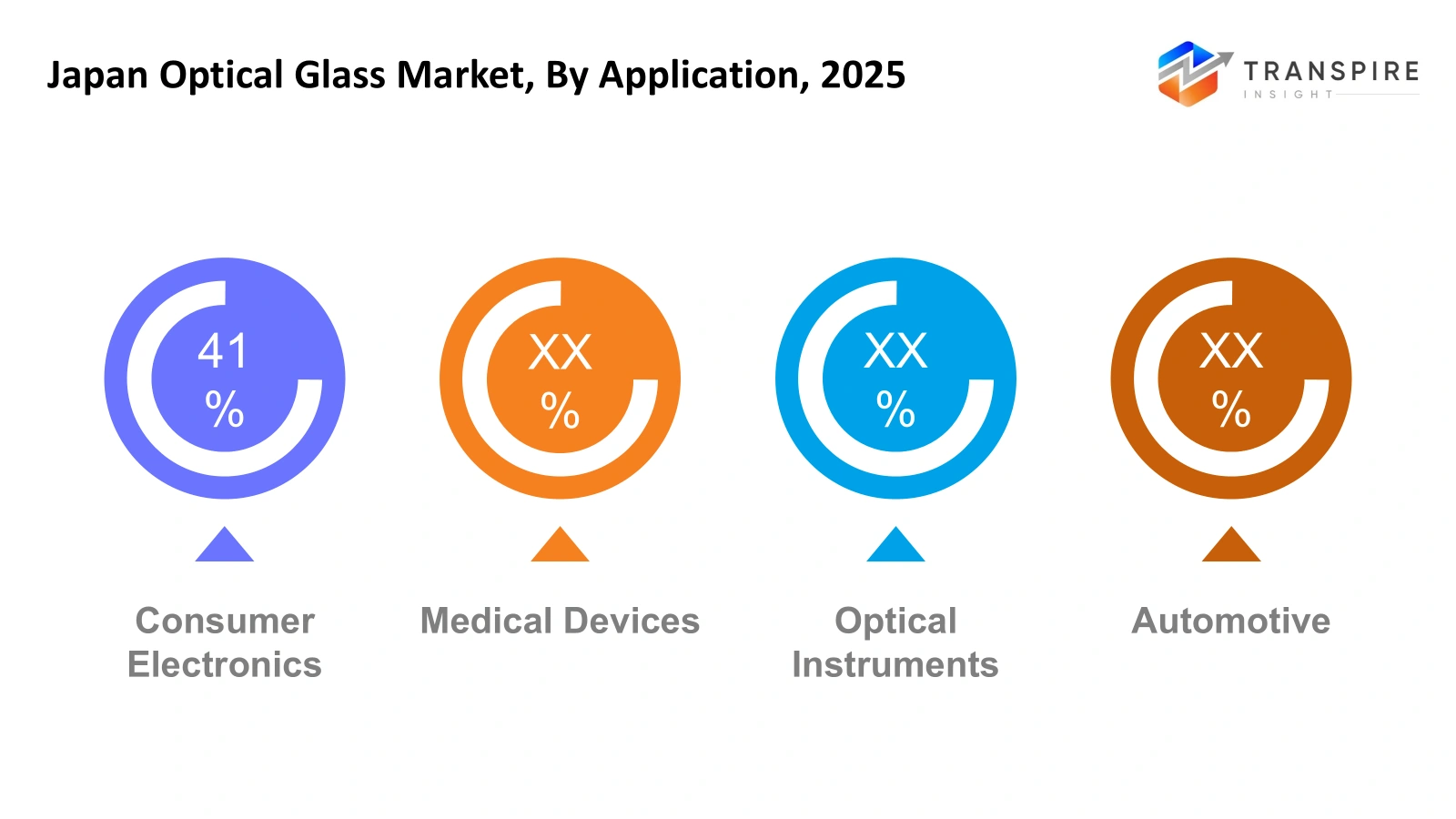
- Consumer Electronics: The smartphone industry depends on optical glass because it improves lens performance and image quality in all smartphones and cameras and VR devices. Japanese manufacturers focus on producing small glass components which have high precision to satisfy consumer demand for electronics with better visual quality and longer durability.
- Medical Devices: Optical glass provides precise measurement standards which medical imaging systems, endoscopes and diagnostic equipment need to operate safely. Japanese producers emphasise clarity, durability, and biocompatibility, supporting hospitals and laboratories with reliable glass solutions for advanced healthcare technologies.
- Optical Instruments: Scientific instruments which include telescopes and microscopes depend on high-performance optical glass for their operations. Japan’s strong R&D and production capabilities ensure superior light transmission and precision, strengthening its position as a global supplier for professional optical equipment.
- Automotive: Optical glass functions in LiDAR systems and sensor technology and camera systems which support autonomous and smart vehicle development. Japanese manufacturers create strong, durable glass products which the automotive industry needs to enhance driver safety and vehicle performance and support technological progress.
To learn more about this report, Download Free Sample Report
Country Insights
Japan has established itself as the leading global optical glass producer because of its experience in precision manufacturing and high-quality material production, which has lasted for many decades. The country demonstrates its ability to manufacture advanced optical glass because it possesses a strong technological foundation which receives backing from extensive research and development efforts. The domestic market shows strong growth because of the consumer electronics industry, which includes smartphones and cameras and new AR/VR technologies and autonomous vehicle development and research. Japanese manufacturers are also expanding export activities, supplying premium optical glass to global markets, reinforcing the country’s reputation for quality and reliability. The combination of government support for innovation and partnerships between industrial sectors and research institutions enables companies to enhance existing products while creating new glass products. The optical glass market in Japan maintains its strength through innovation while it prepares to expand in both domestic and international markets.
Recent Development News
Japan optical glass materials maker OHARA Inc profile overview.
Japanese stocks including glass materials uptick amid market rebound.
|
Report Metrics |
Details |
|
Market size value in 2025 |
USD 2.7 Billion |
|
Market size value in 2026 |
USD 2.87 Billion |
|
Revenue forecast in 2033 |
USD 4.41 Billion |
|
Growth rate |
CAGR of 6.33% from 2026 to 2033 |
|
Base year |
2025 |
|
Historical data |
2021 – 2024 |
|
Forecast period |
2026 – 2033 |
|
Report coverage |
Revenue forecast, competitive landscape, growth factors, and trends |
|
Country scope |
Japan |
|
Key company profiled |
Hoya Corporation, Ohara Inc., Schott AG, Corning Incorporated, Nippon Electric Glass Co. Ltd., Sumita Optical Glass Inc., AGC Inc., Nikon Corporation, Canon Inc., Carl Zeiss AG, Edmund Optics Inc., Jenoptik AG, HOYA Vision Care, Shin-Etsu Chemical Co. Ltd., Kyocera Corporation. |
|
Customization scope |
Free report customization (country, regional & segment scope). Avail customized purchase options to meet your exact research needs. |
|
Report Segmentation |
By Product Type (Borosilicate Glass, Fused Silica Glass, Sapphire Glass), By Application (Consumer Electronics, Medical Devices, Optical Instruments, Automotive). |
Key Japan Optical Glass Company Insights
Japanese optical glass companies are known for their ability to create precise and innovative products which meet high standards of quality. Leading manufacturers focus on developing advanced glass types like borosilicate, fused silica, and sapphire to meet the growing demands of the electronics, automotive, and medical sectors. The companies maintain their research and development funding which enables them to create new products that have miniature sizes and long-lasting durability and efficient light transmission properties. Their partnerships with worldwide technology organisations enable them to achieve greater strength in their business operations. Japanese optical glass companies have built a reputation for delivering dependable products which incorporate advanced technologies, which enables them to promote their domestic business while establishing Japan as the leading country in the worldwide optical materials market.
Company List
- Hoya Corporation
- Ohara Inc.
- Schott AG
- Corning Incorporated
- Nippon Electric Glass Co. Ltd.
- Sumita Optical Glass Inc.
- AGC Inc.
- Nikon Corporation
- Canon Inc.
- Carl Zeiss AG
- Edmund Optics Inc.
- Jenoptik AG
- HOYA Vision Care
- Shin-Etsu Chemical Co. Ltd.
- Kyocera Corporation.
Japan Optical Glass Market Report Segmentation
By Product Type
- Borosilicate Glass
- Fused Silica Glass
- Sapphire Glass
By Application
- Consumer Electronics
- Medical Devices
- Optical Instruments
- Automotive
Frequently Asked Questions
Find quick answers to common questions.
The approximate Japan Optical Glass Market size for the market will be USD 4.41 Billion in 2033.
The key segments of the Japan Optical Glass Market are By Product Type (Borosilicate Glass, Fused Silica Glass, Sapphire Glass), By Application (Consumer Electronics, Medical Devices, Optical Instruments, Automotive).
Major players in the Japan Optical Glass Market are Hoya Corporation, Ohara Inc., Schott AG, Corning Incorporated, Nippon Electric Glass Co. Ltd., Sumita Optical Glass Inc., AGC Inc., Nikon Corporation, Canon Inc., Carl Zeiss AG, Edmund Optics Inc., Jenoptik AG, HOYA Vision Care, Shin-Etsu Chemical Co. Ltd., Kyocera Corporation.
The current market size of the Japan Optical Glass Market is USD 2.7 Billion in 2025.
The Japan Optical Glass Market CAGR is 6.33%.
- Hoya Corporation
- Ohara Inc.
- Schott AG
- Corning Incorporated
- Nippon Electric Glass Co. Ltd.
- Sumita Optical Glass Inc.
- AGC Inc.
- Nikon Corporation
- Canon Inc.
- Carl Zeiss AG
- Edmund Optics Inc.
- Jenoptik AG
- HOYA Vision Care
- Shin-Etsu Chemical Co. Ltd.
- Kyocera Corporation.
Recently Published Reports
-
Apr 2026
Healthcare Polymer Packaging Market
Healthcare Polymer Packaging Market Size, Share & Analysis Report By Packaging Type (Syringes, IV Bottles and Pouches, Clamshells, Blisters, Bottles & Jars, Containers, Tubes, IV Parental Packaging, Others), By Type (Regulated, Non-regulated), By Polymer Type (LDPE (Low-Density Polyethylene), HDPE (High-Density Polyethylene), Homo-polymer (Homo), Random Copolymer (Random), Block Copolymer (Block), PET, Polystyrene, Polyvinyl Chloride, Polyamide/EVOH, Others), and Geography (North America, Europe, Asia-Pacific, Middle East and Africa, South and Central America), 2021 - 2031
-
Apr 2026
Hydrophilic Tape (Waterstop) Market
Hydrophilic Tape (Waterstop) Market Size, Share & Analysis Report By Type (Bentonite-Based Hydrophilic Tape, Rubber-Based Hydrophilic Tape), By Application (Residential Buildings, Commercial Buildings, Infrastructure Projects), and Geography (North America, Europe, Asia-Pacific, Middle East and Africa, South and Central America), 2021 - 2031
-
Apr 2026
Metalens Market
Metalens Market Size, Share & Analysis Report By Type (Visible Light Metalens, and Infrared Metalens), By Application (Consumer Electronics, Automotive Electronics, Industrial, Medical, and Others), and Geography (North America, Europe, Asia-Pacific, Middle East and Africa, South and Central America), 2021 - 2031
-
Apr 2026
PBT Resin Market
PBT Resin Market Size, Share & Analysis Report By Type (Reinforced PBT Resin, Unreinforced PBT Resin), By Processing Method (Injection Molding, Extrusion, Blow Molding, Others), By End-User (Automotive, Electrical & Electronics, Consumer Appliances, Industrial Machinery, Medical Devices, Packaging, Others), and Geography (North America, Europe, Asia-Pacific, Middle East and Africa, South and Central America), 2021 - 2031