
Asia Pacific Bottled Water Market Size & Forecast:
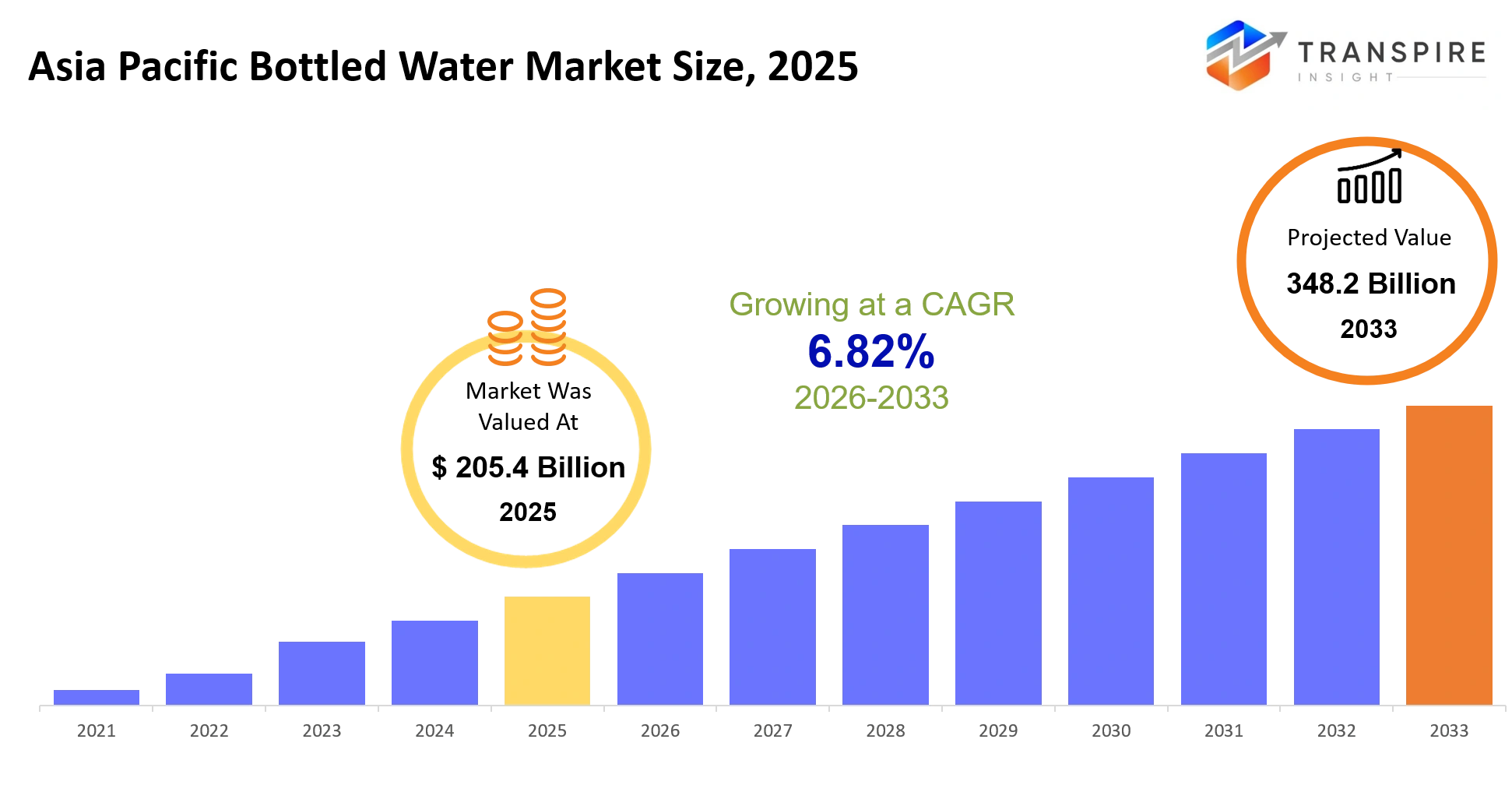
- Asia Pacific Bottled Water Market Size 2025: USD 205.4 Billion
- Asia Pacific Bottled Water Market Size 2033: USD 348.2 Billion
- Asia Pacific Bottled Water Market CAGR: 6.82%
- Asia Pacific Bottled Water Market Segments: By Product Type (Still Water, Sparkling Water, Mineral Water, Purified Water, Flavored Water, Functional Water, Alkaline Water, Others); By Packaging (PET Bottles, Glass Bottles, Cans, Bulk Packs, Cartons, Pouches, Refillable Bottles, Others); By Distribution Channel (Supermarkets, Convenience Stores, Online Retail, Vending Machines, Foodservice, Hypermarkets, Specialty Stores, Others); By End User (Households, Offices, Travelers, Athletes, Hotels, Restaurants, Institutions, Others).
Asia Pacific Bottled Water Market Summary
The Asia Pacific Bottled Water Market was valued at USD 205.4 Billion in 2025. It is forecast to reach USD 348.2 Billion by 2033. That is a CAGR of 6.82% over the period.
The Asia Pacific bottled water market is very important for people to get drinking water. It helps people in cities, factories, construction sites and busy shopping areas get water they can drink. Sometimes the water from the city is not good or not available so people buy water. Companies, hotels and hospitals also buy water because they need water that is safe and good quality.In the few years people have started to want bottled water that is better quality and comes in packaging that can be recycled. Companies are making water with lighter plastic and better filters to help the environment.
There is a change in the bottled water market.This change happened faster because of COVID-19, which made it hard to get things from one place to another. Made people think more about staying clean. At the time some countries in Asia Pacific are making rules to reduce plastic waste so companies are making new packaging that is better for the environment and helps them stand out. The Asia Pacific bottled water market is changing to be more, about sustainability and quality.
Key Market Insights
- The Asia Pacific Bottled Water Market is driven by people wanting water to drink especially in cities and factories where the water from the tap is not always good.
- The Asia Pacific Bottled Water Market is getting bigger because more people are moving to cities and these big cities need water for people to drink every day.
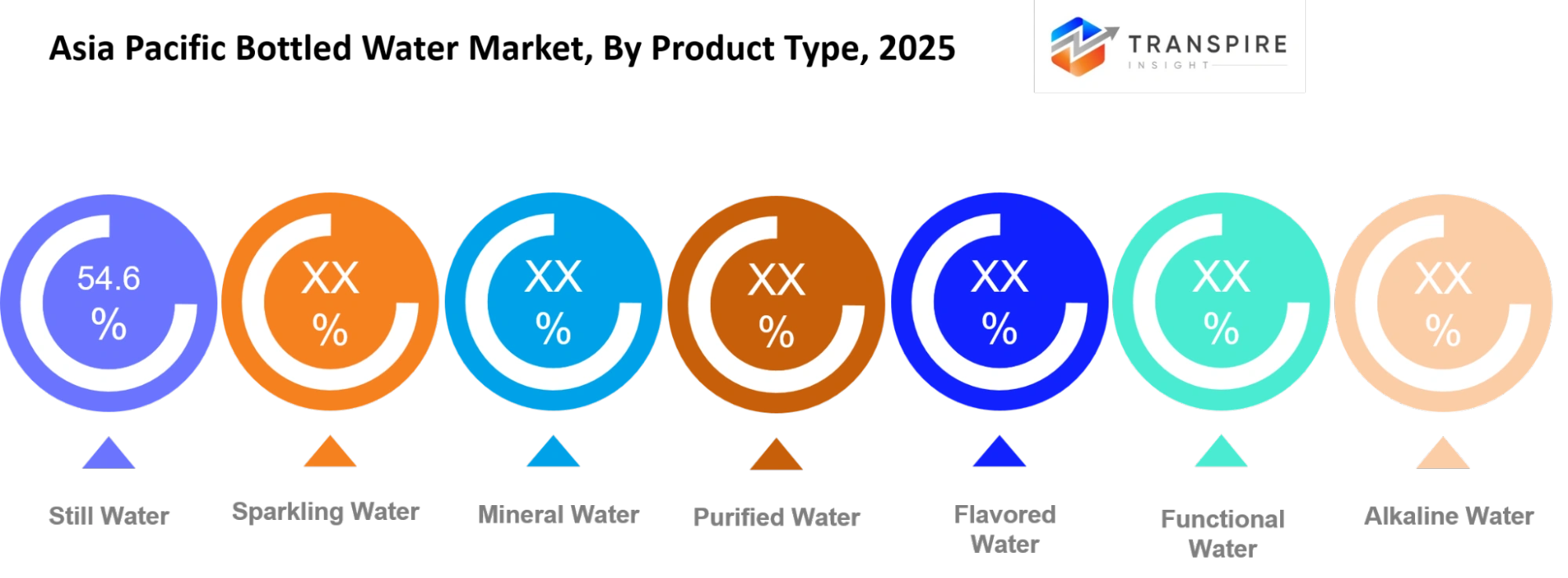
- People mostly buy still water because it is cheap and easy to find in stores all over the place.
- Some people are starting to like flavored and special water because they want to be healthy and drink water that's good for them.
- People who have a lot of money are starting to buy bottled water when they are at hotels or at work because they like nice things.
- Most bottled water is sold in supermarkets and little stores where people can buy things quickly.
- Buying water on the internet is getting more popular because it is easy and people can get it delivered to their homes.
- Most bottled water is bought by people for their homes. Some is also bought by offices and schools because they need to keep things clean.
- Big companies like Nongfu Spring, Danone and The Coca-Cola Company are trying to make their bottles better for the earth and sell their water in places.
- The Asia Pacific Bottled Water Market is changing because of rules about being good, to the earth and making sure companies are working well so they are using bottles and trying to recycle more.
What are the Key Drivers, Restraints, and Opportunities in the Asia Pacific Bottled Water Market?
Drivers
The Asia Pacific Bottled Water Market is driven by people turning to packaged water because the water from sources is not consistent and many people are moving to cities. This change happened faster because of the pandemic and the need for water so people at home in offices and in hotels started to prefer water that is sealed and can be traced. As a result the Asia Pacific Bottled Water Market for branded water has become stronger and brings in money for the companies that make it especially in crowded cities where people and businesses always need it and are willing to pay for it.
Restraints
However the Asia Pacific Bottled Water Market is facing a problem because of the harm that single-use plastic is causing to the environment. This problem is not easy to solve because people in places need bottled water and there are not many other options that are as cheap and work as well as plastic bottles. The government is making rules to reduce waste, which increases costs for the companies that make bottled water and forces them to change the way they package it which slows down their ability to make more money and delays their ability to use cheaper ways to get their products to people who are sensitive to prices.
Opportunities
At the time there is a clear chance for the Asia Pacific Bottled Water Market to grow through the use of refillable water systems and machines that can purify water, which are connected to the internet. In countries like China and India people are investing more in water machines and systems that can purify water in homes and offices. These systems reduce the need, for bottles and create new ways for companies to make money by providing services, which means companies can change from just selling products to providing water services for a long time.
What Has the Impact of Artificial Intelligence Been on the Asia Pacific Bottled Water Market?
The Asia Pacific bottled water industry is changing because of intelligence and new digital technologies. These technologies are making production more efficient improving quality control and making sure products are delivered to the places.Helps production run more smoothly.Computer vision is being used more and more to check for problems with bottles and to make sure they are not contaminated. This helps companies follow rules about food safety.
Companies are also using models to predict when equipment might break down. This means that maintenance teams can fix problems before they happen which reduces the amount of time that production has to stop. This can increase the amount of time that production is running by 10 to 20 percent. Artificial intelligence is also being used to predict how much bottled water people will buy, which helps companies to have the amount of stock.
The Asia Pacific bottled water industry is also becoming more efficient in ways. Companies are using intelligence to monitor how much energy and water they are using, which helps to reduce waste. However some companies are not using intelligence as much as they could be because it can be expensive to set up and because their old systems are not compatible. Many plants are not using systems to collect data, which makes it harder to use artificial intelligence and machine learning. This is slowing down the use of intelligence, in the Asia Pacific bottled water industry.
Key Market Trends
- PET lightweighting is being used more and more with a 25% increase since 2021. This is because manufacturers want to save on packaging costs and also follow the rules about plastic waste in Asia Pacific.
- People started buying bottled water from brands instead of buying in bulk from unbranded sources after 2020. This helped organized retail stores do better and also improved how much money manufacturers made in cities.
- Sales of water online grew a lot after 2022. This was especially true in China, India and Asian cities, where more and more people were getting water delivered to their homes if they subscribed to a service.
- Smart water dispensers are now being used in commercial buildings. This means that people are using single-use bottles and the way companies buy water is changing, especially in offices and hospitals.
- People in hotels and other hospitality places started drinking premium bottled water after 2021.
- New rules about recycling that started between 2022 and 2025 made companies like Nongfu Spring and Danone have to change how they package their products.
- Large factories in Asia Pacific are now using automated bottling and AI to check the quality of their products. This has made them more efficient with some seeing a 15% improvement.
- There's competition in the region now with local companies growing quickly in smaller cities. This is challenging the multinational companies, especially in areas where price is very important.
- Many institutions are now signing contracts with manufacturers to supply them with water. This gives manufacturers an income especially when they supply to places, like hospitals, schools and government buildings.
- In some neighborhoods more and more residential complexes are installing water filtration systems. This is slowly reducing how much bottled water people use.
Asia Pacific Bottled Water Market Segmentation
By Product Type
Water is really popular in the Asia Pacific Bottled Water Market. People drink water every day at home and in their offices. In cities people do not even have tap water so they have to use bottled water. Young people really like water that is sparkling and flavored because they want to try tastes and they like low-calorie drinks. Mineral and functional water are very popular with people who care about their health and want to get nutrients from the water they drink. Alkaline water is becoming very popular in cities where people care about wellness and taking care of themselves. There are types of bottled water so people from different income groups and with different lifestyles can choose the bottled water they like the most.
By Packaging
PET bottles are used the most in the Asia Pacific Bottled Water Market. They are cheap and light which makes them easy to transport. Many offices and institutions use packs of water every single day. Some hotels and restaurants use glass bottles because they want to show an image to their customers. Some people who live in cities like canned and cartoned water because they care about the environment and want to help. Refillable bottles are becoming very popular in offices and residential areas that have water systems. Companies that make water are trying to make packaging that is more recyclable and uses less plastic, which is a good thing for the Asia Pacific Bottled Water Market and, for the environment.
By Distribution Channel
Supermarkets and hypermarkets sell a lot of water in the Asia Pacific Market. People like to buy water in bulk and see the products on the shelves. Convenience stores are popular in cities because people can buy water quickly. Online shopping is growing fast with subscription services and home delivery of water. You can also buy water from vending machines in transport hubs, offices and hospitals. Restaurants and cafés use water for their customers. Specialty stores sell premium bottled water brands.
By End User
Households use water in the Asia Pacific Market.People drink water every day at their homes.
Offices and companies use a lot of water too.When people travel they buy water at airports, train stations and shops on the road.Athletes, like mineral and bottled water to help them perform better in their sports.Hotels and restaurants use water to make their guests feel happy and comfortable.Schools, hospitals and government buildings use a lot of water throughout the year.
What are the Key Use Cases Driving the Asia Pacific Bottled Water Market?
The Asia Pacific Bottled Water Market is really popular in peoples homes. People have to buy the Asia Pacific Bottled Water every day because they cannot drink the water from the tap in cities. This is because the Asia Pacific Bottled Water is safe to drink.
People who live in apartments and houses are always buying the Asia Pacific Bottled Water, which's great for companies that sell the Asia Pacific Bottled Water. This is very true in cities where a lot of people live and the water from the tap is not always safe to drink.Some offices and hotels also buy the Asia Pacific Bottled Water. They need the Asia Pacific Bottled Water to keep their places clean and to make their customers happy. Restaurants and other places that serve food also buy the Asia Pacific Bottled Water to make their customers happy.
There are some ways that people are using the Asia Pacific Bottled Water. Some apartment buildings have machines that you can use to refill your bottle with the Asia Pacific Bottled Water. Some schools and hospitals also have these machines. This helps reduce the amount of trash, from the Asia Pacific Bottled Water and makes it easier for people to get drinking water.Some companies are also starting to deliver the Asia Pacific Bottled Water to peoples homes and offices on a basis, which is a new way of doing things in the Asia Pacific Bottled Water Market.
|
Report Metrics |
Details |
|
Market size value in 2025 |
USD 205.4 Billion |
|
Market size value in 2026 |
USD 219.4 Billion |
|
Revenue forecast in 2033 |
USD 348.2 Billion |
|
Growth rate |
CAGR of 6.82% from 2026 to 2033 |
|
Base year |
2025 |
|
Historical data |
2021 - 2024 |
|
Forecast period |
2026 - 2033 |
|
Report coverage |
Revenue forecast, competitive landscape, growth factors, and trends |
|
Regional scope |
Asia Pacific (India, China, Japan, Australia, South Korea, Rest of Asia Pacific) |
|
Key company profiled |
Nestle Waters, Danone, Coca-Cola, PepsiCo, Nongfu Spring, Wahaha, Bisleri, Tata Consumer, Suntory, Asahi, FIJI Water, Voss, Primo Water, Tingyi, Uni-President. |
|
Customization scope |
Free report customization (country, regional & segment scope). Avail customized purchase options to meet your exact research needs. |
|
Report Segmentation |
By Product Type (Still Water, Sparkling Water, Mineral Water, Purified Water, Flavored Water, Functional Water, Alkaline Water, Others); By Packaging (PET Bottles, Glass Bottles, Cans, Bulk Packs, Cartons, Pouches, Refillable Bottles, Others); By Distribution Channel (Supermarkets, Convenience Stores, Online Retail, Vending Machines, Foodservice, Hypermarkets, Specialty Stores, Others); By End User (Households, Offices, Travelers, Athletes, Hotels, Restaurants, Institutions, Others). |
Which Regions are Driving the Asia Pacific Bottled Water Market Growth?
Asia Pacific is the region for bottled water because it has a huge population cities are growing fast and it has strong networks to get bottled water to stores. China and India are leading the way with many people living in cities where safe drinking water's not always available. The region also has a lot of factories roads for transportation and many supermarkets, which helps get bottled water to people. Governments in Asia Pacific are also focused on making sure food and water are safe which helps people choose water at home and in institutions. All of this makes Asia Pacific a key place for water.
North America and Western Europe are markets for bottled water with people having a lot of money to spend and strong rules to protect consumers. These regions are not growing fast but people are choosing premium and healthy bottled water options. They also have systems for recycling and rules for packaging, which encourages companies to innovate. Bottled water companies in these regions have long-term deals with stores and restaurants which means they have sales. This stability makes North America and Western Europe important for water sales.
Southeast Asia is growing fast with countries like Indonesia, Vietnam and Thailand investing in tourism, housing and retail. People are getting more worried about the quality of groundwater. Its getting easier to keep bottled water cold and transport it. Governments and private companies are also working on sanitation and building hotels, which is helping demand for bottled water grow. For companies looking to enter the market or invest Southeast Asia offers opportunities in areas like distribution, local production and affordable packaging from 2026, to 2033.
Who are the Key Players in the Asia Pacific Bottled Water Market and How Do They Compete?
The Asia Pacific Bottled Water Market is made up of companies, where big global brands compete with strong local brands. Big companies like The Coca-Cola Company and PepsiCo focus on being big having a distribution system and being a brand that people trust. At the time local companies like Nongfu Spring and Bisleri defend their place in the market by being flexible with prices and reaching deep into rural areas. The main reason companies compete is because of how they can distribute their products and how cheaply they can do it not just because their products are different.
The Coca-Cola Company is trying to sell different types of drinks including bottled water by using the same system it uses to sell other drinks. This company has an advantage because it can keep its drinks cold and get them onto store shelves easily. The Coca-Cola Company is good at getting its water into convenience stores and big supermarkets all over the Asia Pacific. PepsiCo is strong because it can buy things in bulk and sell different types of drinks in stores. This helps PepsiCo keep its costs low.
Nongfu Spring is a brand in China because many people in China like and trust it. Nongfu Spring gets its water from sources and controls where its water comes from. Danone is focusing on selling bottled water that is good for peoples health. Danone uses water that has minerals in it and meets high standards for quality to sell to people who live in cities. Bisleri is a brand in India because it sells its bottled water for low prices sells it in many places and has a strong presence in places like offices and schools. These companies are growing by making investments in different places partnering with retailers and getting deeper into new cities in the Asia Pacific Bottled Water Market. The Asia Pacific Bottled Water Market is getting more competitive because of shopping and stores making their own brands. This is putting pressure on brands like The Coca-Cola Company and PepsiCo especially, in cities.
Company List
- Nestlé Waters
- Danone
- The Coca-Cola Company
- PepsiCo
- Nongfu Spring
- Wahaha
- Bisleri
- Tata Consumer Products
- Suntory
- Asahi Group Holdings
- FIJI Water
- Voss
- Primo Water
- Tingyi
- Uni-President
Recent Development News
“In October 2025, Reliance Consumer Products announced plans to launch Campa Sure bottled water through regional manufacturing partnerships. The move strengthens its entry into India’s highly fragmented packaged water market by using aggressive pricing and distributed bottling networks to scale rapidly across tier-2 and tier-3 cities.”
Source: https://economictimes.indiatimes.com
“In August 2025, Bhumi Pednekar and Samiksha Pednekar launched the premium bottled water brand Backbay. The brand’s entry highlights growing interest in celebrity-led premium hydration products targeting urban consumers in India’s expanding wellness-focused beverage segment.”
Source: https://economictimes.indiatimes.com
“In February 2026, Kerala Irrigation Infrastructure Development Corporation introduced the Hilly Aqua bottled water brand using biodegradable PLA bottles. The initiative supports plastic reduction policies and promotes eco-friendly packaging adoption in regulated tourist and public distribution channels.”
Source: https://timesofindia.indiatimes.com
What Strategic Insights Define the Future of the Asia Pacific Bottled Water Market?
The Asia Pacific Bottled Water Market is changing. It is becoming more about services. Being sustainable. This will happen over the 5 to 7 years. The reason for this change is that there are rules about the environment. Many people are living in cities and institutions need water.
Growth in the Asia Pacific Bottled Water Market will come from stores that are organized and from contract-based supply systems. Here it is not about the price but also about being reliable and following the rules. This means that companies that make water will have to think about new packaging ideas and controlling digital distribution as a main part of their business.
There is a risk that people may not notice. A few big companies that make food and drinks are getting bigger and stronger in the Asia Pacific Bottled Water Market. This can make it hard for smaller companies to change their prices and can reduce their profits. At the time people may start using water from municipal filtration systems and purification networks in their buildings. This could reduce the amount of bottled water people drink in cities.The Asia Pacific Bottled Water Market has an opportunity. It is about creating a system where people can refill their bottles at stations. These stations are connected to subscription models, in homes and offices. This idea is already working in China and India. It will change the way people drink water in cities. Companies should invest in this idea early. They should combine selling water with providing hydration services. This will help them stay relevant and have an income. The Asia Pacific Bottled Water Market is. Companies need to adapt to these changes.
Asia Pacific Bottled Water Market Report Segmentation
By Product Type
- Still Water
- Sparkling Water
- Mineral Water
- Purified Water
- Flavored Water
- Functional Water
- Alkaline Water
- Others
By Packaging
- PET Bottles
- Glass Bottles
- Cans
- Bulk Packs
- Cartons
- Pouches
- Refillable Bottles
- Others
By Distribution Channel
- Supermarkets
- Convenience Stores
- Online Retail
- Vending Machines
- Foodservice
- Hypermarkets
- Specialty Stores
- Others
By End User
- Households
- Offices
- Travelers
- Athletes
- Hotels
- Restaurants
- Institutions
- Others
Frequently Asked Questions
Find quick answers to common questions.
The expected Asia Pacific Bottled Water Market size for the market will be USD 348.2 Billion in 2033.
Key segments for the Asia Pacific Bottled Water Market are Type By Product Type (Still Water, Sparkling Water, Mineral Water, Purified Water, Flavored Water, Functional Water, Alkaline Water, Others); By Packaging (PET Bottles, Glass Bottles, Cans, Bulk Packs, Cartons, Pouches, Refillable Bottles, Others); By Distribution Channel (Supermarkets, Convenience Stores, Online Retail, Vending Machines, Foodservice, Hypermarkets, Specialty Stores, Others); By End User (Households, Offices, Travelers, Athletes, Hotels, Restaurants, Institutions, Others).
Major Asia Pacific Bottled Water Market players are Nestle Waters, Danone, Coca-Cola, PepsiCo, Nongfu Spring, Wahaha, Bisleri, Tata Consumer, Suntory, Asahi, FIJI Water, Voss, Primo Water, Tingyi, Uni-President.
The Asia Pacific Bottled Water Market size is USD 205.4 Billion in 2025.
The Asia Pacific Bottled Water Market CAGR is 6.82% from 2026 to 2033.
- Nestlé Waters
- Danone
- The Coca-Cola Company
- PepsiCo
- Nongfu Spring
- Wahaha
- Bisleri
- Tata Consumer Products
- Suntory
- Asahi Group Holdings
- FIJI Water
- Voss
- Primo Water
- Tingyi
- Uni-President
About the Authors

Chetan Dhatrak
I’m Chetan Dhatrak, a Senior Research Analyst at Transpire Insight, specializing in the Consumer Goods, Foods and Beverages industry. I focus on analyzing market trends, consumer behavior, competitive landscapes, and industry developments to deliver accurate, data-driven insights. My research at Transpire Insight is built on credible sources and in-depth analysis, helping businesses and readers better understand market dynamics, emerging opportunities, and evolving consumer preferences. I’m committed to creating reliable, well-researched content that supports informed decision-making and reflects the latest developments in the consumer goods and food & beverage sectors.

Chakradhar Khansole
Chakradhar serves as the Research Director at Transpire Insight, bringing over 8 years of experience in technology, innovation, and strategic market intelligence. He specializes in transforming complex market data into actionable business insights that enable organizations to make informed, growth-oriented decisions. Recognized for his strategic vision and analytical expertise, Chakradhar leads high-impact research initiatives, delivering comprehensive market assessments, competitive intelligence, and forward-looking industry analysis.
Recently Published Reports
-
Apr 2026
Baby Infant Formula Market
Baby Infant Formula Market Size, Share & Analysis Report By ype (Infant Milk, Follow On Milk, Specialty Baby Milk, Growing-Up Milk), By Ingredient (Carbohydrate, Fat, Protein, Minerals, Vitamins, and Others), By Product Form (Powder, Liquid, and Ready-to-feed), By Distribution Channels (Supermarket/Hypermarket, Specialty Store, Pharmacies, Online Retail, and Others), and Geography (North America, Europe, Asia-Pacific, Middle East and Africa, South and Central America), 2021 - 2031
-
Apr 2026
Edible Insects for Animal Feed Market
Edible Insects for Animal Feed Market Size, Share & Analysis Report By Type (Insect Powder, Insect Meal, Insect Bar, Insect Paste, Insect Oil, and Others), By Insect Type (Beetles, Cricket, Caterpillar, Hymenoptera, Orthoptera, Tree Bugs, and Others), By Application (Livestock, Pet Food, and Aquaculture), By Livestock Type (Poultry, Swine, and Others), and Geography (North America, Europe, Asia-Pacific, Middle East and Africa, South and Central America), 2021 - 2031
-
Apr 2026
Food Industry Disinfection and Bacterial Control Market
Food Industry Disinfection and Bacterial Control Market Size, Share & Analysis Report By Type (Chemical Disinfectants, Physical Disinfectants, and Biocides and Antimicrobials), By Application (Food Processing Equipment Surface Disinfection, Food Preparation Areas Surface Disinfection, Storage Areas Surface Disinfection, Anti-microbial Coatings Food Preservation, and Preservative Solutions Food Preservation), By End User (Meat and Poultry Processing, Dairy Processing, Seafood Processing, Bakery and Confectionery, Restaurants and Commercial Kitchens, and Food Service Providers), By Sales Channel (Online, Offline), and Geography (North America, Europe, Asia-Pacific, Middle East and Africa, South and Central America), 2021 - 2031
-
May 2026
Freeze Dried Food Market
Freeze Dried Food Market Size, Share & Analysis Report By Product Type (Fruits, Vegetables, Freeze-Dried Dairy Products, Freeze-Dried Meat and Seafood, Freeze-Dried Pet Food, and Prepared Meal), By Nature (Organic, and Conventional), By Form (Powdered, Granules, and Diced), By End Use (Breakfast Cereals, Dairy Products, Bakery & Confectionery, Nutritional Bars & Supplements, Powdered Beverages, Snacks, and Retail (Household)), and Geography (North America, Europe, Asia-Pacific, Middle East and Africa, South and Central America), 2021 - 2031