
Asia Pacific Augmented Reality (AR) - Immersive Entertainment Market Size & Forecast:
- Asia Pacific Augmented Reality (AR) - Immersive Entertainment Market Size 2025:USD 7.39 Billion
- Asia Pacific Augmented Reality (AR) - Immersive Entertainment Market Size 2033:USD 42.61 Billion
- Asia Pacific Augmented Reality (AR) - Immersive Entertainment Market CAGR: 24.50%
- Asia Pacific Augmented Reality (AR) - Immersive Entertainment Market Segments:By Component (Hardware, Software, Services, AR Platforms, Content Creation Tools, Others); By Application (Gaming, Live Events, Theme Parks, Sports Entertainment, Interactive Media, Education Entertainment, Others); By Device Type (Smartphones, AR Glasses, Headsets, Tablets, Wearables, Others); By End User (Consumers, Enterprises, Media Companies, Event Organizers, Others)
Asia Pacific Augmented Reality (AR) - Immersive Entertainment Market Summary
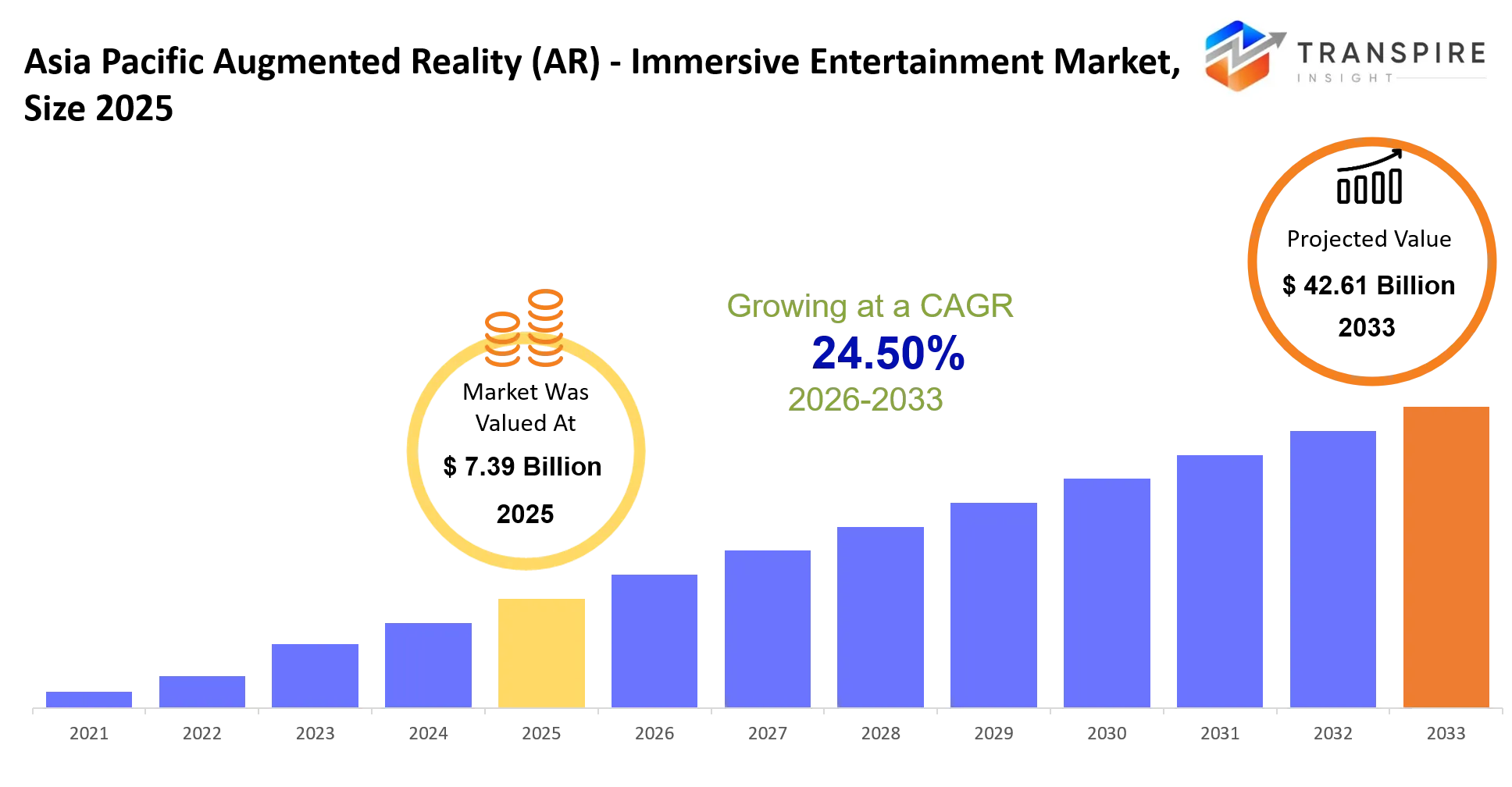
The Asia Pacific Augmented Reality (AR) - Immersive Entertainment Market was valued at USD 7.39 billion in 2025. It is forecast to reach USD 42.61 billion by 2033. That is a CAGR of 24.50% over the period.
The Asia Pacific Augmented Reality Immersive Entertainment Market is about giving people interactive digital experiences. These experiences combine content with real world environments. This happens in things, like gaming, live events, tourism and location-based entertainment.When you use it the Asia Pacific Augmented Reality Immersive Entertainment Market helps people get more involved by adding layers to real world spaces. This lets users interact with characters and stories in time. The Asia Pacific Augmented Reality Immersive Entertainment Market changes entertainment from watching to actually taking part. This helps keep users interested and gives content developers and platform providers chances to make money.
In the few years the Asia Pacific Augmented Reality Immersive Entertainment Market has changed a lot. It used to be that people could only use augmented reality on devices. Now the Asia Pacific Augmented Reality Immersive Entertainment Market uses cloud power and smartphones to create experiences. This change happened because of 5G connectivity. This connectivity lets people interact in time without much delay.
After the live events and tourism started to come back. This made people want to use physical experiences together. So entertainment providers started to use the Asia Pacific Augmented Reality Immersive Entertainment Market to make experiences better and to make money again.
This has led to people being more involved and entertainment providers making money from their content. The Asia Pacific Augmented Reality Immersive Entertainment Market is now a part of the entertainment industry's digital transformation. It is happening in gaming, retail entertainment and location-based attractions. The Asia Pacific Augmented Reality Immersive Entertainment Market is becoming a driver of this change.
Key Market Insights
- The Asia Pacific Augmented Reality market for entertainment had a jump in the use of Augmented Reality for games. This happened because people wanted to play games on their phones. Between 2022 and 2025 the number of people playing Augmented Reality games went up by more than 35 percent.
- Places in cities where people go to have fun, like game centers, had 40 percent of the market in 2025. This is because they started to offer a mix of virtual experiences.
- Southeast Asia is the place where the use of Augmented Reality is growing the fastest from 2025 to 2030. This is happening because more people are using Augmented Reality on their phones and because tourism is getting better.
- East Asia has the share of the market with about 45 percent in 2025. This is because they have systems for playing games and they started using Augmented Reality early.
- Games that use Augmented Reality are still popular and bring in a lot of money. This is because they have known brands and people can play with each other.
- Live events and concerts that use Augmented Reality are growing the fastest from 2024 to 2030. This is because more events are happening that combine virtual things.
- People who play games are using Augmented Reality the most, with 50 percent of them using it. This shows that people really like to interact with the things they play.
- Places like amusement parks are starting to use Augmented Reality. They are adding layers to the real games and rides.
- Companies like Meta and Apple and Sony and Tencent and Niantic are leading the way in Augmented Reality. They are making devices and systems that work well with Augmented Reality.
- To be better than others companies need to be good at making things work fast and in time and they need to be good at making virtual worlds that feel real.
What are the Key Drivers, Restraints, and Opportunities in the Asia Pacific Augmented Reality (AR) - Immersive Entertainment Market?
Drivers
]The main thing that is driving the Asia Pacific Augmented Reality. The Immersive Entertainment Market is that mobile computers are getting a lot better and 5G is being used everywhere. This change in technology means that Augmented Reality content can be shown in time with very little delay so people can have really immersive entertainment experiences on their smartphones and head-mounted devices. The thing that made this happen fast is that the live events and gaming and tourism industries are getting back to normal after the pandemic so entertainment companies had to start using a mix of digital and physical ways to engage with people. As a result companies are making money from things like buying things inside apps and special Augmented Reality attractions in certain places and subscription services that offer really immersive content.
Restraints
One big problem that is slowing down growth is that it costs a lot to make Augmented Reality content and to make sure the hardware works well. This is a challenge because it means companies have to keep spending money on things like special computers and tools to make 3D content and to make sure their products work on all different devices. Smaller companies are having a time making a lot of content, which means there is not as much variety and not as many people are using Augmented Reality. Also the fact that different devices work differently is causing problems so people are not having an experience and companies are not making as much money from people who have cheaper smartphones.
Opportunities
A big opportunity is coming from computers that work with Artificial Intelligence to make content. As these tools get better it will cost less to make content. Places with digital infrastructure like Southeast Asia are going to be the first to try out big Augmented Reality entertainment projects. This will mean that content can be rolled out faster and people will be more engaged and companies will be able to make money in ways from really interactive experiences, with Augmented Reality. The Asia Pacific Augmented Reality. The Immersive Entertainment Market is going to be a part of this and it will keep growing as Augmented Reality technology gets better.
What Has the Impact of Artificial Intelligence Been on the Asia Pacific Augmented Reality (AR) - Immersive Entertainment Market?
The Asia Pacific Augmented Reality Market is changing because of intelligence and new digital technologies. These things are making it easier to create content and make it look better. They are also helping people interact with the Asia Pacific Augmented Reality Market in a fun way. Artificial intelligence is being used to make tools that can create things on their own. This means that people do not have to spend much time designing things. It also means that it takes time to make new content for the Asia Pacific Augmented Reality Market.In games and other fun things that use the Asia Pacific Augmented Reality Market computers can look at the space around them. Know what is there. This helps put things into the real world in a way that looks good.
Machine learning is being used to make the Asia Pacific Augmented Reality Market work better. It does this by knowing when the system is going to be busy and making sure it can handle it. This makes the Asia Pacific Augmented Reality Market more stable. Means that people do not have to wait for things to load. The Asia Pacific Augmented Reality Market is used for things like concerts and games with many players.Some people think that using the cloud to deliver the Asia Pacific Augmented Reality Market can make it work 20 to 30 percent better. It can also reduce the time that the system's down.
There is a problem with the Asia Pacific Augmented Reality Market. It is expensive to make it work well on all devices. Some phones are not powerful enough to handle the Asia Pacific Augmented Reality Market. This means that people who use these phones do not have much fun. So the people who make the Asia Pacific Augmented Reality Market often make it for the better phones. This means that not many people can use the Asia Pacific Augmented Reality Market.
Key Market Trends
- The Asia Pacific Augmented Reality (AR) Immersive Entertainment Market is changing to cloud-based intelligence (AI) immersive environments. These environments make interactive entertainment experiences better in time.
- The growth of this market is because of 5G expansion, people using spatial computing and more people wanting location-based AR.
- Mobile AR use increased by over thirty percent from two thousand twenty-two to two thousand twenty-five. This is because people moved from playing games on consoles to playing on smartphones.
- Places that offer location-based AR entertainment grew forty percent by two thousand twenty-five. This shows that people are getting back into experiences that mix digital things.
- More people started using cloud rendering after two thousand twenty-three. This made it so people did not need hardware. It also made it so AR content could be delivered in time more efficiently.
- People playing multiplayer AR games on platforms grew by more than twenty-five percent between two thousand twenty-three and two thousand twenty-five. This is because the network infrastructure got better and had delays.
- In East Asia companies like Tencent and Sony are investing a lot in AR. They are making platforms that integrate AR content.
- In Southeast Asia there are AR tourism applications. This is because of travel experiences and smart city projects.
- Tools that use AI to generate content cut down the time it takes to make AR assets by thirty-five percent. This makes it easier for entertainment developers to make AR experiences.
- People are using AR devices less in some markets. This is because they are too expensive and do not work with mid-range devices.
Asia Pacific Augmented Reality (AR) - Immersive Entertainment Market Segmentation
By Component:
The Hardware part of Augmented Reality supports cool experiences through devices like headsets and smart glasses and sensors. These devices let us interact with the world and digital things at the same time. Software is very important because it helps create environments and makes sure everything works together. It also helps get content to people across different platforms. The Services part is getting bigger because it helps make content and gets systems working together and supports cloud-based Augmented Reality. Augmented Reality Platforms and tools to make content help make things faster and let us have cool experiences on many devices.
By Application:
Gaming is still the popular use of Augmented Reality because people want to play interactive games that feel real. Live events like concerts and sports are using Augmented Reality to make them more fun and exciting. Theme parks and sports places are using Augmented Reality to make the experience better for visitors. Interactive media and education are also using Augmented Reality to make learning fun.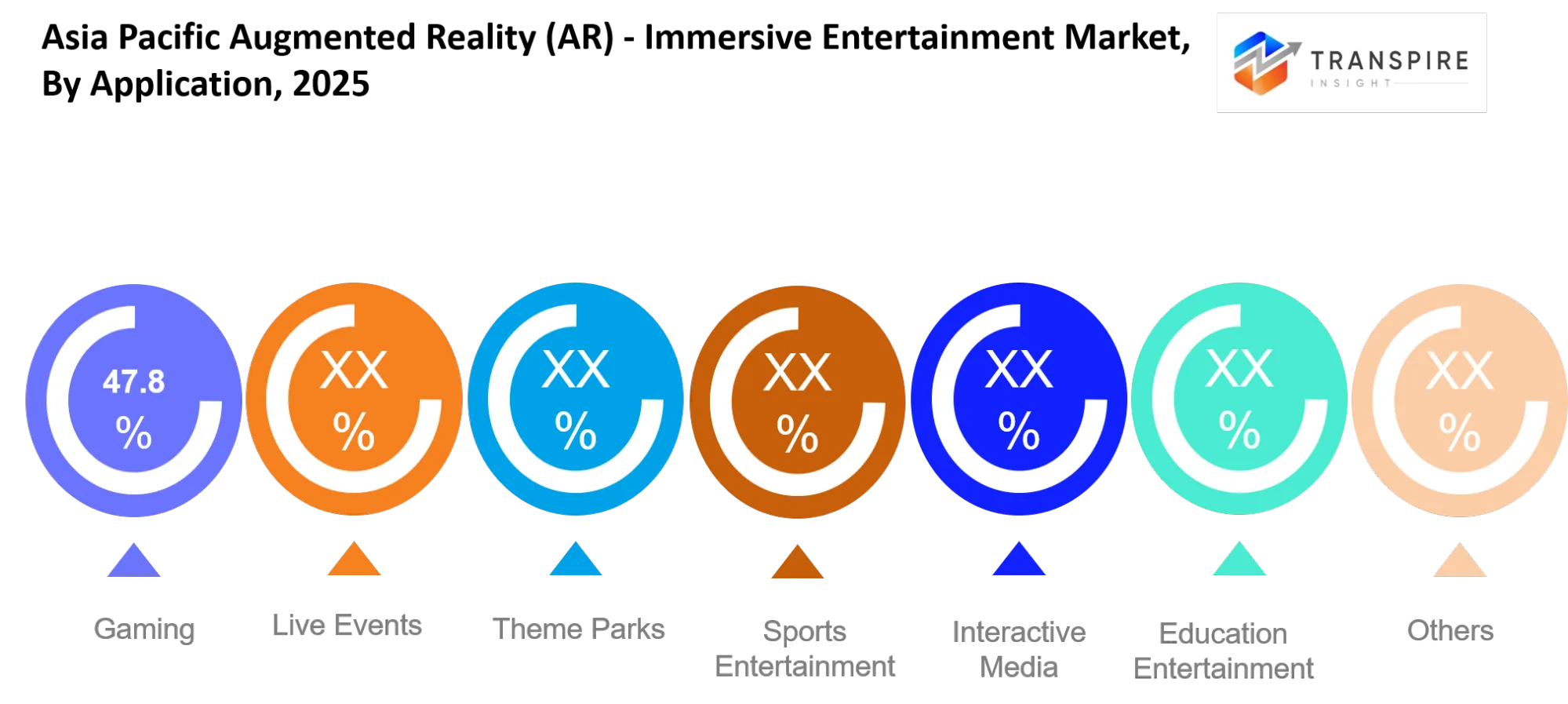
By Device Type:
Most people use their Smartphones for Augmented Reality because they are easy to use and do not need any devices. Augmented Reality glasses and headsets are really good for experiences and will be even better in the future. Tablets and wearable devices are also used for things like education and guided tours. Devices are getting better. Can show really cool things in real-time.
By End User:
Regular people like you and me are the users of Augmented Reality because we like to play games and have interactive fun. Media companies are using Augmented Reality to tell stories and make new kinds of content. People who put on events are using Augmented Reality to make their events more fun and exciting. Big companies are also using Augmented Reality to make cool content, for entertainment.
What are the Key Use Cases Driving the Asia Pacific Augmented Reality (AR) - Immersive Entertainment Market?
Gaming is still the thing people use Augmented Reality for in the Asia Pacific area. This is because people really want to have real-time digital experiences on their smartphones. The reason gaming is so popular is that people can get to immersive content without needing any hardware so a lot of people are using it.
Also smartphones are getting better and better. The software for Augmented Reality is getting better too so games are becoming more realistic and people are playing them for longer.There are things that people are starting to use Augmented Reality for, like live events and sports. Augmented Reality can make concerts and sports games fun by adding extra digital things to them in real time.Media companies and the people who organize events are using Augmented Reality to get people more excited and to make money from people who are not actually at the event.Theme parks are also using Augmented Reality to make their parks more fun by adding things to the rides and games.Some new things that people are starting to use Augmented Reality for are education and virtual tourism.Augmented Reality can make learning fun by letting people interact with what they are learning.It can also make people feel like they are really at a place when they are not by adding things to the real world.These things are getting popular with schools and tourism companies because they want to make people more excited.In the future Augmented Reality will be able to make immersive experiences, like simulations and virtual tours of places that people can do from anywhere.
|
Report Metrics |
Details |
|
Market size value in 2025 |
USD 7.39 Billion |
|
Market size value in 2026 |
USD 9.19 Billion |
|
Revenue forecast in 2033 |
USD 42.61 Billion |
|
Growth rate |
CAGR of 24.50% from 2026 to 2033 |
|
Base year |
2025 |
|
Historical data |
2021 - 2024 |
|
Forecast period |
2026 - 2033 |
|
Report coverage |
Revenue forecast, competitive landscape, growth factors, and trends |
|
Regional scope |
Asia Pacific |
|
Key company profiled |
Meta, Apple, Google, Microsoft, Sony, Snap, Niantic, Unity Technologies, Epic Games, Qualcomm, Samsung, Lenovo, HTC, Magic Leap, Tencent |
|
Customization scope |
Free report customization (country, regional & segment scope). Avail customized purchase options to meet your exact research needs. |
|
Report Segmentation |
By Component (Hardware, Software, Services, AR Platforms, Content Creation Tools, Others); By Application (Gaming, Live Events, Theme Parks, Sports Entertainment, Interactive Media, Education Entertainment, Others); By Device Type (Smartphones, AR Glasses, Headsets, Tablets, Wearables, Others); By End User (Consumers, Enterprises, Media Companies, Event Organizers, Others) |
Which Regions are Driving the Asia Pacific Augmented Reality (AR) - Immersive Entertainment Market Growth?
East Asia is leading the Asia Pacific Augmented Reality (AR) Immersive Entertainment Market. This is because it has a digital setup, advanced gaming systems and was one of the first to use spatial computing technologies. The high number of 5G users and big investments from tech companies help create content and expand platforms. The region benefits from ties between hardware makers and software developers which speeds up the launch of immersive entertainment. People in East Asia already love gaming and live experiences, which helps the market stay on top.
Southeast Asia is a contributor to the market. This is due to improvements in the internet and more people using digital entertainment. Unlike East Asia Southeast Asia's growth relies more on prices and people using AR on their smartphones rather than high-end devices. As more people get internet access and investments in entertainment infrastructure continue, the region plays a role in the market. Southeast Asia makes revenue from mobile gaming, AR apps for tourism and social entertainment platforms.
South Asia is growing fast in the AR Immersive Entertainment Market. This is because more people are using technologies and investing in immersive content platforms. With 5G services and affordable mobile devices more people in cities can access AR. Younger people are getting interested in location-based entertainment and digital storytelling which is driving growth. This growth shows there is an opportunity for new market players, especially, in making low-cost AR content and mobile-first immersive entertainment services from 2026 to 2033.
Who are the Key Players in the Asia Pacific Augmented Reality (AR) - Immersive Entertainment Market and How Do They Compete?
The Asia Pacific Augmented Reality (AR) Immersive Entertainment Market is moderately put together at the platform level. Very scattered at the content and application level. Big tech companies control the systems while smaller developers compete by making special immersive content and experiences based on where you are. The competition is about having the best technology like being able to render things in real-time accurately map spaces and have good AR performance on the cloud. It's also important to have a user experience across different devices especially for gaming and live entertainment.
Meta is focusing on making better technology by growing its AR ecosystem, which includes both hardware and software. They are adding features that help with computing, which makes social entertainment more immersive. Apple is focusing on making their devices perform well and controlling their ecosystem. They make sure their hardware and AR tools work well together which helps developers and makes the user experience better. Sony is building an advantage by integrating entertainment content using their gaming franchises to make interactive media experiences that use AR. They are also expanding into formats that combine console gaming with immersive experiences.
Tencent is strengthening its position by building platforms for AR gaming and social entertainment. They use their networks in the region to get more people engaged. Niantic is standing out by creating AR experiences that use real-world locations and interactive gameplay. They are partnering with tourism and event organizers to expand. Unity Technologies is helping the ecosystem by providing tools to create 3D content in time. This helps independent developers create AR content faster and makes it more popular, across entertainment sectors.
Company List
Meta
Apple
Google
Microsoft
Sony
Snap
Niantic
Unity Technologies
Epic Games
Qualcomm
Samsung
Lenovo
HTC
Magic Leap
Tencent
Recent Development News
In April 2026, Astrogate Inc. entered a strategic integration partnership with Jorjin Technologies. The collaboration enabled AR smart glasses integration with wireless collaboration systems to expand immersive enterprise and education applications, improving real-time interactive experiences and AR adoption across hybrid environments.https://en.prnasia.com
In March 2025, Tropos AR entered a partnership with IQ Global to expand mobile augmented reality solutions across Asia. The agreement focused on integrating SDK-based AR tools into mobile applications, enabling scalable immersive content deployment for entertainment and enterprise use cases.https://www.accessnewswire.com
In May 2026, Moment Factory and Mitsui Fudosan announced a long-term strategic partnership to develop large-scale immersive fan experiences. The initiative aims to create advanced AR-driven entertainment environments combining physical venues with digital storytelling to enhance audience engagement and monetization models.https://www.globenewswire.com
What Strategic Insights Define the Future of the Asia Pacific Augmented Reality (AR) - Immersive Entertainment Market?
The Asia Pacific Augmented Reality (AR) - Immersive Entertainment Market is moving toward a fully cloud-integrated and AI-orchestrated spatial computing ecosystem, where real-time rendering and interactive content delivery will define competitive positioning. This direction is driven by faster 5G expansion, rising edge computing capacity, and growing demand for hybrid digital-physical entertainment formats that merge live experiences with interactive overlays. Over the next 5–7 years, revenue will increasingly shift toward platform-based ecosystems rather than standalone applications, as content scalability becomes the key value driver.
A less visible risk lies in device fragmentation and uneven computing capability across consumer hardware. This creates long-term constraints on content standardization and increases development costs, limiting mass-market scalability despite strong demand. Another emerging opportunity is the integration of AR entertainment into smart tourism ecosystems, particularly in high-density urban entertainment hubs where location-based digital storytelling can monetize physical footfall. This segment remains underdeveloped but shows strong alignment with digital city infrastructure investments.
Market participants will benefit from prioritizing cloud-native AR content architecture that reduces dependency on high-end devices while enabling faster cross-platform deployment and continuous content updates across entertainment ecosystems.
Asia Pacific Augmented Reality (AR) - Immersive Entertainment Market Report Segmentation
By Component:
- Hardware
- Software
- Services
- AR Platforms
- Content Creation Tools
- Others
By Application:
- Gaming
- Live Events
- Theme Parks
- Sports Entertainment
- Interactive Media
- Education Entertainment
- Others
By Device Type:
- Smartphones
- AR Glasses
- Headsets
- Tablets
- Wearables
- Others
By End User:
- Consumers
- Enterprises
- Media Companies
- Event Organizers
- Others
Frequently Asked Questions
Find quick answers to common questions.
The Expected Asia Pacific Augmented Reality (AR) - Immersive Entertainment Market size for the Market will be USD 42.61 Billion in 2033.
Key Segments for the Asia Pacific Augmented Reality (AR) - Immersive Entertainment Market are By Component (Hardware, Software, Services, AR Platforms, Content Creation Tools, Others); By Application (Gaming, Live Events, Theme Parks, Sports Entertainment, Interactive Media, Education Entertainment, Others); By Device Type (Smartphones, AR Glasses, Headsets, Tablets, Wearables, Others); By End User (Consumers, Enterprises, Media Companies, Event Organizers, Others).
Major Asia Pacific Augmented Reality (AR) - Immersive Entertainment Market players are Meta, Apple, Google, Microsoft, Sony, Snap, Niantic, Unity Technologies, Epic Games, Qualcomm, Samsung, Lenovo, HTC, Magic Leap, Tencent.
The Current Asia Pacific Augmented Reality (AR) - Immersive Entertainment Market size is USD USD 7.39 Billion in 2025.
The Asia Pacific Augmented Reality (AR) - Immersive Entertainment Market CAGR is 24.50% from 2026 to 2033.
Meta
Apple
Google
Microsoft
Sony
Snap
Niantic
Unity Technologies
Epic Games
Qualcomm
Samsung
Lenovo
HTC
Magic Leap
Tencent
About the Authors

Mayur Shinde
I am Mayur Shinde, a Senior Research Analyst at Transpire Insight, specializing in the Automotive & Transportation and Information & Communication Technology (ICT) Industry. My work focuses on analyzing emerging market trends, technological advancements, competitive landscapes, and industry developments to deliver accurate, data-driven insights. I am passionate about transforming complex market information into clear, actionable content that helps businesses, professionals, and decision-makers stay informed and make confident strategic decisions.

Chakradhar Khansole
Chakradhar serves as the Research Director at Transpire Insight, bringing over 8 years of experience in technology, innovation, and strategic market intelligence. He specializes in transforming complex market data into actionable business insights that enable organizations to make informed, growth-oriented decisions. Recognized for his strategic vision and analytical expertise, Chakradhar leads high-impact research initiatives, delivering comprehensive market assessments, competitive intelligence, and forward-looking industry analysis.
Recently Published Reports
-
Apr 2026
3D Optical Profiler Market
3D Optical Profiler Market Size, Share & Analysis Report By Type (Desktop 3D Optical Profiler, and Portable 3D Optical Profiler), By Technology (Confocal Technology, and White Light Interference), By End-Use Industry (Manufacturing, Research Institutions, Automotive, Aerospace and Defense, Medical Devices, and Other), and Geography (North America, Europe, Asia-Pacific, Middle East and Africa, South and Central America), 2021 - 2031
-
Apr 2026
Depth Sensor Market
Depth Sensor Market Size, Share & Analysis Report By Type (Infrared Depth Sensors, Time-of-Flight (ToF) Sensors, Stereo Vision Sensors, Structured Light Sensors, Ultrasonic Depth Sensors), By Application (Automotive, Robotics, Gaming, Consumer Electronics, Industrial Automation, Healthcare, Security & Surveillance, Others), By End Users (Automotive Manufacturers, Consumer Electronics Companies, Healthcare Providers, Industrial Companies, Security Agencies, Gaming Companies, Robotics Companies, Others), and Geography (North America, Europe, Asia-Pacific, Middle East and Africa, South and Central America), 2021 – 2031
-
Apr 2026
Digital Manufacturing Market
Digital Manufacturing Market Size, Share & Analysis Report By Component (Hardware, Software, and Services), By Technology (Robotics, 3D Printing, Internet of Things (IoT), and Others), By Application (Automotive and Transportation, Aerospace and Defense, Consumer Electronics, Industrial Machinery, and Others), By Process Type (Computer-Based Designing, Computer-Based Simulation, Computer 3D Visualization, Analytics, and Others), and Geography (North America, Europe, Asia-Pacific, Middle East and Africa, South and Central America), 2021 – 2031
-
Apr 2026
Digital Visa Services Market
Digital Visa Services Market Size, Share & Analysis Report By Type (Individual Travelers, Group Travelers), By Application (Tourism, Business Travel, Others), and Geography (North America, Europe, Asia-Pacific, Middle East and Africa, South and Central America), 2021 – 2031