

Asia Pacific Audiobooks Market Size & Forecast:
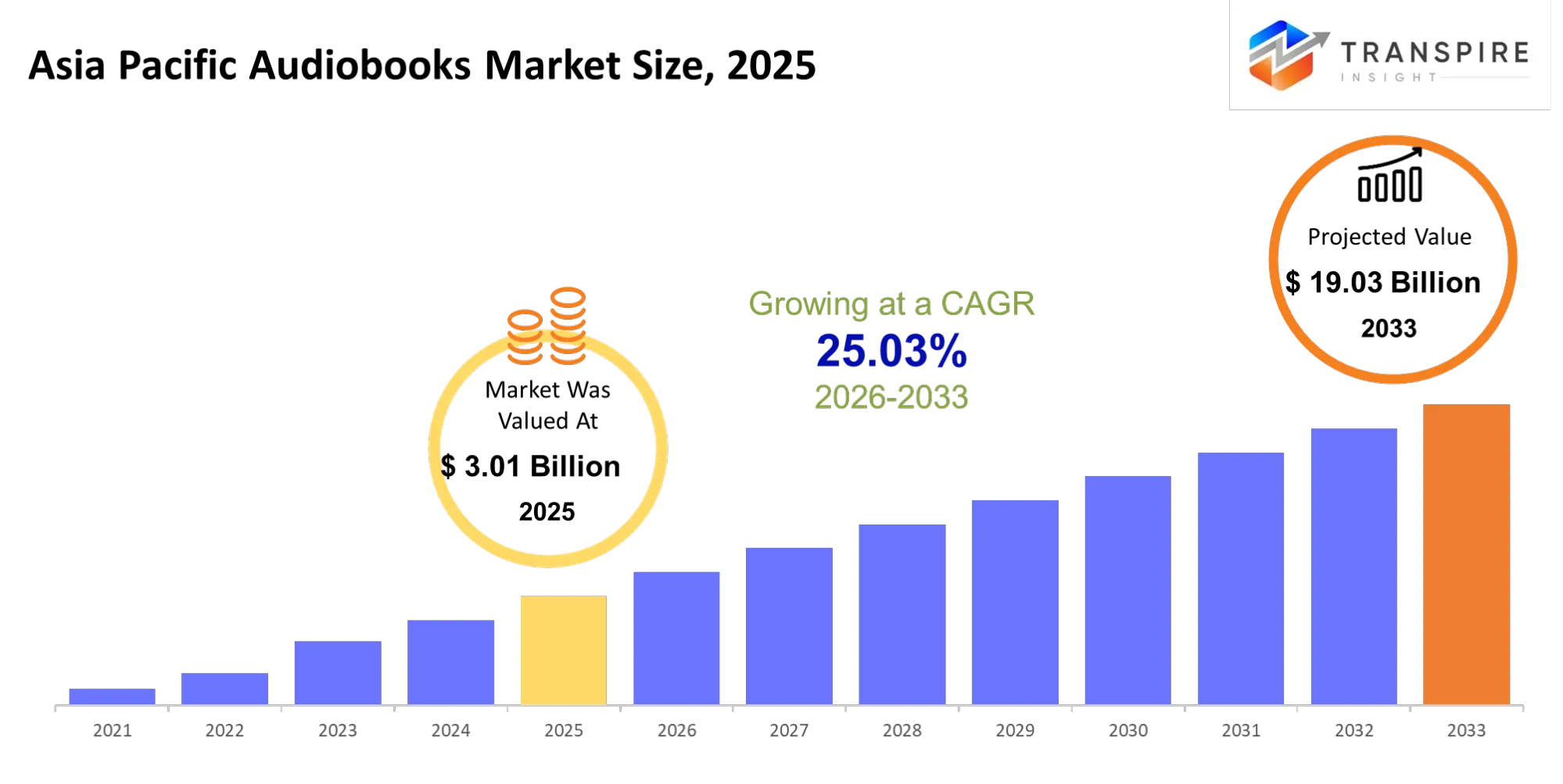
- Asia Pacific Audiobooks Market Size 2025: USD 3.01 Billion
- Asia Pacific Audiobooks Market Size 2033: USD 19.03 Billion
- Asia Pacific Audiobooks Market CAGR: 25.03%
- Asia Pacific Audiobooks Market Segments: By Genre (Fiction, Non-Fiction, Self-Help, Educational, Business, Children’s Books, Others); By Platform (Subscription Services, One-Time Purchase Platforms, Library Platforms, Others); By Device (Smartphones, Tablets, PCs, Smart Speakers, Others); By End User (Adults, Students, Professionals, Others)
Asia Pacific Audiobooks Market Summary
The Asia Pacific Audiobooks Market was valued at USD 3.01 billion in 2025. It is forecast to reach USD 19.03 billion by 2033. That is a CAGR of 25.03% over the period.
The Asia Pacific Audiobooks Market enables consumers to access books through spoken-word formats while commuting, exercising, multitasking, or navigating screen-fatigue environments. In practice, it expands content consumption beyond traditional reading by allowing publishers, educators, and digital platforms to reach audiences during otherwise unproductive time. This capability has become particularly valuable in densely populated urban markets where long travel times shape media consumption habits.
Over the last three to five years, the market has undergone a structural shift from ownership-based purchases toward subscription-driven listening ecosystems integrated with broader digital entertainment platforms. A major real-world trigger was the COVID-19 pandemic, which accelerated adoption of mobile content services and normalized app-based media consumption across multiple age groups. As smartphone penetration deepened and regional-language content libraries expanded, audiobook platforms gained access to previously underserved audiences. This has strengthened monetization opportunities through subscriptions, advertising, and premium content offerings, enabling revenue growth while encouraging publishers to invest in localized and exclusive audio content.
Key Market Insights
- China dominates the market with an estimated 35%–40% share in 2025, supported by mature digital audio ecosystems and large user bases.
- India is the fastest-growing regional market during the forecast period due to expanding smartphone access and vernacular content adoption.
- Southeast Asia is witnessing significant growth as affordable mobile internet improves access to digital audio content.
- Japan and South Korea maintain substantial industry size through premium content consumption and strong digital media spending.
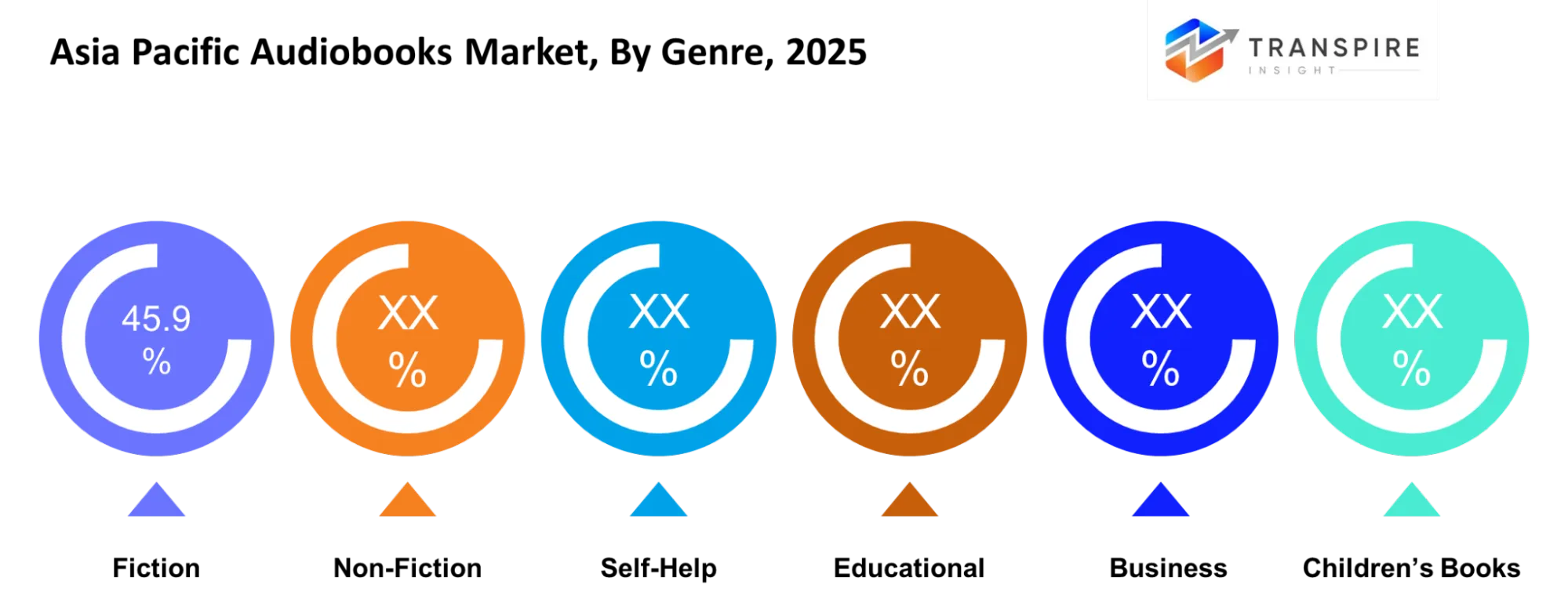
- Fiction remains the leading genre with more than 40% market share, driven by entertainment-focused listening preferences.
- Educational content represents the second-largest segment, supported by professional development and academic learning applications.
- Self-help titles are projected to be the fastest-growing genre through 2032, reflecting demand for personal and career development resources.
- Children's audiobooks continue to gain momentum as families seek flexible learning and storytelling formats.
- Subscription services account for the largest share, supported by recurring revenue models and extensive content libraries.
- One-time purchase platforms maintain a stable position among users seeking permanent access to selected titles.
What are the Key Drivers, Restraints, and Opportunities in the Asia Pacific Audiobooks Market?
The strongest force accelerating the Asia Pacific Audiobooks Market is the rapid expansion of smartphone-centered digital ecosystems combined with affordable mobile data access. Over the last decade, telecom investments and competitive data pricing, particularly in India, Southeast Asia, and parts of China, lowered the cost of streaming and downloading audio content. This shift enabled audiobook platforms to reach consumers beyond traditional book-buying audiences. As listening became possible during commuting, exercising, and other daily activities, platforms increased user engagement and subscription conversion rates. The result has been stronger recurring revenue models and greater investment in exclusive content, regional-language catalogs, and creator partnerships.
The most significant barrier remains the limited availability of high-quality localized audiobook content across many Asia Pacific languages and dialects. This is a structural challenge because audiobook production requires skilled narrators, studio infrastructure, licensing agreements, and extensive content adaptation. Unlike digital text translation, professional audio localization involves substantial time and cost. The shortage of localized libraries restricts platform penetration in underserved markets, reducing subscriber acquisition and limiting monetization opportunities outside major urban and English-speaking audiences.
A major opportunity lies in the adoption of AI-assisted narration and voice synthesis technologies. Advances in natural-sounding synthetic voices are reducing production costs and shortening content development cycles. Markets such as India and Indonesia are particularly attractive because large populations consume content in multiple regional languages. As publishers deploy AI tools to expand language coverage, audiobook platforms can scale catalogs faster, unlock new listener segments, and improve revenue potential across previously underserved markets.
What Has the Impact of Artificial Intelligence Been on the Asia Pacific Audiobooks Market?
Artificial intelligence and advanced digital technologies are transforming the Asia Pacific audiobooks industry by streamlining content creation, personalization, and platform operations. Publishers and audio platforms increasingly use AI-powered narration tools to automate portions of audiobook production, reducing recording timelines and lowering costs for large content libraries. Natural language processing systems also assist with script preparation, pronunciation consistency, metadata generation, and content categorization, enabling faster catalog expansion across multiple languages.
Machine learning models play a growing role in listener analytics and predictive engagement. Platforms analyze listening duration, completion rates, skip behavior, and search patterns to forecast user preferences and recommend relevant titles. These predictive capabilities improve subscriber retention and increase content consumption by delivering more personalized listening experiences. AI-driven recommendation engines also help platforms optimize content investments by identifying genres and language segments with the highest revenue potential.
Operationally, these technologies improve production efficiency, accelerate title launches, and support broader regional-language coverage. Automated workflows can reduce production costs and shorten content development cycles, allowing providers to expand inventories without proportionally increasing labor requirements. Advanced speech synthesis technologies further enable scalable audiobook creation for underserved language markets.
However, a key limitation remains the quality gap between AI-generated narration and professional human voice performances. While synthetic voices continue to improve, maintaining emotional nuance, cultural context, and language-specific accuracy remains challenging, particularly across the diverse linguistic landscape of Asia Pacific markets.
Key Market Trends
- Since 2020, audiobook platforms have shifted from title ownership models toward subscription bundles, creating more predictable recurring revenue streams.
- Regional-language catalogs expanded significantly between 2021 and 2025, enabling platforms to reach audiences beyond major English-speaking urban centers.
- AI-assisted narration tools moved from pilot projects to commercial deployment, reducing production timelines for large audiobook libraries.
- Publishers increasingly prioritize audio-first releases and exclusive content agreements, a strategy adopted by Audible, Storytel, and Spotify.
- Consumer listening behavior shifted from dedicated reading sessions to multitasking environments, particularly during commuting, exercise, and household activities.
- Competition intensified as music streaming and podcast platforms integrated audiobook offerings, blurring boundaries between digital audio categories.
- Data analytics evolved from basic recommendation systems to predictive content planning, helping platforms identify high-engagement genres before launch.
- Smartphone dominance strengthened after affordable 4G and 5G expansion, increasing audiobook accessibility across India, Indonesia, and Southeast Asia.
- Educational and professional learning content gained greater platform visibility as users increasingly consumed skill-development material in audio formats.
- Content localization strategies became a primary competitive differentiator, with providers investing heavily in narration, translation, and culturally relevant storytelling.
Asia Pacific Audiobooks Market Segmentation
By Genre:
Fiction remains the leading genre with more than 40% market share, driven by entertainment-focused listening preferences. Strong adoption of mystery, fantasy, romance, and contemporary storytelling has supported consistent engagement across digital audio platforms. Expanded title libraries and exclusive releases have encouraged longer listening sessions and repeat subscriptions. Consumer preference has gradually shifted from traditional reading formats toward audio-based storytelling during daily activities.
Educational content represents the second-largest segment, supported by professional development and academic learning applications. Universities, training providers, and digital learning platforms continue to add audio content to improve accessibility and convenience. Self-help titles are projected to be the fastest-growing genre through 2032, reflecting demand for personal and career development resources. Children's audiobooks continue to gain momentum as families seek flexible learning and storytelling formats that fit modern schedules.
By Platform:
Subscription services account for the largest share, supported by recurring revenue models and extensive content libraries. Unlimited listening plans have improved content discovery while providing stable income streams for platform operators. Growth in smartphone usage and digital payment adoption has strengthened acceptance of subscription-based access. Market participants continue to expand catalog offerings to improve retention rates and increase listening frequency.
One-time purchase platforms maintain a stable position among users seeking permanent access to selected titles. Premium content, specialized educational material, and niche genres continue to support transaction-based purchases. Subscription-based platforms are expected to record the fastest growth due to convenience, affordability, and content discovery features. Strategic partnerships between publishers and digital platforms will further strengthen content availability across regional markets.
By Device:
Smartphones dominate with more than 70% usage share, reflecting the region’s mobile-first content consumption behavior. Affordable mobile internet services and wider network coverage have made audiobook access easier across urban and rural areas. Improved application interfaces and offline listening features have further increased user engagement. Daily commuting and multitasking habits continue to reinforce smartphone-based listening.
Tablets and PCs continue to support educational and professional audiobook consumption. Students and working professionals frequently use larger screens to access learning materials alongside audio content. Smart speakers are emerging as the fastest-growing device category as voice-enabled technologies gain wider adoption. Integration with connected home ecosystems will create additional opportunities for audio content consumption over the coming years.
By End User:
Adults represent the leading end-user segment, contributing over half of total audiobook consumption across the region. Broad content availability across entertainment, business, education, and lifestyle categories has supported strong engagement levels. Subscription platforms continue to target adult listeners through personalized recommendations and exclusive content offerings. Growth in digital media consumption habits has strengthened adoption across multiple age groups.
Professionals are the fastest-growing user category, utilizing audiobooks for business knowledge and skill enhancement. Audio learning formats allow efficient use of travel time and daily routines while supporting continuous education goals. Students remain a significant audience for educational, language-learning, and exam-preparation content. Multitasking consumers are increasingly adopting audiobooks during commuting, exercising, and household activities, creating new opportunities for platform expansion.
What are the Key Use Cases Driving the Asia Pacific Audiobooks Market?
The primary use case driving adoption is entertainment consumption through on-demand audio storytelling. Fiction content generates the largest share of listening activity because audio formats fit naturally into commuting, exercising, and other daily routines. This convenience allows consumers to consume longer-form content without dedicated reading time, supporting high engagement and subscription retention.
Beyond entertainment, audiobook usage is expanding into professional learning and educational support. Working professionals increasingly use audio content for leadership, business, and productivity topics, while students access language-learning materials, academic resources, and exam preparation content. These applications are strengthening the role of audiobooks within digital learning ecosystems.
Emerging use cases include AI-personalized learning paths and audio-first educational publishing. Publishers are also exploring interactive audio experiences that combine narration with adaptive content recommendations. As voice technologies improve and regional-language libraries expand, these applications are expected to attract new listener groups across developing markets during the forecast period.
|
Report Metrics |
Details |
|
Market size value in 2025 |
USD 3.01 Billion |
|
Market size value in 2026 |
USD 3.81 Billion |
|
Revenue forecast in 2033 |
USD 19.03 Billion |
|
Growth rate |
CAGR of 25.03% from 2026 to 2033 |
|
Base year |
2025 |
|
Historical data |
2021 - 2024 |
|
Forecast period |
2026 - 2033 |
|
Report coverage |
Revenue forecast, competitive landscape, growth factors, and trends |
|
Regional scope |
Asia Pacific |
|
Key company profiled |
Audible, Storytel, Google Play Books, Apple Books, Kobo, Scribd, Spotify Audiobooks, Pocket FM, Kuku FM, Pratilipi FM, Tencent Audio, Himalaya, iReader, Naver Audio, Chirp |
|
Customization scope |
Free report customization (country, regional & segment scope). Avail customized purchase options to meet your exact research needs. |
|
Report Segmentation |
By Genre (Fiction, Non-Fiction, Self-Help, Educational, Business, Children’s Books, Others); By Platform (Subscription Services, One-Time Purchase Platforms, Library Platforms, Others); By Device (Smartphones, Tablets, PCs, Smart Speakers, Others); By End User (Adults, Students, Professionals, Others) |
Which Regions are Driving the Asia Pacific Audiobooks Market Growth?
East Asia holds the leading position in the market, supported by the scale of its digital content ecosystem and large base of connected consumers. China, Japan, and South Korea benefit from advanced mobile infrastructure, high smartphone penetration, and mature digital payment networks that simplify audiobook subscriptions. Strong investment from technology companies, publishers, and audio platforms has created extensive content libraries across multiple genres and languages. This well-developed ecosystem allows platforms to attract listeners, retain subscribers, and continuously expand content offerings.
Oceania represents a smaller but highly stable contributor compared with East Asia. Australia and New Zealand benefit from established digital publishing industries, strong consumer spending power, and consistent adoption of subscription-based media services. Market growth is supported by reliable broadband access, widespread use of connected devices, and a preference for premium digital content. These factors create a predictable business environment that supports steady revenue generation for audiobook providers and publishers.
South Asia is expected to record the fastest growth over the forecast period, driven primarily by India’s expanding digital economy. Affordable mobile data, broader smartphone access, and growing availability of regional-language content have significantly increased audiobook accessibility. Investments in local-language publishing, audio production capabilities, and digital learning platforms have accelerated market participation across diverse consumer groups. This momentum creates attractive opportunities for platform operators, content creators, and investors seeking exposure to high-growth digital media segments between 2026 and 2033.
Who are the Key Players in the Asia Pacific Audiobooks Market and How Do They Compete?
Competition in the Asia Pacific audiobooks industry remains moderately concentrated, with a handful of global platforms controlling a significant share of subscriptions while regional providers compete through language specialization and local content. The primary basis of competition has shifted from catalog size alone toward exclusive content, recommendation technology, and regional-language coverage. Established platforms continue to defend market share through subscription ecosystems and content partnerships, while newer entrants target underserved audiences with localized offerings and mobile-first experiences. Competitive success increasingly depends on retaining listeners through personalization, exclusive releases, and seamless cross-device access.
Audible differentiates itself through a large portfolio of exclusive productions, original audio programming, and integration with the broader Amazon ecosystem. This approach strengthens subscriber retention and encourages long-term engagement. Storytel focuses on regional-language expansion and local publishing partnerships, particularly across India and Southeast Asia. Strong localization capabilities allow faster penetration into markets where international content alone has limited appeal.
Spotify has expanded beyond music and podcasts by incorporating audiobooks into existing subscription offerings, creating a bundled digital audio experience that increases user engagement. Google Play Books maintains a distinct position through its flexible purchase model, allowing consumers to buy individual titles without committing to subscriptions. Kobo differentiates itself through partnerships with publishers and device ecosystems that connect e-books and audiobooks within a single user experience. These strategies help companies expand audience reach while addressing different listening preferences across Asia Pacific markets.
Company List
- Audible
- Storytel
- Google Play Books
- Apple Books
- Kobo
- Scribd
- Spotify Audiobooks
- Pocket FM
- Kuku FM
- Pratilipi FM
- Tencent Audio
- Himalaya
- iReader
- Naver Audio
- Chirp
Recent Development News
In February 2026, Storytel announced a partnership with Spotify. The agreement enables Storytel subscribers to access audiobooks through Spotify, expanding distribution channels and improving audiobook accessibility for consumers. Source: Storytel Press Release. Full link:https://www.storytelgroup.com
In May 2026, Spotify launched new audiobook discovery features during Investor Day 2026. The update introduced conversational search and recommendation tools while supporting a catalog of more than 700,000 audiobook titles across 22 markets, strengthening user engagement and content discovery. Source: Spotify Newsroom. Full link:https://newsroom.spotify.com
In December 2025, Storytel entered a strategic partnership with Ringier Axel Springer Polska. The collaboration combined Storytel’s audiobook platform with Onet Premium to offer a bundled subscription package, expanding digital audiobook reach in the Polish market. Source: Storytel Group Announcement. Full link:https://mfn.se/a/storytel/story
What Strategic Insights Define the Future of the Asia Pacific Audiobooks Market?
Over the next five to seven years, the Asia Pacific audiobooks industry is likely to move beyond simple content distribution and toward highly personalized audio ecosystems built around artificial intelligence, multilingual content production, and integrated digital media subscriptions. The underlying force behind this transition is the growing ability of platforms to match content, language, and listening preferences at scale while lowering production costs through automation. As a result, competitive advantage will increasingly depend on data capabilities and content localization rather than catalog size alone.
A less visible risk lies in market concentration. A small group of large digital platforms controls audience access, discovery algorithms, and subscription ecosystems. This concentration could limit bargaining power for publishers and content creators while increasing dependence on a handful of distribution channels.
An emerging opportunity is the development of AI-assisted regional-language audiobooks in South and Southeast Asia. Improvements in synthetic voice technology could make previously uneconomic language markets commercially viable. Market participants should invest early in proprietary local-language content and technology partnerships, as ownership of localized intellectual property will become a key differentiator in future competition.
Asia Pacific Audiobooks Market Report Segmentation
By Genre
- Fiction
- Non-Fiction
- Self-Help
- Educational
- Business
- Children’s Books
- Others
By Platform
- Subscription Services
- One-Time Purchase Platforms
- Library Platforms
- Others
By Device
- Smartphones
- Tablets
- PCs
- Smart Speakers
- Others
By End User
- Adults
- Students
- Professionals
- Others
Frequently Asked Questions
Find quick answers to common questions.
The expected Asia Pacific Audiobooks Market size for the market will be USD 19.03 Billion in 2033.
Key segments for the Asia Pacific Audiobooks Market are By Genre (Fiction, Non-Fiction, Self-Help, Educational, Business, Children’s Books, Others); By Platform (Subscription Services, One-Time Purchase Platforms, Library Platforms, Others); By Device (Smartphones, Tablets, PCs, Smart Speakers, Others); By End User (Adults, Students, Professionals, Others).
Major Asia Pacific Audiobooks Market players are Audible, Storytel, Google Play Books, Apple Books, Kobo, Scribd, Spotify Audiobooks, Pocket FM, Kuku FM, Pratilipi FM, Tencent Audio, Himalaya, iReader, Naver Audio, Chirp.
The Asia Pacific Audiobooks Market size is USD 3.01 Billion in 2025.
The Asia Pacific Audiobooks Market CAGR is 25.03% from 2026 to 2033.
- Audible
- Storytel
- Google Play Books
- Apple Books
- Kobo
- Scribd
- Spotify Audiobooks
- Pocket FM
- Kuku FM
- Pratilipi FM
- Tencent Audio
- Himalaya
- iReader
- Naver Audio
- Chirp
About the Authors

Chetan Dhatrak
I’m Chetan Dhatrak, a Senior Research Analyst at Transpire Insight, specializing in the Consumer Goods, Foods and Beverages industry. I focus on analyzing market trends, consumer behavior, competitive landscapes, and industry developments to deliver accurate, data-driven insights. My research at Transpire Insight is built on credible sources and in-depth analysis, helping businesses and readers better understand market dynamics, emerging opportunities, and evolving consumer preferences. I’m committed to creating reliable, well-researched content that supports informed decision-making and reflects the latest developments in the consumer goods and food & beverage sectors.

Chakradhar Khansole
Chakradhar serves as the Research Director at Transpire Insight, bringing over 8 years of experience in technology, innovation, and strategic market intelligence. He specializes in transforming complex market data into actionable business insights that enable organizations to make informed, growth-oriented decisions. Recognized for his strategic vision and analytical expertise, Chakradhar leads high-impact research initiatives, delivering comprehensive market assessments, competitive intelligence, and forward-looking industry analysis.
Recently Published Reports
-
Apr 2026
Bottled Water Market
Bottled Water Market Size, Share & Analysis Report By Product Type (Still Bottled Water, Carbonated Bottled Water, Functional Bottled Water, and Others), By Packaging (PET, Cans, and Others), By Sales Channel (Supermarkets/Hypermarkets, Convenience Stores/Drug Stores, Grocery Stores/Club Stores, Foodservice, and Others) and Geography (North America, Europe, Asia-Pacific, Middle East and Africa, South and Central America), 2021 - 2032
-
Apr 2026
Color Cosmetic Packaging Market
Color Cosmetic Packaging Market Size, Share & Analysis Report By Application (Mascara Packaging, Liquid Packaging, and Liquid Face), By Type (Tubes & Bottles, Pens & Markers, Compacts & Containers, and Droppers & Pumps), and Geography (North America, Europe, Asia-Pacific, Middle East and Africa, South and Central America), 2021 - 2031
-
Apr 2026
External Microphone For Camera Market
External Microphone For Camera Market Size, Share & Analysis Report By Type (Shotgun Microphone, Lavalier Microphone, and Others), By Application (Digital Camera, Professional Video Camera, and Others), and Geography (North America, Europe, Asia-Pacific, Middle East and Africa, South and Central America), 2021 - 2031
-
Apr 2026
Foot Orthotic Insoles Market
Foot Orthotic Insoles Market Size, Share & Analysis Report By Type (Pre-fabricated, and Custom-made), By Material (Thermoplastic, Composite Carbon Fiber, and Others), By Distribution Channel (Drug Stores, Hospitals & Clinics, and Others), and Geography (North America, Europe, Asia-Pacific, Middle East and Africa, South and Central America), 2021 - 2031