
Asia Pacific Application Performance Management Software Market Size & Forecast:
- Asia Pacific Application Performance Management Software Market Size 2025: USD 1.2 Billion
- Asia Pacific Application Performance Management Software Market Size 2033: USD 4.2 Billion
- Asia Pacific Application Performance Management Software Market CAGR: 16.99%
- Asia Pacific Application Performance Management Software Market Segments: By Component (Monitoring Software, Analytics Platforms, Dashboards, AI Monitoring Tools, Tracing Tools, Reporting Tools, Alerting Systems, Others); By Deployment (Cloud, On-Premise, Hybrid, SaaS, Multi-Cloud, Private Cloud, Edge Monitoring, Others); By Application (Application Monitoring, Infrastructure Monitoring, Database Monitoring, End User Monitoring, Network Monitoring, Cloud Monitoring, DevOps Monitoring, Others); By End User (IT & Telecom, BFSI, Healthcare, Retail, Manufacturing, Government, Media, Others)
Asia Pacific Application Performance Management Software Market Summary
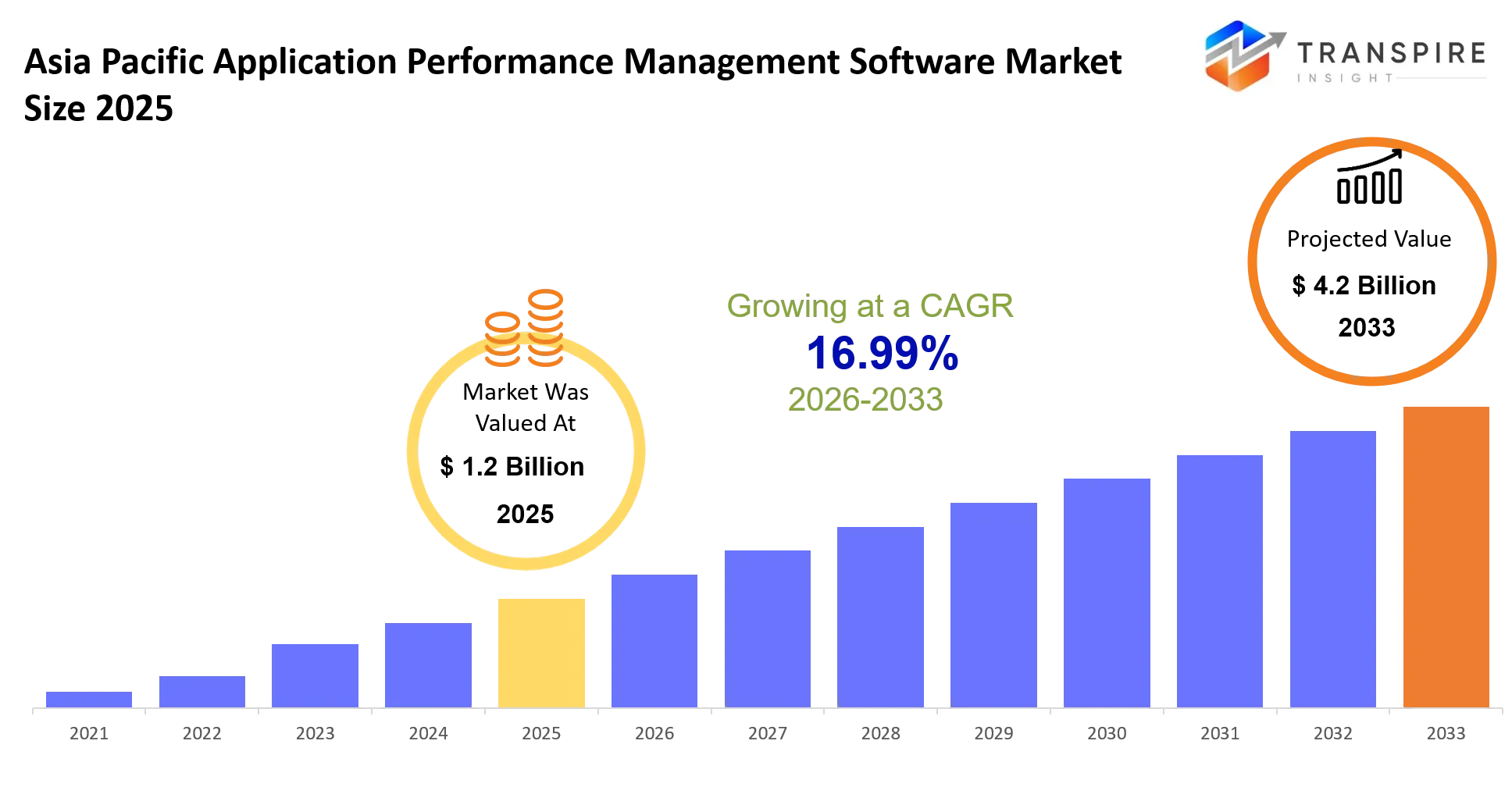
The Asia Pacific Application Performance Management Software Market was valued at USD 1.2 billion in 2025. It is forecast to reach USD 4.2 billion by 2033. That is a CAGR of 16.99% over the period.
The Asia Pacific Application Performance Management (APM) Software Market has become a critical operational layer for enterprises that depend on uninterrupted digital services. In practice, APM platforms help banks, manufacturers, retailers, telecom operators, and public agencies detect performance bottlenecks before they disrupt customer transactions, production systems, or employee workflows. Rather than troubleshooting after outages occur, organizations now continuously monitor applications, infrastructure, and user experiences in real time.
Over the past three to five years, the market has shifted from infrastructure-centric monitoring to AI-driven observability across complex cloud environments. The rapid adoption of hybrid and multi-cloud architectures has made traditional monitoring tools insufficient because applications now span multiple platforms and vendors. The pandemic-era acceleration of digital services also exposed the financial cost of downtime, forcing organizations to prioritize performance visibility. As businesses embed AI, IoT, and edge computing into operations, software complexity is increasing faster than IT teams can manually manage. This is translating into stronger investment in automated diagnostics, predictive analytics, and unified observability platforms, creating new revenue opportunities for vendors that can simplify fragmented digital ecosystems.
Key Market Insights
- China dominates the Asia Pacific Application Performance Management Software Market with approximately 32% market share in 2025, supported by large-scale cloud adoption and enterprise digital transformation initiatives.
- India is the fastest-growing regional market through 2030, driven by expanding fintech ecosystems, digital public infrastructure, and accelerated SaaS adoption.
- Japan maintains a significant share due to strong investments in Industry 4.0, smart manufacturing, and enterprise automation programs.
- Australia and Southeast Asian economies are emerging growth hubs as enterprises modernize legacy IT infrastructure.
- Cloud-based APM solutions lead with nearly 65% market share in 2025 because organizations prefer scalable and subscription-based deployment models.
- Professional services represent the second-largest segment, supporting implementation, integration, and observability transformation projects.
- AI-powered observability platforms are the fastest-growing segment between 2025 and 2030 as enterprises automate performance optimization.
- Unified full-stack observability platforms are replacing standalone monitoring tools across large enterprises.
- IT operations and infrastructure monitoring dominate with approximately 38% market share due to strict business continuity requirements.
- Digital customer experience monitoring is the fastest-growing application segment, especially across banking, telecom, and e-commerce industries.
What are the Key Drivers, Restraints, and Opportunities in the Asia Pacific Application Performance Management Software Market?
The primary force accelerating the Asia Pacific Application Performance Management Software Market is the rapid transition toward cloud-native and multi-cloud enterprise architectures. Over the past few years, organizations across banking, telecommunications, retail, and manufacturing have shifted critical workloads from on-premise environments to distributed cloud ecosystems. This transition has created a visibility gap because traditional monitoring tools cannot track application performance across multiple cloud providers, containers, APIs, and edge environments simultaneously. As a result, enterprises are investing in unified observability platforms that reduce downtime, improve digital customer experiences, and automate root-cause analysis. The financial impact is substantial because even short service disruptions can translate into transaction losses and customer attrition.
The biggest structural barrier is the shortage of skilled observability and cloud operations professionals. Modern APM platforms generate enormous volumes of telemetry data that require specialized expertise to interpret and optimize. Many organizations, particularly mid-sized enterprises, lack personnel who can manage AI-driven monitoring systems across hybrid infrastructures. This skills gap cannot be resolved quickly because workforce development, certification programs, and enterprise process redesign require several years. Consequently, deployment timelines lengthen, software utilization remains below potential, and revenue expansion slows across developing Asia Pacific economies.
A major growth opportunity lies in integrating generative AI with observability platforms. Countries such as India, Singapore, and Australia are rapidly expanding AI investments, creating favorable conditions for intelligent performance management systems. Generative AI can automatically summarize incidents, predict outages, and recommend remediation steps before users experience disruptions. Vendors that embed these capabilities into unified platforms can reduce operational workloads and strengthen long-term enterprise adoption.
What Has the Impact of Artificial Intelligence Been on the Asia Pacific Application Performance Management Software Market?
Artificial intelligence and advanced digital technologies are reshaping the Asia Pacific Application Performance Management Software Market by shifting IT operations from reactive troubleshooting to autonomous performance optimization. Enterprises are increasingly deploying AI-powered observability platforms that automatically monitor applications, infrastructure, databases, cloud workloads, and end-user experiences from a single interface. Instead of relying on manual analysis, these systems continuously correlate Billions of telemetry data points to detect anomalies and prioritize incidents before they affect business operations.
Machine learning models are also strengthening predictive capabilities. Organizations use predictive analytics to forecast application slowdowns, identify infrastructure bottlenecks, and estimate resource consumption patterns before performance degradation occurs. This approach helps IT teams optimize cloud spending, improve workload distribution, and prevent costly outages. Large enterprises have reported incident resolution times improving by 40% to 60% after implementing AI-assisted observability and automated root-cause analysis capabilities.
Advanced automation is generating measurable operational improvements. AI-driven platforms can reduce unplanned downtime, increase service availability, improve digital transaction reliability, and lower operational costs by minimizing manual intervention. Automated remediation tools can restart services, reallocate computing resources, or isolate faulty components without waiting for human intervention.
However, one significant limitation remains. Many organizations still operate fragmented legacy systems across hybrid and multi-cloud environments, making AI integration expensive and technically complex. Inconsistent data quality and siloed infrastructure reduce model accuracy, delaying the full realization of autonomous observability across enterprises in the region.
Key Market Trends
- Since 2021, enterprises have shifted from infrastructure monitoring to full-stack observability as applications became distributed across multi-cloud and hybrid environments.
- Banks and fintech companies have moved from reactive incident management to predictive performance analytics to reduce digital transaction disruptions.
- Organizations increasingly consolidate vendors, replacing multiple monitoring tools with unified platforms from Dynatrace, Datadog, and Cisco AppDynamics.
- AI-powered root-cause analysis has emerged as a core purchasing criterion, reducing manual investigation workloads for IT operations teams.
- Since 2022, Kubernetes and container adoption have accelerated investments in application dependency mapping and real-time service monitoring.
- Telecom operators are integrating APM platforms into 5G infrastructure to manage growing network complexity and latency-sensitive services.
- Enterprises are embedding business metrics into observability platforms, linking application performance directly to revenue generation and customer retention.
- Cloud providers and software vendors have expanded strategic partnerships across India, Singapore, Australia, and Southeast Asia to strengthen regional presence.
- Security and performance monitoring are converging as organizations seek unified visibility across applications, infrastructure, and cyber risks.
- Mid-sized enterprises increasingly prefer SaaS-based deployment models because they reduce implementation complexity and lower operational overhead compared to traditional on-premise systems.
Asia Pacific Application Performance Management Software Market Segmentation
By Component:
Software solutions hold the leading position because modern enterprises require complete visibility across applications, databases, cloud infrastructure, and digital services. Organizations prefer unified platforms that connect performance data from multiple environments instead of managing separate monitoring tools. AI-powered analytics, automated root cause analysis, and observability capabilities have become standard purchasing requirements. Strong investment from banking, telecom, and retail sectors continues to support software adoption.
Services maintain an important position because implementation complexity remains high across hybrid environments. Professional consulting, integration, managed services, and training support help enterprises shorten deployment timelines and improve operational efficiency. Large organizations also seek external expertise to optimize cloud resources and reduce downtime risks. Service providers gain opportunities from long-term maintenance contracts and continuous performance optimization projects.
By Deployment:
Cloud deployment dominates because enterprises seek scalability, flexibility, and lower infrastructure management responsibilities. Subscription models also allow easier budget planning and faster software upgrades. Multi-cloud strategies adopted across large organizations have further accelerated cloud-based implementation. Faster digital transformation programs support long-term growth for cloud environments.
On-premise deployment continues across highly regulated industries that prioritize data governance and internal security requirements. Government agencies and financial institutions still maintain critical workloads inside controlled environments. Hybrid deployment also gains traction because enterprises balance operational flexibility with regulatory obligations. Balanced deployment strategies create stable opportunities for technology vendors operating across diverse customer groups.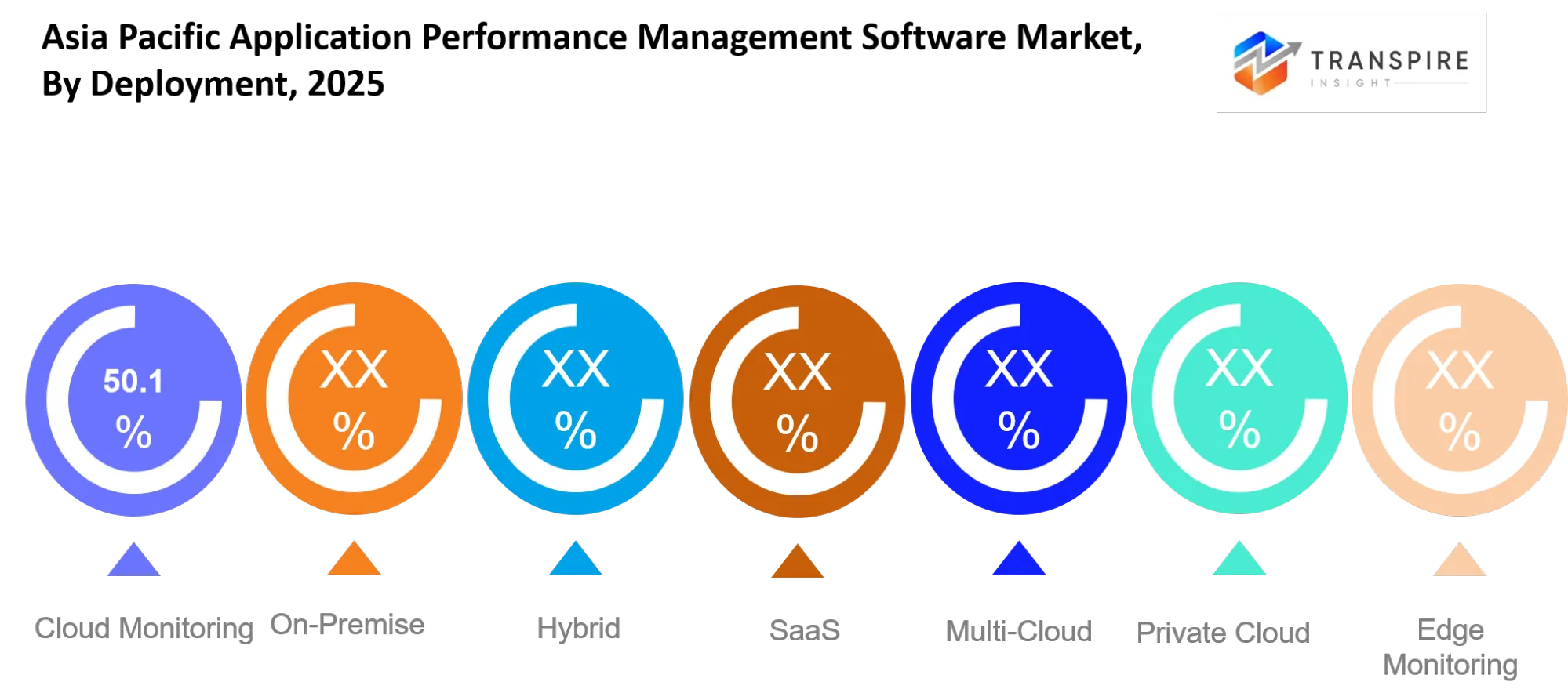
By Application:
IT operations and infrastructure monitoring remain the largest application area because uninterrupted digital services directly influence business continuity. Enterprises continuously monitor servers, databases, applications, networks, and cloud workloads to avoid performance disruptions. Real-time visibility helps operational teams detect bottlenecks before customer impact occurs. Strong operational dependence on digital systems supports sustained investment.
Digital experience monitoring represents one of the fastest advancing application areas. Customer expectations for seamless online banking, e-commerce transactions, and mobile applications have changed enterprise priorities. Organizations now connect application performance metrics with customer retention and revenue outcomes. Microservices monitoring and container observability also expand because cloud-native architectures continue spreading across multiple industries.
By End User:
Banking, financial services, and insurance lead adoption because digital transactions require uninterrupted availability and rapid response times. Payment failures and service outages create immediate financial consequences for institutions operating large customer networks. Continuous monitoring helps maintain service quality and regulatory compliance standards. Advanced observability tools also improve fraud detection support and transaction reliability.
Telecommunications, manufacturing, retail, and government sectors continue expanding investments. Telecom operators manage growing complexity from 5G infrastructure deployments and network virtualization programs. Manufacturing facilities rely on connected systems that require constant performance optimization. Government organizations also modernize digital platforms to improve citizen services and strengthen operational efficiency across public infrastructure.
What are the Key Use Cases Driving the Asia Pacific Application Performance Management Software Market?
The primary use case driving adoption involves real-time monitoring of mission-critical business applications across banking, telecommunications, and large digital platforms. Financial institutions generate the highest demand because payment systems, mobile banking applications, and online transactions require uninterrupted performance. Continuous visibility helps technical teams detect bottlenecks before service disruptions affect customers or revenue.
Expanding applications include digital experience monitoring and cloud workload optimization. Retail and e-commerce companies use these capabilities to maintain fast response times during peak shopping periods, while telecom operators monitor 5G-enabled services and distributed network applications. Manufacturing companies also use performance analytics to support connected production environments.
Emerging use cases include AI-driven autonomous remediation and edge application observability. Smart factories and public sector digital infrastructure projects are beginning to adopt predictive systems that can identify issues and recommend corrective actions automatically. These applications remain at an early stage but show strong long-term potential as enterprises deploy more AI and edge computing technologies.
|
Report Metrics |
Details |
|
Market size value in 2025 |
USD 1.2 Billion |
|
Market size value in 2026 |
USD 1.4 Billion |
|
Revenue forecast in 2033 |
USD 4.2 Billion |
|
Growth rate |
CAGR of 16.99% from 2026 to 2033 |
|
Base year |
2025 |
|
Historical data |
2021 - 2024 |
|
Forecast period |
2026 - 2033 |
|
Report coverage |
Revenue forecast, competitive landscape, growth factors, and trends |
|
Regional scope |
Asia Pacific |
|
Key company profiled |
Dynatrace, Datadog, New Relic, AppDynamics, IBM, Oracle, Microsoft, Splunk, Elastic, SolarWinds, Broadcom, Cisco, LogicMonitor, Riverbed, BMC |
|
Customization scope |
Free report customization (country, regional & segment scope). Avail customized purchase options to meet your exact research needs. |
|
Report Segmentation |
By Component (Monitoring Software, Analytics Platforms, Dashboards, AI Monitoring Tools, Tracing Tools, Reporting Tools, Alerting Systems, Others); By Deployment (Cloud, On-Premise, Hybrid, SaaS, Multi-Cloud, Private Cloud, Edge Monitoring, Others); By Application (Application Monitoring, Infrastructure Monitoring, Database Monitoring, End User Monitoring, Network Monitoring, Cloud Monitoring, DevOps Monitoring, Others); By End User (IT & Telecom, BFSI, Healthcare, Retail, Manufacturing, Government, Media, Others) |
Which Regions are Driving the Asia Pacific Application Performance Management Software Market Growth?
China leads the regional landscape because large enterprises continue investing heavily in cloud computing, artificial intelligence, and digital infrastructure modernization. Strong government support for industrial digitalization and data center expansion has accelerated adoption across banking, manufacturing, telecommunications, and e-commerce sectors. The presence of major cloud providers, hyperscale data centers, and a large technology workforce creates a strong ecosystem that supports long-term implementation. Large organizations also operate complex digital environments that require advanced observability platforms to maintain operational stability.
Japan represents the second-largest contributor, but growth patterns differ from China because investments focus more on reliability, operational precision, and gradual modernization. Established enterprises prioritize system stability over rapid technology replacement, creating a steady demand environment for software vendors. Manufacturing companies, financial institutions, and automotive businesses continue allocating budgets toward performance optimization as part of broader digital transformation strategies. Mature IT governance frameworks also support consistent spending on enterprise monitoring technologies.
India is emerging as the fastest-growing market due to rapid digitalization across both private and public sectors. Recent expansion of digital payment systems, cloud adoption programs, and AI investments has significantly increased application complexity for enterprises. Technology startups, financial institutions, and government organizations are modernizing infrastructure at a faster pace than before, creating new opportunities for observability platform providers. Growth between 2026 and 2033 will make India a strategic destination for vendors seeking new customers, regional partnerships, and long-term revenue expansion opportunities.
Who are the Key Players in the Asia Pacific Application Performance Management Software Market and How Do They Compete?
Competition in the Asia Pacific Application Performance Management Software Market is moderately consolidated, with global technology providers controlling a significant share of enterprise deployments while specialized observability vendors continue expanding influence. Competition no longer depends primarily on pricing because enterprises prioritize automation capabilities, AI integration, and unified visibility across hybrid and multi-cloud environments. Established companies are defending market share by consolidating multiple IT monitoring functions into single platforms, while newer cloud-native providers challenge traditional models with faster deployment and simpler integration. Technology differentiation, scalability, and AI-driven analytics have become the main factors influencing purchasing decisions.
Dynatrace differentiates itself through an AI-powered observability platform that automatically maps application dependencies and identifies root causes without extensive manual intervention. The company continues expanding through strategic partnerships with major cloud providers and stronger investments across India, Australia, and Southeast Asia. Datadog has built competitive strength around a unified SaaS platform that allows enterprises to monitor infrastructure, applications, security, and user experiences from one interface. Continuous product additions and aggressive expansion into security observability have helped Datadog attract enterprises seeking vendor consolidation.
Cisco AppDynamics focuses on connecting application performance directly to business outcomes, allowing organizations to measure how technical disruptions affect revenue and customer experiences. Strong integration with Cisco networking infrastructure creates an advantage among large enterprises with complex digital ecosystems. New Relic differentiates itself through a consumption-based pricing approach that offers greater flexibility for organizations scaling cloud operations. Microsoft continues strengthening market presence by integrating observability capabilities into Azure services, enabling enterprises to manage cloud workloads through familiar ecosystems and simplifying adoption for existing customers.
Company List
- Dynatrace
- Datadog
- New Relic
- AppDynamics
- IBM
- Oracle
- Microsoft
- Splunk
- Elastic
- SolarWinds
- Broadcom
- Cisco
- LogicMonitor
- Riverbed
- BMC
Recent Development News
"In April 2026, Dynatrace announced acquisition of Bindplane. The acquisition expands Dynatrace's telemetry pipeline capabilities, allowing enterprises to better manage logs, metrics, and traces across AI, cloud, and hybrid environments, strengthening observability offerings used by Asia Pacific enterprises.https://www.dynatrace.com
"In January 2026, Dynatrace launched new agentic AI and observability platform enhancements at Perform 2026. The upgrades expanded autonomous operations, AI observability, and cloud operations capabilities, helping enterprises automate performance monitoring across increasingly complex digital ecosystems.https://www.dynatrace.com
"In June 2026, New Relic strengthened its strategic partnership with Microsoft at Build 2026. The collaboration introduced deeper AI observability capabilities for Azure and GitHub environments while expanding marketplace-driven enterprise adoption opportunities across global markets, including Asia Pacific.https://newrelic.com
What Strategic Insights Define the Future of the Asia Pacific Application Performance Management Software Market?
Over the next five to seven years, the Asia Pacific Application Performance Management Software Market will move beyond traditional monitoring and evolve into autonomous observability ecosystems that actively manage enterprise operations with minimal human intervention. The underlying force behind this shift will be the growing complexity of AI workloads, multi-cloud environments, edge computing, and interconnected business applications. Organizations will no longer purchase performance tools solely to detect outages. Investment decisions will increasingly focus on platforms that can predict incidents, automate remediation, and connect technical performance directly to business outcomes.
One hidden risk lies in market concentration around a small group of global software vendors and hyperscale cloud ecosystems. Excessive dependence on a limited number of providers could create vendor lock-in challenges, higher switching costs, and reduced flexibility for enterprises over time. An emerging opportunity is developing around AI observability for sovereign cloud infrastructure, particularly in India and Southeast Asia, where governments are strengthening digital infrastructure investments and data governance requirements. Market participants should invest early in open, interoperable platforms that integrate easily across cloud providers because enterprises will increasingly prioritize flexibility over standalone product capabilities.
Asia Pacific Application Performance Management Software Market Report Segmentation
By Component
- Monitoring Software
- Analytics Platforms
- Dashboards
- AI Monitoring Tools
- Tracing Tools
- Reporting Tools
- Alerting Systems
- Others
By Deployment
- Cloud
- On-Premise
- Hybrid
- SaaS
- Multi-Cloud
- Private Cloud
- Edge Monitoring
- Others
By Application
- Application Monitoring
- Infrastructure Monitoring
- Database Monitoring
- End User Monitoring
- Network Monitoring
- Cloud Monitoring
- DevOps Monitoring
- Others
By End User
- IT & Telecom
- BFSI
- Healthcare
- Retail
- Manufacturing
- Government
- Media
- Others
Frequently Asked Questions
Find quick answers to common questions.
The Expected Asia Pacific Application Performance Management Software Market size for the Market will be USD 4.2 Billion in 2033.
Key Segments for the Asia Pacific Application Performance Management Software Market are By Component (Monitoring Software, Analytics Platforms, Dashboards, AI Monitoring Tools, Tracing Tools, Reporting Tools, Alerting Systems, Others); By Deployment (Cloud, On-Premise, Hybrid, SaaS, Multi-Cloud, Private Cloud, Edge Monitoring, Others); By Application (Application Monitoring, Infrastructure Monitoring, Database Monitoring, End User Monitoring, Network Monitoring, Cloud Monitoring, DevOps Monitoring, Others); By End User (IT & Telecom, BFSI, Healthcare, Retail, Manufacturing, Government, Media, Others).
Major Asia Pacific Application Performance Management Software Market players are Dynatrace, Datadog, New Relic, AppDynamics, IBM, Oracle, Microsoft, Splunk, Elastic, SolarWinds, Broadcom, Cisco, LogicMonitor, Riverbed, BMC.
The Current Asia Pacific Application Performance Management Software Market size is USD 1.2 Billion in 2025.
The Asia Pacific Application Performance Management Software Market CAGR is 16.99% from 2026 to 2033.
- Dynatrace
- Datadog
- New Relic
- AppDynamics
- IBM
- Oracle
- Microsoft
- Splunk
- Elastic
- SolarWinds
- Broadcom
- Cisco
- LogicMonitor
- Riverbed
- BMC
About the Authors

Mayur Shinde
I am Mayur Shinde, a Senior Research Analyst at Transpire Insight, specializing in the Automotive & Transportation and Information & Communication Technology (ICT) Industry. My work focuses on analyzing emerging market trends, technological advancements, competitive landscapes, and industry developments to deliver accurate, data-driven insights. I am passionate about transforming complex market information into clear, actionable content that helps businesses, professionals, and decision-makers stay informed and make confident strategic decisions.

Chakradhar Khansole
Chakradhar serves as the Research Director at Transpire Insight, bringing over 8 years of experience in technology, innovation, and strategic market intelligence. He specializes in transforming complex market data into actionable business insights that enable organizations to make informed, growth-oriented decisions. Recognized for his strategic vision and analytical expertise, Chakradhar leads high-impact research initiatives, delivering comprehensive market assessments, competitive intelligence, and forward-looking industry analysis.
Recently Published Reports
-
Apr 2026
3D Optical Profiler Market
3D Optical Profiler Market Size, Share & Analysis Report By Type (Desktop 3D Optical Profiler, and Portable 3D Optical Profiler), By Technology (Confocal Technology, and White Light Interference), By End-Use Industry (Manufacturing, Research Institutions, Automotive, Aerospace and Defense, Medical Devices, and Other), and Geography (North America, Europe, Asia-Pacific, Middle East and Africa, South and Central America), 2021 - 2031
-
Apr 2026
Depth Sensor Market
Depth Sensor Market Size, Share & Analysis Report By Type (Infrared Depth Sensors, Time-of-Flight (ToF) Sensors, Stereo Vision Sensors, Structured Light Sensors, Ultrasonic Depth Sensors), By Application (Automotive, Robotics, Gaming, Consumer Electronics, Industrial Automation, Healthcare, Security & Surveillance, Others), By End Users (Automotive Manufacturers, Consumer Electronics Companies, Healthcare Providers, Industrial Companies, Security Agencies, Gaming Companies, Robotics Companies, Others), and Geography (North America, Europe, Asia-Pacific, Middle East and Africa, South and Central America), 2021 – 2031
-
Apr 2026
Digital Manufacturing Market
Digital Manufacturing Market Size, Share & Analysis Report By Component (Hardware, Software, and Services), By Technology (Robotics, 3D Printing, Internet of Things (IoT), and Others), By Application (Automotive and Transportation, Aerospace and Defense, Consumer Electronics, Industrial Machinery, and Others), By Process Type (Computer-Based Designing, Computer-Based Simulation, Computer 3D Visualization, Analytics, and Others), and Geography (North America, Europe, Asia-Pacific, Middle East and Africa, South and Central America), 2021 – 2031
-
Apr 2026
Digital Visa Services Market
Digital Visa Services Market Size, Share & Analysis Report By Type (Individual Travelers, Group Travelers), By Application (Tourism, Business Travel, Others), and Geography (North America, Europe, Asia-Pacific, Middle East and Africa, South and Central America), 2021 – 2031